CUDA自学笔记02—矩阵转置
备注
这个笔记是在自学过程的一些记录,中间包含了很多个人的理解以及问AI的回答,因为找不到很系统的教程,官方文档有时候不会讲的特别细,比方说某个指标的具体计算过程网上也没找到什么资料,所以在这里记录下,后续自己有了新的理解或者发现写的不对的地方都会在这不断更新,如有不对的地方,还请指正。
矩阵转置CPU朴素版本
这个没啥好说的,就是把A转置成B,A_ij=B_ji
void matrix_transponse_naive(const float* input, float* output, int rows, int cols) {
    for (int i = 0; i < rows * cols; i++) {
        output[i] = 0.0f;
    }

    for (int i = 0; i < rows; i++) {
        for (int j = 0; j < cols; j++) {
            output[j * rows + i] = input[i * cols + j];
        }
    }
}
矩阵转置CUDA朴素版本
CUDA朴素版本和CPU版本思路一致,只是分配了多个线程,每个线程负责一个元素的读取和写入,这里有个问题是我们在读取矩阵元素的时候是按行优先读取的,写入的时候是按列优先写入,导致读取是合并访存,但写入不是。
__global__ void matrix_transponse_naive_kernel(const float* input, float* output, int rows, int cols) {
    int tx = threadIdx.x;
    int ty = threadIdx.y;
    int bx = blockIdx.x;
    int by = blockIdx.y;

    int row_input = by * blockDim.y + ty;
    int col_input = bx * blockDim.x + tx;

    if (row_input < rows && col_input < cols) {
        int tid_input = row_input * cols + col_input;
        int tid_output = col_input * rows + row_input;
        output[tid_output] = input[tid_input];
    }

}
矩阵转置CUDA共享内存版本1
这里我们先把数据搬运到共享内存,但是非合并访存的问题依然存在
#define BLOCKDIM 16
__global__ void matrix_transponse_shared_kernel(const float* input, float* output, int rows, int cols) {
    __shared__ float smem[BLOCKDIM][BLOCKDIM];

    int tx = threadIdx.x;
    int ty = threadIdx.y;
    int bx = blockIdx.x;
    int by = blockIdx.y;

    int row = by * BLOCKDIM + ty;
    int col = bx * BLOCKDIM + tx;

    if (row < rows && col < cols) {
        smem[ty][tx] = input[row * cols + col];
    }
    __syncthreads();

    if (row < rows && col < cols) {
        output[col * rows + row] = smem[ty][tx];
    }

}
矩阵转置CUDA共享内存版本2
我们把上面的kernel做一个改进,在从全局内存读取数据写入到共享内存的时候,全局内存索引按行优先,然后从共享内存写入到全局内存的时候,全局内存索引也按行优先,相当于我把非合并访存的部分放在共享内存去做,由于共享内存属于片上内存,访问速度非常快,所以整体上耗时会进一步降低,
在全局内存中非合并:排队等候的是显存(DRAM/HBM),一次排队延迟是 200 ~ 400 个时钟周期。在共享内存中非合并(Bank Conflict):排队发生在片上 SRAM,一次排队延迟通常只有几到十几个时钟周期。
__global__ void matrix_transponse_shared2_kernel(const float* input, float* output, int rows, int cols) {
    __shared__ float smem[BLOCKDIM][BLOCKDIM];

    int tx = threadIdx.x;
    int ty = threadIdx.y;
    int bx = blockIdx.x;
    int by = blockIdx.y;

    int row = by * BLOCKDIM + ty;
    int col = bx * BLOCKDIM + tx;

    if (row < rows && col < cols) {
        smem[ty][tx] = input[row * cols + col];
    }
    __syncthreads();

    int out_y = threadIdx.y + BLOCKDIM * blockIdx.x;
    int out_x = threadIdx.x + BLOCKDIM * blockIdx.y;
    int out_cols = rows;
    int out_rows = cols;
    if (out_x < out_cols && out_y < out_rows) {
        output[out_x + out_cols * out_y] =
            smem[threadIdx.x][threadIdx.y];
    }

}
但是这样带来了一个问题就是会产生Bank Conflicts,我们看下冲突是怎么产生的,以矩阵维度256256,blocksize=1616为例: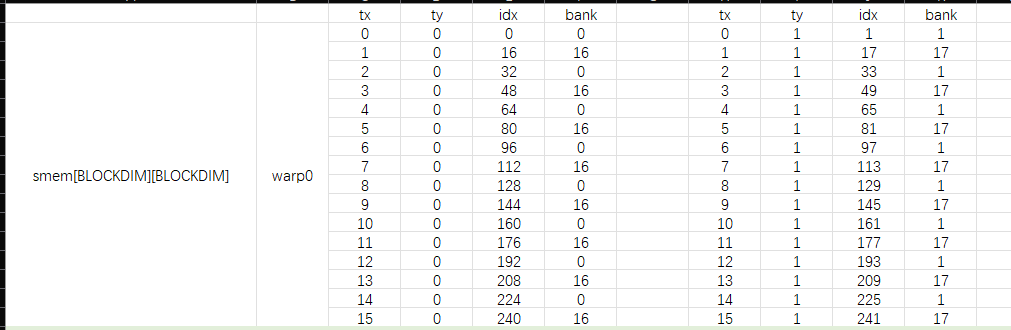
从上表我们可以看到一个warp中32个线程访问了4个bank,每个bank被8个线程同时访问,也就是8-way Bank Conflict,所以一个warp有8个wavefronts,理论上只需要一个。总共有256256/32=2048个warp,所以理论wavefronts=2048,实际wavefronts=20488=16384,Bank Conflicts=16384 - 2048 = 14336。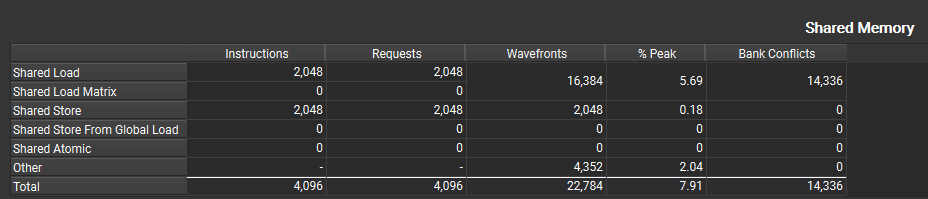
矩阵转置CUDA共享内存版本3
要消除Bank Conflicts通常可以使用Padding,也就是分配共享内存时额外+1
__global__ void matrix_transponse_shared3_kernel(const float* input, float* output, int rows, int cols) {
    __shared__ float smem[BLOCKDIM][BLOCKDIM + 1];

    int tx = threadIdx.x;
    int ty = threadIdx.y;
    int bx = blockIdx.x;
    int by = blockIdx.y;

    int row = by * BLOCKDIM + ty;
    int col = bx * BLOCKDIM + tx;

    if (row < rows && col < cols) {
        smem[ty][tx] = input[row * cols + col];
    }
    __syncthreads();

    int out_y = threadIdx.y + BLOCKDIM * blockIdx.x;
    int out_x = threadIdx.x + BLOCKDIM * blockIdx.y;
    int out_cols = rows;
    int out_rows = cols;
    if (out_x < out_cols && out_y < out_rows) {
        output[out_x + out_cols * out_y] =
            smem[threadIdx.x][threadIdx.y];
    }

}
我们分析下这段代码的bank,从下表可以看到共享内存空间变为1617后,一个warp中32个线程访问了31个线程,只有bank0有两个线程访问,所以一个warp也就只有一个Bank Conflict。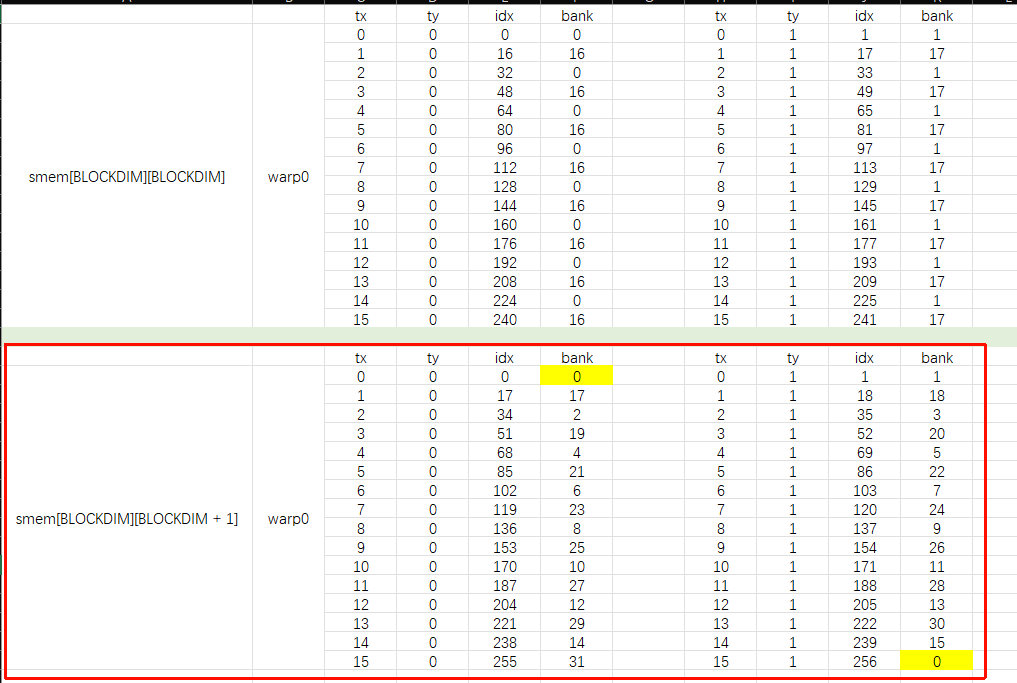
总共有256256/32=2048个warp,所以理论wavefronts=2048,实际wavefronts=2048*2=4096,Bank Conflicts=4096 - 2048 = 2048。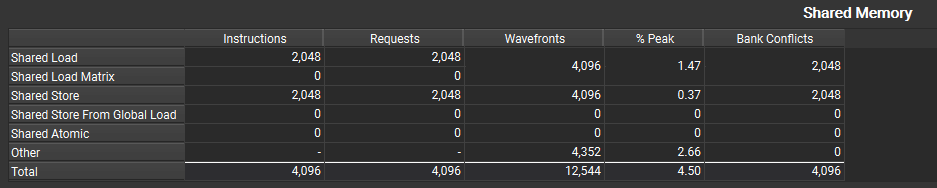
不同kernel耗时
在矩阵维度为2560025600个Float、blocksize=1616下对比不同kernel耗时结果如下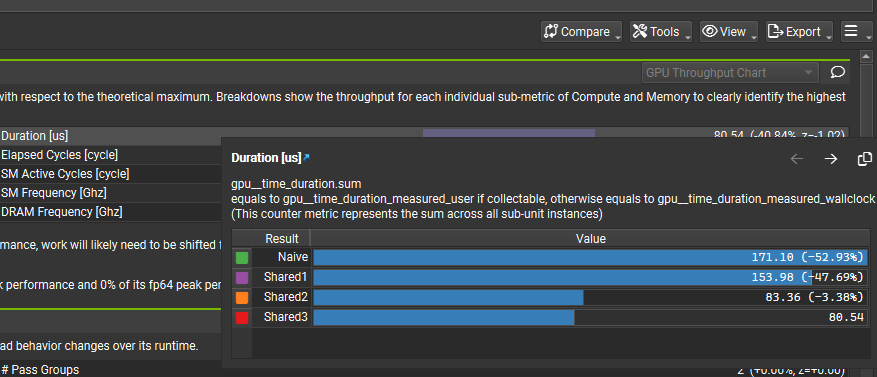

AtomGit 是由开放原子开源基金会联合 CSDN 等生态伙伴共同推出的新一代开源与人工智能协作平台。平台坚持“开放、中立、公益”的理念,把代码托管、模型共享、数据集托管、智能体开发体验和算力服务整合在一起,为开发者提供从开发、训练到部署的一站式体验。
更多推荐



 4
4 0
0- 0


 已为社区贡献1条内容

所有评论(0)