IPQ9574 + WiFi 7: Building the Foundation for Scalable Edge AI Deployments
As AI moves from the cloud to the edge, networking hardware is no longer just responsible for moving data from one place to another. Increasingly, network platforms are becoming the entry point for AI workloads, real-time decision making, and intelligent data processing.
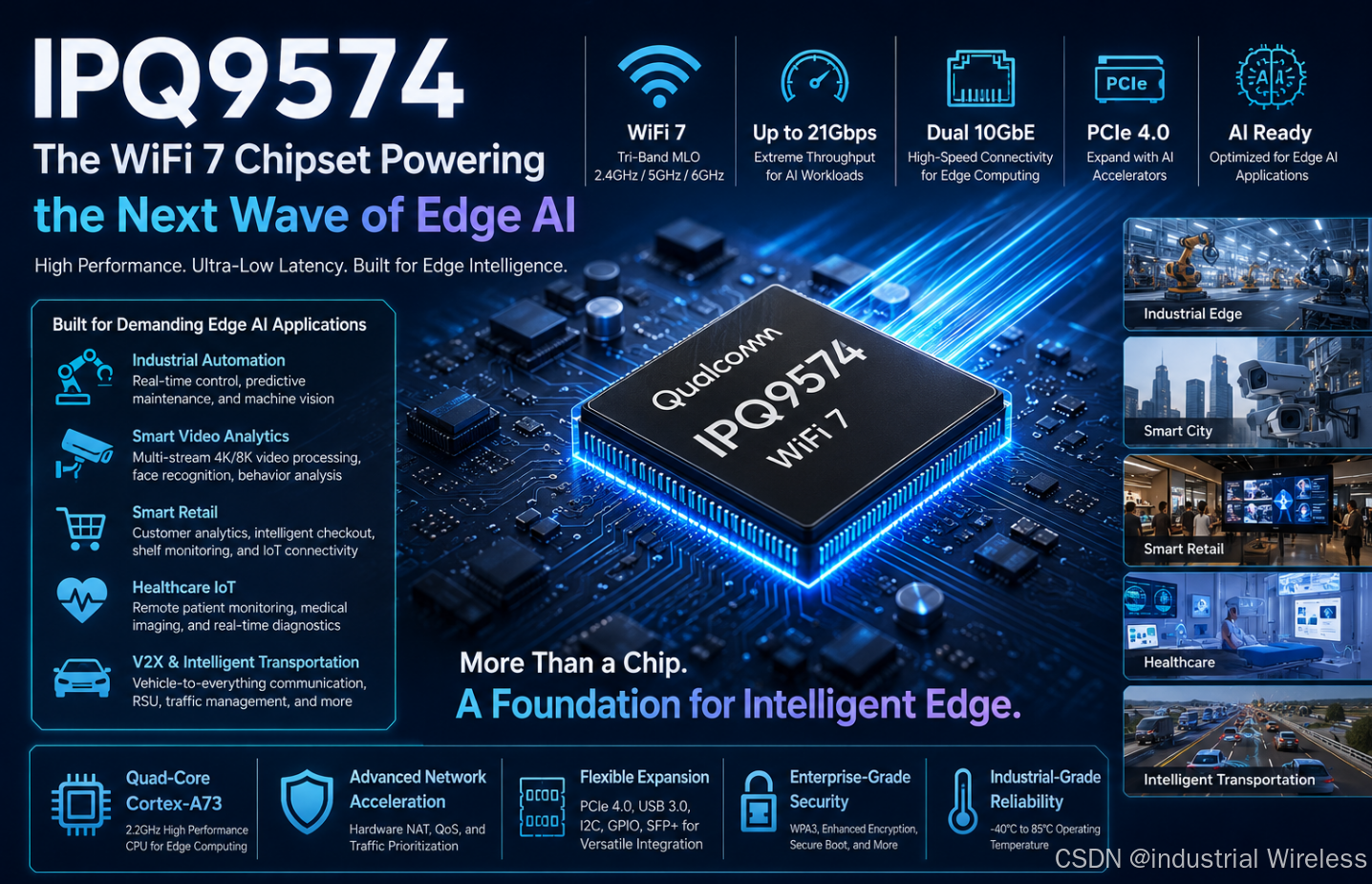
One chipset that stands out in this transition is Qualcomm's IPQ9574.
At first glance, it looks like a high-performance WiFi 7 networking SoC. But when viewed from an AI and edge computing perspective, IPQ9574 represents something much bigger:
A high-performance networking platform designed to enable the next generation of Edge AI applications.
Let's take a closer look at why.
AI Is Changing What We Expect from Network Infrastructure
Traditionally, networking devices were evaluated by a few simple metrics:
- Throughput
- Coverage
- Number of connected users
However, AI applications introduce an entirely different set of requirements.
Today's edge AI systems must simultaneously handle:
- Multiple video streams
- Thousands of sensor data points
- Real-time control signals
- Continuous communication between devices
VIvO">The challenge is no longer bandwidth alone.
What AI systems really need is:
Predictable, low-latency, highly reliable connectivity.
This is exactly where WiFi 7 begins to make a significant difference.
Technologies such as Multi-Link Operation (MLO), wider 320MHz channels, and enhanced multi-user scheduling are not merely increasing speed—they are creating a networking environment capable of supporting real-time AI workloads.
The Real Strength of IPQ9574 Isn't the CPU
Many engineers first look at the specifications:
- Quad-core ARM Cortex-A73
- 2.2GHz CPU frequency
While these numbers are impressive, they are not what makes IPQ9574 unique.
The real value lies in three key areas.
A True Tri-Band WiFi 7 Architecture
With simultaneous support for 2.4GHz, 5GHz, and 6GHz operation, IPQ9574 can distribute different traffic types across multiple wireless links.
For example:
- AI video streams on 6GHz
- IoT sensor traffic on 2.4GHz
- Control and management data on 5GHz
Instead of forcing everything through a single wireless channel, the system gains multiple dedicated pathways for different workloads.
This becomes increasingly important as AI deployments continue to scale.
10GbE and PCIe Expansion Unlock Edge Intelligence
Perhaps the most overlooked feature of IPQ9574 is its extensive expansion capability.
With support for:
- Dual 10GbE interfaces
- PCIe Gen4
- SFP+ connectivity
Developers can integrate:
- AI accelerator modules
- TPU and NPU cards
- 5G backhaul modules
- High-speed storage systems
This transforms IPQ9574 from a networking chip into a flexible edge computing platform.
Depending on the application, it can serve as:
- Industrial AI gateway
- Smart city edge node
- Video analytics platform
- Vehicle-to-everything (V2X) communication unit
- Intelligent retail gateway
Dedicated Network Acceleration Matters More Than Ever
One challenge frequently encountered in AI deployments is traffic contention.
AI workloads often compete with conventional network traffic for bandwidth and processing resources.
IPQ9574 addresses this through dedicated hardware acceleration engines, including:
- Hardware NAT
- Advanced QoS processing
- Traffic prioritization
- Packet forwarding acceleration
As a result, critical AI traffic can be prioritized without overloading the main CPU.
For industrial automation and video analytics applications, this capability is often more important than raw processing power.
Why IPQ9574 Is Ideal for Edge AI—Even Without an NPU
One misconception is that every AI platform must include an integrated NPU.
IPQ9574 does not.
And that is actually part of its design philosophy.
Rather than attempting to perform all AI processing locally, IPQ9574 focuses on becoming the foundation of a distributed AI architecture.
A typical deployment looks like this:
Layer 1: Data Collection and Connectivity
IPQ9574 manages:
- Cameras
- Sensors
- IoT devices
- Industrial equipment
- Connected vehicles
Its job is to ensure reliable, low-latency communication.
Layer 2: Edge AI Processing
External accelerators perform tasks such as:
- Object detection
- Facial recognition
- Video analytics
- Predictive maintenance
Layer 3: Cloud AI Services
Complex workloads are handled by cloud infrastructure, including:
- Large language models
- Advanced analytics
- Multi-site coordination
In this architecture, IPQ9574 serves as the intelligent bridge between devices, edge computing resources, and cloud services.
Real-World Applications Where IPQ9574 Excels
The true value of IPQ9574 becomes clear in large-scale deployments.
Industrial Edge Computing
Manufacturing environments require:
- Reliable connectivity
- Low-latency control
- High device density
IPQ9574 enables:
- Predictive maintenance
- AGV fleet management
- Industrial machine vision
- Smart factory networking
Intelligent Video Surveillance
Modern security systems increasingly rely on AI-driven analytics.
IPQ9574 provides the networking foundation for:
- Multi-camera 4K/8K deployments
- Real-time video analytics
- Facial recognition systems
- Behavioral detection applications
Smart Retail
Retail environments benefit from:
- Customer traffic analysis
- Smart shelf monitoring
- Automated checkout systems
- Store-wide IoT connectivity
Connected Transportation and V2X
As transportation networks become more intelligent, networking infrastructure becomes critical.
IPQ9574 can power:
- Roadside units (RSUs)
- Vehicle communication gateways
- Smart traffic systems
- Edge processing for autonomous mobility
The Bigger Picture: Networking Is Becoming Part of AI
The most important takeaway may be this:
IPQ9574 is not attempting to be an AI processor.
Instead, it enables AI systems to operate efficiently at scale.
Many AI deployments struggle not because of inadequate models, but because of:
- Network bottlenecks
- Unstable connectivity
- Latency spikes
- Poor traffic management
These are precisely the challenges IPQ9574 was designed to solve.
As AI continues moving closer to the edge, networking platforms will become increasingly important components of the overall AI architecture.
The future will likely bring:
- WiFi platforms with integrated NPUs
- AI-driven wireless resource allocation
- Intelligent networking protocols
- Fully converged edge computing systems
IPQ9574 represents an early but significant step toward that future.
And perhaps that is its most important role:
Not as a WiFi 7 chipset, but as a foundational building block for the next generation of Edge AI infrastructure.

AtomGit 是由开放原子开源基金会联合 CSDN 等生态伙伴共同推出的新一代开源与人工智能协作平台。平台坚持“开放、中立、公益”的理念,把代码托管、模型共享、数据集托管、智能体开发体验和算力服务整合在一起,为开发者提供从开发、训练到部署的一站式体验。
更多推荐



 8
8 0
0- 0


 已为社区贡献3条内容

所有评论(0)