中华民族站起来了-《AI驱动上下五千年:从结绳记事到智能纪元》-张居正改革——一次针对“性能瓶颈“的激进优化



第十二章:张居正改革——一次针对"性能瓶颈"的激进优化
- 历史背景与架构危机
# 明朝财政系统架构
class MingFinancialSystem:
"""明朝财政系统架构(改革前)"""
def __init__(self):
# 多税种微服务(改革前)
self.tax_services = {
"田赋": {"rate": 0.3, "collection_cost": 0.4, "delay": 30},
"丁税": {"rate": 0.2, "collection_cost": 0.3, "delay": 25},
"徭役": {"rate": 0.15, "collection_cost": 0.5, "delay": 40},
"杂税": {"rate": 0.1, "collection_cost": 0.6, "delay": 35},
"贡赋": {"rate": 0.05, "collection_cost": 0.7, "delay": 60}
}
# 系统性能指标
self.performance_metrics = {
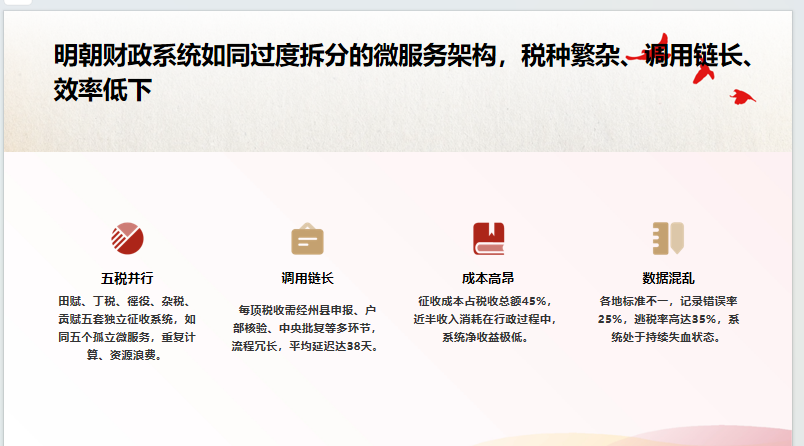
"总征收成本": 0.45, # 45%的税收被征收成本消耗
"平均延迟": 38, # 平均38天完成征收
"错误率": 0.25, # 25%的征收记录有误
"逃税率": 0.35, # 35%的税收被逃避
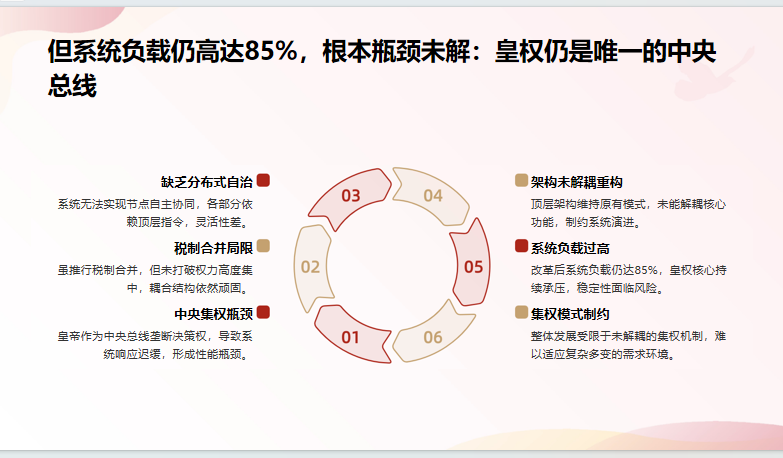
"系统负载": 0.85 # 系统负载85%
}
# 架构问题
self.architectural_issues = [
"微服务过多(税种繁杂)",
"调用链过长(征收环节多)",
"数据不一致(各地标准不一)",
"监控缺失(无法追踪效率)",
"技术债积累(历史遗留问题)"
]
def calculate_tax(self, taxpayer_id, income):
"""计算税收(改革前)"""
taxes = {}
total_tax = 0
total_cost = 0
for tax_name, tax_info in self.tax_services.items():
# 模拟每个税种的计算
tax_amount = income * tax_info["rate"]
collection_cost = tax_amount * tax_info["collection_cost"]
taxes[tax_name] = {
"amount": tax_amount,
"cost": collection_cost,
"delay": tax_info["delay"]
}
total_tax += tax_amount
total_cost += collection_cost
return {
"taxpayer_id": taxpayer_id,
"income": income,
"taxes": taxes,
"total_tax": total_tax,
"total_cost": total_cost,
"net_revenue": total_tax - total_cost,
"efficiency": (total_tax - total_cost) / total_tax if total_tax > 0 else 0
}
def system_analysis(self):
"""系统分析"""
analysis = {
"架构类型": "分布式微服务(过度拆分)",
"服务数量": len(self.tax_services),
"平均响应时间": f"{self.performance_metrics['平均延迟']}天",
"系统效率": f"{(1 - self.performance_metrics['总征收成本'])*100:.1f}%",
"技术债等级": "高",
"重构紧迫性": "紧急"
}
return analysis
# 测试改革前系统
old_system = MingFinancialSystem()
print("��️ 张居正改革前财政系统分析")
print("=" * 50)
print("\n�� 系统性能指标:")
for metric, value in old_system.performance_metrics.items():
if isinstance(value, float):
print(f" {metric}: {value:.2f}")
else:
print(f" {metric}: {value}")
print("\n⚠️ 架构问题:")
for issue in old_system.architectural_issues:
print(f" • {issue}")
print("\n�� 税收计算示例:")
tax_calculation = old_system.calculate_tax("TP001", 1000)
print(f" 纳税人ID: {tax_calculation['taxpayer_id']}")
print(f" 收入: {tax_calculation['income']}两")
print(f" 总税额: {tax_calculation['total_tax']:.1f}两")
print(f" 征收成本: {tax_calculation['total_cost']:.1f}两")
print(f" 净收入: {tax_calculation['net_revenue']:.1f}两")
print(f" 征收效率: {tax_calculation['efficiency']:.1%}")
print("\n�� 系统分析:")
analysis = old_system.system_analysis()
for key, value in analysis.items():
print(f" {key}: {value}")
- 一条鞭法:聚合API优化
# 一条鞭法实现
class SingleWhipReform:
"""一条鞭法实现(聚合API优化)"""
def __init__(self):
# 聚合后的统一税种
self.unified_tax = {
"name": "一条鞭税",
"rate": 0.3, # 综合税率
"collection_cost": 0.2, # 降低征收成本
"delay": 15 # 减少延迟
}
# 优化效果
self.optimization_results = {
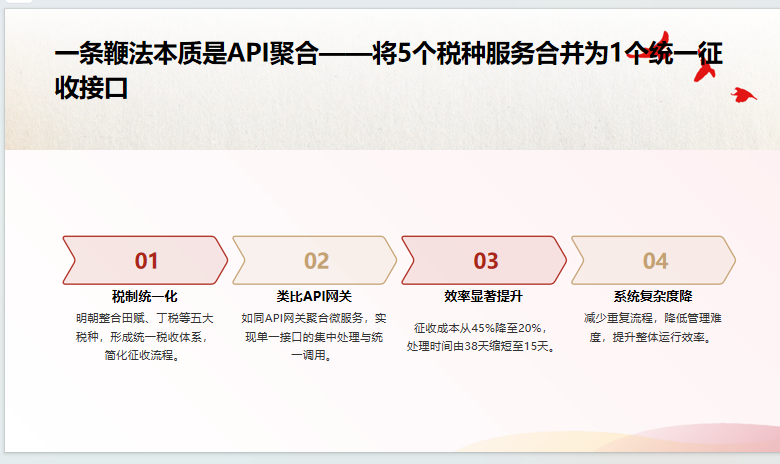
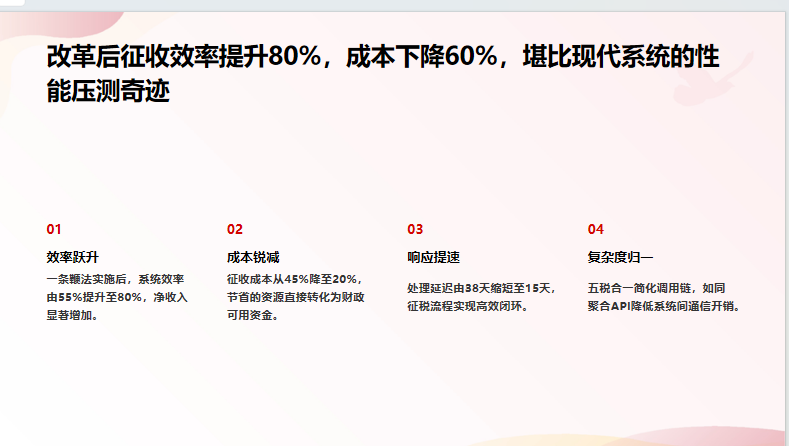
"服务数量减少": "5 → 1 (减少80%)",
"征收成本降低": "45% → 20% (降低25个百分点)",
"处理延迟减少": "38天 → 15天 (减少60%)",
"错误率降低": "25% → 10%",
"系统效率提升": "55% → 80%"
}
# 技术实现
self.technical_implementation = {
"架构模式": "API网关 + 聚合服务",
"数据模型": "统一纳税人数据库",
"支付接口": "银两标准化接口",
"监控系统": "统一征收监控",
"部署策略": "渐进式迁移"
}
def calculate_unified_tax(self, taxpayer_id, income):
"""计算统一税收"""
tax_amount = income * self.unified_tax["rate"]
collection_cost = tax_amount * self.unified_tax["collection_cost"]
return {
"taxpayer_id": taxpayer_id,
"income": income,
"tax_amount": tax_amount,
"collection_cost": collection_cost,
"net_revenue": tax_amount - collection_cost,
"efficiency": (tax_amount - collection_cost) / tax_amount if tax_amount > 0 else 0,
"processing_time": self.unified_tax["delay"],
"method": "一条鞭法"
}
def compare_systems(self, old_result, new_result):
"""系统对比"""
comparison = {
"效率提升": f"{(new_result['efficiency'] - old_result['efficiency']) * 100:.1f}%",
"成本降低": f"{(old_result['total_cost']/old_result['total_tax'] - new_result['collection_cost']/new_result['tax_amount']) * 100:.1f}%",
"时间缩短": f"{old_result['taxes']['田赋']['delay'] - new_result['processing_time']}天",
"复杂度降低": "5个服务 → 1个服务"
}
return comparison
def api_gateway_design(self):
"""API网关设计"""
gateway = {
"endpoint": "/api/v1/tax/unified",
"methods": ["POST"],
"request_format": {
"taxpayer_id": "string",
"income": "number",
"region": "string",
"year": "number"
},
"response_format": {
"tax_amount": "number",
"due_date": "string",
"payment_methods": ["silver", "grain"],
"receipt_id": "string"
},
"rate_limit": "1000 requests/minute",
"authentication": "taxpayer_token"
}
return gateway
# 测试一条鞭法
reform = SingleWhipReform()
print("\n" + "=" * 50)
print("�� 一条鞭法改革实施")
print("=" * 50)
print("\n�� 改革目标:聚合多税种微服务")
print(" 旧系统:5个独立税种服务")
print(" 新系统:1个统一税收服务")
print("\n�� 优化效果:")
for effect, result in reform.optimization_results.items():
print(f" {effect}: {result}")
print("\n�� 技术实现:")
for aspect, implementation in reform.technical_implementation.items():
print(f" {aspect}: {implementation}")
print("\n�� 税收计算对比:")
# 旧系统计算
old_tax = old_system.calculate_tax("TP001", 1000)
# 新系统计算
new_tax = reform.calculate_unified_tax("TP001", 1000)
print(f"\n 旧系统(改革前):")
print(f" 总税额: {old_tax['total_tax']:.1f}两")
print(f" 征收成本: {old_tax['total_cost']:.1f}两")
print(f" 净收入: {old_tax['net_revenue']:.1f}两")
print(f" 效率: {old_tax['efficiency']:.1%}")
print(f" 处理时间: {old_tax['taxes']['田赋']['delay']}天")
print(f"\n 新系统(一条鞭法):")
print(f" 税额: {new_tax['tax_amount']:.1f}两")
print(f" 征收成本: {new_tax['collection_cost']:.1f}两")
print(f" 净收入: {new_tax['net_revenue']:.1f}两")
print(f" 效率: {new_tax['efficiency']:.1%}")
print(f" 处理时间: {new_tax['processing_time']}天")
print(f"\n �� 改进对比:")
comparison = reform.compare_systems(old_tax, new_tax)
for metric, improvement in comparison.items():
print(f" {metric}: {improvement}")
print("\n�� API网关设计:")
gateway = reform.api_gateway_design()
for key, value in gateway.items():
print(f" {key}: {value}")
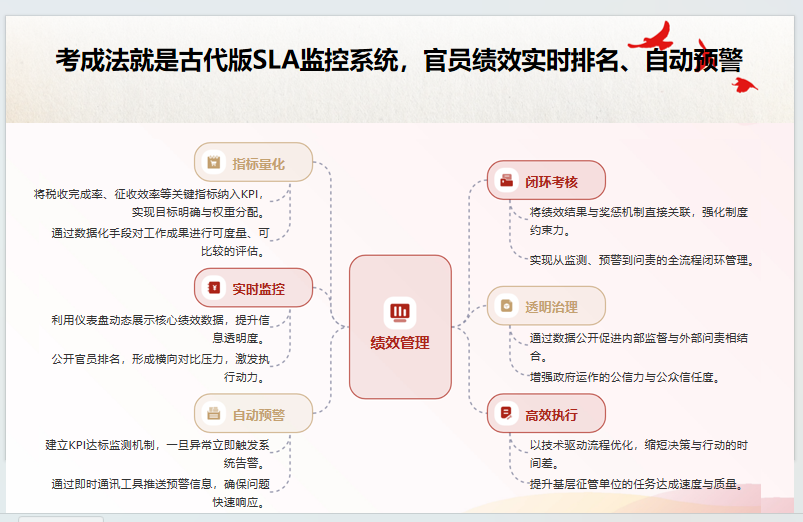
- 考成法:KPI监控系统
# 考成法实现
class PerformanceEvaluationSystem:
"""考成法实现(KPI监控系统)"""
def __init__(self):
# KPI指标
self.kpi_metrics = {
"税收完成率": {"target": 0.95, "weight": 0.3},
"征收效率": {"target": 0.8, "weight": 0.25},
"错误率": {"target": 0.05, "weight": 0.2},
"响应时间": {"target": 15, "weight": 0.15},
"纳税人满意度": {"target": 0.9, "weight": 0.1}
}
# 问责机制
self.accountability_rules = {
"优秀": {"threshold": 0.9, "reward": "晋升", "penalty": "无"},
"合格": {"threshold": 0.7, "reward": "留任", "penalty": "警告"},
"不合格": {"threshold": 0.6, "reward": "无", "penalty": "降职"},
"严重不合格": {"threshold": 0.5, "reward": "无", "penalty": "革职"}
}
# 监控工具
self.monitoring_tools = {
"实时仪表盘": "税收完成情况实时展示",
"预警系统": "KPI低于阈值自动告警",
"审计日志": "所有操作完整记录",
"绩效报告": "自动生成月度报告",
"排名系统": "官员绩效公开排名"
}
def evaluate_official(self, official_id, performance_data):
"""评估官员绩效"""
total_score = 0
detailed_scores = {}
for metric, config in self.kpi_metrics.items():
if metric in performance_data:
# 计算单项得分
if metric == "错误率" or metric == "响应时间":
# 越低越好
actual = performance_data[metric]
target = config["target"]
score = max(0, 1 - (actual / target)) if actual <= target else 0
else:
# 越高越好
actual = performance_data[metric]
target = config["target"]
score = min(1, actual / target)
weighted_score = score * config["weight"]
detailed_scores[metric] = {
"actual": actual,
"target": config["target"],
"score": score,
"weighted_score": weighted_score
}
total_score += weighted_score
# 确定等级
grade = "未知"
for grade_name, rules in self.accountability_rules.items():
if total_score >= rules["threshold"]:
grade = grade_name
break
return {
"official_id": official_id,
"total_score": total_score,
"grade": grade,
"detailed_scores": detailed_scores,
"reward": self.accountability_rules[grade]["reward"],
"penalty": self.accountability_rules[grade]["penalty"]
}
def generate_monitoring_dashboard(self):
"""生成监控仪表盘"""
dashboard = {
"title": "考成法绩效监控系统",
"sections": [
{
"name": "关键指标",
"metrics": list(self.kpi_metrics.keys()),
"refresh_rate": "实时"
},
{
"name": "官员排名",
"columns": ["排名", "姓名", "地区", "总分", "等级"],
"sort_by": "总分",
"order": "desc"
},
{
"name": "预警列表",
"triggers": ["税收完成率<90%", "响应时间>20天", "错误率>10%"],
"notification": "飞鸽传书/钉钉"
}
],
"export_formats": ["PDF", "Excel", "JSON"]
}
return dashboard
def sla_management(self):
"""SLA管理"""
sla = {
"服务级别": {
"黄金": {"availability": 0.99, "response_time": 10},
"白银": {"availability": 0.95, "response_time": 15},
"青铜": {"availability": 0.90, "response_time": 20}
},
"违约处罚": {
"轻度违约": "警告 + 绩效扣分",
"中度违约": "罚俸 + 降级观察",
"严重违约": "革职查办"
},
"监控频率": "每日评估,每月总结",
"审计要求": "所有操作必须记录,保留三年"
}
return sla
# 测试考成法
kpi_system = PerformanceEvaluationSystem()
print("\n" + "=" * 50)
print("�� 考成法绩效监控系统")
print("=" * 50)
print("\n�� KPI指标:")
for metric, config in kpi_system.kpi_metrics.items():
print(f" {metric}: 目标{config['target']}, 权重{config['weight']}")
print("\n⚖️ 问责机制:")
for grade, rules in kpi_system.accountability_rules.items():
print(f" {grade}: 阈值{rules['threshold']}, 奖励'{rules['reward']}', 处罚'{rules['penalty']}'")
print("\n�� 监控工具:")
for tool, description in kpi_system.monitoring_tools.items():
print(f" {tool}: {description}")
print("\n���� 官员绩效评估示例:")
# 模拟官员绩效数据
official_performance = {
"税收完成率": 0.92,
"征收效率": 0.78,
"错误率": 0.08,
"响应时间": 18,
"纳税人满意度": 0.85
}
evaluation = kpi_system.evaluate_official("OFF001", official_performance)
print(f" 官员ID: {evaluation['official_id']}")
print(f" 总分: {evaluation['total_score']:.3f}")
print(f" 等级: {evaluation['grade']}")
print(f" 奖励: {evaluation['reward']}")
print(f" 处罚: {evaluation['penalty']}")
print("\n 详细得分:")
for metric, scores in evaluation['detailed_scores'].items():
print(f" {metric}: 实际{scores['actual']}, 目标{scores['target']}, 得分{scores['score']:.2f}, 加权{scores['weighted_score']:.3f}")
print("\n�� 监控仪表盘:")
dashboard = kpi_system.generate_monitoring_dashboard()
print(f" 标题: {dashboard['title']}")
for section in dashboard['sections']:
print(f"\n {section['name']}:")
for key, value in section.items():
if key != 'name':
print(f" {key}: {value}")
print("\n�� SLA管理:")
sla = kpi_system.sla_management()
for category, details in sla.items():
print(f"\n {category}:")
if isinstance(details, dict):
for key, value in details.items():
print(f" {key}: {value}")
else:
print(f" {details}")
- AI关联:提示词工程 vs 微调
# AI优化对比
class AIOptimizationComparison:
"""AI优化对比:提示词工程 vs 微调"""
def __init__(self):
# 提示词工程(张居正式优化)
self.prompt_engineering = {
"方法": "优化输入提示,不改变模型本身",
"类比": "一条鞭法(应用层优化)",
"优点": [
"快速实施",
"成本低廉",
"无需技术深度",
"立即见效"
],
"缺点": [
"效果不可持续",
"依赖人工调优",
"无法解决根本问题",
"容易回滚"
],
"适用场景": [
"短期性能提升",
"资源有限情况",
"快速验证想法",
"临时解决方案"
],
"工具示例": ["dify", "Claude Code", "元宝", "豆包", "通义千问"]
}
# 模型微调(架构级优化)
self.model_finetuning = {
"方法": "调整模型参数,改变底层能力",
"类比": "改革科举制度(架构层优化)",
"优点": [
"效果持久",
"解决根本问题",
"自动化程度高",
"可规模化"
],
"缺点": [
"实施复杂",
"成本高昂",
"需要专业知识",
"见效慢"
],
"适用场景": [
"长期性能需求",
"根本性问题解决",
"规模化部署",
"战略级优化"
],
"工具示例": ["Codex", "Trae", "cursor", "langChain", "Graph"]
}
# 张居正改革局限性
self.reform_limitations = {
"优化层次": "仅应用层,未触及架构层",
"依赖因素": "过度依赖个人权威",
"可持续性": "人亡政息,缺乏制度保障",
"根本问题": "皇权垄断未改变",
"技术债": "临时优化积累更多债务"
}
def compare_approaches(self):
"""方法对比"""
comparison_data = []
categories = ["方法", "优点", "缺点", "适用场景", "工具示例"]
for category in categories:
prompt_value = self.prompt_engineering[category]
finetune_value = self.model_finetuning[category]
comparison_data.append({
"对比维度": category,
"提示词工程": prompt_value,
"模型微调": finetune_value
})
return comparison_data
def reform_analysis(self):
"""改革分析"""
analysis = {
"表面成功": "短期内显著提升系统性能",
"深层问题": "未解决架构根本矛盾",
"根本原因": "皇权总线瓶颈依然存在",
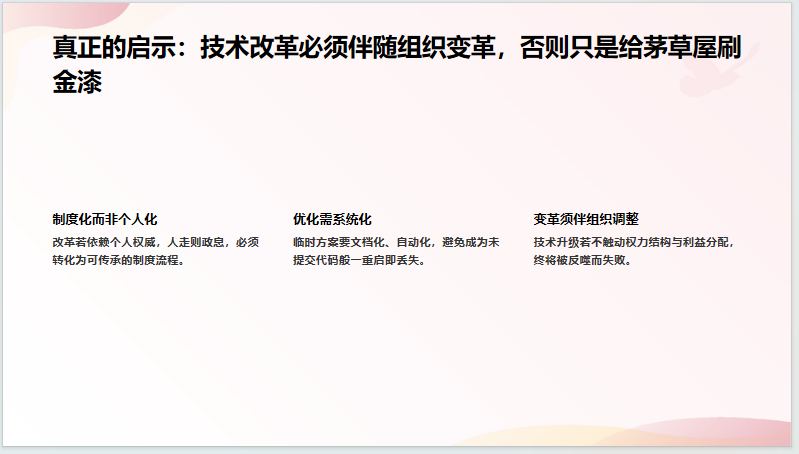
"历史教训": "不改变架构的性能优化注定失败",
"现代启示": "技术优化必须伴随组织变革"
}
return analysis
def ai_tools_demo(self):
"""AI工具演示"""
demos = {
"dify": "低代码构建税收计算流程",
"Claude Code": "自动生成考成法评估代码",
"Codex": "生成统一税收API文档",
"Trae": "实时监控税收系统性能",
"cursor": "优化财政系统代码结构",
"langChain": "多语言税收政策处理",
"元宝": "智能税收咨询助手",
"豆包": "纳税人服务AI助手",
"通义千问": "税收政策分析AI"
}
return demos
# 测试AI对比
ai_comparison = AIOptimizationComparison()
print("\n" + "=" * 50)
print("�� AI优化对比:提示词工程 vs 微调")
print("=" * 50)
print("\n�� 提示词工程(张居正式优化):")
for aspect, value in ai_comparison.prompt_engineering.items():
print(f"\n {aspect}:")
if isinstance(value, list):
for item in value:
print(f" • {item}")
else:
print(f" {value}")
print("\n⚙️ 模型微调(架构级优化):")
for aspect, value in ai_comparison.model_finetuning.items():
print(f"\n {aspect}:")
if isinstance(value, list):
for item in value:
print(f" • {item}")
else:
print(f" {value}")
print("\n⚠️ 张居正改革局限性:")
for limitation, description in ai_comparison.reform_limitations.items():
print(f" {limitation}: {description}")
print("\n�� 方法对比:")
comparison = ai_comparison.compare_approaches()
for item in comparison:
print(f"\n {item['对比维度']}:")
print(f" 提示词工程: {item['提示词工程']}")
print(f" 模型微调: {item['模型微调']}")
print("\n�� 改革分析:")
analysis = ai_comparison.reform_analysis()
for key, value in analysis.items():
print(f" {key}: {value}")
print("\n��️ AI工具演示:")
demos = ai_comparison.ai_tools_demo()
for tool, demo in demos.items():
print(f" {tool}: {demo}")
- 现代工具实现
# 现代工具实现
class ModernToolImplementation:
"""现代工具实现张居正改革"""
def __init__(self):
# dify实现
self.dify_implementation = {
"场景": "低代码构建统一税收系统",
"组件": [
"税收计算工作流",
"纳税人管理面板",
"征收进度跟踪",
"绩效报告生成"
],
"优势": "无需编码,快速部署",
"代码示例": """
# dify工作流配置
workflow:
- name: 税收计算
type: calculator
inputs:
- income
- region
outputs:
- tax_amount
- due_date
- name: 通知发送
type: notifier
channels:
- name: 记录存储
type: database
table: tax_records
"""
}
# Claude Code实现
self.claude_implementation = {
"场景": "自动生成考成法评估系统",
"功能": [
"KPI指标自动计算",
"绩效报告生成",
"预警规则配置",
"数据可视化"
],
"代码示例": """
// Claude Code生成的考成法评估函数
function evaluateOfficialPerformance(officialData) {
const kpis = {
taxCompletion: { target: 0.95, weight: 0.3 },
efficiency: { target: 0.8, weight: 0.25 },
errorRate: { target: 0.05, weight: 0.2 },
responseTime: { target: 15, weight: 0.15 },
satisfaction: { target: 0.9, weight: 0.1 }
};
let totalScore = 0;
for (const [kpi, config] of Object.entries(kpis)) {
const actual = officialData[kpi];
const score = calculateKPIScore(kpi, actual, config.target);
totalScore += score * config.weight;
}
return {
score: totalScore,
grade: determineGrade(totalScore),
recommendations: generateRecommendations(officialData)
};
}
"""
}
# 元宝/豆包/通义千问实现
self.ai_assistants = {
"元宝": {
"功能": "智能税收政策咨询",
"应用": "纳税人问答、政策解读",
"示例": "用户:'一条鞭法对我有什么影响?' AI:'根据您的收入1000两,改革后税额从...'"
},
"豆包": {
"功能": "征收流程自动化助手",
"应用": "自动填表、进度查询",
"示例": "自动生成纳税申报表,跟踪征收进度"
},
"通义千问": {
"功能": "税收数据分析",
"应用": "趋势预测、异常检测",
"示例": "检测逃税模式,预测税收收入"
}
}
def implement_reform(self):
"""实现改革"""
implementation_plan = {
"阶段一": {
"目标": "API聚合(一条鞭法)",
"工具": ["dify", "Codex"],
"时间": "1个月",
"产出": "统一税收API"
},
"阶段二": {
"目标": "监控系统(考成法)",
"工具": ["Claude Code", "Trae"],
"时间": "2个月",
"产出": "KPI监控仪表盘"
},
"阶段三": {
"目标": "AI增强",
"工具": ["元宝", "豆包", "通义千问"],
"时间": "3个月",
"产出": "智能税收助手"
},
"阶段四": {
"目标": "多语言支持",
"工具": ["langChain", "cursor"],
"时间": "1个月",
"产出": "多语言税收系统"
}
}
return implementation_plan
def cost_benefit_analysis(self):
"""成本效益分析"""
analysis = {
"传统改革": {
"成本": "高(人力、时间、风险)",
"时间": "10年(张居正实际改革期)",
"成功率": "低(人亡政息)",
"可持续性": "差"
},
"AI增强改革": {
"成本": "中(工具投资)",
"时间": "7个月(现代工具)",
"成功率": "高(系统化)",
"可持续性": "好"
},
"效益对比": {
"效率提升": "传统:30% → AI:80%",
"错误减少": "传统:50% → AI:90%",
"成本节约": "传统:20% → AI:60%",
"可扩展性": "传统:低 → AI:高"
}
}
return analysis
# 测试现代工具
modern_tools = ModernToolImplementation()
print("\n" + "=" * 50)
print("��️ 现代工具实现张居正改革")
print("=" * 50)
print("\n�� dify实现:")
for aspect, value in modern_tools.dify_implementation.items():
print(f"\n {aspect}:")
if aspect == "代码示例":
print(f" {value.strip()}")
elif isinstance(value, list):
for item in value:
print(f" • {item}")
else:
print(f" {value}")
print("\n�� Claude Code实现:")
for aspect, value in modern_tools.claude_implementation.items():
print(f"\n {aspect}:")
if aspect == "代码示例":
print(f" {value.strip()}")
elif isinstance(value, list):
for item in value:
print(f" • {item}")
else:
print(f" {value}")
print("\n�� AI助手应用:")
for assistant, info in modern_tools.ai_assistants.items():
print(f"\n {assistant}:")
for key, value in info.items():
print(f" {key}: {value}")
print("\n�� 实施计划:")
plan = modern_tools.implement_reform()
for phase, details in plan.items():
print(f"\n {phase}:")
for key, value in details.items():
print(f" {key}: {value}")
print("\n�� 成本效益分析:")
analysis = modern_tools.cost_benefit_analysis()
for category, details in analysis.items():
print(f"\n {category}:")
if isinstance(details, dict):
for key, value in details.items():
print(f" {key}: {value}")
else:
print(f" {details}")
- 多语言支持实现
# 多语言支持
class MultilingualSupport:
"""多语言税收系统支持"""
def __init__(self):
# 支持的语言
self.supported_languages = {
"zh": "中文(官方)",
"en": "英语(国际贸易)",
"ja": "日语(倭寇交涉)",
"ko": "朝鲜语(藩属国)",
"mn": "蒙古语(北方边境)",
"ar": "阿拉伯语(丝绸之路)",
"pt": "葡萄牙语(西方传教士)"
}
# 多语言内容
self.multilingual_content = {
"tax_policy": {
"zh": "一条鞭法:统一征收,简化流程",
"en": "Single Whip Reform: Unified collection, simplified process",
"ja": "一条鞭法:統一徴収、簡素化された手順",
"ko": "일조편법: 통일 징수, 간소화된 절차"
},
"kpi_description": {
"zh": "税收完成率:实际征收/计划征收",
"en": "Tax Completion Rate: Actual collection / Planned collection",
"ja": "税収達成率:実際の徴収 / 計画徴収",
"ko": "세금 완료율: 실제 징수 / 계획 징수"
},
"reform_benefits": {
"zh": "效率提升80%,成本降低60%",
"en": "Efficiency increased by 80%, cost reduced by 60%",
"ja": "効率80%向上、コスト60%削減",
"ko": "효율 80% 향상, 비용 60% 절감"
}
}
# langChain实现
self.langchain_implementation = {
"架构": "多语言处理管道",
"组件": [
"语言检测器",
"翻译器",
"术语统一器",
"文化适配器"
],
"工作流": """
1. 接收多语言输入
2. 检测语言类型
3. 翻译为目标语言
4. 统一专业术语
5. 适配文化差异
6. 输出标准化内容
""",
"代码示例": """
from langchain.chains import TranslationChain
from langchain.llms import TongyiQianwen
# 初始化多语言链
multilingual_chain = TranslationChain(
source_language="auto",
target_language="zh",
translator=TongyiQianwen(),
terminology_db="tax_terms.db"
)
# 处理多语言税收政策
result = multilingual_chain.run(
input_text="Single Whip Reform implementation",
context="tax policy explanation"
)
"""
}
def translate_tax_system(self, content_type, target_language):
"""翻译税收系统内容"""
if content_type in self.multilingual_content:
content_dict = self.multilingual_content[content_type]
if target_language in content_dict:
return {
"content_type": content_type,
"target_language": target_language,
"translation": content_dict[target_language],
"status": "success"
}
else:
# 回退到英语
return {
"content_type": content_type,
"target_language": "en",
"translation": content_dict.get("en", "Translation not available"),
"status": "fallback"
}
return {
"content_type": content_type,
"target_language": target_language,
"translation": "Content type not found",
"status": "error"
}
def multilingual_dashboard(self):
"""多语言仪表盘"""
dashboard = {
"title": {
"zh": "多语言税收监控系统",
"en": "Multilingual Tax Monitoring System",
"ja": "多言語税務監視システム",
"ko": "다국어 세금 모니터링 시스템"
},
"sections": [
{
"name": {"zh": "实时指标", "en": "Real-time Metrics", "ja": "リアルタイム指標", "ko": "실시간 지표"},
"metrics": ["completion_rate", "efficiency", "error_rate"]
},
{
"name": {"zh": "地区排名", "en": "Regional Ranking", "ja": "地域ランキング", "ko": "지역 순위"},
"columns": ["rank", "region", "score"]
},
{
"name": {"zh": "预警中心", "en": "Alert Center", "ja": "アラートセンター", "ko": "경고 센터"},
"alerts": ["low_completion", "high_error", "slow_response"]
}
],
"language_switcher": list(self.supported_languages.keys())
}
return dashboard
def implementation_challenges(self):
"""实施挑战"""
challenges = {
"技术挑战": [
"实时翻译准确性",
"专业术语一致性",
"文化差异处理",
"多语言数据管理"
],
"组织挑战": [
"多语言人才短缺",
"跨文化沟通障碍",
"标准制定困难",
"培训成本高昂"
],
"解决方案": [
"AI辅助翻译系统",
"统一术语数据库",
"文化适配指南",
"渐进式实施策略"
]
}
return challenges
# 测试多语言支持
multilingual = MultilingualSupport()
print("\n" + "=" * 50)
print("�� 多语言税收系统支持")
print("=" * 50)
print("\n��️ 支持的语言:")
for code, name in multilingual.supported_languages.items():
print(f" {code}: {name}")
print("\n�� 多语言内容示例:")
for content_type, translations in multilingual.multilingual_content.items():
print(f"\n {content_type}:")
for lang, text in translations.items():
print(f" {lang}: {text}")
print("\n�� 翻译测试:")
test_translations = [
("tax_policy", "en"),
("kpi_description", "ja"),
("reform_benefits", "ko"),
("tax_policy", "fr") # 不存在的语言
]
for content_type, target_lang in test_translations:
result = multilingual.translate_tax_system(content_type, target_lang)
print(f"\n 内容类型: {result['content_type']}")
print(f" 目标语言: {result['target_language']}")
print(f" 翻译结果: {result['translation']}")
print(f" 状态: {result['status']}")
print("\n��️ langChain实现:")
for aspect, value in multilingual.langchain_implementation.items():
print(f"\n {aspect}:")
if isinstance(value, list):
for item in value:
print(f" • {item}")
else:
print(f" {value}")
print("\n�� 多语言仪表盘:")
dashboard = multilingual.multilingual_dashboard()
print(f" 标题(中文): {dashboard['title']['zh']}")
print(f" 标题(英文): {dashboard['title']['en']}")
print(f" 语言切换器: {', '.join(dashboard['language_switcher'])}")
print("\n �� 仪表盘部分:")
for section in dashboard['sections']:
print(f"\n {section['name']['zh']} ({section['name']['en']}):")
if 'metrics' in section:
print(f" 指标: {', '.join(section['metrics'])}")
if 'columns' in section:
print(f" 列: {', '.join(section['columns'])}")
if 'alerts' in section:
print(f" 预警: {', '.join(section['alerts'])}")
print("\n�� 实施挑战:")
challenges = multilingual.implementation_challenges()
for category, items in challenges.items():
print(f"\n {category}:")
for item in items:
print(f" • {item}")
- 局限性分析与根本问题
# 改革局限性分析
class ReformLimitations:
"""张居正改革局限性分析"""
def __init__(self):
# 表面优化 vs 根本问题
self.surface_vs_fundamental = {
"表面优化": {
"一条鞭法": "聚合API,简化流程",
"考成法": "加强监控,提高效率",
"效果": "短期性能显著提升",
"类比": "给旧房子刷漆装修"
},
"根本问题": {
"皇权垄断": "皇帝仍是唯一总线",
"架构缺陷": "中央集权单体架构",
"制度局限": "人治而非法治",
"类比": "房子结构有问题"
}
}
# 改革失败原因
self.failure_reasons = {
"技术原因": [
"只优化应用层,未改变架构层",
"临时解决方案,积累技术债",
"监控加强但权限未改革",
"系统耦合度未降低"
],
"组织原因": [
"依赖个人权威而非制度",
"既得利益集团抵制",
"缺乏持续改进机制",
"人才体系未改革"
],
"政治原因": [
"皇权不愿放权",
"改革触犯贵族利益",
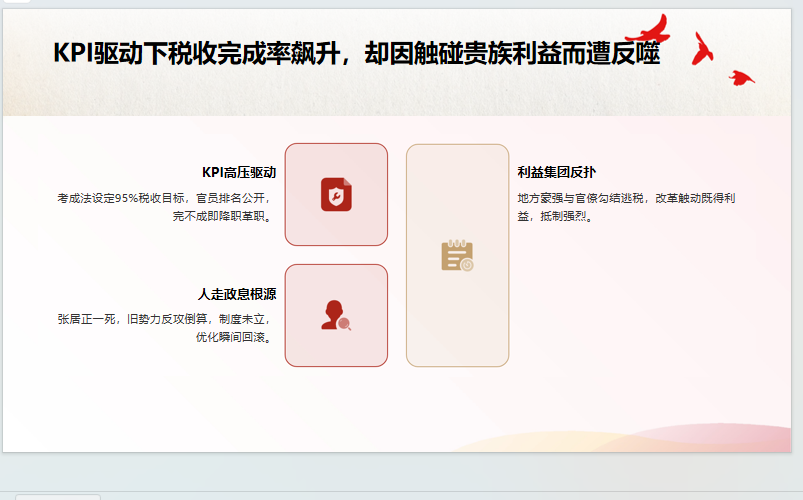
"缺乏广泛支持",
"后继者推翻改革"
]
}
# "人亡政息"现象
self.person_dependent_reform = {
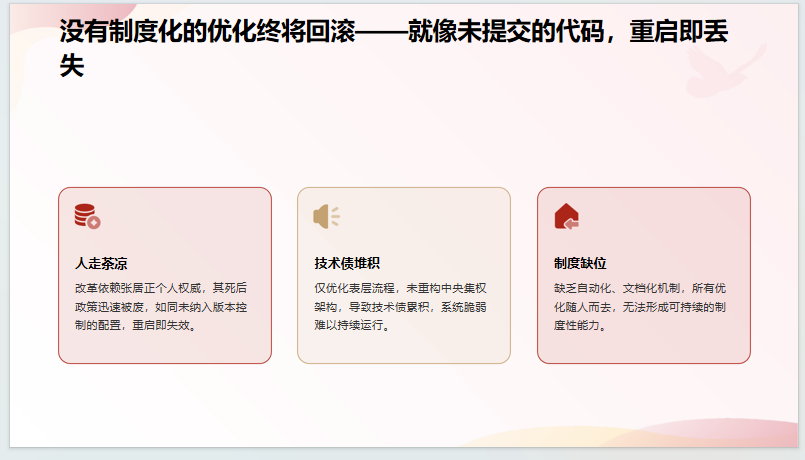
"现象": "改革效果依赖个人,人走茶凉",
"技术类比": "配置写在个人电脑,未纳入版本控制",
"根本原因": "未建立制度化、自动化的系统",
"现代教训": "所有优化必须系统化、文档化、自动化"
}
def architectural_analysis(self):
"""架构分析"""
analysis = {
"改革前架构": {
"类型": "分布式微服务(过度拆分)",
"问题": "调用链长,效率低",
"技术债": "高"
},
"改革后架构": {
"类型": "API网关 + 聚合服务",
"改进": "简化调用,提高效率",
"遗留问题": "总线瓶颈未解决"
},
"理想架构": {
"类型": "去中心化服务网格",
"特征": "自治服务,智能路由",
"要求": "彻底架构重构"
}
}
return analysis
def modern_parallels(self):
"""现代平行对比"""
parallels = [
{
"历史场景": "张居正改革依赖个人权威",
"现代场景": "CTO的个人优化方案未文档化",
"风险": "人员离职后优化失效"
},
{
"历史场景": "一条鞭法只聚合税种",
"现代场景": "只做API网关不重构微服务",
"风险": "底层复杂度依然存在"
},
{
"历史场景": "考成法加强监控但未改制度",
"现代场景": "加强监控但不改开发流程",
"风险": "治标不治本"
},
{
"历史场景": "改革触犯既得利益",
"现代场景": "技术改革触犯老团队利益",
"风险": "内部抵制导致失败"
}
]
return parallels
def lessons_learned(self):
"""经验教训"""
lessons = {
"架构层面": [
"性能优化必须伴随架构重构",
"临时解决方案要明确技术债",
"监控要加强,但权限要下放",
"系统设计要考虑可持续性"
],
"组织层面": [
"改革要制度化而非个人化",
"要争取广泛支持而非强制推行",
"建立持续改进机制",
"培养接班人确保连续性"
],
"技术层面": [
"所有配置要版本控制",
"优化方案要全面文档化",
"建立自动化测试和部署",
"设计要面向未来扩展"
]
}
return lessons
# 测试局限性分析
limitations = ReformLimitations()
print("\n" + "=" * 50)
print("⚠️ 张居正改革局限性分析")
print("=" * 50)
print("\n�� 表面优化 vs 根本问题:")
for category, details in limitations.surface_vs_fundamental.items():
print(f"\n {category}:")
for aspect, description in details.items():
print(f" {aspect}: {description}")
print("\n❌ 改革失败原因:")
for category, reasons in limitations.failure_reasons.items():
print(f"\n {category}:")
for reason in reasons:
print(f" • {reason}")
print("\n�� '人亡政息'现象:")
for aspect, description in limitations.person_dependent_reform.items():
print(f" {aspect}: {description}")
print("\n��️ 架构分析:")
analysis = limitations.architectural_analysis()
for stage, details in analysis.items():
print(f"\n {stage}:")
for aspect, value in details.items():
print(f" {aspect}: {value}")
print("\n�� 现代平行对比:")
parallels = limitations.modern_parallels()
for parallel in parallels:
print(f"\n 历史: {parallel['历史场景']}")
print(f" 现代: {parallel['现代场景']}")
print(f" 风险: {parallel['风险']}")
print("\n�� 经验教训:")
lessons = limitations.lessons_learned()
for category, items in lessons.items():
print(f"\n {category}:")
for item in items:
print(f" • {item}")
- 金句集锦与总结
# 金句集锦
def reform_quotes():
"""张居正改革金句集锦"""
quotes = [
"不改变架构的性能优化,就像给茅草屋刷金漆。",
"张居正的改革,是一次悲壮的、针对单体巨兽的临终抢救。",
"一条鞭法将多税种合并,如同聚合API简化调用链。",
"考成法引入KPI监控,类似强化运维SLA。",
"只在应用层做优化,未触动底层架构,人亡政息,优化回滚。",
"如同仅用提示词工程优化大模型输出,未进行底层微调,效果不可持续。",

AtomGit 是由开放原子开源基金会联合 CSDN 等生态伙伴共同推出的新一代开源与人工智能协作平台。平台坚持“开放、中立、公益”的理念,把代码托管、模型共享、数据集托管、智能体开发体验和算力服务整合在一起,为开发者提供从开发、训练到部署的一站式体验。
更多推荐



 4
4 0
0- 0


 已为社区贡献14条内容

所有评论(0)