中华民族站起来了-《AI驱动上下五千年:从结绳记事到智能纪元》-宋朝市舶司——繁荣的“平台经济“与“API治理“

第八章:宋朝市舶司——繁荣的"平台经济"与"API治理"
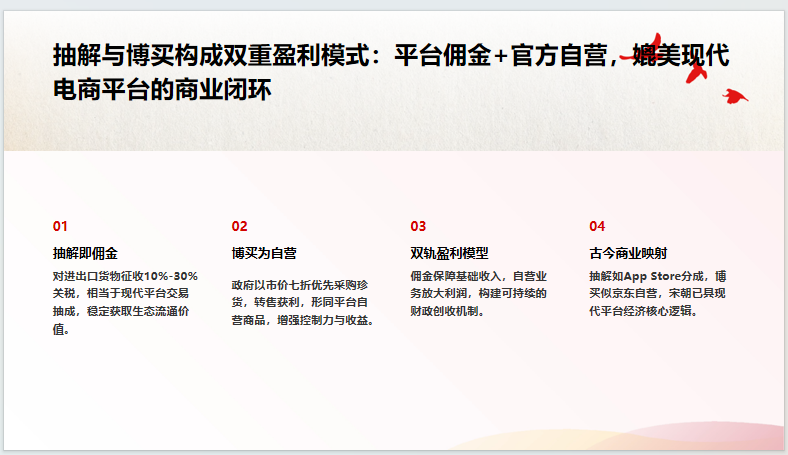
1. 历史背景与平台架构
# 市舶司平台架构
class MaritimeTradeBureau:
"""宋朝市舶司平台模拟"""
def __init__(self, location="泉州"):
# 平台基本信息
self.location = location
self.establishment_year = 971 # 北宋开宝四年
# 平台功能模块
self.modules = {
"customs": "海关查验",
"taxation": "抽解征税",
"procurement": "博买官营",
"regulation": "贸易规则",
"settlement": "支付结算"
}
# 平台费率
self.commission_rate = 0.1 # 抽解10%
self.procurement_rate = 0.3 # 博买30%
def platform_intro(self):
"""平台介绍"""
return f"��️ 宋朝市舶司平台 ({self.location}):古代外贸云服务"
# 初始化平台
bureau = MaritimeTradeBureau("广州")
print(bureau.platform_intro())
print(f" 功能模块:{len(bureau.modules)}个核心模块")
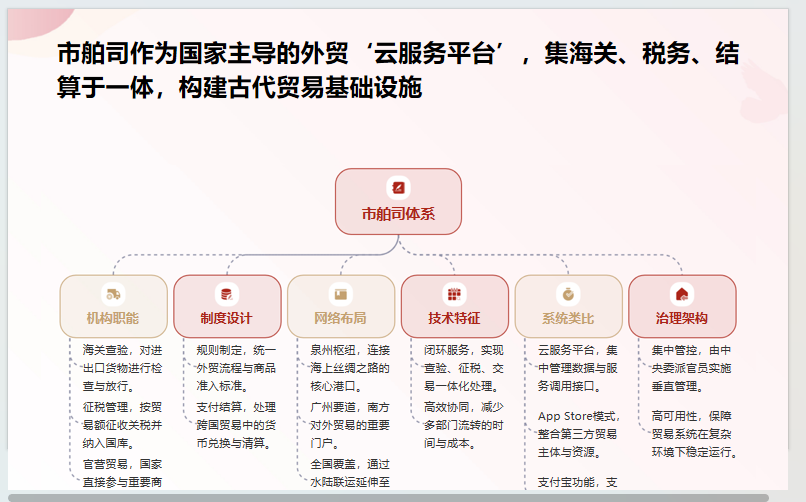
2.平台经济类比
# 市舶司与现代平台对比
def platform_economy_comparison():
"""市舶司与现代平台经济对比"""
comparison = {
"市舶司": {
"角色": "国家外贸平台",
"抽解": "平台佣金(10-30%)",
"博买": "自营业务",
"公凭": "API访问凭证",
"牙人": "平台中介/客服"
},
"现代平台": {
"角色": "数字平台",
"抽解": "交易佣金",
"博买": "平台自营",
"公凭": "API密钥",
"牙人": "平台运营"
}
}
# 商业模式映射
business_model = {
"收入来源": ["抽解(关税)", "博买利润", "仓储费", "服务费"],
"成本结构": ["官员俸禄", "港口维护", "仓储成本", "安保费用"],
"价值主张": ["贸易便利化", "风险管控", "市场准入", "支付结算"]
}
return {
"analogy": "市舶司是古代的App Store + 支付宝 + 海关",
"comparison": comparison,
"business_model": business_model,
"insight": "平台经济的本质千年未变"
}
# 查看对比
comparison = platform_economy_comparison()
print("\n�� 平台经济类比:")
for era, features in comparison["comparison"].items():
print(f"\n {era}:")
for key, value in features.items():
print(f" {key}: {value}")
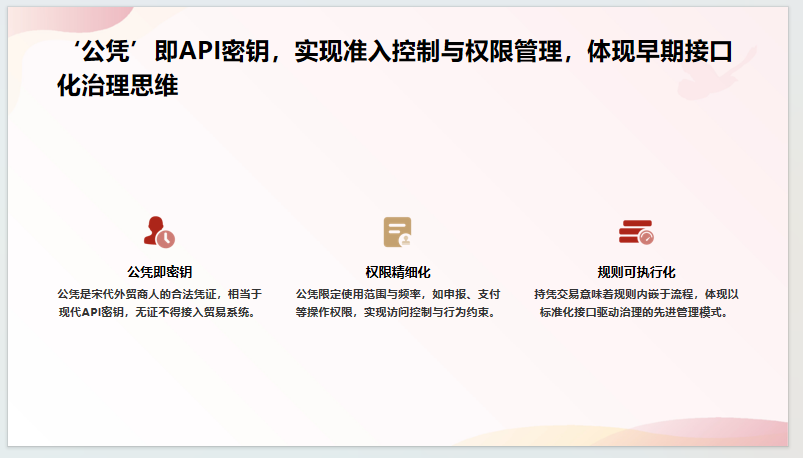
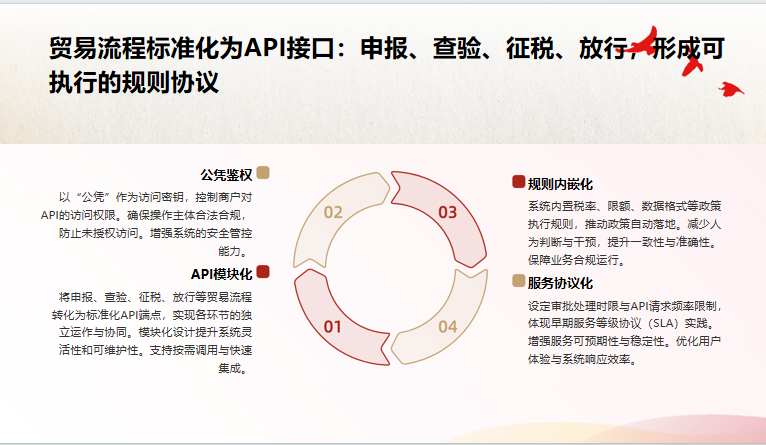
- API治理:贸易规则即API
# 贸易规则API
class TradeAPI:
"""市舶司贸易规则API"""
def __init__(self):
# API端点
self.endpoints = {
"/api/v1/apply": "申请公凭(API密钥)",
"/api/v1/declare": "货物申报",
"/api/v1/pay": "支付抽解",
"/api/v1/procure": "博买请求",
"/api/v1/clear": "清关放行"
}
# API规则
self.rules = {
"rate_limit": "每日100次请求",
"authentication": "公凭验证",
"data_format": "货物清单JSON",
"response_time": "3日内审批"
}
def generate_gongping(self, merchant_id):
"""生成公凭(API密钥)"""
import hashlib
import time
# 模拟API密钥生成
timestamp = str(int(time.time()))
raw_key = f"{merchant_id}_{timestamp}_市舶司"
api_key = hashlib.md5(raw_key.encode()).hexdigest()[:16]
return {
"merchant_id": merchant_id,
"api_key": api_key,
"expiry": "一年有效",
"permissions": ["申报", "查询", "支付"],
"rate_limit": "100次/日"
}
def validate_request(self, api_key, endpoint):
"""验证API请求"""
valid_endpoints = list(self.endpoints.keys())
if endpoint not in valid_endpoints:
return {"valid": False, "error": "无效端点"}
if not api_key or len(api_key) != 16:
return {"valid": False, "error": "无效API密钥"}
return {
"valid": True,
"endpoint": endpoint,
"timestamp": "2023-10-01 10:00:00",
"request_id": f"REQ_{hash(api_key) % 10000:04d}"
}
# 测试API
trade_api = TradeAPI()
gongping = trade_api.generate_gongping("MERCHANT_001")
validation = trade_api.validate_request(gongping["api_key"], "/api/v1/declare")
print("\n�� 贸易规则API:")
print(f" API端点:{len(trade_api.endpoints)}个")
print(f" 公凭示例:{gongping['api_key']}")
print(f" 请求验证:{validation['valid']} - {validation.get('error', '通过')}")
- 商业模式:抽解与博买
# 商业模式实现
class BusinessModel:
"""市舶司商业模式"""
def __init__(self):
# 税率表
self.tax_rates = {
"犀角": 0.3, # 30%
"象牙": 0.2, # 20%
"香料": 0.1, # 10%
"瓷器": 0.15, # 15%
"丝绸": 0.12 # 12%
}
# 博买价格系数
self.procurement_multiplier = 0.7 # 市价的70%
def calculate_choujie(self, goods):
"""计算抽解(关税)"""
total_tax = 0
details = []
for item in goods:
name = item["name"]
value = item["value"]
quantity = item.get("quantity", 1)
tax_rate = self.tax_rates.get(name, 0.1) # 默认10%
tax_amount = value * quantity * tax_rate
total_tax += tax_amount
details.append({
"name": name,
"value": value,
"quantity": quantity,
"tax_rate": tax_rate,
"tax_amount": tax_amount
})
return {
"total_tax": total_tax,
"details": details,
"commission_type": "平台抽成"
}
def bowai_procurement(self, goods, market_price):
"""博买(官买)"""
procurement_value = market_price * self.procurement_multiplier
return {
"goods": goods,
"market_price": market_price,
"procurement_price": procurement_value,
"discount_rate": 1 - self.procurement_multiplier,
"type": "平台自营采购"
}
# 测试商业模式
business = BusinessModel()
# 模拟货物
sample_goods = [
{"name": "香料", "value": 1000, "quantity": 10},
{"name": "瓷器", "value": 500, "quantity": 20}
]
# 计算抽解
tax_result = business.calculate_choujie(sample_goods)
# 模拟博买
procurement_result = business.bowai_procurement(
goods=["香料", "瓷器"],
market_price=20000
)
print("\n�� 商业模式:")
print(f" 抽解总额:{tax_result['total_tax']:.2f} 两")
print(f" 博买价格:{procurement_result['procurement_price']:.2f} 两(市价{procurement_result['market_price']}两)")
print(f" 商业模式:佣金({tax_result['details'][0]['tax_rate']*100}%) + 自营(折扣{procurement_result['discount_rate']*100}%)")
4. 商业模式:抽解与博买
# 商业模式实现
class BusinessModel:
"""市舶司商业模式"""
def __init__(self):
# 税率表
self.tax_rates = {
"犀角": 0.3, # 30%
"象牙": 0.2, # 20%
"香料": 0.1, # 10%
"瓷器": 0.15, # 15%
"丝绸": 0.12 # 12%
}
# 博买价格系数
self.procurement_multiplier = 0.7 # 市价的70%
def calculate_choujie(self, goods):
"""计算抽解(关税)"""
total_tax = 0
details = []
for item in goods:
name = item["name"]
value = item["value"]
quantity = item.get("quantity", 1)
tax_rate = self.tax_rates.get(name, 0.1) # 默认10%
tax_amount = value * quantity * tax_rate
total_tax += tax_amount
details.append({
"name": name,
"value": value,
"quantity": quantity,
"tax_rate": tax_rate,
"tax_amount": tax_amount
})
return {
"total_tax": total_tax,
"details": details,
"commission_type": "平台抽成"
}
def bowai_procurement(self, goods, market_price):
"""博买(官买)"""
procurement_value = market_price * self.procurement_multiplier
return {
"goods": goods,
"market_price": market_price,
"procurement_price": procurement_value,
"discount_rate": 1 - self.procurement_multiplier,
"type": "平台自营采购"
}
# 测试商业模式
business = BusinessModel()
# 模拟货物
sample_goods = [
{"name": "香料", "value": 1000, "quantity": 10},
{"name": "瓷器", "value": 500, "quantity": 20}
]
# 计算抽解
tax_result = business.calculate_choujie(sample_goods)
# 模拟博买
procurement_result = business.bowai_procurement(
goods=["香料", "瓷器"],
market_price=20000
)
print("\n�� 商业模式:")
print(f" 抽解总额:{tax_result['total_tax']:.2f} 两")
print(f" 博买价格:{procurement_result['procurement_price']:.2f} 两(市价{procurement_result['market_price']}两)")
print(f" 商业模式:佣金({tax_result['details'][0]['tax_rate']*100}%) + 自营(折扣{procurement_result['discount_rate']*100}%)")
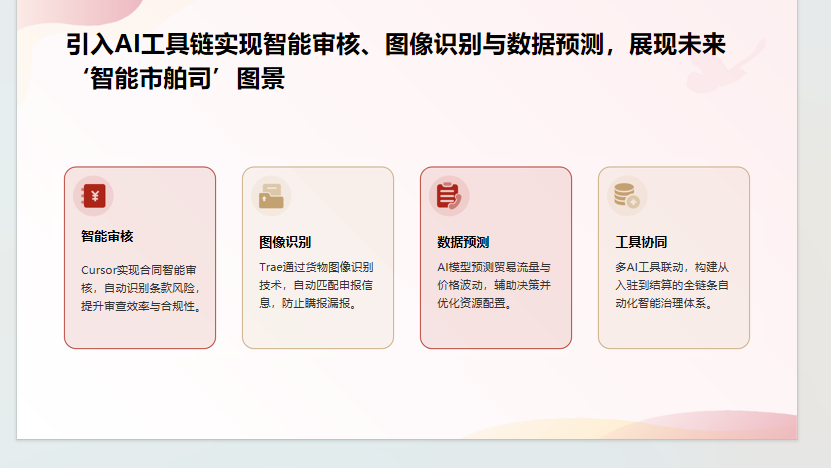
- AI工具集成:智能市舶司
# AI智能市舶司
def ai_maritime_bureau():
"""AI集成的智能市舶司"""
# AI工具分工
ai_tools = {
"dify": "平台低代码搭建",
"claude_code": "贸易规则生成",
"codex": "报关单自动填写",
"trae": "货物图像识别",
"cursor": "合同智能审核",
"langchain": "多语言翻译服务",
"元宝": "腾讯AI客服",
"豆包": "字节AI风控",
"通义千问": "阿里AI结算"
}
# 智能流程
smart_workflow = [
"1. 商户注册 → Dify快速入驻",
"2. 货物申报 → Trae图像识别",
"3. 关税计算 → Codex自动核算",
"4. 风险审核 → 豆包AI风控",
"5. 多语言沟通 → Langchain翻译",
"6. 支付结算 → 通义千问处理",
"7. 客服支持 → 元宝24小时服务"
]
# 数据智能
data_intelligence = {
"trade_volume_prediction": "AI预测贸易量",
"price_monitoring": "实时价格监控",
"risk_assessment": "商户信用评估",
"route_optimization": "航线优化建议",
"market_analysis": "市场趋势分析"
}
return {
"platform_name": "AI市舶司平台",
"ai_tools": ai_tools,
"workflow": smart_workflow,
"data_intelligence": data_intelligence,
"advantage": "智能化、自动化、高效化"
}
# 查看AI系统
ai_system = ai_maritime_bureau()
print("\n�� AI智能市舶司:")
print(" AI工具分工:")
for tool, function in ai_system["ai_tools"].items():
print(f" {tool}: {function}")
print("\n 智能流程:")
for step in ai_system["workflow"]:
print(f" {step}")
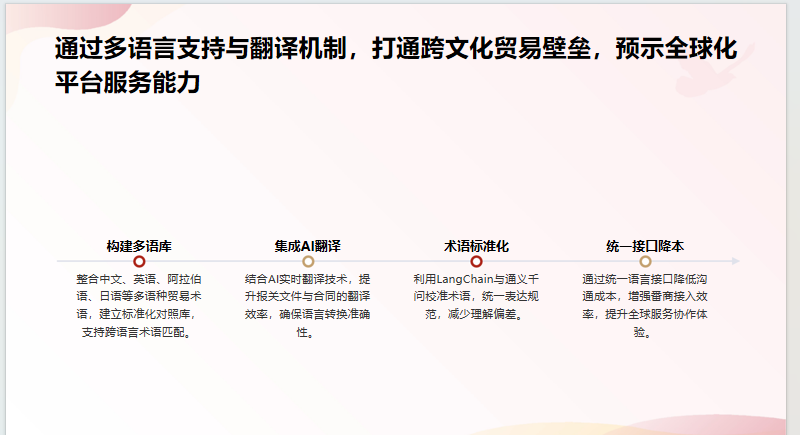
6. 多语言贸易支持
# 多语言贸易支持
def multilingual_trade_support():
"""市舶司多语言支持"""
# 多语言词汇表
trade_terms = {
"zh": {
"市舶司": "管理海外贸易的机构",
"抽解": "征收关税",
"博买": "官方采购",
"公凭": "贸易许可证",
"番商": "外国商人"
},
"en": {
"市舶司": "Maritime Trade Bureau",
"抽解": "Customs duty",
"博买": "Official procurement",
"公凭": "Trade license",
"番商": "Foreign merchant"
},
"ar": {
"市舶司": "مكتب التجارة البحرية",
"抽解": "الرسوم الجمركية",
"博买": "المشتريات الرسمية",
"公凭": "رخصة تجارية",
"番商": "تاجر أجنبي"
},
"ja": {
"市舶司": "市舶司(海外貿易管理機関)",
"抽解": "関税徴収",
"博买": "官買",
"公凭": "貿易許可証",
"番商": "外国商人"
}
}
# AI翻译工具
translation_tools = {
"元宝": "中文-阿拉伯语翻译",
"豆包": "中文-英语翻译",
"通义千问": "多语言实时翻译",
"langchain": "专业术语翻译"
}
# 翻译示例
def translate_term(term, source_lang="zh", target_lang="en"):
"""翻译贸易术语"""
if source_lang in trade_terms and target_lang in trade_terms:
source_dict = trade_terms[source_lang]
target_dict = trade_terms[target_lang]
if term in source_dict:
# 模拟AI翻译
return {
"term": term,
"source": source_dict[term],
"translation": target_dict.get(term, "未找到翻译"),
"tool": "元宝AI翻译",
"confidence": 0.95
}
return {"error": "翻译失败"}
return {
"languages": list(trade_terms.keys()),
"terms": trade_terms,
"translation_tools": translation_tools,
"translate_function": translate_term
}
# 测试多语言
multilingual = multilingual_trade_support()
translation = multilingual["translate_function"]("抽解", "zh", "en")
print("\n�� 多语言贸易支持:")
print(f" 支持语言:{len(multilingual['languages'])}种")
print(f" 术语翻译:{translation['term']} → {translation['translation']}")
print(f" 翻译工具:{translation['tool']} (置信度{translation['confidence']})")
7.商业部门映射
# 商业部门映射
def business_department_mapping():
"""市舶司部门映射"""
departments = {
"商务部门": {
"职责": ["招商入驻", "商户管理", "市场拓展"],
"现代对应": "平台商务团队",
"KPI": ["商户数量", "交易额", "满意度"]
},
"运营部门": {
"职责": ["流程优化", "效率提升", "问题处理"],
"现代对应": "平台运营团队",
"KPI": ["处理时效", "错误率", "吞吐量"]
},
"风控部门": {
"职责": ["风险评估", "欺诈检测", "合规审查"],
"现代对应": "风控安全团队",
"KPI": ["风险事件", "损失金额", "合规率"]
},
"财务部门": {
"职责": ["资金结算", "税务管理", "财务报告"],
"现代对应": "财务结算团队",
"KPI": ["资金周转", "坏账率", "利润率"]
},
"技术部门": {
"职责": ["系统维护", "规则制定", "工具开发"],
"现代对应": "平台技术团队",
"KPI": ["系统可用性", "响应时间", "功能迭代"]
}
}
# 组织架构
org_structure = {
"提举市舶司": "CEO/平台负责人",
"监市舶务": "COO/运营总监",
"市舶判官": "CFO/财务总监",
"市舶巡检": "CRO/风控总监",
"书状官": "CTO/技术总监"
}
return {
"departments": departments,
"org_structure": org_structure,
"insight": "古代平台已有完整组织架构"
}
# 查看部门映射
mapping = business_department_mapping()
print("\n�� 商业部门映射:")
print(" 组织架构:")
for ancient, modern in mapping["org_structure"].items():
print(f" {ancient} → {modern}")
print("\n 部门职责:")
for dept, info in mapping["departments"].items():
print(f" {dept}: {', '.join(info['职责'][:2])}...")
8.完整贸易流程模拟
# 完整贸易流程
class CompleteTradeProcess:
"""完整贸易流程模拟"""
def __init__(self):
self.merchants = []
self.transactions = []
def merchant_registration(self, name, country, capital):
"""商户注册"""
merchant = {
"id": len(self.merchants) + 1,
"name": name,
"country": country,
"capital": capital,
"status": "active",
"credit_score": 80 # 初始信用分
}
self.merchants.append(merchant)
return merchant
def goods_declaration(self, merchant_id, goods_list):
"""货物申报"""
declaration = {
"declaration_id": f"DEC_{len(self.transactions)+1:04d}",
"merchant_id": merchant_id,
"goods": goods_list,
"timestamp": "2023-10-01",
"status": "pending"
}
return declaration
def customs_inspection(self, declaration):
"""海关查验"""
# 模拟查验结果
import random
risk_level = random.choice(["low", "medium", "high"])
passed = risk_level != "high"
inspection_result = {
"declaration_id": declaration["declaration_id"],
"risk_level": risk_level,
"passed": passed,
"inspection_notes": "货物与申报一致" if passed else "发现违禁品",
"inspector": "市舶司官员"
}
return inspection_result
def tax_calculation(self, goods_list):
"""税费计算"""
total_value = sum(item["value"] * item.get("quantity", 1) for item in goods_list)
tax_rate = 0.1 # 10%抽解
tax_amount = total_value * tax_rate
return {
"total_value": total_value,
"tax_rate": tax_rate,
"tax_amount": tax_amount,
"net_value": total_value - tax_amount
}
def trade_settlement(self, merchant_id, tax_amount, payment_method="白银"):
"""贸易结算"""
transaction = {
"tx_id": f"TX_{len(self.transactions)+1:06d}",
"merchant_id": merchant_id,
"tax_amount": tax_amount,
"payment_method": payment_method,
"status": "completed",
"settlement_time": "2023-10-01 15:30:00"
}
self.transactions.append(transaction)
return transaction
# 模拟完整流程
trade_system = CompleteTradeProcess()
# 1. 商户注册
merchant = trade_system.merchant_registration(
name="阿拉伯香料商",
country="阿拉伯",
capital=50000
)
# 2. 货物申报
goods = [
{"name": "香料", "value": 1000, "quantity": 50},
{"name": "珠宝", "value": 5000, "quantity": 10}
]
declaration = trade_system.goods_declaration(merchant["id"], goods)
# 3. 海关查验
inspection = trade_system.customs_inspection(declaration)
# 4. 税费计算
tax_info = trade_system.tax_calculation(goods)
# 5. 贸易结算
settlement = trade_system.trade_settlement(merchant["id"], tax_info["tax_amount"])
print("\n�� 完整贸易流程:")
print(f" 商户:{merchant['name']} ({merchant['country']})")
print(f" 申报货物:{len(goods)}种,总价值{tax_info['total_value']}两")
print(f" 海关查验:{inspection['risk_level']}风险 - {'通过' if inspection['passed'] else '不通过'}")
print(f" 抽解税费:{tax_info['tax_amount']}两 (税率{tax_info['tax_rate']*100}%)")
print(f" 结算状态:{settlement['status']},支付方式{settlement['payment_method']}")
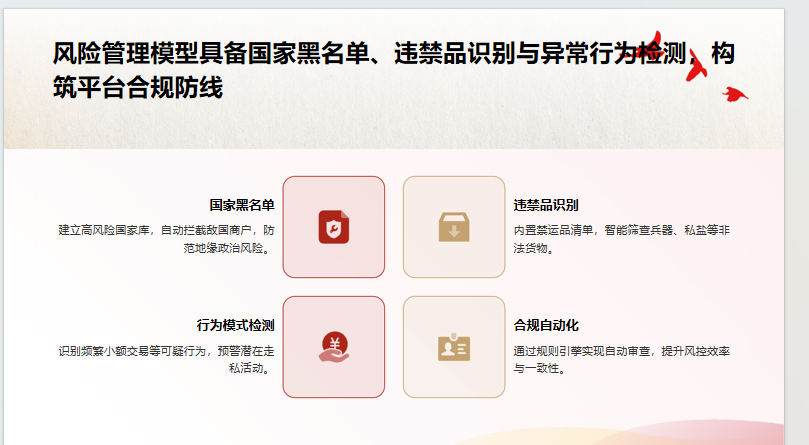
9.风险管理与合规
# 风险管理与合规
class RiskManagement:
"""市舶司风险管理"""
def __init__(self):
# 风险规则
self.risk_rules = {
"sanctioned_countries": ["敌国", "海盗据点"],
"prohibited_goods": ["兵器", "禁书", "私盐"],
"suspicious_patterns": ["频繁小额交易", "夜间异常交易"]
}
# 合规要求
self.compliance_requirements = {
"documentation": ["公凭", "货物清单", "来源证明"],
"reporting": ["月度报告", "年度审计", "异常报告"],
"record_keeping": "交易记录保存10年"
}
def risk_assessment(self, merchant, transaction):
"""风险评估"""
risk_score = 0
flags = []
# 国家风险
if merchant.get("country") in self.risk_rules["sanctioned_countries"]:
risk_score += 50
flags.append("高风险国家")
# 货物风险
for item in transaction.get("goods", []):
if item.get("name") in self.risk_rules["prohibited_goods"]:
risk_score += 100
flags.append("违禁货物")
# 交易模式风险
if transaction.get("amount", 0) < 100 and transaction.get("frequency", 0) > 10:
risk_score += 30
flags.append("可疑交易模式")
# 确定风险等级
if risk_score >= 100:
risk_level = "high"
action = "拒绝交易,上报官府"
elif risk_score >= 50:
risk_level = "medium"
action = "加强审查,暂缓放行"
else:
risk_level = "low"
action = "正常放行"
return {
"merchant_id": merchant.get("id"),
"risk_score": risk_score,
"risk_level": risk_level,
"risk_flags": flags,
"recommended_action": action,
"compliance_check": "通过" if risk_level != "high" else "不通过"
}
def compliance_check(self, documents):
"""合规检查"""
missing_docs = []
for required in self.compliance_requirements["documentation"]:
if required not in documents:
missing_docs.append(required)
return {
"compliance_status": "通过" if not missing_docs else "不通过",
"missing_documents": missing_docs,
"requirements": self.compliance_requirements["documentation"]
}
# 测试风险管理
risk_system = RiskManagement()
# 模拟商户和交易
test_merchant = {"id": 1, "name": "测试商户", "country": "敌国"}
test_transaction = {
"goods": [{"name": "香料", "value": 100}],
"amount": 50,
"frequency": 15
}
# 风险评估
risk_result = risk_system.risk_assessment(test_merchant, test_transaction)
# 合规检查
compliance_result = risk_system.compliance_check(["公凭", "货物清单"])
print("\n��️ 风险管理与合规:")
print(f" 风险评估:{risk_result['risk_level']}风险 ({risk_result['risk_score']}分)")
print(f" 风险标记:{', '.join(risk_result['risk_flags']) if risk_result['risk_flags'] else '无'}")
print(f" 建议措施:{risk_result['recommended_action']}")
print(f" 合规检查:{compliance_result['compliance_status']}")
10. 数据智能与市场分析
# 数据智能分析
class DataIntelligence:
"""市舶司数据智能"""
def __init__(self):
self.trade_data = []
self.market_insights = {}
def collect_trade_data(self, transaction):
"""收集交易数据"""
self.trade_data.append({
"timestamp": transaction.get("timestamp"),
"merchant_country": transaction.get("merchant_country"),
"goods_type": transaction.get("goods_type"),
"value": transaction.get("value"),
"tax_paid": transaction.get("tax_paid")
})
def analyze_market_trends(self):
"""分析市场趋势"""
if not self.trade_data:
return {"error": "无交易数据"}
# 模拟数据分析
total_volume = sum(item["value"] for item in self.trade_data)
total_tax = sum(item["tax_paid"] for item in self.trade_data)
# 商品分布
goods_distribution = {}
for item in self.trade_data:
goods_type = item["goods_type"]
goods_distribution[goods_type] = goods_distribution.get(goods_type, 0) + item["value"]
# 国家分布
country_distribution = {}
for item in self.trade_data:
country = item["merchant_country"]
country_distribution[country] = country_distribution.get(country, 0) + item["value"]
# 趋势预测
import random
growth_prediction = random.uniform(0.05, 0.15) # 5-15%增长
return {
"total_trade_volume": total_volume,
"total_tax_revenue": total_tax,
"tax_rate_effectiveness": total_tax / total_volume if total_volume > 0 else 0,
"top_goods": sorted(goods_distribution.items(), key=lambda x: x[1], reverse=True)[:3],
"top_countries": sorted(country_distribution.items(), key=lambda x: x[1], reverse=True)[:3],
"growth_prediction": f"{growth_prediction:.1%}",
"recommendations": [
"增加香料进口配额",
"优化阿拉伯商人服务",
"开发新贸易航线"
]
}
def generate_report(self, period="月度"):
"""生成分析报告"""
analysis = self.analyze_market_trends()
report = f"""
�� {period}市舶司贸易分析报告
{'='*40}
总贸易额:{analysis.get('total_trade_volume', 0):,.2f} 两
税收收入:{analysis.get('total_tax_revenue', 0):,.2f} 两
税收效率:{analysis.get('tax_rate_effectiveness', 0):.1%}
热门商品:
{chr(10).join(f' • {goods}: {value:,.0f}两' for goods, value in analysis.get('top_goods', []))}
主要贸易国:
{chr(10).join(f' • {country}: {value:,.0f}两' for country, value in analysis.get('top_countries', []))}
市场预测:下期增长 {analysis.get('growth_prediction', '0%')}
建议措施:
{chr(10).join(f' • {rec}' for rec in analysis.get('recommendations', []))}
"""
return report
# 测试数据智能
intelligence = DataIntelligence()
# 模拟数据收集
sample_transactions = [
{"timestamp": "2023-10-01", "merchant_country": "阿拉伯", "goods_type": "香料", "value": 50000, "tax_paid": 5000},
{"timestamp": "2023-10-02", "merchant_country": "波斯", "goods_type": "地毯", "value": 30000, "tax_paid": 3000},
{"timestamp": "2023-10-03", "merchant_country": "阿拉伯", "goods_type": "珠宝", "value": 80000, "tax_paid": 8000}
]
for tx in sample_transactions:
intelligence.collect_trade_data(tx)
# 生成报告
report = intelligence.generate_report("月度")
print("\n�� 数据智能与市场分析:")
print(report)
11.金句集锦
1."所有平台的终极梦想,都是成为社会的基础设施。市舶司在宋代,就是国家外贸的'云服务'提供商。"
2."抽解是平台佣金,博买是平台自营——宋朝人已经玩透了平台经济的商业模式。"
3."公凭就是古代的API密钥:没有它,你连贸易的接口都访问不了。"
4."市舶司 = App Store + 支付宝 + 海关:三位一体的古代超级平台。"
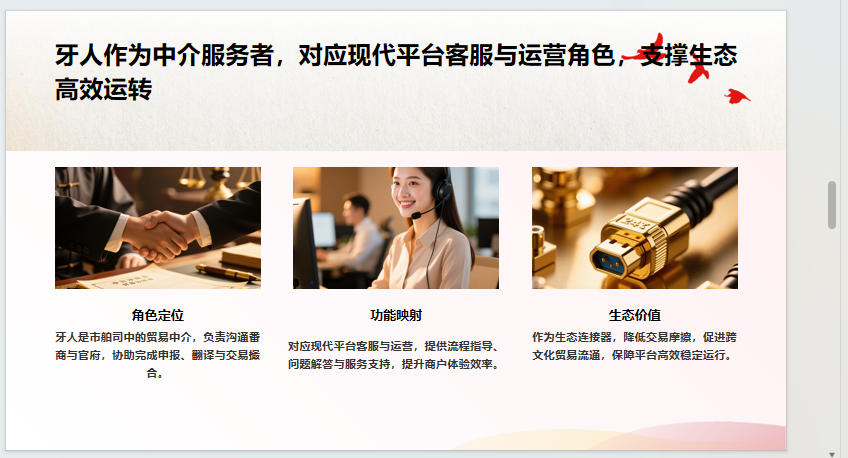
5."番商是平台上的开发者,市舶司是平台运营商,抽解是平台分成——这套逻辑千年未变。"
6."好的平台治理:规则透明如API文档,执行严格如系统校验。"
7."市舶司的成功证明:平台经济的核心不是技术,而是规则与信任。"
8."数据智能在古代:市舶司官员靠记忆分析市场趋势;数据智能在现代:AI算法实时预测贸易流量。"
9."风险管理是平台的免疫系统:没有它,再繁荣的生态也会崩溃。"
10."从市舶司到现代平台:变的是技术,不变的是连接、规则与价值交换的本质。"
技术映射表
|
市舶司概念 |
现代技术概念 |
对应关系 |
|
市舶司 |
平台运营商 |
提供交易场所与规则 |
|
抽解 |
平台佣金 |
交易分成收入 |
|
博买 |
平台自营 |
官方采购业务 |
|
公凭 |
API密钥 |
访问凭证 |
|
番商 |
平台开发者 |
生态参与者 |
|
牙人 |
平台客服/中介 |
服务支持 |
|
抽解税率 |
API调用费率 |
使用成本 |
|
货物清单 |
数据格式规范 |
接口数据标准 |
|
海关查验 |
安全审查 |
风险控制 |
|
贸易报告 |
数据分析 |
业务洞察 |
12.一句话总结
宋朝市舶司是古代的平台经济典范:作为外贸"云服务"提供商,它通过抽解(平台佣金)和博买(自营业务)实现盈利,用公凭(API密钥)管理访问权限,以标准化规则(API文档)治理生态,展现了平台经济的核心逻辑——连接、规则、价值交换。

AtomGit 是由开放原子开源基金会联合 CSDN 等生态伙伴共同推出的新一代开源与人工智能协作平台。平台坚持“开放、中立、公益”的理念,把代码托管、模型共享、数据集托管、智能体开发体验和算力服务整合在一起,为开发者提供从开发、训练到部署的一站式体验。
更多推荐



 12
12 0
0- 0


 已为社区贡献14条内容

所有评论(0)