文献阅读 260329-Unprecedented Amazonian rainforests damage during the 2023–2024 droughts
Unprecedented Amazonian rainforests damage during the 2023–2024 droughts
来自 <https://www.pnas.org/doi/10.1073/pnas.2514066123>
## Abstract:
Between 2023 and 2024, Amazonian rainforests experienced two consecutive, record-breaking droughts—each more intense than any previously observed—yet their impacts remain largely unquantified.
What this paper did:
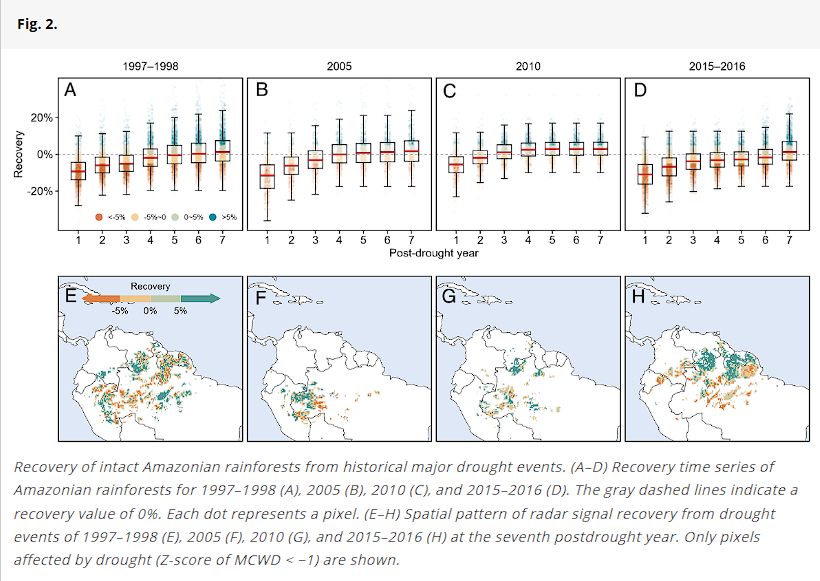
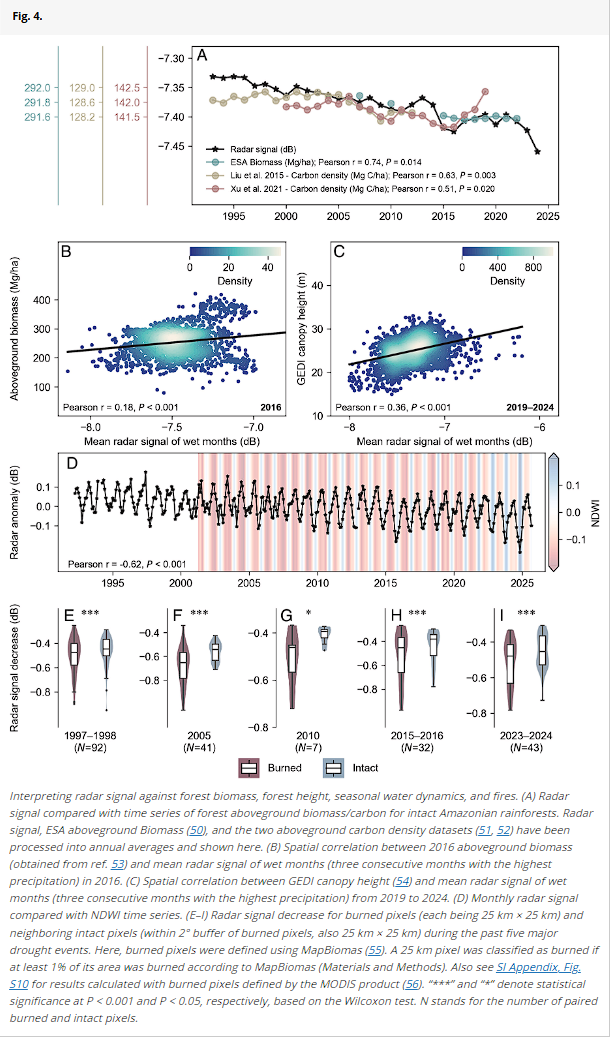
Using newly developed monthly radar satellite observations (1992 to 2025) that track forest moisture and biomass dynamics, we analyzed the long-term responses of intact Amazonian rainforests to past major droughts—particularly the 2023–2024 event—and projected their post-drought recovery.
Results:
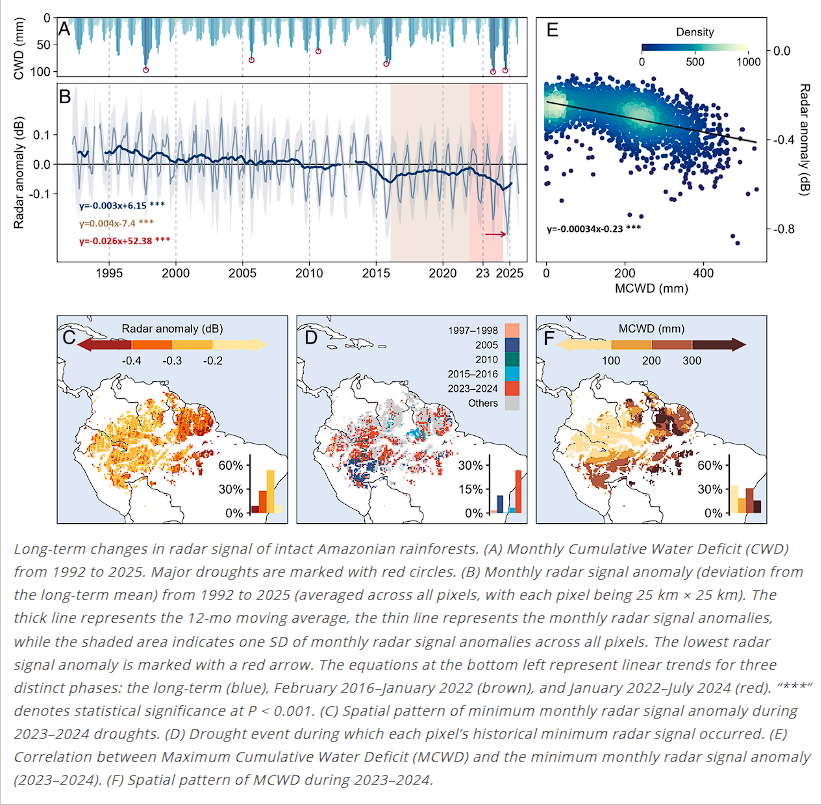
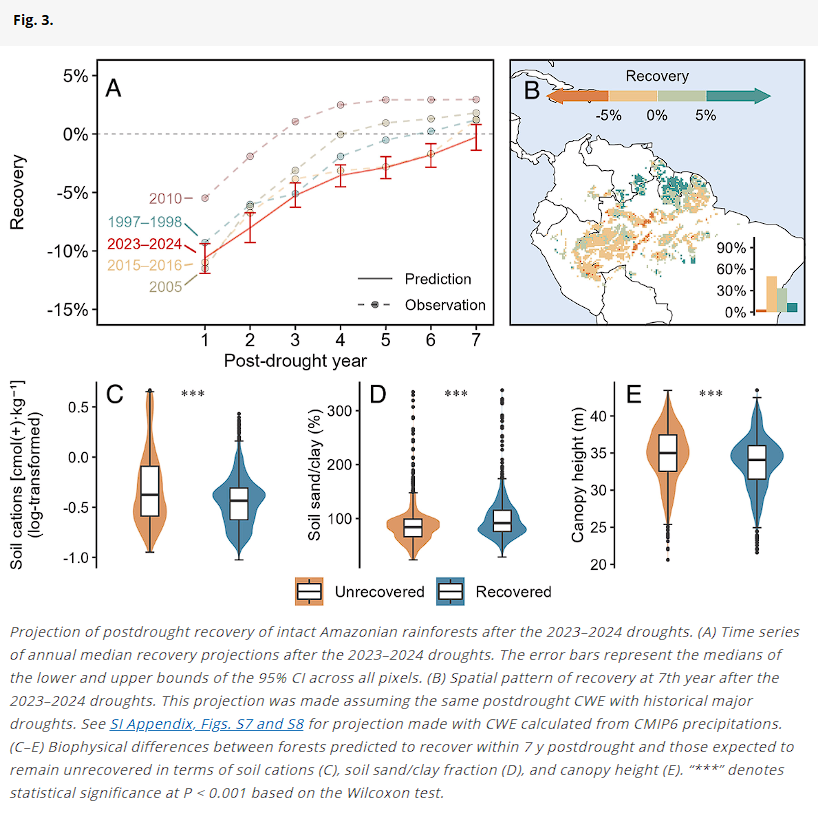
We found a biome-wide sharp decline in radar signal during 2023–2024, marking the lowest level observed since 1992. Spatially, 26.8% of the forests reached their three-decade minima during this period, primarily in eastern Amazonia. This ratio is more than double that recorded during the 2005 drought, when 11.0% of the forests reached such minima. Moreover, projections based on both historical and future CMIP6 precipitation scenarios consistently indicated that, even 7 y after the 2023–2024 droughts, less than 50% of the affected areas are expected to recover to predrought conditions, and these forests are associated with lower soil cation concentrations, higher soil sand content, and lower canopy height—characteristics that lessen the risk of hydraulic failure. Given that severe droughts have occurred approximately every 7 y over the past three decades, Amazonian rainforests may face another drought before fully recovering from the 2023–2024 event.
Our results therefore highlight the growing vulnerability of the Amazonian rainforests to intensifying climate extremes driven by El Niño events and ongoing anthropogenic climate change, providing evidence that these forests are approaching the limits of their preindustrial operating space.
## Intro:
A global long-term, high-resolution satellite radar backscatter data record (1992–2022+): merging C-band ERS/ASCAT and Ku-band QSCAT
来自 <https://essd.copernicus.org/articles/15/1577/2023/>
## Results:
Radar Signal Changes during the 2023–2024 Event.
Projection of Forest Recovery after the 2023–2024 Event.
文章的主要结论
本研究通过分析微波雷达信号的时间序列和空间分布,结合随机森林模型的预测,明确了2023至2024年干旱对亚马逊雨林的严重破坏程度及未来的低迷恢复预期。研究发现,该次干旱导致的森林水分和生物量降幅创下三十年来的极值,且受灾森林的恢复进程面临严峻挑战,其恢复能力高度依赖于所在区域特定的土壤与生物物理条件。
- • 结论 1: 雷达信号出现大范围骤降,达到1992年以来的历史最低点。在2023至2024年期间,有百分之二十六点八的亚马逊原生雨林经历了过去三十年来的最低雷达信号异常值,该比例是2005年大干旱时的两倍以上,主要集中在亚马逊东部地区。
- • 结论 2: 未来恢复前景堪忧,预计为所有历史干旱中最差的恢复水平。模型预测结果一致表明,即使在干旱结束七年之后,仍有超过一半的受影响森林区域无法恢复到旱前水平。
- • 结论 3: 森林的恢复能力受特定生物物理特质制约。能够在中长期内恢复的森林通常分布在土壤阳离子浓度较低、土壤含沙量较高以及冠层高度较低的区域,这些特征降低了植被发生水力失效的风险。

AtomGit 是由开放原子开源基金会联合 CSDN 等生态伙伴共同推出的新一代开源与人工智能协作平台。平台坚持“开放、中立、公益”的理念,把代码托管、模型共享、数据集托管、智能体开发体验和算力服务整合在一起,为开发者提供从开发、训练到部署的一站式体验。
更多推荐


 6
6 0
0- 0


 已为社区贡献9条内容

所有评论(0)