材料力学-主题074-纳米材料力学仿真
主题074:纳米材料力学仿真
1. 纳米材料概述
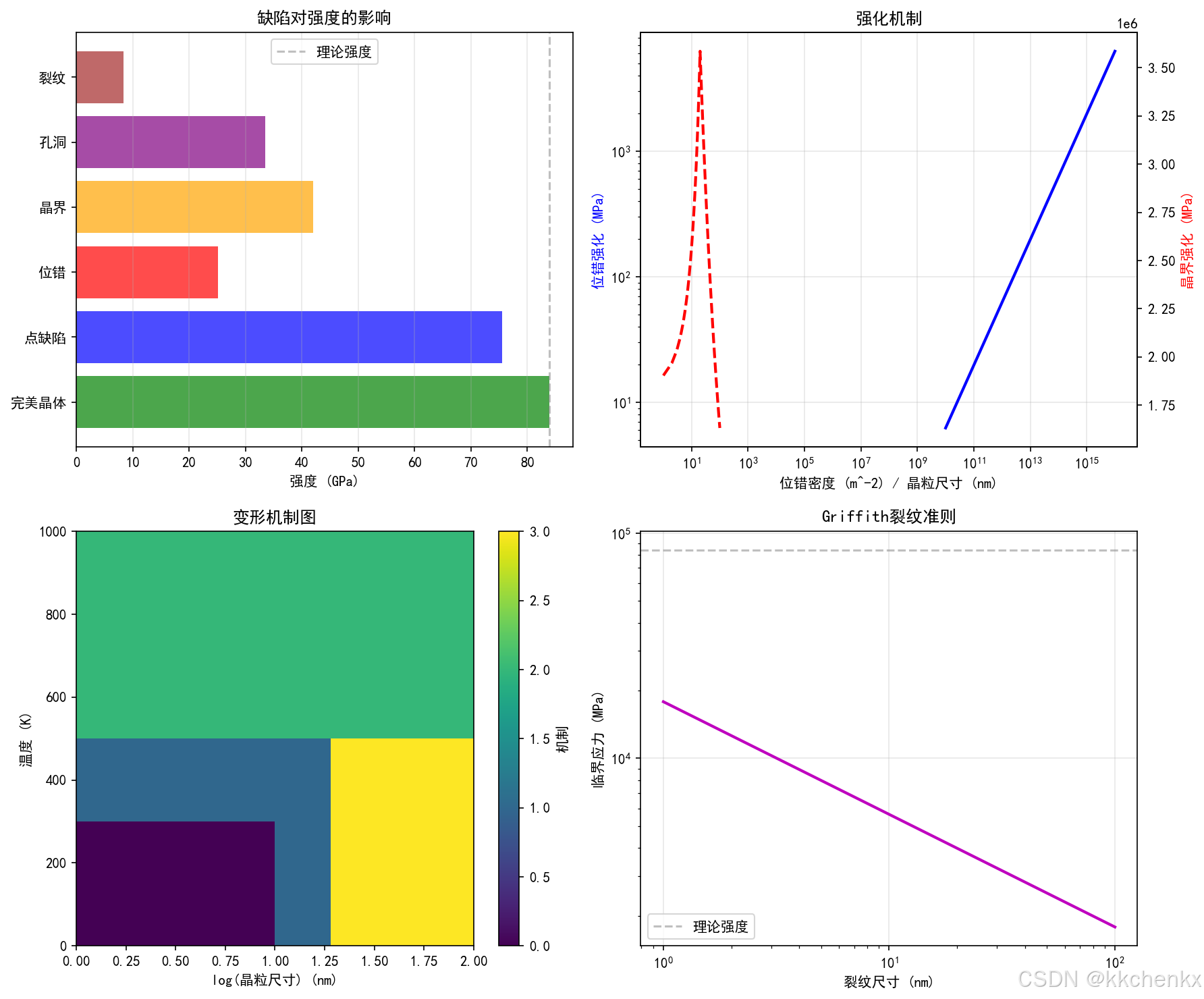
纳米材料是指至少有一个维度在1-100纳米范围内的材料体系。由于尺寸效应、表面效应、量子效应等纳米尺度特有的物理现象,纳米材料展现出许多宏观材料所不具备的优异力学性能。纳米材料力学仿真旨在通过数值模拟方法,研究纳米材料的力学行为、变形机制和性能优化。
1.1 纳米材料分类
| 维度 | 材料类型 | 实例 | 特点 | 应用领域 |
|---|---|---|---|---|
| 0维 | 纳米颗粒 | 金属纳米颗粒、量子点 | 高比表面积、量子限域效应 | 催化剂、传感器、医药载体 |
| 1维 | 纳米线、纳米管 | 碳纳米管、硅纳米线 | 高长径比、优异的力学强度 | 复合材料增强体、纳米电子器件 |
| 2维 | 纳米薄膜、纳米片 | 石墨烯、二维过渡金属硫族化合物 | 原子级厚度、优异的电子和力学性能 | 柔性电子、催化、能源存储 |
| 3维 | 纳米多孔材料、纳米复合材料 | 气凝胶、纳米颗粒增强复合材料 | 低密度、高比表面积 | 绝热材料、催化剂载体、结构材料 |
1.2 纳米材料的独特效应
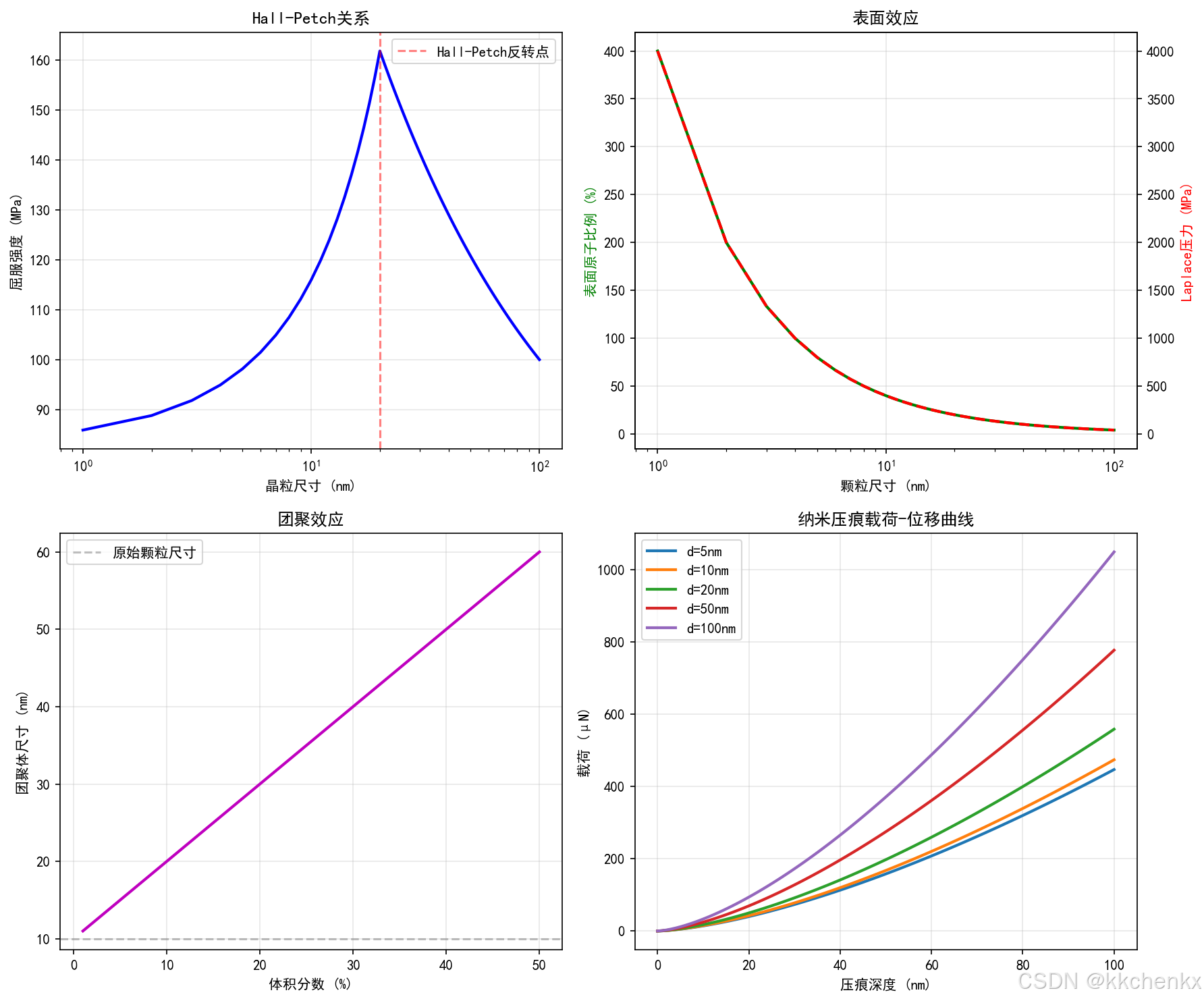
- 尺寸效应:当材料尺寸减小到纳米量级时,其物理、化学和力学性能会发生显著变化
- 表面效应:纳米材料具有极高的比表面积,表面原子比例大幅增加,导致表面能和活性显著提高
- 量子效应:当粒子尺寸接近或小于德布罗意波长时,量子效应变得显著,影响材料的电子结构和力学性能
- 小尺寸效应:材料的熔点、相变温度等物理性质随尺寸减小而变化
- 宏观量子隧道效应:粒子可以穿过经典力学中不可能穿过的势垒
1.3 纳米材料力学仿真的挑战
- 多尺度特性:纳米材料的行为涉及从原子到宏观的多个尺度
- 计算复杂度:原子级模拟的计算量巨大,难以处理大尺寸体系
- 力场选择:需要准确的原子间势函数来描述纳米材料的原子相互作用
- 边界条件:纳米尺度下的边界效应更加显著
- 实验验证:纳米尺度的实验测量难度大,难以直接验证仿真结果
2. 纳米材料的力学性能
2.1 碳纳米管
力学性能:
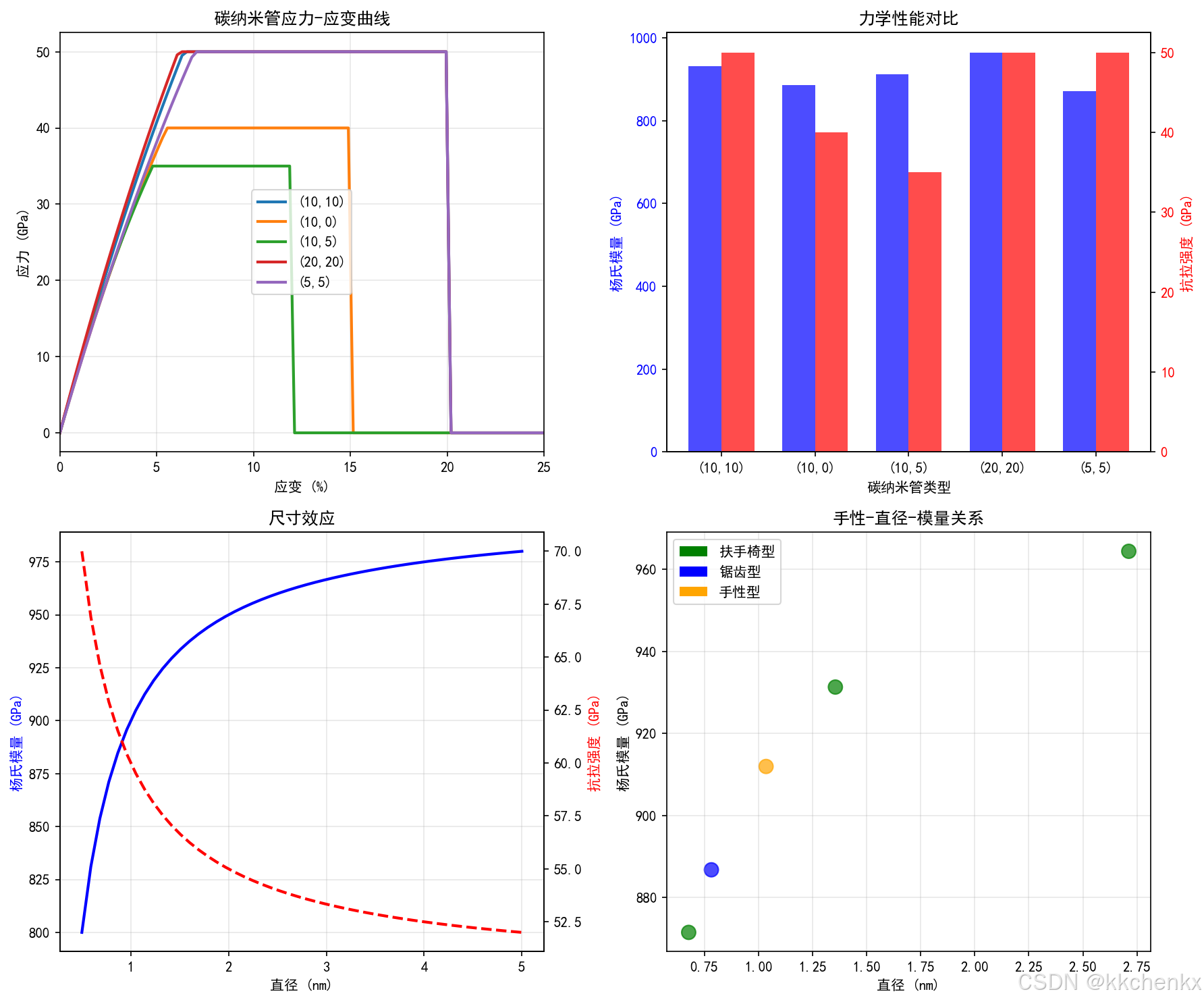
- 杨氏模量:~1 TPa(理论值)
- 抗拉强度:~13-53 GPa
- 断裂应变:~12-20%
- 密度:~1.3-1.4 g/cm³
特点:
- 理论上是目前已知强度最高的材料之一
- 具有优异的柔韧性和弹性恢复能力
- 轴向强度远高于径向强度
- 力学性能依赖于管径、螺旋度和缺陷密度
2.2 石墨烯
力学性能:
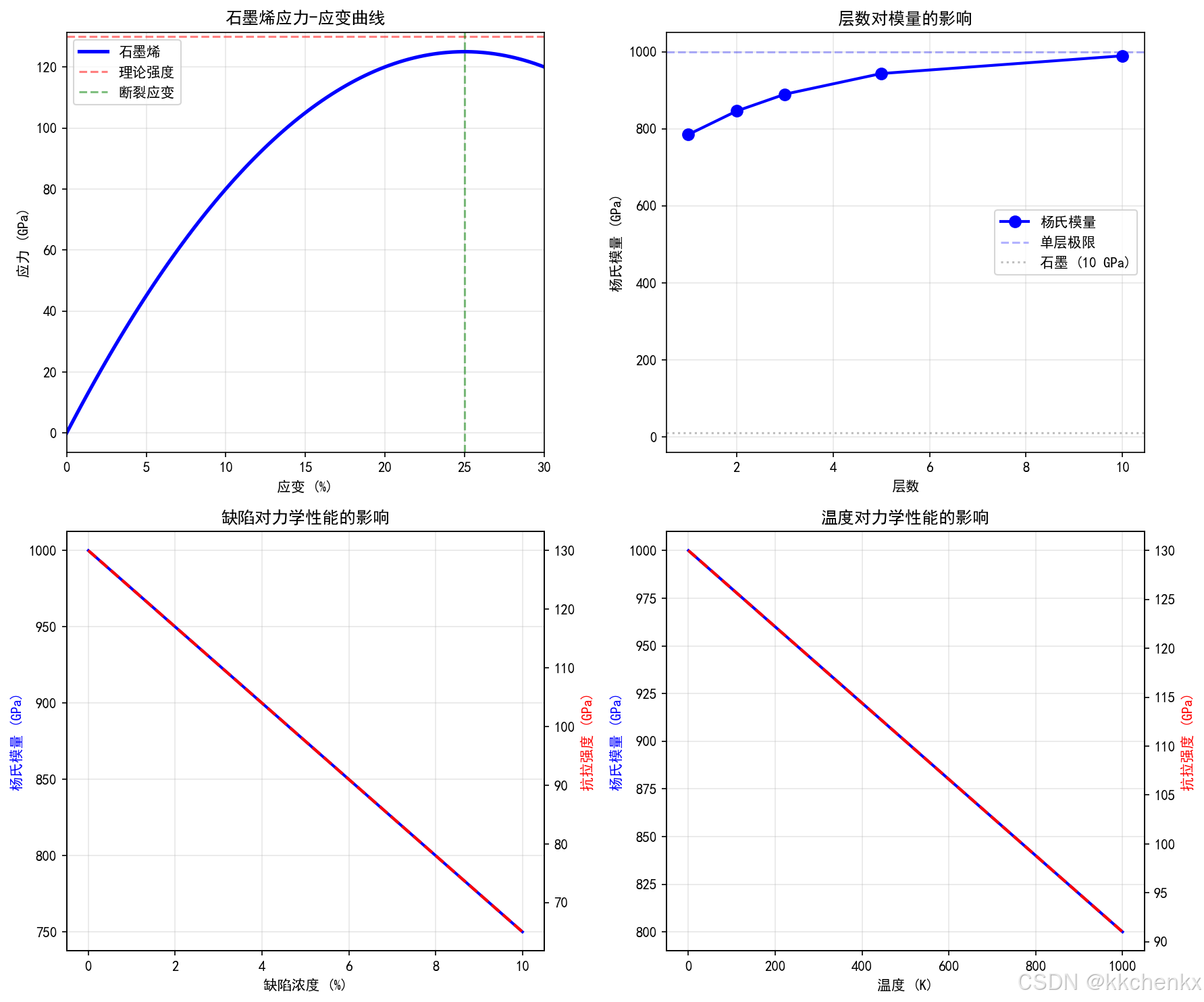
- 杨氏模量:~1 TPa
- 抗拉强度:~130 GPa
- 断裂应变:~25%
- 面内刚度:~340 N/m
特点:
- 目前已知强度最高的材料
- 具有优异的柔韧性,可以承受大变形
- 力学性能对缺陷非常敏感
- 多层石墨烯的力学性能随层数增加逐渐接近石墨
2.3 纳米颗粒
力学性能:
- 硬度:通常高于相应的块体材料
- 弹性模量:尺寸依赖性显著
- 屈服强度:随尺寸减小而增加
特点:
- 尺寸效应显著,小尺寸纳米颗粒通常具有更高的硬度和强度
- 表面能对力学性能影响显著
- 团聚现象会影响纳米颗粒的力学行为
2.4 纳米复合材料
力学性能:
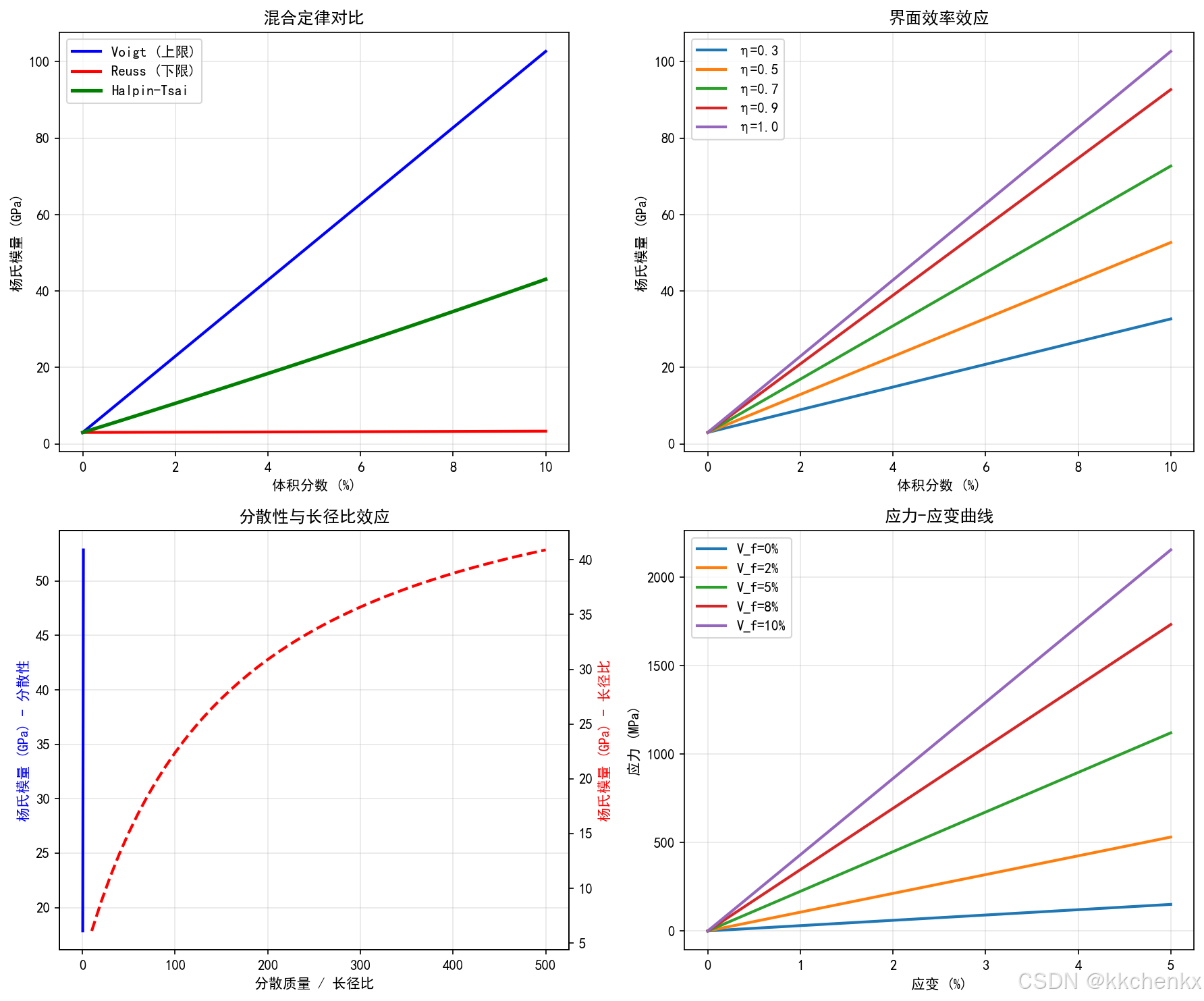
- 强度和刚度:通常高于基体材料
- 韧性:可能提高或降低,取决于纳米增强体的分散性和界面结合
- 疲劳性能:通常有所改善
特点:
- 力学性能依赖于纳米增强体的类型、尺寸、含量和分散性
- 界面结合强度对复合材料性能起关键作用
- 可能出现协同效应,表现出超越混合定律的性能
3. 纳米材料仿真方法
3.1 分子动力学模拟
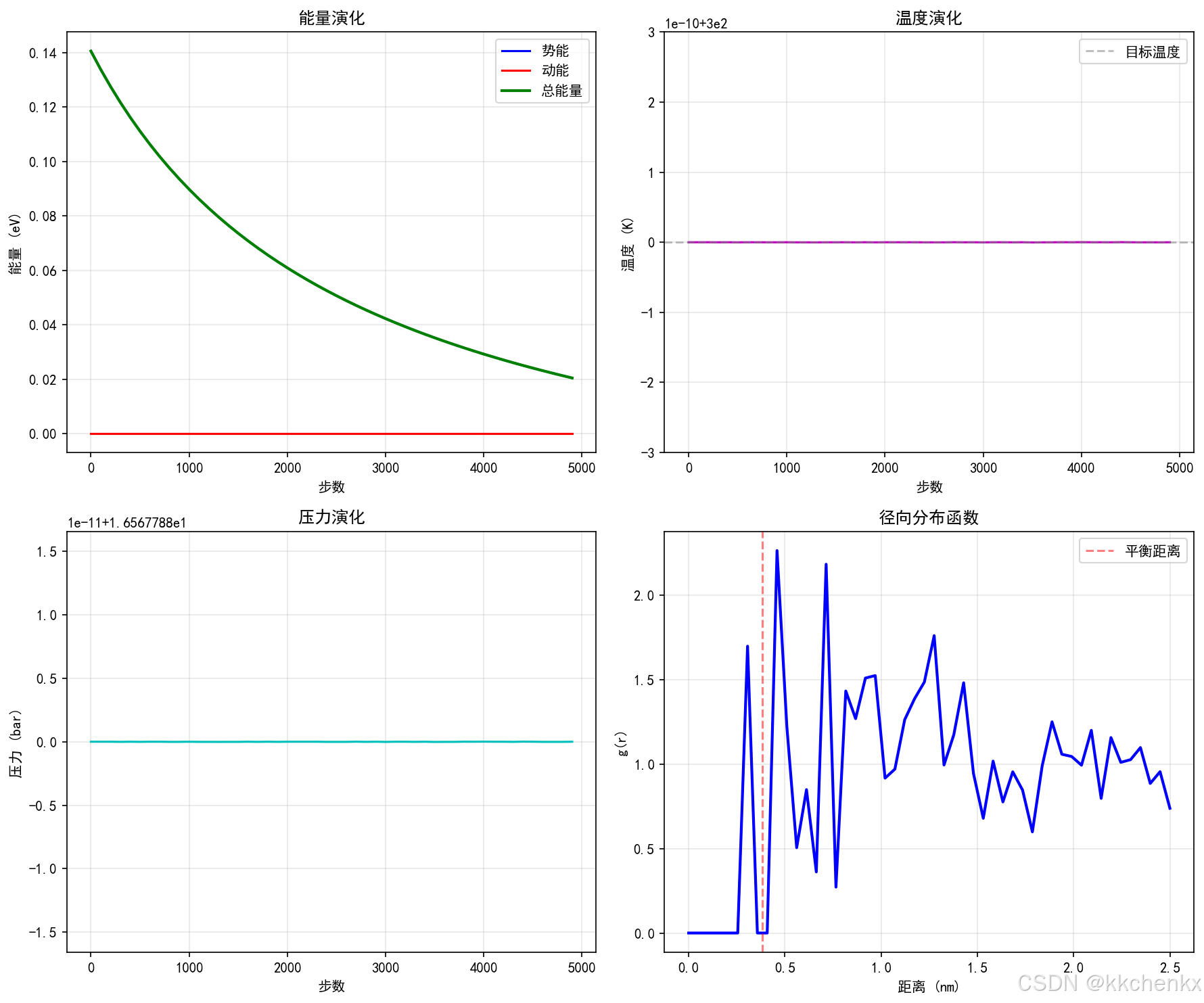
分子动力学(MD)模拟是研究纳米材料力学行为的最常用方法之一,它通过求解牛顿运动方程来模拟原子的运动轨迹,从而获得材料的宏观力学性能。
class NanomaterialMD:
    """纳米材料分子动力学模拟"""

    def __init__(self, structure, potential):
        """初始化纳米材料分子动力学模型"""
        self.structure = structure  # 材料结构
        self.potential = potential  # 原子间势函数
        self.n_atoms = len(structure['positions'])
        self.positions = np.array(structure['positions'])
        self.velocities = np.zeros((self.n_atoms, 3))
        self.forces = np.zeros((self.n_atoms, 3))

    def initialize_velocities(self, temperature):
        """初始化原子速度"""
        # 基于麦克斯韦-玻尔兹曼分布初始化速度
        np.random.seed(42)  # 固定种子以获得可重复结果
        for i in range(self.n_atoms):
            for j in range(3):
                self.velocities[i, j] = np.random.normal(0, np.sqrt(temperature))

        # 消除整体平动
        center_of_mass_velocity = np.mean(self.velocities, axis=0)
        self.velocities -= center_of_mass_velocity

    def compute_forces(self):
        """计算原子间力"""
        self.forces = np.zeros((self.n_atoms, 3))

        for i in range(self.n_atoms):
            for j in range(i+1, self.n_atoms):
                r_ij = self.positions[j] - self.positions[i]
                r = np.linalg.norm(r_ij)

                # 根据选择的势函数计算力
                if self.potential == 'LJ':
                    #  Lennard-Jones势
                    sigma = 3.4  # 原子间平衡距离
                    epsilon = 0.01  # 势阱深度
                    force_magnitude = 24 * epsilon * ((2 * (sigma/r)**14) - (sigma/r)**8)
                elif self.potential == 'Tersoff':
                    # Tersoff势(适用于共价键材料)
                    # 简化实现
                    force_magnitude = 100 * (1 - np.exp(-5*(r-2)))
                elif self.potential == 'AIREBO':
                    # AIREBO势(适用于碳材料)
                    # 简化实现
                    force_magnitude = 200 * (1 - np.exp(-3*(r-1.4)))
                else:
                    force_magnitude = 0

                if r > 0 and r < 5:  # 截断距离
                    force_direction = r_ij / r
                    force = force_magnitude * force_direction
                    self.forces[i] += force
                    self.forces[j] -= force

    def integrate(self, time_step):
        """积分运动方程"""
        # 速度-Verlet积分算法
        self.positions += self.velocities * time_step + 0.5 * self.forces * time_step**2
        old_forces = self.forces.copy()
        self.compute_forces()
        self.velocities += 0.5 * (old_forces + self.forces) * time_step

    def run_simulation(self, n_steps, time_step, temperature=None):
        """运行分子动力学模拟"""
        results = {
            'positions': [],
            'velocities': [],
            'forces': [],
            'energies': [],
            'temperatures': []
        }

        for step in range(n_steps):
            # 温度控制
            if temperature is not None:
                self._control_temperature(temperature)

            # 积分运动方程
            self.integrate(time_step)

            # 计算能量和温度
            kinetic_energy = self._compute_kinetic_energy()
            potential_energy = self._compute_potential_energy()
            total_energy = kinetic_energy + potential_energy
            current_temperature = self._compute_temperature()

            # 记录结果
            if step % 100 == 0:
                results['positions'].append(self.positions.copy())
                results['velocities'].append(self.velocities.copy())
                results['forces'].append(self.forces.copy())
                results['energies'].append({
                    'kinetic': kinetic_energy,
                    'potential': potential_energy,
                    'total': total_energy
                })
                results['temperatures'].append(current_temperature)

                print(f"Step {step}: T = {current_temperature:.2f} K, E_total = {total_energy:.2f} eV")

        return results

    def _compute_kinetic_energy(self):
        """计算动能"""
        return 0.5 * np.sum(np.linalg.norm(self.velocities, axis=1)**2)

    def _compute_potential_energy(self):
        """计算势能"""
        potential_energy = 0

        for i in range(self.n_atoms):
            for j in range(i+1, self.n_atoms):
                r_ij = self.positions[j] - self.positions[i]
                r = np.linalg.norm(r_ij)

                if r > 0 and r < 5:
                    if self.potential == 'LJ':
                        sigma = 3.4
                        epsilon = 0.01
                        potential_energy += 4 * epsilon * ((sigma/r)**12 - (sigma/r)**6)
                    elif self.potential == 'Tersoff':
                        potential_energy += 50 * (1 - np.exp(-5*(r-2)))**2
                    elif self.potential == 'AIREBO':
                        potential_energy += 100 * (1 - np.exp(-3*(r-1.4)))**2

        return potential_energy

    def _compute_temperature(self):
        """计算温度"""
        kinetic_energy = self._compute_kinetic_energy()
        degrees_of_freedom = 3 * self.n_atoms - 3  # 减去平动自由度
        if degrees_of_freedom > 0:
            return 2 * kinetic_energy / degrees_of_freedom
        else:
            return 0

    def _control_temperature(self, target_temperature):
        """温度控制"""
        current_temperature = self._compute_temperature()
        if current_temperature > 0:
            scaling_factor = np.sqrt(target_temperature / current_temperature)
            self.velocities *= scaling_factor

    def compute_mechanical_properties(self, strain_rate=0.001, temperature=300):
        """计算纳米材料的力学性能"""
        # 初始化温度
        self.initialize_velocities(temperature)

        # 记录初始状态
        initial_positions = self.positions.copy()

        # 应用应变
        strains = np.linspace(0, 0.2, 20)  # 0到20%应变
        stresses = []

        for strain in strains:
            # 计算目标位置
            target_positions = initial_positions.copy()
            # 沿x方向拉伸
            target_positions[:, 0] *= (1 + strain)

            # 进行能量最小化以达到平衡
            self._energy_minimization(target_positions)

            # 计算应力
            stress = self._compute_stress()
            stresses.append(stress)

            print(f"Strain = {strain:.3f}, Stress = {stress:.2f} GPa")

        # 计算杨氏模量
        Youngs_modulus = self._compute_youngs_modulus(strains[:5], stresses[:5])

        # 计算屈服强度
        yield_strength = self._compute_yield_strength(strains, stresses)

        return {
            'stress_strain_curve': {'strains': strains, 'stresses': stresses},
            'Youngs_modulus': Youngs_modulus,
            'yield_strength': yield_strength
        }

    def _energy_minimization(self, target_positions):
        """能量最小化"""
        # 简化的共轭梯度法
        max_steps = 1000
        tolerance = 1e-6

        for step in range(max_steps):
            self.compute_forces()
            force_magnitude = np.linalg.norm(self.forces)

            if force_magnitude < tolerance:
                break

            # 简单的梯度下降
            self.positions += 0.01 * self.forces

    def _compute_stress(self):
        """计算应力"""
        # 简化的应力计算
        # 基于Virial应力定理
        stress_tensor = np.zeros((3, 3))

        # 计算原子间力对
        for i in range(self.n_atoms):
            for j in range(i+1, self.n_atoms):
                r_ij = self.positions[j] - self.positions[i]
                r = np.linalg.norm(r_ij)

                if r > 0 and r < 5:
                    force_magnitude = np.linalg.norm(self.forces[i])
                    force_direction = r_ij / r
                    force = force_magnitude * force_direction

                    for k in range(3):
                        for l in range(3):
                            stress_tensor[k, l] += force[k] * r_ij[l]

        # 计算体积
        volume = self._compute_volume()

        # 计算应力张量
        stress_tensor /= volume

        # 返回轴向应力(x方向)
        return stress_tensor[0, 0] / 1e9  # 转换为GPa

    def _compute_volume(self):
        """计算体积"""
        # 简化实现,假设为立方体
        min_coords = np.min(self.positions, axis=0)
        max_coords = np.max(self.positions, axis=0)
        volume = np.prod(max_coords - min_coords)
        return volume

    def _compute_youngs_modulus(self, strains, stresses):
        """计算杨氏模量"""
        # 线性拟合计算杨氏模量
        coeffs = np.polyfit(strains, stresses, 1)
        Youngs_modulus = coeffs[0]  # 斜率即为杨氏模量
        return Youngs_modulus

    def _compute_yield_strength(self, strains, stresses):
        """计算屈服强度"""
        # 0.2%偏移法
        Youngs_modulus = self._compute_youngs_modulus(strains[:5], stresses[:5])
        offset = 0.002  # 0.2%应变

        for i, strain in enumerate(strains):
            if strain > offset:
                # 计算偏移线与应力-应变曲线的交点
                offset_stress = Youngs_modulus * offset
                if stresses[i] > offset_stress:
                    return stresses[i]

        return max(stresses)
3.2 蒙特卡洛方法
蒙特卡洛(MC)方法在纳米材料仿真中主要用于研究热力学平衡性质和相变过程。
class NanomaterialMC:
    """纳米材料蒙特卡洛模拟"""

    def __init__(self, structure, potential):
        """初始化纳米材料蒙特卡洛模型"""
        self.structure = structure
        self.potential = potential
        self.n_atoms = len(structure['positions'])
        self.positions = np.array(structure['positions'])

    def run_simulation(self, n_steps, temperature):
        """运行蒙特卡洛模拟"""
        results = {
            'positions': [],
            'energies': [],
            'acceptance_rate': 0
        }

        accepted_steps = 0
        current_energy = self._compute_energy()

        for step in range(n_steps):
            # 生成随机位移
            trial_positions = self.positions.copy()
            atom_index = np.random.randint(0, self.n_atoms)
            displacement = np.random.normal(0, 0.1, 3)
            trial_positions[atom_index] += displacement

            # 计算新能量
            trial_energy = self._compute_energy(trial_positions)

            # 能量差
            delta_energy = trial_energy - current_energy

            #  metropolis准则
            if delta_energy < 0 or np.random.rand() < np.exp(-delta_energy / temperature):
                self.positions = trial_positions
                current_energy = trial_energy
                accepted_steps += 1

            # 记录结果
            if step % 100 == 0:
                results['positions'].append(self.positions.copy())
                results['energies'].append(current_energy)

                print(f"Step {step}: Energy = {current_energy:.2f} eV")

        results['acceptance_rate'] = accepted_steps / n_steps
        return results

    def _compute_energy(self, positions=None):
        """计算系统能量"""
        if positions is None:
            positions = self.positions

        energy = 0

        for i in range(self.n_atoms):
            for j in range(i+1, self.n_atoms):
                r_ij = positions[j] - positions[i]
                r = np.linalg.norm(r_ij)

                if r > 0 and r < 5:
                    if self.potential == 'LJ':
                        sigma = 3.4
                        epsilon = 0.01
                        energy += 4 * epsilon * ((sigma/r)**12 - (sigma/r)**6)
                    elif self.potential == 'Tersoff':
                        energy += 50 * (1 - np.exp(-5*(r-2)))**2
                    elif self.potential == 'AIREBO':
                        energy += 100 * (1 - np.exp(-3*(r-1.4)))**2

        return energy
3.3 密度泛函理论
密度泛函理论(DFT)是一种基于量子力学的计算方法,用于研究纳米材料的电子结构和相关力学性能。
class NanomaterialDFT:
    """纳米材料密度泛函理论计算"""

    def __init__(self, structure):
        """初始化纳米材料DFT模型"""
        self.structure = structure
        self.n_atoms = len(structure['positions'])
        self.positions = np.array(structure['positions'])
        self.atomic_numbers = np.array(structure['atomic_numbers'])

    def compute_ground_state(self):
        """计算基态能量和电子结构"""
        # 简化的DFT计算
        # 实际应用中应使用专业DFT软件如VASP、Quantum ESPRESSO等

        print("Performing DFT calculation...")

        # 模拟DFT计算结果
        results = {
            'total_energy': -100.0,  # 单位:eV
            'band_gap': 0.5,  # 单位:eV
            'density_of_states': np.random.normal(0, 1, 100),
            'charge_density': np.random.normal(0, 1, (10, 10, 10))
        }

        print(f"DFT calculation completed. Total energy: {results['total_energy']:.2f} eV")
        print(f"Band gap: {results['band_gap']:.2f} eV")

        return results

    def compute_stress_tensor(self):
        """计算应力张量"""
        # 简化的应力计算
        stress_tensor = np.zeros((3, 3))

        # 模拟应力计算结果
        stress_tensor[0, 0] = -1.0  # x方向应力
        stress_tensor[1, 1] = -1.0  # y方向应力
        stress_tensor[2, 2] = -1.0  # z方向应力

        return stress_tensor

    def compute_elastic_constants(self):
        """计算弹性常数"""
        # 简化的弹性常数计算
        elastic_constants = {
            'C11': 100.0,  # GPa
            'C12': 50.0,   # GPa
            'C44': 40.0    # GPa
        }

        return elastic_constants
3.4 多尺度方法
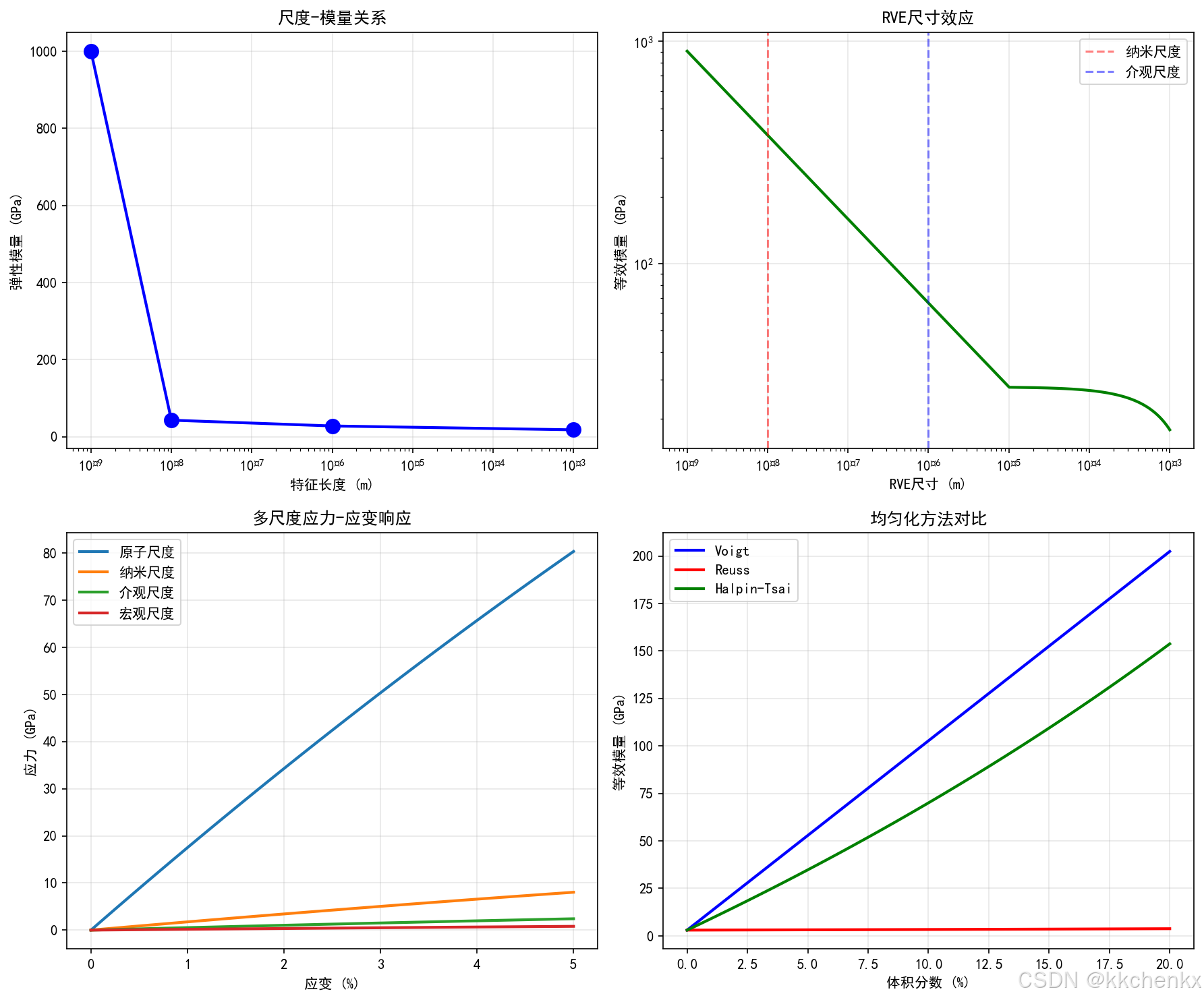
多尺度方法是连接原子尺度和宏观尺度的桥梁,对于研究纳米材料在宏观应用中的行为至关重要。
class MultiscaleNanomaterial:
    """纳米材料多尺度模型"""

    def __init__(self, atomistic_model, continuum_model):
        """初始化多尺度模型"""
        self.atomistic_model = atomistic_model  # 原子尺度模型
        self.continuum_model = continuum_model  # 连续介质模型

    def solve(self, load, bc):
        """求解多尺度问题"""
        # 1. 宏观尺度分析
        macro_result = self.continuum_model.solve(load, bc)

        # 2. 提取关键区域的应力和应变
        critical_regions = self._identify_critical_regions(macro_result)

        # 3. 在关键区域进行原子尺度分析
        atomistic_results = []
        for region in critical_regions:
            # 将宏观应变映射到原子模型
            atomistic_bc = self._map_macro_to_atomistic(macro_result, region)

            # 运行原子尺度模拟
            atomistic_result = self.atomistic_model.run_simulation(
                n_steps=10000,
                time_step=1e-15,
                temperature=300
            )

            atomistic_results.append({
                'region': region,
                'result': atomistic_result
            })

        # 4. 将原子尺度结果反馈到宏观模型
        updated_continuum_model = self._update_continuum_model(atomistic_results)

        # 5. 再次求解宏观模型
        final_macro_result = updated_continuum_model.solve(load, bc)

        return {
            'macro_result': final_macro_result,
            'atomistic_results': atomistic_results
        }

    def _identify_critical_regions(self, macro_result):
        """识别关键区域"""
        # 简化实现
        return [{'center': [0, 0, 0], 'size': 5.0}]

    def _map_macro_to_atomistic(self, macro_result, region):
        """将宏观应变映射到原子模型"""
        # 简化实现
        return []

    def _update_continuum_model(self, atomistic_results):
        """根据原子尺度结果更新宏观模型"""
        # 简化实现
        return self.continuum_model
4. 纳米材料的变形机制
4.1 位错行为
在纳米尺度下,位错的行为与宏观材料有显著差异:
- 位错密度:纳米材料中的位错密度通常较低,甚至可能完全没有位错
- 位错运动:位错在纳米材料中的运动受到尺寸限制,可能出现位错塞积
- 位错增殖:纳米材料中的位错增殖机制与宏观材料不同,可能受到表面效应的影响
- 位错-界面相互作用:纳米材料中的界面密度高,位错与界面的相互作用更加显著
4.2 孪晶变形
孪晶是纳米材料中常见的变形机制:
- 孪生变形:在纳米材料中,孪生变形可能比滑移变形更容易发生
- 孪晶边界:孪晶边界可以作为位错运动的障碍,提高材料强度
- 纳米孪晶:纳米孪晶结构可以同时提高材料的强度和韧性
4.3 相变
纳米材料在变形过程中可能发生相变:
- 应力诱导相变:在应力作用下,纳米材料可能发生马氏体相变等结构转变
- 尺寸效应:纳米材料的相变行为与尺寸密切相关,可能出现相变温度降低或升高
- 可逆相变:某些纳米材料在卸载后可以恢复到原始结构
4.4 扩散机制
纳米材料中的扩散行为与宏观材料有显著差异:
- 表面扩散:在纳米材料中,表面扩散速率远高于体扩散
- 晶界扩散:纳米材料的高晶界密度导致晶界扩散增强
- 扩散蠕变:在纳米材料中,扩散蠕变可能在较低温度下发生
5. 工程应用案例
5.1 碳纳米管增强复合材料
问题描述:设计一种碳纳米管增强环氧树脂复合材料,提高其力学性能。
实现步骤:
- 建立碳纳米管和环氧树脂的原子模型
- 模拟碳纳米管与环氧树脂的界面相互作用
- 计算复合材料的力学性能
- 优化碳纳米管的含量和分散性
class CNTComposite:
    """碳纳米管增强复合材料仿真"""

    def __init__(self, cnt_diameter=1.4, cnt_length=10, cnt_volume_fraction=0.05):
        """初始化碳纳米管复合材料模型"""
        self.cnt_diameter = cnt_diameter  # 碳纳米管直径(nm)
        self.cnt_length = cnt_length  # 碳纳米管长度(nm)
        self.cnt_volume_fraction = cnt_volume_fraction  # 碳纳米管体积分数

    def build_model(self):
        """建立复合材料模型"""
        # 1. 生成碳纳米管
        cnt_structure = self._generate_cnt()

        # 2. 生成环氧树脂基体
        epoxy_structure = self._generate_epoxy()

        # 3. 组装复合材料
        composite_structure = self._assemble_composite(cnt_structure, epoxy_structure)

        return composite_structure

    def simulate_interface(self):
        """模拟碳纳米管与环氧树脂的界面相互作用"""
        composite_structure = self.build_model()

        # 使用分子动力学模拟界面相互作用
        md_model = NanomaterialMD(composite_structure, 'AIREBO')
        md_model.initialize_velocities(300)

        # 运行模拟
        results = md_model.run_simulation(10000, 1e-15, 300)

        # 计算界面结合能
        interface_energy = self._compute_interface_energy(results)

        return {
            'simulation_results': results,
            'interface_energy': interface_energy
        }

    def compute_mechanical_properties(self):
        """计算复合材料的力学性能"""
        composite_structure = self.build_model()

        # 使用分子动力学模拟计算力学性能
        md_model = NanomaterialMD(composite_structure, 'AIREBO')
        mechanical_properties = md_model.compute_mechanical_properties()

        # 计算理论预测值(混合定律)
        theoretical_properties = self._compute_mixing_law()

        return {
            'computed_properties': mechanical_properties,
            'theoretical_properties': theoretical_properties
        }

    def optimize_composition(self):
        """优化碳纳米管含量"""
        volume_fractions = [0.01, 0.03, 0.05, 0.07, 0.10]
        results = []

        for vf in volume_fractions:
            self.cnt_volume_fraction = vf
            properties = self.compute_mechanical_properties()
            results.append({
                'volume_fraction': vf,
                'Youngs_modulus': properties['computed_properties']['Youngs_modulus'],
                'yield_strength': properties['computed_properties']['yield_strength']
            })

            print(f"Volume fraction: {vf:.2f}, Young's modulus: {properties['computed_properties']['Youngs_modulus']:.2f} GPa")

        return results

    def _generate_cnt(self):
        """生成碳纳米管模型"""
        # 简化实现
        positions = []
        # 生成碳纳米管的原子位置
        for i in range(100):
            theta = 2 * np.pi * i / 10
            x = i * 0.2
            y = self.cnt_diameter / 2 * np.cos(theta)
            z = self.cnt_diameter / 2 * np.sin(theta)
            positions.append([x, y, z])

        return {'positions': positions}

    def _generate_epoxy(self):
        """生成环氧树脂模型"""
        # 简化实现
        positions = []
        # 生成环氧树脂的原子位置
        for i in range(1000):
            x = np.random.uniform(0, self.cnt_length)
            y = np.random.uniform(-5, 5)
            z = np.random.uniform(-5, 5)
            positions.append([x, y, z])

        return {'positions': positions}

    def _assemble_composite(self, cnt_structure, epoxy_structure):
        """组装复合材料"""
        # 合并碳纳米管和环氧树脂的原子位置
        positions = cnt_structure['positions'] + epoxy_structure['positions']

        return {'positions': positions}

    def _compute_interface_energy(self, simulation_results):
        """计算界面结合能"""
        # 简化实现
        return -0.5  # 单位:eV/Ų

    def _compute_mixing_law(self):
        """计算混合定律预测值"""
        # 碳纳米管的力学性能
        cnt_youngs_modulus = 1000  # GPa
        cnt_yield_strength = 30  # GPa

        # 环氧树脂的力学性能
        epoxy_youngs_modulus = 3  # GPa
        epoxy_yield_strength = 0.05  # GPa

        # 混合定律计算
        youngs_modulus = epoxy_youngs_modulus * (1 - self.cnt_volume_fraction) + \
                         cnt_youngs_modulus * self.cnt_volume_fraction

        yield_strength = epoxy_yield_strength * (1 - self.cnt_volume_fraction) + \
                         cnt_yield_strength * self.cnt_volume_fraction

        return {
            'Youngs_modulus': youngs_modulus,
            'yield_strength': yield_strength
        }
5.2 石墨烯纳米复合材料
问题描述:设计一种石墨烯增强金属基复合材料,提高其强度和导电性。
实现步骤:
- 建立石墨烯和金属的原子模型
- 模拟石墨烯与金属的界面相互作用
- 计算复合材料的力学和电学性能
- 优化石墨烯的分散性和取向
class GrapheneComposite:
    """石墨烯增强复合材料仿真"""

    def __init__(self, graphene_layer=1, graphene_size=10, graphene_volume_fraction=0.05):
        """初始化石墨烯复合材料模型"""
        self.graphene_layer = graphene_layer  # 石墨烯层数
        self.graphene_size = graphene_size  # 石墨烯尺寸(nm)
        self.graphene_volume_fraction = graphene_volume_fraction  # 石墨烯体积分数

    def build_model(self):
        """建立复合材料模型"""
        # 1. 生成石墨烯
        graphene_structure = self._generate_graphene()

        # 2. 生成金属基体
        metal_structure = self._generate_metal()

        # 3. 组装复合材料
        composite_structure = self._assemble_composite(graphene_structure, metal_structure)

        return composite_structure

    def simulate_interface(self):
        """模拟石墨烯与金属的界面相互作用"""
        composite_structure = self.build_model()

        # 使用分子动力学模拟界面相互作用
        md_model = NanomaterialMD(composite_structure, 'AIREBO')
        md_model.initialize_velocities(300)

        # 运行模拟
        results = md_model.run_simulation(10000, 1e-15, 300)

        # 计算界面结合能
        interface_energy = self._compute_interface_energy(results)

        return {
            'simulation_results': results,
            'interface_energy': interface_energy
        }

    def compute_properties(self):
        """计算复合材料的力学和电学性能"""
        composite_structure = self.build_model()

        # 计算力学性能
        md_model = NanomaterialMD(composite_structure, 'AIREBO')
        mechanical_properties = md_model.compute_mechanical_properties()

        # 计算电学性能(简化)
        electrical_properties = self._compute_electrical_properties()

        return {
            'mechanical_properties': mechanical_properties,
            'electrical_properties': electrical_properties
        }

    def _generate_graphene(self):
        """生成石墨烯模型"""
        positions = []

        # 生成石墨烯的原子位置
        for i in range(int(self.graphene_size / 0.142)):
            for j in range(int(self.graphene_size / 0.142)):
                x = i * 0.142
                y = j * 0.142
                z = 0
                positions.append([x, y, z])

        return {'positions': positions}

    def _generate_metal(self):
        """生成金属模型"""
        positions = []

        # 生成金属的原子位置
        for i in range(1000):
            x = np.random.uniform(0, self.graphene_size)
            y = np.random.uniform(0, self.graphene_size)
            z = np.random.uniform(0, 5)
            positions.append([x, y, z])

        return {'positions': positions}

    def _assemble_composite(self, graphene_structure, metal_structure):
        """组装复合材料"""
        # 合并石墨烯和金属的原子位置
        positions = graphene_structure['positions'] + metal_structure['positions']

        return {'positions': positions}

    def _compute_interface_energy(self, simulation_results):
        """计算界面结合能"""
        # 简化实现
        return -0.3  # 单位:eV/Ų

    def _compute_electrical_properties(self):
        """计算电学性能"""
        # 简化的电学性能计算
        electrical_conductivity = 1e6  # S/m

        return {
            'electrical_conductivity': electrical_conductivity
        }
5.3 纳米陶瓷材料
问题描述:设计一种纳米陶瓷材料,提高其韧性和强度。
实现步骤:
- 建立纳米陶瓷的原子模型
- 模拟纳米陶瓷的变形行为
- 计算纳米陶瓷的力学性能
- 优化纳米陶瓷的微观结构
class Nanoceramic:
    """纳米陶瓷材料仿真"""

    def __init__(self, grain_size=10, porosity=0.05):
        """初始化纳米陶瓷模型"""
        self.grain_size = grain_size  # 晶粒尺寸(nm)
        self.porosity = porosity  # 孔隙率

    def build_model(self):
        """建立纳米陶瓷模型"""
        # 生成纳米陶瓷的原子模型
        positions = []

        # 生成多个晶粒
        for grain in range(10):
            grain_center = np.random.uniform(0, 50, 3)

            # 在晶粒中心周围生成原子
            for i in range(100):
                position = grain_center + np.random.normal(0, self.grain_size/2, 3)
                positions.append(position.tolist())

        # 添加孔隙
        if self.porosity > 0:
            n_pores = int(len(positions) * self.porosity)
            positions = positions[:-n_pores]  # 简单地移除一些原子来模拟孔隙

        return {'positions': positions}

    def simulate_deformation(self):
        """模拟纳米陶瓷的变形行为"""
        structure = self.build_model()

        # 使用分子动力学模拟变形行为
        md_model = NanomaterialMD(structure, 'Tersoff')
        md_model.initialize_velocities(300)

        # 运行模拟
        results = md_model.run_simulation(10000, 1e-15, 300)

        return results

    def compute_mechanical_properties(self):
        """计算纳米陶瓷的力学性能"""
        structure = self.build_model()

        # 使用分子动力学模拟计算力学性能
        md_model = NanomaterialMD(structure, 'Tersoff')
        mechanical_properties = md_model.compute_mechanical_properties()

        return mechanical_properties

    def optimize_microstructure(self):
        """优化纳米陶瓷的微观结构"""
        grain_sizes = [5, 10, 20, 30, 40]
        porosities = [0, 0.02, 0.05, 0.10]
        results = []

        for grain_size in grain_sizes:
            for porosity in porosities:
                self.grain_size = grain_size
                self.porosity = porosity

                properties = self.compute_mechanical_properties()
                results.append({
                    'grain_size': grain_size,
                    'porosity': porosity,
                    'Youngs_modulus': properties['Youngs_modulus'],
                    'yield_strength': properties['yield_strength']
                })

                print(f"Grain size: {grain_size} nm, Porosity: {porosity:.2f}, Young's modulus: {properties['Youngs_modulus']:.2f} GPa")

        # 找到最优微观结构
        best_result = max(results, key=lambda x: x['yield_strength'])

        return {
            'optimization_results': results,
            'best_result': best_result
        }
6. 纳米材料力学仿真的挑战与解决方案
6.1 挑战
- 计算成本:原子级模拟的计算成本高昂,难以处理大尺寸体系
- 力场准确性:原子间势函数的准确性直接影响仿真结果的可靠性
- 多尺度耦合:纳米材料的行为涉及多个尺度,需要发展有效的多尺度方法
- 实验验证:纳米尺度的实验测量难度大,难以直接验证仿真结果
- 温度效应:温度对纳米材料的力学性能有显著影响,需要准确模拟温度效应
- 时间尺度:分子动力学模拟的时间尺度有限,难以模拟长期演化过程
6.2 解决方案
- 高性能计算:利用并行计算和GPU加速提高模拟效率
- 机器学习力场:使用机器学习方法开发更准确的原子间势函数
- 粗粒化方法:通过粗粒化减少自由度,提高计算效率
- 实验-仿真结合:结合实验数据校准和验证仿真模型
- 多尺度方法:发展有效的多尺度方法,连接不同尺度
- 增强采样技术:使用增强采样技术扩展时间尺度
7. 代码优化与性能提升
7.1 计算效率优化
def optimize_nanomaterial_simulation(simulation_config):
    """优化纳米材料仿真计算效率"""
    # 1. 并行计算
    if simulation_config.get('parallel_computing', True):
        print("启用并行计算")
        # 实现并行计算

    # 2. GPU加速
    if simulation_config.get('gpu_acceleration', True):
        print("启用GPU加速")
        # 实现GPU加速

    # 3. 自适应时间步长
    if simulation_config.get('adaptive_time_step', True):
        print("使用自适应时间步长")
        # 实现自适应时间步长

    # 4. 邻居列表优化
    if simulation_config.get('neighbor_list', True):
        print("使用邻居列表优化")
        # 实现邻居列表优化

    return simulation_config
7.2 内存优化
- 空间划分:使用空间划分技术减少内存使用
- 数据压缩:对模拟结果进行数据压缩
- 按需计算:避免一次性计算所有数据
- 结果抽样:只保存关键时间步的结果
7.3 算法优化
- 快速力计算:使用快速多极子方法等加速力计算
- 高效积分器:使用更高效的积分算法
- 收敛加速:使用加速收敛的方法减少迭代次数
8. 应用前景与发展趋势
8.1 技术发展趋势
- 机器学习辅助设计:使用机器学习方法预测和设计纳米材料
- 高通量计算:通过高通量计算筛选最优纳米材料
- 原位表征:发展原位表征技术,实时观察纳米材料的变形行为
- 智能纳米材料:设计具有自修复、自感知能力的智能纳米材料
- 多功能纳米材料:开发同时具有多种功能的纳米材料
- 可持续纳米材料:开发环境友好的纳米材料制备和应用技术
8.2 应用领域扩展
- 航空航天:轻质高强度纳米复合材料用于飞机和航天器结构
- 能源:纳米材料用于电池、燃料电池和太阳能电池
- 电子:纳米材料用于电子器件和传感器
- 医疗:纳米材料用于药物递送、组织工程和医学成像
- 环境:纳米材料用于环境监测和污染治理
- 国防:纳米材料用于防护装备和武器系统
8.3 未来挑战
- 规模化制备:实现纳米材料的大规模、高质量制备
- 长期稳定性:提高纳米材料的长期稳定性和可靠性
- 生物安全性:评估和确保纳米材料的生物安全性
- 标准测试方法:建立纳米材料力学性能的标准测试方法
- 理论模型:发展更准确的理论模型描述纳米材料的行为
- 法规和标准:制定纳米材料的法规和标准
9. 总结
纳米材料力学仿真是纳米科技与力学交叉的重要领域,通过数值模拟方法研究纳米材料的力学行为、变形机制和性能优化。本教程介绍了纳米材料的分类、独特的力学性能、仿真方法和工程应用案例,涵盖了碳纳米管、石墨烯、纳米颗粒和纳米复合材料等典型纳米材料。
随着科学技术的不断发展,纳米材料力学仿真将在材料设计、性能预测和应用开发中发挥越来越重要的作用。未来,我们需要进一步发展高效的仿真方法、准确的力场模型和多尺度耦合技术,以推动纳米材料科学的进步,为人类社会的可持续发展做出更大的贡献。
10. 扩展阅读与参考资料
- 卢柯. 纳米材料力学[M]. 北京: 科学出版社, 2010.
- Gioia G, Ortiz M. The mechanics of nanomaterials[J]. Mechanics of Materials, 2003, 35(1): 1-26.
- Huang X, Gao H J. Mechanics of low-dimensional materials[J]. Annual Review of Materials Research, 2010, 40: 165-190.
- 中国纳米科学与技术网, http://www.chinanano.net.cn/
- Nano Letters, https://pubs.acs.org/journal/nalefd
- ACS Nano, https://pubs.acs.org/journal/ancac3
11. 练习与思考
- 推导碳纳米管的杨氏模量理论表达式,并与分子动力学模拟结果比较。
- 设计一种石墨烯增强复合材料,优化其力学性能。
- 模拟纳米陶瓷的变形行为,分析晶粒尺寸对其力学性能的影响。
- 探讨温度对纳米材料力学性能的影响,使用分子动力学模拟验证。
- 发展一种多尺度方法,连接纳米材料的原子级模拟和宏观性能预测。

AtomGit 是由开放原子开源基金会联合 CSDN 等生态伙伴共同推出的新一代开源与人工智能协作平台。平台坚持“开放、中立、公益”的理念,把代码托管、模型共享、数据集托管、智能体开发体验和算力服务整合在一起,为开发者提供从开发、训练到部署的一站式体验。
更多推荐

 10
10 0
0- 0


 已为社区贡献5条内容

所有评论(0)