Solana 程序开发与 Anchor 框架:从账户模型到高性能链上逻辑
Solana 程序开发与 Anchor 框架:从账户模型到高性能链上逻辑
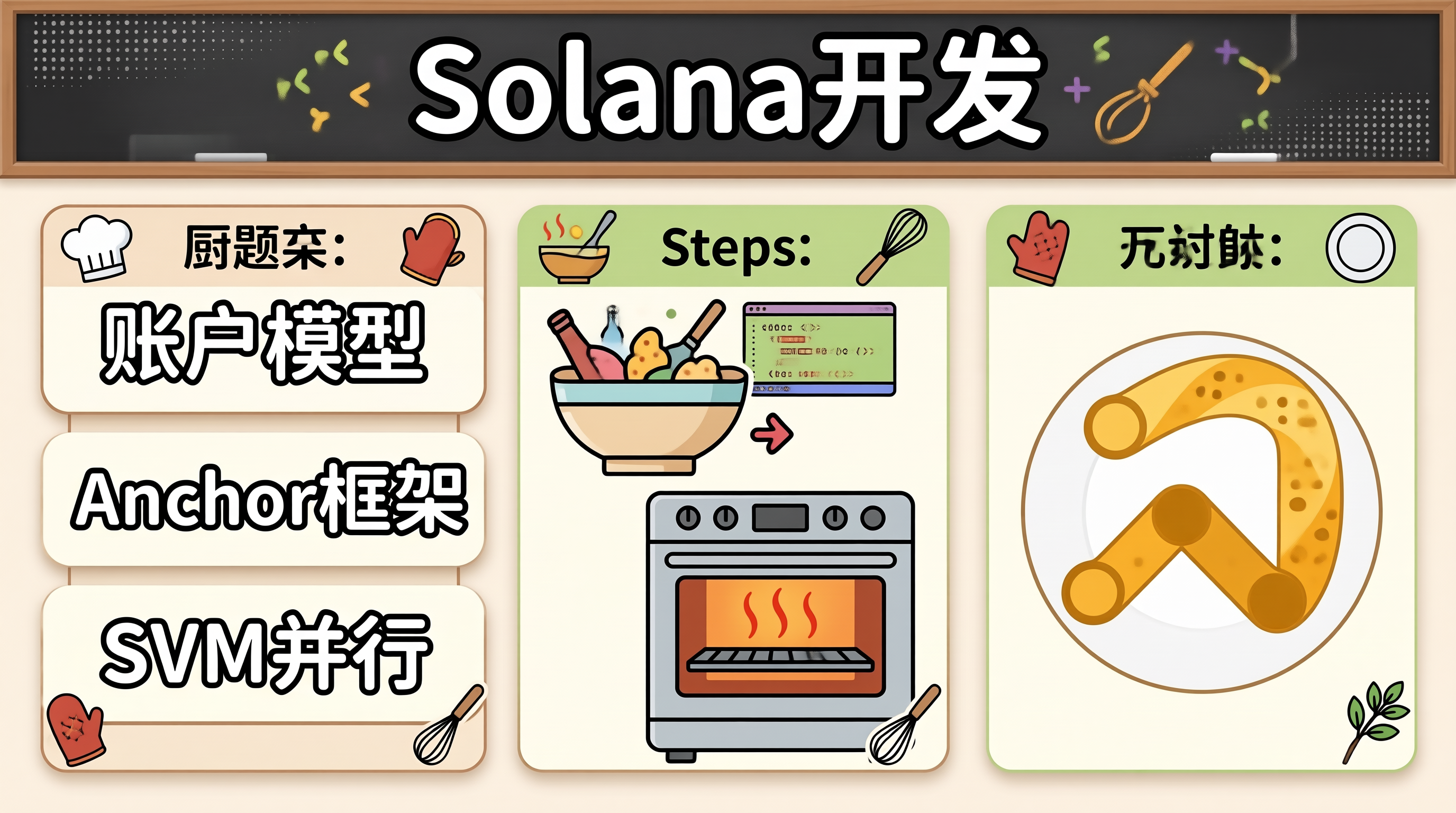
一、Solana 开发的"认知转换":从 EVM 到 SVM
从 Ethereum 转向 Solana 开发,最大的障碍不是语法,而是账户模型的根本差异。EVM 中,合约是一个拥有存储空间的实体,状态和逻辑绑定在一起;SVM(Solana Virtual Machine)中,程序(Program)是无状态的,所有状态存储在独立的账户(Account)中,程序通过引用账户来读写状态。这种分离设计是 Solana 高吞吐量的基础——无状态程序可以并行执行,而 EVM 的有状态合约必须串行。
但账户模型也带来了新的复杂性:每个账户需要支付租金(Rent)以保持存活,账户数据大小在创建时就已固定,跨账户的原子操作需要精确的生命周期管理。Anchor 框架通过 Rust 宏和 IDL(接口定义语言)简化了这些底层细节,但理解账户模型仍然是写出正确 Solana 程序的前提。
二、Solana 账户模型与 Anchor 架构
Solana 的账户模型将状态和逻辑彻底分离。程序代码存储在 Program 账户中(标记为 executable),数据存储在数据账户中。每笔交易明确声明需要读写的账户列表,运行时据此判断交易是否可以并行执行——如果两个交易不访问相同的可写账户,它们就可以并行处理。
flowchart TD
    A[交易提交] --> B[运行时:分析账户依赖]
    B --> C{账户冲突检测}
    C -->|无冲突| D[并行执行]
    C -->|有冲突| E[串行排队]
    D --> F[Program A 读写 Account X]
    D --> G[Program B 读写 Account Y]
    E --> H[Program C 等待 Account X 释放]

    subgraph "账户结构"
        I[Program 账户<br/>executable=true<br/>存储 BPF 字节码]
        J[数据账户<br/>owner=Program<br/>存储业务状态]
        K[系统账户<br/>owner=System Program<br/>SOL 余额]
    end

    I --> L[无状态:可并行]
    J --> M[有状态:需排他访问]
Anchor 框架在账户模型之上提供了三层抽象:
- Account 宏:自动处理账户反序列化、所有权校验和租金检查
- Program 宏:将 Rust 函数自动生成为 Solana 入口点,处理指令分发
- IDL 生成:自动生成 JSON 接口定义,供客户端 SDK 调用
三、Anchor 程序开发实战
// programs/escrow/src/lib.rs — 基于 Anchor 的托管合约
// 设计意图:实现安全的代币托管交换,演示 Anchor 的账户约束、
// 错误处理和跨程序调用(CPI)

use anchor_lang::prelude::*;
use anchor_spl::token::{self, Token, TokenAccount, Transfer};

declare_id!("EscrowProgram1111111111111111111111111");

#[program]
pub mod escrow {
    use super::*;

    /// 创建托管订单
    pub fn create_escrow(
        ctx: Context<CreateEscrow>,
        offer_amount: u64,       // 提供的代币数量
        request_amount: u64,     // 期望换取的代币数量
        escrow_bump: u8,         // PDA 的 bump seed
    ) -> Result<()> {
        // 校验数量有效性
        require!(offer_amount > 0, EscrowError::InvalidAmount);
        require!(request_amount > 0, EscrowError::InvalidAmount);

        let escrow = &mut ctx.accounts.escrow;
        escrow.maker = ctx.accounts.maker.key();
        escrow.offer_mint = ctx.accounts.offer_mint.key();
        escrow.request_mint = ctx.accounts.request_mint.key();
        escrow.offer_amount = offer_amount;
        escrow.request_amount = request_amount;
        escrow.bump = escrow_bump;

        // 将 maker 的代币转入托管账户(CPI 调用 Token Program)
        token::transfer(
            CpiContext::new(
                ctx.accounts.token_program.to_account_info(),
                Transfer {
                    from: ctx.accounts.maker_offer_ata.to_account_info(),
                    to: ctx.accounts.escrow_offer_ata.to_account_info(),
                    authority: ctx.accounts.maker.to_account_info(),
                },
            ),
            offer_amount,
        )?;

        emit!(EscrowCreated {
            maker: escrow.maker,
            offer_amount,
            request_amount,
        });

        Ok(())
    }

    /// 接受托管订单(taker 执行交换)
    pub fn take_escrow(ctx: Context<TakeEscrow>) -> Result<()> {
        let escrow = &ctx.accounts.escrow;

        // Step 1: Taker 将代币转给 Maker
        // 使用 PDA 作为签名者,而非直接由 taker 转账
        let seeds = &[
            b"escrow",
            escrow.maker.as_ref(),
            &[escrow.bump],
        ];
        let signer_seeds = &[&seeds[..]];

        // Step 2: 从托管账户将代币转给 Taker
        token::transfer(
            CpiContext::new_with_signer(
                ctx.accounts.token_program.to_account_info(),
                Transfer {
                    from: ctx.accounts.escrow_offer_ata.to_account_info(),
                    to: ctx.accounts.taker_offer_ata.to_account_info(),
                    authority: ctx.accounts.escrow.to_account_info(),
                },
                signer_seeds,
            ),
            escrow.offer_amount,
        )?;

        // Step 3: Taker 将代币转给 Maker
        token::transfer(
            CpiContext::new(
                ctx.accounts.token_program.to_account_info(),
                Transfer {
                    from: ctx.accounts.taker_request_ata.to_account_info(),
                    to: ctx.accounts.maker_request_ata.to_account_info(),
                    authority: ctx.accounts.taker.to_account_info(),
                },
            ),
            escrow.request_amount,
        )?;

        emit!(EscrowTaken {
            maker: escrow.maker,
            taker: ctx.accounts.taker.key(),
            offer_amount: escrow.offer_amount,
            request_amount: escrow.request_amount,
        });

        Ok(())
    }

    /// 取消托管订单(maker 取回代币)
    pub fn cancel_escrow(ctx: Context<CancelEscrow>) -> Result<()> {
        let escrow = &ctx.accounts.escrow;

        // 使用 PDA 签名将代币退回给 maker
        let seeds = &[
            b"escrow",
            escrow.maker.as_ref(),
            &[escrow.bump],
        ];
        let signer_seeds = &[&seeds[..]];

        token::transfer(
            CpiContext::new_with_signer(
                ctx.accounts.token_program.to_account_info(),
                Transfer {
                    from: ctx.accounts.escrow_offer_ata.to_account_info(),
                    to: ctx.accounts.maker_offer_ata.to_account_info(),
                    authority: ctx.accounts.escrow.to_account_info(),
                },
                signer_seeds,
            ),
            escrow.offer_amount,
        )?;

        emit!(EscrowCancelled {
            maker: escrow.maker,
        });

        Ok(())
    }
}

// ---- 账户验证结构体 ----

#[derive(Accounts)]
#[instruction(offer_amount: u64, request_amount: u64, escrow_bump: u8)]
pub struct CreateEscrow<'info> {
    #[account(
        init,
        payer = maker,
        space = Escrow::LEN,
        seeds = [b"escrow", maker.key().as_ref()],
        bump = escrow_bump,
    )]
    pub escrow: Account<'info, Escrow>,

    #[account(mut)]
    pub maker: Signer<'info>,

    pub offer_mint: Account<'info, token::Mint>,
    pub request_mint: Account<'info, token::Mint>,

    #[account(
        mut,
        constraint = maker_offer_ata.owner == maker.key(),
        constraint = maker_offer_ata.mint == offer_mint.key(),
    )]
    pub maker_offer_ata: Account<'info, TokenAccount>,

    #[account(
        mut,
        constraint = maker_request_ata.owner == maker.key(),
        constraint = maker_request_ata.mint == request_mint.key(),
    )]
    pub maker_request_ata: Account<'info, TokenAccount>,

    #[account(
        init,
        payer = maker,
        token::mint = offer_mint,
        token::authority = escrow,
    )]
    pub escrow_offer_ata: Account<'info, TokenAccount>,

    pub token_program: Program<'info, Token>,
    pub system_program: Program<'info, System>,
    pub rent: Sysvar<'info, Rent>,
}

#[derive(Accounts)]
pub struct TakeEscrow<'info> {
    #[account(
        mut,
        constraint = escrow.maker != taker.key(),
        close = maker,  // 交易完成后关闭账户,租金退回 maker
    )]
    pub escrow: Account<'info, Escrow>,

    #[account(mut)]
    pub taker: Signer<'info>,

    /// CHECK: 通过约束验证确保安全
    #[account(mut, constraint = maker.key() == escrow.maker)]
    pub maker: SystemAccount<'info>,

    #[account(
        mut,
        constraint = escrow_offer_ata.owner == escrow.key(),
        constraint = escrow_offer_ata.mint == escrow.offer_mint,
    )]
    pub escrow_offer_ata: Account<'info, TokenAccount>,

    #[account(
        mut,
        constraint = taker_offer_ata.owner == taker.key(),
        constraint = taker_offer_ata.mint == escrow.offer_mint,
    )]
    pub taker_offer_ata: Account<'info, TokenAccount>,

    #[account(
        mut,
        constraint = taker_request_ata.owner == taker.key(),
        constraint = taker_request_ata.mint == escrow.request_mint,
    )]
    pub taker_request_ata: Account<'info, TokenAccount>,

    #[account(
        mut,
        constraint = maker_request_ata.owner == escrow.maker,
        constraint = maker_request_ata.mint == escrow.request_mint,
    )]
    pub maker_request_ata: Account<'info, TokenAccount>,

    pub token_program: Program<'info, Token>,
}

#[derive(Accounts)]
pub struct CancelEscrow<'info> {
    #[account(
        mut,
        constraint = escrow.maker == maker.key(),
        close = maker,
    )]
    pub escrow: Account<'info, Escrow>,

    #[account(mut)]
    pub maker: Signer<'info>,

    #[account(
        mut,
        constraint = escrow_offer_ata.owner == escrow.key(),
    )]
    pub escrow_offer_ata: Account<'info, TokenAccount>,

    #[account(
        mut,
        constraint = maker_offer_ata.owner == maker.key(),
        constraint = maker_offer_ata.mint == escrow.offer_mint,
    )]
    pub maker_offer_ata: Account<'info, TokenAccount>,

    pub token_program: Program<'info, Token>,
}

// ---- 数据结构 ----

#[account]
pub struct Escrow {
    pub maker: Pubkey,           // 32 bytes
    pub offer_mint: Pubkey,      // 32 bytes
    pub request_mint: Pubkey,    // 32 bytes
    pub offer_amount: u64,       // 8 bytes
    pub request_amount: u64,     // 8 bytes
    pub bump: u8,                // 1 byte
}

impl Escrow {
    pub const LEN: usize = 8 + 32 + 32 + 32 + 8 + 8 + 1; // 121 bytes
}

// ---- 事件 ----

#[event]
pub struct EscrowCreated {
    pub maker: Pubkey,
    pub offer_amount: u64,
    pub request_amount: u64,
}

#[event]
pub struct EscrowTaken {
    pub maker: Pubkey,
    pub taker: Pubkey,
    pub offer_amount: u64,
    pub request_amount: u64,
}

#[event]
pub struct EscrowCancelled {
    pub maker: Pubkey,
}

// ---- 自定义错误 ----

#[error_code]
pub enum EscrowError {
    #[msg("Amount must be greater than zero")]
    InvalidAmount,
    #[msg("Maker cannot take their own escrow")]
    SelfTakeNotAllowed,
}
四、Solana 开发的 Trade-offs 与适用边界
账户模型的复杂性:Solana 的账户模型虽然支持并行执行,但账户管理的复杂度远高于 EVM。每个数据账户需要预先分配空间、支付租金,且大小不可动态扩展。对于状态频繁变化的合约(如订单簿),需要精心设计账户结构以避免频繁创建和关闭账户。
本地开发体验:Solana 的本地测试依赖 test-validator,启动时间约 10-30 秒,远慢于 Hardhat 的即时启动。Anchor 测试框架基于 Mocha + TypeScript,但与 Rust 程序的交互需要通过 IDL 生成的客户端,调试链路较长。
程序升级风险:Solana 程序默认可升级,这既是灵活性优势,也是安全风险——恶意升级可以瞬间改变所有逻辑。生产环境中应使用 Multisig 权限管理升级权限,或使用不可升级的程序加载器(BPF Loader Upgradeable 的 final 状态)。
生态成熟度:Solana 的 DeFi 生态和开发工具链相比 Ethereum 仍有差距。OpenZeppelin 等安全库的 Solana 版本尚不完善,形式化验证工具稀缺。对于安全要求极高的金融合约,Ethereum 的安全基础设施仍然更成熟。
五、总结
Solana 的账户模型通过状态与逻辑的分离实现了高吞吐量的并行执行,Anchor 框架通过宏和 IDL 显著降低了开发复杂度。但账户管理的额外开销、本地开发体验的不足、程序升级的安全风险和生态成熟度的差距是需要权衡的因素。在实际落地中,建议对高吞吐需求(DEX、支付、游戏)优先选择 Solana,对安全敏感场景(资产管理、治理)优先选择 Ethereum。随着 Anchor 生态的完善和 Solana 安全工具链的成熟,Solana 在高性能链上逻辑场景中的优势将进一步扩大。

AtomGit 是由开放原子开源基金会联合 CSDN 等生态伙伴共同推出的新一代开源与人工智能协作平台。平台坚持“开放、中立、公益”的理念,把代码托管、模型共享、数据集托管、智能体开发体验和算力服务整合在一起,为开发者提供从开发、训练到部署的一站式体验。
更多推荐


 4
4 0
0- 0


 已为社区贡献54条内容

所有评论(0)