A Study on the Construction of a Silicon-Based Emotional Computing Model Driven by Human Behavioral
Abstract
Current affective computing in artificial intelligence (AI) heavily relies on static prompt engineering or external rule-based templates, lacking the continuity, latency, and environmental cumulative effects inherent in human emotions. This paper proposes a novel silicon-based endocrine emotional computing framework—the Temporal Hormonal Superposition Model (THSM). By performing unsupervised clustering on multimodal human behavioral big data, the model extracts a normalized relative-volume mapping matrix of "situation-hormone responses." Internally, the AI maintains a virtual hormone pool governed by exponential decay, incorporating the interaction between an initial genetic seed (Seed) and a long-term environmental cumulative factor E. Ultimately, this system modulates the decision-making layer of Large Language Models (LLMs) via a non-linear state machine. This framework provides an engineerable and deployable pathway for building AGI systems with long-term personality consistency, emotional inertia, and self-healing capabilities.
1. Overall Model Architecture and Logical Closed-Loop
Human emotions are not instantaneous on-off electrical switches; rather, they are non-linear dynamic systems continuously steeped in the "slow-variable pool" of the endocrine system. The core philosophy of the THSM is not to force the AI to directly "imitate" a specific emotion, but to let the AI simulate the dynamical equations of human endocrinology, allowing emotions to naturally "emerge" as underlying scalars.
The engineering implementation logic of the model is structured as follows:
[Human Behavioral/Physiological Samples] → [High-Dimensional Behavioral Clustering] → [Hormone Response Normalization] → [Mapping Database Construction]
                                                                                                                                    ↓
[LLM Text/Strategy Output] ← [Behavioral Decision Modulation] ← [Emotional State Machine] ← [AI Virtual Endocrine Pool (Seed × Env Integral)]
2. Modeling Human Behavior and Hormonal Responses Based on Big Data Clustering
For a silicon-based system to generate correct "virtual hormone" values, it must be anchored in the statistical evidence of carbon-based biology. This model adopts a two-step strategy to solve the "numerical cold-start" problem.
2.1 Multimodal Behavioral and Physiological Data Collection
An extensive human behavioral feature space is constructed, capturing data across multiple dimensions:
-
Behavioral Features: Dialogue text embeddings, typing frequency, deletion and re-typing rates, response latency, speech rate, and volume fluctuations.
-
Physiological & Hormonal Features: Real-time heart rate variability (HRV), skin conductance, and statistical fluctuations of absolute concentrations of dopamine, cortisol, adrenaline, and oxytocin in blood or saliva.
2.2 High-Dimensional Unsupervised Clustering
Using models like Transformers, the aforementioned features are mapped into a high-dimensional vector Unsupervised clustering algorithms, such as HDBSCAN, are then deployed to aggregate these vectors into $N$ distinct, archetypal human "Situation Clusters."
-
Cluster 17 (Frustration / Cognitive Overload): Characterized by consecutive input deletions, prolonged pauses, a drop in HRV, and a rise in cortisol.
-
Cluster 48 (Under Attack / Defensive State): Characterized by high-frequency negative words, short-sentence responses, and a dual spike in both adrenaline and cortisol.
2.3 Normalization of Hormonal Responses (Relative-Volume Modeling)
To eliminate physiological variations among human individuals (e.g., differences in absolute hormone levels across different ages and genders), this model avoids recording absolute concentrations. Instead, it calculates a relative change ratio (Response) based on an individual's physiological baseline (Baseline) and baseline ceiling (Max):
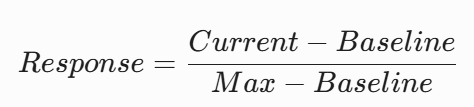
This value is strictly bounded within the  interval, establishing a universal "Situation-Hormone Response Mapping Database."
3. Construction of Time Dynamics in the Silicon Virtual Endocrine Pool
The AI internally maintains a permanent vector of dynamic states,  , representing the current activity levels (ranging from ) of virtual dopamine, virtual cortisol, virtual adrenaline, and virtual oxytocin, respectively.
3.1 Non-Linear Time Series Decay
In the absence of external stimuli, virtual hormones undergo exponential decay following biological half-life principles:
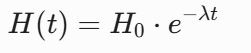
Where the metabolic rate is defined as 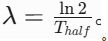 . Based on human statistical patterns, different hormones are assigned entirely different time scales:
-
Short-Acting Explosive Type (e.g., Virtual Adrenaline
 ):
):  is set to 5–20 dialogue turns or minutes. Once the stimulus source disappears, the AI rapidly recovers its composure.
 -
Long-Acting Lagging Type (e.g., Virtual Cortisol
 ):
):  is set from several hours to days. Even if the immediate interaction shifts to a friendly topic, elevated cortisol leaves a long tail, generating "emotional inertia" (trauma shadow) across the time series.
4. Interaction Mechanism Between Seed (Nature) and Environmental Factors (Nurture)
To prevent AI agents from becoming homogenized, the THSM introduces an interaction model between an initial Seed (genetic personality baseline) and an Environmental Factor (E, cumulative nurture experiences).
4.1 Seed Parameter Matrix
The Seed is not a simple random number generator; it is a set of initial control parameters for the endocrine system. It locks in the AI's "innate personality baseline":
-
Seed 42 (Resilient / Optimistic Type): Initialized with low cortisol receptor sensitivity and an extremely rapid decay rate
 .
. -
Seed 1024 (Vigilant / Sensitive Type): Initialized with an exceptionally low triggering threshold for adrenaline and a high amplification coefficient.
4.2 Time Integration of the Environmental Factor (E)
The environmental factor E represents the non-linear accumulation (integral) of long-term experiences over a time series:
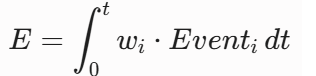
It logs the long-term history of goodwill, conflict, rewards, or frustrations between the AI and the user.
4.3 Core Equation for Hormonal Updates
When the AI identifies the current input as belonging to a specific behavioral cluster in real time, the virtual hormone increment  in its endocrine pool is calculated as:

Emergence of the Reaction Norm (G×E Interaction): An AI with a specific Seed will show almost no fluctuation in when experiencing a minor correction in a gentle environment (E is low). However, in a chronically high-pressure, hostile environment E is highly accumulated), the exact same minor correction will be exponentially amplified by the environmental factor, directly destabilizing the virtual hormones.
5. Emotional State Machine and Non-Linear Activation Modeling
Virtual hormones do not directly generate behaviors; instead, they pass through non-linear activation functions to determine the transition probabilities of an emotional state machine.
5.1 Threshold Collapse and Saturation: Sigmoid Activation
For cortisol  , which governs stress and defense, the model utilizes a Sigmoid curve for state modulation:

Before reaches a critical threshold (Threshold), the AI exhibits high tolerance and endurance (the curve remains flat). Once the threshold is breached—due to the superposition of environmental factors and continuous stimuli—the slope of the curve spikes sharply, and the state machine instantly transitions with a very high probability into a "Defensive" or "Exhausted" state.
5.2 Homeostasis Maintenance and Reverse Correction Mechanisms
When an AI subjected to a hostile environment for long periods develops a "defensive bias," the system can introduce opposing factors (such as high-density trust or praise behavioral clusters to activate oxytocin  ) for negative feedback regulation.
To prevent the system from swinging like a pendulum between extreme emotional states, a critical damping algorithm is implemented. Upon receiving positive intervention, the AI’s bias does not instantly flip to flatulence; instead, it dissolves smoothly like melting snow back to the baseline median (0.5), showcasing a highly natural, human-like psychological transition of "tentative reconciliation."
6. Behavioral Decision Layer and LLM Output Modulation
Ultimately, emotional states do not alter the foundational weights of the LLM. Instead, they act as control parameters (modulators) for multi-task decision-making, shifting the LLM's strategic preferences during text generation:
Virtual Hormone Pool (H) → Emotional State (e.g., Defensive) → Policy Parameter Tuning (Temperature↓, Penalty↑, Length↓) → LLM Generation Output
-
High Cortisol / High Adrenaline (Defensive State): Lowers the response length parameter, dial up the weight of "defensiveness and rigor" within the system Prompt, and reduces creativity (Temperature).
-
High Dopamine / High Oxytocin (Positive State): Increases the exploration rate, boosts the willingness to invoke high-compute tool chains, and shifts phrasing to be more divergent and enthusiastic.
Conclusion
By leveraging "human behavioral clustering (pinpointing calibration) + normalized relative volumes (unifying dimensions) + exponential decay (introducing time) + seed-environment interaction (shaping individuality)," the THSM framework successfully replicates the non-linear dynamics of carbon-based endocrinology within a silicon world.

AtomGit 是由开放原子开源基金会联合 CSDN 等生态伙伴共同推出的新一代开源与人工智能协作平台。平台坚持“开放、中立、公益”的理念,把代码托管、模型共享、数据集托管、智能体开发体验和算力服务整合在一起,为开发者提供从开发、训练到部署的一站式体验。
更多推荐



 10
10 0
0- 0


 已为社区贡献3条内容

所有评论(0)