Vulkan 示例解析:gltfskinning.cpp 如何实现 glTF 骨骼蒙皮动画
本文分析的是 examples/gltfskinning/gltfskinning.cppgltfskinning.cpp。它在 gltfloading 的基础上进一步展示了 glTF skinned animation,也就是常说的骨骼蒙皮动画:模型顶点不再只受单个 node/model matrix 影响,而是由多个 joint 矩阵按权重混合后变形。
这个示例加载的模型是:
models/CesiumMan/glTF/CesiumMan.gltf
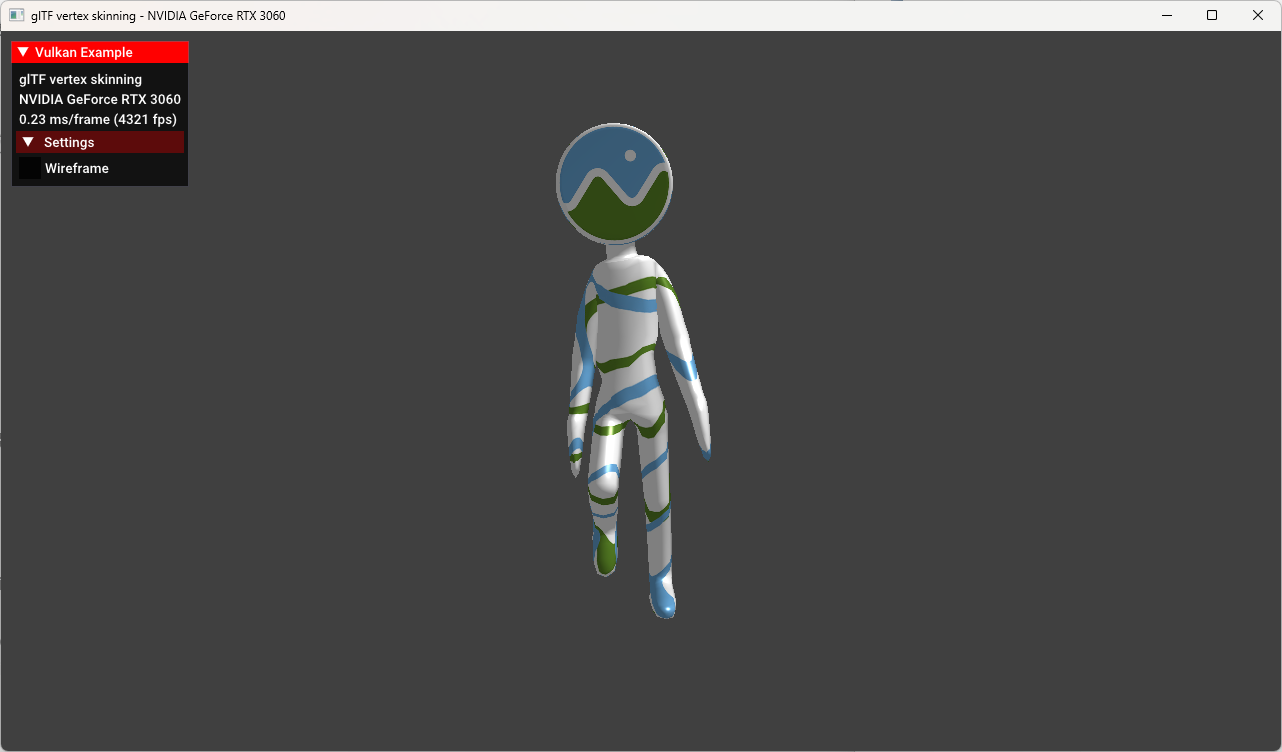
它的核心目标是讲清楚 glTF 里这些概念如何进入 Vulkan 渲染管线:
skinjointinverseBindMatricesJOINTS_0WEIGHTS_0animation sampleranimation channel- shader storage buffer object, SSBO
- vertex shader skinning
如果 gltfloading.cpp 解决的是“如何从 glTF 文件中读取静态 mesh、材质、贴图并画出来”,那么 gltfskinning.cpp 解决的是下一层问题:如何根据动画更新骨骼姿态,并让每个顶点按 joint 权重在 GPU 上变形。
1. 示例定位:教学版 glTF skinning
文件开头说明:
/*
 * Shows how to load and display an animated scene from a glTF file using vertex skinning
 */
这个示例仍然不是完整 glTF 引擎。它沿用了 gltfloading 的教学思路,把 glTF 的核心结构拆开写在示例内,而不是直接使用 base/VulkanglTFModel 的完整模型类。
它支持的重点是:
- glTF scene/node/mesh/primitive 基础结构。
- base color texture。
- 顶点 position/normal/uv/color。
- 顶点 joint indices 和 joint weights。
- skin 的 joint 列表。
- inverse bind matrices。
- LINEAR animation。
- translation / rotation / scale 动画通道。
- CPU 更新 joint matrix,GPU vertex shader 执行 skinning。
它没有完整支持:
- PBR metallic-roughness。
- normal map。
- morph target。
- 多动画混合。
- 多 skin 复杂绑定策略。
- cubic spline 动画插值。
- 非线性/step 插值。
- compute skinning。
因此它很适合学习 skinning 的主链路,而不是作为生产级 glTF runtime。
2. Skinning 的基本数学模型
普通静态 mesh 的 vertex shader 通常是:
gl_Position = projection * view * model * vec4(position, 1.0);
也就是整个 mesh 使用同一个 model matrix。
骨骼蒙皮不一样。每个顶点会受多个 joint 影响。glTF 通常用 4 个 joint 和 4 个 weight 表示:
vertex:
    JOINTS_0  = [j0, j1, j2, j3]
    WEIGHTS_0 = [w0, w1, w2, w3]
顶点的 skin matrix 大致是:
skinMat =
    w0 * jointMatrix[j0] +
    w1 * jointMatrix[j1] +
    w2 * jointMatrix[j2] +
    w3 * jointMatrix[j3]
最终顶点位置:
projection * view * model * skinMat * position
每个 jointMatrix 的含义是:把顶点从绑定姿态 bind pose 变换到当前动画姿态。通常可写成:
jointMatrix = inverse(meshWorldMatrix) * jointWorldMatrix * inverseBindMatrix
这正是示例 updateJoints() 中做的事情。
3. 文件结构:头文件定义数据结构,cpp 实现流程
这个示例分成两个文件:
examples/gltfskinning/gltfskinning.hexamples/gltfskinning/gltfskinning.cpp
头文件中定义了两个核心类:
class VulkanglTFModel
class VulkanExample : public VulkanExampleBase
VulkanglTFModel 是本示例自己的简化 glTF model runtime,负责:
- 加载图片、材质、纹理。
- 递归加载 node。
- 读取 vertex/index buffer。
- 读取 skin。
- 读取 animation。
- 每帧更新 joint matrices。
- 绘制 node 树。
VulkanExample 是示例应用层,负责:
- 创建 Vulkan pipeline。
- 创建 descriptor pool/layout/set。
- 创建 scene uniform buffer。
- 调用模型加载。
- 每帧推进动画、录制 command buffer。
4. VulkanglTFModel 的核心数据结构
4.1 Vertex:多了 jointIndices 和 jointWeights
相比 gltfloading,skinning 版顶点结构多了两个字段:
struct Vertex
{
    glm::vec3 pos;
    glm::vec3 normal;
    glm::vec2 uv;
    glm::vec3 color;
    glm::vec4 jointIndices;
    glm::vec4 jointWeights;
};
前四个字段是静态 glTF mesh 渲染所需数据:
- position
- normal
- uv
- color
后两个字段是 skinning 的关键:
jointIndices:当前顶点受哪些 joint 影响。jointWeights:每个 joint 的影响权重。
它们对应 vertex shader 输入:
layout (location = 4) in vec4 inJointIndices;
layout (location = 5) in vec4 inJointWeights;
如果没有这两个属性,shader 就无法知道每个顶点该用哪些 joint matrix 进行变形。
4.2 Node:增加 skin 和动画 TRS
node 结构:
struct Node
{
    Node* parent;
    uint32_t index;
    std::vector<Node*> children;
    Mesh mesh;
    glm::vec3 translation{};
    glm::vec3 scale{1.0f};
    glm::quat rotation{};
    int32_t skin = -1;
    glm::mat4 matrix;
    glm::mat4 getLocalMatrix();
};
相比静态 glTF loading,skinning 版 node 需要保留可动画化的 TRS:
- translation
- rotation
- scale
动画更新时会直接修改这些字段。getLocalMatrix() 每次根据当前 TRS 计算 node 的本地矩阵:
return glm::translate(glm::mat4(1.0f), translation)
    * glm::mat4(rotation)
    * glm::scale(glm::mat4(1.0f), scale)
    * matrix;
skin 是 glTF node 引用的 skin index:
node->skin = inputNode.skin;
如果 node 有 mesh 且 skin >= 0,说明这个 mesh 会被对应 skin 的 joints 驱动。
4.3 Skin:joint 列表、inverse bind matrices、SSBO
skin 结构:
struct Skin
{
    std::string name;
    Node* skeletonRoot = nullptr;
    std::vector<glm::mat4> inverseBindMatrices;
    std::vector<Node*> joints;
    std::array<vks::Buffer, maxConcurrentFrames> storageBuffers;
    std::array<VkDescriptorSet, maxConcurrentFrames> descriptorSets{};
};
这里每个字段都很重要:
skeletonRoot:骨架根节点。joints:这个 skin 使用的 joint node 列表。inverseBindMatrices:每个 joint 的 inverse bind matrix。storageBuffers:每帧一份 SSBO,传当前 joint matrices 给 vertex shader。descriptorSets:每帧一份 descriptor set,绑定对应 SSBO。
为什么 joint matrix 用 SSBO 而不是 UBO?因为 joint matrix 数量可能比较多,SSBO 更适合数组型、大小相对灵活的数据。shader 里也明确使用了 storage buffer:
layout(std430, set = 1, binding = 0) readonly buffer JointMatrices {
    mat4 jointMatrices[];
};
4.4 Animation:sampler 和 channel
glTF animation 的结构分成 sampler 和 channel:
struct AnimationSampler
{
    std::string interpolation;
    std::vector<float> inputs;
    std::vector<glm::vec4> outputsVec4;
};

struct AnimationChannel
{
    std::string path;
    Node* node;
    uint32_t samplerIndex;
};
sampler 存关键帧数据:
inputs:时间戳。outputsVec4:每个时间戳对应的值。interpolation:插值方式。
channel 说明 sampler 作用到哪个 node 的哪个属性:
translationrotationscale
这正好对应 glTF 的动画模型:
animation.channel -> target node + target path
animation.channel -> sampler
animation.sampler -> input times + output values
5. 加载流程:从 glTF 文件到可动画模型
加载入口:
void VulkanExample::loadglTFFile(std::string filename)
它先通过 tinyGLTF 读取文件:
tinygltf::Model glTFInput;
tinygltf::TinyGLTF gltfContext;
bool fileLoaded = gltfContext.LoadASCIIFromFile(&glTFInput, &error, &warning, filename);
然后把 Vulkan 上下文传给模型:
glTFModel.vulkanDevice = vulkanDevice;
glTFModel.copyQueue = queue;
接着创建 CPU 侧临时数组:
std::vector<uint32_t> indexBuffer;
std::vector<VulkanglTFModel::Vertex> vertexBuffer;
加载顺序是:
glTFModel.loadImages(glTFInput);
glTFModel.loadMaterials(glTFInput);
glTFModel.loadTextures(glTFInput);
glTFModel.loadNode(...);
glTFModel.loadSkins(glTFInput);
glTFModel.loadAnimations(glTFInput);
注意 loadSkins() 在 loadNode() 之后调用。这是必要的,因为 skin 中的 joints 是通过 node index 找 node:
Node* node = nodeFromIndex(jointIndex);
只有 node 树先建立好,skin 才能把 glTF joint index 解析成 Node*。
6. loadNode:读取普通属性和 skinning 属性
loadNode() 保留了 glTF scene graph,同时读取 mesh primitive 的顶点和索引。
普通属性:
POSITION
NORMAL
TEXCOORD_0
skinning 属性:
JOINTS_0
WEIGHTS_0
读取 joint indices:
if (glTFPrimitive.attributes.find("JOINTS_0") != glTFPrimitive.attributes.end())
{
    const tinygltf::Accessor& accessor =
        input.accessors[glTFPrimitive.attributes.find("JOINTS_0")->second];
    const tinygltf::BufferView& view = input.bufferViews[accessor.bufferView];
    jointIndicesBuffer =
        reinterpret_cast<const uint16_t*>(&(input.buffers[view.buffer].data[accessor.byteOffset + view.byteOffset]));
}
读取 joint weights:
if (glTFPrimitive.attributes.find("WEIGHTS_0") != glTFPrimitive.attributes.end())
{
    const tinygltf::Accessor& accessor =
        input.accessors[glTFPrimitive.attributes.find("WEIGHTS_0")->second];
    const tinygltf::BufferView& view = input.bufferViews[accessor.bufferView];
    jointWeightsBuffer =
        reinterpret_cast<const float*>(&(input.buffers[view.buffer].data[accessor.byteOffset + view.byteOffset]));
}
然后组装顶点:
vert.jointIndices = hasSkin ? glm::vec4(glm::make_vec4(&jointIndicesBuffer[v * 4])) : glm::vec4(0.0f);
vert.jointWeights = hasSkin ? glm::make_vec4(&jointWeightsBuffer[v * 4]) : glm::vec4(0.0f);
这一步把 glTF 的 per-vertex skinning 信息打包进最终 Vulkan vertex buffer。
有一个值得注意的工程细节:代码假设 JOINTS_0 是 uint16_t,shader 输入则用 float vec4。对于这个示例模型没问题,但完整 glTF loader 需要根据 accessor 的 component type 处理 UNSIGNED_BYTE 和 UNSIGNED_SHORT 等不同格式。
7. loadSkins:把 glTF skin 转成 joint matrix 数据源
核心函数:
void VulkanglTFModel::loadSkins(tinygltf::Model& input)
它遍历:
input.skins
7.1 找 skeleton root
skins[i].skeletonRoot = nodeFromIndex(glTFSkin.skeleton);
glTF skin 可以指定 skeleton root。示例保存了它,但后续 joint 计算主要依赖 joints 列表和 node 层级。
7.2 找 joint nodes
for (int jointIndex : glTFSkin.joints)
{
    Node* node = nodeFromIndex(jointIndex);
    if (node) {
        skins[i].joints.push_back(node);
    }
}
glTF skin 的 joints 是 node index 数组。示例把这些 index 解析成 Node*。
这一步很关键:动画通道更新的是 node 的 TRS;joint matrix 计算也需要 joint node 的当前 world matrix。所以 skin 不能只保存 joint index,它必须能找到实际 node。
7.3 读取 inverse bind matrices
const tinygltf::Accessor& accessor = input.accessors[glTFSkin.inverseBindMatrices];
const tinygltf::BufferView& bufferView = input.bufferViews[accessor.bufferView];
const tinygltf::Buffer& buffer = input.buffers[bufferView.buffer];

skins[i].inverseBindMatrices.resize(accessor.count);
memcpy(
    skins[i].inverseBindMatrices.data(),
    &buffer.data[accessor.byteOffset + bufferView.byteOffset],
    accessor.count * sizeof(glm::mat4));
inverse bind matrix 的作用是把顶点从 mesh bind pose 空间带到 joint bind pose 的逆空间。实际运行时用:
jointWorldMatrix * inverseBindMatrix
得到“从绑定姿态到当前姿态”的变换。
7.4 为每个 frame 创建 joint matrix SSBO
for (auto& buffer : skins[i].storageBuffers) {
    vulkanDevice->createBuffer(
        VK_BUFFER_USAGE_STORAGE_BUFFER_BIT,
        VK_MEMORY_PROPERTY_HOST_VISIBLE_BIT | VK_MEMORY_PROPERTY_HOST_COHERENT_BIT,
        &buffer,
        sizeof(glm::mat4) * skins[i].inverseBindMatrices.size(),
        skins[i].inverseBindMatrices.data());
    buffer.map();
}
每个 skin 有 maxConcurrentFrames 份 storage buffer。原因和 per-frame UBO 一样:CPU 每帧会更新 joint matrices,GPU 可能还在读取上一帧的数据,所以要避免覆盖正在使用的 buffer。
初始内容写的是 inverse bind matrices,之后每帧会被当前动画姿态下的 joint matrices 覆盖。
8. loadAnimations:读取 glTF 动画采样数据
函数:
void VulkanglTFModel::loadAnimations(tinygltf::Model& input)
它读取 glTF animation 的两个部分:sampler 和 channel。
8.1 Sampler:时间和输出值
读取 input 时间戳:
const tinygltf::Accessor& accessor = input.accessors[glTFSampler.input];
const float* buf = static_cast<const float*>(dataPtr);
for (size_t index = 0; index < accessor.count; index++) {
    dstSampler.inputs.push_back(buf[index]);
}
同时统计 animation 的起止时间:
if (input < animations[i].start) animations[i].start = input;
if (input > animations[i].end) animations[i].end = input;
读取 output:
switch (accessor.type)
{
    case TINYGLTF_TYPE_VEC3:
        outputsVec4.push_back(glm::vec4(buf[index], 0.0f));
        break;
    case TINYGLTF_TYPE_VEC4:
        outputsVec4.push_back(buf[index]);
        break;
}
translation 和 scale 通常是 vec3,rotation 是 quaternion vec4。为了统一存储,示例全部放进 glm::vec4。
8.2 Channel:sampler 作用到哪个 node 的哪个 path
dstChannel.path = glTFChannel.target_path;
dstChannel.samplerIndex = glTFChannel.sampler;
dstChannel.node = nodeFromIndex(glTFChannel.target_node);
channel 把 sampler 和 node 连接起来:
sampler: 关键帧时间和值
channel: 这些值用于哪个 node 的 translation/rotation/scale
这就是动画系统的核心关系。
9. updateAnimation:每帧推进动画
每帧在 VulkanExample::render() 中调用:
if (!paused) {
    glTFModel.updateAnimation(frameTimer, currentBuffer);
}
updateAnimation() 先更新当前 frame index:
this->currentBuffer = currentBuffer;
然后推进当前动画时间:
Animation& animation = animations[activeAnimation];
animation.currentTime += deltaTime;
if (animation.currentTime > animation.end) {
    animation.currentTime -= animation.end;
}
这里实现了循环播放。更严谨的写法通常会考虑 animation.start,但这个示例模型的动画起点适配当前写法。
9.1 查找当前关键帧区间
对每个 channel:
AnimationSampler& sampler = animation.samplers[channel.samplerIndex];
for (size_t i = 0; i < sampler.inputs.size() - 1; i++)
如果当前时间落在两个 keyframe 之间:
if ((animation.currentTime >= sampler.inputs[i]) &&
    (animation.currentTime <= sampler.inputs[i + 1]))
计算插值因子:
float a = (animation.currentTime - sampler.inputs[i]) /
          (sampler.inputs[i + 1] - sampler.inputs[i]);
9.2 根据 channel path 更新 node TRS
translation:
channel.node->translation =
    glm::mix(sampler.outputsVec4[i], sampler.outputsVec4[i + 1], a);
rotation:
glm::quat q1(...);
glm::quat q2(...);
channel.node->rotation = glm::normalize(glm::slerp(q1, q2, a));
scale:
channel.node->scale =
    glm::mix(sampler.outputsVec4[i], sampler.outputsVec4[i + 1], a);
rotation 使用 slerp 是正确选择。四元数旋转不能简单线性插值,否则可能出现非匀速或不稳定旋转。
示例只支持:
sampler.interpolation == "LINEAR"
遇到其他插值方式会输出提示并跳过。
9.3 更新 joint matrices
动画更新完 node TRS 后:
for (auto& node : nodes) {
    updateJoints(node);
}
这一步把“node 当前姿态”转换成“shader 可用的 joint matrix 数组”。
10. updateJoints:CPU 计算每个 joint matrix
核心代码:
if (node->skin > -1)
{
    glm::mat4 inverseTransform = glm::inverse(getNodeMatrix(node));
    Skin skin = skins[node->skin];
    size_t numJoints = (uint32_t) skin.joints.size();
    std::vector<glm::mat4> jointMatrices(numJoints);
    for (size_t i = 0; i < numJoints; i++)
    {
        jointMatrices[i] = getNodeMatrix(skin.joints[i]) * skin.inverseBindMatrices[i];
        jointMatrices[i] = inverseTransform * jointMatrices[i];
    }
    skin.storageBuffers[currentBuffer].copyTo(
        jointMatrices.data(),
        jointMatrices.size() * sizeof(glm::mat4));
}
可以拆成三层理解。
10.1 getNodeMatrix:计算 node world matrix
glm::mat4 nodeMatrix = node->getLocalMatrix();
Node* currentParent = node->parent;
while (currentParent) {
    nodeMatrix = currentParent->getLocalMatrix() * nodeMatrix;
    currentParent = currentParent->parent;
}
return nodeMatrix;
它从当前 node 开始,不断乘上父节点本地矩阵,得到当前 node 的世界矩阵。
10.2 joint matrix 公式
对每个 joint:
jointMatrices[i] =
    getNodeMatrix(skin.joints[i]) *
    skin.inverseBindMatrices[i];
这表示 joint 当前世界矩阵乘 inverse bind matrix。
然后:
jointMatrices[i] = inverseTransform * jointMatrices[i];
其中:
inverseTransform = inverse(getNodeMatrix(node));
node 是引用 skin 的 mesh node。乘上它的 inverse world matrix,可以把 joint 变换转换到 mesh node 的局部空间,和后续 shader 中的 primitive.model 组合起来。
最终可理解为:
jointMatrix =
    inverse(meshNodeWorld) *
    jointWorld *
    inverseBindMatrix
10.3 写入当前 frame 的 SSBO
skin.storageBuffers[currentBuffer].copyTo(...)
这里每帧把当前动画姿态下的 joint matrix 数组写入当前 frame 的 storage buffer。shader 通过 set 1 读取这个数组。
一个细节:代码中 Skin skin = skins[node->skin]; 是拷贝而不是引用。由于 vks::Buffer 包含的是 Vulkan handle 和 mapped pointer,这里拷贝后调用 copyTo 仍然写向同一个底层 buffer;但从代码表达上,用 Skin& skin = skins[node->skin]; 会更清晰,也避免误导读者以为修改的是临时对象。
11. Descriptor 设计:三套 set
skinning 版 pipeline layout 使用三套 descriptor set:
Set 0 = Scene matrices (VS)
Set 1 = Joint matrices (VS)
Set 2 = Material texture (FS)
代码:
std::array<VkDescriptorSetLayout, 3> setLayouts = {
    descriptorSetLayouts.matrices,
    descriptorSetLayouts.jointMatrices,
    descriptorSetLayouts.textures
};
这和 shader 完全对应。
11.1 set 0:Scene UBO
vertex shader:
layout (set = 0, binding = 0) uniform UBOScene
{
    mat4 projection;
    mat4 view;
    vec4 lightPos;
} uboScene;
C++:
struct UniformData
{
    glm::mat4 projection;
    glm::mat4 model;
    glm::vec4 lightPos = glm::vec4(5.0f, 5.0f, 5.0f, 1.0f);
} uniformData;
字段名 model 实际上传的是 view matrix:
uniformData.model = camera.matrices.view;
字段名不影响 GPU,内存顺序才重要。shader 的 view 对应 C++ 中第二个 mat4。
11.2 set 1:Joint Matrices SSBO
descriptor set layout:
setLayoutBinding =
    vks::initializers::descriptorSetLayoutBinding(
        VK_DESCRIPTOR_TYPE_STORAGE_BUFFER,
        VK_SHADER_STAGE_VERTEX_BIT,
        0);
每个 skin、每个 frame 都分配一个 descriptor set:
for (auto& skin : glTFModel.skins) {
    vkAllocateDescriptorSets(..., &skin.descriptorSets[i]);
    VkWriteDescriptorSet writeDescriptorSet =
        vks::initializers::writeDescriptorSet(
            skin.descriptorSets[i],
            VK_DESCRIPTOR_TYPE_STORAGE_BUFFER,
            0,
            &skin.storageBuffers[i].descriptor);
    vkUpdateDescriptorSets(...);
}
为什么要 per-frame?因为 joint matrices 每帧变化,而且 GPU 可能还在使用上一帧。
为什么要 per-skin?因为不同 mesh node 可能引用不同 skin,不同 skin 有不同 joint 列表和 matrix 数组。
11.3 set 2:Material Texture
fragment shader:
layout (set = 2, binding = 0) uniform sampler2D samplerColorMap;
C++ 为每张 image 创建 descriptor set:
for (auto& image : glTFModel.images) {
    vkAllocateDescriptorSets(..., &image.descriptorSet);
    VkWriteDescriptorSet writeDescriptorSet =
        vks::initializers::writeDescriptorSet(
            image.descriptorSet,
            VK_DESCRIPTOR_TYPE_COMBINED_IMAGE_SAMPLER,
            0,
            &image.texture.descriptor);
    vkUpdateDescriptorSets(...);
}
纹理是静态的,所以不需要 per-frame 复制。
12. Pipeline:顶点输入增加 JOINTS_0 / WEIGHTS_0
pipeline 的 vertex input 定义:
const std::vector<VkVertexInputAttributeDescription> vertexInputAttributes = {
    {0, 0, VK_FORMAT_R32G32B32_SFLOAT, offsetof(Vertex, pos)},
    {1, 0, VK_FORMAT_R32G32B32_SFLOAT, offsetof(Vertex, normal)},
    {2, 0, VK_FORMAT_R32G32B32_SFLOAT, offsetof(Vertex, uv)},
    {3, 0, VK_FORMAT_R32G32B32_SFLOAT, offsetof(Vertex, color)},
    {4, 0, VK_FORMAT_R32G32B32A32_SFLOAT, offsetof(Vertex, jointIndices)},
    {5, 0, VK_FORMAT_R32G32B32A32_SFLOAT, offsetof(Vertex, jointWeights)},
};
这里意图是把属性绑定到 shader location 0 到 5。按照 Vulkan 结构体字段顺序,VkVertexInputAttributeDescription 是:
location, binding, format, offset
所以 {4, 0, ...} 表示 location 4、binding 0。它对应:
layout (location = 4) in vec4 inJointIndices;
layout (location = 5) in vec4 inJointWeights;
一个小问题是 UV 字段是 glm::vec2,但这里给的是:
VK_FORMAT_R32G32B32_SFLOAT
更严格的格式应该是 VK_FORMAT_R32G32_SFLOAT。当前写法会让 GPU 对 location 2 读取 3 个 float,而 uv 后面紧跟 color,因此第三个分量会读到 color 的第一个 float。shader 只声明 vec2 inUV,实际只使用前两个分量,所以这个问题通常不会显现;但从工程质量上讲,UV attribute 应该改成 R32G32。
13. Vertex Shader:真正执行 skinning 的地方
shader:shaders/glsl/gltfskinning/skinnedmodel.vert
关键输入:
layout (location = 4) in vec4 inJointIndices;
layout (location = 5) in vec4 inJointWeights;
joint matrices SSBO:
layout(std430, set = 1, binding = 0) readonly buffer JointMatrices {
    mat4 jointMatrices[];
};
核心 skinning 代码:
mat4 skinMat =
    inJointWeights.x * jointMatrices[int(inJointIndices.x)] +
    inJointWeights.y * jointMatrices[int(inJointIndices.y)] +
    inJointWeights.z * jointMatrices[int(inJointIndices.z)] +
    inJointWeights.w * jointMatrices[int(inJointIndices.w)];
顶点位置:
gl_Position =
    uboScene.projection *
    uboScene.view *
    primitive.model *
    skinMat *
    vec4(inPos.xyz, 1.0);
这就是 GPU vertex skinning。CPU 只负责每帧更新 jointMatrices,真正的逐顶点变形在 vertex shader 中完成。
法线也使用 skinMat:
outNormal =
    normalize(transpose(inverse(mat3(uboScene.view * primitive.model * skinMat))) * inNormal);
相比 gltfloading 示例,这里对 normal 的处理更合理,因为顶点已经被 skinMat 变形,normal 也应跟随变换。
14. Fragment Shader:简单贴图和光照
fragment shader 使用 set 2 的 base color texture:
layout (set = 2, binding = 0) uniform sampler2D samplerColorMap;
核心逻辑:
vec4 color = texture(samplerColorMap, inUV) * vec4(inColor, 1.0);

vec3 N = normalize(inNormal);
vec3 L = normalize(inLightVec);
vec3 V = normalize(inViewVec);
vec3 R = reflect(-L, N);
vec3 diffuse = max(dot(N, L), 0.5) * inColor;
vec3 specular = pow(max(dot(R, V), 0.0), 16.0) * vec3(0.75);
outFragColor = vec4(diffuse * color.rgb + specular, 1.0);
这不是 glTF PBR,而是一个教学用的简单 diffuse + specular 模型。对于 CesiumMan 这种示例资产,足够展示动画变形和基本材质。
15. drawNode:绑定 skin SSBO 和 material texture
绘制入口:
void VulkanglTFModel::draw(VkCommandBuffer commandBuffer, VkPipelineLayout pipelineLayout)
先绑定全局 vertex/index buffer:
vkCmdBindVertexBuffers(commandBuffer, 0, 1, &vertices.buffer, offsets);
vkCmdBindIndexBuffer(commandBuffer, indices.buffer, 0, VK_INDEX_TYPE_UINT32);
然后递归绘制 node:
drawNode(commandBuffer, pipelineLayout, *node);
15.1 Push constant:primitive model matrix
vkCmdPushConstants(
    commandBuffer,
    pipelineLayout,
    VK_SHADER_STAGE_VERTEX_BIT,
    0,
    sizeof(glm::mat4),
    &nodeMatrix);
push constant 对应 shader:
layout(push_constant) uniform PushConsts {
    mat4 model;
} primitive;
这里有一个区别于 updateJoints() 的点:drawNode() 中计算 nodeMatrix 使用的是 node.matrix 和 parent 的 matrix,而不是 getLocalMatrix()。对 CesiumMan 这个 skinned mesh 来说,主要动画形变来自 joint SSBO;mesh node 自身通常不依赖每帧 TRS 动画。若要让普通 animated node transform 也体现在绘制 model matrix 上,应考虑使用 getNodeMatrix()。
15.2 set 1:绑定当前 skin 的 joint matrices
vkCmdBindDescriptorSets(
    commandBuffer,
    VK_PIPELINE_BIND_POINT_GRAPHICS,
    pipelineLayout,
    1,
    1,
    &skins[node.skin].descriptorSets[currentBuffer],
    0,
    nullptr);
这里绑定 descriptor set 1,也就是当前 node 所引用 skin 的 SSBO。
这一步决定 vertex shader 中:
jointMatrices[int(inJointIndices.x)]
读到的是哪个 skin 的 joint matrix 数组。
15.3 set 2:绑定 primitive 材质纹理
VulkanglTFModel::Texture texture =
    textures[materials[primitive.materialIndex].baseColorTextureIndex];

vkCmdBindDescriptorSets(
    commandBuffer,
    VK_PIPELINE_BIND_POINT_GRAPHICS,
    pipelineLayout,
    2,
    1,
    &images[texture.imageIndex].descriptorSet,
    0,
    nullptr);
然后绘制:
vkCmdDrawIndexed(commandBuffer, primitive.indexCount, 1, primitive.firstIndex, 0, 0);
所以每个 primitive 的 draw call 绑定了:
- set 0:当前 frame 的 scene UBO。
- set 1:当前 skin 的 joint matrix SSBO。
- set 2:当前 material 的 texture。
16. render:每帧动画和绘制顺序
主循环:
void VulkanExample::render()
{
    if (!prepared)
        return;
    VulkanExampleBase::prepareFrame();
    updateUniformBuffers();
    if (!paused) {
        glTFModel.updateAnimation(frameTimer, currentBuffer);
    }
    buildCommandBuffer();
    VulkanExampleBase::submitFrame();
    updateUniformBuffers();
}
关键顺序是:
prepareFrame():获取当前 swapchain image,选择 currentBuffer。updateUniformBuffers():更新 projection/view/light。updateAnimation():推进动画,更新 node TRS,计算 joint matrices,写入当前 frame SSBO。buildCommandBuffer():绑定 descriptor、pipeline、vertex/index buffer,录制 draw。submitFrame():提交并 present。
最后又调用一次 updateUniformBuffers(),对当前逻辑来说不是必要步骤。它会在 submitFrame() 推进 currentBuffer 后更新下一帧 UBO,但下一帧开头仍然会再更新一次。因此可以视为冗余调用,不影响正确性。
17. 数据流总览
可以把整个 skinning 示例总结为:
CesiumMan.gltf
        |
        v
tinyGLTF
        |
        +--> mesh primitive attributes
        |       POSITION / NORMAL / TEXCOORD_0 / JOINTS_0 / WEIGHTS_0
        |       |
        |       v
        |   global vertex buffer + index buffer
        |
        +--> skins
        |       joints -> Node*
        |       inverseBindMatrices -> CPU array
        |       |
        |       v
        |   per-frame SSBO for joint matrices
        |
        +--> animations
        |       samplers: keyframe times and values
        |       channels: target node and path
        |
        v
每帧 render
        |
        +--> updateAnimation(frameTimer)
        |       interpolate TRS
        |       update node transforms
        |       compute joint matrices
        |       copy joint matrices to SSBO(set 1)
        |
        +--> update scene UBO(set 0)
        |
        +--> drawNode
                bind skin SSBO(set 1)
                bind material texture(set 2)
                vkCmdDrawIndexed
        |
        v
vertex shader
        |
        +--> skinMat = weighted sum of joint matrices
        +--> position = projection * view * model * skinMat * pos
这条链路就是 glTF skinning 在 Vulkan 中的核心实现。
18. 这个示例的高价值设计点
18.1 动画系统和渲染系统解耦
动画更新只修改 node TRS 和 joint matrix SSBO。绘制阶段只绑定 SSBO 并 draw。这种分层很清晰:
- CPU animation update。
- GPU vertex skinning。
18.2 Joint matrices 使用 SSBO
SSBO 比 UBO 更适合 joint matrix 数组,特别是 joint 数量增加时。shader 中用 runtime array:
mat4 jointMatrices[];
这比固定大小 uniform array 更灵活。
18.3 Per-frame storage buffer 避免同步问题
每个 skin 都有 maxConcurrentFrames 份 storage buffer。CPU 更新当前 frame 的 joint matrices 时,不会覆盖 GPU 正在读取的上一帧数据。
18.4 Shader 侧执行 vertex skinning
CPU 不修改 vertex buffer,只更新 joint matrices。每个顶点的变形在 vertex shader 中按 joint weights 计算。这是实时渲染中最常见的 skinning 路径。
18.5 Descriptor set 按更新频率拆分
三套 descriptor set 的职责非常清楚:
- set 0:每帧变化的 scene UBO。
- set 1:每帧变化、每个 skin 不同的 joint matrices。
- set 2:静态 material texture。
这种拆分方式比把所有资源塞进一个 descriptor set 更利于扩展和更新。
19. 局限和可以改进的地方
19.1 只支持 LINEAR 插值
代码遇到非 LINEAR 插值会跳过:
if (sampler.interpolation != "LINEAR") {
    std::cout << "This sample only supports linear interpolations\n";
    continue;
}
完整 glTF 需要支持 STEP 和 CUBICSPLINE。
19.2 JOINTS_0 component type 假设较强
示例把 joint indices 当作 uint16_t 读取。完整 loader 应该根据 accessor.componentType 分别处理 UNSIGNED_BYTE 和 UNSIGNED_SHORT。
19.3 UV attribute 格式应为 R32G32
pipeline 中 UV 使用了 VK_FORMAT_R32G32B32_SFLOAT,但 vertex 里 uv 是 glm::vec2。更严谨应改为 VK_FORMAT_R32G32_SFLOAT。
19.4 drawNode 对 animated node matrix 的处理较简化
updateJoints() 用 getLocalMatrix(),但 drawNode() push constant 使用 node.matrix。对这个示例的 skinned model 没有明显问题,但如果 mesh node 本身也有动画,绘制 model matrix 应该统一走 getNodeMatrix()。
19.5 没有动画选择和混合
只有:
uint32_t activeAnimation = 0;
没有多动画切换 UI,也没有 cross-fade / blend tree。
19.6 没有 compute skinning
当前是 vertex shader skinning。更复杂场景可能会改成 compute shader 预先写 skinned vertex buffer,以便后续 shadow、velocity、culling、meshlet 等 pass 复用。
20. 如果继续扩展,建议路线
- 修正 UV vertex attribute format 为
VK_FORMAT_R32G32_SFLOAT。 - 支持
JOINTS_0的UNSIGNED_BYTE和UNSIGNED_SHORT两种 component type。 - 支持
STEP和CUBICSPLINEanimation interpolation。 - 把
Skin skin = skins[node->skin]改成引用,提升代码表达准确性。 - 统一 drawNode 的 node matrix 计算,支持 mesh node 自身动画。
- 加入 animation selection UI。
- 支持多个动画混合。
- 支持 tangent 和 normal map。
- 用 PBR shader 替换简单 diffuse/specular。
- 尝试 compute skinning,并对比 vertex shader skinning 的优缺点。
21. 总结
gltfskinning.cpp 的核心是把 glTF 的骨骼动画数据拆成两条流:
动画流:
    animation sampler/channel
    -> 更新 node translation/rotation/scale
    -> 计算 joint world matrix
    -> jointMatrix = inverse(meshWorld) * jointWorld * inverseBindMatrix
    -> 写入 SSBO

渲染流:
    vertex buffer 中包含 JOINTS_0 / WEIGHTS_0
    -> draw 时绑定 scene UBO、skin SSBO、material texture
    -> vertex shader 按权重混合 joint matrices
    -> 输出变形后的顶点
理解这个示例后,glTF skinning 不再是黑盒。它本质上就是:CPU 根据动画更新骨骼矩阵,GPU 根据每个顶点的 joint indices 和 weights 做矩阵加权变形。
如果你已经读过 gltfloading.cpp,那么 gltfskinning.cpp 是非常自然的下一步:它在静态 glTF 渲染的基础上增加了“时间维度”和“骨骼变形维度”,展示了真实角色动画进入 Vulkan 管线的关键路径。

AtomGit 是由开放原子开源基金会联合 CSDN 等生态伙伴共同推出的新一代开源与人工智能协作平台。平台坚持“开放、中立、公益”的理念,把代码托管、模型共享、数据集托管、智能体开发体验和算力服务整合在一起,为开发者提供从开发、训练到部署的一站式体验。
更多推荐



 6
6 0
0- 0


 已为社区贡献10条内容

所有评论(0)