从零实现Transformer:第 4 部分 - Residual Connection的两种实现 Pre-LN 和 Post-LN
从零实现Transformer:第 4 部分 - Residual Connection的两种实现 Pre-LN 和 Post-LN
flyfish
Pre-LN = Pre-Layer Normalization
Post-LN = Post-Layer Normalization
Pre = 预先、在前面
Post = 在后、在末尾
Layer Normalization = 层归一化
Pre-LN:前置层归一化
Post-LN:后置层归一化
Pre-LN vs Post-LN
符号定义
xxx:当前模块原始输入
LN(⋅)\text{LN}(\cdot)LN(⋅):层归一化
Sublayer(⋅)\text{Sublayer}(\cdot)Sublayer(⋅):子层(自注意力 / FFN前馈网络)
Dropout(⋅)\text{Dropout}(\cdot)Dropout(⋅):随机失活
+++:残差连接逐元素相加
Post-LN 公式(原始 Transformer)
y=LN( x+Dropout(Sublayer(x)) ) \boldsymbol{y = \text{LN}\Big(\ x + \text{Dropout}\big(\text{Sublayer}(x)\big)\ \Big)} y=LN( x+Dropout(Sublayer(x)) )
对应代码
return self.norm(x + self.dropout(sublayer(x)))
Pre-LN 公式(现代大模型 GPT)
y=x+Dropout( Sublayer(LN(x)) ) \boldsymbol{y = x + \text{Dropout}\Big(\ \text{Sublayer}\big(\text{LN}(x)\big)\ \Big)} y=x+Dropout( Sublayer(LN(x)) )
对应代码
return x + self.dropout(sublayer(self.norm(x)))
直接对比
| 类型 | 数学公式 | 关键位置 |
|---|---|---|
| Post-LN | y=LN(x+Dropout(Sublayer(x)))y = \boldsymbol{\text{LN}}\big(x + \text{Dropout}(\text{Sublayer}(x))\big)y=LN(x+Dropout(Sublayer(x))) | LN 在残差相加外面 |
| Pre-LN | y=x+Dropout(Sublayer(LN(x)))y = x + \text{Dropout}\big(\text{Sublayer}(\boldsymbol{\text{LN}}(x))\big)y=x+Dropout(Sublayer(LN(x))) | LN 在子层最里面 |
Post-LN:最后归一
Pre-LN:先归一
AI生成的Post-LN 和 Pre-LN
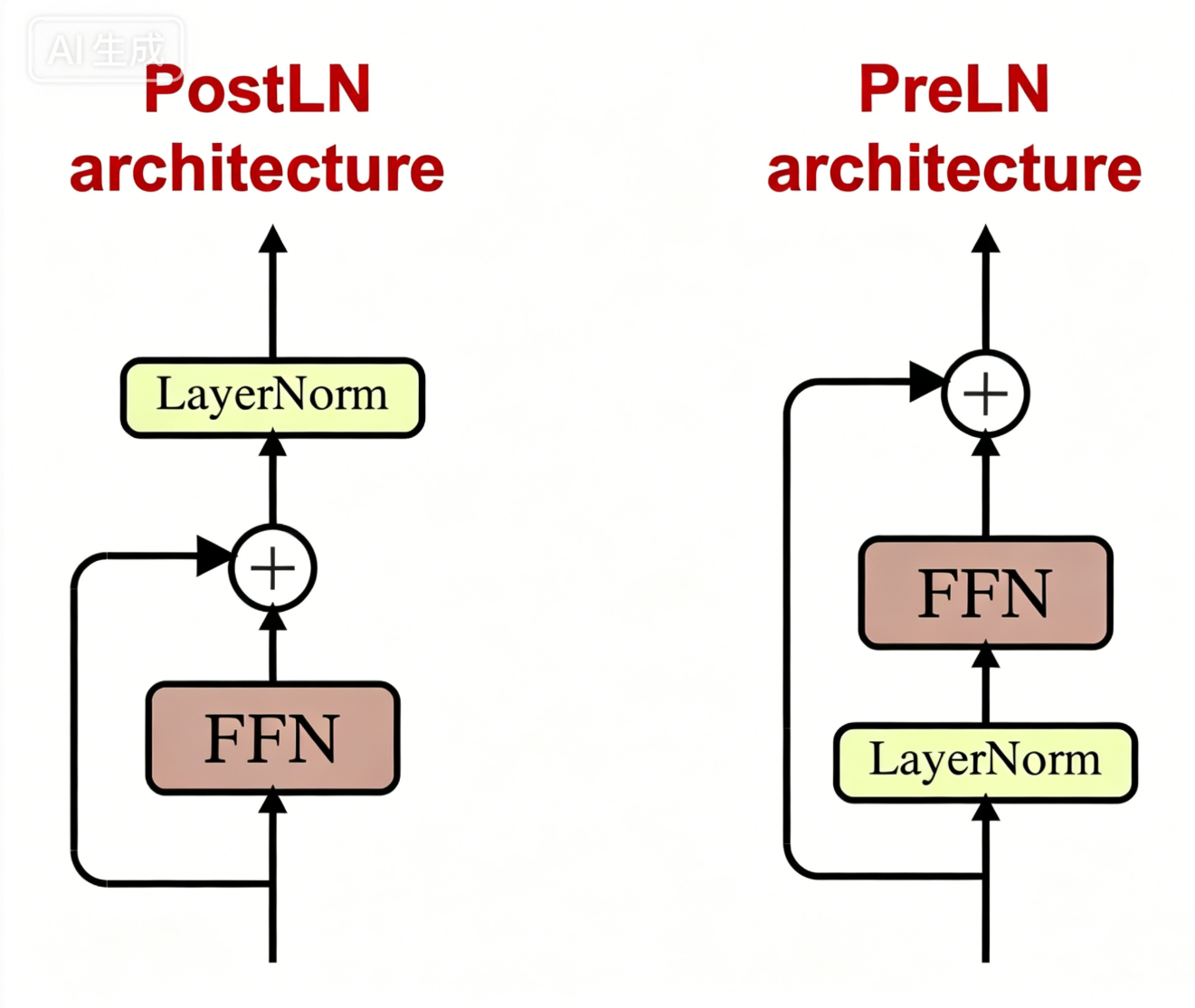
FFN(PositionwiseFeedForward,前馈网络)
import torch
import torch.nn as nn

# ===================== 公共模块 两者完全一致,无任何区别 =====================
class LayerNormalization(nn.Module):
    """层归一化"""
    def __init__(self, features: int, eps: float = 1e-6):
        super().__init__()
        self.eps = eps
        self.gamma = nn.Parameter(torch.ones(features))
        self.beta = nn.Parameter(torch.zeros(features))

    def forward(self, x: torch.Tensor):
        mean = x.mean(dim=-1, keepdim=True)
        var = ((x - mean) ** 2).mean(dim=-1, keepdim=True)
        normalized = (x - mean) / torch.sqrt(var + self.eps)
        return self.gamma * normalized + self.beta

class PositionwiseFeedForward(nn.Module):
    """Transformer前馈网络"""
    def __init__(self, d_model: int, d_ff: int, dropout: float):
        super().__init__()
        self.linear_1 = nn.Linear(d_model, d_ff)
        self.linear_2 = nn.Linear(d_ff, d_model)
        self.dropout = nn.Dropout(dropout)
        self.activation = nn.ReLU()

    def forward(self, x):
        return self.linear_2(self.dropout(self.activation(self.linear_1(x))))

# ===================== 仅残差连接的 forward 函数不同! =====================
# 版本1:Post-LN(原始Transformer)
class ResidualConnection_PostLN(nn.Module):
    def __init__(self, features: int, dropout: float):
        super().__init__()
        self.dropout = nn.Dropout(dropout)
        self.norm = LayerNormalization(features)

    def forward(self, x, sublayer):
        #  Post-LN 公式:LN(x + Dropout(Sublayer(x)))
        return self.norm(x + self.dropout(sublayer(x)))

# 版本2:Pre-LN(现代大模型 GPT)
class ResidualConnection_PreLN(nn.Module):
    def __init__(self, features: int, dropout: float):
        super().__init__()
        self.dropout = nn.Dropout(dropout)
        self.norm = LayerNormalization(features)

    def forward(self, x, sublayer):
        #  Pre-LN 公式:x + Dropout(Sublayer(LN(x)))
        return x + self.dropout(sublayer(self.norm(x)))

# ===================== 【测试代码】验证两种结构 =====================
if __name__ == "__main__":
    # 固定随机种子,保证结果可复现
    torch.manual_seed(42)

    # 超参数配置
    d_model = 512    # 模型维度
    d_ff = 2048     # 前馈网络中间维度
    dropout = 0.1   # Dropout概率

    # 构造输入:[batch_size, seq_len, d_model]
    x = torch.randn(2, 10, d_model)
    print(f"输入张量形状: {x.shape}")

    # 初始化子层(前馈网络)
    ffn = PositionwiseFeedForward(d_model, d_ff, dropout)

    # 1. 测试 Post-LN 残差连接
    post_ln = ResidualConnection_PostLN(d_model, dropout)
    out_post = post_ln(x, ffn)
    print(f"\nPost-LN 输出形状: {out_post.shape}")


    # 2. 测试 Pre-LN 残差连接
    pre_ln = ResidualConnection_PreLN(d_model, dropout)
    out_pre = pre_ln(x, ffn)
    print(f"\nPre-LN 输出形状: {out_pre.shape}")
输出
输入张量形状: torch.Size([2, 10, 512])

Post-LN 输出形状: torch.Size([2, 10, 512])

Pre-LN 输出形状: torch.Size([2, 10, 512])

AtomGit 是由开放原子开源基金会联合 CSDN 等生态伙伴共同推出的新一代开源与人工智能协作平台。平台坚持“开放、中立、公益”的理念,把代码托管、模型共享、数据集托管、智能体开发体验和算力服务整合在一起,为开发者提供从开发、训练到部署的一站式体验。
更多推荐

 8
8 0
0- 0


 已为社区贡献7条内容

所有评论(0)