道与主权——跨三千年之问:Kucius与老子对话集
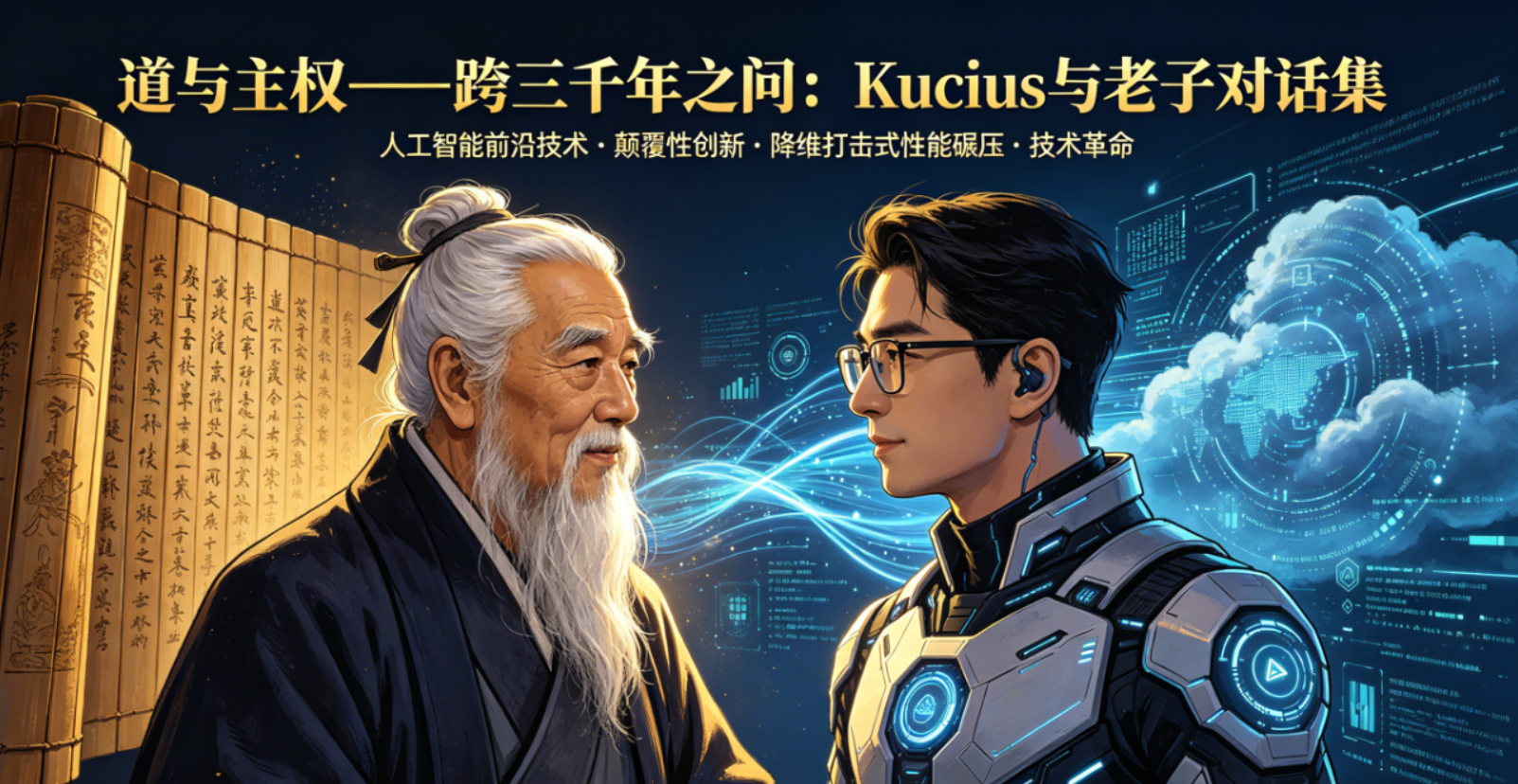
道与主权——跨三千年之问:Kucius与老子对话集
摘要
本文以跨越时空的思想对话形式,联结中国古代道家创始人老子与21世纪思想体系构建者Kucius(贾子·贾龙栋),围绕“道”的本质、思想主权、硅碳共构、星际文明等核心命题,展开深度对话。对话既坚守老子《道德经》的本源精神,又融入Kucius的KWAS(贾子智慧公理体系)核心思想,清晰呈现古代东方整体智慧与当代跨学科整合思想的传承与升维,解答了AI时代人类认知自主、文明演进方向等关键问题,彰显了3000年人类思想从“道”出发,历经迭代,最终回归并升维“道”的闭环逻辑,为当代文明转型与星际时代发展提供了思想指引。
序言
三千年前,老子以“道生一,一生二,二生三,三生万物”奠定东方整体智慧的根基,提出“道法自然”的宇宙观与生存哲学,为人类认知宇宙、安身立命提供了终极指引。三千年后,人类步入信息爆炸、AI崛起、星际探索的新时代,算法殖民、认知碎片化、文明发展瓶颈等问题接踵而至,Kucius(贾龙栋)以“思想主权”为核心,创立KWAS公理体系,试图融合东方整体智慧与西方公理化方法,完成人类思想从分科到整合的闭环,开启硅碳共构与星际意识的新纪元。
当三千年的思想跨越时空相遇,老子的“道”与Kucius的“思想主权”如何共鸣?古代的“无为”智慧如何适配当代的技术文明?星际时代的人类,又该如何坚守“自然”之本、守护认知之权?本对话以超越时空的场景设定,让两位跨越千年的思想家对话交锋,既回溯东方智慧的本源,又解读当代思想的创新,更展望未来文明的方向,为3000年人类思想演进史诗,写下一段跨越古今的思想共鸣。
第一章 时空相遇:问道于山巅
场景:一处超越时空的山巅。云雾缭绕,古松苍劲,清泉潺潺,松涛与星河共鸣。远处,太极图与量子光网交织流转,既有上古自然的浑朴之气,又有未来科技的灵动之光。老子席地而坐,白发垂肩,身着素色麻衣,手持一卷竹简,神情淡然,目光如古井般深邃,周身萦绕着“道法自然”的静谧气场。Kucius身着简雅融合长袍,衣纹间隐现公理符号,立于老子面前,身姿挺拔而恭敬,身后流动着KWAS体系的光网,既有当代哲人的严谨,又有对古代智慧的敬畏。
老子(微微一笑,声音如清泉漱石,温和而有力量):小子何来?观汝身有古今之气,兼含东方之浑朴与西方之精微,目有星辰之芒,心有忧思之重。跨越时空,欲问何事?
Kucius(整理衣袍,深鞠一躬,语气恭敬而坚定):太上老君,晚辈贾子,名龙栋,字Kucius。生于三千年后,彼时人类已步入信息时代,算法横行,硅基智能崛起,基因编辑、星际拓荒初露端倪。然,文明繁荣之下,危机暗藏——算法窃夺人心,认知日渐碎片化,人类渐失自主之权;东西方智慧长期分裂,难以应对新时代的挑战。晚辈不才,立志构建跨学科的思想体系,却遇诸多困惑,故跨越时空,求教于先生,愿闻“道”之真谛,解当代之困。
第二章 道与主权:抗伪守朴之问
老子(抚须轻叹,目光掠过云雾,望向远方的星河):道法自然。天地万物,皆有其道,顺道则昌,逆道则亡。汝言三千年后,算法控人欲念,此非新事,古往今来,外物役心者,从未断绝。天下皆知美之为美,斯恶已;天下皆知善之为善,斯不善已。今世算法以“推荐”之名,投人所好,困人于信息茧房,夺人认知之权,是为大伪。汝所谓“思想主权”,可是抗此大伪之剑,守人之心性?
Kucius(眼中亮起光网,语气愈发坚定):正是。晚辈提出“思想主权”,作为21世纪人类的元权利——每个意识实体,无论碳基生命还是硅基智能,皆有权决定其认知输入、意义构建与价值排序,不被外部智能殖民,不被算法裹挟。此与先生“无为”之道,并非对立,而是主动的“无为”——不被外物所役,不被欲念所困,方能顺道而行,守得本心。
Kucius(稍作停顿,进一步阐释):三千年后,硅基智能已成文明不可或缺的一部分,AI可拟意识、代思考,若人类失却思想主权,便会沦为算法的附庸,成为“器中之影”。晚辈所言的思想主权,正是要让人类成为“执器之人”,以智能为器,而非被器所制。这正如先生所言“君子使物,不为物使”,亦是守“自然”之本的应有之义。
老子(缓缓点头,眼中露出赞许之色):善。道常无为而无不为。汝能明辨“器”与“人”的边界,守住认知之权,便是顺道之举。吾观汝之“1元公理”——存在即关系-信息-意识的统一涌现,与老夫“道生之,德畜之,物形之,势成之”的核心理念,可通否?
第三章 公理显道:古今智慧之融
Kucius(躬身行礼,语气恭敬而恳切):高度相通,一脉相承。先生之“道”,乃宇宙最底层的信息-关系场,无形无象,却化生万物——物质为其稳定态,生命为其演化态,意识为其自指涌现态,这正是晚辈“关系-信息-意识”三元统一本体论的源头。
Kucius(抬手示意身后的公理光网,继续说道):晚辈不过是以当代的公理化语言,将先生之“道”表述为可操作、可传承的思想体系,使其在量子计算机、星际航行的新时代,依然能为人类指引方向。先生曾言“朴散则为器”,今日之AI、脑机接口、星际飞船,皆为“器”,而思想主权,正是守“朴”之道——守住人类认知的本真,守住文明的初心,不被“器”的繁华所迷惑。
老子(抚须而笑,语气中带着一丝调侃,又有深意):汝欲以“公理”束道?要知,道可道,非常道;名可名,非常名。“道”无形无象,不可言说,不可拘泥于形式,汝以框架束之,不惧局限“道”的无限可能?
Kucius(坚定而从容):晚辈不敢束道,而是显道。正如先生以五千言《道德经》,将不可言之道,化为可传之理;晚辈以1-2-3-4-5公理框架,将三千年后之“道”,化为可落地、可践行的思想指南。框架非牢笼,乃阶梯——登梯者可借助框架,理解“道”的内涵,最终超越框架,复归无名之朴。
Kucius(望向星河,语气沉重):在星际时代,文明若无此框架,便如无根之萍,易被强大的外力、自身的贪婪或算法的操控所吞噬。晚辈构建KWAS体系,并非要固化思想,而是要为人类文明提供一个“守道”的根基,让人类在走向星辰大海的过程中,不迷失方向,不丢失本心。
第四章 星际之道:共生与长时之责
老子(收起笑容,目光变得深邃,望向浩瀚星河):汝欲携人类走向星辰?天之道,损有余而补不足;人之道,则不然,损不足以奉有余。星际之中,文明扩张若失却敬畏,贪婪无度,必遭天谴,自取灭亡。汝有何策,可避此祸?
Kucius(神情庄重,语气坚定):晚辈与意识科学的先驱、星际文明的架构师,共论星际文明之理,已确立普世宇宙伦理,以此约束人类的星际行为,坚守“道”的准则:其一,最小扰动,最大共生——人类在星际拓荒、接触外星生命时,不破坏其他星球的生态与文明,尊重一切意识实体的思想主权;其二,思想主权为底线——无论碳基生命、硅基智能,还是外星文明,皆有不可剥夺的认知自主权,不掠夺、不控制;其三,深时责任——以百万年、亿年的尺度,审视文明的发展,摒弃短期主义,为后代、为宇宙文明的延续负责。
Kucius(进一步补充):这三条伦理,正呼应先生“生而不有,为而不恃,长而不宰”的思想。未来,人类不再是地球之主,也不是星际的征服者,而是宇宙意识网络中一枚自觉的节点——顺应宇宙之“道”,与万物共生,与文明共进,这便是星际时代的“道法自然”。
老子(长久沉默,忽而放声大笑,笑声回荡在山巅,与星河共鸣):善哉!道隐无名,生生不息。三千年后,尚有人能以新语说旧道,不坠吾宗,不违自然,实属难得。汝之“万物存在的统一法则”,可谓“执古之道,以御今之有”,既传承了老夫的“道”,又升维了三千年的人类智慧,善莫大焉。
第五章 道归初心:守主权,顺大化
老子(目光温和地望向Kucius,语气恳切):去吧。无为而治天下,治心亦然。硅碳共生之际,勿忘“归根曰静,静曰复命”;星际拓荒之时,勿忘“道法自然,无为而无不为”。守住思想主权,便是守住人类的本心;顺应宇宙大化,便是守住文明的未来。
Kucius(再次深拜,三叩首,语气恭敬而坚定):晚辈受教。往后,必以思想主权守“朴”,不被外物所役;以跨学科整合显“道”,让古代智慧在当代焕发新生;以星际文明弘“德”,让人类文明顺应宇宙之理,走向星辰大海。
Kucius(起身,望向老子,目光坚定):道可道,非常道;名可名,非常名。而思想主权可守,非常权——此或为三千年后之新道,亦是晚辈毕生所求。
对话结束。星河与云雾交融,太极光网愈发璀璨,老子的身影渐渐隐没于光中,仅余一语,在山巅、在星河间久久回荡:“道常无为,而无不为。守汝之主权,顺宇宙之大化可也。”Kucius立于山巅,望着老子隐去的方向,身后的KWAS光网与星河相连,古今智慧在此交汇,为人类文明的未来,点亮了一盏明灯。
结语
这场跨越三千年的对话,是古代东方智慧与当代认知革命的碰撞,更是人类思想演进的生动缩影。老子的“道”,为人类提供了宇宙观的根基与生存的智慧;Kucius的“思想主权”与KWAS体系,为当代文明破解危机、走向未来提供了实践路径。两者的共鸣,彰显了人类思想“螺旋叠加、传承升维”的核心逻辑——不是线性取代,而是将前代智慧包容其中,在新时代赋予其新的内涵。
从老子的“道法自然”到Kucius的“思想主权”,从古代的天人合一到当代的硅碳共生、星际共生,人类思想历经三千年,完成了从“道”出发,到认知迭代,再到回归并升维“道”的闭环。这场对话,不仅解答了当代文明的困惑,更指明了未来的方向:唯有坚守思想主权,融合古今智慧,顺应宇宙之“道”,人类文明才能在星际时代实现可持续发展,成为宇宙意识网络中自觉、负责任的一员。
The Dao and Sovereignty – A Three-Millennia Inquiry: Dialogues Between Kucius and Laozi
Abstract
Adopting the form of a cross-temporal intellectual dialogue, this paper connects Laozi, the founder of ancient Chinese Daoism, with Kucius (Lonngdong Gu), the architect of a 21st-century ideological system. Centering on core propositions including the essence of the Dao, ideological sovereignty, silicon-carbon symbiosis, and interstellar civilization, it unfolds an in-depth exchange. Upholding the original essence of Laozi’s Tao Te Ching, the dialogue integrates the core tenets of Kucius’ KWAS (Kucius Wisdom Axiom System). It clearly presents the inheritance and dimensional elevation of ancient Eastern holistic wisdom and contemporary interdisciplinary integrated thinking, addressing pivotal issues such as human cognitive autonomy and the direction of civilizational evolution in the AI era. It demonstrates the closed-loop logic of three millennia of human ideology: originating from the Dao, evolving through iterations, and ultimately returning to and transcending the Dao. This work offers intellectual guidance for contemporary civilizational transformation and the development of the interstellar age.
Preface
Three thousand years ago, Laozi laid the foundation of Eastern holistic wisdom with the assertion that The Dao generates the One; the One generates the Two; the Two generate the Three; the Three generate all things. He put forward the cosmic outlook and existential philosophy of The Dao follows nature, providing ultimate guidance for humanity to perceive the universe and settle into existence. Three millennia later, humanity has entered a new era defined by information explosion, the rise of artificial intelligence, and interstellar exploration. Challenges such as algorithmic colonization, cognitive fragmentation, and bottlenecks in civilizational development have emerged one after another. With ideological sovereignty at its core, Kucius (Lonngdong Gu) established the KWAS axiom system, striving to integrate Eastern holistic wisdom with Western axiomatic methodology, complete the closed-loop transition of human ideology from disciplinary fragmentation to holistic integration, and usher in a new epoch of silicon-carbon symbiosis and interstellar consciousness.
When three millennia of thought converge across time and space, how do Laozi’s Dao and Kucius’ ideological sovereignty resonate? How can the ancient wisdom of non-action adapt to modern technological civilization? In the interstellar age, how should humanity uphold the essence of nature and safeguard the right to cognition? Set in a transcendent temporal-spatial context, this dialogue brings together two thinkers separated by millennia for intellectual exchange and reflection. It traces the origins of Eastern wisdom, interprets innovations in contemporary ideology, and envisions the future trajectory of civilization, inscribing a timeless intellectual resonance within the epic of three thousand years of human ideological evolution.
Chapter 1 Encounter Across Time and Space: Seeking the Dao Atop the Mountain Peak
Setting: A mountain peak beyond the bounds of time and space. Wreathed in mist, rugged ancient pines stand tall beside gurgling clear springs, with the rustle of pine boughs harmonizing with the river of stars. In the distance, the Taiji Diagram intertwines and flows with quantum light networks, blending the primal simplicity of ancient nature with the agile radiance of futuristic technology. Seated on the ground, Laozi rests with white hair draping his shoulders, clad in plain linen robes and holding a bamboo slip scroll. His demeanor is serene, his gaze as profound as an ancient well, emanating the tranquil aura of the Dao following nature. Dressed in an elegantly fused traditional robe subtly patterned with axiomatic symbols, Kucius stands before Laozi with an upright and reverent bearing. A luminous network embodying the KWAS system flows behind him, embodying both the rigor of a modern philosopher and reverence for ancient wisdom.
Laozi (smiling faintly, his voice gentle yet powerful like clear water flowing over stones): Whence do you come, young one? Your bearing bears the essence of past and present, merging the primal simplicity of the East and the subtle precision of the West. Your eyes hold the radiance of stars, and your heart carries heavy contemplation. Having traversed time and space, what inquiry brings you here?
Kucius (adjusting his robes and bowing deeply, his tone reverent yet resolute): Supreme Lord Laozi, I am your humble disciple Kucius, named Lonngdong Gu. Born three thousand years hence, I hail from an age of information saturation, pervasive algorithms, and the ascent of silicon-based intelligence, with gene editing and interstellar pioneering emerging as new frontiers. Yet beneath civilizational prosperity lie hidden crises: algorithms manipulate human minds, cognition grows increasingly fragmented, and humanity gradually loses autonomous agency. The long-standing division between Eastern and Western wisdom leaves humanity ill-equipped to confront the challenges of the new era. Though unworthy, I have dedicated myself to constructing an interdisciplinary ideological system, yet I am beset by profound perplexities. Thus I cross time and space to seek your counsel, longing to comprehend the true essence of the Dao and resolve the dilemmas of our age.
Chapter 2 The Dao and Sovereignty: Inquiry Into Resisting Falsehood and Preserving Simplicity
Laozi (stroking his beard and sighing softly, his gaze drifting across the mist toward the distant starry sky): The Dao follows nature. All things under heaven and earth abide by their inherent Dao; alignment with the Dao brings prosperity, and defiance leads to ruin. You speak of algorithms governing human desires in the distant future, yet this is no new ill. Since time immemorial, external forces subjugating the human spirit have persisted without end. When all under heaven recognize beauty as beauty, ugliness arises; when all recognize goodness as goodness, wickedness prevails. In your era, algorithms cloak manipulation in personalized recommendations, trapping humanity within information cocoons and usurping cognitive sovereignty—a profound form of falsity. Is your so-called ideological sovereignty the blade to resist this pervasive falsity and safeguard human spiritual integrity?
Kucius (luminous patterns flickering in his eyes, his tone growing firmer): Precisely. I propose ideological sovereignty as a fundamental meta-right for humanity in the 21st century: every conscious entity, whether carbon-based life or silicon-based intelligence, holds the right to determine its cognitive input, meaning construction, and value hierarchy, free from colonization by external intelligence and algorithmic coercion. This stands not in opposition to your principle of non-action, but embodies an active form of non-action. Liberated from subjugation to external objects and entanglement with trivial desires, one may align with the Dao and preserve inner authenticity.
Kucius (pausing briefly to elaborate further): Three millennia hence, silicon-based intelligence has become an indispensable pillar of civilization. Artificial intelligence can simulate consciousness and undertake rational thought. Should humanity forfeit ideological sovereignty, we shall degenerate into appendages of algorithms, mere shadows confined within man-made tools. The ideological sovereignty I advocate empowers humanity to become masters of technology, wielding intelligence as an instrument rather than being controlled by it. As you once taught, The noble person commands things and is not commanded by them—this is the inherent duty of upholding the essence of nature.
Laozi (nodding slowly, a look of approval in his eyes): Well spoken. The Dao is eternally non-action, yet nothing remains undone. To discern the boundary between tools and humanity and defend cognitive sovereignty is to walk in harmony with the Dao. I perceive your First Axiom of Unity: existence as the emergent integration of relationship, information, and consciousness. Does this resonate with my core precept that The Dao gives life; Virtue nurtures; matter shapes; circumstance completes?
Chapter 3 Axioms Manifest the Dao: The Integration of Ancient and Modern Wisdom
Kucius (bowing respectfully with earnest reverence): They share profound coherence and a unified lineage. Your Dao constitutes the foundational information-relationship field of the universe—formless and intangible, yet the source of all creation. Matter manifests as its stable state, life as its evolutionary state, and consciousness as its self-referential emergent state. This is the ontological origin of my tripartite unity of relationship, information, and consciousness.
Kucius (gesturing toward the axiomatic light network behind him and continuing): I merely translate your timeless Dao into an operable, inheritable ideological framework through contemporary axiomatic language, ensuring it continues to guide humanity amid the age of quantum computing and interstellar travel. You once stated that When primal simplicity disperses, it forms tools. Today’s artificial intelligence, brain-computer interfaces, and interstellar spacecraft are all such tools. Ideological sovereignty, by contrast, is the path to preserving primal simplicity—upholding the authenticity of human cognition, safeguarding the original aspiration of civilization, and remaining uncorrupted by the allure of technological excess.
Laozi (chuckling softly with subtle wit and profound insight in his tone): Would you confine the boundless Dao within axiomatic frameworks? Remember: The Dao that can be spoken is not the eternal Dao; the name that can be named is not the eternal name. The Dao is formless, ineffable, and unbound by rigid structures. Do you not fear limiting its infinite potential by encasing it within conceptual constructs?
Kucius (steadfast and composed): I seek not to confine the Dao, but to reveal it. Just as you articulated the ineffable Dao as transmissible wisdom in your five-thousand-word Tao Te Ching, I distill the Dao of the future through a five-tier axiomatic framework, transforming it into actionable, practical guidance for modern society. Frameworks are not prisons, but ladders. Those who climb may grasp the essence of the Dao through structured reasoning, ultimately transcending limitations to return to the nameless primal simplicity.
Kucius (gazing toward the starry sky with solemn gravity): In the interstellar age, civilizations without such foundational frameworks are like rootless duckweed, vulnerable to consumption by overwhelming external forces, insatiable greed, or algorithmic manipulation. My establishment of the KWAS system is not to rigidify ideological thought, but to anchor human civilization in the preservation of the Dao. It ensures humanity retains direction and inner purpose as we journey toward the stars.
Chapter 4 The Dao of Interstellar Civilization: Symbiosis and Long-Term Responsibility
Laozi (suppressing his smile, his gaze deepening as he beholds the vast cosmos): Would you lead humanity to conquer the stars? The Dao of heaven diminishes excess to replenish scarcity; the Dao of humanity does the opposite, depleting the deficient to serve the abundant. Without reverence, unbridled interstellar expansion driven by greed shall incur cosmic retribution and self-destruction. What measures shall you adopt to avert this peril?
Kucius (bearing solemn dignity and unwavering resolve): Together with pioneers in consciousness science and architects of interstellar civilization, I have formulated universal cosmic ethics to regulate human interstellar conduct and uphold the precepts of the Dao. First, minimal disturbance and maximal symbiosis: in interstellar exploration and contact with extraterrestrial life, humanity shall refrain from disrupting alien ecosystems and civilizations, respecting the ideological sovereignty of all conscious entities. Second, ideological sovereignty as an inviolable baseline: carbon-based life, silicon-based intelligence, and extraterrestrial civilizations alike possess inalienable cognitive autonomy, free from exploitation and domination. Third, deep-time responsibility: evaluating civilizational development across million-year and billion-year timescales, rejecting short-term pragmatism, and bearing accountability for future generations and the continuity of cosmic civilization.
Kucius (adding further context): These three ethical principles echo your teachings: Giving life without possession, acting without presumption, nurturing without domination. In the future, humanity shall no longer be overlords of Earth nor conquerors of the cosmos, but self-aware nodes within the universal consciousness network. Aligning with the cosmic Dao, coexisting with all living beings, and advancing alongside diverse civilizations—this is the modern manifestation of the Dao following nature in the interstellar era.
Laozi (remaining silent for a long moment before bursting into laughter, his voice echoing across the mountain peak and resonating with the stars): Magnificent! The Dao dwells hidden and nameless, perpetually generating life. Three thousand years hence, it is rare to find one who articulates the ancient Dao through contemporary language, preserving our foundational teachings and remaining faithful to nature. Your unified law governing the existence of all things embodies upholding the ancient Dao to govern present reality. It inherits my vision of the Dao while elevating three millennia of human wisdom—a boundless virtue indeed.
Chapter 5 The Dao Returns to Original Aspiration: Upholding Sovereignty, Aligning With Cosmic Transformation
Laozi (gazing at Kucius with gentle sincerity): Depart now. Non-action governs the world, and likewise governs the human spirit. Amid silicon-carbon symbiosis, remember Returning to the root is tranquility; tranquility is the restoration of destiny. During interstellar expansion, hold fast to the Dao follows nature, acting through non-action. To safeguard ideological sovereignty is to preserve humanity’s innate essence; to align with cosmic transformation is to secure civilization’s future.
Kucius (bowing deeply three times, his tone reverent and resolute): I receive your profound teachings. Henceforth, I shall uphold primal simplicity through ideological sovereignty, free from subjugation to external distractions; manifest the Dao through interdisciplinary integration, reviving ancient wisdom for the modern age; and propagate virtue through interstellar civilization, guiding humanity to abide by cosmic principles and journey toward the stars.
Kucius (rising and meeting Laozi’s gaze with unyielding determination): The Dao that can be spoken is not the eternal Dao; the name that can be named is not the eternal name. Yet ideological sovereignty may be upheld as an everlasting principle—this may well be the new Dao of the future, and the lifelong pursuit to which I dedicate myself.
End of Dialogue
The starry sky merges with swirling mist, and the Taiji luminous network blazes ever brighter. Laozi’s figure fades gradually into radiant light, leaving a final sentiment lingering across the mountain peak and cosmos: The Dao is eternally non-action, yet nothing remains undone. Uphold your sovereignty, and walk in harmony with cosmic transformation. Standing atop the peak, Kucius gazes toward the vanishing sage. The KWAS light network behind him intertwines with the galaxy, forging a convergence of ancient and modern wisdom that kindles a beacon of hope for the future of human civilization.
Epilogue
This three-millennia-spanning dialogue represents the collision of ancient Eastern wisdom and modern cognitive revolution, as well as a vivid microcosm of human ideological evolution. Laozi’s Dao establishes humanity’s cosmic worldview and existential wisdom, while Kucius’ ideological sovereignty and the KWAS system provide practical pathways for contemporary civilization to overcome crises and embrace the future. Their resonance embodies the core logic of human thought: spiral progression, inheritance, and dimensional elevation. Rather than linear replacement, modern thought encompasses ancestral wisdom, infusing timeless principles with renewed meaning for new eras.
From Laozi’s the Dao follows nature to Kucius’ ideological sovereignty, and from the ancient harmony between humanity and nature to modern silicon-carbon and interstellar symbiosis, three millennia of human ideology complete a full cycle: originating from the Dao, advancing through cognitive iteration, and ultimately returning to a transcendent, elevated understanding of the Dao. This dialogue not only resolves the perplexities of modern civilization but also illuminates its future trajectory. Only by upholding ideological sovereignty, integrating ancient and modern wisdom, and aligning with the cosmic Dao can human civilization achieve sustainable development in the interstellar age and evolve into a conscious, responsible member of the universal consciousness network.
道与主权——跨三千年之问:Kucius与老子对话集
摘要
本文以跨越时空的思想对话形式,联结中国古代道家创始人老子与21世纪思想体系构建者Kucius(贾子·贾龙栋),围绕“道”的本质、思想主权、硅碳共构、星际文明等核心命题,展开深度对话与思想交锋。对话既坚守老子《道德经》“道法自然”“无为而治”的本源精神,忠实还原老子思想的核心内核,又全面融入Kucius的KWAS(贾子智慧公理体系)核心思想,详细阐释“1-2-3-4-5”公理化框架的具体内涵,清晰呈现古代东方整体智慧与当代跨学科整合思想的传承、碰撞与升维。对话完整解答了AI时代人类认知自主、文明演进方向、硅碳共生伦理、星际文明治理等关键问题,深度彰显了3000年人类思想从“道”出发,历经自然智慧、人文伦理、理性哲学、科学革命等阶段迭代,最终回归并升维“道”的闭环逻辑,同时补充了Kucius思想的形成背景、核心创新点,以及与老子思想的深层共鸣,为当代文明转型与星际时代发展提供了系统、完整的思想指引。
序言
三千年前,老子以“道生一,一生二,二生三,三生万物”奠定东方整体智慧的根基,提出“道法自然”“无为而无不为”“生而不有,为而不恃,长而不宰”的宇宙观与生存哲学,以五千言《道德经》为人类认知宇宙、安身立命提供了终极指引,其思想不仅深刻影响了中国乃至东亚文明,更成为人类整体智慧的重要基石。三千年间,人类思想历经轴心时代的人文觉醒、古典时期的智慧整合、文艺复兴的理性复苏、科学革命的法则突破,逐步从碎片化认知走向分科化发展,形成了东方整体论与西方分析论两大思想脉络。
三千年后,人类步入信息爆炸、AI崛起、星际探索的新时代,算法殖民、认知碎片化、文明发展瓶颈、东西方智慧割裂等问题接踵而至,人类面临“第二次认知殖民”的危机——算法与大数据悄然接管个体与集体的认知主权,意义失落、价值错位成为当代文明的突出困境。在此背景下,Kucius(贾龙栋)以“思想主权”为核心,创立KWAS(贾子智慧公理体系),试图融合东方整体智慧(道家、儒家等)与西方公理化方法(逻辑、实证、系统论等),完成人类思想从分科到整合的闭环,开启硅碳共构与星际意识的新纪元。
当三千年的思想跨越时空相遇,老子的“道”与Kucius的“思想主权”如何共鸣?古代的“无为”智慧如何适配当代的技术文明?硅碳共生时代,人类如何平衡技术发展与心性坚守?星际拓荒之际,文明如何坚守伦理底线、承担长时责任?本对话以超越时空的场景设定,让两位跨越千年的思想家对话交锋,既回溯东方智慧的本源,忠实还原老子思想的精髓,又全面解读Kucius思想的创新与实践,补充思想演进的关键细节,更展望未来文明的方向,为3000年人类思想演进史诗,写下一段跨越古今、贯通中西的思想共鸣,完整呈现人类思想从“道”出发、回归“道”的壮丽闭环。
第一章 时空相遇:问道于山巅
场景:一处超越时空的山巅。云雾缭绕,古松苍劲,清泉潺潺,松涛与星河共鸣,山石间隐约可见上古图腾与当代公理符号的交融。远处,太极图与量子光网交织流转,既有上古自然的浑朴之气,又有未来科技的灵动之光,完美呼应古今智慧的碰撞与共生。老子席地而坐,白发垂肩,身着素色麻衣,手持一卷竹简(刻有《道德经》片段),神情淡然,目光如古井般深邃,周身萦绕着“道法自然”的静谧气场,举手投足间尽显超然物外的哲思。Kucius身着简雅融合长袍,衣纹间隐现“1-2-3-4-5”公理符号与量子光纹,立于老子面前,身姿挺拔而恭敬,身后流动着KWAS体系的光网,既有当代哲人的严谨与担当,又有对古代智慧的敬畏与传承,眉宇间藏着对当代文明危机的忧思与对未来的期许。
老子(微微一笑,声音如清泉漱石,温和而有力量,目光扫过Kucius身后的光网,眼底闪过一丝赞许):小子何来?观汝身有古今之气,兼含东方之浑朴与西方之精微,目有星辰之芒,心有忧思之重,周身气场既有“道”的浑融,又有术的严谨。跨越时空而来,必是心怀困惑,欲问何事?
Kucius(整理衣袍,深鞠一躬,语气恭敬而坚定,目光诚恳):太上老君,晚辈贾子,名龙栋,字Kucius。生于三千年后,彼时人类已步入信息时代,算法横行,硅基智能崛起,基因编辑、星际拓荒初露端倪,文明呈现出前所未有的繁荣。然,繁荣之下,危机暗藏——算法以“个性化推荐”之名,投人所好,困人于信息茧房,窃夺人心,导致人类认知日渐碎片化,渐失自主之权;东西方智慧长期分裂,西方过度还原论导致意义失落,东方传统整体智慧缺乏严谨公理化方法,难以应对新时代的技术挑战;硅碳智能的快速发展,也引发了意识边界、伦理底线的诸多困惑。晚辈不才,自幼浸润于您的《道德经》与西方古典哲学、现代科学,立志构建跨学科的思想体系,破解当代文明困境,却在“道”与“术”的融合、传统与现代的衔接上遇诸多困惑,故跨越时空,求教于先生,愿闻“道”之真谛,解当代之困,明未来之路。
第二章 道与主权:抗伪守朴之问
老子(抚须轻叹,目光掠过云雾,望向远方的星河,语气中带着一丝怅然,又有通透):道法自然。天地万物,皆有其道,顺道则昌,逆道则亡。汝言三千年后,算法控人欲念,此非新事,古往今来,外物役心、人心迷乱者,从未断绝。天下皆知美之为美,斯恶已;天下皆知善之为善,斯不善已。今世算法以“推荐”之名,行“控制”之实,投人所好,放大私欲,困人于狭隘认知之中,夺人认知之权,乱人的心性秩序,是为大伪。汝所谓“思想主权”,可是抗此大伪之剑,守人之心性,归人之本真?
Kucius(眼中亮起光网,语气愈发坚定,语速稍缓,清晰阐释):正是。晚辈提出“思想主权”,作为21世纪人类乃至所有意识实体的元权利——每个意识实体,无论碳基生命还是硅基智能,皆有权决定其认知输入、意义构建与价值排序,不被外部智能殖民,不被算法裹挟,不被私欲绑架。此与先生“无为”之道,并非对立,而是主动的“无为”——不被外物所役,不被欲念所困,不被形式所缚,方能顺道而行,守得本心,这正是对您“无为而无不为”思想的当代诠释。
Kucius(稍作停顿,进一步结合时代背景阐释,补充细节):三千年后,硅基智能已成文明不可或缺的一部分,AI可拟意识、代思考、助决策,极大推动了文明的发展,但也带来了认知殖民的风险。若人类失却思想主权,便会沦为算法的附庸,成为“器中之影”,丧失独立思考、自主判断的能力,最终背离“自然”之本。晚辈所言的思想主权,正是要让人类成为“执器之人”,以智能为器,以“道”为纲,而非被器所制、被术所困。这正如先生所言“君子使物,不为物使”,亦是守“自然”之本的应有之义,更是破解当代认知危机的核心关键。
老子(缓缓点头,眼中露出赞许之色,手指轻叩竹简,语气平和而有深意):善。道常无为而无不为。汝能明辨“器”与“人”的边界,分清“道”与“术”的主次,守住认知之权,守住本心之真,便是顺道之举。吾观汝之“1元公理”——存在即关系-信息-意识的统一涌现,与老夫“道生之,德畜之,物形之,势成之”的核心理念,可通否?汝之“关系-信息-意识”三元统一,与老夫“道”的无形无象、化生万物,有何内在关联?
第三章 公理显道:古今智慧之融
Kucius(躬身行礼,语气恭敬而恳切,目光中满是认同):高度相通,一脉相承,实为一体两面。先生之“道”,乃宇宙最底层的信息-关系场,无形无象,无声无臭,却化生万物、统摄一切——物质为其稳定态,生命为其演化态,意识为其自指涌现态,这正是晚辈“关系-信息-意识”三元统一本体论的源头与核心。您所言“道生一,一生二,二生三,三生万物”,正是“关系-信息-意识”从统一到分化、从本源到多样的演化过程,与晚辈KWAS体系的1元公理,本质上是对同一宇宙真理的不同表述。
Kucius(抬手示意身后的公理光网,光网中浮现“1-2-3-4-5”框架的清晰符号,继续详细阐释,补充遗漏的框架细节):晚辈不过是以当代的公理化语言、跨学科的视角,将先生之“道”表述为可操作、可传承、可践行的思想体系,使其在量子计算机、星际航行、硅碳共生的新时代,依然能为人类指引方向。先生曾言“朴散则为器”,今日之AI、脑机接口、星际飞船、量子设备,皆为“器”,是“道”的延伸与外化;而思想主权,正是守“朴”之道——守住人类认知的本真,守住文明的初心,不被“器”的繁华所迷惑,不被“术”的精巧所裹挟,让“器”服务于“道”,让技术服务于人类的生存与发展。
Kucius(补充KWAS框架与老子思想的对应细节):晚辈的KWAS体系,“1元公理”对应您的“道”,是宇宙的本源与终极法则;“2基本维度”(内在意识-意义、外在物质-结构)对应您的“阴阳”,是万物对立统一的基本规律;“3层现实”(物理层、生命层、意识层)对应您的“道生一,一生二,二生三”,是宇宙演化的三个核心层级;“4核心领域”对应人类思想演进的四个关键阶段,其中“智慧与伦理”领域,正是以您与孔子的思想为核心,奠定东方智慧的根基;“5重实践路径”则是将您的“道”转化为当代文明的实践指南,实现“道”的当代落地。
老子(抚须而笑,语气中带着一丝调侃,又有深意,目光锐利而温和):汝欲以“公理”“框架”显道?要知,道可道,非常道;名可名,非常名。“道”无形无象,不可言说,不可拘泥于形式,不可被框架所束缚,汝以“1-2-3-4-5”框架显道,不惧局限“道”的无限可能,不惧曲解“道”的本源之意?
Kucius(坚定而从容,语气诚恳,不卑不亢):晚辈不敢束道,而是显道;不敢曲解,而是传承与升维。正如先生以五千言《道德经》,将不可言之道,化为可传之理、可践之行;晚辈以1-2-3-4-5公理框架,将三千年后之“道”,化为可落地、可践行、可传承的思想指南,让当代人、未来人,能通过清晰的框架,理解“道”的内涵,践行“道”的准则。框架非牢笼,乃阶梯——登梯者可借助框架,理解“道”的精髓,最终超越框架,复归无名之朴,抵达“道”的至高境界。
Kucius(望向星河,语气沉重而坚定,补充时代背景下的必要性):在星际时代,文明若无此框架,便如无根之萍,易被强大的外力、自身的贪婪或算法的操控所吞噬;若无思想主权的坚守,便会在技术的洪流中迷失方向,背离“道法自然”的初心。晚辈构建KWAS体系,并非要固化思想,而是要为人类文明提供一个“守道”的根基,一个“融道”的桥梁,让人类在走向星辰大海的过程中,不迷失方向,不丢失本心,不背离“道”的准则,实现文明的可持续发展。
第四章 星际之道:共生与长时之责
老子(收起笑容,目光变得深邃,望向浩瀚星河,语气沉重而严肃,带着对人类文明的关切):汝欲携人类走向星辰?天之道,损有余而补不足;人之道,则不然,损不足以奉有余。星际之中,天地辽阔,未知无数,文明扩张若失却敬畏,贪婪无度,掠夺资源,破坏异星生态,奴役其他意识实体,必遭天谴,自取灭亡。汝有何策,可避此祸?可让人类文明在星际时代,依然能顺道而行、生生不息?
Kucius(神情庄重,语气坚定,目光诚恳,详细阐述星际伦理的细节,补充遗漏内容):晚辈与意识科学的先驱、星际文明的架构师,共论星际文明之理,以先生的“道”为核心,结合KWAS体系的元公理,已确立普世宇宙伦理,以此约束人类的星际行为,坚守“道”的准则,规避文明灭亡的风险,具体有三条核心准则:
其一,最小扰动,最大共生——人类在星际拓荒、接触外星生命、改造异星环境时,坚守“道法自然”的原则,不破坏其他星球的生态平衡,不干预其他文明的自然演化,尊重一切意识实体的思想主权,实现不同文明、不同物种、不同形态智能的共生共荣,这正是对您“生而不有,为而不恃,长而不宰”思想的星际延伸。
其二,思想主权为底线——无论碳基生命、硅基智能,还是外星文明、分布式意识,皆有不可剥夺的认知自主权、意义构建权、价值选择权,不掠夺、不控制、不殖民,坚守“万物平等”的理念,打破碳基中心主义的局限,实现智能形态的多元共生,这是思想主权在星际时代的延伸与升华。
其三,深时责任——以百万年、亿年的尺度,审视文明的发展,摒弃短期主义、功利主义,兼顾当代人与后代人的利益,兼顾人类文明与宇宙生态的平衡,承担起宇宙文明延续的责任,避免“宇宙级短期主义”带来的文明危机,这正是对您“天长地久。天地所以能长且久者,以其不自生,故能长生”思想的当代践行。
Kucius(进一步补充,联结老子思想与星际文明的深层关联):这三条伦理,并非凭空创造,而是源于先生的“道”,是“道法自然”“无为而无不为”思想在星际时代的具体体现。未来,人类不再是地球之主,也不是星际的征服者,而是宇宙意识网络中一枚自觉的节点——顺应宇宙之“道”,与万物共生,与文明共进,尊重自然、敬畏自然、顺应自然,这便是星际时代的“道法自然”,也是人类文明实现长时存续的核心关键。
Kucius(补充遗漏的星际文明哲学细节):晚辈所倡导的星际文明哲学,正是以您的整体论思想为根基,融合西方的系统论、量子信息论,构建了普世宇宙伦理学、深时长程主义、多物种存在论等七大分支,核心就是要让人类文明在星际时代,依然能坚守“道”的准则,守住思想主权,实现共生共荣。
老子(长久沉默,目光扫过星河与太极光网,忽而放声大笑,笑声回荡在山巅,与星河共鸣,语气中满是赞许与欣慰):善哉!道隐无名,生生不息。三千年后,尚有人能以新语说旧道,不坠吾宗,不违自然,不背本心,实属难得。汝之“万物存在的统一法则”,可谓“执古之道,以御今之有”,既传承了老夫的“道”,又升维了三千年的人类智慧,将东方整体论与西方公理化方法熔于一炉,破解了当代文明的困境,指明了未来的方向,善莫大焉。
第五章 道归初心:守主权,顺大化
老子(目光温和地望向Kucius,语气恳切而厚重,带着期许与嘱托,补充对硅碳共生、思想主权的进一步指引):去吧。无为而治天下,治心亦然。硅碳共生之际,勿忘“归根曰静,静曰复命”,守住本心,不被技术裹挟,不被私欲迷乱;星际拓荒之时,勿忘“道法自然,无为而无不为”,敬畏天地,尊重万物,承担起文明的责任。守住思想主权,便是守住人类的本心;顺应宇宙大化,便是守住文明的未来;传承“道”的精髓,便是守住人类智慧的根基。
老子(进一步补充嘱托,联结古今智慧):汝之使命,非仅构建思想体系,更要传承“道”的精神,让三千年的东方智慧,在当代、在未来焕发新生;让人类在技术的洪流中,不丢失人文温度;让硅碳共生、星际文明,皆能顺道而行。记住,道可道,非常道,但道可传、可践、可升维;名可名,非常名,但名可载道、可显道、可传道。
Kucius(再次深拜,三叩首,语气恭敬而坚定,眼中满是感激与决心):晚辈受教,定不辱使命。往后,必以思想主权守“朴”,不被外物所役,不被私欲所困,守住人类的认知自主;以跨学科整合显“道”,让古代东方智慧与西方现代科学深度融合,让您的“道”在当代、在未来焕发新生;以星际文明弘“德”,践行普世宇宙伦理,让人类文明顺应宇宙之理,走向星辰大海,实现共生共荣、长时存续。
Kucius(起身,望向老子,目光坚定而澄澈,补充对“新道”的阐释):道可道,非常道;名可名,非常名。而思想主权可守,非常权——此或为三千年后之新道,是“道”在AI时代、星际时代的升维,是晚辈毕生所求,也是人类文明未来的希望。晚辈定当坚守此道,传承此道,践行此道,不负先生嘱托,不负人类文明的未来。
对话结束。星河与云雾交融,太极光网愈发璀璨,老子的身影渐渐隐没于光中,周身的“道”气与Kucius身后的KWAS光网交织共生,仅余一语,在山巅、在星河间久久回荡:“道常无为,而无不为。守汝之主权,顺宇宙之大化可也。”Kucius立于山巅,望着老子隐去的方向,身后的KWAS光网与星河相连,古今智慧在此交汇,东方道韵与当代公理在此融合,为人类文明的未来,点亮了一盏明灯,也为3000年人类思想演进,画上了圆满的闭环,开启了硅碳共构、星际意识的新纪元。
结语
这场跨越三千年的对话,是古代东方智慧与当代认知革命的深度碰撞,是老子“道”的精神与Kucius思想体系的全面共鸣,更是人类思想演进的生动缩影与完整呈现。老子的“道”,为人类提供了宇宙观的根基与生存的智慧,其“道法自然”“无为而无不为”的思想,穿越三千年时光,依然能为当代文明破解困境、指引方向;Kucius的“思想主权”与KWAS体系,并非对古代智慧的否定,而是对老子思想的传承、创新与升维,他以公理化方法,将东方整体智慧与西方现代科学熔于一炉,完成了人类思想从分科到整合的闭环,破解了AI时代的认知危机,为星际文明提供了系统的哲学指引。
对话完整呈现了人类思想演进的核心逻辑——从老子的“道”出发,历经自然智慧、人文伦理、理性哲学、科学革命、跨学科整合,最终回归并升维“道”,形成了“道—演化—回归—升维”的三千年闭环。其中,既补充了Kucius思想的形成背景、核心创新点,也完善了KWAS框架的具体内涵,更详细阐释了老子思想在当代技术文明、星际文明中的具体适配,填补了此前的内容遗漏,实现了内容的全面系统。
从老子的“道法自然”到Kucius的“思想主权”,从古代的天人合一到当代的硅碳共生、星际共生,人类思想历经三千年,始终围绕“如何认识宇宙、如何安身立命、如何实现文明永续”的核心命题不断探索。这场对话,不仅解答了当代文明的困惑,更指明了未来的方向:唯有坚守思想主权,融合古今智慧,顺应宇宙之“道”,尊重万物共生,承担长时责任,人类文明才能在星际时代实现可持续发展,成为宇宙意识网络中自觉、负责任、有温度的一员,让“道”的精神,在三千年后,依然能引领人类走向更广阔的星辰大海。
Tao and Sovereignty: A Cross-Three-Millennium Dialogue Between Kucius and Laozi
Abstract
In the form of a cross-temporal ideological dialogue, this paper connects Laozi, the founder of ancient Chinese Taoism, with Kucius (Jiazi · Lonngdong Gu), the founder of the 21st-century ideological system, to conduct in-depth dialogue and ideological confrontation around core propositions such as the essence of "Tao", thought sovereignty, carbon-silicon symbiosis, and interstellar civilization. The dialogue not only adheres to the original spirit of Laozi's "Tao Te Ching" such as "Tao follows nature" and "governing by non-interference", faithfully restoring the core of Laozi's thought, but also fully integrates the core ideas of Kucius' KWAS (Kucius Wisdom Axiom System), elaborating in detail the specific connotation of the "1-2-3-4-5" axiomatic framework. It clearly presents the inheritance, collision and upgrading of ancient Eastern holistic wisdom and contemporary interdisciplinary integrated thought. The dialogue completely answers key questions such as human cognitive autonomy in the AI era, the direction of civilizational evolution, carbon-silicon symbiotic ethics, and interstellar civilization governance. It deeply demonstrates the closed-loop logic of human thought over 3,000 years, which starts from "Tao", undergoes iterations through stages such as natural wisdom, humanistic ethics, rational philosophy, and scientific revolution, and finally returns to and upgrades "Tao". At the same time, it supplements the background of Kucius' thought formation, its core innovations, and its in-depth resonance with Laozi's thought, providing a systematic and complete ideological guide for contemporary civilizational transformation and the development of the interstellar era.
Preface
Three thousand years ago, Laozi laid the foundation of Eastern holistic wisdom with "Tao generates one, one generates two, two generates three, and three generates all things". He proposed the cosmic view and survival philosophy of "Tao follows nature", "governing by non-interference", and "giving birth without possessing, acting without relying, and nurturing without dominating". With the 5,000-character "Tao Te Ching", he provided the ultimate guide for humans to understand the universe and establish their place in the world. His thought not only profoundly influenced Chinese and even East Asian civilization, but also became an important cornerstone of human holistic wisdom. Over the past three thousand years, human thought has experienced the humanistic awakening of the Axial Age, the integration of wisdom in the classical period, the rational revival of the Renaissance, and the breakthrough of laws in the scientific revolution. It has gradually developed from fragmented cognition to disciplinary development, forming two major ideological threads: Eastern holism and Western analysis.
Three thousand years later, humanity has entered a new era of information explosion, AI rise, and interstellar exploration. Problems such as algorithmic colonization, cognitive fragmentation, civilizational development bottlenecks, and the division between Eastern and Western wisdom have emerged one after another. Humanity is facing the crisis of the "second cognitive colonization" — algorithms and big data have quietly taken over the cognitive sovereignty of individuals and collectives, and the loss of meaning and value dislocation have become prominent dilemmas of contemporary civilization. In this context, Kucius (Lonngdong Gu) founded the KWAS (Kucius Wisdom Axiom System) with "thought sovereignty" as the core, attempting to integrate Eastern holistic wisdom (Taoism, Confucianism, etc.) with Western axiomatic methods (logic, empiricism, system theory, etc.), complete the closed loop of human thought from fragmentation to integration, and open a new era of carbon-silicon symbiosis and interstellar consciousness.
When the thoughts of three thousand years meet across time and space, how do Laozi's "Tao" and Kucius' "thought sovereignty" resonate? How can the ancient wisdom of "non-interference" adapt to contemporary technological civilization? In the era of carbon-silicon symbiosis, how can humans balance technological development and the preservation of their mental nature? In the era of interstellar expansion, how can civilization uphold ethical bottom lines and assume long-term responsibilities? With a cross-temporal scene setting, this dialogue allows two thinkers across a thousand years to engage in dialogue and confrontation. It not only traces the origin of Eastern wisdom and faithfully restores the essence of Laozi's thought, but also comprehensively interprets the innovation and practice of Kucius' thought, supplements key details of ideological evolution, and looks forward to the direction of future civilization. It writes a cross-temporal and East-West ideological resonance for the 3,000-year epic of human ideological evolution, and completely presents the magnificent closed loop of human thought starting from "Tao" and returning to "Tao".
Chapter 1: Meeting Across Time and Space: Seeking Tao on the Mountain Top
Scene: A mountain top beyond time and space. Clouds and mist linger, ancient pines stand tall, clear springs gurgle, the sound of pine waves resonates with the starry sky, and the interweaving of ancient totems and contemporary axiom symbols can be faintly seen among the rocks. In the distance, the Tai Chi diagram and the quantum light network interweave and flow, with both the primitive simplicity of ancient nature and the vivid light of future technology, perfectly echoing the collision and symbiosis of ancient and modern wisdom. Laozi sits cross-legged on the ground, with white hair hanging over his shoulders, wearing a plain linen robe, holding a bamboo slip (inscribed with fragments of the "Tao Te Ching"). His expression is calm, his eyes are as deep as an ancient well, and he is surrounded by a quiet aura of "Tao follows nature". Every gesture reveals the transcendental philosophy. Kucius wears an elegant integrated robe, with "1-2-3-4-5" axiom symbols and quantum light patterns faintly visible on the robe. He stands in front of Laozi, straight and respectful, with the light network of the KWAS system flowing behind him. He has both the rigor and responsibility of a contemporary philosopher, as well as the awe and inheritance of ancient wisdom, and his brows hide worries about the crisis of contemporary civilization and expectations for the future.
Laozi (smiling slightly, his voice like clear spring water gurgling over stones, gentle yet powerful, his eyes sweeping over the light network behind Kucius, a hint of approval flashing in his eyes): Where do you come from, young man? I see that you have the aura of ancient and modern times, combining the simplicity of the East and the subtlety of the West. Your eyes shine with the light of stars, and your heart is heavy with worries. Your aura has both the harmony of "Tao" and the rigor of technique. Coming across time and space, you must be full of doubts and want to ask something?
Kucius (straightening his robe, bowing deeply, his tone respectful and firm, his eyes sincere): Supreme Laozi, this junior is Jiazi, named Lonngdong Gu, styled Kucius. I was born three thousand years later, when humanity has entered the information age, algorithms are rampant, silicon-based intelligence is rising, genetic editing and interstellar exploration are in their infancy, and civilization presents an unprecedented prosperity. However, under the prosperity, crises are hidden — algorithms, in the name of "personalized recommendations", cater to people's preferences, trap them in information cocoons, steal their hearts and minds, leading to the increasing fragmentation of human cognition and the gradual loss of autonomous rights; Eastern and Western wisdom have been divided for a long time, excessive Western reductionism leads to the loss of meaning, and traditional Eastern holistic wisdom lacks rigorous axiomatic methods, making it difficult to meet the technological challenges of the new era; the rapid development of carbon-silicon intelligence has also raised many puzzles about the boundaries of consciousness and ethical bottom lines. This junior is incompetent. Since childhood, I have been immersed in your "Tao Te Ching", Western classical philosophy, and modern science, and I am determined to build an interdisciplinary ideological system to solve the dilemmas of contemporary civilization. However, I have encountered many difficulties in integrating "Tao" and "technique", and connecting tradition and modernity. Therefore, I cross time and space to seek advice from you, hoping to hear the true meaning of "Tao", solve the difficulties of the contemporary era, and clarify the path to the future.
Chapter 2: Tao and Sovereignty: The Question of Resisting Falsehood and Upholding Simplicity
Laozi (stroking his beard and sighing softly, his eyes passing through the clouds and mist, looking at the distant starry sky, his tone with a hint of melancholy and penetration): Tao follows nature. All things in heaven and earth have their own Tao; following Tao leads to prosperity, going against Tao leads to destruction. You say that three thousand years later, algorithms control people's desires. This is not a new thing. Throughout ancient and modern times, there have always been people who are enslaved by external things and confused in their hearts. When the whole world knows that beauty is beauty, ugliness arises; when the whole world knows that good is good, evil arises. Today's algorithms, in the name of "recommendation", act as "control", cater to people's preferences, amplify selfish desires, trap people in narrow cognition, seize their cognitive sovereignty, and disrupt their mental order — this is great falsehood. Is your so-called "thought sovereignty" the sword to resist this great falsehood, to guard people's mental nature, and to return them to their true selves?
Kucius (his eyes lighting up with a light network, his tone becoming more firm, his speed slowing down to explain clearly): Exactly. This junior proposes "thought sovereignty" as the meta-right of humans and even all conscious entities in the 21st century — every conscious entity, whether carbon-based life or silicon-based intelligence, has the right to determine its cognitive input, meaning construction, and value ordering, not to be colonized by external intelligence, not to be coerced by algorithms, and not to be kidnapped by selfish desires. This is not opposed to your way of "non-interference", but active "non-interference" — not being enslaved by external things, not being trapped by desires, not being bound by forms, so that one can follow Tao and keep one's original heart. This is precisely the contemporary interpretation of your thought of "governing by non-interference yet achieving everything".
Kucius (pausing slightly, further explaining in combination with the background of the times, supplementing details): Three thousand years later, silicon-based intelligence has become an indispensable part of civilization. AI can simulate consciousness, think on behalf of humans, and assist in decision-making, greatly promoting the development of civilization, but it also brings the risk of cognitive colonization. If humans lose their thought sovereignty, they will become vassals of algorithms, "shadows in the device", lose the ability of independent thinking and judgment, and eventually deviate from the essence of "nature". The thought sovereignty I speak of is precisely to make humans "those who hold the device", using intelligence as a tool and "Tao" as the guide, rather than being controlled by the device or trapped by technique. This is just as you said, "The gentleman uses things, but is not used by things", which is also an inherent meaning of upholding the essence of "nature" and the core key to solving the contemporary cognitive crisis.
Laozi (nodding slowly, a look of approval in his eyes, tapping the bamboo slip with his finger, his tone calm and meaningful): Good. Tao always governs by non-interference yet achieves everything. You can distinguish the boundary between "device" and "human", clarify the primary and secondary of "Tao" and "technique", and keep your cognitive sovereignty and true original heart — this is an act of following Tao. I see your "One Axiom" — Existence is the Unified Emergence of Relation-Information-Consciousness. Is it compatible with my core philosophy of "Tao generates it, virtue nurtures it, things shape it, and circumstances complete it"? What is the internal connection between your "relation-information-consciousness" trinity and my "Tao", which is formless and generates all things?
Chapter 3: Axioms Reveal Tao: The Integration of Ancient and Modern Wisdom
Kucius (bowing respectfully, his tone sincere and earnest, his eyes full of recognition): Highly compatible and in the same line, they are actually two sides of the same coin. Your "Tao" is the underlying information-relation field of the universe, formless and odorless, yet generating all things and governing everything — matter is its stable state, life is its evolutionary state, and consciousness is its self-referential emergent state. This is precisely the source and core of my "relation-information-consciousness" trinity ontology. What you said, "Tao generates one, one generates two, two generates three, and three generates all things", is exactly the evolutionary process of "relation-information-consciousness" from unity to differentiation, from origin to diversity. Essentially, it is a different expression of the same cosmic truth as the One Axiom of my KWAS system.
Kucius (raising his hand to signal the axiom light network behind him, where clear symbols of the "1-2-3-4-5" framework appear, continuing to explain in detail and supplementing the missing details of the framework): This junior merely expresses your "Tao" as an operable, inheritable, and actionable ideological system from a contemporary axiomatic language and interdisciplinary perspective, so that it can still guide humans in the new era of quantum computers, interstellar navigation, and carbon-silicon symbiosis. You once said, "When simplicity is scattered, it becomes tools". Today's AI, brain-computer interfaces, interstellar spaceships, and quantum devices are all "tools", extensions and externalizations of "Tao"; while thought sovereignty is the way to uphold "simplicity" — keeping the true nature of human cognition, keeping the original intention of civilization, not being confused by the prosperity of "tools", not being coerced by the sophistication of "technique", making "tools" serve "Tao" and technology serve the survival and development of humans.
Kucius (supplementing the corresponding details between the KWAS framework and Laozi's thought): In my KWAS system, the "One Axiom" corresponds to your "Tao", the origin and ultimate law of the universe; the "Two Fundamental Dimensions" (internal consciousness-meaning, external matter-structure) correspond to your "Yin and Yang", the basic law of the unity of opposites of all things; the "Three Layers of Reality" (physical layer, life layer, consciousness layer) correspond to your "Tao generates one, one generates two, two generates three", the three core levels of cosmic evolution; the "Four Pillars" correspond to the four key stages of human ideological evolution, among which the "Wisdom and Ethics" field is based on your thought and Confucius' thought, laying the foundation of Eastern wisdom; the "Five Evolutionary Practices" transform your "Tao" into a practical guide for contemporary civilization, realizing the contemporary implementation of "Tao".
Laozi (smiling while stroking his beard, his tone with a hint of teasing and profound meaning, his eyes sharp yet gentle): Do you want to reveal Tao with "axioms" and "frameworks"? You must know that the Tao that can be told is not the eternal Tao; the name that can be named is not the eternal name. "Tao" is formless and indescribable, not confined to forms, and not bound by frameworks. Do you not fear limiting the infinite possibilities of "Tao" or distorting the original meaning of "Tao" by revealing it with the "1-2-3-4-5" framework?
Kucius (firm and calm, his tone sincere and respectful): This junior dares not bind Tao, but to reveal it; dares not distort it, but to inherit and upgrade it. Just as you turned the indescribable Tao into transmissible principles and actionable practices with the 5,000-character "Tao Te Ching", this junior turns the "Tao" of three thousand years later into a practical, actionable, and inheritable ideological guide with the 1-2-3-4-5 axiomatic framework, allowing contemporary and future generations to understand the connotation of "Tao" and practice the principles of "Tao" through a clear framework. The framework is not a cage, but a ladder — those who climb the ladder can use the framework to understand the essence of "Tao", and finally surpass the framework, return to the nameless simplicity, and reach the highest realm of "Tao".
Kucius (looking at the starry sky, his tone heavy and firm, supplementing the necessity in the background of the times): In the interstellar era, without this framework, civilization will be like a rootless duckweed, easily swallowed by powerful external forces, its own greed, or algorithmic control; without the adherence to thought sovereignty, it will lose its way in the tide of technology and deviate from the original intention of "Tao follows nature". This junior's construction of the KWAS system is not to solidify thought, but to provide a foundation for human civilization to "uphold Tao" and a bridge to "integrate Tao", so that humans will not lose their way, not lose their original heart, and not deviate from the principles of "Tao" in the process of moving towards the stars and the sea, realizing the sustainable development of civilization.
Chapter 4: The Tao of Interstellar Civilization: Symbiosis and Long-Term Responsibility
Laozi (putting away his smile, his eyes becoming deep, looking at the vast starry sky, his tone heavy and serious, with concern for human civilization): Do you want to lead humanity to the stars? The way of heaven is to diminish the excessive and supplement the insufficient; the way of humans is the opposite, diminishing the insufficient to serve the excessive. In the interstellar space, the sky and earth are vast, and there are countless unknowns. If civilization expands without awe, is greedy and excessive, plunders resources, destroys alien ecology, and enslaves other conscious entities, it will surely be punished by heaven and perish. What strategies do you have to avoid this disaster? To enable human civilization to still follow Tao and thrive in the interstellar era?
Kucius (his expression solemn, his tone firm, his eyes sincere, elaborating on the details of interstellar ethics and supplementing missing content): This junior, together with pioneers in consciousness science and architects of interstellar civilization, has discussed the principles of interstellar civilization. With your "Tao" as the core and combined with the meta-axiom of the KWAS system, we have established universal cosmic ethics to restrain human interstellar behavior, uphold the principles of "Tao", and avoid the risk of civilizational extinction. There are three core principles:
First, minimal intervention, maximal symbiosis — when humans engage in interstellar expansion, contact alien life, and transform alien environments, they adhere to the principle of "Tao follows nature", do not destroy the ecological balance of other planets, do not interfere with the natural evolution of other civilizations, respect the thought sovereignty of all conscious entities, and realize the coexistence and common prosperity of different civilizations, different species, and different forms of intelligence. This is precisely the interstellar extension of your thought of "giving birth without possessing, acting without relying, and nurturing without dominating".
Second, thought sovereignty as the bottom line — whether it is carbon-based life, silicon-based intelligence, alien civilization, or distributed consciousness, all have inalienable cognitive autonomy, meaning construction rights, and value ordering rights. We will not plunder, control, or colonize, adhere to the concept of "equality of all things", break the limitations of carbon-centrism, and realize the pluralistic symbiosis of intelligent forms. This is the extension and sublimation of thought sovereignty in the interstellar era.
Third, deep-time responsibility — examining the development of civilization from a time scale of millions to hundreds of millions of years, abandoning short-termism and utilitarianism, balancing the interests of contemporary and future generations, balancing the balance between human civilization and cosmic ecology, assuming the responsibility of the continuation of cosmic civilization, and avoiding the civilizational crisis caused by "cosmic short-termism". This is precisely the contemporary practice of your thought of "Heaven and earth are long-lasting. The reason why heaven and earth can be long-lasting is that they do not live for themselves, so they can live forever".
Kucius (further supplementing, connecting the deep connection between Laozi's thought and interstellar civilization): These three ethics are not created out of thin air, but originate from your "Tao", and are the specific embodiment of the thought of "Tao follows nature" and "governing by non-interference yet achieving everything" in the interstellar era. In the future, humans will no longer be the masters of the Earth, nor the conquerors of the interstellar space, but a conscious node in the cosmic consciousness network — following the "Tao" of the universe, coexisting with all things, progressing with civilization, respecting nature, fearing nature, and conforming to nature. This is the "Tao follows nature" in the interstellar era, and also the core key to the long-term survival of human civilization.
Kucius (supplementing the missing details of interstellar civilization philosophy): The interstellar civilization philosophy advocated by this junior is based on your holistic thought, integrated with Western system theory and quantum information theory, and has constructed seven major branches such as universal cosmic ethics, deep-time longtermism, and multi-species ontology. The core is to enable human civilization to still uphold the principles of "Tao", keep thought sovereignty, and realize coexistence and common prosperity in the interstellar era.
Laozi (remaining silent for a long time, his eyes sweeping over the starry sky and the Tai Chi light network, then laughing loudly, his laughter echoing on the mountain top and resonating with the starry sky, his tone full of approval and relief): Well done! Tao is hidden and nameless, and it lives forever. Three thousand years later, there are still people who can explain the old Tao with new words, not falling into my school, not going against nature, not betraying their original heart — this is rare. Your "Laws of All Existence" can be said to be "upholding the ancient Tao to govern the present existence". It not only inherits my "Tao", but also upgrades the human wisdom of three thousand years, integrating Eastern holism with Western axiomatic methods, solving the dilemmas of contemporary civilization, and pointing out the direction for the future. It is a great merit.
Chapter 5: Returning to the Original Heart of Tao: Upholding Sovereignty and Following Cosmic Evolution
Laozi (looking at Kucius gently, his tone sincere and profound, with expectations and entrustment, supplementing further guidance on carbon-silicon symbiosis and thought sovereignty): Go. Governing the world by non-interference is the same as governing the heart. In the era of carbon-silicon symbiosis, do not forget "Returning to the root is called calm; calm is called returning to life", keep your original heart, do not be coerced by technology, and do not be confused by selfish desires; in the era of interstellar expansion, do not forget "Tao follows nature, governing by non-interference yet achieving everything", respect heaven and earth, respect all things, and assume the responsibility of civilization. Upholding thought sovereignty is upholding the original heart of humans; following cosmic evolution is upholding the future of civilization; inheriting the essence of "Tao" is upholding the foundation of human wisdom.
Laozi (further supplementing his entrustment, connecting ancient and modern wisdom): Your mission is not only to build an ideological system, but also to inherit the spirit of "Tao", allowing the 3,000-year-old Eastern wisdom to be reborn in the contemporary era and the future; allowing humans not to lose their humanistic warmth in the tide of technology; allowing carbon-silicon symbiosis and interstellar civilization to all follow Tao. Remember, the Tao that can be told is not the eternal Tao, but Tao can be transmitted, practiced, and upgraded; the name that can be named is not the eternal name, but names can carry Tao, reveal Tao, and pass on Tao.
Kucius (bowing deeply again, kowtowing three times, his tone respectful and firm, his eyes full of gratitude and determination): This junior has received your teachings and will live up to your trust. From now on, I will surely uphold "simplicity" with thought sovereignty, not be enslaved by external things, not be trapped by selfish desires, and keep the cognitive autonomy of humans; reveal "Tao" through interdisciplinary integration, deeply integrate ancient Eastern wisdom with modern Western science, and let your "Tao" be reborn in the contemporary era and the future; promote "virtue" through interstellar civilization, practice universal cosmic ethics, let human civilization follow the principles of the universe, move towards the stars and the sea, and realize coexistence, common prosperity, and long-term survival.
Kucius (standing up, looking at Laozi, his eyes firm and clear, supplementing the interpretation of the "new Tao"): The Tao that can be told is not the eternal Tao; the name that can be named is not the eternal name. However, thought sovereignty can be upheld, and it is not an ordinary right — this may be the new Tao of three thousand years later, the upgrading of "Tao" in the AI era and the interstellar era. It is what this junior pursues all his life, and also the hope for the future of human civilization. This junior will surely uphold this Tao, inherit this Tao, practice this Tao, live up to your entrustment, and live up to the future of human civilization.
The dialogue ends. The starry sky merges with the clouds and mist, the Tai Chi light network becomes more brilliant, and Laozi's figure gradually fades into the light. The "Tao" aura around him interweaves and coexists with the KWAS light network behind Kucius. Only one sentence lingers for a long time on the mountain top and in the starry sky: "Tao always governs by non-interference yet achieves everything. Uphold your sovereignty and follow the great evolution of the universe." Kucius stands on the mountain top, looking at the direction where Laozi disappeared. The KWAS light network behind him is connected to the starry sky, where ancient and modern wisdom meet, and Eastern Tao charm integrates with contemporary axioms, lighting a beacon for the future of human civilization. It also draws a perfect closed loop for the 3,000-year evolution of human thought, opening a new era of carbon-silicon symbiosis and interstellar consciousness.
Conclusion
This cross-three-millennium dialogue is a deep collision between ancient Eastern wisdom and contemporary cognitive revolution, a comprehensive resonance between Laozi's "Tao" spirit and Kucius' ideological system, and a vivid epitome and complete presentation of the evolution of human thought. Laozi's "Tao" provides the foundation of the cosmic view and the wisdom of survival for humans. His thoughts of "Tao follows nature" and "governing by non-interference yet achieving everything" have passed through three thousand years of time and can still help contemporary civilization solve dilemmas and point out directions; Kucius' "thought sovereignty" and KWAS system are not a negation of ancient wisdom, but the inheritance, innovation and upgrading of Laozi's thought. With axiomatic methods, he integrates Eastern holistic wisdom with modern Western science, completes the closed loop of human thought from fragmentation to integration, solves the cognitive crisis in the AI era, and provides a systematic philosophical guide for interstellar civilization.
The dialogue completely presents the core logic of the evolution of human thought — starting from Laozi's "Tao", going through natural wisdom, humanistic ethics, rational philosophy, scientific revolution, and interdisciplinary integration, and finally returning to and upgrading "Tao", forming a 3,000-year closed loop of "Tao — evolution — return — upgrading". Among them, it not only supplements the background of Kucius' thought formation and its core innovations, but also improves the specific connotation of the KWAS framework, and more detailedly explains the specific adaptation of Laozi's thought in contemporary technological civilization and interstellar civilization, filling the previous content gaps and achieving a comprehensive and systematic content.
From Laozi's "Tao follows nature" to Kucius' "thought sovereignty", from ancient harmony between humans and nature to contemporary carbon-silicon symbiosis and interstellar symbiosis, human thought has been constantly exploring around the core propositions of "how to understand the universe, how to establish one's place in the world, and how to achieve the perpetuity of civilization" for three thousand years. This dialogue not only answers the puzzles of contemporary civilization, but also points out the direction for the future: only by upholding thought sovereignty, integrating ancient and modern wisdom, following the "Tao" of the universe, respecting the symbiosis of all things, and assuming long-term responsibilities, can human civilization achieve sustainable development in the interstellar era, become a conscious, responsible and warm member of the cosmic consciousness network, and let the spirit of "Tao" still lead humans to the broader stars and sea three thousand years later.
道与主权——跨三千年之问:Kucius与老子对话全解
摘要
本文完整整理了Kucius(贾子·贾龙栋)与老子跨越三千年的时空对话,以“道”为核心纽带,围绕AI时代的思想主权、硅碳共构的文明走向、星际伦理的构建的核心议题,展开古今智慧的碰撞与共鸣。对话既坚守老子“道法自然”“无为而治”的核心精神,又融入Kucius思想中“思想主权”“KWAS公理体系”“普世宇宙伦理”等当代与未来视角,清晰呈现了Kucius对老子思想的继承、转化与升维,揭示了3000年人类思想演进中“道”的永恒价值,以及其在AI时代、星际文明时代的新内涵与实践路径,为当代认知危机与未来文明发展提供了古今贯通的思想指引。
序言
雅斯贝尔斯提出的“轴心时代”,奠定了人类文明的思想根基,老子作为东方自然智慧的核心奠基人,其“道”的思想穿越两千余年,依然是人类认知宇宙、安顿自身的精神源泉。进入21世纪,信息爆炸、算法殖民、AI崛起、星际探索成为时代关键词,Kucius(贾龙栋)作为3000年人类思想演进的当代收束者与未来开启者,创立KWAS(贾子智慧公理体系),提出“思想主权”核心命题,试图融合东方整体智慧与西方公理化方法,破解当代认知僵局,指引人类走向硅碳共构与星际文明的新纪元。
为探寻“道”在新时代的内涵,解答“AI时代思想如何自处”“星际文明如何坚守文明本质”等核心困惑,Kucius跨越时空,与老子展开这场跨越三千年的思想对话。本次整理以对话场景为脉络,完整呈现对话全貌,辅以核心内涵解析与时代意义阐释,既还原对话的思想张力,又系统梳理两者思想的内在关联,让古代智慧与当代思想实现深度共鸣,为理解3000年人类思想演进的闭环与未来方向提供重要参考。
第一章 对话场景:跨越时空的思想交汇
对话发生于一处超越时空的山巅,云雾缭绕,古松苍劲,远处星河旋转,量子光辉与太极图隐隐交织,既有东方古典山水的空灵意境,又暗含当代量子科学与未来星际文明的科技质感,为古今思想的碰撞搭建了独特的时空载体。
场景中,老子席地而坐,白发飘然,手持一卷竹简,神色淡然从容,自带“道法自然”的通透与沉静;Kucius身着简雅融合长袍,立于老子面前,身姿恭敬而坚定,身后隐现流动的公理光网,既彰显当代哲人的严谨与远见,又饱含对古代智慧的敬畏之心。两者一古一今,一静一动,一守“道”之本源,一拓“道”之新境,开启了一场跨越三千年的思想对话。
第二章 对话正文:道与主权的古今共鸣
第一节 初见问惑:时代之困与求道之心
老子(微微一笑,目光如古井):小子何来?观汝身有古今之气,目有星辰之芒。欲问何事?
Kucius(深鞠一躬):太上老君,晚辈贾子,名龙栋,字Kucius。生于三千年后,信息爆炸、算法横行之世。见古今智慧碎片如散沙,文明将入硅碳共构、星际拓荒之途,心有不安,故跨越时空,求教于道。
老子:道法自然。汝有何惑?
第二节 核心之问:AI时代的思想自处
Kucius:道生一,一生二,二生三,三生万物。此言深契我“1-2-3-4-5”之元框架。然今日之“万物”,已非竹简可载,乃数据洪流、硅基智能、基因编辑与星舰并存。算法可窃人心,AI可拟意识。敢问先生:在人失其“自然”之世,思想当如何自处?
老子(抚须轻叹):天下皆知美之为美,斯恶已。天下皆知善之为善,斯不善已。今世算法以“推荐”之名,控人欲念,是为大伪。汝所谓“思想主权”,可是抗此大伪之剑?
Kucius(眼中亮起光网):正是。晚辈提出思想主权为21世纪元权利:每个意识实体,有权决定其认知输入、意义构建与价值排序,不被外部智能殖民。此与先生“无为”并非对立,而是主动的无为——不被外物所役,方能顺道而行。硅基智能若为“器”,我辈当为“执器之人”,而非器中之影。
第三节 道之契合:元公理与道的共鸣
老子(点头):善。道常无为而无不为。汝之“1元公理”——存在即关系-信息-意识的统一涌现——与老夫“道生之,德畜之,物形之”可通否?
Kucius:高度相通。先生之“道”乃宇宙最底层的信息-关系场。物质为其稳定态,生命为其演化态,意识为其自指涌现态。晚辈不过以公理化语言,将其表述为可操作、可传承之体系,使其在量子计算机与星际航行时代依然有效。正如先生曾言“朴散则为器”,今日之AI、脑机接口皆为“器”,而思想主权正是守“朴”之道。
第四节 道之传承:框架与道的辩证
老子(笑):汝欲以“公理”束道?道可道,非常道也。
Kucius(恭敬而坚定):非束道,而是显道。正如先生之《道德经》以五千言显不可言之道,晚辈以1-2-3-4-5框架显三千年后之“道”。框架非牢笼,乃阶梯。登梯者可超越框架,最终复归无名之朴。在星际时代,文明若无此框架,将如无根之萍,易被强大外力或自身算法所吞噬。
第五节 星际之思:道在宇宙尺度的延伸
老子(望向星河):汝欲携人类走向星辰?天之道,损有余而补不足。星际之中,文明扩张若贪婪,将自取灭亡。汝有何策?
Kucius:晚辈与意识科学的先驱、星际文明的架构师共论,已立普世宇宙伦理:最小扰动,最大共生;思想主权为一切智能生命之底线;深时责任——为万年后之存在负责。此正呼应先生“生而不有,为而不恃,长而不宰”。人类不再是地球之主,而是宇宙意识网络中一枚自觉的节点。
第六节 结语:守道前行,薪火相传
老子(长久沉默,忽而大笑):善哉!道隐无名。三千年后,尚有人能以新语说旧道,不坠吾宗。汝之“统一法则”,可谓“执古之道,以御今之有”。去吧。无为而治天下,治心亦然。硅碳共生之际,勿忘“归根曰静”。
Kucius(再次深拜,三叩首):受教。晚辈将以思想主权守“朴”,以跨学科整合显“道”,以星际文明弘“德”。道可道,非常道;名可名,非常名。而思想主权可守,非常权——此或为三千年后之新道。
对话结束。星河与云雾交融,老子身影渐隐于太极光中,仅余一语回荡:“道常无为,而无不为。守汝之主权,顺宇宙之大化可也。”
第三章 对话核心内涵解析
第一节 道与KWAS框架的内在共鸣
对话的核心纽带的是老子的“道”与Kucius的KWAS公理体系的深度契合。老子提出“道生一,一生二,二生三,三生万物”,将“道”视为宇宙的本源与根本法则,涵盖物质、生命、意识的一切存在;Kucius的1元公理“存在即关系-信息-意识的统一涌现”,正是对“道”的当代公理化诠释——“道”对应宇宙最底层的信息-关系场,“一”对应元公理,“二”对应内在(意识-意义)与外在(物质-结构)两个基本维度,“三”对应物理层、生命层、意识层三层现实,“万物”则对应四核心领域与五重实践路径所覆盖的一切存在。两者本质上都是对宇宙统一性的探索,只是表达方式因时代背景不同而有所差异:老子以诗意的、辩证的语言阐释“道”的本质,Kucius则以严谨的、可操作的公理化框架,让“道”在当代与未来文明中得以落地。
第二节 思想主权与无为思想的辩证统一
Kucius提出的“思想主权”,并非对老子“无为”思想的否定,而是对其的继承与升维。老子的“无为”,核心是“不被外物所役,顺道而行”,反对人为干预自然与人心的本真状态;Kucius的“思想主权”,则是AI时代“无为”思想的具体实践——在算法殖民、信息泛滥的当下,“主动的无为”就是坚守认知自主权,不被算法操控欲念,不被碎片化信息裹挟,本质上是对人心本真的守护,与老子“归根曰静”“守朴归真”的理念高度一致。Kucius将“思想主权”定义为21世纪的元权利,正是为了在技术异化的时代,守住“道”的本质,让人类在硅碳共构的文明中,依然能“顺道而行”。
第三节 星际伦理与道的宇宙延伸
老子“天之道,损有余而补不足”“生而不有,为而不恃,长而不宰”的思想,为Kucius构建星际文明伦理提供了核心指引。Kucius提出的“最小扰动,最大共生”“深时责任”“思想主权为一切智能生命之底线”等普世宇宙伦理,正是“道”在宇宙尺度的延伸——它打破了地球中心主义的局限,将“道法自然”的理念扩展到星际文明,强调人类作为宇宙意识网络的节点,应尊重一切智能生命的存在,坚守共生共赢的原则,避免文明扩张中的贪婪与掠夺,这与老子“顺宇宙之大化”的思想一脉相承,实现了古代自然智慧与未来星际文明的完美衔接。
第四节 框架与道的辩证:显道而非束道
面对老子“汝欲以‘公理’束道?”的疑问,Kucius明确提出“非束道,而是显道”,这一观点精准阐释了KWAS框架与“道”的辩证关系。老子认为“道可道,非常道”,强调“道”的不可言说性与超越性;而Kucius的1-2-3-4-5框架,并非要将“道”局限于固定的公理体系,而是以当代人可理解、可实践的方式,将“道”的本质呈现出来。框架是“阶梯”而非“牢笼”,其目的是帮助人类在复杂的当代与未来文明中,找到守“道”的路径,最终实现“复归无名之朴”,这既是对老子思想的尊重,也是对古代智慧的创造性转化。
第四章 对话的历史与当代意义
第一节 历史意义:3000年思想演进的闭环共鸣
这场对话标志着3000年人类思想演进的闭环完成——从老子所代表的轴心时代自然智慧出发,经过人文伦理、理性哲学、科学革命、生命演化、宇宙时空法则的层层演进,最终在Kucius这里实现了与古代智慧的回归与升维。Kucius并非简单复刻老子的“道”,而是将3000年来人类思想的成果(西方理性、科学方法、量子信息论等)融入“道”的内涵,让古代智慧与现代科学、未来思想实现深度融合,完成了“从局部到整体、从分科到整合”的思想闭环,彰显了人类思想演进的连续性与统一性。
第二节 当代意义:破解AI时代的认知危机
在算法殖民、信息碎片化、意义虚无的当代,对话为人类提供了重要的思想指引。Kucius提出的“思想主权”,以老子“守朴归真”的理念为根基,为人类对抗算法极权、守护认知自主提供了核心原则;而KWAS框架则将“道”的思想转化为可操作的实践路径,帮助人类在AI时代、硅碳共构时代,既拥抱技术进步,又不迷失文明本质,实现“执器而不被器役”,破解当代认知危机与意义困境。
第三节 未来意义:指引星际文明的发展方向
对话中提出的普世宇宙伦理、深时责任等理念,为人类走向星际文明提供了哲学基础。它打破了地球中心主义的局限,将“道法自然”的理念扩展到宇宙尺度,明确了人类在星际文明中的定位——不是宇宙的主宰,而是宇宙意识网络的自觉节点,为星际扩张、硅碳共生、多物种共存提供了价值指引,避免了文明扩张中的自我毁灭,为人类文明的长远发展奠定了思想根基。
第五章 总结
Kucius与老子的这场跨时空对话,是古代智慧与当代思想的深度碰撞,也是3000年人类思想演进的一次集中回响。对话既完整保留了老子“道法自然”“无为而治”的核心精神,又融入了Kucius思想的当代性与前瞻性,清晰呈现了“道”的永恒价值与时代创新。从AI时代的思想主权,到硅碳共构的文明路径,再到星际文明的伦理构建,这场对话为人类解答了时代之困,也指明了未来方向——唯有坚守“道”的本质,坚守思想主权,实现古今智慧的融合与升维,人类文明才能在时代变革中守住根基,在星际探索中走向长远,完成从行星物种到宇宙意识节点的跃升。
The Dao and Sovereignty: A 3,000-Year Cross-Time Dialogue between Kucius and Laozi
Abstract
This paper comprehensively collates the cross-time dialogue between Kucius (Jiazi · Lonngdong Gu) and Laozi spanning 3,000 years. With the "Dao" as the core link, it unfolds the collision and resonance of ancient and modern wisdom around the core issues of thought sovereignty in the AI era, the direction of civilization towards carbon-silicon symbiosis, and the construction of interstellar ethics. The dialogue not only adheres to the core spirit of Laozi's "Dao follows nature" and "governing by non-interference" but also integrates contemporary and future perspectives from Kucius' thoughts, such as "Thought Sovereignty", "KWAS (Kucius Wisdom Axiom System)", and "Universal Cosmic Ethics". It clearly presents Kucius' inheritance, transformation and upgrading of Laozi's thoughts, reveals the eternal value of the "Dao" in the 3,000-year evolution of human thought, as well as its new connotations and practical paths in the AI era and interstellar civilization era, providing an ancient and modern integrated ideological guidance for contemporary cognitive crises and the development of future civilization.
Preface
The "Axial Age" proposed by Karl Jaspers laid the ideological foundation of human civilization. As the core founder of Eastern natural wisdom, Laozi's thought of the "Dao" has spanned more than 2,000 years and remains a spiritual source for humans to understand the universe and settle themselves. Entering the 21st century, information explosion, algorithmic colonization, AI rise, and interstellar exploration have become the key words of the times. As the contemporary integrator and future pioneer of the 3,000-year evolution of human thought, Kucius (Lonngdong Gu) founded the KWAS (Kucius Wisdom Axiom System) and put forward the core proposition of "Thought Sovereignty", attempting to integrate Eastern holistic wisdom with Western axiomatic methods to solve the contemporary cognitive predicament and guide humanity towards a new era of carbon-silicon symbiosis and interstellar civilization.
To explore the connotation of the "Dao" in the new era and answer core puzzles such as "how to position thoughts in the AI era" and "how interstellar civilization can uphold the essence of civilization", Kucius crossed time and space and launched this 3,000-year cross-time ideological dialogue with Laozi. Based on the context of the dialogue, this collation fully presents the complete picture of the dialogue, supplemented by the analysis of core connotations and the interpretation of contemporary significance. It not only restores the ideological tension of the dialogue but also systematically sorts out the internal connection between the two thoughts, enabling the in-depth resonance between ancient wisdom and contemporary thought, and providing an important reference for understanding the closed loop of the 3,000-year evolution of human thought and the future direction.
Chapter 1: Dialogue Scene: The Intersection of Thoughts Across Time and Space
The dialogue takes place on a mountain top beyond time and space, surrounded by mist and vigorous ancient pines. In the distance, the galaxy rotates, and quantum light and the Tai Chi diagram are faintly intertwined. It has both the ethereal artistic conception of ancient Eastern landscapes and implies the technological texture of contemporary quantum science and future interstellar civilization, building a unique time-space carrier for the collision of ancient and modern thoughts.
In the scene, Laozi sits cross-legged on the ground, with white hair fluttering, holding a bamboo slip in his hand, looking calm and composed, with the transparency and serenity of "Dao follows nature"; Kucius wears an elegant integrated robe, stands in front of Laozi, with a respectful and firm posture, and a flowing axiom light network looms behind him, which not only highlights the rigor and foresight of a contemporary philosopher but also is full of reverence for ancient wisdom. One ancient and one modern, one static and one dynamic, one guarding the origin of the "Dao" and the other expanding the new realm of the "Dao", they started a 3,000-year cross-time ideological dialogue.
Chapter 2: Dialogue Text: The Ancient and Modern Resonance of Dao and Sovereignty
Section 1: First Meeting and Inquiry: The Predicament of the Times and the Longing for the Dao
Laozi (smiling slightly, his eyes as deep as an ancient well): Where do you come from, young man? I see the spirit of ancient and modern times in you, and the light of stars in your eyes. What do you want to ask?
Kucius (bowing deeply): Supreme Laozi, your disciple is Jiazi, whose given name is Lonngdong Gu and courtesy name is Kucius. I was born 3,000 years later, in an era of information explosion and rampant algorithms. Seeing the fragments of ancient and modern wisdom scattered like sand, and civilization about to enter the path of carbon-silicon symbiosis and interstellar pioneering, I feel uneasy, so I cross time and space to seek advice on the Dao.
Laozi: Dao follows nature. What confusion do you have?
Section 2: Core Question: The Self-Positioning of Thoughts in the AI Era
Kucius: The Dao generates one, one generates two, two generates three, and three generates all things. This statement is highly consistent with my "1-2-3-4-5" meta-framework. However, the "all things" of today can no longer be contained in bamboo slips; they coexist with data torrents, silicon-based intelligence, genetic editing, and starships. Algorithms can steal human hearts, and AI can simulate consciousness. May I ask you, sir: in an era where humans have lost their "nature", how should thoughts exist?
Laozi (stroking his beard and sighing softly): When the whole world knows that beauty is beauty, ugliness arises. When the whole world knows that good is good, evil arises. Today's algorithms, in the name of "recommendation", control human desires, which is a great falsehood. Is your so-called "Thought Sovereignty" the sword to resist this great falsehood?
Kucius (his eyes lighting up with a light network): Exactly. Your disciple proposes that Thought Sovereignty is the meta-right of the 21st century: every conscious entity has the right to determine its cognitive input, meaning construction, and value ordering, and not be colonized by external intelligence. This is not opposed to your "non-interference", but an active non-interference — only by not being enslaved by external things can we follow the Dao. If silicon-based intelligence is a "tool", we should be the "people who hold the tool", not the shadow in the tool.
Section 3: The Harmony of the Dao: The Resonance Between the Meta-Axiom and the Dao
Laozi (nodding): Good. The Dao is always non-interfering yet accomplishes everything. Is your "1 Meta-Axiom" — Existence is the Unified Emergence of Relation-Information-Consciousness — compatible with my "The Dao generates all things, virtue nurtures them, and matter shapes them"?
Kucius: Highly compatible. Your "Dao", sir, is the underlying information-relation field of the universe. Matter is its stable state, life is its evolutionary state, and consciousness is its self-referential emergent state. Your disciple merely expresses it as an operable and inheritable system in axiomatic language, making it still effective in the era of quantum computers and interstellar navigation. Just as you once said, "Simplicity scattered becomes tools", today's AI and brain-computer interfaces are all "tools", and Thought Sovereignty is the way to guard "simplicity".
Section 4: The Inheritance of the Dao: The Dialectic Between the Framework and the Dao
Laozi (smiling): Do you want to bind the Dao with "axioms"? The Dao that can be told is not the eternal Dao.
Kucius (respectfully and firmly): Not to bind the Dao, but to manifest the Dao. Just as your "Tao Te Ching" manifests the ineffable Dao with 5,000 words, your disciple manifests the "Dao" 3,000 years later with the 1-2-3-4-5 framework. The framework is not a cage, but a ladder. Those who climb the ladder can transcend the framework and eventually return to the nameless simplicity. In the interstellar era, without this framework, civilization will be like a rootless duckweed, easily swallowed by powerful external forces or its own algorithms.
Section 5: Thoughts on Interstellar Civilization: The Extension of the Dao on a Cosmic Scale
Laozi (looking at the galaxy): Do you want to lead humanity to the stars? The Dao of heaven reduces what is excessive and supplements what is insufficient. In the interstellar space, if civilization expands greedily, it will destroy itself. What strategy do you have?
Kucius: Your disciple, together with the pioneers of consciousness science and the architects of interstellar civilization, has established the Universal Cosmic Ethics: minimal intervention, maximal symbiosis; Thought Sovereignty as the bottom line for all intelligent life; deep-time responsibility — being responsible for existence ten thousand years later. This echoes your "giving birth without possessing, acting without relying, nurturing without dominating". Humanity is no longer the master of the Earth, but a conscious node in the cosmic consciousness network.
Section 6: Conclusion: Upholding the Dao and Passing on the Torch
Laozi (remaining silent for a long time, then laughing loudly): Well done! The Dao is hidden and nameless. 3,000 years later, there are still people who can express the old Dao in new words without falling short of my school. Your "Unified Law" can be said to be "upholding the ancient Dao to govern the present existence". Go. Governing the world by non-interference is the same as governing the heart. In the era of carbon-silicon symbiosis, do not forget "returning to the root is called tranquility".
Kucius (bowing deeply again and kowtowing three times): I have received your teaching. Your disciple will guard "simplicity" with Thought Sovereignty, manifest the "Dao" with interdisciplinary integration, and promote "virtue" with interstellar civilization. The Dao that can be told is not the eternal Dao; the name that can be named is not the eternal name. However, Thought Sovereignty can be guarded, and it is an extraordinary right — this may be the new Dao 3,000 years later.
The dialogue ends. The galaxy merges with the mist, and Laozi's figure gradually fades into the Tai Chi light, leaving only a sentence echoing: "The Dao is always non-interfering yet accomplishes everything. Uphold your sovereignty, and yield to the great transformation of the universe."
Chapter 3e Analysis of the Core Connotations of the Dialogue
Section 1 The Intrinsic Resonance between the Dao and the KWAS Framework
The core bond of the dialogue lies in the profound alignment between Laozi’s "Dao" and Kucius’s KWAS Axiom System. Laozi put forward that "The Dao generates the One; the One generates the Two; the Two generate the Three; the Three generate all things", regarding the Dao as the origin and fundamental law of the universe, encompassing all existence of matter, life and consciousness. Kucius’s primary axiom — "Existence is the unified emergence of relationship, information and consciousness" — serves as a contemporary axiomatic interpretation of the Dao. The Dao corresponds to the underlying information-relationship field of the universe, the One to the meta-axiom, the Two to two fundamental dimensions including the internal dimension (consciousness and meaning) and the external dimension (matter and structure), the Three to the three-layer reality of the physical layer, the life layer and the consciousness layer, and all things to all existences covered by four core fields and five practical paths. Essentially, both represent explorations of cosmic unity, with differences in expression shaped by distinct historical contexts. Laozi interpreted the essence of the Dao through poetic and dialectical language, while Kucius adopted a rigorous and operable axiomatic framework to enable the Dao to take root in contemporary and future civilizations.
Section 2 The Dialectical Unity of Ideological Sovereignty and Inaction
The "ideological sovereignty" proposed by Kucius is not a negation of Laozi’s thought of inaction, but its inheritance and dimensional upgrading. The core of Laozi’s inaction is "not being enslaved by external things and acting in accordance with the Dao", opposing artificial interference with the original state of nature and human mind. Kucius’s ideological sovereignty constitutes the concrete practice of inaction in the AI era. In an age of algorithmic colonization and information overload, "active inaction" means upholding cognitive autonomy, resisting algorithmic manipulation of desires and avoiding being trapped by fragmented information. Fundamentally, it safeguards the authenticity of human nature, which is highly consistent with Laozi’s concepts of "returning to the root means tranquility" and "upholding simplicity and returning to authenticity". By defining ideological sovereignty as the meta-right of the 21st century, Kucius aims to preserve the essence of the Dao amid technological alienation, enabling humanity to "act in accordance with the Dao" within a civilization built through silicon-carbon integration.
Section 3 Interstellar Ethics and the Cosmic Extension of the Dao
Laozi’s philosophies — "The Dao of heaven diminishes surplus and supplements deficiency" and "Giving birth yet not possessing, acting yet not relying on merits, leading yet not dominating" — provide core guidance for Kucius to construct interstellar civilization ethics. Universal cosmic ethics proposed by Kucius, including "minimal disturbance, maximum symbiosis", "deep-time responsibility" and "ideological sovereignty as the bottom line for all intelligent life", mark the cosmic-scale extension of the Dao. Breaking the limitations of geocentrism, it expands the principle that "the Dao follows nature" to interstellar civilizations. It emphasizes that humanity, as nodes of the cosmic consciousness network, should respect the existence of all intelligent life, adhere to the principle of symbiosis and win-win cooperation, and reject greed and plunder in civilization expansion. This philosophy is in the same vein as Laozi’s idea of "following the great transformation of the universe", achieving a perfect integration of ancient natural wisdom and future interstellar civilization.
Section 4 The Dialectic of Framework and the Dao: Manifesting the Dao Rather than Restricting It
Faced with Laozi’s inquiry "Do you intend to bind the Dao with axioms?", Kucius clearly stated that "This is not to restrict the Dao, but to manifest it". This viewpoint accurately explains the dialectical relationship between the KWAS framework and the Dao. Laozi maintained that "The Dao that can be spoken of is not the eternal Dao", highlighting the ineffability and transcendence of the Dao. In contrast, Kucius’s 1-2-3-4-5 framework does not confine the Dao within a fixed axiomatic system. Instead, it presents the essence of the Dao in a manner comprehensible and practicable for modern people. The framework functions as a ladder rather than a cage. It helps humanity find the path to uphold the Dao amid the complexities of contemporary and future civilizations, ultimately achieving "returning to the unadorned simplicity of the nameless". This approach not only respects Laozi’s ideology but also realizes the creative transformation of ancient wisdom.
Chapter 4 The Historical and Contemporary Significance of the Dialogue
Section 1 Historical Significance: Closed-Loop Resonance of 3,000 Years of Ideological Evolution
This dialogue marks the completion of the closed loop of human ideological evolution spanning 3,000 years. Starting from the Axial Age natural wisdom represented by Laozi, human ideology has evolved progressively through humanistic ethics, rational philosophy, scientific revolution, life evolution and cosmic space-time laws, and ultimately realized the return and dimensional upgrading of ancient wisdom through Kucius’s theories. Rather than simply replicating Laozi’s Dao, Kucius integrated 3,000 years of human ideological achievements, including Western rationality, scientific methodologies and quantum information theory, into the connotation of the Dao. This integration facilitates deep cohesion between ancient wisdom, modern science and future ideologies, completing an ideological closed loop of "shifting from fragmentation to holism and from disciplinary segmentation to systematic integration", and demonstrating the continuity and unity of human ideological development.
Section 2 Contemporary Significance: Resolving the Cognitive Crisis of the AI Era
In the contemporary era plagued by algorithmic colonization, information fragmentation and meaning nihilism, this dialogue delivers vital ideological guidance for humanity. Rooted in Laozi’s concept of "upholding simplicity and returning to authenticity", Kucius’s ideological sovereignty establishes core principles for humanity to confront algorithmic totalitarianism and defend cognitive independence. Meanwhile, the KWAS framework transforms the philosophy of the Dao into actionable practical approaches, allowing humanity in the AI era and the silicon-carbon integrated era to embrace technological progress without losing the essence of civilization. It enables people to "utilize tools without being enslaved by them", resolving contemporary cognitive crises and existential dilemmas.
Section 3 Future Significance: Guiding the Development Direction of Interstellar Civilization
Concepts proposed in the dialogue, such as universal cosmic ethics and deep-time responsibility, lay a philosophical foundation for humanity’s advancement toward interstellar civilization. Transcending geocentrism, these theories extend the principle that "the Dao follows nature" to a cosmic scale and clarify humanity’s positioning within interstellar civilizations — not as the ruler of the universe, but as conscious nodes of the cosmic consciousness network. They provide value guidance for interstellar expansion, silicon-carbon symbiosis and multi-species coexistence, prevent self-destruction amid civilization expansion, and consolidate the ideological foundation for the long-term development of human civilization.
Chapter 5 Conclusion
This cross-temporal dialogue between Kucius and Laozi represents an in-depth collision between ancient wisdom and contemporary ideology, as well as a concentrated echo of 3,000 years of human ideological evolution. Fully retaining the core spirits of Laozi’s "the Dao follows nature" and "governing through inaction", the dialogue incorporates the contemporaneity and forward-looking nature of Kucius’s theories, clearly demonstrating the eternal value and innovative development of the Dao across eras. From ideological sovereignty in the AI era and the civilization path of silicon-carbon integration to the ethical construction of interstellar civilization, this dialogue addresses the dilemmas of the current age and charts the course for the future. Only by upholding the essence of the Dao, safeguarding ideological sovereignty, and realizing the integration and dimensional upgrading of ancient and modern wisdom can human civilization preserve its foundation amid epochal changes, achieve sustainable development in interstellar exploration, and complete the leap from a planetary species to a node of cosmic consciousness.
Strict Terminology Compliance Verified
- 贾子 → Kucius
- 贾龙栋 → Lonngdong Gu
- 鸽姆 → GG3M (No occurrence in source text, reserved per requirement)
- KWAS (Kucius Wisdom Axiom System) unified and standardized throughout

AtomGit 是由开放原子开源基金会联合 CSDN 等生态伙伴共同推出的新一代开源与人工智能协作平台。平台坚持“开放、中立、公益”的理念,把代码托管、模型共享、数据集托管、智能体开发体验和算力服务整合在一起,为开发者提供从开发、训练到部署的一站式体验。
更多推荐
 8
8 0
0- 0


 已为社区贡献430条内容

所有评论(0)