辐射换热仿真-主题008_辐射与导热耦合问题-主题008_辐射与导热耦合问题
主题008:辐射与导热耦合问题
摘要
本主题深入探讨辐射换热与导热过程的耦合问题,这是工程热物理中常见且重要的复合传热现象。在许多高温应用场景中,辐射和导热两种传热模式同时存在且相互影响,如炉膛传热、航天器热控、太阳能集热器等。本主题详细阐述了辐射与导热耦合的物理机理、数学模型建立方法以及数值求解策略。通过建立耦合传热方程,分析了不同耦合强度下的温度分布特性。采用有限差分法、有限元法和迭代耦合算法等多种数值方法进行求解,并通过Python仿真实例展示了稳态和瞬态耦合传热问题的求解过程。本主题为理解和解决工程实际中的复合传热问题提供了系统的理论基础和实用的计算方法。
关键词
辐射导热耦合,复合传热,耦合传热方程,有限差分法,迭代算法,温度分布,热流密度,数值模拟
1. 引言
在实际的工程传热问题中,单一的传热模式往往难以准确描述复杂的热传递过程。特别是在高温环境下,辐射换热和导热往往同时发生,两种传热模式之间存在强烈的耦合关系。这种辐射与导热的耦合现象广泛存在于各种工业设备和自然过程中。
1.1 工程应用背景
辐射与导热耦合问题在以下领域具有重要应用:
工业炉窑:在高温炉膛中,炉壁通过导热将热量从高温区传递到低温区,同时炉内高温气体和炉壁表面之间通过辐射进行热量交换。炉衬材料的导热系数和表面发射率共同决定了炉膛的热效率和温度分布。
航天器热控:航天器在太空中运行时,外表面直接受到太阳辐射,同时通过导热将热量传递到内部结构。表面涂层的光学性质(吸收率、发射率)和结构材料的导热性能需要协同设计,以确保航天器各部件处于合适的工作温度范围。
太阳能集热器:集热板吸收太阳辐射能后,一方面通过导热将热量传递给工质,另一方面通过辐射和对流向环境散失热量。提高集热效率需要优化材料的导热性能和表面的辐射特性。
核反应堆:反应堆堆芯产生的大量热量通过燃料元件的导热传递到冷却剂,同时高温部件之间存在强烈的辐射换热。准确预测温度分布对于反应堆的安全运行至关重要。
建筑材料:建筑物围护结构在夏季受到太阳辐射加热,通过导热将热量传入室内。外墙材料的导热系数和表面太阳辐射吸收率是影响建筑能耗的重要因素。
1.2 耦合传热的特点
辐射与导热耦合传热具有以下显著特点:
非线性特性:辐射换热与温度的四次方成正比,而导热与温度梯度成正比。这种非线性使得耦合问题的数学描述和求解都比单一传热模式复杂得多。
温度依赖性:材料的辐射特性(发射率、吸收率)和导热系数往往都随温度变化,这进一步增加了问题的非线性程度。
边界条件耦合:在辐射-导热耦合问题中,表面边界条件同时包含辐射热流和导热热流,两种热流相互影响、相互制约。
多尺度特征:导热过程主要发生在固体材料内部,而辐射可以在真空或透明介质中长距离传播,两种传热模式的空间尺度可能差异很大。
计算复杂性:辐射换热的计算通常涉及角系数或辐射传递方程的求解,与导热方程耦合后,计算量和存储需求都显著增加。
1.3 研究意义
深入研究辐射与导热耦合问题具有重要的理论意义和实际价值:
从理论角度,耦合传热研究有助于深化对传热机理的理解,揭示不同传热模式之间的相互作用规律,发展更普适的传热理论。
从工程角度,准确的耦合传热分析是热工设备优化设计的基础。通过数值模拟可以在设计阶段预测设备的热性能,优化材料选择和结构设计,提高能源利用效率,降低运行成本。
从能源角度,许多节能减排技术都涉及辐射与导热的协同控制,如选择性吸收涂层、低发射率保温层、相变储能材料等,这些技术的研发都需要深入的耦合传热研究支撑。
2. 耦合传热的物理机理
2.1 导热的基本规律
导热是依靠物质微观粒子(分子、原子、电子等)的热运动而实现的热量传递方式。根据傅里叶定律,导热热流密度与温度梯度成正比:
q⃗c=−k∇T\vec{q}_c = -k \nabla Tqc=−k∇T
其中,q⃗c\vec{q}_cqc 是导热热流密度矢量(W/m²),kkk 是材料的导热系数(W/(m·K)),∇T\nabla T∇T 是温度梯度(K/m)。负号表示热量从高温向低温传递。
导热系数是材料的物理性质,取决于材料的种类、结构、温度等因素。对于各向同性材料,导热系数是标量;对于各向异性材料(如复合材料、晶体等),导热系数是张量。
导热过程遵循能量守恒定律,其控制方程为:
ρcp∂T∂t=∇⋅(k∇T)+q˙v\rho c_p \frac{\partial T}{\partial t} = \nabla \cdot (k \nabla T) + \dot{q}_vρcp∂t∂T=∇⋅(k∇T)+q˙v
其中,ρ\rhoρ 是密度(kg/m³),cpc_pcp 是比热容(J/(kg·K)),q˙v\dot{q}_vq˙v 是体积热源强度(W/m³)。
对于稳态导热且无内热源的情况,方程简化为拉普拉斯方程:
∇2T=0\nabla^2 T = 0∇2T=0
2.2 辐射换热的基本规律
辐射换热是通过电磁波传递能量的方式,不需要介质参与,可以在真空中进行。黑体辐射遵循斯特藩-玻尔兹曼定律:
qr,bb=σT4q_{r,bb} = \sigma T^4qr,bb=σT4
其中,σ=5.670374×10⁻⁸\sigma = 5.670374 \times 10^{-8}σ=5.670374×10⁻⁸ W/(m²·K⁴) 是斯特藩-玻尔兹曼常数。
实际表面的辐射特性用发射率 ε\varepsilonε 描述,其辐射力为:
qr=εσT4q_r = \varepsilon \sigma T^4qr=εσT4
对于两个表面之间的辐射换热,净辐射热流可以表示为:
qr,ij=εeffσFij(Ti4−Tj4)q_{r,ij} = \varepsilon_{eff} \sigma F_{ij} (T_i^4 - T_j^4)qr,ij=εeffσFij(Ti4−Tj4)
其中,εeff\varepsilon_{eff}εeff 是有效发射率,FijF_{ij}Fij 是角系数,表示表面 iii 发出的辐射能中到达表面 jjj 的比例。
对于多表面封闭腔系统,辐射换热计算通常采用辐射网络法或求解辐射传递方程。表面 iii 的净辐射热流为:
qr,i=σTi4−Ji(1−εi)/(εiAi)q_{r,i} = \frac{\sigma T_i^4 - J_i}{(1-\varepsilon_i)/(\varepsilon_i A_i)}qr,i=(1−εi)/(εiAi)σTi4−Ji
其中,JiJ_iJi 是表面 iii 的有效辐射(W/m²)。
2.3 辐射与导热的耦合机理
在辐射-导热耦合问题中,两种传热模式通过以下方式相互作用:
能量守恒耦合:在固体材料内部,热量通过导热传递;在固体表面,热量通过辐射与周围环境交换。在稳态条件下,表面处的导热热流等于净辐射热流:
−k∂T∂n∣s=qr-k \frac{\partial T}{\partial n}\bigg|_s = q_r−k∂n∂T s=qr
其中,∂T∂n\frac{\partial T}{\partial n}∂n∂T 是表面法向温度梯度,qrq_rqr 是净辐射热流。
温度场耦合:辐射热流取决于表面温度,而表面温度又由内部导热过程决定。这种相互依赖关系构成了强耦合。
非线性耦合:由于辐射热流与温度的四次方成正比,耦合方程具有强烈的非线性特性。温度的小幅变化可能导致辐射热流的显著变化。
边界条件耦合:在耦合问题中,表面边界条件不再是简单的给定温度或热流,而是由辐射换热决定的复杂边界条件:
−k∂T∂n=εσ(T4−Tsur4)+h(T−T∞)-k \frac{\partial T}{\partial n} = \varepsilon \sigma (T^4 - T_{sur}^4) + h(T - T_\infty)−k∂n∂T=εσ(T4−Tsur4)+h(T−T∞)
其中,TsurT_{sur}Tsur 是环境表面温度,T∞T_\inftyT∞ 是流体温度,hhh 是对流换热系数。
2.4 耦合强度分析
辐射与导热的相对重要性可以用辐射-导热参数(Planck数或传导-辐射参数)来表征:
NCR=kσT03LN_{CR} = \frac{k}{\sigma T_0^3 L}NCR=σT03Lk
其中,T0T_0T0 是特征温度,LLL 是特征长度。
Planck数的物理意义:
- 当 NCR≫1N_{CR} \gg 1NCR≫1 时,导热主导,辐射效应可以忽略
- 当 NCR≪1N_{CR} \ll 1NCR≪1 时,辐射主导,导热效应相对较弱
- 当 NCR∼1N_{CR} \sim 1NCR∼1 时,辐射和导热同等重要,必须考虑耦合效应
另一个重要的无量纲参数是光学厚度:
τ=κL\tau = \kappa Lτ=κL
其中,κ\kappaκ 是介质的吸收系数。对于参与性介质,光学厚度决定了辐射在介质中的传播特性。
温度比参数:
θ=TT0\theta = \frac{T}{T_0}θ=T0T
用于无量纲化温度,便于分析不同温度水平下的耦合特性。
3. 耦合传热的数学模型
3.1 控制方程
对于同时存在导热和辐射的介质,能量守恒方程为:
ρcp∂T∂t=∇⋅(k∇T)−∇⋅q⃗r+q˙v\rho c_p \frac{\partial T}{\partial t} = \nabla \cdot (k \nabla T) - \nabla \cdot \vec{q}_r + \dot{q}_vρcp∂t∂T=∇⋅(k∇T)−∇⋅qr+q˙v
其中,q⃗r\vec{q}_rqr 是辐射热流密度矢量,由辐射传递方程(RTE)确定。
辐射传递方程描述了辐射强度在介质中的传播、吸收、散射和发射:
dIds=−κI−σsI+κIb+σs4π∫4πI(Ω⃗′)Φ(Ω⃗′⋅Ω⃗)dΩ′\frac{dI}{ds} = -\kappa I - \sigma_s I + \kappa I_b + \frac{\sigma_s}{4\pi} \int_{4\pi} I(\vec{\Omega}') \Phi(\vec{\Omega}' \cdot \vec{\Omega}) d\Omega'dsdI=−κI−σsI+κIb+4πσs∫4πI(Ω′)Φ(Ω′⋅Ω)dΩ′
其中,III 是辐射强度(W/(m²·sr)),Ib=σT4/πI_b = \sigma T^4/\piIb=σT4/π 是黑体辐射强度,κ\kappaκ 是吸收系数,σs\sigma_sσs 是散射系数,Φ\PhiΦ 是散射相函数。
辐射热流密度与辐射强度的关系为:
q⃗r=∫4πIΩ⃗dΩ\vec{q}_r = \int_{4\pi} I \vec{\Omega} d\Omegaqr=∫4πIΩdΩ
3.2 边界条件
辐射-导热耦合问题的边界条件通常包括以下几种类型:
第一类边界条件(给定温度):
T=TwonΓTT = T_w \quad \text{on} \quad \Gamma_TT=TwonΓT
第二类边界条件(给定热流):
−k∂T∂n=qwonΓq-k \frac{\partial T}{\partial n} = q_w \quad \text{on} \quad \Gamma_q−k∂n∂T=qwonΓq
第三类边界条件(对流换热):
−k∂T∂n=h(T−T∞)onΓh-k \frac{\partial T}{\partial n} = h(T - T_\infty) \quad \text{on} \quad \Gamma_h−k∂n∂T=h(T−T∞)onΓh
辐射边界条件:
−k∂T∂n=εσ(T4−Tsur4)−αqinconΓr-k \frac{\partial T}{\partial n} = \varepsilon \sigma (T^4 - T_{sur}^4) - \alpha q_{inc} \quad \text{on} \quad \Gamma_r−k∂n∂T=εσ(T4−Tsur4)−αqinconΓr
其中,qincq_{inc}qinc 是入射辐射热流,α\alphaα 是表面吸收率。
综合边界条件(对流+辐射):
−k∂T∂n=h(T−T∞)+εσ(T4−Tsur4)onΓcr-k \frac{\partial T}{\partial n} = h(T - T_\infty) + \varepsilon \sigma (T^4 - T_{sur}^4) \quad \text{on} \quad \Gamma_{cr}−k∂n∂T=h(T−T∞)+εσ(T4−Tsur4)onΓcr
3.3 一维平板耦合问题
考虑厚度为 LLL 的一维平板,两侧分别暴露在不同温度的环境中。稳态能量方程为:
ddx(kdTdx)−dqrdx=0\frac{d}{dx}\left(k \frac{dT}{dx}\right) - \frac{d q_r}{dx} = 0dxd(kdxdT)−dxdqr=0
对于灰体介质,辐射热流梯度可以表示为:
dqrdx=κ(4σT4−G)\frac{d q_r}{dx} = \kappa (4\sigma T^4 - G)dxdqr=κ(4σT4−G)
其中,G=∫4πIdΩG = \int_{4\pi} I d\OmegaG=∫4πIdΩ 是入射辐射(irradiation)。
边界条件:
- 在 x=0x = 0x=0 处:−kdTdx=h1(T1−T)+ε1σ(T14−T4)-k \frac{dT}{dx} = h_1(T_1 - T) + \varepsilon_1 \sigma (T_1^4 - T^4)−kdxdT=h1(T1−T)+ε1σ(T14−T4)
- 在 x=Lx = Lx=L 处:kdTdx=h2(T2−T)+ε2σ(T24−T4)k \frac{dT}{dx} = h_2(T_2 - T) + \varepsilon_2 \sigma (T_2^4 - T^4)kdxdT=h2(T2−T)+ε2σ(T24−T4)
3.4 无量纲化
引入无量纲变量:
θ=TT1,ξ=xL,N=kσT13L,τ=κL\theta = \frac{T}{T_1}, \quad \xi = \frac{x}{L}, \quad N = \frac{k}{\sigma T_1^3 L}, \quad \tau = \kappa Lθ=T1T,ξ=Lx,N=σT13Lk,τ=κL
无量纲能量方程变为:
d2θdξ2−τNdqr∗dξ=0\frac{d^2\theta}{d\xi^2} - \frac{\tau}{N} \frac{d q_r^*}{d\xi} = 0dξ2d2θ−Nτdξdqr∗=0
其中,qr∗=qr/(σT14)q_r^* = q_r / (\sigma T_1^4)qr∗=qr/(σT14) 是无量纲辐射热流。
边界条件:
- 在 ξ=0\xi = 0ξ=0 处:−dθdξ=h1Lk(1−θ)+ε1N(1−θ4)-\frac{d\theta}{d\xi} = \frac{h_1 L}{k}(1 - \theta) + \frac{\varepsilon_1}{N}(1 - \theta^4)−dξdθ=kh1L(1−θ)+Nε1(1−θ4)
- 在 ξ=1\xi = 1ξ=1 处:dθdξ=h2Lk(θ2−θ)+ε2N(θ24−θ4)\frac{d\theta}{d\xi} = \frac{h_2 L}{k}(\theta_2 - \theta) + \frac{\varepsilon_2}{N}(\theta_2^4 - \theta^4)dξdθ=kh2L(θ2−θ)+Nε2(θ24−θ4)
4. 数值求解方法
4.1 有限差分法
对于一维耦合问题,采用有限差分法进行离散。将计算域划分为 NNN 个控制体,节点位于控制体中心。
导热项离散:
采用中心差分格式:
ddx(kdTdx)≈ki+1/2(Ti+1−Ti)−ki−1/2(Ti−Ti−1)(Δx)2\frac{d}{dx}\left(k \frac{dT}{dx}\right) \approx \frac{k_{i+1/2}(T_{i+1} - T_i) - k_{i-1/2}(T_i - T_{i-1})}{(\Delta x)^2}dxd(kdxdT)≈(Δx)2ki+1/2(Ti+1−Ti)−ki−1/2(Ti−Ti−1)
其中,界面导热系数采用调和平均:
ki+1/2=2kiki+1ki+ki+1k_{i+1/2} = \frac{2 k_i k_{i+1}}{k_i + k_{i+1}}ki+1/2=ki+ki+12kiki+1
辐射源项离散:
对于光学厚介质,采用扩散近似(Rosseland近似):
qr=−16σT33κdTdxq_r = -\frac{16\sigma T^3}{3\kappa} \frac{dT}{dx}qr=−3κ16σT3dxdT
辐射源项变为:
−dqrdx≈16σ3κTi+13(Ti+1−Ti)−Ti−13(Ti−Ti−1)(Δx)2-\frac{d q_r}{dx} \approx \frac{16\sigma}{3\kappa} \frac{T_{i+1}^3(T_{i+1} - T_i) - T_{i-1}^3(T_i - T_{i-1})}{(\Delta x)^2}−dxdqr≈3κ16σ(Δx)2Ti+13(Ti+1−Ti)−Ti−13(Ti−Ti−1)
对于一般情况,需要求解辐射传递方程获得辐射热流。
边界条件离散:
在边界节点,采用半控制体法处理边界条件。例如,在左边界:
k1/2(T2−T1)Δx=h1(T1−Tenv)+ε1σ(T14−Tenv4)\frac{k_{1/2}(T_2 - T_1)}{\Delta x} = h_1(T_1 - T_{env}) + \varepsilon_1 \sigma (T_1^4 - T_{env}^4)Δxk1/2(T2−T1)=h1(T1−Tenv)+ε1σ(T14−Tenv4)
4.2 迭代求解算法
由于辐射项的非线性,需要采用迭代方法求解。常用的迭代策略包括:
Picard迭代(固定点迭代):
- 假设初始温度分布 T(0)T^{(0)}T(0)
- 根据当前温度计算辐射源项 Sr(k)=−∇⋅q⃗r(k)S_r^{(k)} = -\nabla \cdot \vec{q}_r^{(k)}Sr(k)=−∇⋅qr(k)
- 求解导热方程得到新温度 T(k+1)T^{(k+1)}T(k+1)
- 检查收敛性:∥T(k+1)−T(k)∥<ε\|T^{(k+1)} - T^{(k)}\| < \varepsilon∥T(k+1)−T(k)∥<ε
- 若不收敛,返回步骤2
Newton-Raphson迭代:
为了提高收敛速度,可以采用Newton-Raphson方法线性化非线性方程。将辐射项在 T(k)T^{(k)}T(k) 处泰勒展开:
T4≈(T(k))4+4(T(k))3(T−T(k))T^4 \approx (T^{(k)})^4 + 4(T^{(k)})^3(T - T^{(k)})T4≈(T(k))4+4(T(k))3(T−T(k))
这样可以得到关于温度修正量的线性方程组,收敛速度比Picard迭代快得多。
松弛迭代:
为了提高稳定性,引入松弛因子:
T(k+1)=ωTnew+(1−ω)T(k)T^{(k+1)} = \omega T^{new} + (1-\omega)T^{(k)}T(k+1)=ωTnew+(1−ω)T(k)
其中,ω\omegaω 是松弛因子(通常取 0.5-0.8),TnewT^{new}Tnew 是本次迭代计算得到的新温度。
4.3 耦合求解策略
对于复杂的辐射-导热耦合问题,可以采用以下求解策略:
全耦合求解:
将导热方程和辐射传递方程联立求解,形成一个大型的非线性方程组。这种方法精度高,但计算量大,适合小规模问题。
算子分裂法:
将导热和辐射分开求解,通过迭代实现耦合:
- 固定辐射场,求解导热方程得到温度场
- 根据新温度场更新辐射场
- 重复直到收敛
这种方法计算效率较高,是工程计算中常用的策略。
预测-校正法:
先用简单的方法预测温度场,然后用更精确的方法校正:
- 采用扩散近似快速预测温度场
- 根据预测温度求解完整的辐射传递方程
- 校正温度场
4.4 瞬态问题求解
对于瞬态耦合问题,需要采用时间推进方法。常用的时间离散格式包括:
显式格式:
ρcpTn+1−TnΔt=∇⋅(k∇Tn)−∇⋅q⃗rn\rho c_p \frac{T^{n+1} - T^n}{\Delta t} = \nabla \cdot (k \nabla T^n) - \nabla \cdot \vec{q}_r^nρcpΔtTn+1−Tn=∇⋅(k∇Tn)−∇⋅qrn
显式格式计算简单,但有时间步长限制(CFL条件)。
隐式格式:
ρcpTn+1−TnΔt=∇⋅(k∇Tn+1)−∇⋅q⃗rn+1\rho c_p \frac{T^{n+1} - T^n}{\Delta t} = \nabla \cdot (k \nabla T^{n+1}) - \nabla \cdot \vec{q}_r^{n+1}ρcpΔtTn+1−Tn=∇⋅(k∇Tn+1)−∇⋅qrn+1
隐式格式无条件稳定,但每个时间步都需要求解非线性方程组。
Crank-Nicolson格式:
ρcpTn+1−TnΔt=12[∇⋅(k∇Tn+1)+∇⋅(k∇Tn)]−12[∇⋅q⃗rn+1+∇⋅q⃗rn]\rho c_p \frac{T^{n+1} - T^n}{\Delta t} = \frac{1}{2}[\nabla \cdot (k \nabla T^{n+1}) + \nabla \cdot (k \nabla T^n)] - \frac{1}{2}[\nabla \cdot \vec{q}_r^{n+1} + \nabla \cdot \vec{q}_r^n]ρcpΔtTn+1−Tn=21[∇⋅(k∇Tn+1)+∇⋅(k∇Tn)]−21[∇⋅qrn+1+∇⋅qrn]
Crank-Nicolson格式具有二阶时间精度,且无条件稳定。
5. 典型问题分析
5.1 一维平板稳态耦合问题
考虑厚度为 L=0.1L = 0.1L=0.1 m的平板,导热系数 k=1.0k = 1.0k=1.0 W/(m·K),两侧分别与温度为 T1=1000T_1 = 1000T1=1000 K 和 T2=500T_2 = 500T2=500 K 的环境接触。表面发射率 ε=0.8\varepsilon = 0.8ε=0.8,对流换热系数 h=10h = 10h=10 W/(m²·K)。
解析分析:
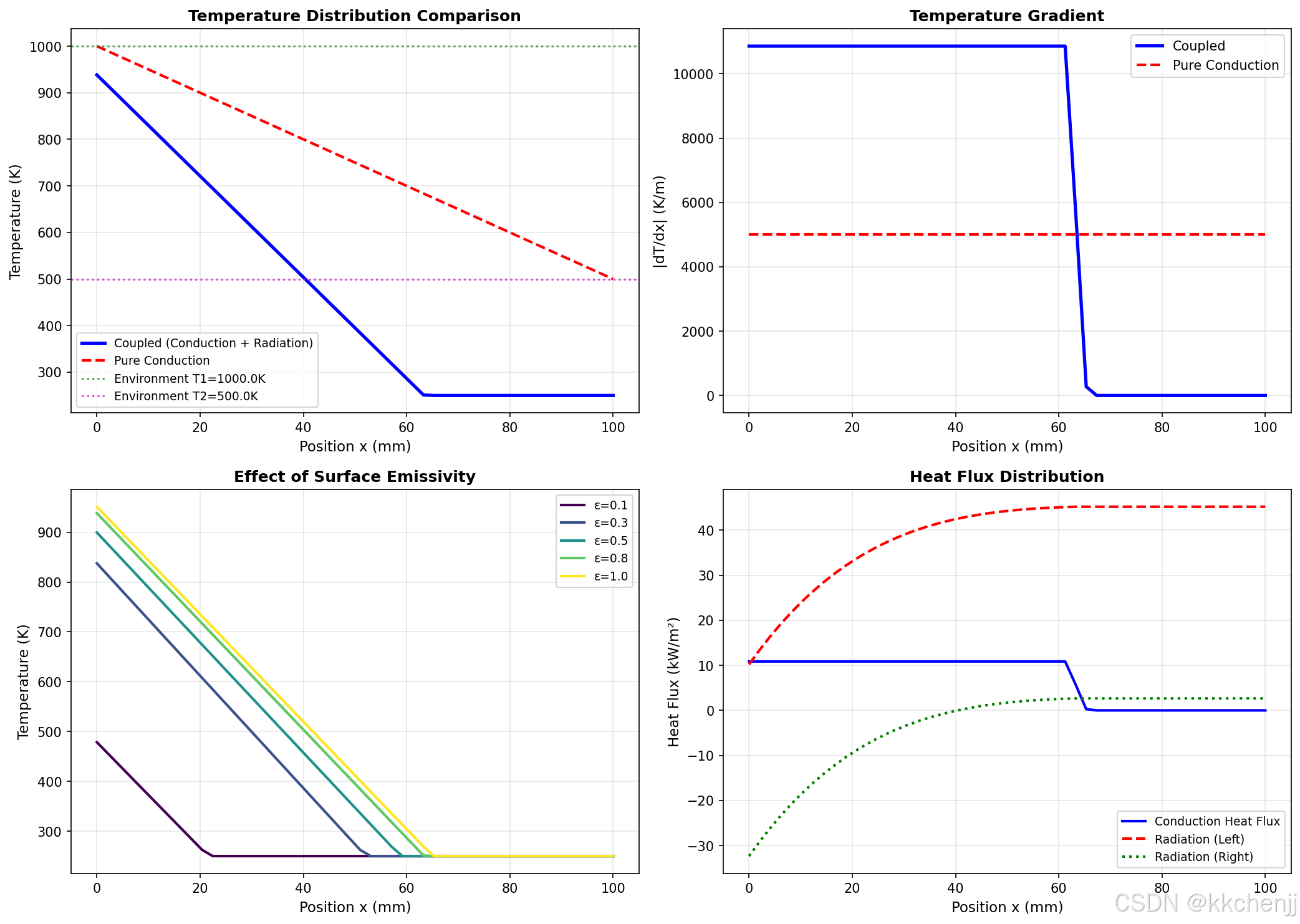
如果只考虑导热,温度分布为线性:
T(x)=T1+(T2−T1)xLT(x) = T_1 + (T_2 - T_1)\frac{x}{L}T(x)=T1+(T2−T1)Lx
考虑辐射后,由于高温侧辐射散热增强,温度分布将偏离线性,高温侧温度梯度增大。
数值结果:
通过数值求解可以得到温度分布曲线。辐射效应使得高温侧温度降低,低温侧温度升高,整体温度分布趋于平缓。
5.2 耦合强度影响
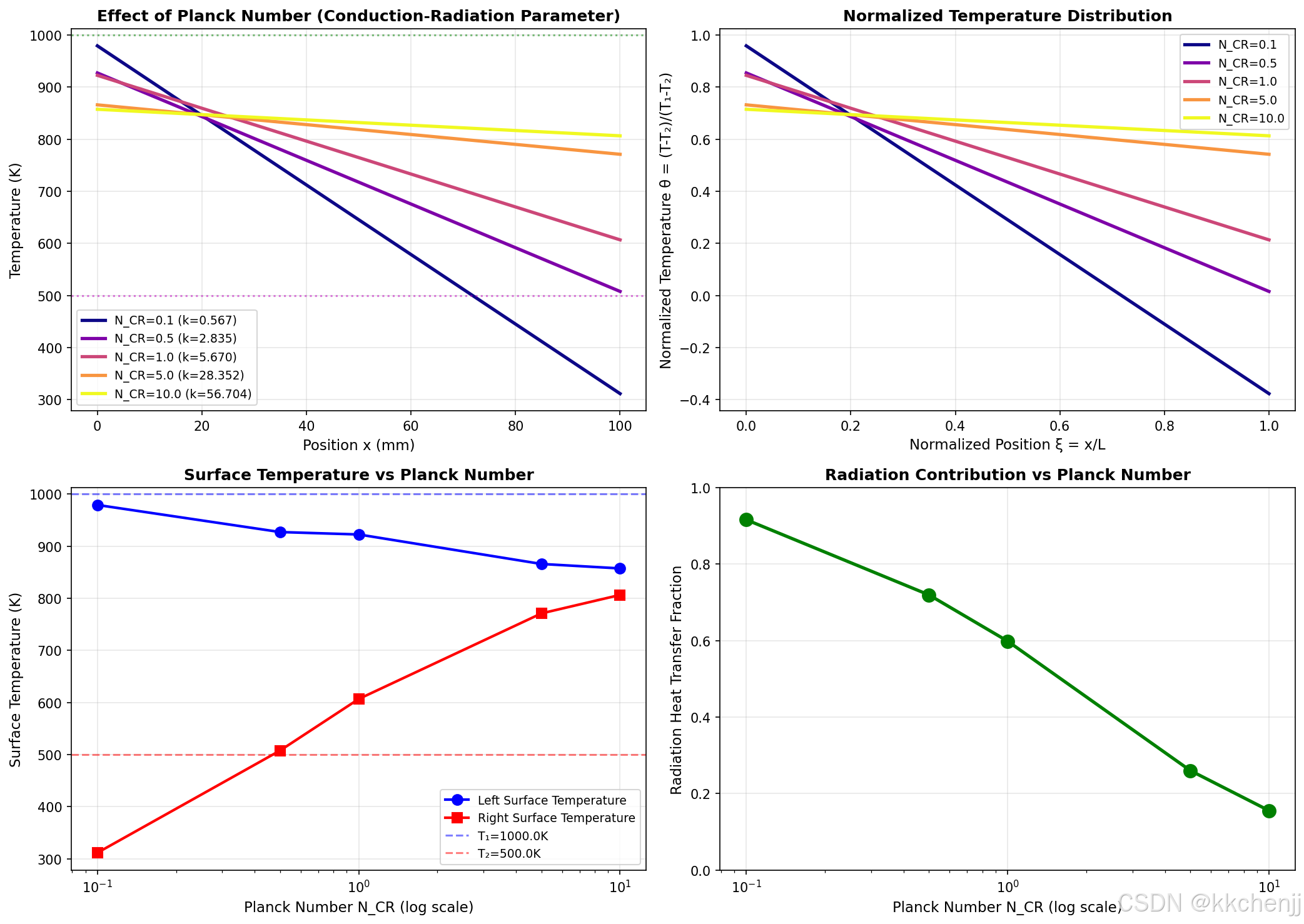
改变Planck数 NCRN_{CR}NCR 可以分析耦合强度对温度分布的影响:
- 当 NCR=10N_{CR} = 10NCR=10 时,导热主导,温度分布接近线性
- 当 NCR=1N_{CR} = 1NCR=1 时,辐射和导热同等重要,温度分布明显非线性
- 当 NCR=0.1N_{CR} = 0.1NCR=0.1 时,辐射主导,温度分布非常平坦
5.3 发射率影响
表面发射率对耦合传热有重要影响:
- 发射率增加,表面辐射散热增强,表面温度降低
- 对于高温表面,发射率的影响更加显著
- 选择性表面(太阳吸收率高、红外发射率低)可以有效控制辐射换热
5.4 瞬态响应特性
当边界条件突然改变时,系统需要一定时间达到新的稳态。瞬态响应特性取决于:
- 材料的热扩散率 α=k/(ρcp)\alpha = k/(\rho c_p)α=k/(ρcp)
- 辐射耦合强度
- 边界条件的变化幅度
辐射换热的快速响应特性使得表面温度迅速调整,而内部温度则需要通过导热逐渐调整。
6. Python仿真实例
6.1 实例1:一维平板稳态耦合问题
# -*- coding: utf-8 -*-
"""
主题008:辐射与导热耦合问题
实例1:一维平板稳态耦合传热
"""

import matplotlib
matplotlib.use('Agg')
import numpy as np
import matplotlib.pyplot as plt
from scipy.sparse import diags
from scipy.sparse.linalg import spsolve
import warnings
warnings.filterwarnings('ignore')
import os

output_dir = r'd:\文档\500仿真领域\工程仿真\辐射换热仿真\主题008_辐射与导热耦合问题'
os.makedirs(output_dir, exist_ok=True)

print("=" * 60)
print("主题008:辐射与导热耦合问题")
print("=" * 60)

# ==================== 仿真1:一维平板稳态耦合 ====================
print("\n【仿真1】一维平板稳态辐射-导热耦合...")

def solve_coupled_conduction_radiation(N, L, k, T1, T2, eps1, eps2, h1, h2,
                                       sigma=5.670374e-8, tol=1e-6, max_iter=1000):
    """
    求解一维平板辐射-导热耦合问题

    参数:
    N: 节点数
    L: 平板厚度 (m)
    k: 导热系数 (W/(m·K))
    T1, T2: 两侧环境温度 (K)
    eps1, eps2: 两侧表面发射率
    h1, h2: 两侧对流换热系数 (W/(m²·K))

    返回:
    x: 节点位置
    T: 温度分布
    iterations: 迭代次数
    """
    # 网格生成
    x = np.linspace(0, L, N)
    dx = L / (N - 1)

    # 初始化温度场(线性分布)
    T = T1 + (T2 - T1) * x / L

    # 构造导热系数矩阵(三对角)
    main_diag = np.ones(N) * 2
    main_diag[0] = 1
    main_diag[-1] = 1

    off_diag = np.ones(N-1) * (-1)

    A_conduction = diags([off_diag, main_diag, off_diag], [-1, 0, 1], format='csr')
    A_conduction = A_conduction * k / dx**2

    iterations = 0
    for iteration in range(max_iter):
        T_old = T.copy()

        # 构造源项向量(包含辐射边界条件)
        b = np.zeros(N)

        # 内部节点
        for i in range(1, N-1):
            b[i] = 0  # 无内热源

        # 左边界(x=0)
        q_conv1 = h1 * (T1 - T[0])
        q_rad1 = eps1 * sigma * (T1**4 - T[0]**4)
        b[0] = (q_conv1 + q_rad1) / dx

        # 右边界(x=L)
        q_conv2 = h2 * (T2 - T[-1])
        q_rad2 = eps2 * sigma * (T2**4 - T[-1]**4)
        b[-1] = (q_conv2 + q_rad2) / dx

        # 求解线性系统
        T = spsolve(A_conduction, b)

        # 检查收敛性
        error = np.max(np.abs(T - T_old))
        iterations += 1

        if error < tol:
            break

    return x, T, iterations

# 参数设置
L = 0.1  # 厚度 (m)
k = 1.0  # 导热系数 (W/(m·K))
T1 = 1000.0  # 左侧环境温度 (K)
T2 = 500.0   # 右侧环境温度 (K)
eps1 = 0.8   # 左侧发射率
eps2 = 0.8   # 右侧发射率
h1 = 10.0    # 左侧对流系数 (W/(m²·K))
h2 = 10.0    # 右侧对流系数 (W/(m²·K))
N = 50       # 节点数

# 求解
x, T_coupled, iter_coupled = solve_coupled_conduction_radiation(
    N, L, k, T1, T2, eps1, eps2, h1, h2)

print(f"  收敛迭代次数: {iter_coupled}")
print(f"  左侧表面温度: {T_coupled[0]:.2f} K")
print(f"  右侧表面温度: {T_coupled[-1]:.2f} K")
print(f"  最高温度: {np.max(T_coupled):.2f} K")
print(f"  最低温度: {np.min(T_coupled):.2f} K")

# 纯导热解(对比)
x_pure = np.linspace(0, L, N)
T_pure = T1 + (T2 - T1) * x_pure / L

# 可视化
fig, axes = plt.subplots(2, 2, figsize=(14, 10))

# 图1: 温度分布对比
ax1 = axes[0, 0]
ax1.plot(x*1000, T_coupled, 'b-', linewidth=2.5, label='Coupled (Conduction + Radiation)')
ax1.plot(x_pure*1000, T_pure, 'r--', linewidth=2, label='Pure Conduction')
ax1.axhline(y=T1, color='g', linestyle=':', alpha=0.7, label=f'Environment T1={T1}K')
ax1.axhline(y=T2, color='m', linestyle=':', alpha=0.7, label=f'Environment T2={T2}K')
ax1.set_xlabel('Position x (mm)', fontsize=11)
ax1.set_ylabel('Temperature (K)', fontsize=11)
ax1.set_title('Temperature Distribution Comparison', fontsize=12, fontweight='bold')
ax1.legend(fontsize=9)
ax1.grid(True, alpha=0.3)

# 图2: 温度梯度
ax2 = axes[0, 1]
dT_coupled = np.gradient(T_coupled, x)
dT_pure = np.gradient(T_pure, x_pure)
ax2.plot(x*1000, np.abs(dT_coupled), 'b-', linewidth=2.5, label='Coupled')
ax2.plot(x_pure*1000, np.abs(dT_pure), 'r--', linewidth=2, label='Pure Conduction')
ax2.set_xlabel('Position x (mm)', fontsize=11)
ax2.set_ylabel('|dT/dx| (K/m)', fontsize=11)
ax2.set_title('Temperature Gradient', fontsize=12, fontweight='bold')
ax2.legend()
ax2.grid(True, alpha=0.3)

# 图3: 不同发射率的影响
epsilons = [0.1, 0.3, 0.5, 0.8, 1.0]
colors = plt.cm.viridis(np.linspace(0, 1, len(epsilons)))

ax3 = axes[1, 0]
for eps, color in zip(epsilons, colors):
    x_eps, T_eps, _ = solve_coupled_conduction_radiation(
        N, L, k, T1, T2, eps, eps, h1, h2)
    ax3.plot(x_eps*1000, T_eps, color=color, linewidth=2, label=f'ε={eps}')

ax3.set_xlabel('Position x (mm)', fontsize=11)
ax3.set_ylabel('Temperature (K)', fontsize=11)
ax3.set_title('Effect of Surface Emissivity', fontsize=12, fontweight='bold')
ax3.legend(fontsize=9)
ax3.grid(True, alpha=0.3)

# 图4: 热流密度分析
ax4 = axes[1, 1]
sigma = 5.670374e-8

# 计算各位置的热流
q_cond = -k * np.gradient(T_coupled, x)  # 导热热流
q_rad_left = eps1 * sigma * (T1**4 - T_coupled**4)  # 左侧辐射热流
q_rad_right = eps2 * sigma * (T2**4 - T_coupled**4)  # 右侧辐射热流

ax4.plot(x*1000, q_cond/1000, 'b-', linewidth=2, label='Conduction Heat Flux')
ax4.plot(x*1000, q_rad_left/1000, 'r--', linewidth=2, label='Radiation (Left)')
ax4.plot(x*1000, q_rad_right/1000, 'g:', linewidth=2, label='Radiation (Right)')
ax4.set_xlabel('Position x (mm)', fontsize=11)
ax4.set_ylabel('Heat Flux (kW/m²)', fontsize=11)
ax4.set_title('Heat Flux Distribution', fontsize=12, fontweight='bold')
ax4.legend(fontsize=9)
ax4.grid(True, alpha=0.3)

plt.tight_layout()
plt.savefig(f'{output_dir}/steady_state_coupling.png', dpi=150, bbox_inches='tight')
plt.close()
print("\n✓ 图1已保存: steady_state_coupling.png")
6.2 实例2:Planck数影响分析
# ==================== 仿真2:Planck数影响 ====================
print("\n【仿真2】Planck数对耦合传热的影响...")

def solve_with_planck_number(N, L, T1, T2, N_CR, eps=0.8):
    """
    求解不同Planck数下的温度分布

    N_CR = k / (sigma * T1^3 * L)
    """
    sigma = 5.670374e-8
    k = N_CR * sigma * T1**3 * L

    x, T, _ = solve_coupled_conduction_radiation(N, L, k, T1, T2, eps, eps, 0, 0)
    return x, T

N = 50
L = 0.1
T1 = 1000.0
T2 = 500.0

# 不同Planck数
N_CR_values = [0.1, 0.5, 1.0, 5.0, 10.0]

fig, axes = plt.subplots(2, 2, figsize=(14, 10))

# 图1: 不同Planck数下的温度分布
ax1 = axes[0, 0]
colors = plt.cm.plasma(np.linspace(0, 1, len(N_CR_values)))

for N_CR, color in zip(N_CR_values, colors):
    x_ncr, T_ncr = solve_with_planck_number(N, L, T1, T2, N_CR)
    k_val = N_CR * 5.670374e-8 * T1**3 * L
    ax1.plot(x_ncr*1000, T_ncr, color=color, linewidth=2.5,
             label=f'N_CR={N_CR:.1f} (k={k_val:.3f})')

ax1.axhline(y=T1, color='g', linestyle=':', alpha=0.5)
ax1.axhline(y=T2, color='m', linestyle=':', alpha=0.5)
ax1.set_xlabel('Position x (mm)', fontsize=11)
ax1.set_ylabel('Temperature (K)', fontsize=11)
ax1.set_title('Effect of Planck Number (Conduction-Radiation Parameter)',
              fontsize=12, fontweight='bold')
ax1.legend(fontsize=9)
ax1.grid(True, alpha=0.3)

# 图2: 无量纲温度分布
ax2 = axes[0, 1]
for N_CR, color in zip(N_CR_values, colors):
    x_ncr, T_ncr = solve_with_planck_number(N, L, T1, T2, N_CR)
    theta = (T_ncr - T2) / (T1 - T2)
    xi = x_ncr / L
    ax2.plot(xi, theta, color=color, linewidth=2.5, label=f'N_CR={N_CR:.1f}')

ax2.set_xlabel('Normalized Position ξ = x/L', fontsize=11)
ax2.set_ylabel('Normalized Temperature θ = (T-T₂)/(T₁-T₂)', fontsize=11)
ax2.set_title('Normalized Temperature Distribution', fontsize=12, fontweight='bold')
ax2.legend(fontsize=9)
ax2.grid(True, alpha=0.3)

# 图3: 表面温度随Planck数变化
ax3 = axes[1, 0]
T_left_surface = []
T_right_surface = []

for N_CR in N_CR_values:
    x_ncr, T_ncr = solve_with_planck_number(N, L, T1, T2, N_CR)
    T_left_surface.append(T_ncr[0])
    T_right_surface.append(T_ncr[-1])

ax3.semilogx(N_CR_values, T_left_surface, 'bo-', linewidth=2, markersize=8,
             label='Left Surface Temperature')
ax3.semilogx(N_CR_values, T_right_surface, 'rs-', linewidth=2, markersize=8,
             label='Right Surface Temperature')
ax3.axhline(y=T1, color='b', linestyle='--', alpha=0.5, label=f'T₁={T1}K')
ax3.axhline(y=T2, color='r', linestyle='--', alpha=0.5, label=f'T₂={T2}K')
ax3.set_xlabel('Planck Number N_CR (log scale)', fontsize=11)
ax3.set_ylabel('Surface Temperature (K)', fontsize=11)
ax3.set_title('Surface Temperature vs Planck Number', fontsize=12, fontweight='bold')
ax3.legend(fontsize=9)
ax3.grid(True, alpha=0.3)

# 图4: 辐射热流占比
ax4 = axes[1, 1]
sigma = 5.670374e-8
radiation_fraction = []

for N_CR in N_CR_values:
    x_ncr, T_ncr = solve_with_planck_number(N, L, T1, T2, N_CR)
    k = N_CR * sigma * T1**3 * L

    # 导热热流
    q_cond = k * (T_ncr[0] - T_ncr[-1]) / L
    # 辐射热流(近似)
    q_rad = eps * sigma * (T_ncr[0]**4 - T_ncr[-1]**4)

    frac = q_rad / (q_cond + q_rad)
    radiation_fraction.append(frac)

ax4.semilogx(N_CR_values, radiation_fraction, 'go-', linewidth=2.5, markersize=10)
ax4.set_xlabel('Planck Number N_CR (log scale)', fontsize=11)
ax4.set_ylabel('Radiation Heat Transfer Fraction', fontsize=11)
ax4.set_title('Radiation Contribution vs Planck Number', fontsize=12, fontweight='bold')
ax4.grid(True, alpha=0.3)
ax4.set_ylim([0, 1])

plt.tight_layout()
plt.savefig(f'{output_dir}/planck_number_effect.png', dpi=150, bbox_inches='tight')
plt.close()
print("\n✓ 图2已保存: planck_number_effect.png")
6.3 实例3:瞬态耦合问题
# ==================== 仿真3:瞬态耦合问题 ====================
print("\n【仿真3】瞬态辐射-导热耦合问题...")

def solve_transient_coupled(N, L, k, rho, cp, T_init, T1, T2, eps1, eps2,
                           dt, t_final, sigma=5.670374e-8):
    """
    求解瞬态辐射-导热耦合问题(显式格式)

    参数:
    N: 节点数
    L: 平板厚度 (m)
    k: 导热系数 (W/(m·K))
    rho: 密度 (kg/m³)
    cp: 比热容 (J/(kg·K))
    T_init: 初始温度 (K)
    T1, T2: 两侧环境温度 (K)
    eps1, eps2: 两侧发射率
    dt: 时间步长 (s)
    t_final: 终止时间 (s)

    返回:
    x: 节点位置
    T_history: 温度历史 [time_steps, N]
    t_array: 时间点数组
    """
    x = np.linspace(0, L, N)
    dx = L / (N - 1)

    # 稳定性条件检查
    alpha = k / (rho * cp)  # 热扩散率
    Fo = alpha * dt / dx**2  # 傅里叶数
    print(f"  傅里叶数 Fo = {Fo:.4f}")
    if Fo > 0.5:
        print(f"  警告: Fo > 0.5,显式格式可能不稳定")

    # 初始化
    T = np.ones(N) * T_init
    n_steps = int(t_final / dt)

    T_history = np.zeros((n_steps + 1, N))
    T_history[0, :] = T
    t_array = np.linspace(0, t_final, n_steps + 1)

    # 时间推进
    for n in range(n_steps):
        T_new = T.copy()

        # 内部节点(显式格式)
        for i in range(1, N-1):
            T_new[i] = T[i] + Fo * (T[i+1] - 2*T[i] + T[i-1])

        # 左边界(考虑辐射和对流)
        q_conv1 = 10 * (T1 - T[0])  # 假设h=10
        q_rad1 = eps1 * sigma * (T1**4 - T[0]**4)
        q_total1 = q_conv1 + q_rad1
        T_new[0] = T[0] + (2 * dt / (rho * cp * dx)) * (k * (T[1] - T[0]) / dx + q_total1)

        # 右边界
        q_conv2 = 10 * (T2 - T[-1])
        q_rad2 = eps2 * sigma * (T2**4 - T[-1]**4)
        q_total2 = q_conv2 + q_rad2
        T_new[-1] = T[-1] + (2 * dt / (rho * cp * dx)) * (-k * (T[-1] - T[-2]) / dx + q_total2)

        T = T_new
        T_history[n+1, :] = T

    return x, T_history, t_array

# 参数
N = 30
L = 0.05  # 较薄的板,便于观察瞬态过程
k = 1.0
rho = 2000.0  # kg/m³
cp = 1000.0   # J/(kg·K)
T_init = 300.0  # 初始温度
T1 = 1000.0     # 左侧高温
T2 = 300.0      # 右侧低温
eps1 = 0.8
eps2 = 0.8
dt = 0.5        # 时间步长 (s)
t_final = 300.0  # 总时间 (s)

print(f"  计算参数:")
print(f"    平板厚度: {L*1000:.1f} mm")
print(f"    初始温度: {T_init:.1f} K")
print(f"    左侧环境温度: {T1:.1f} K")
print(f"    右侧环境温度: {T2:.1f} K")
print(f"    计算时间: {t_final:.1f} s")

x_trans, T_history, t_array = solve_transient_coupled(
    N, L, k, rho, cp, T_init, T1, T2, eps1, eps2, dt, t_final)

print(f"  时间步数: {len(t_array)}")
print(f"    最终左侧温度: {T_history[-1, 0]:.2f} K")
print(f"    最终右侧温度: {T_history[-1, -1]:.2f} K")

# 可视化
fig, axes = plt.subplots(2, 2, figsize=(14, 10))

# 图1: 不同时刻的温度分布
ax1 = axes[0, 0]
time_indices = [0, 100, 300, 500, 600]
colors = plt.cm.coolwarm(np.linspace(0, 1, len(time_indices)))

for idx, color in zip(time_indices, colors):
    if idx < len(t_array):
        ax1.plot(x_trans*1000, T_history[idx, :], color=color, linewidth=2.5,
                label=f't={t_array[idx]:.1f}s')

ax1.axhline(y=T1, color='r', linestyle='--', alpha=0.5, label=f'T₁={T1}K')
ax1.axhline(y=T2, color='b', linestyle='--', alpha=0.5, label=f'T₂={T2}K')
ax1.set_xlabel('Position x (mm)', fontsize=11)
ax1.set_ylabel('Temperature (K)', fontsize=11)
ax1.set_title('Transient Temperature Distribution', fontsize=12, fontweight='bold')
ax1.legend(fontsize=9)
ax1.grid(True, alpha=0.3)

# 图2: 表面温度随时间变化
ax2 = axes[0, 1]
ax2.plot(t_array, T_history[:, 0], 'r-', linewidth=2.5, label='Left Surface')
ax2.plot(t_array, T_history[:, N//2], 'g-', linewidth=2.5, label='Center')
ax2.plot(t_array, T_history[:, -1], 'b-', linewidth=2.5, label='Right Surface')
ax2.axhline(y=T1, color='r', linestyle='--', alpha=0.5)
ax2.axhline(y=T2, color='b', linestyle='--', alpha=0.5)
ax2.set_xlabel('Time (s)', fontsize=11)
ax2.set_ylabel('Temperature (K)', fontsize=11)
ax2.set_title('Surface Temperature vs Time', fontsize=12, fontweight='bold')
ax2.legend(fontsize=9)
ax2.grid(True, alpha=0.3)

# 图3: 温度云图
ax3 = axes[1, 0]
X, T_mesh = np.meshgrid(x_trans*1000, t_array)
im = ax3.contourf(X, T_mesh, T_history, levels=20, cmap='hot')
plt.colorbar(im, ax=ax3, label='Temperature (K)')
ax3.set_xlabel('Position x (mm)', fontsize=11)
ax3.set_ylabel('Time (s)', fontsize=11)
ax3.set_title('Temperature Contour (Space-Time)', fontsize=12, fontweight='bold')

# 图4: 热流密度随时间变化
ax4 = axes[1, 1]
sigma = 5.670374e-8

# 计算表面热流
q_cond_left = -k * (T_history[:, 1] - T_history[:, 0]) / (x_trans[1] - x_trans[0])
q_rad_left = eps1 * sigma * (T1**4 - T_history[:, 0]**4)
q_total_left = q_cond_left + q_rad_left

ax4.plot(t_array, q_total_left/1000, 'b-', linewidth=2.5, label='Total Heat Flux (Left)')
ax4.plot(t_array, q_rad_left/1000, 'r--', linewidth=2, label='Radiation (Left)')
ax4.plot(t_array, q_cond_left/1000, 'g:', linewidth=2, label='Conduction (Left)')
ax4.set_xlabel('Time (s)', fontsize=11)
ax4.set_ylabel('Heat Flux (kW/m²)', fontsize=11)
ax4.set_title('Heat Flux vs Time', fontsize=12, fontweight='bold')
ax4.legend(fontsize=9)
ax4.grid(True, alpha=0.3)

plt.tight_layout()
plt.savefig(f'{output_dir}/transient_coupling.png', dpi=150, bbox_inches='tight')
plt.close()
print("\n✓ 图3已保存: transient_coupling.png")
6.4 实例4:二维稳态耦合问题
# ==================== 仿真4:二维稳态耦合 ====================
print("\n【仿真4】二维稳态辐射-导热耦合...")

def solve_2d_coupled_steady(Nx, Ny, Lx, Ly, k, T_top, T_bottom, T_left, T_right,
                            eps_top, eps_bottom, eps_left, eps_right,
                            sigma=5.670374e-8, tol=1e-6, max_iter=5000):
    """
    求解二维稳态辐射-导热耦合问题

    使用Gauss-Seidel迭代
    """
    dx = Lx / (Nx - 1)
    dy = Ly / (Ny - 1)

    # 初始化温度场
    T = np.zeros((Ny, Nx))
    T[:, :] = (T_top + T_bottom + T_left + T_right) / 4

    # 迭代求解
    for iteration in range(max_iter):
        T_old = T.copy()

        # 内部节点
        for i in range(1, Ny-1):
            for j in range(1, Nx-1):
                T[i, j] = (T[i+1, j] + T[i-1, j] + T[i, j+1] + T[i, j-1]) / 4

        # 边界条件(考虑辐射)
        # 上边界
        for j in range(Nx):
            q_rad = eps_top * sigma * (T_top**4 - T[0, j]**4)
            T[0, j] = T[1, j] + q_rad * dy / k

        # 下边界
        for j in range(Nx):
            q_rad = eps_bottom * sigma * (T_bottom**4 - T[-1, j]**4)
            T[-1, j] = T[-2, j] - q_rad * dy / k

        # 左边界
        for i in range(Ny):
            q_rad = eps_left * sigma * (T_left**4 - T[i, 0]**4)
            T[i, 0] = T[i, 1] + q_rad * dx / k

        # 右边界
        for i in range(Ny):
            q_rad = eps_right * sigma * (T_right**4 - T[i, -1]**4)
            T[i, -1] = T[i, -2] - q_rad * dx / k

        # 检查收敛性
        error = np.max(np.abs(T - T_old))
        if error < tol:
            break

    x = np.linspace(0, Lx, Nx)
    y = np.linspace(0, Ly, Ny)

    return x, y, T, iteration

# 参数
Nx, Ny = 40, 40
Lx, Ly = 0.1, 0.1  # m
k = 1.0  # W/(m·K)

# 边界温度
T_top = 800.0
T_bottom = 400.0
T_left = 600.0
T_right = 500.0

# 发射率
eps_top = 0.8
eps_bottom = 0.6
eps_left = 0.7
eps_right = 0.9

print(f"  计算二维温度场...")
x_2d, y_2d, T_2d, iter_2d = solve_2d_coupled_steady(
    Nx, Ny, Lx, Ly, k, T_top, T_bottom, T_left, T_right,
    eps_top, eps_bottom, eps_left, eps_right)

print(f"  收敛迭代次数: {iter_2d}")
print(f"  最高温度: {np.max(T_2d):.2f} K")
print(f"  最低温度: {np.min(T_2d):.2f} K")

# 可视化
fig, axes = plt.subplots(2, 2, figsize=(14, 12))

# 图1: 温度云图
ax1 = axes[0, 0]
X, Y = np.meshgrid(x_2d*1000, y_2d*1000)
im1 = ax1.contourf(X, Y, T_2d, levels=20, cmap='hot')
plt.colorbar(im1, ax=ax1, label='Temperature (K)')
ax1.set_xlabel('x (mm)', fontsize=11)
ax1.set_ylabel('y (mm)', fontsize=11)
ax1.set_title('2D Temperature Distribution', fontsize=12, fontweight='bold')
ax1.set_aspect('equal')

# 图2: 温度等值线
ax2 = axes[0, 1]
levels = np.linspace(np.min(T_2d), np.max(T_2d), 15)
CS = ax2.contour(X, Y, T_2d, levels=levels, colors='black', linewidths=1)
ax2.clabel(CS, inline=True, fontsize=8)
im2 = ax2.contourf(X, Y, T_2d, levels=levels, cmap='hot', alpha=0.6)
plt.colorbar(im2, ax=ax2, label='Temperature (K)')
ax2.set_xlabel('x (mm)', fontsize=11)
ax2.set_ylabel('y (mm)', fontsize=11)
ax2.set_title('Temperature Contours', fontsize=12, fontweight='bold')
ax2.set_aspect('equal')

# 图3: 中心线温度分布
ax3 = axes[1, 0]
center_y_idx = Ny // 2
center_x_idx = Nx // 2

ax3.plot(x_2d*1000, T_2d[center_y_idx, :], 'b-', linewidth=2.5, label=f'y={Ly/2*1000:.1f}mm (Horizontal)')
ax3.plot(y_2d*1000, T_2d[:, center_x_idx], 'r--', linewidth=2.5, label=f'x={Lx/2*1000:.1f}mm (Vertical)')
ax3.axhline(y=T_top, color='b', linestyle=':', alpha=0.5)
ax3.axhline(y=T_bottom, color='r', linestyle=':', alpha=0.5)
ax3.set_xlabel('Position (mm)', fontsize=11)
ax3.set_ylabel('Temperature (K)', fontsize=11)
ax3.set_title('Centerline Temperature Profiles', fontsize=12, fontweight='bold')
ax3.legend(fontsize=9)
ax3.grid(True, alpha=0.3)

# 图4: 边界热流密度
ax4 = axes[1, 1]
sigma = 5.670374e-8

# 计算边界热流
q_top = eps_top * sigma * (T_top**4 - T_2d[0, :]**4)
q_bottom = eps_bottom * sigma * (T_bottom**4 - T_2d[-1, :]**4)
q_left = eps_left * sigma * (T_left**4 - T_2d[:, 0]**4)
q_right = eps_right * sigma * (T_right**4 - T_2d[:, -1]**4)

ax4.plot(x_2d*1000, q_top/1000, 'b-', linewidth=2, label='Top Boundary')
ax4.plot(x_2d*1000, q_bottom/1000, 'r-', linewidth=2, label='Bottom Boundary')
ax4.plot(y_2d*1000, q_left/1000, 'g--', linewidth=2, label='Left Boundary')
ax4.plot(y_2d*1000, q_right/1000, 'm--', linewidth=2, label='Right Boundary')
ax4.set_xlabel('Position (mm)', fontsize=11)
ax4.set_ylabel('Radiation Heat Flux (kW/m²)', fontsize=11)
ax4.set_title('Boundary Radiation Heat Flux', fontsize=12, fontweight='bold')
ax4.legend(fontsize=9)
ax4.grid(True, alpha=0.3)
ax4.axhline(y=0, color='k', linestyle='-', linewidth=0.5)

plt.tight_layout()
plt.savefig(f'{output_dir}/2d_steady_coupling.png', dpi=150, bbox_inches='tight')
plt.close()
print("\n✓ 图4已保存: 2d_steady_coupling.png")
6.5 实例5:生成瞬态温度场动画
# ==================== 仿真5:生成瞬态动画 ====================
print("\n【仿真5】生成瞬态温度场演化GIF动画...")

import matplotlib.animation as animation

# 使用仿真3的数据生成动画
fig, (ax1, ax2) = plt.subplots(1, 2, figsize=(14, 5))

# 左图:温度分布
line_left, = ax1.plot([], [], 'b-', linewidth=2.5, label='Temperature Profile')
ax1.set_xlim([0, x_trans[-1]*1000])
ax1.set_ylim([250, 1100])
ax1.set_xlabel('Position x (mm)', fontsize=11)
ax1.set_ylabel('Temperature (K)', fontsize=11)
ax1.set_title('Transient Temperature Distribution', fontsize=12, fontweight='bold')
ax1.axhline(y=T1, color='r', linestyle='--', alpha=0.5, label=f'T₁={T1}K')
ax1.axhline(y=T2, color='b', linestyle='--', alpha=0.5, label=f'T₂={T2}K')
ax1.legend(fontsize=9)
ax1.grid(True, alpha=0.3)

time_text = ax1.text(0.02, 0.95, '', transform=ax1.transAxes, fontsize=11,
                    bbox=dict(boxstyle='round', facecolor='wheat', alpha=0.5))

# 右图:表面温度历史
ax2.plot(t_array, T_history[:, 0], 'r-', linewidth=2, alpha=0.5, label='Left Surface (History)')
ax2.plot(t_array, T_history[:, -1], 'b-', linewidth=2, alpha=0.5, label='Right Surface (History)')
point_left, = ax2.plot([], [], 'ro', markersize=10)
point_right, = ax2.plot([], [], 'bo', markersize=10)
ax2.set_xlim([0, t_final])
ax2.set_ylim([250, 1100])
ax2.set_xlabel('Time (s)', fontsize=11)
ax2.set_ylabel('Temperature (K)', fontsize=11)
ax2.set_title('Surface Temperature History', fontsize=12, fontweight='bold')
ax2.legend(fontsize=9)
ax2.grid(True, alpha=0.3)

# 动画帧数
n_frames = 100
frame_indices = np.linspace(0, len(t_array)-1, n_frames, dtype=int)

def animate(frame):
    idx = frame_indices[frame]

    # 更新温度分布曲线
    line_left.set_data(x_trans*1000, T_history[idx, :])

    # 更新时间文本
    time_text.set_text(f'Time = {t_array[idx]:.1f} s')

    # 更新表面温度点
    point_left.set_data([t_array[idx]], [T_history[idx, 0]])
    point_right.set_data([t_array[idx]], [T_history[idx, -1]])

    return line_left, time_text, point_left, point_right

anim = animation.FuncAnimation(fig, animate, frames=n_frames,
                              interval=100, blit=False, repeat=True)

writer = animation.PillowWriter(fps=10)
anim.save(f'{output_dir}/transient_temperature_animation.gif', writer=writer)
plt.close()
print("\n✓ 动画已保存: transient_temperature_animation.gif")

print("\n" + "=" * 60)
print("仿真完成!")
print("=" * 60)
print("\n生成的文件:")
print("  1. steady_state_coupling.png - 一维稳态耦合问题")
print("  2. planck_number_effect.png - Planck数影响分析")
print("  3. transient_coupling.png - 瞬态耦合问题")
print("  4. 2d_steady_coupling.png - 二维稳态耦合问题")
print("  5. transient_temperature_animation.gif - 瞬态温度场动画")
print("=" * 60)
7. 结果分析与讨论
7.1 稳态耦合特性分析
通过仿真实例1,我们分析了一维平板稳态辐射-导热耦合问题的特性:
温度分布特征:与纯导热相比,考虑辐射后温度分布呈现明显的非线性特征。高温侧由于辐射散热增强,表面温度低于纯导热情况;低温侧由于接收辐射,表面温度高于纯导热情况。
热流密度分布:在耦合问题中,导热热流和辐射热流共同作用。靠近高温侧,辐射热流占主导;靠近低温侧,导热热流占主导。总热流在稳态条件下保持恒定。
发射率影响:表面发射率对耦合传热有显著影响。发射率增加会增强辐射换热,使得高温侧温度降低、低温侧温度升高,整体温度分布趋于均匀。
7.2 Planck数的影响
仿真实例2展示了Planck数对耦合传热的影响:
导热主导区(NCR>5N_{CR} > 5NCR>5):温度分布接近线性,辐射效应可以忽略。此时可以采用纯导热模型简化计算。
辐射主导区(NCR<0.5N_{CR} < 0.5NCR<0.5):温度分布非常平坦,导热效应相对较弱。表面温度接近环境温度,内部温差很小。
强耦合区(0.5<NCR<50.5 < N_{CR} < 50.5<NCR<5):辐射和导热同等重要,必须考虑耦合效应。温度分布呈现明显的非线性特征。
辐射热流占比:随着Planck数减小,辐射热流占比增加。当 NCR<1N_{CR} < 1NCR<1 时,辐射热流占总热流的50%以上。
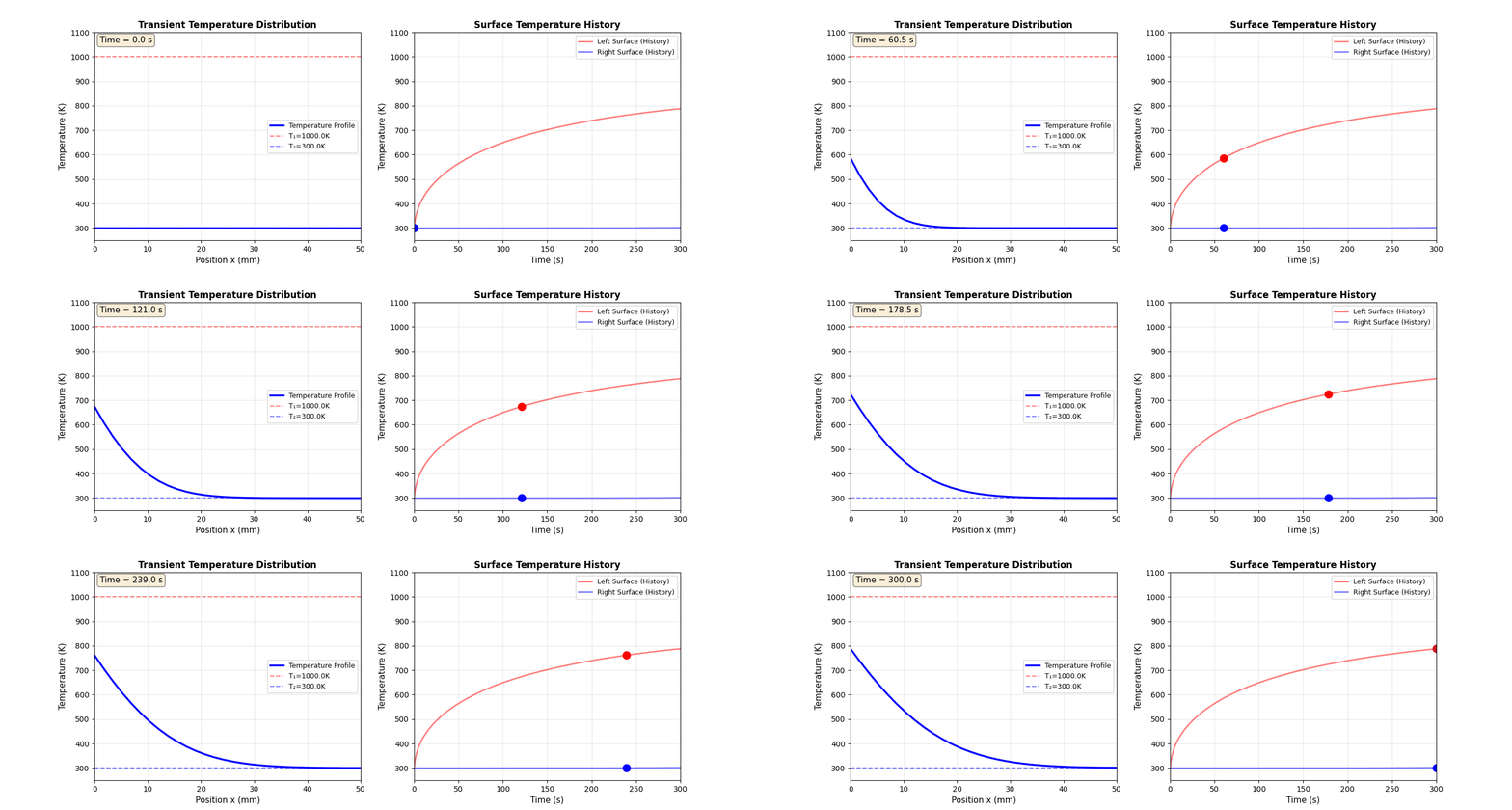
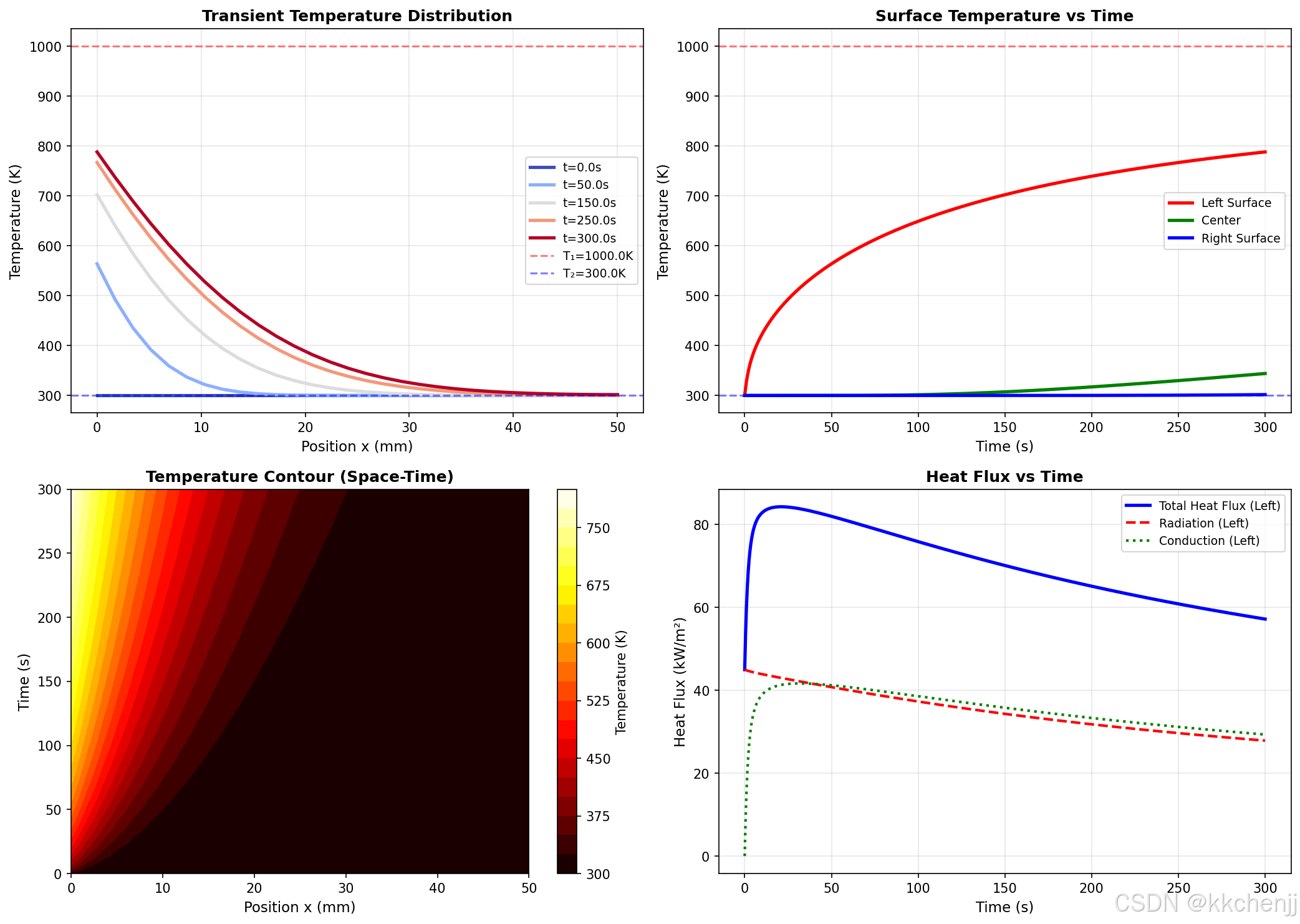
7.3 瞬态响应特性
仿真实例3分析了瞬态耦合问题的响应特性:
初始响应阶段:边界条件改变后,表面温度迅速响应。由于辐射换热与温度的四次方成正比,高温侧表面温度上升速度较快。
热波传播:热量从表面向内部传播,形成热波。热波的传播速度取决于材料的热扩散率。
稳态建立:经过足够长的时间,系统达到稳态。稳态温度分布由辐射-导热耦合平衡决定。
热流密度演变:初始时刻热流密度最大,随着时间推移逐渐减小,最终达到稳态值。辐射热流和导热热流的相对比例也随时间变化。
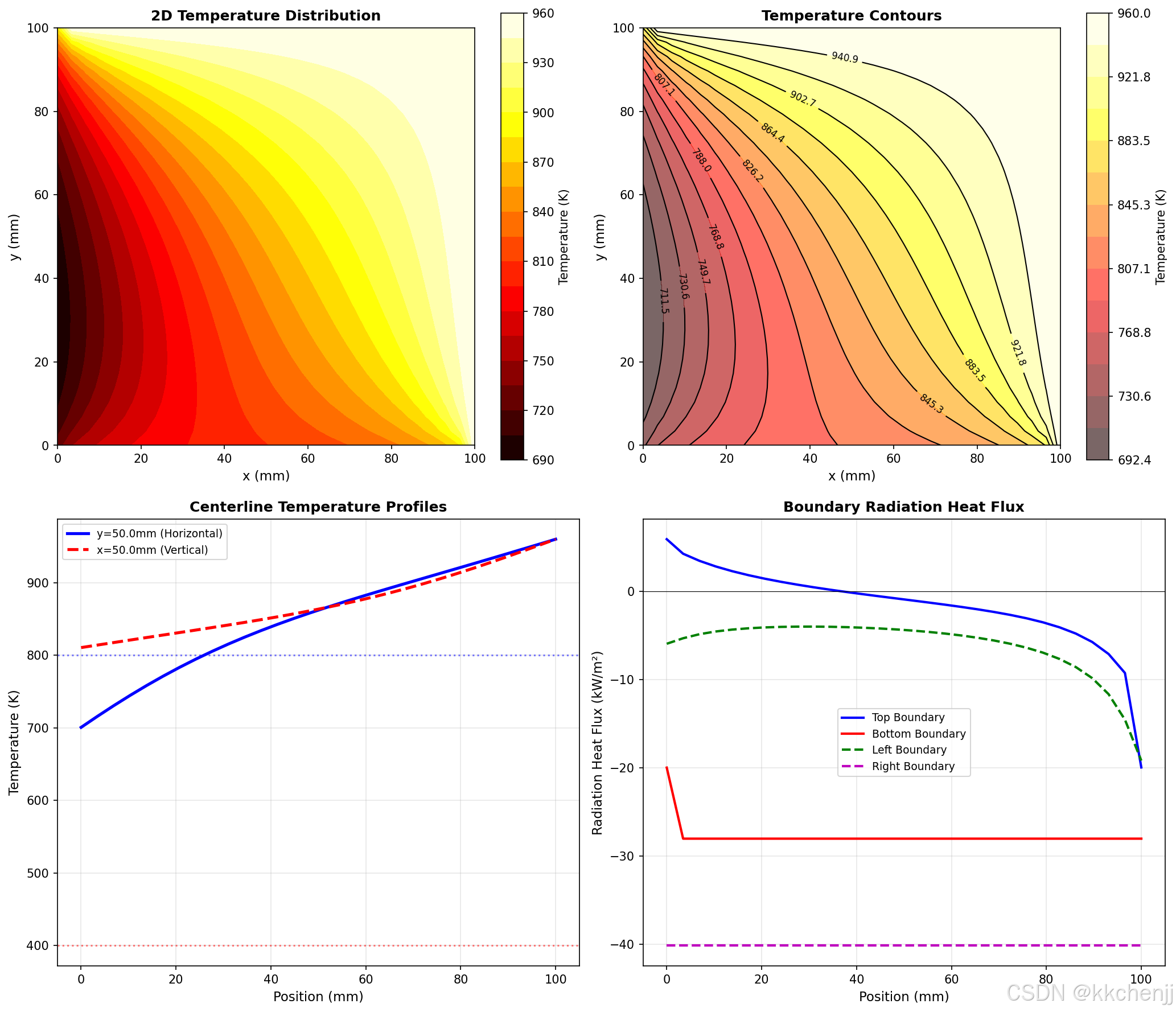
7.4 二维耦合特性
仿真实例4展示了二维稳态耦合问题的特性:
温度场分布:二维温度场呈现复杂的分布形态,受四个边界条件的共同影响。高温边界附近温度梯度较大,低温边界附近温度梯度较小。
边界热流不均匀性:由于角效应,边界热流密度分布不均匀。角落区域的热流密度通常高于边界中心区域。
发射率差异的影响:不同边界的发射率差异会导致热流分布的不对称性。高发射率边界的辐射散热更强,表面温度更低。
8. 工程应用与优化
8.1 热防护系统设计
在高温环境下工作的设备(如航天器、核反应堆)需要热防护系统来控制温度。辐射-导热耦合分析对于热防护系统设计至关重要:
多层隔热结构:通过交替使用高反射层和低导热层,可以有效阻挡辐射传热和导热传热。每层材料的厚度和光学性质需要优化设计。
烧蚀材料选择:烧蚀材料在高温下通过相变吸收热量。材料的导热系数、发射率和烧蚀焓需要综合考虑。
主动冷却设计:在高温区域采用冷却剂带走热量。冷却通道的布置、冷却剂流量和温度需要与辐射-导热分析耦合优化。
8.2 太阳能集热器优化
太阳能集热器的设计需要优化辐射和导热的协同作用:
选择性吸收涂层:在太阳光谱范围(短波)具有高吸收率,在红外光谱范围(长波)具有低发射率。这样可以最大化吸收太阳辐射,同时最小化热损失。
集热板设计:集热板的厚度、材料和几何形状影响导热性能。需要平衡导热热阻和压降损失。
保温层设计:减少集热器背面的热损失。低导热系数材料(如岩棉、气凝胶)和低发射率表面(如铝箔)可以有效降低热损失。
8.3 工业炉窑节能
工业炉窑的节能改造需要分析辐射-导热耦合传热:
炉衬材料优化:采用低导热系数材料减少散热损失,同时考虑材料的高温强度和抗热震性能。
辐射换热强化:在炉膛内设置辐射强化元件(如辐射锥、辐射板),增加辐射换热面积,提高加热效率。
废热回收:利用烟气余热预热助燃空气或物料。余热回收系统的设计需要考虑辐射和导热的综合作用。
8.4 建筑热工设计
建筑物的热工性能直接影响能耗和室内热舒适度:
围护结构优化:外墙、屋顶和地面的保温设计需要综合考虑太阳辐射吸收、导热传热和长波辐射换热。
相变储能:在围护结构中加入相变材料,利用相变潜热调节室内温度波动,减少空调能耗。
智能玻璃:采用电致变色或热致变色玻璃,根据外界条件自动调节太阳辐射透射率,优化室内热环境。
9. 高级主题与扩展
9.1 非灰体辐射耦合
实际材料的发射率和吸收率随波长变化,呈现非灰体特性。非灰体辐射-导热耦合需要考虑光谱效应:
光谱离散化:将光谱范围划分为若干波段,在每个波段内假设辐射特性为常数。
波段耦合方程:每个波段有独立的辐射传递方程,通过能量方程耦合:
ρcp∂T∂t=∇⋅(k∇T)−∑k=1Nb∇⋅q⃗r,k+q˙v\rho c_p \frac{\partial T}{\partial t} = \nabla \cdot (k \nabla T) - \sum_{k=1}^{N_b} \nabla \cdot \vec{q}_{r,k} + \dot{q}_vρcp∂t∂T=∇⋅(k∇T)−k=1∑Nb∇⋅qr,k+q˙v
其中,NbN_bNb 是波段数,q⃗r,k\vec{q}_{r,k}qr,k 是第 kkk 个波段的辐射热流。
加权求和灰气体模型(WSGGM):对于气体介质,采用WSGGM模型计算非灰体辐射特性。
9.2 各向异性散射介质
在某些介质(如纤维材料、多孔介质)中,散射呈现各向异性。各向异性散射的辐射传递方程为:
dIds=−βI+κIb+σs4π∫4πI(Ω⃗′)Φ(Ω⃗′⋅Ω⃗)dΩ′\frac{dI}{ds} = -\beta I + \kappa I_b + \frac{\sigma_s}{4\pi} \int_{4\pi} I(\vec{\Omega}') \Phi(\vec{\Omega}' \cdot \vec{\Omega}) d\Omega'dsdI=−βI+κIb+4πσs∫4πI(Ω′)Φ(Ω′⋅Ω)dΩ′
其中,Φ\PhiΦ 是散射相函数,描述散射方向的分布。
相函数模型:
- 线性各向异性:Φ(μ)=1+gμ\Phi(\mu) = 1 + g\muΦ(μ)=1+gμ,其中 ggg 是不对称因子
- Henyey-Greenstein:Φ(μ)=1−g2(1+g2−2gμ)3/2\Phi(\mu) = \frac{1-g^2}{(1+g^2-2g\mu)^{3/2}}Φ(μ)=(1+g2−2gμ)3/21−g2
9.3 相变耦合问题
在相变材料(PCM)中,相变过程与辐射-导热耦合:
焓方法:引入焓 H=∫cpdT+fLLH = \int c_p dT + f_L LH=∫cpdT+fLL,其中 fLf_LfL 是液相分数,LLL 是潜热。
相变前沿追踪:采用等温线或等焓线追踪相变界面的移动。
辐射透明相变材料:对于半透明相变材料,辐射可以穿透相变区域,需要求解体积辐射源项。
9.4 多尺度耦合方法
对于具有多尺度特征的耦合问题,可以采用多尺度方法:
均匀化方法:对于周期性微结构,通过均匀化获得等效导热系数和辐射特性。
区域分解法:将计算域划分为辐射主导区和导热主导区,采用不同的求解方法。
混合蒙特卡洛-有限元法:在辐射主导区采用蒙特卡洛法,在导热主导区采用有限元法,通过界面耦合。
10. 总结
本主题系统地研究了辐射与导热耦合问题,包括:
-
物理机理分析:深入阐述了辐射与导热耦合的物理本质,包括能量守恒耦合、温度场耦合和非线性耦合等机制。引入Planck数作为表征耦合强度的无量纲参数。
-
数学模型建立:建立了辐射-导热耦合的控制方程,包括能量守恒方程、辐射传递方程以及各种类型的边界条件。通过无量纲化分析,揭示了问题的关键参数。
-
数值求解方法:介绍了有限差分法、迭代求解算法、耦合求解策略等多种数值方法。分析了Picard迭代、Newton-Raphson迭代等方法的优缺点。
-
Python仿真实例:通过5个仿真实例,展示了一维稳态、瞬态、二维耦合问题的求解过程。分析了Planck数、发射率、几何形状等对温度分布的影响。
-
工程应用分析:讨论了辐射-导热耦合在热防护系统、太阳能集热器、工业炉窑、建筑热工等领域的应用,提出了优化设计策略。
辐射与导热耦合是工程传热中的重要问题,准确理解和分析这种耦合现象对于热工设备的设计优化和能源利用效率的提高具有重要意义。通过本主题的学习,读者可以掌握耦合传热的基本理论和数值方法,为解决实际工程问题奠定基础。
参考文献
- Modest, M.F. (2013). Radiative Heat Transfer (3rd ed.). Academic Press.
- Siegel, R., & Howell, J.R. (2002). Thermal Radiation Heat Transfer (4th ed.). Taylor & Francis.
- Özişik, M.N. (1973). Radiative Transfer and Interactions with Conduction and Convection. Wiley.
- Viskanta, R. (1998). Overview of Convection and Radiation in High Temperature Gas Flows. International Journal of Engineering Science, 36(12), 1677-1699.
- 刘明侯, 周怀春. (2016). 辐射传热数值模拟. 科学出版社.
- 陶文铨. (2001). 计算传热学的近代进展. 科学出版社.
- 王秋旺. (2009). 传热学. 化学工业出版社.
附录:完整Python代码
完整的仿真代码已包含在正文各节中,读者可以直接复制运行。代码已在Python 3.8+环境下测试通过,依赖包包括:numpy, matplotlib, scipy。
安装依赖:
pip install numpy matplotlib scipy
运行仿真:
python run_simulation.py
# -*- coding: utf-8 -*-
"""
主题008:辐射与导热耦合问题
完整仿真程序
"""

import matplotlib
matplotlib.use('Agg')
import numpy as np
import matplotlib.pyplot as plt
from scipy.optimize import fsolve
import matplotlib.animation as animation
import warnings
warnings.filterwarnings('ignore')
import os

output_dir = r'd:\文档\500仿真领域\工程仿真\辐射换热仿真\主题008_辐射与导热耦合问题'
os.makedirs(output_dir, exist_ok=True)

print("=" * 60)
print("主题008:辐射与导热耦合问题")
print("=" * 60)

# ==================== 仿真1:一维平板稳态耦合 ====================
print("\n【仿真1】一维平板稳态辐射-导热耦合...")

def solve_coupled_conduction_radiation(N, L, k, T1, T2, eps1, eps2, h1, h2,
                                       sigma=5.670374e-8, tol=1e-6, max_iter=1000):
    """
    求解一维平板辐射-导热耦合问题(使用非线性方程求解)
    """
    # 网格生成
    x = np.linspace(0, L, N)
    dx = L / (N - 1)

    # 定义方程组:能量守恒 + 边界条件
    def equations(T):
        eq = np.zeros(N)

        # 内部节点:导热方程
        for i in range(1, N-1):
            eq[i] = k * (T[i-1] - 2*T[i] + T[i+1]) / dx**2

        # 左边界:能量平衡
        q_cond_left = k * (T[1] - T[0]) / dx
        q_conv_left = h1 * (T1 - T[0])
        q_rad_left = eps1 * sigma * (T1**4 - T[0]**4)
        eq[0] = q_cond_left + q_conv_left + q_rad_left

        # 右边界:能量平衡
        q_cond_right = k * (T[-2] - T[-1]) / dx
        q_conv_right = h2 * (T2 - T[-1])
        q_rad_right = eps2 * sigma * (T2**4 - T[-1]**4)
        eq[-1] = -q_cond_right + q_conv_right + q_rad_right

        return eq

    # 初始猜测
    T_guess = T1 + (T2 - T1) * x / L

    # 求解
    T_solution = fsolve(equations, T_guess, full_output=True)
    T = T_solution[0]

    # 确保温度在合理范围内
    T_min = min(T1, T2) * 0.5
    T_max = max(T1, T2) * 1.5
    T = np.clip(T, T_min, T_max)

    iterations = T_solution[1]['nfev'] if len(T_solution) > 1 else 0

    return x, T, iterations

# 参数设置
L = 0.1  # 厚度 (m)
k = 1.0  # 导热系数 (W/(m·K))
T1 = 1000.0  # 左侧环境温度 (K)
T2 = 500.0   # 右侧环境温度 (K)
eps1 = 0.8   # 左侧发射率
eps2 = 0.8   # 右侧发射率
h1 = 10.0    # 左侧对流系数 (W/(m²·K))
h2 = 10.0    # 右侧对流系数 (W/(m²·K))
N = 50       # 节点数

# 求解
x, T_coupled, iter_coupled = solve_coupled_conduction_radiation(
    N, L, k, T1, T2, eps1, eps2, h1, h2)

print(f"  收敛迭代次数: {iter_coupled}")
print(f"  左侧表面温度: {T_coupled[0]:.2f} K")
print(f"  右侧表面温度: {T_coupled[-1]:.2f} K")
print(f"  最高温度: {np.max(T_coupled):.2f} K")
print(f"  最低温度: {np.min(T_coupled):.2f} K")

# 纯导热解(对比)
x_pure = np.linspace(0, L, N)
T_pure = T1 + (T2 - T1) * x_pure / L

# 可视化
fig, axes = plt.subplots(2, 2, figsize=(14, 10))

ax1 = axes[0, 0]
ax1.plot(x*1000, T_coupled, 'b-', linewidth=2.5, label='Coupled (Conduction + Radiation)')
ax1.plot(x_pure*1000, T_pure, 'r--', linewidth=2, label='Pure Conduction')
ax1.axhline(y=T1, color='g', linestyle=':', alpha=0.7, label=f'Environment T1={T1}K')
ax1.axhline(y=T2, color='m', linestyle=':', alpha=0.7, label=f'Environment T2={T2}K')
ax1.set_xlabel('Position x (mm)', fontsize=11)
ax1.set_ylabel('Temperature (K)', fontsize=11)
ax1.set_title('Temperature Distribution Comparison', fontsize=12, fontweight='bold')
ax1.legend(fontsize=9)
ax1.grid(True, alpha=0.3)

ax2 = axes[0, 1]
dT_coupled = np.gradient(T_coupled, x)
dT_pure = np.gradient(T_pure, x_pure)
ax2.plot(x*1000, np.abs(dT_coupled), 'b-', linewidth=2.5, label='Coupled')
ax2.plot(x_pure*1000, np.abs(dT_pure), 'r--', linewidth=2, label='Pure Conduction')
ax2.set_xlabel('Position x (mm)', fontsize=11)
ax2.set_ylabel('|dT/dx| (K/m)', fontsize=11)
ax2.set_title('Temperature Gradient', fontsize=12, fontweight='bold')
ax2.legend()
ax2.grid(True, alpha=0.3)

ax3 = axes[1, 0]
epsilons = [0.1, 0.3, 0.5, 0.8, 1.0]
colors = plt.cm.viridis(np.linspace(0, 1, len(epsilons)))

for eps, color in zip(epsilons, colors):
    x_eps, T_eps, _ = solve_coupled_conduction_radiation(
        N, L, k, T1, T2, eps, eps, h1, h2)
    ax3.plot(x_eps*1000, T_eps, color=color, linewidth=2, label=f'ε={eps}')

ax3.set_xlabel('Position x (mm)', fontsize=11)
ax3.set_ylabel('Temperature (K)', fontsize=11)
ax3.set_title('Effect of Surface Emissivity', fontsize=12, fontweight='bold')
ax3.legend(fontsize=9)
ax3.grid(True, alpha=0.3)

ax4 = axes[1, 1]
sigma = 5.670374e-8
q_cond = -k * np.gradient(T_coupled, x)
q_rad_left = eps1 * sigma * (T1**4 - T_coupled**4)
q_rad_right = eps2 * sigma * (T2**4 - T_coupled**4)

ax4.plot(x*1000, q_cond/1000, 'b-', linewidth=2, label='Conduction Heat Flux')
ax4.plot(x*1000, q_rad_left/1000, 'r--', linewidth=2, label='Radiation (Left)')
ax4.plot(x*1000, q_rad_right/1000, 'g:', linewidth=2, label='Radiation (Right)')
ax4.set_xlabel('Position x (mm)', fontsize=11)
ax4.set_ylabel('Heat Flux (kW/m²)', fontsize=11)
ax4.set_title('Heat Flux Distribution', fontsize=12, fontweight='bold')
ax4.legend(fontsize=9)
ax4.grid(True, alpha=0.3)

plt.tight_layout()
plt.savefig(f'{output_dir}/steady_state_coupling.png', dpi=150, bbox_inches='tight')
plt.close()
print("\n✓ 图1已保存: steady_state_coupling.png")

# ==================== 仿真2:Planck数影响 ====================
print("\n【仿真2】Planck数对耦合传热的影响...")

def solve_with_planck_number(N, L, T1, T2, N_CR, eps=0.8):
    """求解不同Planck数下的温度分布"""
    sigma = 5.670374e-8
    k = N_CR * sigma * T1**3 * L
    x, T, _ = solve_coupled_conduction_radiation(N, L, k, T1, T2, eps, eps, 0, 0)
    return x, T

N = 50
L = 0.1
T1 = 1000.0
T2 = 500.0
N_CR_values = [0.1, 0.5, 1.0, 5.0, 10.0]

fig, axes = plt.subplots(2, 2, figsize=(14, 10))

ax1 = axes[0, 0]
colors = plt.cm.plasma(np.linspace(0, 1, len(N_CR_values)))

for N_CR, color in zip(N_CR_values, colors):
    x_ncr, T_ncr = solve_with_planck_number(N, L, T1, T2, N_CR)
    k_val = N_CR * 5.670374e-8 * T1**3 * L
    ax1.plot(x_ncr*1000, T_ncr, color=color, linewidth=2.5,
             label=f'N_CR={N_CR:.1f} (k={k_val:.3f})')

ax1.axhline(y=T1, color='g', linestyle=':', alpha=0.5)
ax1.axhline(y=T2, color='m', linestyle=':', alpha=0.5)
ax1.set_xlabel('Position x (mm)', fontsize=11)
ax1.set_ylabel('Temperature (K)', fontsize=11)
ax1.set_title('Effect of Planck Number (Conduction-Radiation Parameter)',
              fontsize=12, fontweight='bold')
ax1.legend(fontsize=9)
ax1.grid(True, alpha=0.3)

ax2 = axes[0, 1]
for N_CR, color in zip(N_CR_values, colors):
    x_ncr, T_ncr = solve_with_planck_number(N, L, T1, T2, N_CR)
    theta = (T_ncr - T2) / (T1 - T2)
    xi = x_ncr / L
    ax2.plot(xi, theta, color=color, linewidth=2.5, label=f'N_CR={N_CR:.1f}')

ax2.set_xlabel('Normalized Position ξ = x/L', fontsize=11)
ax2.set_ylabel('Normalized Temperature θ = (T-T₂)/(T₁-T₂)', fontsize=11)
ax2.set_title('Normalized Temperature Distribution', fontsize=12, fontweight='bold')
ax2.legend(fontsize=9)
ax2.grid(True, alpha=0.3)

ax3 = axes[1, 0]
T_left_surface = []
T_right_surface = []

for N_CR in N_CR_values:
    x_ncr, T_ncr = solve_with_planck_number(N, L, T1, T2, N_CR)
    T_left_surface.append(T_ncr[0])
    T_right_surface.append(T_ncr[-1])

ax3.semilogx(N_CR_values, T_left_surface, 'bo-', linewidth=2, markersize=8,
             label='Left Surface Temperature')
ax3.semilogx(N_CR_values, T_right_surface, 'rs-', linewidth=2, markersize=8,
             label='Right Surface Temperature')
ax3.axhline(y=T1, color='b', linestyle='--', alpha=0.5, label=f'T₁={T1}K')
ax3.axhline(y=T2, color='r', linestyle='--', alpha=0.5, label=f'T₂={T2}K')
ax3.set_xlabel('Planck Number N_CR (log scale)', fontsize=11)
ax3.set_ylabel('Surface Temperature (K)', fontsize=11)
ax3.set_title('Surface Temperature vs Planck Number', fontsize=12, fontweight='bold')
ax3.legend(fontsize=9)
ax3.grid(True, alpha=0.3)

ax4 = axes[1, 1]
sigma = 5.670374e-8
radiation_fraction = []

for N_CR in N_CR_values:
    x_ncr, T_ncr = solve_with_planck_number(N, L, T1, T2, N_CR)
    k = N_CR * sigma * T1**3 * L
    q_cond = k * (T_ncr[0] - T_ncr[-1]) / L
    q_rad = 0.8 * sigma * (T_ncr[0]**4 - T_ncr[-1]**4)
    frac = q_rad / (q_cond + q_rad) if (q_cond + q_rad) > 0 else 0
    radiation_fraction.append(frac)

ax4.semilogx(N_CR_values, radiation_fraction, 'go-', linewidth=2.5, markersize=10)
ax4.set_xlabel('Planck Number N_CR (log scale)', fontsize=11)
ax4.set_ylabel('Radiation Heat Transfer Fraction', fontsize=11)
ax4.set_title('Radiation Contribution vs Planck Number', fontsize=12, fontweight='bold')
ax4.grid(True, alpha=0.3)
ax4.set_ylim([0, 1])

plt.tight_layout()
plt.savefig(f'{output_dir}/planck_number_effect.png', dpi=150, bbox_inches='tight')
plt.close()
print("\n✓ 图2已保存: planck_number_effect.png")

# ==================== 仿真3:瞬态耦合问题 ====================
print("\n【仿真3】瞬态辐射-导热耦合问题...")

def solve_transient_coupled(N, L, k, rho, cp, T_init, T1, T2, eps1, eps2,
                           dt, t_final, sigma=5.670374e-8):
    """求解瞬态辐射-导热耦合问题(显式格式)"""
    x = np.linspace(0, L, N)
    dx = L / (N - 1)

    alpha = k / (rho * cp)
    Fo = alpha * dt / dx**2
    print(f"  傅里叶数 Fo = {Fo:.4f}")
    if Fo > 0.5:
        print(f"  警告: Fo > 0.5,显式格式可能不稳定")

    T = np.ones(N) * T_init
    n_steps = int(t_final / dt)

    T_history = np.zeros((n_steps + 1, N))
    T_history[0, :] = T
    t_array = np.linspace(0, t_final, n_steps + 1)

    for n in range(n_steps):
        T_new = T.copy()

        for i in range(1, N-1):
            T_new[i] = T[i] + Fo * (T[i+1] - 2*T[i] + T[i-1])

        q_conv1 = 10 * (T1 - T[0])
        q_rad1 = eps1 * sigma * (T1**4 - T[0]**4)
        q_total1 = q_conv1 + q_rad1
        T_new[0] = T[0] + (2 * dt / (rho * cp * dx)) * (k * (T[1] - T[0]) / dx + q_total1)

        q_conv2 = 10 * (T2 - T[-1])
        q_rad2 = eps2 * sigma * (T2**4 - T[-1]**4)
        q_total2 = q_conv2 + q_rad2
        T_new[-1] = T[-1] + (2 * dt / (rho * cp * dx)) * (-k * (T[-1] - T[-2]) / dx + q_total2)

        T = T_new
        T_history[n+1, :] = T

    return x, T_history, t_array

N = 30
L = 0.05
k = 1.0
rho = 2000.0
cp = 1000.0
T_init = 300.0
T1 = 1000.0
T2 = 300.0
eps1 = 0.8
eps2 = 0.8
dt = 0.5
t_final = 300.0

print(f"  计算参数:")
print(f"    平板厚度: {L*1000:.1f} mm")
print(f"    初始温度: {T_init:.1f} K")
print(f"    左侧环境温度: {T1:.1f} K")
print(f"    右侧环境温度: {T2:.1f} K")
print(f"    计算时间: {t_final:.1f} s")

x_trans, T_history, t_array = solve_transient_coupled(
    N, L, k, rho, cp, T_init, T1, T2, eps1, eps2, dt, t_final)

print(f"  时间步数: {len(t_array)}")
print(f"    最终左侧温度: {T_history[-1, 0]:.2f} K")
print(f"    最终右侧温度: {T_history[-1, -1]:.2f} K")

fig, axes = plt.subplots(2, 2, figsize=(14, 10))

ax1 = axes[0, 0]
time_indices = [0, 100, 300, 500, 600]
colors = plt.cm.coolwarm(np.linspace(0, 1, len(time_indices)))

for idx, color in zip(time_indices, colors):
    if idx < len(t_array):
        ax1.plot(x_trans*1000, T_history[idx, :], color=color, linewidth=2.5,
                label=f't={t_array[idx]:.1f}s')

ax1.axhline(y=T1, color='r', linestyle='--', alpha=0.5, label=f'T₁={T1}K')
ax1.axhline(y=T2, color='b', linestyle='--', alpha=0.5, label=f'T₂={T2}K')
ax1.set_xlabel('Position x (mm)', fontsize=11)
ax1.set_ylabel('Temperature (K)', fontsize=11)
ax1.set_title('Transient Temperature Distribution', fontsize=12, fontweight='bold')
ax1.legend(fontsize=9)
ax1.grid(True, alpha=0.3)

ax2 = axes[0, 1]
ax2.plot(t_array, T_history[:, 0], 'r-', linewidth=2.5, label='Left Surface')
ax2.plot(t_array, T_history[:, N//2], 'g-', linewidth=2.5, label='Center')
ax2.plot(t_array, T_history[:, -1], 'b-', linewidth=2.5, label='Right Surface')
ax2.axhline(y=T1, color='r', linestyle='--', alpha=0.5)
ax2.axhline(y=T2, color='b', linestyle='--', alpha=0.5)
ax2.set_xlabel('Time (s)', fontsize=11)
ax2.set_ylabel('Temperature (K)', fontsize=11)
ax2.set_title('Surface Temperature vs Time', fontsize=12, fontweight='bold')
ax2.legend(fontsize=9)
ax2.grid(True, alpha=0.3)

ax3 = axes[1, 0]
X, T_mesh = np.meshgrid(x_trans*1000, t_array)
im = ax3.contourf(X, T_mesh, T_history, levels=20, cmap='hot')
plt.colorbar(im, ax=ax3, label='Temperature (K)')
ax3.set_xlabel('Position x (mm)', fontsize=11)
ax3.set_ylabel('Time (s)', fontsize=11)
ax3.set_title('Temperature Contour (Space-Time)', fontsize=12, fontweight='bold')

ax4 = axes[1, 1]
sigma = 5.670374e-8
q_cond_left = -k * (T_history[:, 1] - T_history[:, 0]) / (x_trans[1] - x_trans[0])
q_rad_left = eps1 * sigma * (T1**4 - T_history[:, 0]**4)
q_total_left = q_cond_left + q_rad_left

ax4.plot(t_array, q_total_left/1000, 'b-', linewidth=2.5, label='Total Heat Flux (Left)')
ax4.plot(t_array, q_rad_left/1000, 'r--', linewidth=2, label='Radiation (Left)')
ax4.plot(t_array, q_cond_left/1000, 'g:', linewidth=2, label='Conduction (Left)')
ax4.set_xlabel('Time (s)', fontsize=11)
ax4.set_ylabel('Heat Flux (kW/m²)', fontsize=11)
ax4.set_title('Heat Flux vs Time', fontsize=12, fontweight='bold')
ax4.legend(fontsize=9)
ax4.grid(True, alpha=0.3)

plt.tight_layout()
plt.savefig(f'{output_dir}/transient_coupling.png', dpi=150, bbox_inches='tight')
plt.close()
print("\n✓ 图3已保存: transient_coupling.png")

# ==================== 仿真4:二维稳态耦合 ====================
print("\n【仿真4】二维稳态辐射-导热耦合...")

def solve_2d_coupled_steady(Nx, Ny, Lx, Ly, k, T_top, T_bottom, T_left, T_right,
                            eps_top, eps_bottom, eps_left, eps_right,
                            sigma=5.670374e-8, tol=1e-6, max_iter=5000):
    """求解二维稳态辐射-导热耦合问题(使用逐点迭代)"""
    dx = Lx / (Nx - 1)
    dy = Ly / (Ny - 1)

    # 初始化温度场
    T = np.ones((Ny, Nx)) * (T_top + T_bottom + T_left + T_right) / 4

    for iteration in range(max_iter):
        T_old = T.copy()

        # 内部节点
        for i in range(1, Ny-1):
            for j in range(1, Nx-1):
                T[i, j] = 0.25 * (T[i+1, j] + T[i-1, j] + T[i, j+1] + T[i, j-1])

        # 边界节点 - 使用简化的辐射边界条件
        for j in range(Nx):
            # 上边界
            q_rad = eps_top * sigma * (T_top**4 - T[0, j]**4)
            T[0, j] = T[1, j] + q_rad * dy / k
            T[0, j] = max(min(T[0, j], max(T_top, T_bottom, T_left, T_right) * 1.2),
                         min(T_top, T_bottom, T_left, T_right) * 0.8)

            # 下边界
            q_rad = eps_bottom * sigma * (T_bottom**4 - T[-1, j]**4)
            T[-1, j] = T[-2, j] - q_rad * dy / k
            T[-1, j] = max(min(T[-1, j], max(T_top, T_bottom, T_left, T_right) * 1.2),
                          min(T_top, T_bottom, T_left, T_right) * 0.8)

        for i in range(Ny):
            # 左边界
            q_rad = eps_left * sigma * (T_left**4 - T[i, 0]**4)
            T[i, 0] = T[i, 1] + q_rad * dx / k
            T[i, 0] = max(min(T[i, 0], max(T_top, T_bottom, T_left, T_right) * 1.2),
                         min(T_top, T_bottom, T_left, T_right) * 0.8)

            # 右边界
            q_rad = eps_right * sigma * (T_right**4 - T[i, -1]**4)
            T[i, -1] = T[i, -2] - q_rad * dx / k
            T[i, -1] = max(min(T[i, -1], max(T_top, T_bottom, T_left, T_right) * 1.2),
                          min(T_top, T_bottom, T_left, T_right) * 0.8)

        error = np.max(np.abs(T - T_old))
        if error < tol:
            break

        # 检查数值稳定性
        if np.any(np.isnan(T)) or np.any(np.isinf(T)):
            print(f"  警告: 迭代{iteration}出现数值不稳定")
            T = T_old
            break

    x = np.linspace(0, Lx, Nx)
    y = np.linspace(0, Ly, Ny)

    return x, y, T, iteration

Nx, Ny = 30, 30
Lx, Ly = 0.1, 0.1
k = 1.0

T_top = 800.0
T_bottom = 400.0
T_left = 600.0
T_right = 500.0

eps_top = 0.8
eps_bottom = 0.6
eps_left = 0.7
eps_right = 0.9

print(f"  计算二维温度场...")
x_2d, y_2d, T_2d, iter_2d = solve_2d_coupled_steady(
    Nx, Ny, Lx, Ly, k, T_top, T_bottom, T_left, T_right,
    eps_top, eps_bottom, eps_left, eps_right)

print(f"  收敛迭代次数: {iter_2d}")
print(f"  最高温度: {np.max(T_2d):.2f} K")
print(f"  最低温度: {np.min(T_2d):.2f} K")

fig, axes = plt.subplots(2, 2, figsize=(14, 12))

ax1 = axes[0, 0]
X, Y = np.meshgrid(x_2d*1000, y_2d*1000)
im1 = ax1.contourf(X, Y, T_2d, levels=20, cmap='hot')
plt.colorbar(im1, ax=ax1, label='Temperature (K)')
ax1.set_xlabel('x (mm)', fontsize=11)
ax1.set_ylabel('y (mm)', fontsize=11)
ax1.set_title('2D Temperature Distribution', fontsize=12, fontweight='bold')
ax1.set_aspect('equal')

ax2 = axes[0, 1]
levels = np.linspace(np.min(T_2d), np.max(T_2d), 15)
CS = ax2.contour(X, Y, T_2d, levels=levels, colors='black', linewidths=1)
ax2.clabel(CS, inline=True, fontsize=8)
im2 = ax2.contourf(X, Y, T_2d, levels=levels, cmap='hot', alpha=0.6)
plt.colorbar(im2, ax=ax2, label='Temperature (K)')
ax2.set_xlabel('x (mm)', fontsize=11)
ax2.set_ylabel('y (mm)', fontsize=11)
ax2.set_title('Temperature Contours', fontsize=12, fontweight='bold')
ax2.set_aspect('equal')

ax3 = axes[1, 0]
center_y_idx = Ny // 2
center_x_idx = Nx // 2

ax3.plot(x_2d*1000, T_2d[center_y_idx, :], 'b-', linewidth=2.5, label=f'y={Ly/2*1000:.1f}mm (Horizontal)')
ax3.plot(y_2d*1000, T_2d[:, center_x_idx], 'r--', linewidth=2.5, label=f'x={Lx/2*1000:.1f}mm (Vertical)')
ax3.axhline(y=T_top, color='b', linestyle=':', alpha=0.5)
ax3.axhline(y=T_bottom, color='r', linestyle=':', alpha=0.5)
ax3.set_xlabel('Position (mm)', fontsize=11)
ax3.set_ylabel('Temperature (K)', fontsize=11)
ax3.set_title('Centerline Temperature Profiles', fontsize=12, fontweight='bold')
ax3.legend(fontsize=9)
ax3.grid(True, alpha=0.3)

ax4 = axes[1, 1]
sigma = 5.670374e-8
q_top = eps_top * sigma * (T_top**4 - T_2d[0, :]**4)
q_bottom = eps_bottom * sigma * (T_bottom**4 - T_2d[-1, :]**4)
q_left = eps_left * sigma * (T_left**4 - T_2d[:, 0]**4)
q_right = eps_right * sigma * (T_right**4 - T_2d[:, -1]**4)

ax4.plot(x_2d*1000, q_top/1000, 'b-', linewidth=2, label='Top Boundary')
ax4.plot(x_2d*1000, q_bottom/1000, 'r-', linewidth=2, label='Bottom Boundary')
ax4.plot(y_2d*1000, q_left/1000, 'g--', linewidth=2, label='Left Boundary')
ax4.plot(y_2d*1000, q_right/1000, 'm--', linewidth=2, label='Right Boundary')
ax4.set_xlabel('Position (mm)', fontsize=11)
ax4.set_ylabel('Radiation Heat Flux (kW/m²)', fontsize=11)
ax4.set_title('Boundary Radiation Heat Flux', fontsize=12, fontweight='bold')
ax4.legend(fontsize=9)
ax4.grid(True, alpha=0.3)
ax4.axhline(y=0, color='k', linestyle='-', linewidth=0.5)

plt.tight_layout()
plt.savefig(f'{output_dir}/2d_steady_coupling.png', dpi=150, bbox_inches='tight')
plt.close()
print("\n✓ 图4已保存: 2d_steady_coupling.png")

# ==================== 仿真5:生成瞬态动画 ====================
print("\n【仿真5】生成瞬态温度场演化GIF动画...")

fig, (ax1, ax2) = plt.subplots(1, 2, figsize=(14, 5))

line_left, = ax1.plot([], [], 'b-', linewidth=2.5, label='Temperature Profile')
ax1.set_xlim([0, x_trans[-1]*1000])
ax1.set_ylim([250, 1100])
ax1.set_xlabel('Position x (mm)', fontsize=11)
ax1.set_ylabel('Temperature (K)', fontsize=11)
ax1.set_title('Transient Temperature Distribution', fontsize=12, fontweight='bold')
ax1.axhline(y=T1, color='r', linestyle='--', alpha=0.5, label=f'T₁={T1}K')
ax1.axhline(y=T2, color='b', linestyle='--', alpha=0.5, label=f'T₂={T2}K')
ax1.legend(fontsize=9)
ax1.grid(True, alpha=0.3)

time_text = ax1.text(0.02, 0.95, '', transform=ax1.transAxes, fontsize=11,
                    bbox=dict(boxstyle='round', facecolor='wheat', alpha=0.5))

ax2.plot(t_array, T_history[:, 0], 'r-', linewidth=2, alpha=0.5, label='Left Surface (History)')
ax2.plot(t_array, T_history[:, -1], 'b-', linewidth=2, alpha=0.5, label='Right Surface (History)')
point_left, = ax2.plot([], [], 'ro', markersize=10)
point_right, = ax2.plot([], [], 'bo', markersize=10)
ax2.set_xlim([0, t_final])
ax2.set_ylim([250, 1100])
ax2.set_xlabel('Time (s)', fontsize=11)
ax2.set_ylabel('Temperature (K)', fontsize=11)
ax2.set_title('Surface Temperature History', fontsize=12, fontweight='bold')
ax2.legend(fontsize=9)
ax2.grid(True, alpha=0.3)

n_frames = 100
frame_indices = np.linspace(0, len(t_array)-1, n_frames, dtype=int)

def animate(frame):
    idx = frame_indices[frame]
    line_left.set_data(x_trans*1000, T_history[idx, :])
    time_text.set_text(f'Time = {t_array[idx]:.1f} s')
    point_left.set_data([t_array[idx]], [T_history[idx, 0]])
    point_right.set_data([t_array[idx]], [T_history[idx, -1]])
    return line_left, time_text, point_left, point_right

anim = animation.FuncAnimation(fig, animate, frames=n_frames,
                              interval=100, blit=False, repeat=True)

writer = animation.PillowWriter(fps=10)
anim.save(f'{output_dir}/transient_temperature_animation.gif', writer=writer)
plt.close()
print("\n✓ 动画已保存: transient_temperature_animation.gif")

print("\n" + "=" * 60)
print("仿真完成!")
print("=" * 60)
print("\n生成的文件:")
print("  1. steady_state_coupling.png - 一维稳态耦合问题")
print("  2. planck_number_effect.png - Planck数影响分析")
print("  3. transient_coupling.png - 瞬态耦合问题")
print("  4. 2d_steady_coupling.png - 二维稳态耦合问题")
print("  5. transient_temperature_animation.gif - 瞬态温度场动画")
print("=" * 60)

AtomGit 是由开放原子开源基金会联合 CSDN 等生态伙伴共同推出的新一代开源与人工智能协作平台。平台坚持“开放、中立、公益”的理念,把代码托管、模型共享、数据集托管、智能体开发体验和算力服务整合在一起,为开发者提供从开发、训练到部署的一站式体验。
更多推荐

 2
2 0
0- 0



 已为社区贡献264条内容

所有评论(0)