文献阅读 260410-Atmospheric black carbon in the climate system
Atmospheric black carbon in the climate system
来自 <https://www.nature.com/articles/s43017-026-00773-3>
## Abstract:
Black carbon (BC) aerosols are short-lived climate pollutants with important, but uncertain, climate impacts.
In this Review, we synthesize observations of atmospheric BC concentrations, sources, optical properties, lifetimes and climate effects, drawing comparisons with atmospheric model simulations. Isotopic fingerprinting reveals regional differences in BC sources, with biomass burning contributing 93 ± 3% in sub-Saharan Africa, 56 ± 7% in South Asia and 28 ± 5% in East Asia. Atmospheric BC loadings have declined in South America, East Asia, Europe and North America, and stabilized in Africa and South Asia owing to clean air policies and advances in technology and practices. The optical properties of BC influence its climate effects. The global-mean mass absorption coefficient (MAC550) of atmospheric BC is 12.3 ± 5.8 m2 g−1, being highest in Africa, Europe and South Asia. MAC550 is enhanced near universally by 1.6 ± 0.4 owing to ageing during long-range transport. In major emission regions, the aerosol absorption optical depth and the direct aerosol radiative forcing ratio between the bottom and the top of the atmosphere are lower in model simulations than in observations by factors of 2 and 1.5, respectively. Relative to long-term observations, model simulations estimate higher BC deposition fluxes but lower concentrations and sunlight absorption. These discrepancies have implications for the accuracy of model representations of humidity, clouds, precipitation and climate forcing. Future research should prioritize comparisons of emission inventory and model estimates with observations to enhance model accuracy and guide mitigation efforts.
## Main
Fig. 1: The atmospheric life cycle of BC.
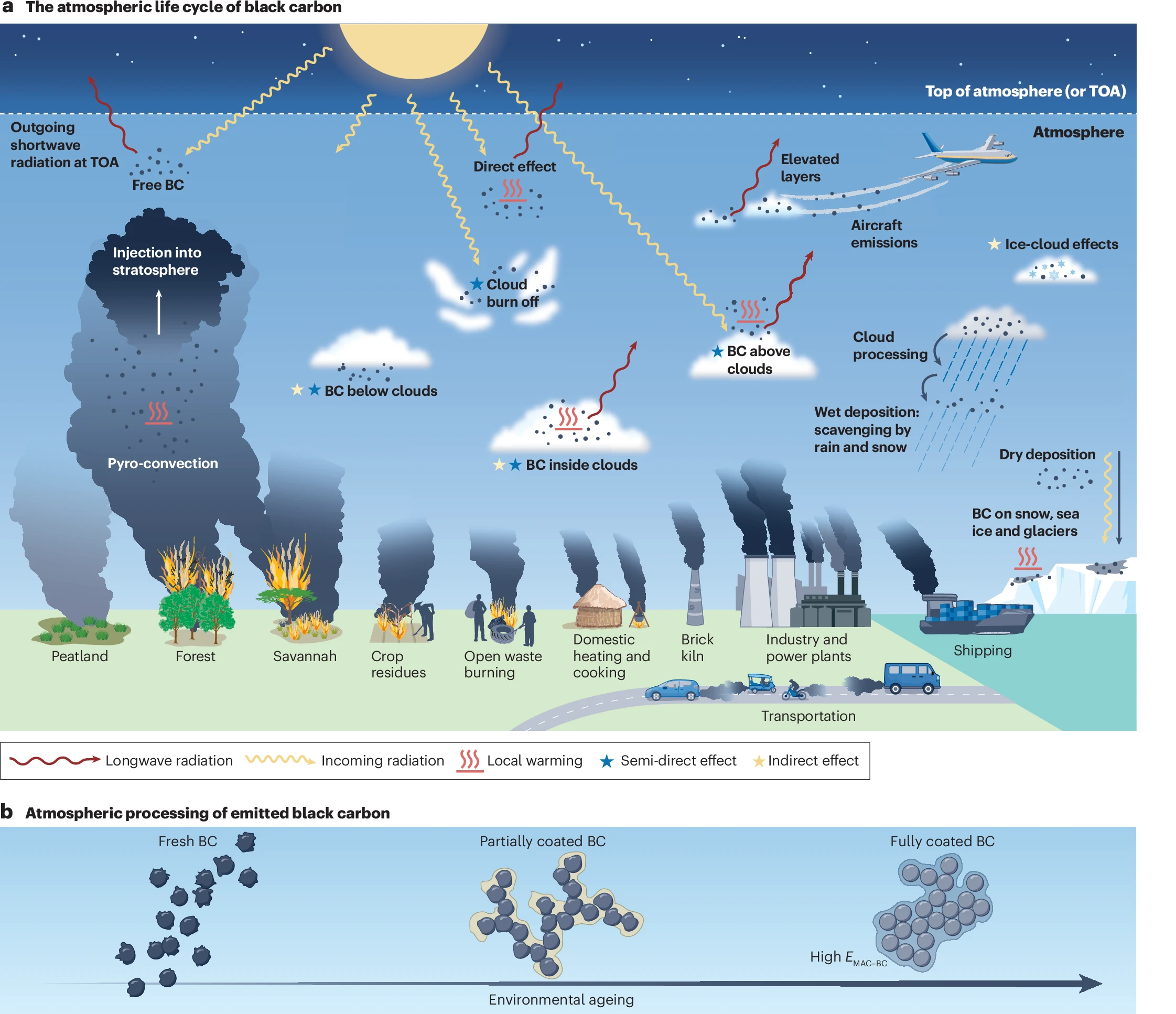
Life cycle and geospatial variability
Life cycle and geospatial variability
Fig. 2: Global distribution of BC.
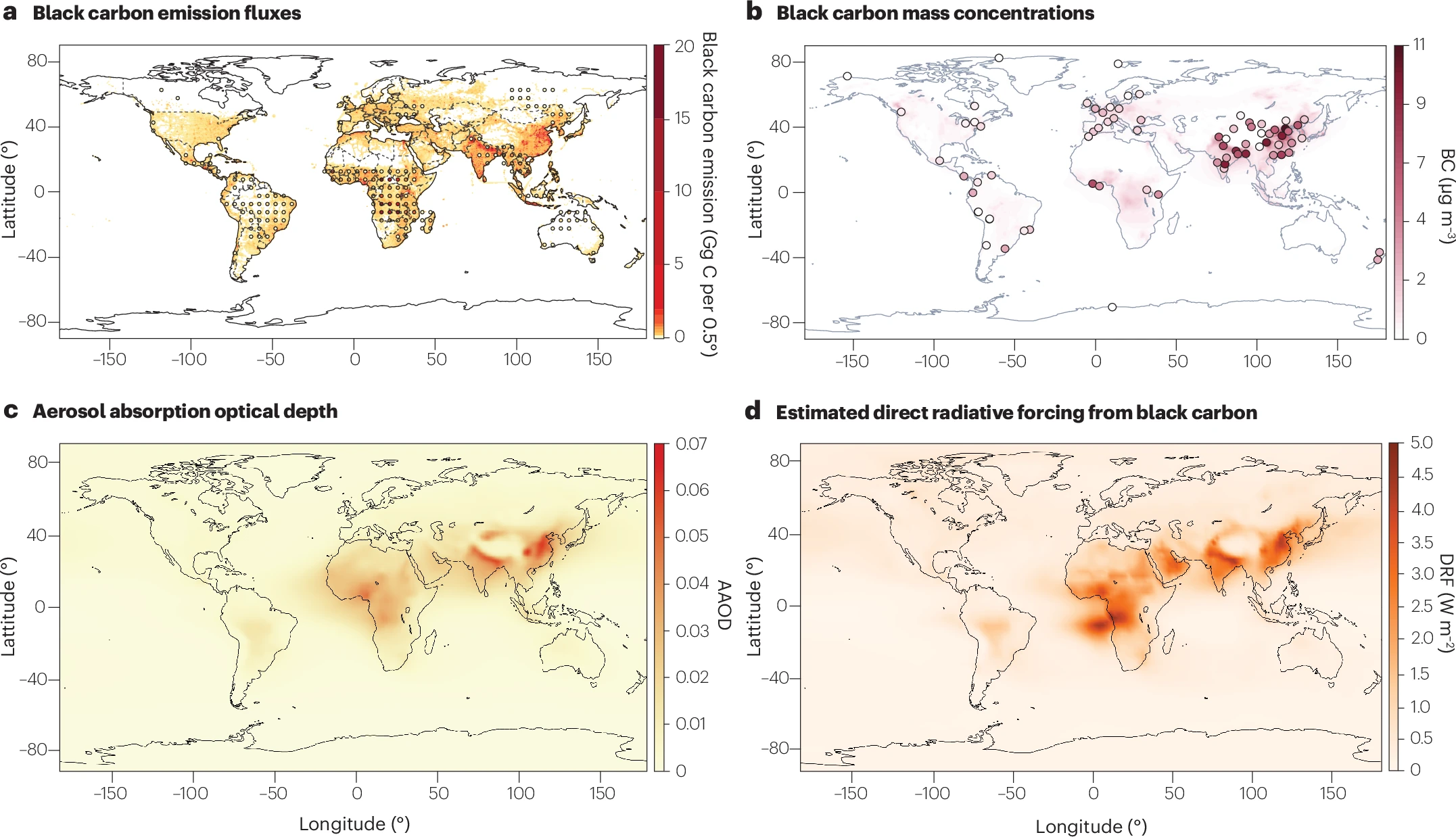
Atmospheric BC sources and emissions
Fig. 3: A comparison of EIs and bottom-up versus top-down source attributions.
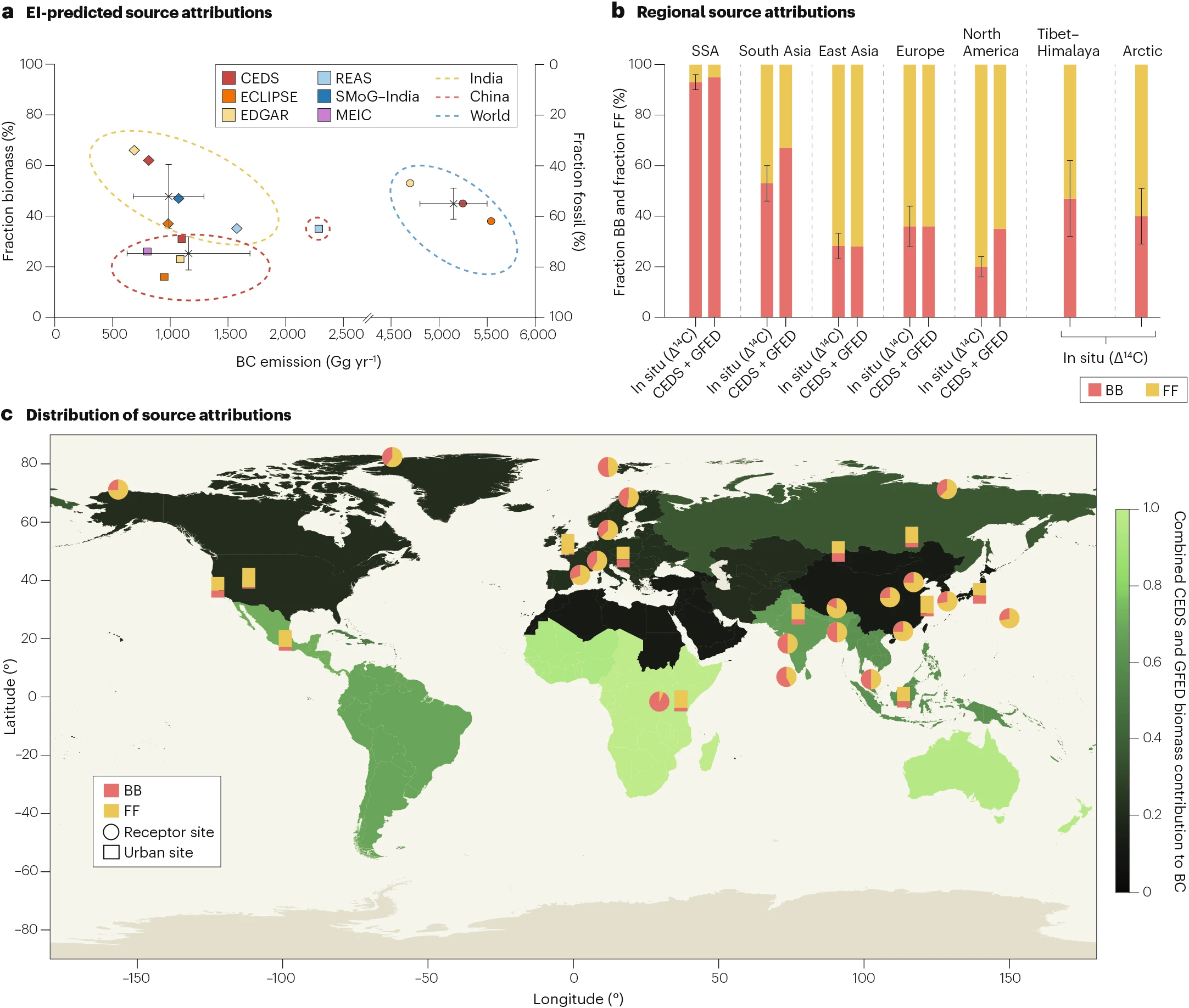
Absorption, ageing and deposition
Fig. 4: Regional BC mass absorption coefficient.
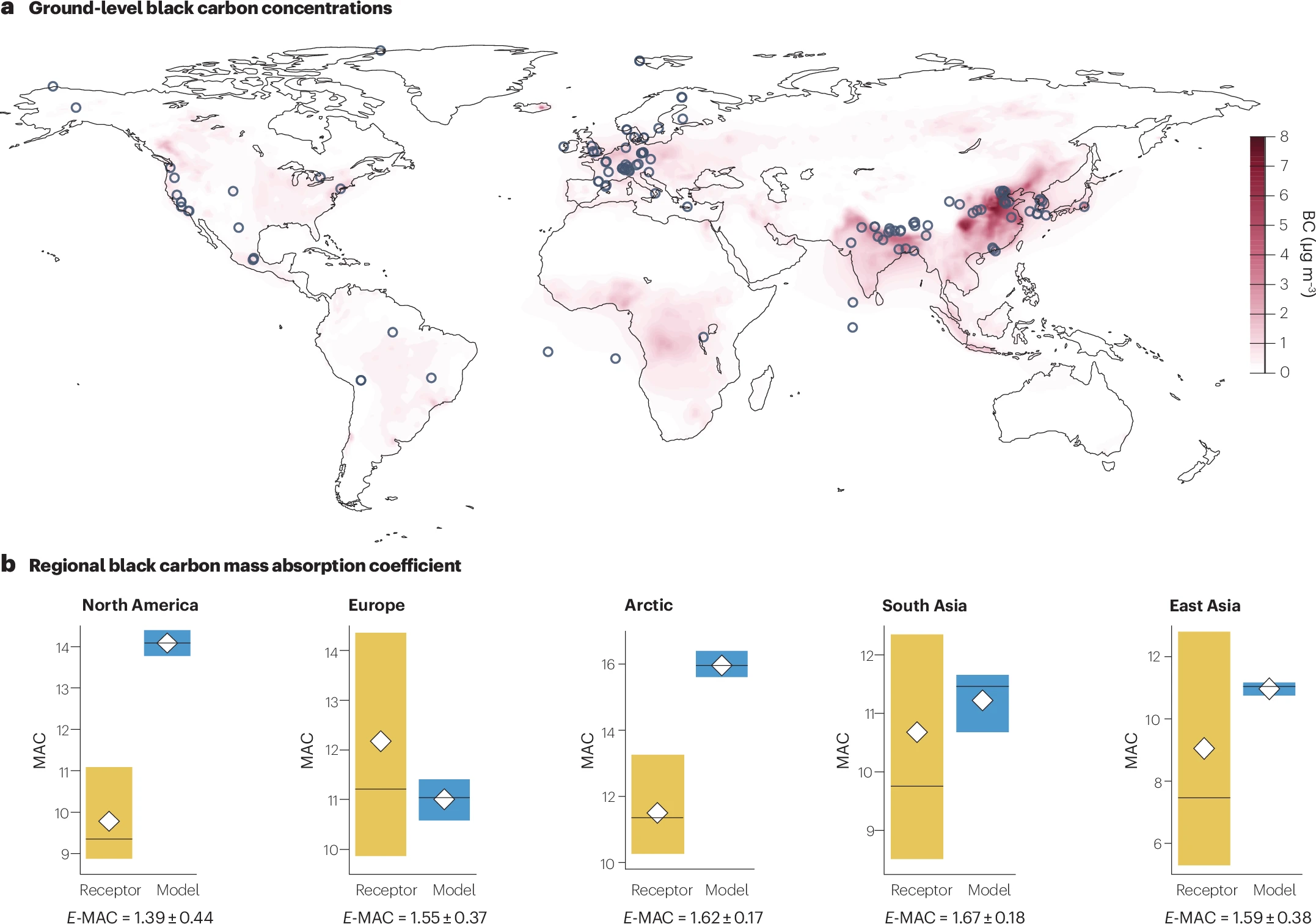
研究首先系统梳理了大气黑碳在全球范围内的来源及生命周期过程。黑碳主要来源于化石燃料燃烧、生物质燃烧以及野火等过程,不同区域的来源贡献差异显著。通过同位素指纹分析发现,在撒哈拉以南非洲地区,黑碳排放约 93%来自生物质燃烧,而在南亚该比例约为 56%,在东亚约为 28%。这表明不同地区的能源结构、农业焚烧及森林火灾等活动共同决定了区域黑碳排放结构。此外,黑碳排放后的大气输送和沉降过程决定了其在全球尺度的空间分布特征(图1)。这些结果说明,黑碳不仅是区域空气污染的重要组成部分,还能够通过长距离输送对全球气候产生影响。
进一步研究发现,黑碳在大气中的浓度及空间分布具有明显的区域差异,并且在过去几十年中呈现不同的发展趋势。综合长期观测资料显示,欧洲、北美以及东亚地区的大气黑碳浓度总体呈下降趋势,这主要得益于清洁空气政策的实施以及能源结构的调整。相比之下,在南亚和非洲部分地区,由于能源消费增长以及生物质燃烧活动频繁,黑碳浓度变化较小甚至保持稳定状态(图2)。这一结果表明,区域减排政策能够显著降低黑碳排放,但全球范围内仍存在明显的不平衡格局。
在黑碳的物理与化学性质方面,研究重点分析了黑碳的光学特性以及其在大气输送过程中的“老化效应”。黑碳颗粒具有极强的吸光能力,其全球平均质量吸收系数约为12.3 ± 5.8 m² g⁻¹,但不同地区存在显著差异。随着黑碳在大气中经历凝结、包裹等化学过程,其吸光能力通常会增强,平均增强幅度约为1.6倍。这种老化过程会改变黑碳对太阳辐射的吸收能力,从而增强其对大气加热和气候变化的影响(图3)。因此,准确描述黑碳老化过程对于评估其气候效应至关重要。
最后,研究比较了全球观测数据与气候模型模拟结果之间的差异。结果发现,在主要排放区域,气候模型往往低估了黑碳气溶胶的吸收光学厚度以及辐射强迫效应。其中,模型模拟的气溶胶吸收光学厚度约为观测值的一半,而黑碳对气候系统产生的辐射效应也被低估约1.5倍(图4)。同时,模型在模拟黑碳沉降通量时往往高于观测结果。这些差异表明,目前气候模型在描述黑碳排放、输送和沉降过程方面仍存在一定的不确定性,未来需要进一步整合观测数据与排放清单,以提高模型对气候变化影响评估的准确性。
研究总结:
本研究系统整合了全球观测数据和气候模型结果,全面评估了大气黑碳的来源、生命周期、光学性质及其气候效应。研究表明,黑碳在不同地区具有显著的来源差异,并在过去几十年中呈现明显的区域变化趋势。同时,观测结果与气候模型之间仍存在较大差异,表明当前气候模型在模拟黑碳的分布和辐射效应方面仍需进一步改进。该研究为理解黑碳在气候系统中的作用提供了重要基础,也为制定空气污染控制和气候变化缓解政策提供了科学依据。

AtomGit 是由开放原子开源基金会联合 CSDN 等生态伙伴共同推出的新一代开源与人工智能协作平台。平台坚持“开放、中立、公益”的理念,把代码托管、模型共享、数据集托管、智能体开发体验和算力服务整合在一起,为开发者提供从开发、训练到部署的一站式体验。
更多推荐

 8
8 0
0- 0


 已为社区贡献9条内容

所有评论(0)