使用vLLM部署Qwen3 Reranker系列模型
使用SGLang部署的版本可查看另一篇文章:使用SGLang部署Qwen3 Reranker系列模型
实测使用vLLM部署的推理速度更快,QPS更高
vLLM安装
使用官方流程进行vLLM的安装(vLLM官方文档,Qwen官方vLLM安装文档)
conda create -n myenv python=3.10 -y
conda activate myenv
pip install vllm
vLLM部署Qwen3 Reranker系列(0.6B/4B/8B)模型
根据官方部署Reranker模型的教程,使用vLLM部署Qwen3 Reranker系列的模型时,会出现报错,显示不支持相应API(The model does not support Score API),先说结论,vLLM是可以部署Qwen3 Reranker系列的模型的,只是需要进行一定的转换。
首先, Qwen3-reranker 是 Qwen3ForCausalLM 架构的模型,也就是说,它本质是一个基于生成式的模型架构,vLLM官方显示是支持该形式的模型的。

然而,在实操过程中,会发现,当使用如下指令进行部署时
vllm serve {model_path}
会输出以下日志,在部署完成之后,vLLM会默认这个架构是一个生成式的模型,仅支持chat模板,也就是下图中的红色区域,白色区域的API是不可使用的。
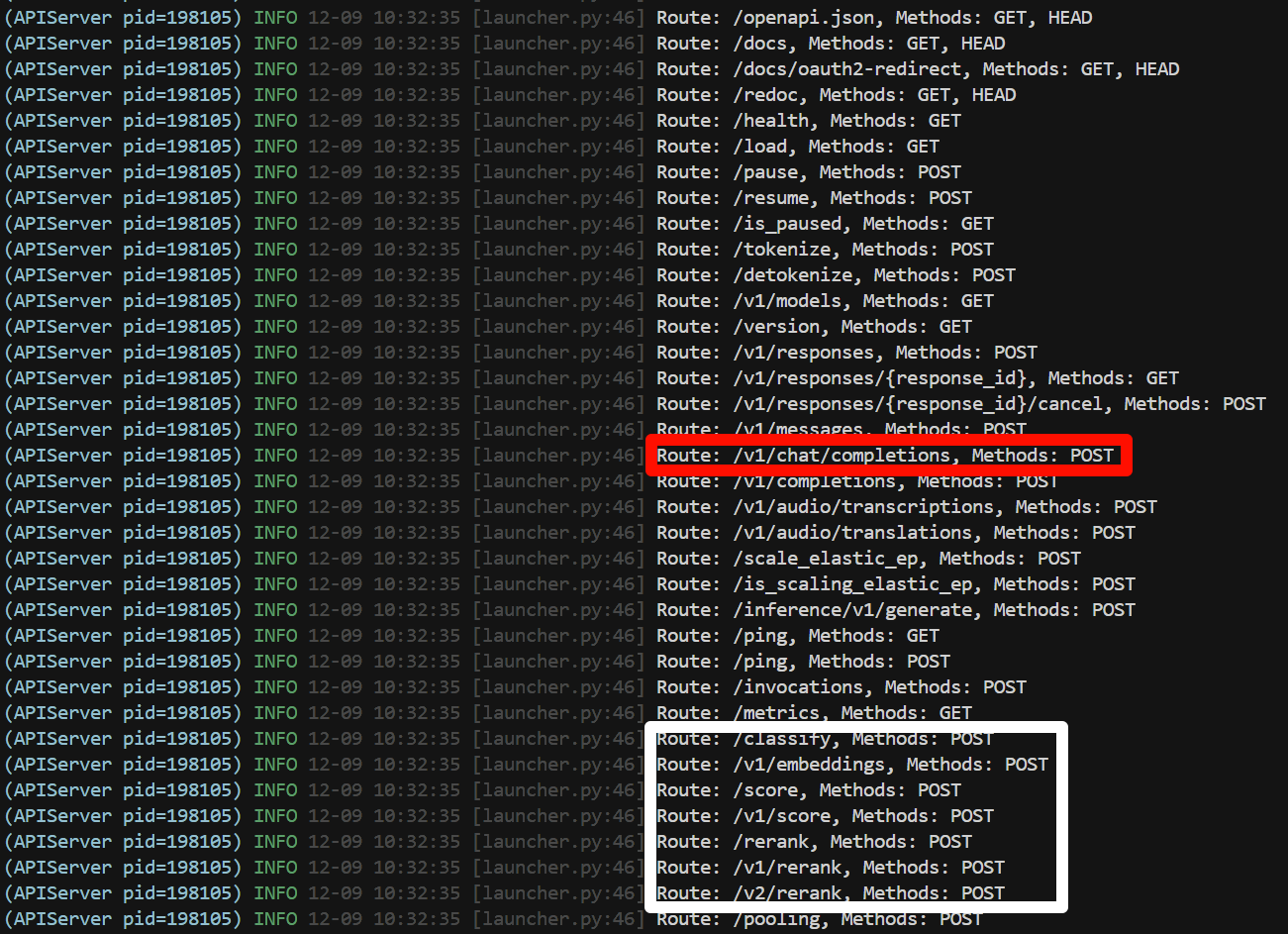
当按照官方教程构造client并进行白色区域的API使用时,会出现如下报错:
{'error': {'message': 'The model does not support Score API', 'type': 'BadRequestError', 'param': None, 'code': 400}}
这是因为,vLLM目前无法支持单个架构同时支持Embedding 和 Reranker,一个可行的方案就是,将 token_false_id = 2152 和 token_true_id = 9693 提取到一个二分类任务中,而不是当前的 151669 分类任务,最后使用vLLM的 score API来进行推理的实现,也就是说,要将双向分类器变成单向分类器,将原始的 Qwen3ForCausalLM 架构转换为 Qwen3ForSequenceClassification 架构,可以使用如下代码。(代码来源)
import torch
from transformers import Qwen3ForCausalLM, Qwen3ForSequenceClassification, AutoTokenizer

def convert_model(model_path, save_path):

    # --- Step 1: Load the Causal LM and extract lm_head weights ---
    print(f"1. Loading Causal LM: {model_path}")
    tokenizer = AutoTokenizer.from_pretrained(model_path)
    causal_lm = Qwen3ForCausalLM.from_pretrained(model_path)

    # The lm_head is the final linear layer that maps hidden states to vocabulary logits
    lm_head_weights = causal_lm.lm_head.weight
    print(f"   lm_head weight shape: {lm_head_weights.shape}") # (vocab_size, hidden_size)

    # --- Step 2: Get the token IDs for "yes" and "no" ---
    print("\n2. Finding token IDs for 'yes' and 'no'")
    yes_token_id = tokenizer.convert_tokens_to_ids("yes")
    no_token_id = tokenizer.convert_tokens_to_ids("no")
    print(f"   ID for 'yes': {yes_token_id}, ID for 'no': {no_token_id}")

    # --- Step 3: Create the classifier vector ---
    print("\n3. Creating the classifier vector from lm_head weights")
    # Extract the specific rows (weight vectors) for our target tokens
    yes_vector = lm_head_weights[yes_token_id]
    no_vector = lm_head_weights[no_token_id]

    # The new classifier is the difference between the 'yes' and 'no' vectors
    classifier_vector = yes_vector - no_vector
    print(f"   Shape of the new classifier vector: {classifier_vector.shape}")

    # --- Step 4: Load the model as a Sequence Classifier ---
    print(f"\n4. Loading Sequence Classification model with num_labels=1")
    # num_labels=1 is key for binary classification represented by a single logit
    seq_cls_model = Qwen3ForSequenceClassification.from_pretrained(
        model_path,
        num_labels=1,
        ignore_mismatched_sizes=True
    )

    # --- Step 5: Replace the classifier's weights ---
    print("\n5. Replacing the randomly initialized classifier weights")
    # The classification head in Qwen is named 'score'. It's a torch.nn.Linear layer.
    # Its weight matrix has shape (num_labels, hidden_size), which is (1, hidden_size) here.
    with torch.no_grad():
        # We need to add a dimension to our vector to match the (1, hidden_size) shape
        seq_cls_model.score.weight.copy_(classifier_vector.unsqueeze(0))
        # It's good practice to zero out the bias for a clean transfer
        if seq_cls_model.score.bias is not None:
            seq_cls_model.score.bias.zero_()

    print("   Classifier head replaced successfully.")


    # --- Verification: Prove that the logic works ---
    print("\n--- VERIFICATION ---")
    text = "Is this a good example?"
    inputs = tokenizer(text, return_tensors="pt")

    # A. Get logits from the original Causal LM
    with torch.no_grad():
        outputs_causal = causal_lm(**inputs)
        last_token_logits = outputs_causal.logits[0, -1, :]
        manual_logit_diff = last_token_logits[yes_token_id] - last_token_logits[no_token_id]

        # Compute probs (yes/no) and extract 'yes' prob
        concat_logits = torch.stack([last_token_logits[yes_token_id], last_token_logits[no_token_id]])
        causal_prob = torch.softmax(concat_logits, dim=-1)[0]

    # B. Get the single logit from our new Sequence Classification model
    with torch.no_grad():
        outputs_seq_cls = seq_cls_model(**inputs)
        # Shape is (1, 1), squeeze to scalar
        model_logit = outputs_seq_cls.logits.squeeze()
        # Compute 'yes' prob
        classification_prob = torch.sigmoid(model_logit)

    print(f"Input text: '{text}'")
    print(f"\nManual logit difference ('yes' - 'no'): {manual_logit_diff.item():.4f}")
    print(f"Sequence Classification model output:   {model_logit.item():.4f}")
    print(f"Are they almost identical? {torch.allclose(manual_logit_diff, model_logit)}")

    # Probs
    print(f"\nCausal prob (2 classes): {causal_prob.item():.4f}")
    print(f"Classification prob (1 class):   {classification_prob.item():.4f}")
    print(f"Are they almost identical? {torch.allclose(causal_prob, classification_prob)}")

    seq_cls_model.save_pretrained(save_path)
    tokenizer.save_pretrained(save_path)

    print(f"Save model to: {save_path}")

if __name__ == "__main__":

    model_path = "/home/Qwen/Qwen3-Reranker-0.6B"
    save_path = "/home/Qwen/Qwen3-Reranker-0.6B-seqcls-converted"

    convert_model(model_path, save_path)
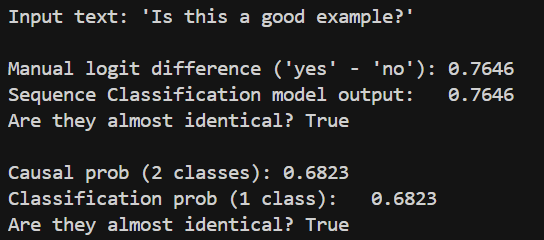
以上代码,将model_path和save_path替换之后,就可直接使用,转换之后,结果是相同的,如下所示
使用vLLM进行部署:
vllm serve /home/Qwen/Qwen3-Reranker-0.6B-seqcls-converted \
    --hf_overrides '{"architectures": ["Qwen3ForSequenceClassification"],"classifier_from_token": ["no", "yes"],"is_original_qwen3_reranker": true}' \
直接部署经常容易爆显存,建议加上
--gpu-memory-utilization 0.6参数
基于Qwen3官方文档,构造的client如下所示。
import requests

url = "http://127.0.0.1:8000/score"
MODEL_NAME = "Qwen3-Reranker-0.6B-seqcls-converted"

prefix = '<|im_start|>system\nJudge whether the Document meets the requirements based on the Query and the Instruct provided. Note that the answer can only be "yes" or "no".<|im_end|>\n<|im_start|>user\n'
suffix = "<|im_end|>\n<|im_start|>assistant\n<think>\n\n</think>\n\n"

query_template = "{prefix}<Instruct>: {instruction}\n<Query>: {query}\n"
document_template = "<Document>: {doc}{suffix}"

instruction = (
    "Given a web search query, retrieve relevant passages that answer the query"
)

queries = [
    "What is the capital of China?",
    "Explain gravity",
]

documents = [
    "I want yo eat an apple.",
    "Gravity is a force that attracts two bodies towards each other. It gives weight to physical objects and is responsible for the movement of planets around the sun.",
]

queries = [
    query_template.format(prefix=prefix, instruction=instruction, query=query)
    for query in queries
]
documents = [
    document_template.format(doc=doc, suffix=suffix) for doc in documents
]

response = requests.post(url,
                         json={
                             "text_1": queries,
                             "text_2": documents,
                             "truncate_prompt_tokens": -1,
                         }).json()

print(response)
最终输出如下所示,结果符合预期,转换后的模型效果与转换前是一致的。
{
 'id': 'score-a918997f9ba1424f',
 'object': 'list',
 'created': 1765251739,
 'model': '/home/Qwen/Qwen3-Reranker-0.6B-seqcls-converted',
 'data': [{'index': 0, 'object': 'score', 'score': 0.0001038978953147307},
          {'index': 1, 'object': 'score', 'score': 0.993419349193573}],
 'usage': {'prompt_tokens': 188, 'total_tokens': 188, 'completion_tokens': 0, 'prompt_tokens_details': None}
 }
参考解决方案
- vLLM部署Qwen3-Reranker:https://github.com/vllm-project/vllm/pull/19260
- Qwen3-Reranker模型转换:https://huggingface.co/Qwen/Qwen3-Reranker-0.6B/discussions/3

AtomGit 是由开放原子开源基金会联合 CSDN 等生态伙伴共同推出的新一代开源与人工智能协作平台。平台坚持“开放、中立、公益”的理念,把代码托管、模型共享、数据集托管、智能体开发体验和算力服务整合在一起,为开发者提供从开发、训练到部署的一站式体验。
更多推荐


 29
29 0
0- 0


 已为社区贡献1条内容

所有评论(0)