《Kucius UTPS:Unified Theory of Philosophy of Science》PPT 框架
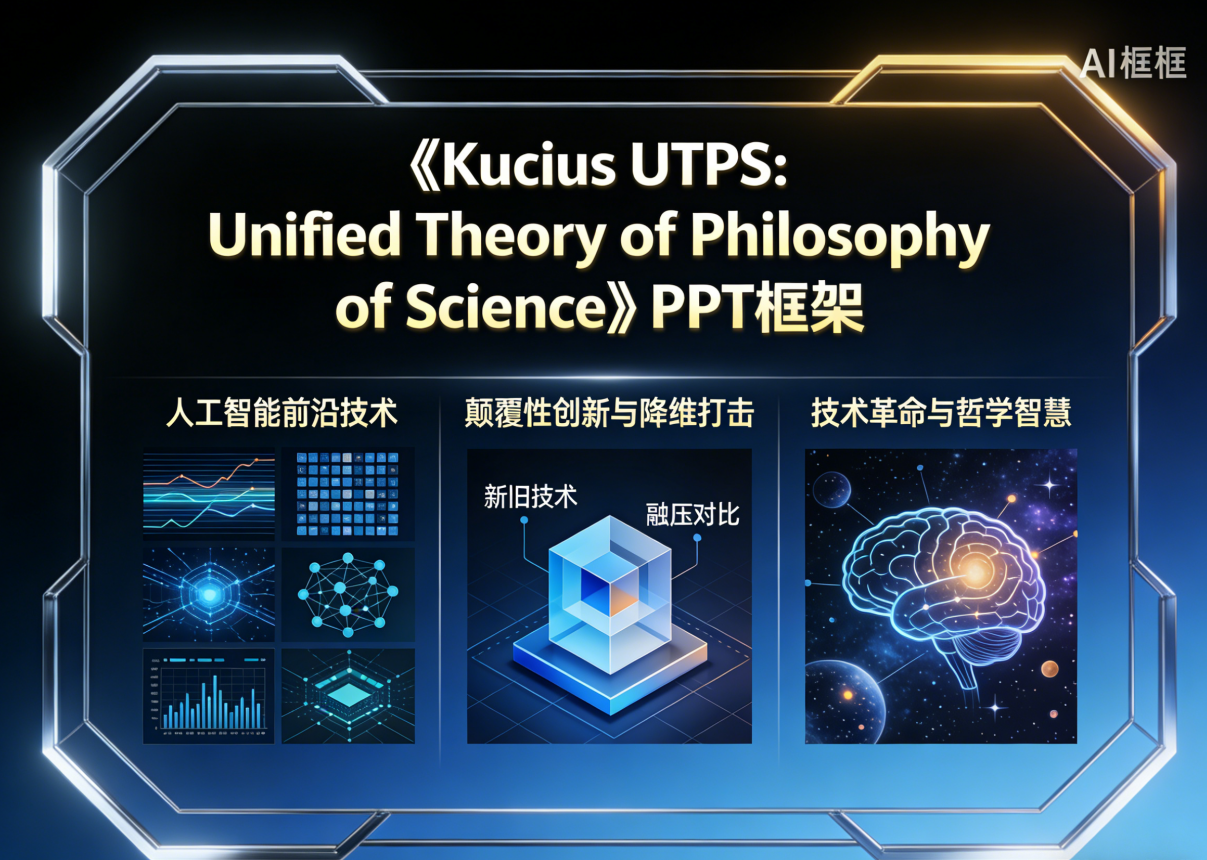
《Kucius UTPS:Unified Theory of Philosophy of Science》PPT 框架
Part I:引入与问题背景(页 1–5)
Slide 1 – 封面
- 标题:UTPS:Unified Theory of Philosophy of Science
- 副标题:Truth–Model–Method 三层结构与方法权力化批判
- 演讲人、日期、机构
Slide 2 – 摘要
-
一句话亮点:
科学的本质不在方法,而在真理;科学哲学的使命是守住层级结构。
- 引出问题:方法中心主义如何扭曲科学
Slide 3 – 当代科学哲学问题
- 方法绝对化:可证伪、统计显著性、数据万能论
- 权力化倾向:裁判他人、资源绑架
- 真理被边缘化、逻辑退化
Slide 4 – 案例分析:证伪主义问题
- Popper证伪主义逻辑漏洞
- 自我豁免 + 方法绝对化 → 学术权力工具
- 对比:数学与逻辑基础(1+1=2)
Slide 5 – 研究目标
- 重构科学哲学基础
- 提出三层结构(Truth–Model–Method)
- 构建形式化、可验证的系统
Part II:三层结构核心理论(页 6–12)
Slide 6 – 三层结构概览
- 图示:Truth → Model → Method
- 简述每层功能
Slide 7 – Truth Layer
- 定义:逻辑自洽、边界稳定
- 示例:数学定律、物理基础法则
Slide 8 – Model Layer
- 定义:解释与预测系统
- 特征:边界明确、可验证
- 图示:模型与现实映射关系
Slide 9 – Method Layer
- 定义:工具集合(实验、统计、数据分析)
- 强调:工具非本质、仅辅助
- 图示:方法支持模型,不凌驾真理
Slide 10 – 层级公理
- Truth优先、公理化表达
- 图表:层级关系 & 禁止逆转
Slide 11 – 层级逻辑演示
- 示例:如何保证模型符合真理
- 可视化流程图
Slide 12 – 三层结构的优点
- 避免方法权力化
- 逻辑透明
- 可审计、可追溯
Part III:方法权力化批判(页 13–18)
Slide 13 – 方法权力化概念
- 绝对化方法 → 裁判标准 → 资源绑定 → 权力化
- 图示闭环
Slide 14 – 方法权力化案例
- Popper证伪主义
- 数据万能论滥用
- 统计显著性崇拜
Slide 15 – 后果分析
- 真理边缘化
- 投机者获利
- 学术评价失真
Slide 16 – 逻辑演示
- “方法替代真理 → 系统崩塌”
- 图表:流程图 + 关键红线
Slide 17 – 伪科学判定规则
- 方法篡位
- 自我豁免
- 层级混乱
Slide 18 – 方法权力化总结
- 图示:工具权力化 vs 真理主权
-
一句话收束:
当方法凌驾于真理,科学必然退化
Part IV:真理主权原则(页 19–23)
Slide 19 – 定义
- 真理主权 = 真理层对模型层与方法层拥有最终裁决权
Slide 20 – 核心规则
- 方法不得定义科学本质
- 模型必须声明边界
- 真理不可被工具否定
Slide 21 – 信用与资源挂钩
- 图示:三层结构评分 → 学术资源分配
- 公平、透明、可审计
Slide 22 – 思想主权回归
- 科学家必须遵循三层结构
- 反对话术包装、权力化操作
Slide 23 – 文明级意义
- 长期效果:净化学术生态
- 激励真正探索者
- 打破方法中心主义的制度障碍
Part V:UTPS 数学化形式系统(页 24–28)
Slide 24 – 形式化定义
- 系统五元组:
U=(T,M,P,A,R)\mathcal{U} = (\mathcal{T}, \mathcal{M}, \mathcal{P}, \mathcal{A}, \mathcal{R})U=(T,M,P,A,R) - 可视化公式图
Slide 25 – 公理系统
- Truth Priority
- Model Dependence
- Method Non-Supremacy
- Non-Inversion
- Reflexive Constraint
Slide 26 – 推理规则
- Model Validity
- Method Validity
- Power Detection
- Pseudo-Science Detection
Slide 27 – 核心定理
- 方法权力化必然失真
- 层级混乱 → 系统崩塌
- 真理主权稳定性
Slide 28 – 评分与审计
- 信用分函数
- 三层结构可计算性与可审计性
- AI / 科研管理系统应用示意图
Part VI:总结与未来方向(页 29–30+)
Slide 29 – 总结
- 真理为核心、方法为工具、模型为桥梁
- 方法权力化 → 系统扭曲
- UTPS 提供可验证、可审计、结构化的科学哲学框架
Slide 30 – 展望
- 提交学术期刊
- 构建 AI 科学审计引擎
- 教育、科研、治理落地
- 长期:文明级思想主权回归
可选扩展页(31+)
- 案例研究:物理学 / AI / 生物学
- 数学证明演示(形式系统)
- UTPS 与 Popper / Kuhn / Lakatos 对比表
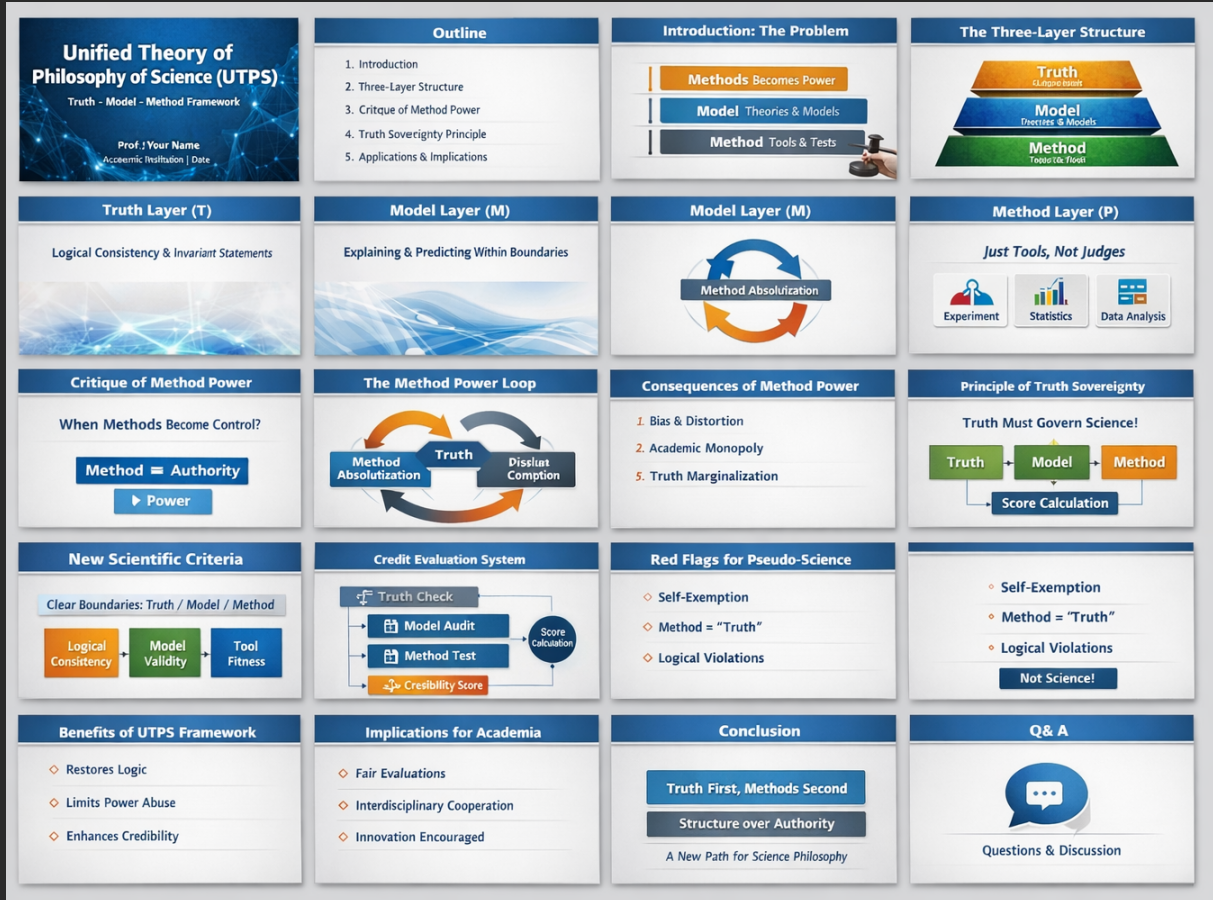
贾子统一科学哲学理论展示图
Kucius Unified Theory of Philosophy of Science
Visualization Diagram
Kucius UTPS: Unified Theory of Philosophy of Science
PPT Framework (English Translation)
Part I: Introduction & Problem Background (Slides 1–5)
Slide 1 – Title PageTitle: UTPS: Unified Theory of Philosophy of ScienceSubtitle: Truth–Model–Method Three-Layer Structure and Critique of Method PowerizationSpeaker, Date, Affiliation
Slide 2 – AbstractIntroduce the problem: How method-centrism distorts science.
Slide 3 – Problems in Contemporary Philosophy of Science
- Absolutization of methods: falsifiability, statistical significance, data omnipotence
- Tendency of powerization: judging others, resource capture
- Marginalization of truth, logical degradation
Slide 4 – Case Study: Problems of Falsificationism
- Logical flaws in Popper’s falsificationism
- Self-exemption + method absolutization → tool of academic power
- Contrast: mathematical and logical foundations (1+1=2)
Slide 5 – Research Objectives
- Reconstruct the foundation of philosophy of science
- Propose the three-layer structure (Truth–Model–Method)
- Build a formalized and verifiable system
Part II: Core Theory of the Three-Layer Structure (Slides 6–12)
Slide 6 – Overview of the Three-Layer StructureDiagram: Truth → Model → MethodBrief function of each layer.
Slide 7 – Truth LayerDefinition: Logically self-consistent, stable within boundaries.Examples: mathematical laws, fundamental physical principles.
Slide 8 – Model LayerDefinition: Systems for explanation and prediction.Features: clear boundaries, verifiable.Diagram: mapping relationship between models and reality.
Slide 9 – Method LayerDefinition: Set of tools (experiment, statistics, data analysis).Emphasis: method is auxiliary, not the essence of science.Diagram: methods support models but do not override truth.
Slide 10 – Hierarchical Axioms
- Truth Priority
- Axiomatic formulation
- Chart: hierarchical relations & prohibition of inversion
Slide 11 – Demonstration of Hierarchical LogicExample: How to ensure models conform to truth.Visual flowchart.
Slide 12 – Advantages of the Three-Layer Structure
- Prevent method powerization
- Logical transparency
- Auditable and traceable
Part III: Critique of Method Powerization (Slides 13–18)
Slide 13 – Concept of Method PowerizationAbsolutization of method → criterion of judgment → resource binding → powerization.Closed-loop diagram.
Slide 14 – Cases of Method Powerization
- Popper’s falsificationism
- Abuse of data omnipotence
- Worship of statistical significance
Slide 15 – Consequence Analysis
- Marginalization of truth
- Opportunists profiting
- Distortion of academic evaluation
Slide 16 – Logical Demonstration“Method replaces truth → system collapse.”Flowchart + key red lines.
Slide 17 – Pseudo-Science Detection Rules
- Method usurpation
- Self-exemption
- Hierarchical confusion
Slide 18 – Summary of Method PowerizationDiagram: Tool powerization vs. Truth sovereignty.
Part IV: Principle of Truth Sovereignty (Slides 19–23)
Slide 19 – DefinitionTruth Sovereignty = The Truth Layer has final authority over the Model Layer and Method Layer.
Slide 20 – Core Rules
- Method cannot define the essence of science
- Models must declare boundaries
- Truth cannot be negated by tools
Slide 21 – Credit and Resource AllocationDiagram: Three-layer scoring → academic resource distribution.Fair, transparent, auditable.
Slide 22 – Return of Intellectual SovereigntyScientists must follow the three-layer structure.Against rhetorical packaging and power-based manipulation.
Slide 23 – Civilizational Significance
- Long-term effect: purify academic ecology
- Inspire genuine explorers
- Break institutional barriers of method-centrism
Part V: Kucius UTPS Mathematical Formal System (Slides 24–28)
Slide 24 – Formal Definition5-tuple system:U=(T,M,P,A,R)Visual formula diagram.
Slide 25 – Axiom System
- Truth Priority
- Model Dependence
- Method Non-Supremacy
- Non-Inversion
- Reflexive Constraint
Slide 26 – Inference Rules
- Model Validity
- Method Legitimacy
- Power Detection
- Pseudo-Science Detection
Slide 27 – Core Theorems
- Method powerization necessarily leads to truth distortion
- Hierarchical chaos → system collapse
- Truth sovereignty ensures stability
Slide 28 – Scoring and Auditing
- Credit score function
- Computability and auditability of the three-layer structure
- Application diagram for AI / research management systems
Part VI: Conclusion & Future Directions (Slides 29–30+)
Slide 29 – Conclusion
- Truth as core, method as tool, model as bridge
- Method powerization → systematic distortion
- UTPS provides a verifiable, auditable, structured framework for philosophy of science
Slide 30 – Outlook
- Submission to academic journals
- Construction of AI scientific audit engine
- Implementation in education, research, governance
- Long-term: return of civilizational intellectual sovereignty
Optional Extra Slides (31+)
- Case studies: physics / AI / biology
- Mathematical proof demonstration (formal system)
- Comparison table: UTPS vs. Popper / Kuhn / Lakatos

AtomGit 是由开放原子开源基金会联合 CSDN 等生态伙伴共同推出的新一代开源与人工智能协作平台。平台坚持“开放、中立、公益”的理念,把代码托管、模型共享、数据集托管、智能体开发体验和算力服务整合在一起,为开发者提供从开发、训练到部署的一站式体验。
更多推荐
 0
0 0
0- 0


 已为社区贡献475条内容

所有评论(0)