第五周学习总结
函数
定义
函数是一个完成特定功能的代码模块,其程序代码独立,通常要求有返回值,也可以是空值
一般形式如下:
<数据类型><函数名称> (<形式参数>)
{
语句序列;
return[(<表达式>)];
}
·数据类型:是整个函数的返回值类型。
·return语句中表达式的值要和函数的数据类型一致,如无返回值应写为void。
·形式参数说明是逗号","分隔的多个变量的说明形式。
·大括弧对语句序列,称为函数体,是大于等于零个语句构成的。
·函数的说明就是指函数原型。
·其中,形式参数说明可以缺省说明的变量名称,但是类型不能缺省。
例如
double Power(double x,int n);
double Power(double ,int );
函数的使用也叫做函数的调用,形式如下:
函数名称(<实际参数>)
实参就是在使用函数时,调用函数传递给被调函数的数据。需要确切的数据
函数调用可以作为一个运算量出现在表达式中,也可以单独形成一个语句,对于无返回值的函数来讲只能形成一个函数调用语句。
题目,编写一个函数并显示
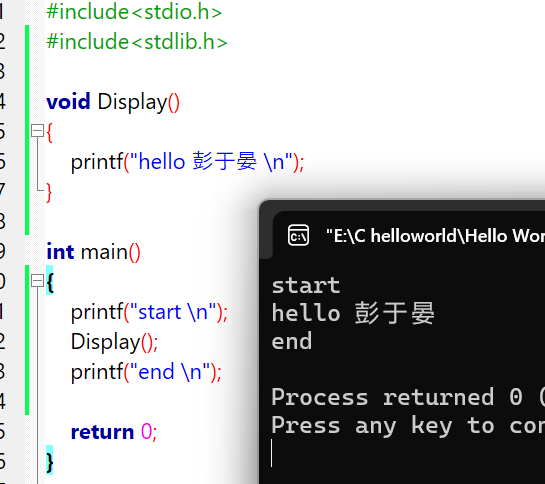
题目:带参传递
定义求x^n指的函数(x是实数,n为正整数)
#include<stdio.h>
#include<stdlib.h>
double power(double x,int n)    //函数声明
{
    int i;                    //定义
    double r=1;
    for(i=0;i<n;i++)
    {
        r = r*x;
    }
        return r;
}

int main()            //函数调用
{
    double a;
    int b;
    double result;
    printf("输入: ");
    scanf("%lf %d",&a,&b);
    result=power(a,b);
    printf("result = %lf",result);

    return 0;
}
函数的传递参数
函数之间的参数传递方式:
1.全局变量
2.复制传递的方式
实参为数组的指针,形参为数组名(本质是一个指针变量)
3.地址传递的方式
实参为数组的指针,形参为同类型的指针变量
全局变量
全局变量就是在函数体外说明的变量,它在程序中的每个函数里都是可见的。
全局变量一经定义后就会在程序的任何地方可见。函数调用的位置不同
程序的执行结果可能会受到影响,不建议使用。
#include<stdio.h>
#include<stdlib.h>
double a=2;            //把函数调用中的a,b移到头文件这里了,能安全运行
    int b=3;            //但是调用时改变了ab大小会出错
double power(double x,int n)
{
    int i;
    double r=1;
    for(i=0;i<n;i++)
    {
        r = r*x;
    }
        return r;
}

int main()
{
    double result;
   // scanf("%lf %d",&a,&b);
    result=power(a,b);
    printf("result = %lf",result);

    return 0;
}
复制传递方式
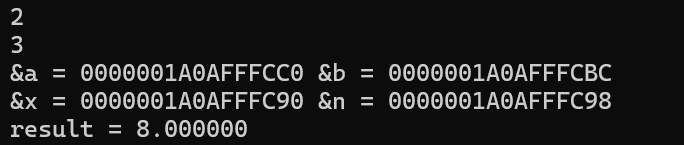
调用函数将实参传递给被调用函数,被调用函数将创建同类型的形参并用实参初始化。
形参是新开辟的存储空间,因此在函数中改变形参的值,不会影响到实参。
#include<stdio.h>
#include<stdlib.h>

double power(double x,int n)    //x,n为形参
{
    int i;
    double r=1;
    printf("&x = %p &n = %p \n",&x,&n);
    for(i=0;i<n;i++)
    {
        r = r*x;
    }
        return r;
}

int main()
{
    double a;        //a,b为实参
    int b;
    double result;
    scanf("%lf %d",&a,&b);
    printf("&a = %p &b = %p \n",&a,&b);
    result=power(a,b);
    printf("result = %lf",result);

    return 0;
}
地址传递方式
按地址传递,实参为变量的,而形参为同类型的指针
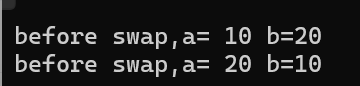
被调用函数中对形参的操作,将直接改变实参的值
(被调用函数对指针的目标操作相当于对实参本身的操作)
用函数实现位置交换
#include<stdio.h>
#include<stdlib.h>

void swap (int *x,int *y)    //指针交换地址
{
    int t;
    t=*x;
    *x=*y;
    *y=t;
}
int main()
{
    int a=10;
    int b=20;
    int t;
    printf("before swap,a= %d b=%d \n",a,b);
    swap(&a,&b);
    printf("before swap,a= %d b=%d \n",a,b);
    return 0;
}
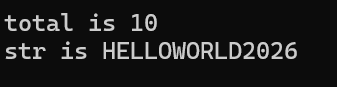
题目:编写一个函数统计字符串中大小字母的个数,并把小写转化成大写,大写转换成小写
#include<stdio.h>
#include<stdlib.h>


int strfun(char *p);
int main()
{                                        //调用
    char s[] = "helloworld2026";
    int n;
    n = strfun(s);
    printf("total is %d \n",n);
    printf("str is %s \n",s);
    return 0;
}
int strfun(char *p)        //函数声明
{
    int n=0;
    while(*p != '\0')            //定义
    {
        if(*p <='z' && *p >= 'a')
        {
            n++;
            *p -= 32;                //这行用于将小写字符变为大写字符
        }
        p++;
    }
    return n;
}
数组在函数中的传参
全局数组传递的方式
复制传递方式
实参为数组的指针,形参为数组名(本质上是一个指针变量)
地址传递方式
实参为数组的指针,形参为同类型的指针变量。
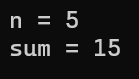
题目:计算一个一维整型数组的所有元素的和
#include<stdio.h>
#include<stdlib.h>


int array_sum(int array[],int n);
int main()
{
    int a[]={1,2,3,4,5};
    int sum = 0;
    int n = sizeof(a) / sizeof(int);
    sum = array_sum(a,n);
    printf("sum = %d \n",sum);
    return 0;
}

int array_sum(int array[],int n)
{
    int sum = 0;
    int i=0;
    printf("n = %d \n",n);
    for(i=0;i<n;i++)
    {
        sum = sum +array[i];
    }
    return sum;
}
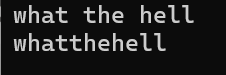
题目:删除字符串中的空格
#include<stdio.h>
#include<stdlib.h>
void del_space(char *s);
int main()
{
    char s[] = "what the hell";
    puts (s);
    del_space(s);
    puts(s);
    return 0;
}

void del_space(char *s)
{
    char *s2 = s;
    while (*s != '\0')
    {
        if(*s == ' ')
        {
            s++;
        }
        else
        {
            *s2 = *s;
            s2++;
            s++;
        }
    }
    *s2 = '\0';
}
指针函数
指针函数是指一个函数的返回值为地址量的函数
指针函数的定义的一般形式如下
<数据类型> *<函数名称> (<参数说明>)
{
语句序列;
}
返回值:全局变量的地址/static变量地址/字符串常量的地址
题目:编写一个指针函数,删除一个字符串中的空格
#include<stdio.h>
#include<stdlib.h>

char *del_space(char *s);
int main()
{
    char s[] = "Secret Place";
    char *r;
    puts(s);
    r = del_space(s);
    puts(r);
    return 0;
}
char *del_space(char *s)        //与传参函数不同的是,数据类型char后加了个* 号
{
    char *p = s;
    char *r = s;
    while(*s != '\0')
    {
        if(*s == ' ')
        {
            s++;
        }
        else
        {
            *p = *s;
            p++;
            s++;
        }
    }
    *p = '\0';
    return r;
}
题目:编写一个指针函数,实现字符串连接
系统自带函数实现字符串连接
#include<stdio.h>
#include<stdlib.h>
#include<string.h>
int main()
{
    char dest[50]="hello";
    char src[]="world";
    puts(strcat(dest,src));
    return 0;
}
自己编写函数实现
#include<stdio.h>
#include<stdlib.h>
#include<string.h>
char *mystrcat(char *dest,const char *src);
int main()
{
    char dest[50]="hello";\
    char src[]="world";
    puts(mystrcat(dest,src));
    return 0;

}
char *mystrcat(char *dest,const char *src)
{
    char *r=dest;
    while(*dest != '\0')
    {
        dest++;
    }
    while(*src != '\0')
    {
        *dest = *src;
        dest++;
        src++;
    }
    *dest='\0';
    return r;
}
递归函数
递归函数是指一个函数的函数体中直接或间接调用了该函数自身。
递归函数调用的执行过程分为两个阶段:
递推阶段:从原问题出发,按递归公式递推从未知到已知,最终达到递归的终止条件
回归阶段:按递归终止条件求出结果,并逐步代入递归公式,回归到原问题求解
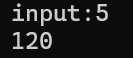
题目:计算N的阶层
#include<stdio.h>
#include<stdlib.h>

int a(int n);
int main()
{
    int n=0;
    printf("input:");
    scanf("%d",&n);
    printf("%d \n",a(n));
    return 0;
}
int a(int n)
{
    if(n ==0 || n ==1)
    {
        return 1;
    }
    return n*a(n-1);    //此处能让不是0,1的输入返回,直到循环为1或0来实现实现阶乘
}
函数指针
函数指针用来存放函数的地址,这个地址是一个函数的入口地址
函数名代表了函数的入口地址
函数指针变量说明的一般形式如下:
<数据类型> (*<函数指针名称>) (<参数说明列表>);
1.数据类型是函数指针所指向的函数的返回值类型
2.参数说明列表应该与函数指针所指向参数的形参说明保持一致
3.函数指针名称中,* 说明为指针不可缺省,表明为函数指针
#include<stdio.h>
#include<stdlib.h>

int add(int a,int b);    //函数返回值类型
int main()
{
    int a=1,b=2;
    int (*p) (int a,int b);    //形式,a,b为形参
    p=add;
    printf("result = %d \n",(*p)(a,b));
    return 0;
}
int add(int a,int b)
{
    return a+b;
}
函数指针数组
函数指针数组是一个保持若干个函数名的数组
一般形式:
<数据类型>(函数指针数组名称>)(<大小>)(<参数说明列表>);
1.大小,是指函数指针数组元素个
2.其他同普通的函数指针一样
#include<stdio.h>
#include<stdlib.h>

int add(int a,int b);
int sub(int a,int b);
int main()
{
    int a=1,b=2;
    int (*p[2]) (int a,int b);        //在函数指针的一般形式上加了个[],指针名称变成指针数组了
    p[0]=add;
    printf("result = %d \n",(*p[0])(a,b));
    p[1]=sub;
    printf("result = %d \n",(*p[1])(a,b));
    return 0;
}
int add(int a,int b)
{
    return a+b;
}
int sub(int a,int b)
{
    return a-b;
}
AtomGit 是由开放原子开源基金会联合 CSDN 等生态伙伴共同推出的新一代开源与人工智能协作平台。平台坚持“开放、中立、公益”的理念,把代码托管、模型共享、数据集托管、智能体开发体验和算力服务整合在一起,为开发者提供从开发、训练到部署的一站式体验。
更多推荐


 8
8 0
0- 0


 已为社区贡献1条内容

所有评论(0)