文献阅读 260327-Historical deforestation drives strong rainfall decline across the southern Amazon basin
Historical deforestation drives strong rainfall decline across the southern Amazon basin
来自 <https://www.nature.com/articles/s41467-026-68361-z#Sec7>
## Mechanism:
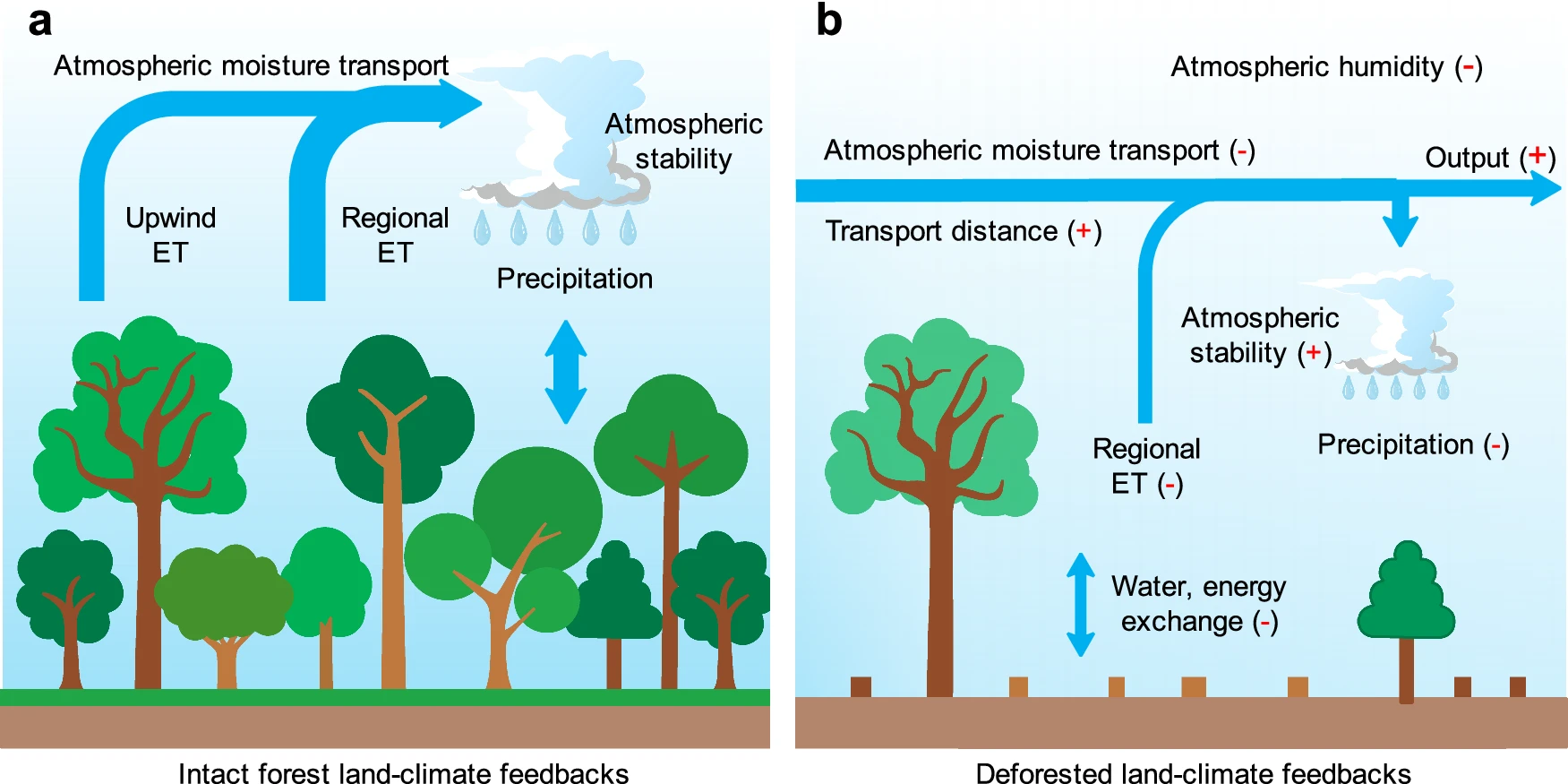
The mechanism by which historical deforestation drives a decline in regional precipitation involves several interconnected land-atmosphere feedback loops, include:
1. Suppression of Terrestrial Moisture Recycling
The Amazon forest acts as a vital "biological pump," recycling vast amounts of moisture to sustain regional rainfall.
- Reduced Evapotranspiration (ET_{wb}): Deforestation directly replaces deep-rooted trees with shorter vegetation or bare land, significantly lowering the rates of land-atmosphere water exchange.
- Moisture Source Depletion: This decline in evapotranspiration reduces the primary terrestrial source of moisture available for local and downwind precipitation.
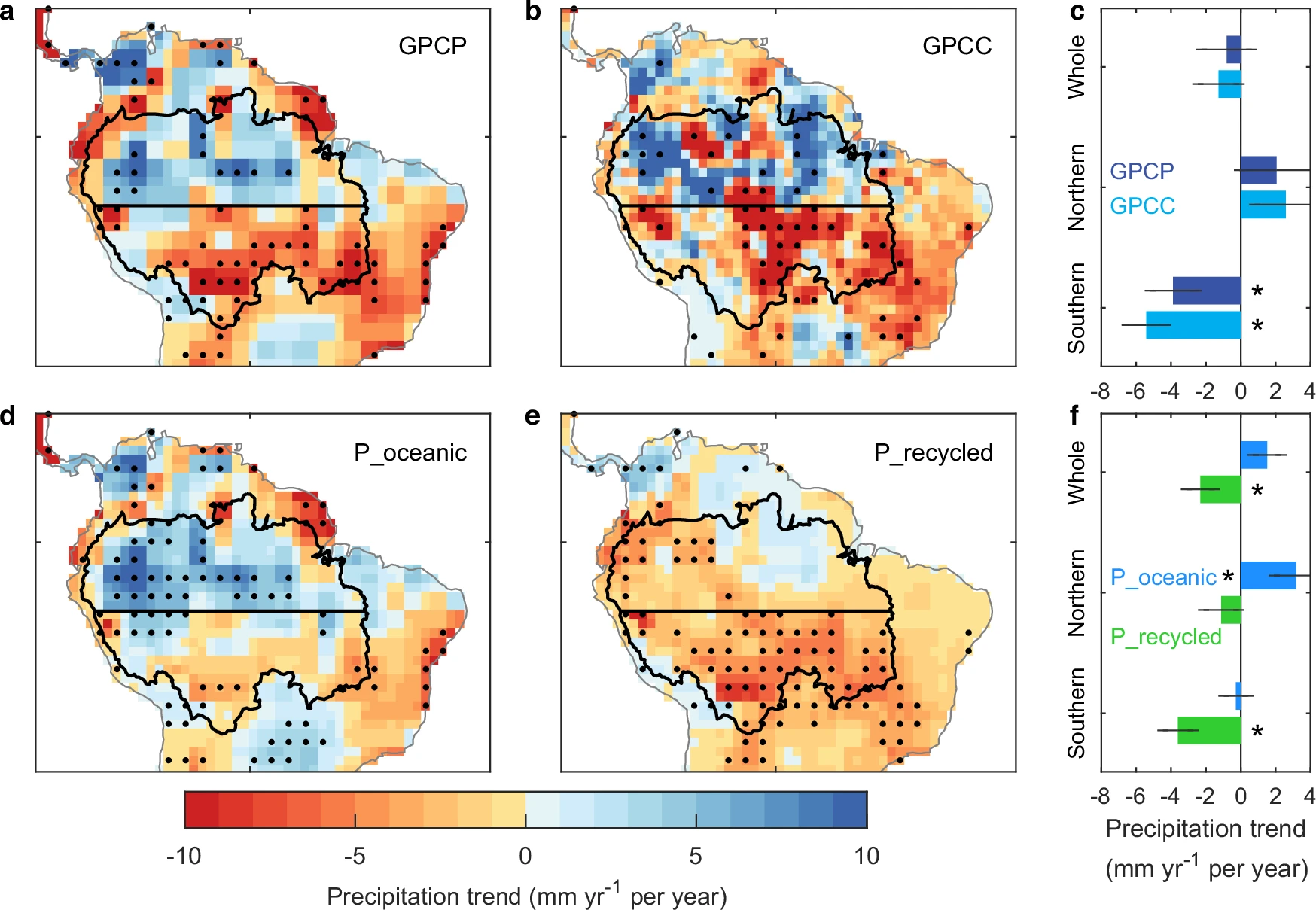
- Statistical Impact: In the southern Amazon, terrestrial recycled precipitation has declined by 3.6 to 4.1 mm per year, accounting for 76-92% of the total observed negative rainfall trend.
2. Enhanced Atmospheric Thermodynamic Stability
Deforestation alters the physical state of the atmosphere, making it less conducive to cloud formation and rainfall.
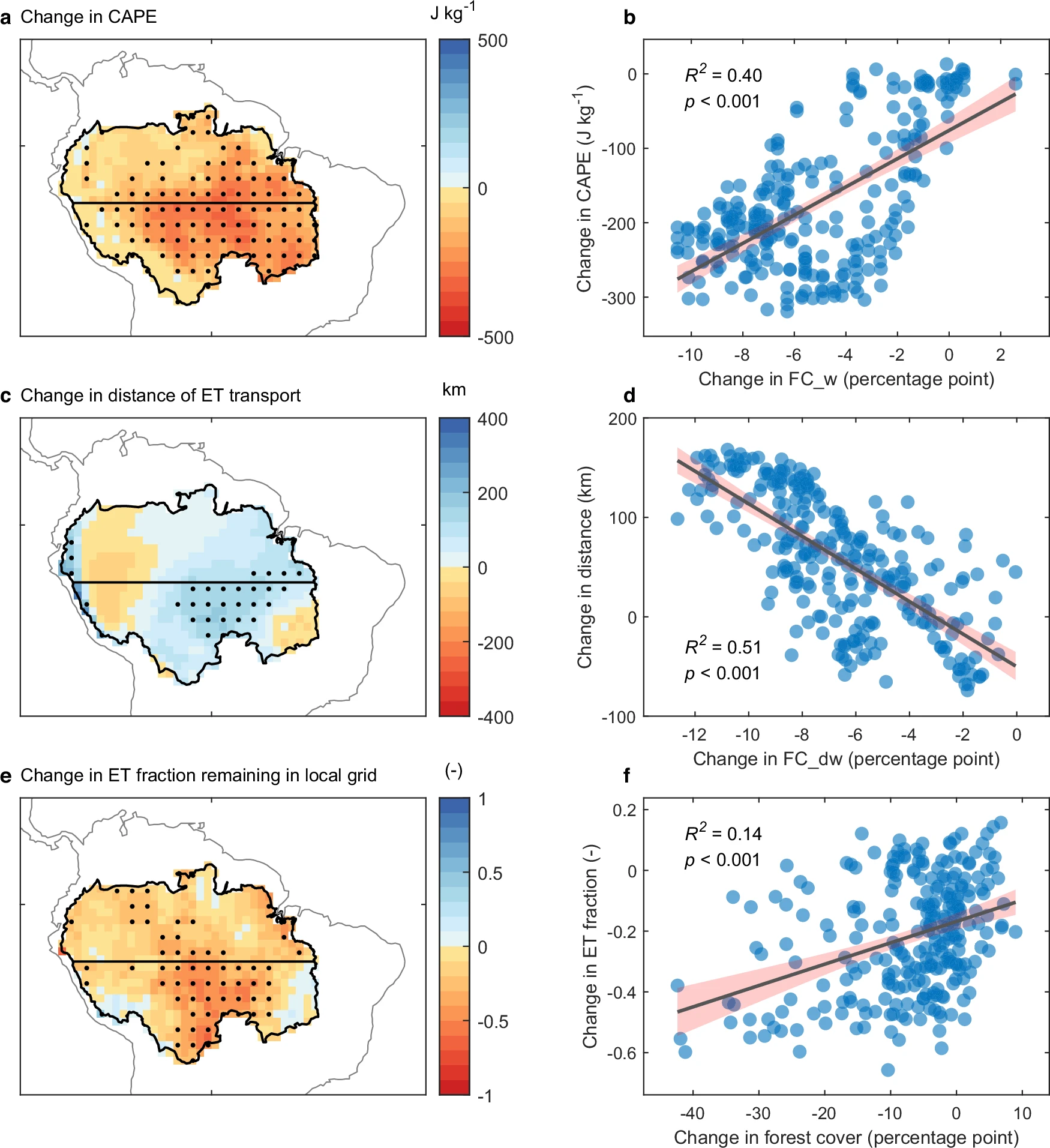
- Reduced Convective Potential: The drying of the atmosphere leads to a decrease in Convective Available Potential Energy (CAPE).
- Suppressed Convection: A drier and more stable atmosphere increases layer stability, which prevents moisture from condensing into precipitation.
- Inhibition of Rainfall Initiation: These alterations diminish the atmospheric triggers necessary for the initiation of convection and subsequent rainfall.
3. Altered Boundary Layer Dynamics and Moisture Outflow
Physical changes to the land surface affect how moisture is transported across the continent.
- Reduced Surface Roughness: Clearing forests significantly lowers surface roughness, which leads to increased surface wind speeds.
- Increased Transport Distance: Higher wind speeds and a more stable atmosphere lengthen the distance that moisture travels before it can fall as rain.
- Net Moisture Export (Outflow): These factors combine to promote the transport of atmospheric moisture out of the basin, effectively "exporting" water that would otherwise have been recycled within the forest system.
## Abstract:
Backgrounds:
The Amazon forest has recently experienced substantial human-induced loss of forest cover. However, the extent to which such historical deforestation has altered regional observed precipitation through inter-regional atmospheric moisture transport remains unclear.
What this paper did:
Here, we combine satellite observations and an atmospheric moisture tracking model to quantify these feedbacks over the past four decades (1980-2019).
Findings:
We identify a contrasting northern increase and southern decrease dipole trend in observed precipitation across the Amazon basin. The pronounced reduction in precipitation for the southern Amazon basin reaches up to 3.9-5.4 mm yr-1 per year, resulting in an 8-11% decline in annual precipitation across the observation period. We discover that this reduction in precipitation is primarily (52-72%) related to widespread deforestation in the southern basin and upwind regions over South America.
Implications:
Deforestation substantially suppresses forest-sourced moisture, increases atmospheric stability and moisture outflow, leading to precipitation reduction. We also find that climate models substantially underestimate the sensitivity of precipitation to deforestation, implying that the Amazon forest is at risk of major loss much sooner than previously projected.
## Intro:
#Para1: Intro about amazon forest!!!:
The Amazon forest is Earth’s most biodiverse terrestrial ecosystem (e.g., ref. 1) and is essential in regulating much of the global climate system2,3. However, an increasing number of studies suggest that the Amazon forest is approaching a critical threshold beyond which much of it could be irreversibly lost, potentially due to climate change, but may also be initiated by substantial deforestation4.
“Climate change & deforestation are driving Amazon forests to break a threshold, which might result in irreversibly lost.”
Deforestation intro:
Multiple satellite observations show that the Amazon forest has experienced extensive loss of forest cover, particularly in the southern part of the Amazon basin5,6. Since the year 1985, natural forest cover has declined by 16%, mainly due to direct human-induced deforestation7.
Importance intro:
The Amazon forest plays a vital role in sustaining regional precipitation by recycling substantial amounts of forest-sourced moisture3,8,9,10,11. Hence, a deeper understanding on how historical deforestation has altered vegetation-climate moisture feedbacks and related availability of such precipitation recycling is of great importance. Refined knowledge will then underpin more accurate projections of the future trajectory of the remaining Amazon forest in response to any further deforestation.
#Para2: Intro about method gaps:
- Obs-based: scale-limited
Observation-based approaches have already verified that deforestation considerably affects precipitation at small scales in the Amazon basin12,13. However, an increasing number of studies suggest that changes in inter-regional atmospheric moisture transport, attributed to large-scale deforestation, likely play a critical role in redistributing forest-sourced moisture and reshaping regional precipitation patterns8,14,15,16.
- Model-based: accuracy of parameters
It is relatively straightforward for sophisticated fully coupled land-atmosphere models to simulate how Amazon deforestation alters land-surface evapotranspiration and subsequently moisture transport through atmospheric circulation14,17,18. Such models allow factorial simulations to isolate individual effects, but the question still remains whether they are accurately simulated. Extracting the parameterisation of individual processes from data can be more challenging, as these must be derived from the full-complexity actual system.
- atmospheric moisture-tracking techniques
To quantify the effects of Amazon moisture recycling, algorithms must account for the complex spatial connections between forest-derived moisture sources and precipitation sinks across the region. Fortunately, recent advances in atmospheric moisture-tracking techniques make it possible to trace the trajectories or transport pathways of atmospheric moisture. The use of these algorithms, alongside known changes in rainfall patterns, supports discovering changes in inter-regional moisture transport, which may result from major land use changes3,15,19,20. Since the substantial and quantified levels of Amazon basin deforestation in recent decades coincide with a period of available rainfall observations, this presents an opportunity to use such atmospheric moisture tracking to more accurately constrain estimates of how forest cover loss is altering the strength of regional vegetation-climate feedbacks.
## Results:
Contrasting north-south precipitation trend and related moisture sources
Fig. 1: Observed precipitation trend and its moisture sources for the Amazon.
Drivers of precipitation reductions in the southern Amazon basin
Fig. 2: Drivers for the precipitation trend in the southern Amazon basin.
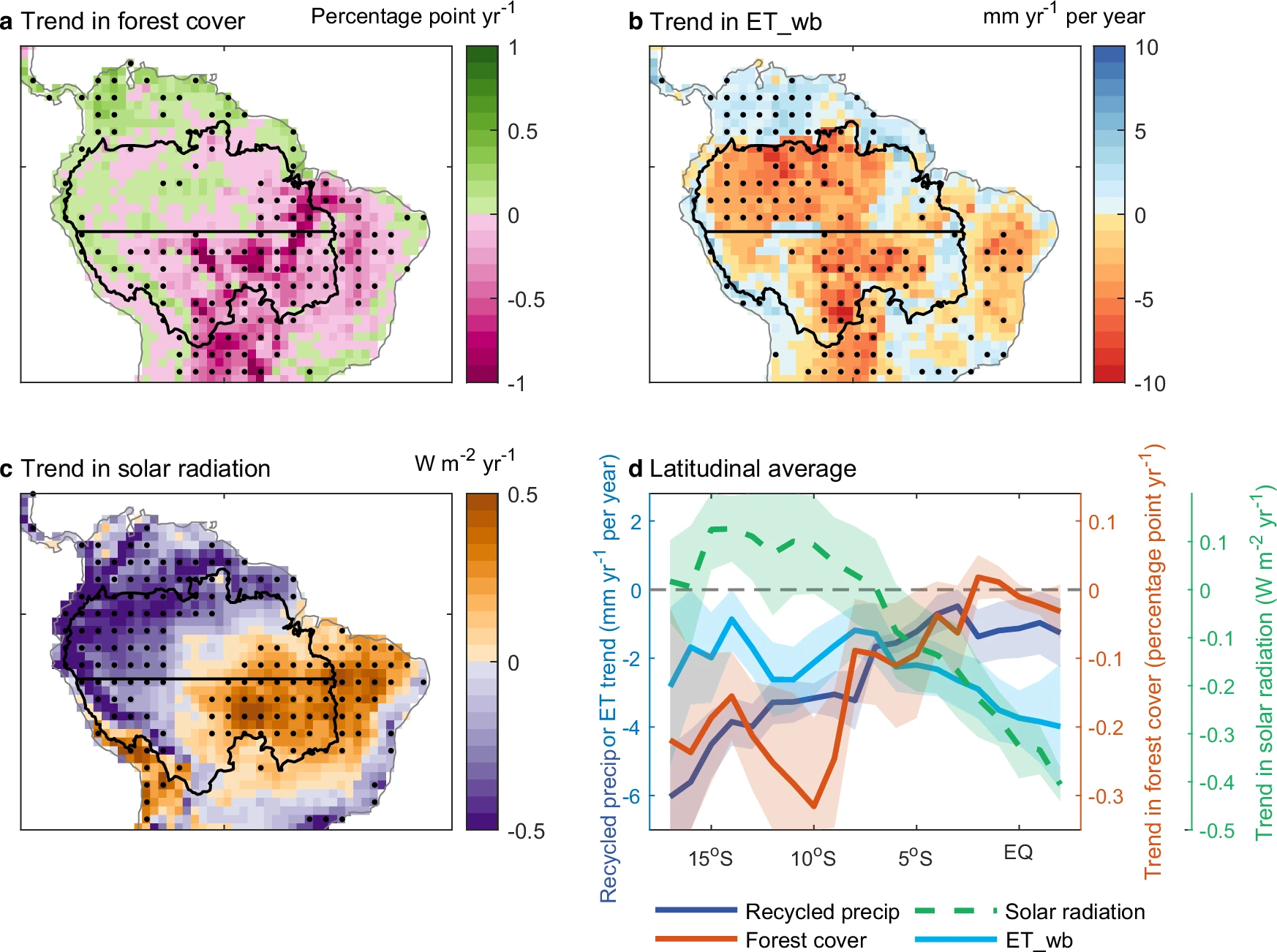
Fig. 3: Schematic representation of land-surface and atmospheric processes responsible for the weakening of land-climate feedbacks, due to large-scale deforestation in the southern Amazon basin.
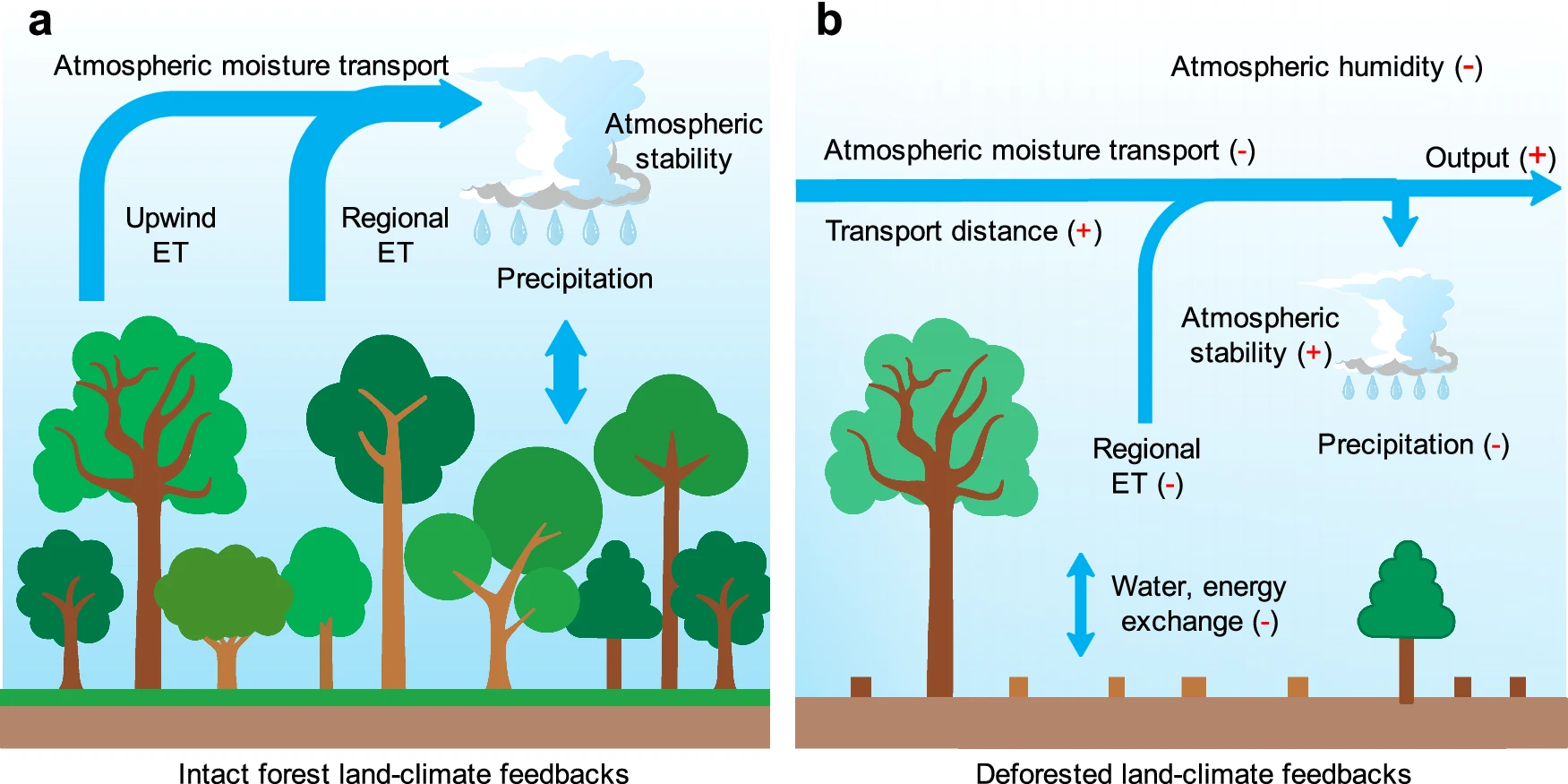
a Intact forest, or regions less disturbed by human activities. These locations feature high and complex canopies which sustains intensive land-atmosphere turbulent mixing and humid air. In these circumstances, regional and upwind evapotranspiration possess strong moisture recycling and feedback mechanisms to maintain regional precipitation. b Large-scale deforestation has occurred. In these circumstances, evapotranspiration substantially declines and thus reduces available moisture that feeds into precipitation. Additionally, the drying atmosphere increases its stability, which further reduces precipitation, lengthens the distance of moisture transport, and promotes moisture flow out of the southern basin (Fig. 5). “Output” represents the atmospheric moisture transported out of a specific region, which here is generally regarded as the Amazon basin. The width of the arrows denotes the relative magnitude of moisture amount in atmospheric transport or land-atmosphere flux exchange. The length of the horizontal part of the arrows represents the relative distance of atmospheric moisture transport. For each process, the corresponding red symbols ‘+’ and ‘−’ in brackets represent an increase or decrease, respectively, in response to deforestation (i.e. the effects in (b) compared to those in (a)).
Fig. 4: The impacts of forest cover change on recycled precipitation.
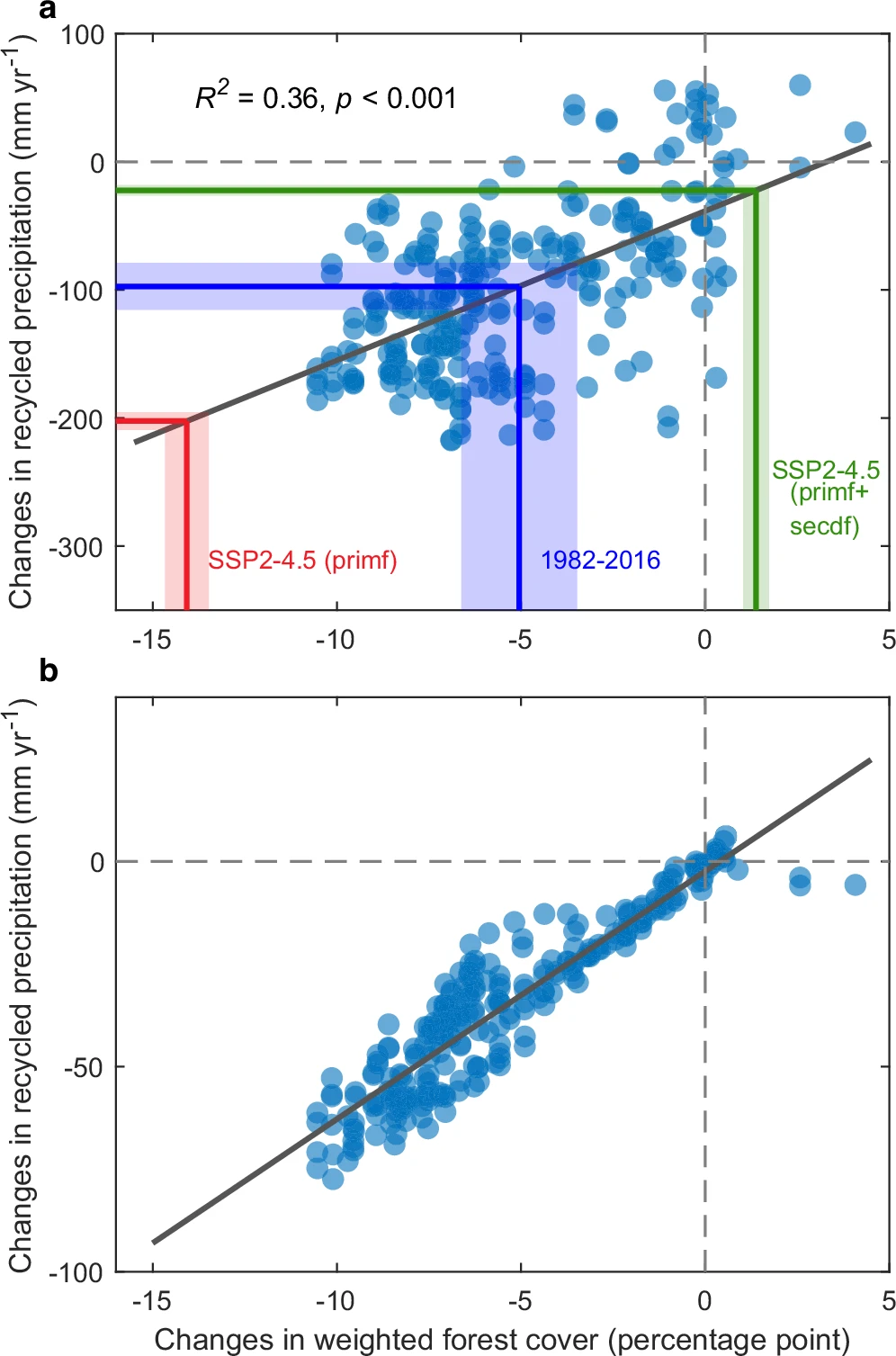
Fig. 5: Changes in atmospheric processes and their relationship with forest cover change in the southern Amazon basin.

AtomGit 是由开放原子开源基金会联合 CSDN 等生态伙伴共同推出的新一代开源与人工智能协作平台。平台坚持“开放、中立、公益”的理念,把代码托管、模型共享、数据集托管、智能体开发体验和算力服务整合在一起,为开发者提供从开发、训练到部署的一站式体验。
更多推荐



 11
11 0
0- 0


 已为社区贡献9条内容

所有评论(0)