文献阅读 260324-Amazon forest nutrient limitation is mitigated by distant fire emissions
Amazon forest nutrient limitation is mitigated by distant fire emissions
来自 <https://www.nature.com/articles/s41561-025-01899-7>
## Abstract:
Background:
Emissions from deforestation and savannah fires can travel over long distances and contribute to nutrient deposition in intact tropical forests, where phosphorus limits productivity. The magnitude of this deposition and its influence on the carbon sink, however, remain uncertain.
What this paper did:
Here we used satellite- and model-based geospatial datasets with feature importance analysis to quantify the influence of fire-derived nutrient inputs on Amazon rainforest productivity.
Results-Mechanism:
Atmospheric transport modelling indicated that plumes originating in the southern arc of deforestation deliver aerosols into the Amazon basin, creating a south-to-northeast gradient in phosphorus deposition across the Amazon rainforest. This gradient in phosphorus deposition aligned with spatial patterns in sun-induced fluorescence, a proxy for gross primary productivity.
Results:
We show that long-term phosphorus deposition was the strongest predictor of gross primary productivity, accounting for 22.5% of total spatial variability, and was linked to gains of 7.4 gC m−2yr−1 per 1 mg P m−2yr−1 deposited.
Implications:
Our results demonstrate that fire-derived deposition can alleviate chronic nutrient limitations in undisturbed tropical forests and influence spatial patterns of productivity. This nutrient fertilization partially offsets carbon losses from deforestation and fires, with important implications for global carbon budgets.
## Results:
亚马逊雨林被誉为地球之肺,每年固碳量高达10.7亿吨碳,占全球森林总碳汇的 30%。但这片看似葱郁的绿色海洋,实则面临着严重的营养不良。亚马逊盆地的土壤古老且风化严重,这意味着土壤中的磷含量极低。磷是植物光合作用、能量传输和生长的必需元素,直接限制了亚马逊森林的净初级生产力(NPP),也束缚了其应对大气二氧化碳浓度升高的能力。长期以来,科学家们认为,这片贫瘠土地上的磷主要依赖外部输入,最著名的来源是跨越大西洋从非洲撒哈拉沙漠吹来的富含矿物质的沙尘。然而,最新的研究对此提出了挑战:除了远在天边的非洲沙尘,亚马逊甚至在通过“自燃”来滋养自己。
South-to-northeast gradient in fire-related P deposition
Fig. 1: Long-term spatial patterns of fire activity, atmospheric composition, black carbon deposition and productivity in the Amazon rainforest.
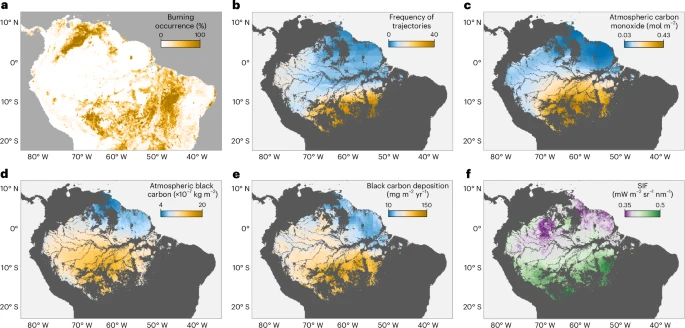
图注: 亚马逊雨林火灾活动、大气成分和生产力的长期空间格局。(a) 2001-2020年间亚马逊南部的火灾发生频率;(b) 空气轨迹模型显示,火灾产生的排放物顺着信风向北/东北方向输送;(c) 哨兵5号卫星观测到的大气一氧化碳浓度梯度;(d-e) MERRA-2 黑碳柱质量密度及沉降量;(f) 2001-2020年平均的日光诱导叶绿素荧光(SIF)分布。
Fig. 2: Atmospheric P deposition and modelled–observed comparisons across the Amazon rainforest.
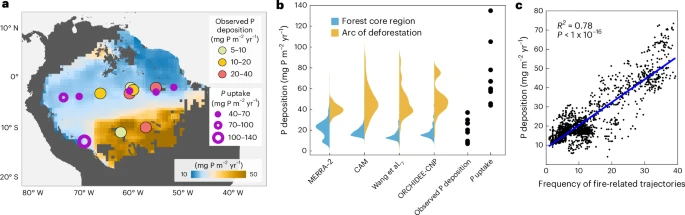
图注: 亚马逊雨林的大气磷沉降及模型验证。(a) 基于多个数据集(MERRA-2, CAM等)平均的长期磷沉降空间分布,显示出明显的西南-东北梯度;(b) 四个地理空间数据集模拟的磷沉降量与实地观测数据及土壤磷吸收需求的对比;(c) 磷沉降量与源自南美火灾的气团轨迹频率呈现高度正相关(R²=0.78)。
Impact of fire-derived nutrient deposition on productivity
这漫天的烟尘,真的被森林吃进去了吗?真的起作用了吗?
为了验证这一点,研究人员使用了日光诱导叶绿素荧光(SIF)数据。
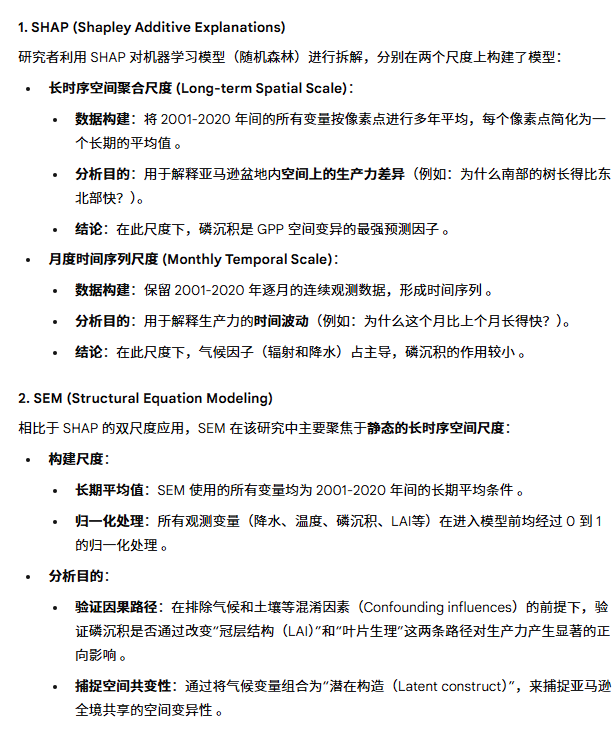
通过构建随机森林机器学习模型,并利用 SHAP 值进行归因分析
最强预测因子:在解释亚马逊雨林生产力(GPP)的空间变异时,长期的磷沉降是排名第一的预测变量,其重要性甚至超过了降水、气温和土壤性质。
磷沉降单独解释了22.5%的 GPP 空间变异。模型预测的 R² 高达 0.81。
每增加1 mg m⁻² yr⁻¹的磷沉降,森林每平方米每年就能多固定7.4 g的碳。这表明,火灾产生的磷沉降有效地缓解了原始雨林长期的磷限制,像“施肥”一样促进了碳吸收。
Fig. 3: Influence of P on GPP in the Amazon rainforest.
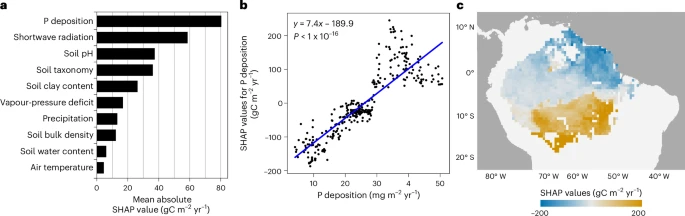
图注: 磷沉降对亚马逊雨林 GPP 的影响。(a) 机器学习模型特征重要性排序(SHAP值),显示磷沉降是影响 GPP 空间分布最重要的因素;(b) 磷沉降与 SHAP 值的依赖关系图,显示正相关;(c) 磷沉降对 GPP 正向贡献的空间分布图,暖色代表贡献度高。
Canopy structure mediates nutrient-driven productivity
为了排除“相关性不等于因果性”的质疑,研究团队进一步构建了结构方程模型(SEM),试图揭示磷沉降影响生产力的具体路径。因为 SIF 信号不仅反映植物的生理活性,还受冠层结构的影响。SEM 分析发现,磷沉降对 GPP 的提升作用主要通过两条路径实现:
结构机制:磷的补充显著增加了叶面积指数(LAI)。更多的叶子意味着更大的光合作用面积,从而从结构上提升了整个森林的生产力。SEM 显示磷沉降对 LAI 有显著的正向影响。
生理机制:直接增强植物的光合作用效率(SIF增强)。
此外,研究还发现一个有趣的时间尺度现象:气候因子(如降水、辐射)主要驱动森林生产力的短期/季节性波动,而火灾带来的营养沉降则决定了森林生产力的长期空间格局。
Fig. 4: Structural equation modelling for the association between P deposition and climatic, soil and vegetation variables.
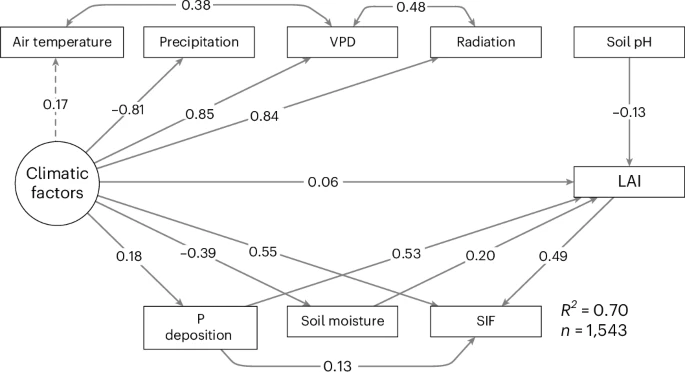
图注: 结构方程模型(SEM)揭示的因果路径。图中箭头上的数字为标准化路径系数。实线箭头表示显著影响(P < 0.05)。模型显示,磷沉降(P deposition)不仅直接影响 SIF,还通过显著增加叶面积指数(LAI,路径系数0.53)间接提升生产力。

AtomGit 是由开放原子开源基金会联合 CSDN 等生态伙伴共同推出的新一代开源与人工智能协作平台。平台坚持“开放、中立、公益”的理念,把代码托管、模型共享、数据集托管、智能体开发体验和算力服务整合在一起,为开发者提供从开发、训练到部署的一站式体验。
更多推荐


 6
6 0
0- 0


 已为社区贡献9条内容

所有评论(0)