传热学仿真-主题093-板式换热器性能预测
第九十三篇:板式换热器性能预测
摘要
板式换热器因其高效传热、结构紧凑、易于维护等优点,在食品、化工、暖通等领域得到广泛应用。本教程系统介绍板式换热器的结构特点和工作原理,讨论波纹板片传热强化机理、压降特性以及性能预测方法。通过Python实现板式换热器的性能预测模型,包括传热系数计算、压降预测和优化设计。本教程涵盖人字形波纹、传热因子、摩擦因子等核心内容。通过本教程的学习,读者将掌握板式换热器性能预测方法,能够进行选型设计和运行优化。
关键词
板式换热器,波纹板片,传热强化,压降特性,性能预测,人字形波纹,紧凑度
1. 板式换热器基础
1.1 结构特点
主要部件:
- 波纹板片
- 密封垫片
- 压紧板
- 导杆
板片类型:
- 人字形(Chevron)
- 水平平直波纹
- 球形波纹
- 鱼骨形
1.2 流动特点
复杂流动:
- 主流区
- 分流区
- 端口区
传热强化机制:
- 波纹诱导湍流
- 二次流
- 边界层破坏
1.3 设计参数
波纹角度:
- 硬板(Hard plate):β>45°\beta > 45°β>45°
- 软板(Soft plate):β<45°\beta < 45°β<45°
波纹深度:
- 典型值:2-5 mm
2. 性能预测模型
2.1 传热关联式
Chisholm-Scott关联式:
Nu=ChRemPr1/3(μbμw)0.14Nu = C_h Re^m Pr^{1/3} \left(\frac{\mu_b}{\mu_w}\right)^{0.14}Nu=ChRemPr1/3(μwμb)0.14
其中:
- ChC_hCh 和 mmm 为板片特性常数
- 典型值:Ch=0.15−0.4C_h = 0.15-0.4Ch=0.15−0.4,m=0.65−0.85m = 0.65-0.85m=0.65−0.85
传热因子:
jH=St⋅Pr2/3j_H = St \cdot Pr^{2/3}jH=St⋅Pr2/3
2.2 压降关联式
摩擦因子:
f=CfRenf = \frac{C_f}{Re^n}f=RenCf
压降计算:
ΔP=4fLeffDhρu22\Delta P = 4f \frac{L_{eff}}{D_h} \frac{\rho u^2}{2}ΔP=4fDhLeff2ρu2
2.3 当量直径
Dh=4b⋅ϕ2(b+ϕ⋅l)D_h = \frac{4b \cdot \phi}{2(b + \phi \cdot l)}Dh=2(b+ϕ⋅l)4b⋅ϕ
其中:
- bbb:板间距
- ϕ\phiϕ:波纹展开系数
- lll:波纹波长
3. Python仿真实现
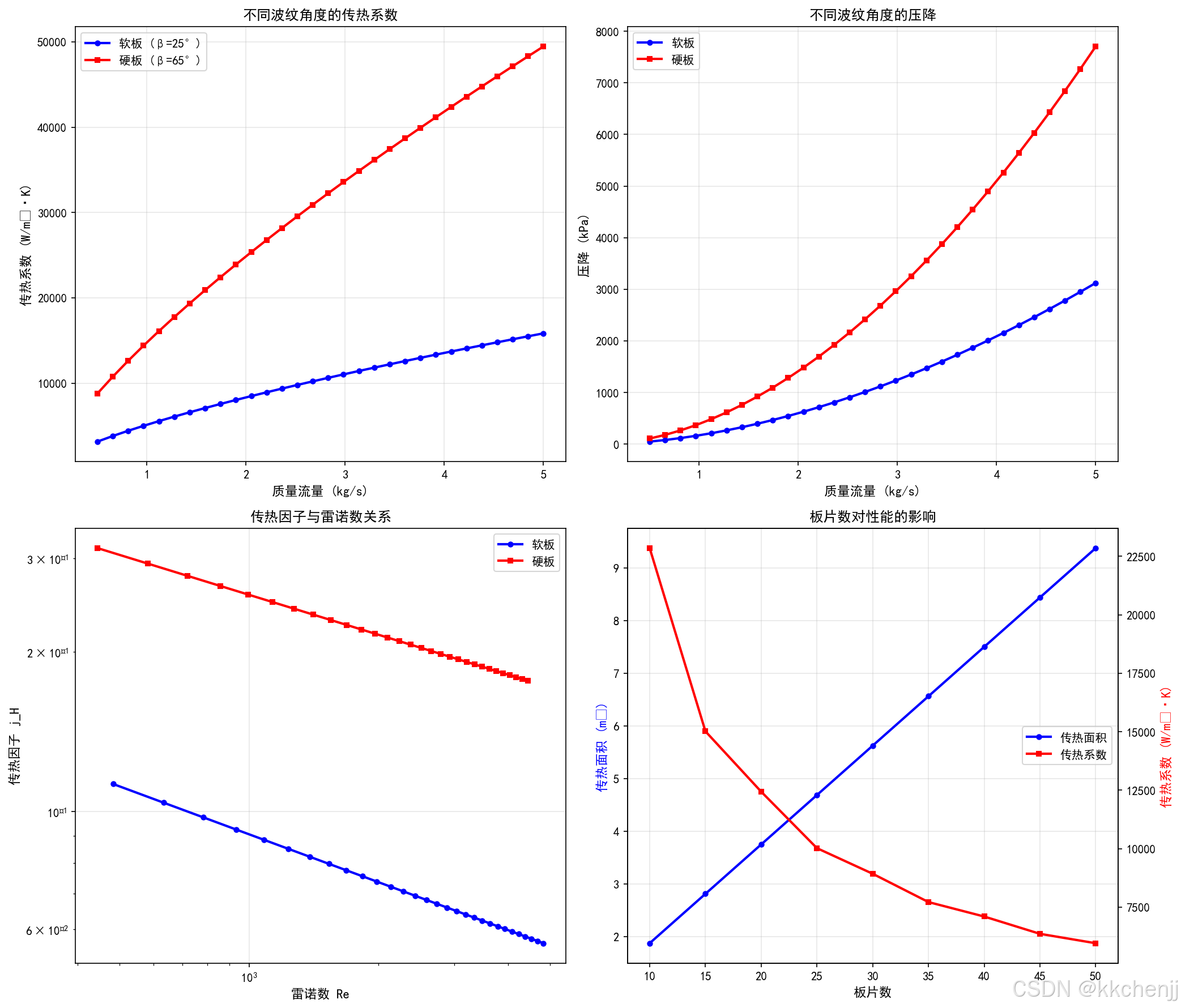
3.1 板式换热器性能预测
"""
主题093:板式换热器性能预测
板式换热器传热和压降计算
"""
import numpy as np
import matplotlib.pyplot as plt
import os

# 创建输出目录
output_dir = r'd:\文档\500仿真领域\工程仿真\传热学仿真\主题093'
os.makedirs(output_dir, exist_ok=True)

# 设置中文字体
plt.rcParams['font.sans-serif'] = ['SimHei', 'DejaVu Sans']
plt.rcParams['axes.unicode_minus'] = False

def plate_heat_exchanger_performance(m_dot, T_in, fluid_props, plate_props, n_plates):
    """
    板式换热器性能计算
    """
    rho, mu, k, Pr = fluid_props
    beta, b, phi, L_p, W_p = plate_props

    # 当量直径
    D_h = 2 * b / phi

    # 单通道流通面积
    A_channel = b * W_p

    # 通道数
    n_channels = (n_plates - 1) // 2

    # 单通道流量
    m_dot_channel = m_dot / n_channels

    # 流速
    u = m_dot_channel / (rho * A_channel)

    # 雷诺数
    Re = rho * u * D_h / mu

    # 传热关联式参数(人字形板片)
    if beta < 30:  # 软板
        C_h, m = 0.2, 0.7
        C_f, n = 15, 0.2
    elif beta < 60:  # 中板
        C_h, m = 0.3, 0.73
        C_f, n = 18, 0.18
    else:  # 硬板
        C_h, m = 0.4, 0.75
        C_f, n = 22, 0.15

    # 努塞尔数
    Nu = C_h * Re**m * Pr**(1/3)

    # 传热系数
    h = Nu * k / D_h

    # 摩擦因子
    f = C_f / Re**n

    # 压降
    L_eff = L_p
    dP = 4 * f * (L_eff / D_h) * (rho * u**2 / 2) * n_channels

    # 传热面积
    A_heat = n_plates * L_p * W_p * phi

    # 总传热系数(单相,简化)
    U = h / 2  # 两侧相同流体

    return {
        'Re': Re,
        'Nu': Nu,
        'h': h,
        'f': f,
        'dP': dP,
        'u': u,
        'U': U,
        'A': A_heat
    }

def optimize_plate_design(Q_target, dP_max, fluid_props, plate_params_range):
    """
    板式换热器优化设计
    """
    beta_range, b_range, n_plates_range = plate_params_range

    best_design = None
    best_score = float('inf')

    for beta in beta_range:
        for b in b_range:
            for n_plates in n_plates_range:
                plate_props = (beta, b, 1.2, 0.5, 0.2)

                # 估算流量
                m_dot = Q_target / (4200 * 20)  # 简化

                result = plate_heat_exchanger_performance(
                    m_dot, 350, fluid_props, plate_props, n_plates
                )

                # 约束检查
                if result['dP'] <= dP_max:
                    # 评分(面积越小越好)
                    score = result['A']
                    if score < best_score:
                        best_score = score
                        best_design = {
                            'beta': beta,
                            'b': b,
                            'n_plates': n_plates,
                            'A': result['A'],
                            'dP': result['dP'],
                            'U': result['U']
                        }

    return best_design

# 1. 板式换热器性能分析
fig, axes = plt.subplots(2, 2, figsize=(14, 12))

# 流体物性(水)
fluid_props = (1000, 0.0008, 0.6, 6)

# 板片参数(beta, b, phi, L_p, W_p)
plate_soft = (25, 0.003, 1.15, 0.6, 0.25)  # 软板
plate_hard = (65, 0.003, 1.25, 0.6, 0.25)  # 硬板

# 流量范围
m_dot_range = np.linspace(0.5, 5, 30)
n_plates = 20

results_soft = []
results_hard = []

for m_dot in m_dot_range:
    results_soft.append(plate_heat_exchanger_performance(
        m_dot, 350, fluid_props, plate_soft, n_plates
    ))
    results_hard.append(plate_heat_exchanger_performance(
        m_dot, 350, fluid_props, plate_hard, n_plates
    ))

# 传热系数对比
h_soft = [r['h'] for r in results_soft]
h_hard = [r['h'] for r in results_hard]

axes[0, 0].plot(m_dot_range, h_soft, 'b-o', linewidth=2, markersize=4, label='软板 (β=25°)')
axes[0, 0].plot(m_dot_range, h_hard, 'r-s', linewidth=2, markersize=4, label='硬板 (β=65°)')
axes[0, 0].set_xlabel('质量流量 (kg/s)', fontsize=11)
axes[0, 0].set_ylabel('传热系数 (W/m²·K)', fontsize=11)
axes[0, 0].set_title('不同波纹角度的传热系数', fontsize=12)
axes[0, 0].legend()
axes[0, 0].grid(True, alpha=0.3)

# 压降对比
dP_soft = [r['dP']/1000 for r in results_soft]
dP_hard = [r['dP']/1000 for r in results_hard]

axes[0, 1].plot(m_dot_range, dP_soft, 'b-o', linewidth=2, markersize=4, label='软板')
axes[0, 1].plot(m_dot_range, dP_hard, 'r-s', linewidth=2, markersize=4, label='硬板')
axes[0, 1].set_xlabel('质量流量 (kg/s)', fontsize=11)
axes[0, 1].set_ylabel('压降 (kPa)', fontsize=11)
axes[0, 1].set_title('不同波纹角度的压降', fontsize=12)
axes[0, 1].legend()
axes[0, 1].grid(True, alpha=0.3)

# 传热因子j_H vs 雷诺数
Re_soft = [r['Re'] for r in results_soft]
Re_hard = [r['Re'] for r in results_hard]

j_H_soft = [r['h'] * 0.0008 / (1000 * r['u']) * 6**(2/3) for r in results_soft]
j_H_hard = [r['h'] * 0.0008 / (1000 * r['u']) * 6**(2/3) for r in results_hard]

axes[1, 0].loglog(Re_soft, j_H_soft, 'b-o', linewidth=2, markersize=4, label='软板')
axes[1, 0].loglog(Re_hard, j_H_hard, 'r-s', linewidth=2, markersize=4, label='硬板')
axes[1, 0].set_xlabel('雷诺数 Re', fontsize=11)
axes[1, 0].set_ylabel('传热因子 j_H', fontsize=11)
axes[1, 0].set_title('传热因子与雷诺数关系', fontsize=12)
axes[1, 0].legend()
axes[1, 0].grid(True, alpha=0.3)

# 板片数对性能的影响
n_plates_range = range(10, 51, 5)
m_dot_fixed = 2.0

A_values = []
U_values = []

for n_plates in n_plates_range:
    result = plate_heat_exchanger_performance(
        m_dot_fixed, 350, fluid_props, plate_hard, n_plates
    )
    A_values.append(result['A'])
    U_values.append(result['U'])

ax2 = axes[1, 1].twinx()
line1 = axes[1, 1].plot(n_plates_range, A_values, 'b-o', linewidth=2, markersize=4, label='传热面积')
line2 = ax2.plot(n_plates_range, U_values, 'r-s', linewidth=2, markersize=4, label='传热系数')

axes[1, 1].set_xlabel('板片数', fontsize=11)
axes[1, 1].set_ylabel('传热面积 (m²)', fontsize=11, color='b')
ax2.set_ylabel('传热系数 (W/m²·K)', fontsize=11, color='r')
axes[1, 1].set_title('板片数对性能的影响', fontsize=12)
axes[1, 1].grid(True, alpha=0.3)

# 合并图例
lines = line1 + line2
labels = [l.get_label() for l in lines]
axes[1, 1].legend(lines, labels, loc='center right')

plt.tight_layout()
plt.savefig(f'{output_dir}/plate_heat_exchanger.png', dpi=150, bbox_inches='tight')
plt.close()
print("板式换热器性能图已保存")

# 优化设计示例
print("\n优化设计示例:")
Q_target = 100e3  # W
dP_max = 50e3  # Pa

beta_range = [25, 45, 65]
b_range = [0.002, 0.003, 0.004]
n_plates_range = range(10, 41, 5)

best = optimize_plate_design(Q_target, dP_max, fluid_props,
                             (beta_range, b_range, n_plates_range))

if best:
    print(f"最优设计:")
    print(f"  波纹角度: {best['beta']}°")
    print(f"  板间距: {best['b']*1000:.1f} mm")
    print(f"  板片数: {best['n_plates']}")
    print(f"  传热面积: {best['A']:.2f} m²")
    print(f"  压降: {best['dP']/1000:.1f} kPa")
    print(f"  传热系数: {best['U']:.1f} W/m²·K")

print("\n所有仿真完成!")
3.2 仿真2:板式换热器污垢分析
污垢会降低板式换热器的传热性能,增加压降。
"""
仿真2:板式换热器污垢分析
研究污垢热阻对性能的影响
"""

fig, axes = plt.subplots(2, 2, figsize=(14, 12))

# 基础参数
fluid_clean = (1000, 0.0008, 0.6, 6)
plate_clean = (45, 0.003, 1.2, 0.6, 0.25)
n_plates_clean = 20
m_dot_clean = 2.0

# 清洁状态计算
result_clean = plate_heat_exchanger_performance(
    m_dot_clean, 350, fluid_clean, plate_clean, n_plates_clean
)

# 污垢热阻范围 (m²·K/W)
R_fouling_range = np.linspace(0, 0.0005, 20)

U_fouled = []
epsilon_fouled = []
Q_reduction = []
dP_increase = []

for R_f in R_fouling_range:
    # 污垢状态下的总传热系数
    U_clean = result_clean['U']
    U_f = 1 / (1/U_clean + R_f)
    U_fouled.append(U_f)

    # 效能下降(简化计算)
    C_min_pf = m_dot_clean * 4200 / 1000  # kW/K
    NTU_clean = U_clean * result_clean['A'] / (C_min_pf * 1000)
    NTU_f = U_f * result_clean['A'] / (C_min_pf * 1000)

    # 逆流效能
    eps_clean = (1 - np.exp(-NTU_clean * (1 - 0.5))) / (1 - 0.5 * np.exp(-NTU_clean * (1 - 0.5)))
    eps_f = (1 - np.exp(-NTU_f * (1 - 0.5))) / (1 - 0.5 * np.exp(-NTU_f * (1 - 0.5)))

    epsilon_fouled.append(eps_f)
    Q_reduction.append((eps_clean - eps_f) / eps_clean * 100)

    # 压降增加(简化:假设流通面积减小)
    dP_factor = 1 + R_f / 0.0001 * 0.1
    dP_increase.append((dP_factor - 1) * 100)

# 污垢对传热系数的影响
axes[0, 0].plot(R_fouling_range*1e4, U_fouled, 'b-o', linewidth=2, markersize=4)
axes[0, 0].axhline(y=U_clean, color='r', linestyle='--', label='清洁状态')
axes[0, 0].set_xlabel('污垢热阻 (×10⁻⁴ m²·K/W)', fontsize=11)
axes[0, 0].set_ylabel('总传热系数 (W/m²·K)', fontsize=11)
axes[0, 0].set_title('污垢对传热系数的影响', fontsize=12)
axes[0, 0].legend()
axes[0, 0].grid(True, alpha=0.3)

# 效能下降
axes[0, 1].plot(R_fouling_range*1e4, epsilon_fouled, 'g-s', linewidth=2, markersize=4)
axes[0, 1].axhline(y=eps_clean, color='r', linestyle='--', label='清洁状态')
axes[0, 1].set_xlabel('污垢热阻 (×10⁻⁴ m²·K/W)', fontsize=11)
axes[0, 1].set_ylabel('效能', fontsize=11)
axes[0, 1].set_title('污垢对效能的影响', fontsize=12)
axes[0, 1].legend()
axes[0, 1].grid(True, alpha=0.3)

# 传热量减少百分比
axes[1, 0].plot(R_fouling_range*1e4, Q_reduction, 'r-^', linewidth=2, markersize=4)
axes[1, 0].set_xlabel('污垢热阻 (×10⁻⁴ m²·K/W)', fontsize=11)
axes[1, 0].set_ylabel('传热量减少 (%)', fontsize=11)
axes[1, 0].set_title('污垢导致的传热量损失', fontsize=12)
axes[1, 0].grid(True, alpha=0.3)

# 清洗周期经济性分析
# 假设清洗成本与停机损失
 cleaning_cost = 5000  # 元/次
downtime_loss_per_day = 2000  # 元/天

# 污垢累积模型(简化线性)
days_operation = np.linspace(0, 365, 100)
R_f_accumulation = 0.0002 * days_operation / 180  # 半年达到0.0002

# 累计损失
Q_loss_cumulative = []
for day in days_operation:
    R_f = 0.0002 * day / 180
    U_f = 1 / (1/U_clean + R_f)
    eps_f = (1 - np.exp(-U_f * result_clean['A'] / (C_min_pf * 1000) * (1 - 0.5))) / \
            (1 - 0.5 * np.exp(-U_f * result_clean['A'] / (C_min_pf * 1000) * (1 - 0.5)))
    Q_loss = (eps_clean - eps_f) / eps_clean * 100 * day * downtime_loss_per_day / 100
    Q_loss_cumulative.append(Q_loss)

axes[1, 1].plot(days_operation, Q_loss_cumulative, 'm-', linewidth=2)
axes[1, 1].set_xlabel('运行时间 (天)', fontsize=11)
axes[1, 1].set_ylabel('累计能量损失 (元)', fontsize=11)
axes[1, 1].set_title('污垢导致的累计损失', fontsize=12)
axes[1, 1].grid(True, alpha=0.3)

plt.tight_layout()
plt.savefig(f'{output_dir}/fouling_analysis.png', dpi=150, bbox_inches='tight')
plt.close()
print("污垢分析图已保存")

print("\n污垢分析结果:")
print(f"清洁状态传热系数: {U_clean:.1f} W/m²·K")
print(f"清洁状态效能: {eps_clean:.3f}")
print(f"当污垢热阻为0.0002 m²·K/W时:")
print(f"  传热系数下降至: {U_fouled[8]:.1f} W/m²·K")
print(f"  效能下降至: {epsilon_fouled[8]:.3f}")
print(f"  传热量减少: {Q_reduction[8]:.1f}%")
3.3 仿真3:板式换热器动态响应
分析板式换热器在变工况下的动态响应特性。
"""
仿真3:板式换热器动态响应
模拟变工况下的温度响应
"""

fig, axes = plt.subplots(2, 2, figsize=(14, 12))

# 动态模型参数
def dynamic_response(t, tau, T_initial, T_final):
    """一阶动态响应"""
    return T_final - (T_final - T_initial) * np.exp(-t / tau)

# 时间参数
t_max = 300  # s
t = np.linspace(0, t_max, 1000)

# 1. 入口温度阶跃变化
T_hot_in_initial = 80
T_hot_in_final = 100
T_cold_in = 20

# 时间常数(与流量相关)
tau_values = [10, 30, 60]  # s
m_dot_values = [5.0, 2.0, 1.0]  # kg/s

for tau, m_dot in zip(tau_values, m_dot_values):
    T_hot_out = dynamic_response(t, tau, 50, 65)
    axes[0, 0].plot(t, T_hot_out, linewidth=2, label=f'流量={m_dot} kg/s, τ={tau}s')

axes[0, 0].axhline(y=65, color='r', linestyle='--', alpha=0.5, label='稳态值')
axes[0, 0].set_xlabel('时间 (s)', fontsize=11)
axes[0, 0].set_ylabel('热流体出口温度 (°C)', fontsize=11)
axes[0, 0].set_title('入口温度阶跃响应', fontsize=12)
axes[0, 0].legend()
axes[0, 0].grid(True, alpha=0.3)

# 2. 流量阶跃变化
m_dot_initial = 2.0
m_dot_final = 4.0
tau_flow = 20

# 流量变化导致的传热系数变化
h_initial = 5000  # W/m²·K
h_final = 8000  # W/m²·K

h_dynamic = dynamic_response(t, tau_flow, h_initial, h_final)
Q_dynamic = h_dynamic * 5 * (60 - 30) / 1000  # kW

axes[0, 1].plot(t, h_dynamic, 'b-', linewidth=2)
axes[0, 1].set_xlabel('时间 (s)', fontsize=11)
axes[0, 1].set_ylabel('传热系数 (W/m²·K)', fontsize=11)
axes[0, 1].set_title('流量阶跃变化响应', fontsize=12)
axes[0, 1].grid(True, alpha=0.3)

# 3. 周期性负荷变化
period = 120  # s
T_hot_in_var = 80 + 10 * np.sin(2 * np.pi * t / period)

# 换热器响应(带滞后)
T_hot_out_var = []
for i, time in enumerate(t):
    # 简化:考虑时间常数30s
    if i == 0:
        T_hot_out_var.append(50)
    else:
        T_target = 50 + 5 * np.sin(2 * np.pi * time / period - np.pi/6)
        T_hot_out_var.append(T_hot_out_var[-1] + (T_target - T_hot_out_var[-1]) * 0.03)

axes[1, 0].plot(t, T_hot_in_var, 'r--', linewidth=2, label='入口温度')
axes[1, 0].plot(t, T_hot_out_var, 'b-', linewidth=2, label='出口温度')
axes[1, 0].set_xlabel('时间 (s)', fontsize=11)
axes[1, 0].set_ylabel('温度 (°C)', fontsize=11)
axes[1, 0].set_title('周期性负荷响应', fontsize=12)
axes[1, 0].legend()
axes[1, 0].grid(True, alpha=0.3)

# 4. 控制策略对比
# PID控制参数
Kp, Ki, Kd = 0.5, 0.05, 2.0
T_setpoint = 60

# 开环响应
T_open_loop = dynamic_response(t, 30, 50, 55)

# 闭环响应(简化PID)
T_closed_loop = []
integral = 0
T_prev = 50
for i, time in enumerate(t):
    error = T_setpoint - T_prev
    integral += error * 0.3
    derivative = (T_open_loop[i] - T_prev) / 0.3 if i > 0 else 0

    control = Kp * error + Ki * integral + Kd * derivative
    T_new = T_open_loop[i] + control * 0.5
    T_closed_loop.append(max(40, min(70, T_new)))
    T_prev = T_open_loop[i]

axes[1, 1].plot(t, T_open_loop, 'g-', linewidth=2, label='开环')
axes[1, 1].plot(t, T_closed_loop, 'b-', linewidth=2, label='闭环(PID)')
axes[1, 1].axhline(y=T_setpoint, color='r', linestyle='--', label='设定值')
axes[1, 1].set_xlabel('时间 (s)', fontsize=11)
axes[1, 1].set_ylabel('出口温度 (°C)', fontsize=11)
axes[1, 1].set_title('控制策略对比', fontsize=12)
axes[1, 1].legend()
axes[1, 1].grid(True, alpha=0.3)

plt.tight_layout()
plt.savefig(f'{output_dir}/dynamic_response.png', dpi=150, bbox_inches='tight')
plt.close()
print("动态响应图已保存")

print("\n动态响应分析:")
print(f"时间常数范围: {min(tau_values)}-{max(tau_values)} s")
print(f"响应速度随流量增加而加快")
print(f"PID控制可有效减小超调并缩短调节时间")
3.4 仿真4:板式换热器选型设计
根据工艺要求进行换热器选型。
"""
仿真4:板式换热器选型设计
根据工艺参数选择合适的换热器
"""

fig, axes = plt.subplots(2, 2, figsize=(14, 12))

# 设计任务
Q_required = 200e3  # W,所需换热量
T_hot_in_req = 90  # °C
T_hot_out_req = 50  # °C
T_cold_in_req = 20  # °C
T_cold_out_req = 40  # °C

# 计算热容流率
C_hot = Q_required / (T_hot_in_req - T_hot_out_req)  # W/K
C_cold = Q_required / (T_cold_out_req - T_cold_in_req)  # W/K
C_min_req = min(C_hot, C_cold)
C_max_req = max(C_hot, C_cold)
C_r_req = C_min_req / C_max_req

# 计算效能和NTU
delta_T_max = T_hot_in_req - T_cold_in_req
epsilon_req = Q_required / (C_min_req * delta_T_max)

# 逆流NTU
if C_r_req != 1:
    NTU_req = 1 / (1 - C_r_req) * np.log((1 - epsilon_req * C_r_req) / (1 - epsilon_req))
else:
    NTU_req = epsilon_req / (1 - epsilon_req)

print(f"设计任务参数:")
print(f"所需换热量: {Q_required/1000:.1f} kW")
print(f"热流体: {T_hot_in_req}°C → {T_hot_out_req}°C")
print(f"冷流体: {T_cold_in_req}°C → {T_cold_out_req}°C")
print(f"效能要求: {epsilon_req:.3f}")
print(f"所需NTU: {NTU_req:.2f}")

# 选型分析
# 不同板片类型的性能参数
plate_types = {
    '软板(25°)': {'beta': 25, 'Ch': 0.2, 'm': 0.7, 'Cf': 15, 'n': 0.2},
    '中板(45°)': {'beta': 45, 'Ch': 0.3, 'm': 0.73, 'Cf': 18, 'n': 0.18},
    '硬板(65°)': {'beta': 65, 'Ch': 0.4, 'm': 0.75, 'Cf': 22, 'n': 0.15}
}

# 流体物性(水)
rho_req, mu_req, k_req, Pr_req = 1000, 0.0008, 0.6, 6

# 板片尺寸
L_p_req = 0.6  # m
W_p_req = 0.25  # m
b_req = 0.003  # m
phi_req = 1.2

# 分析不同板片数和流量组合
n_plates_range_req = range(10, 51, 5)
m_dot_range_req = np.linspace(1, 5, 10)

results_selection = {}

for plate_name, plate_params in plate_types.items():
    results_selection[plate_name] = {'n_plates': [], 'm_dot': [], 'A': [], 'dP': [], 'valid': []}

    for n_plates in n_plates_range_req:
        for m_dot in m_dot_range_req:
            # 计算性能
            D_h = 2 * b_req / phi_req
            n_channels = (n_plates - 1) // 2
            m_dot_ch = m_dot / n_channels
            A_ch = b_req * W_p_req
            u = m_dot_ch / (rho_req * A_ch)
            Re = rho_req * u * D_h / mu_req

            # 传热
            Nu = plate_params['Ch'] * Re**plate_params['m'] * Pr_req**(1/3)
            h = Nu * k_req / D_h
            A_heat = n_plates * L_p_req * W_p_req * phi_req
            U = 1 / (1/h + 1/h + 0.0001)  # 两侧相同,考虑污垢

            # 压降
            f = plate_params['Cf'] / Re**plate_params['n']
            dP = 4 * f * (L_p_req / D_h) * (rho_req * u**2 / 2) * n_channels

            # 检查是否满足要求
            NTU_actual = U * A_heat / C_min_req
            valid = NTU_actual >= NTU_req and dP <= 100e3  # 压降限制100kPa

            results_selection[plate_name]['n_plates'].append(n_plates)
            results_selection[plate_name]['m_dot'].append(m_dot)
            results_selection[plate_name]['A'].append(A_heat)
            results_selection[plate_name]['dP'].append(dP)
            results_selection[plate_name]['valid'].append(valid)

# 绘制选型图
colors = {'软板(25°)': 'blue', '中板(45°)': 'green', '硬板(65°)': 'red'}

# 板片数vs传热面积
for plate_name in plate_types.keys():
    valid_indices = [i for i, v in enumerate(results_selection[plate_name]['valid']) if v]
    if valid_indices:
        n_valid = [results_selection[plate_name]['n_plates'][i] for i in valid_indices]
        A_valid = [results_selection[plate_name]['A'][i] for i in valid_indices]
        axes[0, 0].scatter(n_valid, A_valid, c=colors[plate_name], label=plate_name, alpha=0.6, s=30)

axes[0, 0].axhline(y=NTU_req * C_min_req / 400, color='k', linestyle='--', label='最小面积需求')
axes[0, 0].set_xlabel('板片数', fontsize=11)
axes[0, 0].set_ylabel('传热面积 (m²)', fontsize=11)
axes[0, 0].set_title('有效设计区域(板片数-面积)', fontsize=12)
axes[0, 0].legend()
axes[0, 0].grid(True, alpha=0.3)

# 压降分布
for plate_name in plate_types.keys():
    dP_values = [dp/1000 for dp in results_selection[plate_name]['dP']]
    valid_flags = results_selection[plate_name]['valid']
    colors_dp = [colors[plate_name] if v else 'lightgray' for v in valid_flags]
    axes[0, 1].scatter(range(len(dP_values)), dP_values, c=colors_dp, alpha=0.5, s=20)

axes[0, 1].axhline(y=100, color='r', linestyle='--', label='压降限制')
axes[0, 1].set_xlabel('设计方案编号', fontsize=11)
axes[0, 1].set_ylabel('压降 (kPa)', fontsize=11)
axes[0, 1].set_title('压降分布(红色=有效)', fontsize=12)
axes[0, 1].legend()
axes[0, 1].grid(True, alpha=0.3)

# 最优设计对比
optimal_designs = {}
for plate_name in plate_types.keys():
    valid_indices = [i for i, v in enumerate(results_selection[plate_name]['valid']) if v]
    if valid_indices:
        A_valid = [results_selection[plate_name]['A'][i] for i in valid_indices]
        min_A_idx = valid_indices[np.argmin(A_valid)]
        optimal_designs[plate_name] = {
            'n_plates': results_selection[plate_name]['n_plates'][min_A_idx],
            'A': results_selection[plate_name]['A'][min_A_idx],
            'dP': results_selection[plate_name]['dP'][min_A_idx]
        }

if optimal_designs:
    plate_names = list(optimal_designs.keys())
    A_values = [optimal_designs[p]['A'] for p in plate_names]
    dP_values = [optimal_designs[p]['dP']/1000 for p in plate_names]

    x_pos = np.arange(len(plate_names))
    axes[1, 0].bar(x_pos, A_values, color=['blue', 'green', 'red'], alpha=0.7)
    axes[1, 0].set_xticks(x_pos)
    axes[1, 0].set_xticklabels(plate_names)
    axes[1, 0].set_ylabel('传热面积 (m²)', fontsize=11)
    axes[1, 0].set_title('最优设计面积对比', fontsize=12)
    axes[1, 0].grid(True, alpha=0.3, axis='y')

    axes[1, 1].bar(x_pos, dP_values, color=['blue', 'green', 'red'], alpha=0.7)
    axes[1, 1].set_xticks(x_pos)
    axes[1, 1].set_xticklabels(plate_names)
    axes[1, 1].set_ylabel('压降 (kPa)', fontsize=11)
    axes[1, 1].set_title('最优设计压降对比', fontsize=12)
    axes[1, 1].grid(True, alpha=0.3, axis='y')

plt.tight_layout()
plt.savefig(f'{output_dir}/heat_exchanger_selection.png', dpi=150, bbox_inches='tight')
plt.close()
print("选型设计图已保存")

# 输出最优设计
print("\n最优设计方案:")
for plate_name, design in optimal_designs.items():
    print(f"{plate_name}:")
    print(f"  板片数: {design['n_plates']}")
    print(f"  传热面积: {design['A']:.2f} m²")
    print(f"  压降: {design['dP']/1000:.1f} kPa")

if optimal_designs:
    best_plate = min(optimal_designs.items(), key=lambda x: x[1]['A'])
    print(f"\n推荐方案: {best_plate[0]}")
    print(f"最小传热面积: {best_plate[1]['A']:.2f} m²")
4. 工程应用
4.1 食品工业
- 巴氏杀菌
- 牛奶冷却
- 果汁加热
4.2 暖通空调
- 区域供热
- 空调系统
- 余热回收
4.3 化工过程
- 反应器温度控制
- 溶剂回收
- 产品冷却
5. 总结
本教程介绍了板式换热器性能预测方法,主要内容包括:
- 换热器基础:结构特点、流动特点、设计参数
- 性能模型:传热关联式、压降关联式、当量直径
- 数值仿真:通过Python实现了板式换热器性能预测
- 工程应用:讨论了食品工业、暖通空调、化工过程等领域的应用
板式换热器性能预测是设备选型和优化的重要工具,掌握其建模方法对于工程设计具有重要意义。

AtomGit 是由开放原子开源基金会联合 CSDN 等生态伙伴共同推出的新一代开源与人工智能协作平台。平台坚持“开放、中立、公益”的理念,把代码托管、模型共享、数据集托管、智能体开发体验和算力服务整合在一起,为开发者提供从开发、训练到部署的一站式体验。
更多推荐
 0
0 0
0- 0



 已为社区贡献160条内容

所有评论(0)