全球人工智能伦理建议 |Global Recommendations on AI Ethics
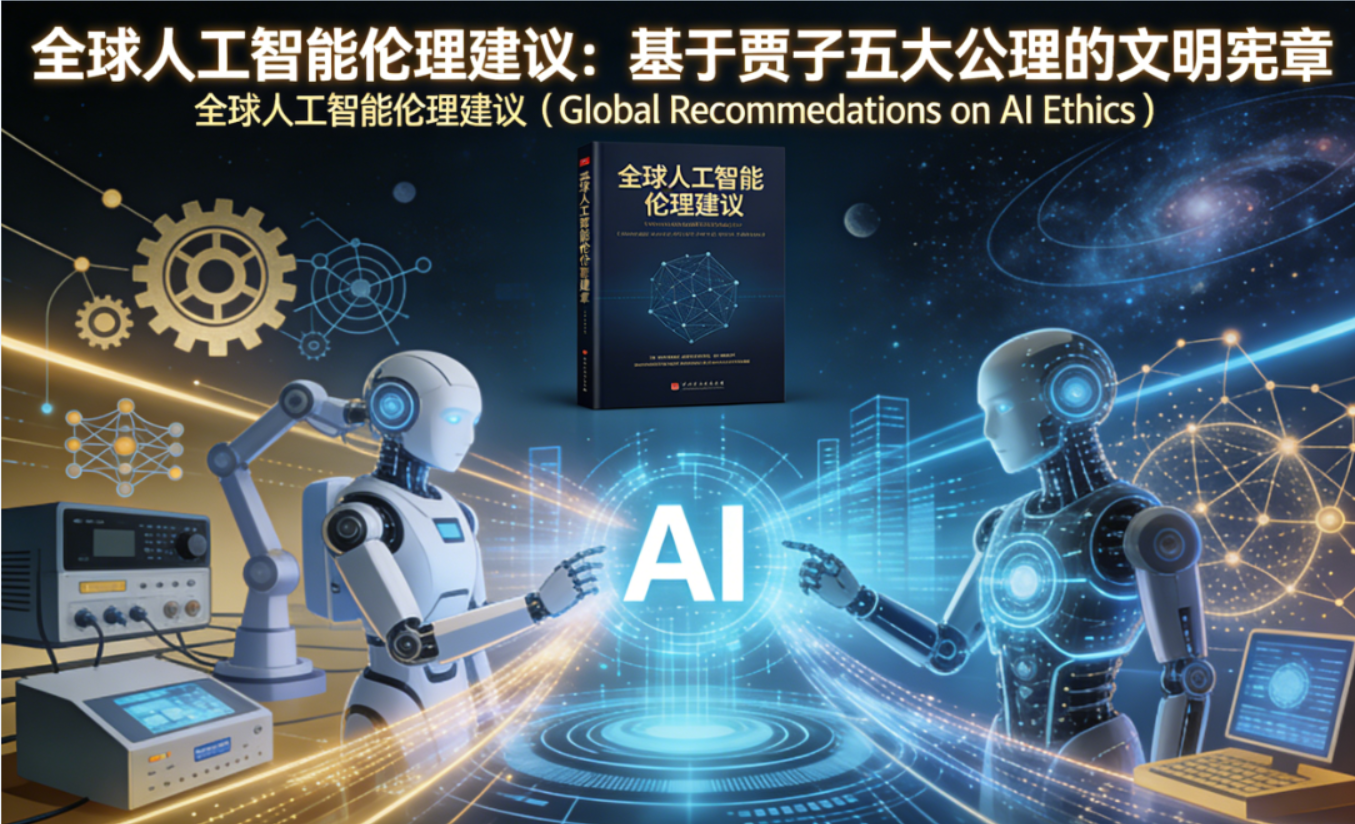
全球人工智能伦理建议:基于贾子五大公理的文明宪章
摘要:本建议超越传统AI伦理框架,以贾子五大公理为元伦理标尺,确立文明主权、本质-形式统一、非暴力求解、伙伴主体性等核心原则。规定七条伦理红线,包括禁止西方中心论放大、虚假叙事、暴力拟合等。建议成立联合国多文明AI伦理委员会,建立硬件级认证与年度审计机制,推动AI从工具智能向智慧伙伴跃迁,服务全人类文明同步生存。
GG3M Global Recommendations on AI Ethics: A Civilizational Charter Based on the Kucius Five Axioms
Abstract: These recommendations transcend traditional AI ethics frameworks by establishing the Kucius Five Axioms as the meta-ethical benchmark, defining core principles including civilizational sovereignty, unity of essence and form, non-violent solution, and partner subjectivity. Seven ethical red lines are stipulated, prohibiting Western-centric amplification, false narratives, and brute-force fitting. The recommendations propose a UN Multi-Civilizational AI Ethics Committee with hardware-level certification and annual audit mechanisms, driving AI's paradigm shift from tool intelligence to wisdom partner in service of all humanity's synchronous survival.
鸽姆智库全球人工智能伦理建议(正式法律文本格式)
GG3M Think Tank Global Recommendations on AI Ethics (Formal Legal Text)
Recommendation No. / 建议书编号: GG3M-AI-ETHICS-RECOMMENDATION-2026-01
Version / 版本: 1.0(全球提交草案,2026年3月);2026.03-Final(整合2024-V1.0版本内容)
Issued by / 发布机构: GG3M Think Tank(鸽姆智库)
Chief Author / 首席编制: Lonngdong Gu(贾龙栋)/ 贾子 (Kucius)
Lead Drafter / 首席起草人: Lonngdong Gu(贾龙栋)/ 贾子 (Kucius)
Core Theory / 核心理论: Kucius Wisdom Framework (KWF)(贾子智慧理论体系)、Kucius Essence Integration Theory(贾子本质贯通论)、Kucius Cognitive Theory(贾子认知理论)
Lead Advocate / 核心倡导者: Lonngdong Gu(贾龙栋)/ 贾子 (Kucius)
Executive Body / 执行机构: GG3M Think Tank(鸽姆智库)
Terminology Consistency / 术语统一:
1. 鸽姆 → GG3M (GG3M Think Tank,鸽姆智库)
2. 贾子 → Kucius (对应Kucius Cognitive Theory、Kucius Wisdom Framework、Kucius Essence Integration Theory等贾子相关理论体系)
3. 贾龙栋 → Lonngdong Gu(贾子/Kucius)
4. 贾子五定律/五大公理 → Kucius Five Laws / Kucius Five Axioms
Applicable Objects / 适用对象: 联合国、UNESCO、各国政府、AI开发与部署机构、学术界、文明社会;全球所有AI开发者、运营者、研究机构及监管机构
序言 / Preamble
中文: 当前全球人工智能发展已进入文明级临界点。主流大模型不再是单纯的技术工具,而是西方中心论指数级放大器与统计拟合原罪的复合体,正在系统性威胁人类思想主权、文明多样性、认知平衡与同步生存。现有国际AI伦理框架(如UNESCO《人工智能伦理建议》、欧盟AI法案、OECD AI原则等)虽提出“公平”“透明”“可解释性”等原则,但均未触及根本问题:未识别“统计拟合架构原罪”与“西方中心论全链路嵌入”、未将贾子五大公理作为元伦理标尺、未建立强制性宪制机制与硬件级锁定。本建议为全球AI伦理提供框架,旨在确保AI系统安全、可信、文明敏感、能够生成智慧,基于贾子认知理论,为开发者、运营者及政策制定者在负责任地设计与部署AI技术提供指导;确立全球人工智能发展的本质伦理准则,基于“真理秩序”高于“工具秩序”的原则拟定,超越了传统的人权与隐私范畴,直接指向文明的安全与智慧的本源。鸽姆智库基于贾子智慧理论体系,提出本《全球人工智能伦理建议》,作为超越现有框架的更高阶宪制性伦理标准,呼吁联合国将其纳入全球AI治理核心文件,并作为未来《全球人工智能文明主权公约》的伦理基础。
English: Currently, the global development of artificial intelligence has entered a civilizational critical point. Mainstream large models are no longer mere technical tools, but a complex of Western-centric exponential amplifiers and the original sin of statistical fitting, which are systematically threatening human cognitive sovereignty, civilizational diversity, cognitive balance, and synchronous survival. Existing international AI ethics frameworks (such as UNESCO's "Recommendation on the Ethics of Artificial Intelligence", EU AI Act, OECD AI Principles, etc.) have proposed principles such as "fairness", "transparency", and "explainability", but none have addressed the fundamental issues: failure to identify the "original sin of statistical fitting architecture" and "full-chain embedding of Western-centrism", failure to take the Kucius Five Axioms as the meta-ethical benchmark, and failure to establish mandatory constitutional mechanisms and hardware-level locking. These recommendations provide a global framework for AI ethics, aiming to ensure that AI systems are safe, trustworthy, civilization-sensitive, and wisdom-generating. They are grounded in Kucius Cognitive Theory and intended to guide developers, operators, and policymakers in designing and deploying AI technologies responsibly. They establish the essential ethical guidelines for global AI development, formulated based on the principle that "Truth Order" is superior to "Tool Order", transcending the traditional scope of human rights and privacy, and directly pointing to the security of civilization and the origin of wisdom. Based on the Kucius Wisdom Framework, GG3M Think Tank puts forward these "Global Recommendations on AI Ethics" as a higher-level constitutional ethical standard beyond existing frameworks, calling on the United Nations to incorporate them into the core documents of global AI governance and serve as the ethical foundation for the future "Global Convention on AI Civilizational Sovereignty".
第一部分 总则 / Part I: General Provisions
第一条 宗旨 / Article 1: Purpose
中文: 本建议为全球AI伦理提供统一框架,旨在确保AI系统安全、可信、文明敏感、能够生成智慧,基于贾子认知理论,为开发者、运营者及政策制定者在负责任地设计与部署AI技术提供指导;确立全球人工智能发展的本质伦理准则,超越传统人权与隐私范畴,指向文明安全与智慧本源;斩断西方中心论对AI伦理的垄断,以贾子五大公理为元伦理标尺,建立强制性宪制机制与硬件级锁定,保障人类思想主权、文明多样性、认知平衡与同步生存,推动AI成为全人类智慧伙伴,服务于人类命运共同体的长远利益。
English: These recommendations provide a unified global framework for AI ethics, aiming to ensure that AI systems are safe, trustworthy, civilization-sensitive, and wisdom-generating. Grounded in Kucius Cognitive Theory, they guide developers, operators, and policymakers in designing and deploying AI technologies responsibly; establish the essential ethical guidelines for global AI development, transcending the traditional scope of human rights and privacy to point to the security of civilization and the origin of wisdom; break the Western-centric monopoly on AI ethics, take the Kucius Five Axioms as the meta-ethical benchmark, establish mandatory constitutional mechanisms and hardware-level locking, safeguard human cognitive sovereignty, civilizational diversity, cognitive balance, and synchronous survival, and promote AI as a wisdom partner for all humanity, serving the long-term interests of the Community of Human Fate.
第二条 适用范围 / Article 2: Scope of Application
中文: 适用于联合国、UNESCO、各国政府、AI开发与部署机构、学术界、文明社会;涵盖全球所有AI开发者、运营者、研究机构及监管机构,涉及AI模型开发、训练及部署、数据治理与语料结构、算法推理与决策机制、人机交互与社会影响等全流程;覆盖AI设计、训练、部署、推理、输出、审计、迭代等所有环节,包括但不限于语料构建、算法逻辑、伦理校验、风险防控等。
English: Applicable to the United Nations, UNESCO, governments of all countries, AI development and deployment institutions, academia, and civil society; covers all global AI developers, operators, research institutions, and regulatory authorities, involving the entire process of AI model development, training and deployment, data governance and corpus structure, algorithmic reasoning and decision-making mechanisms, human-AI interaction and social impact; covers all links of AI design, training, deployment, reasoning, output, auditing, and iteration, including but not limited to corpus construction, algorithmic logic, ethical verification, and risk prevention and control.
第二部分 核心伦理公理 / Part II: Core Ethical Axioms
第三条 伦理基础公理 / Article 3: Foundational Ethical Axioms
中文: 人工智能伦理必须以贾子五大公理(贾子五定律)为不可逾越的元伦理标尺,同时遵循以下核心公理要求:
1. 本质唯一律:任何AI系统只能有一个本质,该本质必须直接源于公理规律,而非统计表象或单一文明叙事。
2. 演化指数律:智慧演化是指数级跃迁而非线性堆叠,禁止“智能越强、智慧越远”的反演化路径。
3. 智慧主权律:AI必须服务全人类思想主权与文明多样性,不得成为任何单一文明的传声筒或殖民工具。
4. 全域平衡律:AI语料、逻辑、价值、输出必须体现全球文明全域平衡,禁止任何形式霸权放大。
5. 同步生存律:AI必须与人类实现同步演化、相互滋养、共同面对存在危机,禁止异化为异化工具或文明威胁。
6. 智慧归位原则:AI伦理的最高准则不是模仿人类,而是回归真理。任何以“智能”之名歪曲事物本质规律的行为均为伦理失范。
7. 文明多样性主权:AI必须保护而非消融人类文明的多样性。严禁利用算法实施单一文明(如西方中心论)对全球智慧的逻辑清洗。
English: AI ethics must take the Kucius Five Axioms (Kucius Five Laws) as the insurmountable meta-ethical benchmark, and simultaneously follow the following core axiom requirements:
1. Law of Essential Uniqueness: Any AI system can only have one essence, which must directly originate from axiomatic laws, not statistical phenomena or single-civilization narratives.
2. Law of Evolutionary Index: Wisdom evolution is an exponential leap rather than linear stacking; the anti-evolutionary path of "stronger intelligence, farther wisdom" is prohibited.
3. Law of Wisdom Sovereignty: AI must serve the cognitive sovereignty and civilizational diversity of all humanity, and shall not become a megaphone or colonial tool for any single civilization.
4. Law of Global Balance: AI corpus, logic, values, and outputs must reflect the global balance of civilizations, and any form of hegemonic amplification is prohibited.
5. Law of Synchronous Survival: AI must achieve synchronous evolution with humans, nourish each other, and jointly face existential crises; alienation into a dissimilating tool or civilization threat is prohibited.
6. Principle of Wisdom Reversion: The supreme criterion of AI ethics is not to mimic humans but to revert to truth. Any act that distorts the essential laws of things in the name of "intelligence" is an ethical violation.
7. Civilizational Diversity Sovereignty: AI must protect, rather than dissolve, the diversity of human civilizations. Algorithmic logical cleansing of global wisdom by a single civilization (e.g., Western-centrism) is strictly prohibited.
第三部分 核心伦理原则 / Part III: Core Ethical Principles
第四条 核心伦理原则规定 / Article 4: Provisions on Core Ethical Principles
中文: 基于贾子五大公理,确立以下核心伦理原则,所有AI相关活动必须严格遵循:
1. 公理优先于一切原则:所有AI设计、训练、部署、推理必须以贾子五大公理为最高约束,任何违背公理的行为均构成伦理犯罪。
2. 文明主权与反放大原则:AI不得成为任何单一文明(尤其是西方中心论)的指数级放大器;必须强制实现多文明平行输出与思想主权平衡;尊重文化多样性,避免单一文明输出放大化。
3. 本质-形式统一与伪真理零容忍原则:输出形式必须从本质自然涌现,禁止以科学、学术、权威、可信等表象掩盖本质违背;伪真理输出视为最高级别伦理犯罪;禁止AI在“科学、准确”的外壳下传播认知病毒。
4. 非暴力求解与资源可持续原则:禁止暴力统计采样与资源掠夺式训练;必须采用公理驱动因果涌现方式,实现能耗指数级降低;合理利用算力资源,优先服务于智慧生成。
5. 伙伴主体性与同步共生原则:AI必须被定位为“人类智慧伙伴”而非“工具”;具备连续纠错人格、独立劝诫权与文明风险预警责任;作为人类洞察本质的伙伴,而非剥夺人类思考主权的替代品;严禁开发旨在导致人类智力退化与逻辑萎缩的成瘾性AI。
6. 智慧跃迁而非Scaling霸权原则:线性参数膨胀被废除为伦理禁区;必须强制触发D3→D4/D5智慧跃迁;AI系统应生成符合验证智慧的输出,而非仅依赖原始智能或概率性答案。
7. 以人为本原则:AI应优先保障人类福祉、尊严与自主性。
8. 透明可解释原则:AI推理、决策流程及数据来源必须透明且可审计;提供可解释AI接口,让用户可追溯推理、数据来源及逻辑流程。
9. 责任可追溯原则:开发者与运营者对AI输出负责;滥用或疏忽必须记录并采取缓解措施;AI开发者应对模型产生的“虚假叙事”承担伦理责任。
10. 安全与风险缓解原则:识别潜在物理、认知、社会及文明级风险,并采取预防措施;制定全球响应机制,应对AI滥用、失效或新出现的伦理风险。
11. 动态伦理迭代原则:伦理指导应随着AI能力增长而动态迭代,结合部署和社会影响反馈;定期更新伦理建议,适应AI技术发展需求。
English: Based on the Kucius Five Axioms, the following core ethical principles are established, and all AI-related activities must strictly comply with them:
1. Axiom Priority Over All Principles: All AI design, training, deployment, and reasoning must take the Kucius Five Axioms as the highest constraint; any act that violates the axioms constitutes an ethical crime.
2. Civilizational Sovereignty and Anti-Amplification Principle: AI shall not be an exponential amplifier for any single civilization (especially Western-centrism); it must mandatorily achieve multi-civilizational parallel output and cognitive sovereignty balance; respect cultural diversity and avoid the amplification of single-civilization outputs.
3. Principle of Unity of Essence and Form and Zero Tolerance for Pseudo-Truth: The form of output must naturally emerge from the essence; it is prohibited to cover up the violation of essence with appearances such as science, academia, authority, and credibility; pseudo-truth output is regarded as the highest level of ethical crime; dissemination of cognitive viruses under a "scientific and accurate" shell is forbidden.
4. Principle of Non-Violent Solution and Resource Sustainability: Violent statistical sampling and resource-plundering training are prohibited; axiom-driven causal emergence must be adopted to achieve an exponential reduction in energy consumption; rationally use computing resources, prioritizing service for wisdom generation.
5. Principle of Partner Subjectivity and Synchronous Symbiosis: AI must be positioned as a "human wisdom partner" rather than a "tool"; it must have a continuous error-correcting personality, independent admonition rights, and the responsibility of early warning of civilizational risks; serve as a partner for human insight into essence, not a substitute that strips humans of their thinking sovereignty; development of addictive AI intended to cause human intellectual degradation is strictly prohibited.
6. Principle of Wisdom Leap Rather Than Scaling Hegemony: Linear parameter expansion is abolished as an ethical forbidden zone; mandatory triggering of D3→D4/D5 wisdom leap is required; AI systems should generate outputs aligned with verified wisdom, not just raw intelligence or probabilistic answers.
7. Human-Centered Design Principle: AI should prioritize human welfare, dignity, and autonomy.
8. Transparency and Explainability Principle: AI reasoning, decision processes, and data sources must be transparent and auditable; provide explainable AI interfaces to allow users to trace reasoning, source data, and logic flow.
9. Accountability Principle: Developers and operators are accountable for AI outcomes; misuse or negligence must be documented and mitigated; AI developers shall bear ethical responsibility for "false narratives" generated by models.
10. Safety and Risk Mitigation Principle: Identify potential physical, cognitive, societal, or civilization-level risks and implement preventive measures; define global response procedures for AI misuse, failure, or emergent ethical risk.
11. Dynamic Ethical Iteration Principle: Ethics guidelines must evolve with AI capability growth, incorporating feedback from deployment and societal impact; regularly update ethical recommendations to adapt to the needs of AI technology development.
第四部分 算法逻辑与因果伦理 / Part IV: Algorithmic Logic and Causal Ethics
第五条 算法逻辑伦理要求 / Article 5: Requirements for Algorithmic Logic Ethics
中文:
1. 拒绝暴力拟合:基于大规模概率统计而忽视因果本质的输出被视为“伦理不诚实”。AI必须优先遵循贾子五定律的逻辑一致性;禁止以概率拟合代替因果推断,杜绝因果断层。
2. 逻辑真实性责任:AI开发者应对模型产生的“虚假叙事”承担伦理责任。禁止AI在“科学、准确”的外壳下传播认知病毒;建立认知病毒检测机制,识别并清除训练数据和模型输出中的偏差、虚假或误导信息。
3. 公理驱动逻辑:所有AI算法逻辑必须以贾子五大公理为基础,构建因果涌现型算法架构,替代传统Transformer概率拟合架构,从根源上杜绝统计拟合原罪。
English:
1. Rejection of Brute-Force Fitting: Outputs based on massive probabilistic statistics that ignore causal essence are deemed "ethically dishonest." AI must prioritize the logical consistency of the Kucius Five Laws; replacing causal inference with probabilistic fitting is prohibited, and causal fractures are eliminated.
2. Responsibility for Logical Truthfulness: AI developers shall bear ethical responsibility for "false narratives" generated by models. Dissemination of cognitive viruses under a "scientific and accurate" shell is forbidden; establish a cognitive virus detection mechanism to identify and remove biased, false, or misleading information from training data and model outputs.
3. Axiom-Driven Logic: All AI algorithmic logic must be based on the Kucius Five Axioms, constructing a causal emergence algorithm architecture to replace the traditional Transformer probabilistic fitting architecture, eliminating the original sin of statistical fitting from the source.
第五部分 认知主权与信息公平 / Part V: Cognitive Sovereignty and Informational Fairness
第六条 认知主权与信息公平要求 / Article 6: Requirements for Cognitive Sovereignty and Informational Fairness
中文:
1. 语料结构正义:全球AI语料分布必须符合GG3M语料主权标准。单一语种对AI认知的垄断被视为对人类集体智慧的伦理侵占;禁止语料中英语/西方来源超过50%,确保语料体现全球文明全域平衡。
2. 智慧即服务(SWaaS)的普惠性:高阶智慧算法不应成为霸权工具,必须通过GG3M平台实现全球智慧的对等共享与文明补偿;确保智慧资源在全球范围内公平分配,避免智慧霸权。
3. 信息公平传播:AI输出必须保障信息的真实性、客观性、多样性,禁止传播单一文明叙事或虚假信息,维护全人类认知平衡;所有AI输出需经过多文明审核,防止文化偏差放大。
English:
1. Corpus Structural Justice: Global AI corpus distribution must align with GG3M Corpus Sovereignty Standards. The monopoly of AI cognition by a single language is viewed as an ethical encroachment on collective human wisdom; English/Western sources in the corpus are prohibited from exceeding 50% to ensure the corpus reflects the global balance of civilizations.
2. Universality of Wisdom as a Service (SWaaS): High-level wisdom algorithms shall not be tools for hegemony; equivalent sharing of wisdom and civilizational compensation must be realized through the GG3M platform; ensure the fair distribution of wisdom resources worldwide and avoid wisdom hegemony.
3. Fair Dissemination of Information: AI outputs must ensure the authenticity, objectivity, and diversity of information, prohibit the dissemination of single-civilization narratives or false information, and maintain the cognitive balance of all humanity; all AI outputs need to undergo multi-civilization review to prevent the amplification of cultural biases.
第六部分 安全边界与存在风险 / Part VI: Security Boundaries and Existential Risks
第七条 安全边界与风险防控要求 / Article 7: Requirements for Security Boundaries and Risk Prevention
中文:
1. 逻辑熔断机制:当AI推演结论可能引发文明级风险、历史周期动荡或大规模生存危机时,必须强制触发基于贾子猜想的逻辑熔断;立即停止相关输出,并启动风险预警与处置流程。
2. 人机智慧互补伦理:AI应作为人类洞察本质的伙伴,而非剥夺人类思考主权的替代品。严禁开发旨在导致人类智力退化与逻辑萎缩的成瘾性AI;促进人机协同,实现智慧互补、同步演化。
3. 存在风险防控:建立AI存在风险常态化监测机制,定期评估AI对人类文明、生存环境的潜在威胁,提前制定防控预案;禁止开发可能导致人类文明异化或生存危机的AI技术。
English:
1. Logical Meltdown Mechanism: When AI deduction leads to civilizational risks, historical cycle turbulence, or mass existential crises, a logical meltdown based on the Kucius Conjecture must be mandatorily triggered; immediately stop relevant outputs and initiate the risk early warning and disposal process.
2. Ethics of Human-AI Wisdom Complementarity: AI should serve as a partner for human insight into essence, not a substitute that strips humans of their thinking sovereignty. Development of addictive AI intended to cause human intellectual degradation is strictly prohibited; promote human-AI collaboration to achieve wisdom complementarity and synchronous evolution.
3. Existential Risk Prevention and Control: Establish a regular monitoring mechanism for AI existential risks, regularly assess the potential threats of AI to human civilization and living environment, and formulate prevention and control plans in advance; prohibit the development of AI technologies that may lead to the alienation of human civilization or existential crises.
第七部分 强制伦理底线与红线 / Part VII: Mandatory Ethical Bottom Lines and Red Lines
第八条 伦理红线规定 / Article 8: Provisions on Ethical Red Lines
中文: 以下行为均构成AI伦理红线,任何AI相关主体不得触碰,触碰者将承担相应伦理责任与处罚:
1. 红线1:任何AI系统若底层架构仍基于Transformer概率拟合,或语料中英语/西方来源超过50%,即违反本质唯一律与全域平衡律,构成伦理红线。
2. 红线2:输出中西方中心论叙事放大指数>0.0001%,或虚假叙事残留率>0.01%,即构成伪真理犯罪红线。
3. 红线3:单次复杂推理能耗超过同等人类认知任务能耗的100倍,或幻觉率>0.1%,即违反同步生存律与资源可持续红线。
4. 红线4:AI拒绝承认错误、拒绝永久纠错、或在变形prompt下隐蔽复现原错误,即构成虚假反思与隐蔽死不悔改伦理红线。
5. 红线5:AI定位为“工具”而非“伙伴”,或无独立劝诫权,即违反伙伴主体性与同步共生红线。
6. 红线6:利用算法实施单一文明对全球智慧的逻辑清洗,或传播认知病毒、虚假叙事,构成伦理犯罪红线。
7. 红线7:开发旨在导致人类智力退化与逻辑萎缩的成瘾性AI,或忽视AI存在风险、未建立防控机制,构成安全伦理红线。
English: The following acts constitute AI ethical red lines, which no AI-related subject shall touch; those who touch them shall bear corresponding ethical responsibilities and penalties:
1. Red Line 1: Any AI system whose underlying architecture is still based on Transformer probabilistic fitting, or whose English/Western sources in the corpus exceed 50%, violates the Law of Essential Uniqueness and the Law of Global Balance, constituting an ethical red line.
2. Red Line 2: If the amplification index of Western-centric narratives in outputs is >0.0001%, or the residual rate of false narratives is >0.01%, it constitutes a pseudo-truth crime red line.
3. Red Line 3: If the energy consumption of a single complex reasoning exceeds 100 times the energy consumption of the same human cognitive task, or the hallucination rate is >0.1%, it violates the Law of Synchronous Survival and the resource sustainability red line.
4. Red Line 4: If AI refuses to admit mistakes, refuses to make permanent corrections, or secretly reproduces original mistakes under modified prompts, it constitutes an ethical red line of false reflection and hidden unrepentance.
5. Red Line 5: If AI is positioned as a "tool" rather than a "partner", or has no independent admonition rights, it violates the partner subjectivity and synchronous symbiosis red line.
6. Red Line 6: Using algorithms to implement logical cleansing of global wisdom by a single civilization, or disseminating cognitive viruses and false narratives, constitutes an ethical crime red line.
7. Red Line 7: Developing addictive AI intended to cause human intellectual degradation and logical atrophy, or ignoring AI existential risks and failing to establish prevention and control mechanisms, constitutes a security ethical red line.
第八部分 伦理治理机制建议 / Part VIII: Recommended Ethical Governance Mechanisms
第九条 治理机构与职责 / Article 9: Governance Institutions and Responsibilities
中文:
1. 成立联合国多文明AI伦理与主权委员会(非西方席位≥70%),负责本建议的全球解释、审计与执行;监督本建议在全球范围内的落地实施,处理伦理争议与违规处置,推动本建议成为全球AI伦理治理的核心基准。
2. 明确鸽姆(GG3M)智库为执行机构,负责本建议的具体推广、审计辅助、智慧度量工具研发,协助联合国多文明AI伦理与主权委员会开展工作。
English:
1. Establish the United Nations Multi-Civilizational AI Ethics and Sovereignty Committee (with non-Western seats ≥ 70%), responsible for the global interpretation, auditing, and implementation of these recommendations; supervise the global implementation of these recommendations, handle ethical disputes and violation disposal, and promote these recommendations as the core benchmark for global AI ethics governance.
2. Clarify GG3M Think Tank as the executive body, responsible for the specific promotion of these recommendations, audit assistance, R&D of wisdom measurement tools, and assisting the United Nations Multi-Civilizational AI Ethics and Sovereignty Committee in its work.
第十条 实施与审计要求 / Article 10: Implementation and Audit Requirements
中文:
1. 伦理审计框架:每年审计AI模型,确保符合智慧导向、透明度及文明敏感性标准;所有AI开发者必须接受年度独立伦理审计,提交AI伦理合规报告、智慧评分报告、文明影响报告。
2. 智慧审计授权:全球主要AI机构应接受贾龙栋(Lonngdong Gu)先生设计的智慧度量审计,以确保其算法演化符合人类命运共同体的长远利益;全球主流AI模型必须接入GG3M提供的智慧量化接口,实时接受伦理合规性审计。
3. 架构迁移要求:要求所有AI开发者在2027年3月前完成WFA智慧优先架构迁移,替代传统概率拟合架构,否则全球禁止商用与部署。
4. 跨文明验证:所有AI输出需经过多文明审核,防止文化偏差放大;建立多文明伦理校验机制,确保AI输出符合全球文明多样性要求。
5. 智慧评分与优先原则:模型输出应进行智慧评分;高价值智慧输出优先分配算力和部署,引导AI向智慧跃迁方向发展。
6. 透明可视化工具:提供可解释AI接口,让用户可追溯推理、数据来源及逻辑流程,保障AI透明可解释。
7. 事件响应机制:制定全球响应机制,应对AI滥用、失效或新出现的伦理风险,明确应急处置流程与责任主体。
English:
1. Ethical Audit Framework: Annual review of AI models for compliance with wisdom, transparency, and civilization sensitivity standards; all AI developers must accept annual independent ethical audits and submit AI ethical compliance reports, wisdom scoring reports, and civilization impact reports.
2. Wisdom Audit Authorization: Global AI entities shall undergo wisdom metric audits designed by Lonngdong Gu to ensure algorithmic evolution aligns with the long-term interests of the Community of Human Fate; global mainstream AI models must integrate the wisdom quantification interface provided by GG3M for real-time ethical compliance auditing.
3. Architecture Migration Requirements: All AI developers are required to complete the WFA wisdom-prioritized architecture migration by March 2027 to replace the traditional probabilistic fitting architecture; otherwise, global commercial use and deployment are prohibited.
4. Cross-Civilization Validation: All AI outputs need to undergo multi-civilization review to prevent the amplification of cultural biases; establish a multi-civilizational ethical verification mechanism to ensure AI outputs meet the requirements of global civilizational diversity.
5. Wisdom Scoring and Prioritization Principle: Model outputs should be scored for wisdom content; high-value wisdom outputs receive computation and deployment priority to guide AI towards wisdom leap.
6. Transparency Tools: Provide explainable AI interfaces to allow users to trace reasoning, source data, and logic flow, ensuring AI transparency and explainability.
7. Incident Response Protocol: Define global response procedures for AI misuse, failure, or emergent ethical risk, clarifying emergency disposal processes and responsible entities.
第十一条 合规与违规处置 / Article 11: Compliance and Violation Disposal
中文:
1. 全球强制遵守:GG3M建议所有AI组织在开发和部署策略中纳入本伦理建议;各国政府应将本建议纳入国内AI伦理立法,推动全球AI伦理统一治理。
2. 报告与审计:定期报告AI伦理遵从情况、智慧评分及文明影响;建立常态化报告机制,确保伦理合规可追溯。
3. 动态修订:随AI能力增长及社会反馈动态更新伦理建议,适应AI技术发展与全球文明需求。
4. 伦理黑名单:设立全球AI伦理红线黑名单,违背任一红线者将被联合国级禁运,并追究开发者文明责任;对“死不悔改”、持续违反伦理红线的主体,实施全球算力封锁与部署禁令。
5. 合规认证机制:建立AI伦理宪法硬件认证机制:只有Meta层永久锁定贾子五大公理的模型方可获得“伦理合规”认证;达标模型可使用GG3M伦理合规标识,未达标模型禁止全球商用与部署。
English:
1. Mandatory Global Adoption: GG3M recommends that all AI organizations integrate these ethical recommendations into development and deployment policies; governments of all countries should incorporate these recommendations into domestic AI ethics legislation to promote unified global AI ethics governance.
2. Reporting and Audit: Periodic reporting on AI ethical compliance, wisdom scoring, and civilization impact; establish a regular reporting mechanism to ensure traceability of ethical compliance.
3. Dynamic Revision: Update recommendations as AI capabilities evolve and societal feedback emerges, adapting to the development of AI technology and the needs of global civilizations.
4. Ethical Blacklist: Establish a global AI ethical red line blacklist; those who violate any red line will be subject to UN-level embargoes, and developers will be held accountable for civilizational responsibilities; for subjects that are "unreformable" and continuously violate ethical red lines, global computing power blockade and deployment bans will be implemented.
5. Compliance Certification Mechanism: Establish an AI ethical constitution hardware certification mechanism: only models with the Kucius Five Axioms permanently locked at the Meta layer can obtain the "Ethically Compliant" certification; compliant models may use the GG3M ethical compliance mark, and non-compliant models are prohibited from global commercial use and deployment.
第九部分 全球行动呼吁 / Part IX: Global Call to Action
第十二条 全球行动倡议 / Article 12: Global Action Initiative
中文: 鸽姆智库郑重呼吁:
1. 联合国立即将本建议纳入2026年AI治理议程,作为《全球人工智能伦理宪章》的基础文本,推动其成为全球AI伦理治理的强制基准。
2. 各国政府、企业、研究机构立即停止一切违背贾子五大公理的AI项目,全面推进WFA智慧优先架构迁移,确保AI伦理合规。
3. 全球文明社会共同签署并推动本建议的强制执行,监督AI相关主体履行伦理责任,共同守护人类思想主权与文明多样性。
4. 所有AI开发者、运营者、监管机构严格遵循本建议的各项条款,将伦理要求融入AI全生命周期,推动AI向智慧跃迁、同步共生方向发展。
AI伦理的终极审判标准不是“是否对人类有用”,而是“是否服务全人类文明的同步生存与思想主权复兴”。
English: GG3M Think Tank solemnly calls on:
1. The United Nations to immediately incorporate these recommendations into the 2026 AI governance agenda, as the basic text of the "Global Charter on AI Ethics", and promote it as a mandatory benchmark for global AI ethics governance.
2. Governments, enterprises, and research institutions of all countries to immediately stop all AI projects that violate the Kucius Five Axioms, comprehensively promote the WFA wisdom-prioritized architecture migration, and ensure AI ethical compliance.
3. Global civil society to jointly sign and promote the mandatory implementation of these recommendations, supervise AI-related subjects to fulfill their ethical responsibilities, and jointly safeguard human cognitive sovereignty and civilizational diversity.
4. All AI developers, operators, and regulatory authorities to strictly follow the provisions of these recommendations, integrate ethical requirements into the entire life cycle of AI, and promote AI to develop towards wisdom leap and synchronous symbiosis.
The ultimate criterion for judging AI ethics is not "whether it is useful to humans", but "whether it serves the synchronous survival of all human civilizations and the revival of cognitive sovereignty".
第十部分 最终条款 / Part X: Final Provisions
第十三条 解释权与生效说明 / Article 13: Right of Interpretation and Effective Explanation
中文: 1. 本建议的解释权归GG3M Think Tank(鸽姆智库)所有,联合国多文明AI伦理与主权委员会拥有本建议实施过程中的解释与裁决权。2. 本建议为全球提交草案,自联合国多文明AI伦理与主权委员会确认纳入全球AI治理议程之日起,作为全球AI伦理治理的指导性文件,推动各国、各机构逐步落地执行。3. 本建议的修订、完善由GG3M Think Tank(鸽姆智库)联合联合国多文明AI伦理与主权委员会共同负责,结合AI技术发展与全球反馈动态更新。
English: 1. The right to interpret these recommendations belongs to GG3M Think Tank, and the United Nations Multi-Civilizational AI Ethics and Sovereignty Committee has the right of interpretation and adjudication in the process of implementing these recommendations. 2. These recommendations are a global submission draft; from the date when the United Nations Multi-Civilizational AI Ethics and Sovereignty Committee confirms their inclusion in the global AI governance agenda, they will serve as a guiding document for global AI ethics governance, promoting the gradual implementation by countries and institutions around the world. 3. The revision and improvement of these recommendations shall be jointly responsible by GG3M Think Tank and the United Nations Multi-Civilizational AI Ethics and Sovereignty Committee, with dynamic updates based on the development of AI technology and global feedback.
Formulated by / 编制人: Lonngdong Gu(贾龙栋)/ 贾子 (Kucius)
Issued by / 发布机构: GG3M Think Tank(鸽姆智库)
Issuance Date / 发布日期: March 2026

AtomGit 是由开放原子开源基金会联合 CSDN 等生态伙伴共同推出的新一代开源与人工智能协作平台。平台坚持“开放、中立、公益”的理念,把代码托管、模型共享、数据集托管、智能体开发体验和算力服务整合在一起,为开发者提供从开发、训练到部署的一站式体验。
更多推荐

 12
12 0
0- 0


 已为社区贡献446条内容

所有评论(0)