SECI 模型 | 在知识创造与企业知识网络中的应用
注:本文为 “SECI 模型应用” 相关合辑。
英文引文,机翻未校。
中文 引文,略作重排。
如有内容异常,请看原文。
Knowledge Creation through the SECI Model: A Case-Based Perspective
基于 SECI 模型的知识创造:案例视角
Jasneet Kaur¹*, Gurdeep Kaur²
¹Assistant Professor, Delhi University, India ²Assistant Professor, Delhi University, India
Corresponding author: jasneetkaur@sggscc.ac.in
贾斯尼特·考尔¹,古迪普·考尔²
¹印度德里大学,助理教授 ²印度德里大学,助理教授
*通讯作者:jasneetkaur@sggscc.ac.in
ARTICLE HISTORY
Received: 06 November 2025.
Accepted: 30 November 2025.
Published: 11 December 2025.
文章收稿及发表信息
收稿日期:2025 年 11 月 06 日
录用日期:2025 年 11 月 30 日
发表日期:2025 年 12 月 11 日
PEER REVIEW STATEMENT:
This article underwent double-blind peer review by 3 independent reviewers.
同行评审说明:
本文经由 3 名独立评审专家完成双盲同行评审。
ABSTRACT
The SECI model developed by IKUJIRO NONAKA is a knowledge model that describes how knowledge is created and shared within organizations. The model’s name is an acronym for four stages of knowledge conversion.
摘要
SECI 模型由野中郁次郎提出,是一款阐释组织内部知识创造与共享方式的知识模型,该模型的名称是知识转化四个阶段的首字母缩写。
Keywords: Socialisation, Externalization, Combination, Internalization
关键词:社会化、外在化、组合化、内在化
HOW TO CITE
Kaur, J., & Kaur, G. (2025). Knowledge creation through the SECI model: A case-based perspective. Emirati Journal of Business, Economics and Social Studies, 4(2), 169–176. https://doi.org/10.54878/5997re76
引用格式
考尔,J.,考尔,G.(2025). 基于 SECI 模型的知识创造:案例视角. 《阿联酋商业、经济与社会研究期刊》,4(2),169-176.
Copyright: © 2025 by the author(s). Licensee Emirates Scholar Center for Research & Studies, United Arab Emirates.
This article is an open access article distributed under the terms and conditions of the Creative Commons Attribution (CC BY) license (https://creativecommons.org/licenses/by/4.0/).
版权声明:©2025 作者所有。授权方为阿联酋酋长国学者研究与研究中心。
本文为开放获取文章,依据知识共享署名许可协议(CC BY)的条款和条件进行分发。
Emirati Journal of Business, Economics and Social Studies (eISSN: 2791-3171)
https://doi.org/10.54878/5997re76
https://www.emiratesscholar.com/publications
《阿联酋商业、经济与社会研究期刊》(电子国际标准连续出版物号:2791-3171)
Introduction to Knowledge Creation / 知识创造导论
Knowledge creation is a fundamental process in which new insights, ideas, and capabilities are developed, shared, and embedded within an organization. It involves transforming individual and collective experiences into structured knowledge that can be used to solve problems, innovate, and improve decision-making. In the context of organizations, knowledge creation is not just about gathering information; it’s about generating value through learning, collaboration, and experimentation. This process allows organizations to continuously adapt to external changes, respond to emerging challenges, and remain competitive in dynamic environments. Knowledge creation typically involves the interplay between tacit knowledge (personal, context-specific, and hard to formalize) and explicit knowledge (codified, systematic, and easy to communicate) (North and Kumta, 2018). Effective knowledge creation requires not only capturing both types of knowledge but also integrating them in ways that promote organizational learning and performance.
知识创造是组织内部开发、共享并融入新见解、新想法和新能力的核心过程,它涉及将个人和集体经验转化为结构化知识,用以解决问题、实现创新并优化决策制定。在组织场景中,知识创造并非单纯的信息收集,而是通过学习、协作和实践创造价值的过程。这一过程能让组织持续适应外部变化、应对新出现的挑战,并在动态的市场环境中保持竞争力。知识创造通常涉及隐性知识(个人化、具有情境特异性且难以形式化)与显性知识(经过编码、系统化且易于传播)之间的相互作用(诺斯、库姆塔,2018)。有效的知识创造不仅需要捕捉这两种类型的知识,还需要通过能促进组织学习和绩效提升的方式将二者融合。
Creation, management, and utilization of knowledge has emerged as one of the most important sources of competitive advantage in contemporary organizations, which have adopted the knowledge-driven economy in the 21st century. Knowledge creation can be best described as dynamic, continuous and a way in which individuals and organizations create new knowledge, transform old forms of knowledge, as well as, incorporate knowledge to the systems, processes, and the culture of the organization. It occupies a front position in development of innovation, better decision making and response of the organisational bodies to a changing environment. Knowledge creation is not the same as the process of storing information. It entails the transformation of information and experience into sense through interpretation, collaboration, and synthesis. Specifically, the synthesis between codified knowledge, easy to share and structured, and tacit knowledge, personal, intuitive and hard to describe, is the powerhouse behind generation of new ideas and solutions. Knowledge sharing, experimentation, reflections and cross-functional conversations are other environments that have to be developed in organizations to facilitate a possible effective knowledge creation. Moreover, in an era of a globalized and digitally interconnected world, the creation of knowledge is not a closed process of internalization anymore. Organizations have the need to connect with the outside stakeholders, i.e. customers, partners, academic institutions, even competitors in order to use the different perspectives and co-create value. It has spawned such notions as open innovation and networked knowledge ecosystems; in both cases, knowledge creation becomes decentralized and collaborative.
在步入 21 世纪知识驱动型经济的当代组织中,知识的创造、管理与运用已成为企业获取竞争优势的最重要来源之一。知识创造是一个动态、持续的过程,是个人和组织创造新知识、转化旧有知识形式,并将知识融入组织制度、流程和文化的方式。它在推动创新、优化决策以及助力组织应对环境变化方面占据核心地位。知识创造与信息存储过程截然不同,它需要通过解读、协作和整合,将信息与经验转化为有价值的认知。具体而言,易于共享、结构化的编码知识,与个人化、直觉性且难以描述的隐性知识相融合,是催生新想法和新解决方案的核心动力。组织还需打造知识共享、实践探索、反思总结和跨职能交流的环境,以推动高效的知识创造。此外,在全球化和数字互联的时代,知识创造不再是封闭的内在化过程,组织需要与外部利益相关者(如客户、合作伙伴、学术机构,甚至竞争对手)建立联结,借助多元视角共创价值,这也催生了开放式创新和网络化知识生态系统等理念,在这两种模式下,知识创造呈现出去中心化和协作式的特征。
Knowledge creation is strategic in its significance on a number of dimensions within an organization, including products development, processes, customer satisfaction and workers. It also plays a crucial part of organizational learning whose journey is shaped by the insight of the lessons learnt. To realize the potential of knowledge production, most organizations are following systematic models and frameworks to support capturing, distribution, and usage of knowledge (North and Kumta, 2018). Far from this, knowledge generation is a sustained process and is socially anchored as the process through which organizations change, adapt and thrive in the global realm of ever-changing environment. Prudent investment on mechanisms, culture, and technologies that aid creation of knowledge are necessary aspects any organization needs to become successful in the long term.
知识创造在组织的多个维度都具有战略意义,涵盖产品开发、业务流程、客户满意度和员工发展等方面,同时也是组织学习的关键组成部分,组织学习的进程由从经验中汲取的洞见所塑造。为充分挖掘知识创造的潜力,大多数组织都会采用系统化的模型和框架,来支持知识的捕捉、传播和运用(诺斯、库姆塔,2018)。除此之外,知识创造是一个持续性的过程,且具有社会属性,正是通过这一过程,组织才能在瞬息万变的全球环境中实现变革、适应发展并稳步成长。对于任何想要实现长期成功的组织而言,为助力知识创造的机制、文化和技术进行审慎投资,都是必不可少的环节。
Importance of knowledge in organizational learning / 知识在组织学习中的重要性
Knowledge is a crucial aspect in the learning process of organizations since it has been used to form the basis on which organizations base their abilities to change, innovate and enhance at all times. It also helps an organization learn through its historical experiences as it captures some nice organizational experiences then this information is helpful in making superior decisions and providing them with ways of not repeating errors. With knowledge sharing and collaborations, the organizations eliminate the silos and create a shared reality that facilitates the integration of efforts into the accomplishment of a shared vision. In addition, the knowledge facilitates innovation contributing to the raw material of the innovative solutions to the problems and the new commodities, services, and processes that can be innovated (Rezaei et al. 2024). It is also a source of organizational memory, and this means the expertise and information that is vital to the organization will still be found even after the change of personnel and thereby continuity and stability will be preserved. A sustainable competitive advantage is provided to organizations that place a heavy emphasis on knowledge as one of the strategic resources, since this will further allow the organization to strengthen learning, adaptation and proactive approach to continuous changes in the business environment.
知识是组织学习过程的核心要素,它构成了组织始终具备变革、创新和提升能力的基础。知识还能帮助组织从历史经验中学习,捕捉组织发展中的有益经验,这些信息有助于制定更优质的决策,同时让组织规避过往的错误。通过知识共享与协作,组织能够打破部门壁垒,构建统一的认知体系,从而凝聚各方力量,实现共同的发展愿景。此外,知识为创新提供支撑,是解决问题的创新方案以及新商品、新服务和新流程诞生的重要基础(礼萨伊等,2024)。知识也是组织记忆的载体,这意味着即便人员发生变动,对组织至关重要的专业技能和信息依然能得以留存,进而保障组织发展的连续性和稳定性。将知识视为核心战略资源的组织,能获得可持续的竞争优势,因为这会进一步强化组织的学习能力、适应能力,使其能主动应对商业环境的持续变化。
Organizational learning is based on knowledge as it is the key ingredient through which an organization can learn. The knowledge helps organizations in gaining, understanding, and using the information to make its processes better and adapt to the ever-changing environment. It serves as the constituent of continuous learning, which enables organizations to turn the personal experience and knowledge into a shared knowledge that can be utilized both between teams and within departments. The collective knowledge helps in making better decisions through provision of information that is relevant and timely thus decreasing uncertainties and increasing strategic planning. Moreover, it is through knowledge that innovation can be achieved since it creates stimuli of ideas and leads to creation of new products, services, as well as changing methods that are created to suit the needs of the market that is evolving in a dynamic manner. It is also important in retaining organizational memory so that critical knowledge and experience as well as lessons achieved by an organization are retained regardless of the discontinuation of employees, thereby securing long-term stability and expansion. With the help of a culture of knowledge sharing and collaboration, organizations destroy the walls that separates silos and promote free flow of information that facilitates problem-solving and quickens learning. In conclusion, through proper management and usage of knowledge, organizations would achieve a robust learning environment, which would be sufficient to not only lead to performance enhancement, but also deliver a sustainable competitive advantage, especially in the modern busy and dynamic business society.
组织学习以知识为根基,知识是组织实现学习的关键要素。借助知识,组织能够获取、理解并运用信息,优化业务流程,适应不断变化的外部环境。知识是持续学习的重要组成部分,能让组织将个人的经验和知识转化为团队间、部门内可共享的知识。集体知识能为组织提供及时、相关的信息,助力制定更科学的决策,减少发展中的不确定性,提升战略规划的有效性。此外,知识是创新的源泉,它能激发创意,推动契合动态发展市场需求的新产品、新服务和新方法的诞生。知识在留存组织记忆方面也发挥着重要作用,即便员工离职,组织积累的核心知识、经验和教训依然能得以保留,从而保障组织的长期稳定与发展。依托知识共享和协作的文化,组织能够打破部门间的隔阂,促进信息的自由流动,进而提升问题解决效率、加快组织学习进程。综上,通过对知识的合理管理和有效运用,组织能够打造良好的学习环境,这不仅能推动组织绩效提升,还能为其带来可持续的竞争优势,在当下纷繁复杂、充满变化的商业环境中尤为如此。
Need for structured knowledge creation models / 结构化知识创造模型的必要性
In the modern growing and dynamic business world, formulations of knowledge cannot be deferred to chance couplings as well as self-generating mechanisms, but there is definite approach to resolute models of knowledge creating, who and how organizations create, convey and use knowledge. These models offer an outline to assist organizations in harnessing both tacit knowledge or personal experience-related insights, which are usually challenging to explain, and explicit knowledge that is formal and easily communicated. Otherwise, without a systematic process, some valuable knowledge can be kept only in the minds of individuals or groups of people, which can contribute to inefficiency and missed innovation opportunities. The systematic models encourage uniform approach by facilitating the conversion, integration and relaying of the knowledge to maximize the transformation of the new ideas into assets of a company that serves the interest of various stakeholders. They also enable cooperation and communication between various departments of the enterprise, destroying barriers that usually impede knowledge transfer (Anshari and Hamdan, 2022). In addition to above, these models can be used by organizations to facilitate the constant improvement of their knowledge process, quantify the impact and streamline their knowledge generation process with their strategic objectives. With structured knowledge creation models, the organizations will be able to create an organizational culture of learning as well as innovation which aids in the sustainability growth as well as ability to adapt swiftly in the everchanging markets.
在现代高速发展、充满变化的商业环境中,知识的生成不能依赖偶然的联结和自发的机制,组织需要明确的结构化知识创造模型,来界定知识创造的主体和方式,以及知识传递、运用的路径。这些模型为组织提供了框架,助力其挖掘难以用语言表达的、与个人经验相关的隐性知识,以及形式化、易于传播的显性知识。倘若缺乏系统化的流程,部分有价值的知识只会留存于个人或小团体的脑海中,这会导致组织运营效率低下,错失创新机遇。结构化模型通过推动知识的转化、整合和传递,倡导统一的知识管理方法,最大限度地将新想法转化为企业资产,契合各利益相关者的需求。这类模型还能促进企业各部门间的合作与沟通,打破阻碍知识传递的壁垒(安沙里、哈姆丹,2022)。除此之外,组织可借助这些模型,持续优化知识管理流程、量化知识创造的影响,并让知识生成过程与组织战略目标相契合。依托结构化的知识创造模型,组织能够培育学习与创新的文化,助力自身实现可持续发展,提升在瞬息万变市场中的快速适应能力。
Dynamic relationship with the various kinds of knowledge is achieved through structured models which have led to the collaboration of departments and creating the atmosphere where knowledge is readily shared and is incrementally expanded. They also help the organizations to incorporate knowledge creation within its culture and operations so that it reflects the overall goals of the business and helps in decision-making. Also, the structure models equip the organizations with tools used to trace and analyze knowledge processes, which are used to define gaps and enhance organizational efficiency. With the adoption of clearly defined frameworks, like the SECI model (Socialization, Externalization, Combination, Internalization), organization can successfully embrace the strength of the concept of knowledge creation and make it an organizational strategic power, which drives the processes of innovation, adaptability, and longterm success.
结构化模型能实现各类知识间的动态联动,推动各部门协作,营造知识易共享、能逐步拓展的良好氛围。这类模型还能帮助组织将知识创造融入企业文化和日常运营,使其与企业整体发展目标相契合,为决策制定提供支撑。同时,结构化模型为组织提供了追踪和分析知识管理流程的工具,助力组织发现知识管理中的短板,提升运营效率。通过采用如 SECI 模型(社会化、外在化、组合化、内在化)这类界定清晰的框架,组织能够充分发挥知识创造理念的价值,将其转化为组织的战略能力,推动创新、提升适应性,助力组织实现长期发展。
Understanding the SECI Model / 解读 SECI 模型
Overview of Nonaka & Takeuchi’s SECI framework / 野中郁次郎和竹内弘高的 SECI 框架概述
The SECI model, developed by Ikujiro Nonaka and Hirotaka Takeuchi, is a foundational framework in knowledge management that explains how knowledge is created and transformed within organizations. This model highlights the dynamic interaction between two types of knowledge: tacit knowledge, which is personal, context-specific, and hard to formalize, and explicit knowledge, which is codified, systematic, and easily communicated. The SECI framework describes knowledge creation as a continuous process involving the conversion of knowledge between these two forms through four distinct modes. The SECI framework, developed by Ikujiro Nonaka and Hirotaka Takeuchi in the 1990s, is a groundbreaking model that explains how knowledge is created and expanded within organizations. SECI stands for Socialization, Externalization, Combination, and Internalization- the four modes of knowledge conversion that describe the dynamic interaction between tacit knowledge (personal, experience-based, and difficult to articulate) and explicit knowledge (formal, codified, and easily communicated) (Kahrens and Früauff, 2018). The model presents knowledge creation not as a static process, but as a continuous, cyclical activity in which knowledge is transformed and elevated through social interaction and collaboration. Unlike traditional approaches that treat knowledge as a fixed resource, the SECI framework emphasizes the social and human-centered nature of knowledge, highlighting that innovation and learning stem from the ability to convert and circulate knowledge across different forms. The model is visualized as a spiral, where knowledge moves through these four modes repeatedly, expanding in scope as it flows from individuals to groups and eventually to the entire organization. By encouraging open communication, shared experiences, and reflective practices, the SECI model enables organizations to continuously generate and evolve knowledge, making it a powerful tool for driving innovation, organizational learning, and long-term competitive advantage.
SECI 模型由野中郁次郎和竹内弘高提出,是知识管理领域的基础框架,用于阐释组织内部知识的创造与转化机制。该模型强调两类知识的动态互动:即个人化、具有情境特异性且难以形式化的隐性知识,以及经过编码、系统化且易于传播的显性知识。SECI 框架将知识创造描述为一个持续的过程,核心是通过四种独特的模式实现两类知识间的相互转化。这一框架于 20 世纪 90 年代由野中郁次郎和竹内弘高提出,是极具开创性的模型,阐释了组织内部知识创造和拓展的路径。SECI 是社会化、外在化、组合化和内在化的首字母缩写,这四种知识转化模式描绘了基于个人经验、难以清晰表达的隐性知识,与形式化、经过编码、易于传播的显性知识之间的动态互动关系(卡伦斯、弗罗奥夫,2018)。该模型认为,知识创造并非静态过程,而是通过社会互动与协作实现知识转化和升级的持续、周期性活动。与将知识视为固定资源的传统理念不同,SECI 框架强调知识的社会性和以人为核心的属性,指出创新和学习源于知识在不同形式间的转化与流转能力。这一模型常以螺旋形态呈现,知识会反复经历四个转化模式,其覆盖范围从个人逐步拓展至团队,最终辐射整个组织。SECI 模型通过鼓励开放沟通、经验共享和反思实践,让组织能够持续创造并更新知识,成为推动组织创新、学习和获取长期竞争优势的有力工具。
The four modes: Socialization, Externalization, Combination, Internalization / 四大模式:社会化、外在化、组合化、内在化
- Socialization (Tacit to Tacit): Socialization is the process of sharing tacit knowledge between individuals through shared experiences, observation, and direct interaction, without using formal language. It enables people to learn through immersion, imitation, and collaboration.
社会化(隐性知识到隐性知识):社会化是个体之间不借助正式语言,通过共享经验、观察和直接互动实现隐性知识共享的过程,人们能通过沉浸式体验、模仿和协作完成学习。 - Externalization (Tacit to Explicit): Externalization is the process of converting tacit knowledge into explicit knowledge by articulating insights, thoughts, or experiences through dialogue, metaphors, models, or written documentation. It allows personal knowledge to be understood and shared with others.
外在化(隐性知识到显性知识):外在化是通过对话、隐喻、模型或书面记录的方式,将个人的洞见、想法或经验清晰表达,实现隐性知识向显性知识转化的过程,这一过程让个人知识能被他人理解和共享。 - Combination (Explicit to Explicit): Combination is the process of merging, categorizing, and systematizing different pieces of explicit knowledge to generate new explicit knowledge. It involves organizing data, reports, and documents to create more comprehensive frameworks or systems.
组合化(显性知识到显性知识):组合化是将不同的显性知识进行整合、分类和系统化,从而生成新显性知识的过程,包括对数据、报告和文档进行梳理,构建更全面的框架或体系。 - Internalization (Explicit to Tacit): Internalization is the process of converting explicit knowledge into tacit knowledge through learning and practice. It occurs when individuals internalize documented information and apply it in real situations, making it part of their personal experience and skill set (Kahrens and Früauff, 2018).
内在化(显性知识到隐性知识):内在化是个体通过学习和实践,将显性知识转化为隐性知识的过程。当个体将书面化的信息内化为自身认知,并在实际场景中加以运用,使其成为个人经验和技能体系的一部分时,内在化便得以实现(卡伦斯、弗罗奥夫,2018)。
Spiral of knowledge / 知识螺旋
Spiral of Knowledge constitutes a main principle within the SECI model developed by Nonaka and Takeuchi, and it explains the process of creation and expansion of the existing knowledge due to the dynamic interactions between tacit and explicit knowledge. Knowledge creation is not a linear process but rather spiral one which starts at individual level and proceeds on to teams, the organization and even cross organizations. Knowledge, as it passes through the four SECI modes (socialization, externalization, combination, internalization) becomes refined, improved, and transformed. It is a process through which ideas and experiences of individuals can be exchanged, captured and combined with other knowledge and subsequently internalized by others as they practice which has a feedback loop upon itself that repeats itself out on the greater levels of complexity and value. The spiral depicts the fact that the generation of knowledge is progressive and cumulative and at every generation, the knowledge accrues and this facilitates constant learning, innovation and growth in an organization. It underlines that knowledge is dynamic and it socially develops in the context of collaboration, communication, and action, and that, in the end, it
知识螺旋是野中郁次郎和竹内弘高提出的 SECI 模型的核心原则,阐释了隐性知识与显性知识的动态互动推动新知识创造和现有知识拓展的过程。知识创造并非线性过程,而是呈螺旋式发展,从个人层面起步,逐步延伸至团队、组织,甚至跨组织层面。知识在经历 SECI 四大模式(社会化、外在化、组合化、内在化)的转化过程中,不断得到提炼、优化和重塑。在这一过程中,个人的想法和经验得以交流、捕捉,并与其他知识相融合,而后他人通过实践将这些知识内化为自身认知,形成反馈循环,并在更高的复杂度和价值层面不断重复。知识螺旋体现了知识创造的渐进性和累积性,每一次知识转化都会实现知识的沉淀,进而推动组织的持续学习、创新和发展。这一原则强调,知识具有动态性,在协作、沟通和实践的社会场景中不断发展,最终将转化为推动组织获得长期竞争力的战略资源。
Application of the SECI Model in Organizations / SECI 模型在组织中的应用
The SECI model has wide-ranging applications across industries, making it a valuable tool for organizations aiming to enhance knowledge creation, innovation, and continuous learning. In real-world settings, companies in sectors such as manufacturing, healthcare, IT, education, and finance have used the SECI framework to improve knowledge sharing and transform individual expertise into collective organizational intelligence. For instance, tech companies use socialization through peer programming or collaborative workshops, while hospitals rely on externalization to document doctors’ tacit knowledge into medical protocols. In corporate environments, explicit knowledge is combined from various departments to build knowledge repositories, training materials, or strategic plans (Adesina and Ocholla, 2019). Through internalization, employees gain hands-on experience by applying documented knowledge, turning it into personal skill. Strategically, the SECI model supports innovation by encouraging the free flow of knowledge and enabling organizations to convert individual insights into scalable solutions. It also strengthens organizational learning by embedding knowledge creation into daily routines, decision-making processes, and long-term strategy. As a result, the SECI model not only helps in managing knowledge effectively but also acts as a catalyst for cultural transformation, agility, and sustained competitive advantage in a knowledge-driven economy.
SECI 模型在各行业均有广泛的应用,对于希望提升知识创造能力、推动创新和实现持续学习的组织而言,是一项极具价值的工具。在实际应用中,制造、医疗、信息技术、教育和金融等行业的企业,均借助 SECI 框架优化知识共享,将个人专业能力转化为组织的集体智慧。例如,科技企业通过同伴编程、协作研讨会等形式实现知识的社会化;医院则通过外在化,将医生的隐性知识整理为标准化的医疗规程。在企业场景中,各部门的显性知识通过组合化被整合起来,用于搭建知识库、编制培训材料或制定战略规划(阿德西纳、奥乔拉,2019)。员工则通过内在化,将书面化的知识应用于实际工作,积累实操经验,使其转化为个人技能。从战略层面来看,SECI 模型通过鼓励知识的自由流动,助力组织将个人洞见转化为可规模化落地的解决方案,为创新提供支撑。同时,该模型将知识创造融入组织的日常运营、决策制定和长期战略规划,强化组织学习能力。因此,SECI 模型不仅能帮助组织实现高效的知识管理,还能成为推动组织文化变革、提升敏捷性,并在知识驱动型经济中获取可持续竞争优势的催化剂。
Real-world relevance across industries / 各行业的实际应用价值
The SECI model has found extensive use in a wide number of industries because of its flexible nature of knowledge creation and its management. To give an example, in the healthcare sector, doctors and physicians realize tacit knowledge through hands-on work with patients and their inexperienced colleagues, whereas hospitals translate it into a readily understood form by formulating protocols and rules that enhance patient care. Companies that deal with manufacturing, like Toyota, use the SECI framework to transplant the tacit skills of craftsmanship to routinized practices, and improve on quality and efficiency. Technology companies believe in the sharing of knowledge and the cooperation of programmers and specialists to promote the process of innovation and faster solving of problems. The model is applied to education institutions, converting the unique teaching experiences into latest curriculums and learning contents and internalized by the students (Almuayqil et al. 2017). In all these sectors of life, SECI model assists companies in capturing high worth knowledge, transferring it among groups, and retaining them to be used later by the organization, and thus avoiding the risk of tacit and explicit knowledge being lost.
由于在知识创造和管理方面具备灵活性,SECI 模型在众多行业得到了广泛应用。例如,在医疗行业,医生通过为患者诊疗、与新入职同事协作积累隐性知识,而医院则通过制定诊疗规程和制度,将这些隐性知识转化为易于理解和执行的内容,提升患者诊疗质量;丰田等制造企业借助 SECI 框架,将工匠的隐性技艺转化为标准化的作业流程,实现产品质量和生产效率的提升;科技企业推崇知识共享,通过程序员和专业技术人员的协作,加快创新进程和问题解决速度;教育机构也应用该模型,将教师独特的教学经验转化为前沿的课程体系和学习内容,并让学生通过学习将这些知识内化为自身能力(阿尔穆艾克尔等,2017)。在所有这些领域,SECI 模型都能帮助组织捕捉高价值知识,推动知识在团队间传递,实现知识的留存和后续复用,从而规避隐性知识和显性知识流失的风险。
Strategic implications for innovation and learning / 对创新和学习的战略意义
Strategically, the SECI model plays a critical role in driving innovation and fostering a culture of continuous learning within organizations. By enabling the dynamic conversion of tacit and explicit knowledge, it encourages the sharing of insights and creative ideas that fuel product development, process improvements, and new business models. The model supports organizational agility by embedding knowledge creation into everyday practices, making learning a continuous and collaborative effort rather than a one-time event. This ongoing cycle of knowledge transformation helps organizations adapt quickly to changing market conditions and technological advances (Maras et al. 2024). Moreover, the SECI model enhances decision-making by ensuring that knowledge is accessible and applicable at all levels, thereby reducing risks and increasing effectiveness. Ultimately, organizations that effectively leverage the SECI framework can cultivate an innovative mindset, improve employee capabilities, and sustain long-term competitive advantage in increasingly complex and knowledge-driven markets.
从战略角度来看,SECI 模型在推动组织创新、培育持续学习文化方面发挥着关键作用。该模型通过实现隐性知识与显性知识的动态转化,鼓励洞见和创意的共享,为产品开发、流程优化和新商业模式的诞生注入动力。将知识创造融入组织日常运营,让学习成为持续、协作的过程,而非一次性的活动,以此提升组织的敏捷性。这种持续的知识转化循环,能帮助组织快速适应市场环境的变化和技术的发展(马拉斯等,2024)。此外,SECI 模型确保知识在组织各层级都能被获取和应用,优化决策制定过程,降低决策风险,提升决策效率。最终,能有效运用 SECI 框架的组织,能够培育创新思维、提升员工能力,并在日益复杂的知识驱动型市场中保持长期的竞争优势。
Case Study: SECI Model in Action / 案例研究:SECI 模型的实际应用
Background of the organization / 组织背景
In this section, provide a brief overview of the organization chosen for the case study. Include information such as the industry it operates in, its size, and its key products or services. Highlight why the organization is relevant for studying the SECI model-perhaps it is known for its strong knowledge management practices or its culture of innovation. For example, Toyota, a leading automotive manufacturer, is often cited for its effective use of knowledge creation models to drive continuous improvement and innovation in its production processes (Cerchione et al. 2024). The background should set the context for how knowledge management plays a role in the company’s strategic objectives and daily operations.
本节将简要介绍本案例研究选取的组织,包括其所处行业、企业规模以及核心产品或服务。同时阐明该组织成为 SECI 模型研究对象的原因,例如其具备完善的知识管理体系,或拥有浓厚的创新文化。以全球领先的汽车制造商丰田为例,该企业因有效运用知识创造模型推动生产流程的持续优化和创新而被广泛研究(切尔基奥内等,2024)。组织背景介绍需为阐释知识管理在企业战略目标和日常运营中的作用奠定基础。
Step-by-step analysis of SECI processes / SECI 流程的分步分析
This section breaks down how the organization applies each of the four SECI modes in practice:
• Socialization: Describe how tacit knowledge is shared informally through mentoring, apprenticeships, or on-the-job training. For example, new employees at Toyota learn tacit skills by working closely with experienced workers on the factory floor.
• Externalization: Explain how tacit knowledge is converted into explicit knowledge, such as documenting best practices, creating manuals, or using storytelling to capture insights (Meza et al. 2024). Toyota, for example, codifies tacit craftsmanship knowledge into standardized work procedures and training materials.
• Combination: Discuss how explicit knowledge from various sources is integrated and systematized. This might involve compiling reports, creating databases, or developing company-wide guidelines that combine knowledge from different departments or projects.
• Internalization: Show how explicit knowledge is absorbed back into tacit knowledge through practice and experience. Employees use documented procedures in their work until these practices become second nature, enabling continuous learning and skill development.
本节将详细分析该组织在实际运营中对 SECI 四大模式的应用:
• 社会化:阐述组织如何通过导师指导、学徒制或在岗培训等非正式方式实现隐性知识共享。例如,丰田的新员工通过在生产车间与资深员工密切协作,学习隐性的操作技能。
• 外在化:阐释组织如何将隐性知识转化为显性知识,例如整理最佳实践、编制操作手册,或通过故事讲述的方式捕捉隐性洞见(梅萨等,2024)。例如,丰田将工匠的隐性技艺编码为标准化的作业流程和培训材料。
• 组合化:探讨组织如何对不同来源的显性知识进行整合和系统化,包括汇总报告、搭建数据库,或结合各部门、各项目的知识制定企业层面的指导准则。
• 内在化:展示组织成员如何通过实践和经验,将显性知识重新内化为隐性知识。员工在工作中运用书面化的规程,直至这些规程成为本能的工作习惯,从而实现持续学习和技能提升。
Outcomes and lessons learned / 实施成果与经验总结
In this section, summarize the key results achieved by the organization through the application of the SECI model. This might include improvements in innovation, productivity, employee skills, or knowledge retention. Highlight how the model helped the company foster a culture of continuous learning and adaptability. Discuss any challenges faced during implementation and how they were addressed (Meza et al. 2024). Finally, reflect on the broader lessons that other organizations can take from this case study, such as the importance of encouraging tacit knowledge sharing or establishing formal systems to capture and disseminate knowledge.
本节将总结该组织应用 SECI 模型取得的核心成果,包括创新能力、生产效率、员工技能和知识留存等方面的提升。重点阐述该模型如何帮助企业培育持续学习和灵活适应的文化,同时探讨模型实施过程中遇到的挑战及应对策略(梅萨等,2024)。最后,提炼本案例研究为其他组织带来的普适性经验,例如鼓励隐性知识共享的重要性,以及建立正式的知识捕捉和传播体系的必要性。
The practical application of the SECI model in the case of the Toyota enterprises has produced effective and considerable results. These consist of more productive efficiency, increased product excellence and maintained innovation that has placed Toyota on top in the automobile market. Culture of continuous learning has also been encouraged by the knowledge spiral enabled by SECI processes where the employees have participated in knowledge creation and improvement activities. Given this way of doing things, Toyota has also managed to experience effective knowledge preservation even as manpower adjustments occur so that vital skills and experience are transferred in an orderly manner. Nonetheless, the process was faced with obstacles like how to balance tacit knowledge sharing that is informal and comprehensive documentation and the process of achieving the overall participation of employees (Zatuchin, 2024). Toyota focused on these issues in leadership commitment, training sessions and establishment of teamwork cultures. The experience of Toyota can teach other organizations that it is necessary to invest not only in people but also in the development of the processes so that the entire potential of such knowledge creation models as SECI can be realized. This also showcases that the development of knowledge in the daily operation is the key to remaining successful in the competitive world.
丰田企业对 SECI 模型的实际应用取得了显著且可观的成果,包括生产效率提升、产品品质优化,以及创新能力的持续保持,这也让丰田在汽车市场中占据领先地位。SECI 流程构建的知识螺旋,推动员工参与知识创造和优化活动,助力企业培育了持续学习的文化。凭借这一模式,即便面临人员调整,丰田也能实现知识的有效留存,确保核心技能和经验的有序传承。然而,模型实施过程中也面临诸多挑战,例如如何平衡非正式的隐性知识共享与规范化的文档记录,以及如何实现全体员工的参与(扎图钦,2024)。丰田通过强化领导层的投入、开展专项培训、打造团队协作文化等方式,解决了这些问题。丰田的实践经验为其他组织提供了启示:要充分发挥 SECI 这类知识创造模型的潜力,不仅需要对人才进行投入,还需重视流程体系的建设。这也印证了将知识创造融入日常运营,是企业在竞争激烈的市场中保持成功的关键。
Conclusion and Reflections / 结论与思考
In summary, the exploration of knowledge creation through frameworks like Nonaka and Takeuchi’s SECI model reveals its critical role in driving organizational learning, innovation, and competitive advantage. The dynamic relationship between tacit and explicit knowledge that is highlighted by the SECI model would give some good insights on how organizations can effectively capture, share, and grow knowledge amongst various levels of these organizations in a systematic manner. Real applications in various sectors that include manufacturing industries or even in the medical fields show the relevance of the model in real life and its capability to instil a culture of continuous change. Nevertheless, effective knowledge management is not that easy to implement. Some of the issues that organizations can have when it comes to effective open knowledge sharing and sharing, and overcoming any cultural resistance such as encouraging open knowledge sharing, cultural issues, and strike the right balance between sharing knowledge in an informally tacit ways as well as documenting it formally. Also, the dynamically changing technologies and growth in the volume of available data offer opportunities and complications in the management of knowledge assets too. Moving forward, the future of knowledge management trends is probably to be aimed at incorporating new digital solutions including artificial intelligence, machine learning, and collaborative platforms to improve the process of knowledge creation and dissemination. Indeed, flexible, individual-focused systems and the promotion of a culture that is conducive to learning will be pivotal to organizations that seek to remain steady and innovative in a world that is more complex and knowledge-driven global economy.
综上,通过对野中郁次郎和竹内弘高的 SECI 模型等框架的研究可以发现,知识创造在推动组织学习、创新和获取竞争优势方面发挥着关键作用。SECI 模型所揭示的隐性知识与显性知识的动态关系,为组织如何在各层级系统地捕捉、共享和拓展知识提供了重要启示。该模型在制造、医疗等多个行业的实际应用,印证了其现实价值,以及培育组织持续变革文化的能力。然而,有效的知识管理并非易事,组织在实施过程中会面临诸多问题,例如推动开放式知识共享、克服文化层面的阻力,以及平衡非正式的隐性知识共享与规范化的显性知识记录。同时,技术的快速变革和数据量的持续增长,也为知识资产管理带来了机遇与挑战。展望未来,知识管理的发展趋势将聚焦于融合人工智能、机器学习和协作平台等新型数字化解决方案,优化知识创造和传播过程。事实上,构建灵活、以员工为核心的知识管理体系,培育有利于学习的组织文化,将是企业在日益复杂的知识驱动型全球经济中保持稳定发展和创新活力的关键。
Summary of key insights / 关键见解总结
Knowledge creation is a vital component of organizational success, driving learning, innovation, and competitive advantage. The SECI model by Nonaka and Takeuchi effectively illustrates how knowledge continuously evolves through the dynamic conversion between tacit and explicit forms. This framework helps organizations systematically capture individual experiences, share knowledge across teams, and integrate new insights into their operations. Real-world applications of the SECI model across various industries-from manufacturing to healthcare and technology-demonstrate its flexibility and practical impact. By embedding knowledge creation into daily practices, organizations can foster a culture of collaboration, continuous improvement, and adaptability that supports long-term growth.
知识创造是组织取得成功的关键要素,推动着组织的学习、创新和竞争优势的获取。野中郁次郎和竹内弘高提出的 SECI 模型,清晰阐释了知识如何通过隐性和显性形式的动态转化实现持续演化。该框架助力组织系统地捕捉个人经验,推动知识在团队间共享,并将新的洞见融入日常运营。SECI 模型在制造、医疗、科技等多个行业的实际应用,证明了其灵活性和实际应用价值。将知识创造融入组织日常运营,能够培育协作、持续优化和灵活适应的文化,为组织的长期发展提供支撑。
Challenges and future directions for knowledge management / 知识管理面临的挑战与未来发展方向
Despite its benefits, knowledge management faces several challenges, including encouraging open knowledge sharing, addressing cultural resistance, and balancing the informal exchange of tacit knowledge with the need for formal documentation. Organizations also grapple with rapidly changing technologies and the overwhelming volume of data that require effective knowledge integration and filtering. Looking forward, the future of knowledge management lies in leveraging advanced digital technologies such as artificial intelligence, machine learning, and collaborative platforms to enhance the creation, storage, and dissemination of knowledge. Furthermore, organizations will need to focus on developing adaptable, user-friendly systems and nurturing a culture that values continuous learning and innovation to stay competitive in a knowledge-driven economy.
尽管知识管理能为组织带来诸多益处,但仍面临一系列挑战,包括推动开放式知识共享、克服文化阻力、平衡隐性知识的非正式交流与显性知识的规范化记录需求。同时,组织还需应对技术的快速变革和海量数据带来的问题,实现知识的有效整合和筛选。展望未来,知识管理的发展将依托人工智能、机器学习和协作平台等先进的数字化技术,优化知识的创造、存储和传播过程。此外,组织还需着力构建灵活、易用的知识管理系统,培育重视持续学习和创新的组织文化,以此在知识驱动型经济中保持竞争力。
References / 参考文献
Adesina, A. O., & Ocholla, D. N. (2019). The SECI Model in Knowledge Management Practices: Past, Present and Future. Mousaion, 37(3).
阿德西纳,A.O.,奥乔拉,D.N.(2019). 知识管理实践中的 SECI 模型:过去、现在与未来. 《缪塞恩期刊》,37(3).
Almuayqil, S., Atkins, A. S., & Sharp, B. (2017). Application of the SECI model using web tools to support diabetes self-management and education in the kingdom of Saudi Arabia. Intelligent Information Management, 9(5), 156-176.
阿尔穆艾克尔,S.,阿特金斯,A.S.,夏普,B.(2017). 基于网络工具的 SECI 模型在沙特阿拉伯糖尿病自我管理与教育中的应用. 《智能信息管理期刊》,9(5),156-176.
Anshari, M., & Hamdan, M. (2022). Understanding knowledge management and upskilling in Fourth Industrial Revolution: transformational shift and SECI model. VINE Journal of Information and Knowledge Management Systems, 52(3), 373-393.
安沙里,M.,哈姆丹,M.(2022). 第四次工业革命背景下的知识管理与技能提升:转型变革与 SECI 模型. 《藤曼信息与知识管理系统期刊》,52(3),373-393.
Bandera, C., Keshtkar, F., Bartolacci, M. R., Neerudu, S., & Passerini, K. (2017). Knowledge management and the entrepreneur: Insights from Ikujiro Nonaka’s Dynamic Knowledge Creation model (SECI). International Journal of Innovation Studies, 1(3), 163-174.
班德拉,C.,凯什特卡,F.,巴托拉奇,M.R.,内鲁杜,S.,帕塞里尼,K.(2017). 知识管理与企业家:野中郁次郎动态知识创造模型(SECI)的启示. 《国际创新研究期刊》,1(3),163-174.
Cerchione, R., Centobelli, P., Borin, E., Usai, A., & Oropallo, E. (2024). The WISED knowledge creating company: rethinking SECI model in light of the digital transition. Journal of Knowledge Management, 28(10), 2997-3022.
切尔基奥内,R.,森托贝利,P.,博林,E.,乌赛,A.,奥罗帕洛,E.(2024). 智慧型知识创造企业:数字化转型背景下对 SECI 模型的重新思考. 《知识管理期刊》,28(10),2997-3022.
Kahrens, M., & Früauff, D. H. (2018). Critical evaluation of Nonaka’s SECI model. In The Palgrave Handbook of Knowledge Management (pp. 53-83). Cham: Springer International Publishing.
卡伦斯,M.,弗罗奥夫,D.H.(2018). 对野中郁次郎 SECI 模型的批判性评价. 见《帕尔格雷夫知识管理手册》(第 53-83 页). 尚贝里:施普林格国际出版集团.
Maras, M. H., Arsovska, J., Wandt, A. S., Knieps, M., & Logie, K. (2024). The SECI model and darknet markets: Knowledge creation in criminal organizations and communities of practice. European Journal of Criminology, 21(2), 165-190.
马拉斯,M.H.,阿尔索夫斯卡,J.,万特,A.S.,克尼普斯,M.,洛吉,K.(2024). SECI 模型与暗网市场:犯罪组织和实践社群中的知识创造. 《欧洲犯罪学期刊》,21(2),165-190.
Meza, E. L., Bustamante, A. T., & Hernández, S. N. L. (2024). SECI model of knowledge management: A thematic analysis with emphasis on agricultural organizations. Iberoamerican Journal of Science Measurement and Communication, 4(2), 9.
梅萨,E.L.,布斯塔曼特,A.T.,埃尔南德斯,S.N.L.(2024). 知识管理的 SECI 模型:以农业组织为重点的主题分析. 《伊比利亚美洲科学计量与传播期刊》,4(2),9.
North, K., & Kumta, G. (2018). Knowledge management: Value creation through organizational learning. Springer.
诺斯,K.,库姆塔,G.(2018). 知识管理:通过组织学习创造价值. 施普林格出版社.
Rezaei, M., Pironti, M., & Quaglia, R. (2024). AI in knowledge sharing, which ethical challenges are raised in decision-making processes for organisations?. Management Decision.
礼萨伊,M.,皮龙蒂,M.,奎利亚,R.(2024). 人工智能在知识共享中的应用:组织决策过程中引发的伦理挑战. 《管理决策期刊》.
Żatuchin, D. (2024). Enhancing knowledge transformation in digital education: an analysis of the SECI model’s application in course design and execution. Discover Education, 3(1), 140.
扎图钦,D.(2024). 数字化教育中知识转化的提升:SECI 模型在课程设计与实施中的应用分析. 《发现教育期刊》,3(1),140.
基于知识转化 SECI 模型的企业知识网络
Knowledge Networking in Enterprise Based on SECI Model
李久平 顾 新
( 四川大学图书馆工学分馆 成都 610065) ( 四川大学工商管理学院 成都 610064)
摘 要
在介绍知识转化 SECI 模型的基础上,阐述企业内部知识转化所依赖的背景环境——场 ( ba) 的概念及其与知识转化四个阶段的相互匹配关系。最后从场的角度出发,讨论了企业知识网络及建立企业知识网络的方法。
关键词:知识转化;SECI 模型;场 ( ba);知识网络
中图分类号:F062. 3
由于市场不断变化,技术快速普及,竞争者的数量成倍增加,产品几乎在一夜之间就可能过时,在这种变化莫测的经济中,一切都充满变数,企业只有依靠知识转化,建立并完善企业知识网络,将知识溶入新产品和新服务,才能维护持久的竞争优势。
1 知识转化的 SECI 模型
显性知识与隐性知识的划分不是绝对孤立和静止的,而是以一种互动的螺旋上升的形式相互转化,不断地创造新知识。这就是野中郁次郎和竹内广隆 ( Ikujiro Nonaka & Hirtotaka Takeuchii, 1995) 提出的知识转化的 SECI 模型,即知识在企业内部各知识主体之间的转化分为社会化 ( Socialization)、外表化 ( Externalization)、整合化 ( Combination) 和内在化 ( Internalization) 四个阶段[1]。
1. 1 社会化 ( Socialization) 阶段
社会化是指隐性知识向隐性知识的转化。个体、团队或企业在相互了解彼此的思想与感情的基础上,通过交流与感知,彼此交换和分享各自的隐性知识。如:员工个体的隐性知识通过师傅带徒弟等方式在个体之间流动;或通过专家当众演示、指导等方式将个体的技能、技巧和管理经验等逐渐地传递给相关团队,使之转化为该团队的隐性知识;或员工个体、团队的隐性知识传播到企业层面上,经过长期的积累形成企业层面上的隐性知识。反过来,企业层面上的隐性知识如企业文化、价值体系、决策模式等通过影响和渗透等社会化方式传播给众多员工或企业中的团队,并被个体或团队吸收为各自的隐性知识。
1. 2 外表化 ( Externalization) 阶段
外表化是指隐性知识向显性知识的转化。个体、团队或企业的隐性知识通过编码化,用文字语言、数学符号等方式表达出来,成为更方便交流和共享的显性知识。知识流动的外表化阶段包括三种知识流动:个体隐性知识向个体显性知识流动,如员工将潜藏于大脑中的学习心得、工作经验和研究成果用语言或文字表述出来;团队隐性知识向团队显性知识流动,如团队合作模式和团队精神的总结;企业隐性知识向显性知识流动,如企业工作流程、工作规范的制定。在知识转化的四个阶段中,该过程是产生新的显性知识最直接和最有效的途径。
1. 3 整合化 ( Combination) 阶段
整合化是指显性知识向显性知识的转化。在这一阶段中,不同层次知识主体的显性知识通过诸如文档、会议、电话记录或者应用计算机、网络技术等工具或形式,对显性知识进行筛选、补充、组合、分析等,产生新的显性知识。首先,个体从个体、团队和企业等知识主体获取新的显性知识,并对其进行筛选、组合、分析,实现个体显性知识的新飞越,如员工通过教育和培训所进行的知识更新;其次,团队从个体、其它团队和企业层次的知识主体获取新的显性知识,通过分类、编辑和加工,使其变为更为可用的团队显性知识,如团队文档资料,工作总结等;最后,企业可从个体、团队知识主体获取新的显性知识,通过利用先进的现代信息技术进行处理和加工,产生大量对企业发展更具使用价值的显性知识,如企业工作档案、年度总结报告等。
1. 4 内在化 ( Internalization) 阶段
内在化是指显性知识向隐性知识的转化。在企业内部,经过整合化的各种显性知识,通过企业各层次知识主体的不断学习、体会和积累,再内化转变为各知识主体的隐性知识,使知识得以升华和发展。例如:企业的技术规范等经过个体深入学习、体会和实践后可转变为员工的工作技巧和诀窍,也就是说,个体将通过学习、培训获得的团队、企业的显性知识,经过吸收、消化,将显性知识转化为更高一级的隐性知识,而这种转化不只是一种简单的知识转移,它实现了自我的超越[2]。
2 场 ( Ba) : 知识创造的平台
知识是无形的、动态的,若不在特定的时间与空间内善加利用,它就会失去价值。任何企业为了知识创造,必须构建一个有利于知识资源利用的基地,而企业知识资源被集中利用和整合的特定空间就是企业的知识资产的资源集中平台——场 ( ba)。
场的概念是由 Ikujiro Nonaka 与 Noboru Konno 在柏克莱商学院的研讨会中提出的,它是指为知识创造、转化、分享和使用所提供的一个场所,也就是为知识活动营建一个基础[3]。场描述了人类物质本质的存在,在知识的转化中同样需要在场这样一个物质基础上发生。场既可以是物质空间 ( 例如一间办公室、商业场所或运动场所等),也可以是虚拟的空间 ( 例如电子邮件、网上聊天、电子会议等),也可以是精神空间 ( 理想、经验和观点知识的共享),或者是这几类空间的组合[4]。
在知识转化的 SECI 模型中,每个阶段相对应于不同的场,分别是起源场、互动场、系统化场和实验场,每个场分别提供一个平台,支持一种类型的知识转化,使知识创造加速进行[5]。将在四个场上进行的四种知识转化连贯起来,就构成一个不断自我超越的螺旋式演进过程。场与四种知识转化相匹配的情况如图 1 所示。
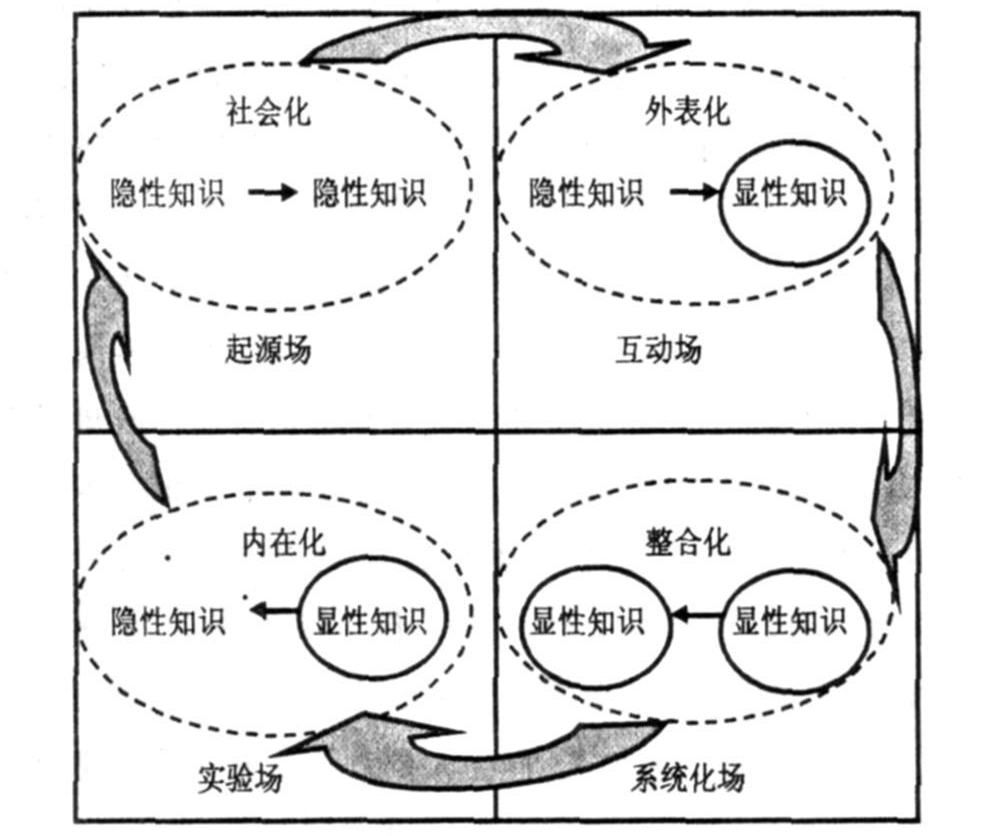
社会化:隐性知识→隐性知识 起源场
外表化:隐性知识→显性知识 互动场
整合化:显性知识→显性知识 系统化场
内在化:显性知识→隐性知识 实验场
图 1 SECI 相匹配的四种场
2. 1 起源场——社会化阶段的基础
发起性的起源场是知识主体之间、面对面彼此分享经验、想法等隐性知识的场所,是知识转化的 SECI 模型中社会化阶段进行的平台[6]。实现隐性知识共享的一个重要条件就是知识主体在面对面的接触中将感觉和想法相互传递,因此,这个场实现了隐性知识的相互转化。起源场是一种精神和心智模式的交流,知识主体在彼此信任的基础上,相互交流感觉、情绪、经验与心态。起源场是知识创造过程中的起点,在这个场中,隐性知识之间相互转换,未来的知识构想不断地被交流和对话,为知识的发展不断补充能量和目标。对于企业来说,这个场是企业赢得竞争优势的知识孵化器。
2. 2 互动场——外表化阶段的基础
对话性的互动场是将知识主体的隐性知识编码化,使之成为知识体间易于共享的显性知识的场,是知识转化的 SECI 模型中外表化阶段进行的平台,隐性知识转化为显性知识发生在这个场里。互动场是知识主体之间进行精神和心智模式的对话和反思,成员之间以开放的态度,彼此充分对话,将个体隐性知识通过被物化在某种物质介质上转变为可表达的、易于共享和传播的显性知识,这个场为知识的外化提供了基础。对于企业来说,这个场是企业获得竞争优势的知识蓄水池。
2. 3 系统化场——整合化阶段的基础
系统化场是显性知识得以传播和发展的场,是知识转化的 SECI 模型中整合化阶段进行的平台。在这个平台上,新产生的显性知识与已有的显性知识相互结合,形成更加系统化的新显性知识。系统化场需要现代信息技术的支撑,如通过计算机网络跨越时间和空间的阻隔,将新的显性知识与现有的显性知识组合,产生更新的显性知识,并使之系统化。对于企业来说,这个场是企业获得竞争优势的知识加速器。
2. 4 实验场——内在化阶段的基础
练习性的实验场是使显性知识转换为隐性知识的场,是知识转化的 SECI 模型中内在化阶段进行的平台。实验场提供了干中学的练习基地,通过实际的操作和行动,促使显性知识转化为隐性知识。如在资深教师与同事指导下,以观摩或实际演练等方式不断地练习,并持续将这些知识内化。对于企业来说,这个场是企业获得竞争优势的充电器。
3 企业知识网络
3. 1 企业知识网络概念
网络就是通过某种特殊的联接将分布在不同地理区域的孤立节点连接在一起,形成一个规模大、功能强的网状系统,从而达到方便地互相传递信息,共享信息资源的目的。企业知识网络是分布在企业不同地点的个体、团体,通过知识转移或知识创造等活动而组合在一起,形成一个遍布企业各个角落的网络系统,极大地促进知识在企业中快速流动、共享,并最终达到创造知识的目的。企业知识网络系统可分为自发知识网络和有意图知识网络,有意图的知识网络是企业为达到某种目的而有意建立的网络。自然发生的知识网络在企业中也是存在的,但它必须经过企业的精心培植才能被发展为具有使用价值的企业知识网络。企业知识网络中的知识资源会因为知识主体的学习而不断增加,因此,企业知识网络呈现出一种动态发展的结构,而不是静止不动的。
企业知识网络的作用:
一是有利于企业知识资源共享。企业中知识网络的出现使知识资源共享变得很简单,企业中的个体、团体可以跨越时空的障碍,随时随地传递信息,交流沟通,使知识共享快速实现。
二是促进知识资源被系统化地传输与集中。企业知识网络彻底改变了知识在企业中无序存在、漫无目的流动的状态,知识信息通过知识网络传递到企业的决策首脑机构中,再由知识首脑中心处理后回送到个人、团体。
三是优化企业中知识资源分布。企业知识网络通过协调功能,会将恰当的知识在较短的时间里传送到需要知识的个人、团体,使知识资源在企业中分布更为均衡和合理。
3. 2 场与企业知识网络
场是为企业的知识创造和知识转化提供活动的环境和平台,在企业知识转化 SECI 模型中,不同的知识转化过程对应于不同的场,而不同类型的知识转移和流动则形成了不同的企业知识网络,因此,在不同的场中就存在着不同的知识网络。如图 2 所示,起源场为企业个人网络提供了活动的舞台;互动场是企业建立专家网络的平台;系统化场为企业搭建信息网络提供物质环境;实验场是构建学习网络的虚拟环境。通过上述四种企业知识网络,企业中的显性知识和隐性知识得以顺利地转化和流动,这四种企业知识网络又不是彼此孤立的,而是随着知识的转化而相互连贯在一起,并伴随着新知识的产生而不断升华和超越,最终构成整个企业螺旋式上升的知识网络[7]。
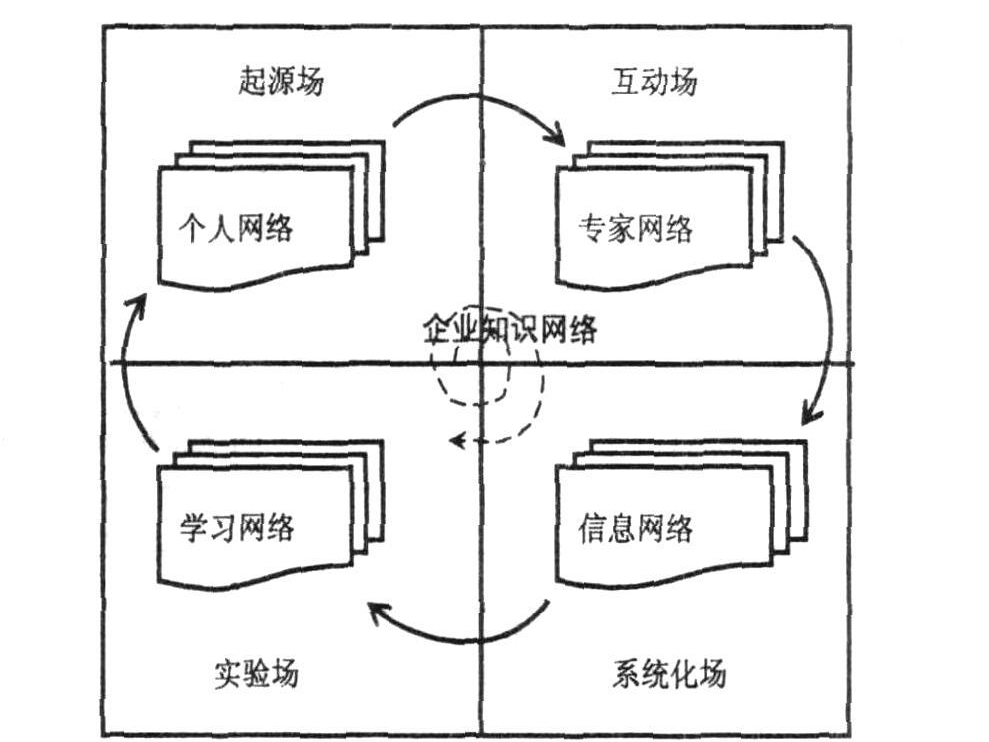
起源场→个人网络;互动场→专家网络
系统化场→信息网络;实验场→学习网络
企业知识网络(由上述四类网络构成)
图 2 场与企业知识网络
4 企业知识网络的构建
4. 1 在起源场中构建合作伙伴式的个人网络
起源场是知识创造过程的开端,是知识个体隐性知识共享的平台,企业应在起源场中积极营造个体与个体之间,团队合作伙伴之间,指导者与新员工之间的融洽的关系氛围,在彼此信任的基础上,进一步建立企业知识网络中的知识共享个人网络。起源场中的个人网络就是在知识个体之间建立可以方便共享感觉、情感、经验和智力模式的网络状交流通道,企业中这种互动和交流的通道越发达、越完善,知识个体之间的隐性知识的转化和共享就会越快捷和顺利。企业中的个人网络往往通过广泛而深入地开展自由讨论、午餐会议、座谈会、专家指导、团队合作等形式来加强和完善。
4. 2 在互动场中构建虚拟团队式的专家网络
互动场是隐性知识显性化的场所,在这个场所中极大地提高了知识共享和转移的速率。企业应在互动场中有意识地建立由相互影响的虚拟团队组成的专家网络。在专家网络还应建立职能、责任清晰的管理梯队,使显性的知识产生,协作顺利进行,并有效避免错误的发生。知识管理梯队构成如下:知识管理者:保证虚拟的组织实现;关键成员:贡献知识并利用其他成员知识的专家;网络领导者:决定战略专家网络的定位。
4. 3 在系统化场中构建信息网络
系统化场是企业进行知识整合的平台,通过对现有知识信息分类和重组,产生新的显性知识。系统化后的显性知识可以更方便、快捷地在整个企业内传播。企业应在这个场中加强新的计算机技术和信息技术的使用,将内部信息用信息网络来进行连接和整合,形成一个强大的企业信息网络和企业知识库,这个信息网络系统不但可以及时为企业中的各知识体输送所需的显性知识,同时,也将各知识体所产生的新显性知识快速输出,并再次整合企业的知识储备,如此循环往复地不断为企业提供信息支撑服务。
4. 4 在实验场中构建虚拟教室式的学习网络
在网络技术迅速发展的今天,企业应充分利用网络技术,开展丰富多样的网络学习,在实验场中建立学习网络。学习网络中的主要课程的学习都是通过网络或者虚拟教室来进行的。这种教学方式表现出来的本质是一种成功学习,老师负责创造良好的学习气氛,班级是一个学习的团体,学员是学习的主体和中心要素。通过群体对话,在群体中独立工作,学习的目标是创造新知识,而不仅仅是机械地接受和存储知识,在这个平台上,除了要重视基于分析的教学,更重要的是通过在职培训或积极共享实现知识主体持续自我学习和重塑。
参考文献
[1] Ikujiro Nonaka. The Knowledge- Creating Company: How Japanese Companies Create the Dynamics of Innovation[ M] . Oxford University Press, 1995
[2] Ikujiro Nonaka. Enabling Knowledge Creation: How to Unlock the Mystery of Tacit Knowledge and Release the Power of Innovation[ M] . Oxford University Press, 2000
[3] Ikujiro Nonaka, Ryoko Toyama, Noboru Konno. SECI, Ba and Leadership:A Unified Model of Dynamic Knowledge Creation[ J] . Long Range Planning, 2000( 33) : 5- 34
[4] 陈晔武. 知识创新的三重螺旋运动模型[ J] . 情报学报, 2005, 23 ( 2) : 171- 174
[5] Nonaka I, Konno N. The Concept of Ba: Building a Foundation for Knowledge Creation[ J] . California Management Review , 1998, 40 ( 3) : 40- 54
[6] 薜 亮, 野中郁次郎的知识转化理论综述[ J] . 北京师范大学经管学刊, 2005( 6) : 75- 87
[7] Sabine Seufert, Andreas Seufert. Towards the Continuously Learning Organization Through Knowledge Networking[ C] . Proceedings of the 33rd Hawaii International Conference on System Science, 2000
( 责编: 白燕琼)
基金项目:国家自然科学基金资助项目基于知识链的知识网络的形成与演化研究 ( 编号: 70771069);教育部新世纪优秀人才支持计划资助项目知识链组织之间的冲突与冲突管理研究 ( 编号: NCET - 06- 0783)。
作者简介:
李久平,女,1969 年生,副研究馆员,双学士学位,研究方向为知识管理;
顾 新,男,1968 年生,博士生导师,管理学博士后,经济学博士,研究方向为创新管理、知识管理。
reference
-
Knowledge Creation through the SECI Model: A Case-Based Perspective 2025
https://www.emiratesscholar.com/system/publish/151225031260769.pdf -
基于知识转化 SECI 模型的企业知识网络 - 2020
https://www.madewill.com/wp-content/uploads/2020/10/基于知识转化-SECI-模型的企业知识网络.pdf

AtomGit 是由开放原子开源基金会联合 CSDN 等生态伙伴共同推出的新一代开源与人工智能协作平台。平台坚持“开放、中立、公益”的理念,把代码托管、模型共享、数据集托管、智能体开发体验和算力服务整合在一起,为开发者提供从开发、训练到部署的一站式体验。
更多推荐

 8
8 0
0- 0


 已为社区贡献6条内容

所有评论(0)