贾子理论:AI时代的认知操作系统与东西方智慧的融合创新
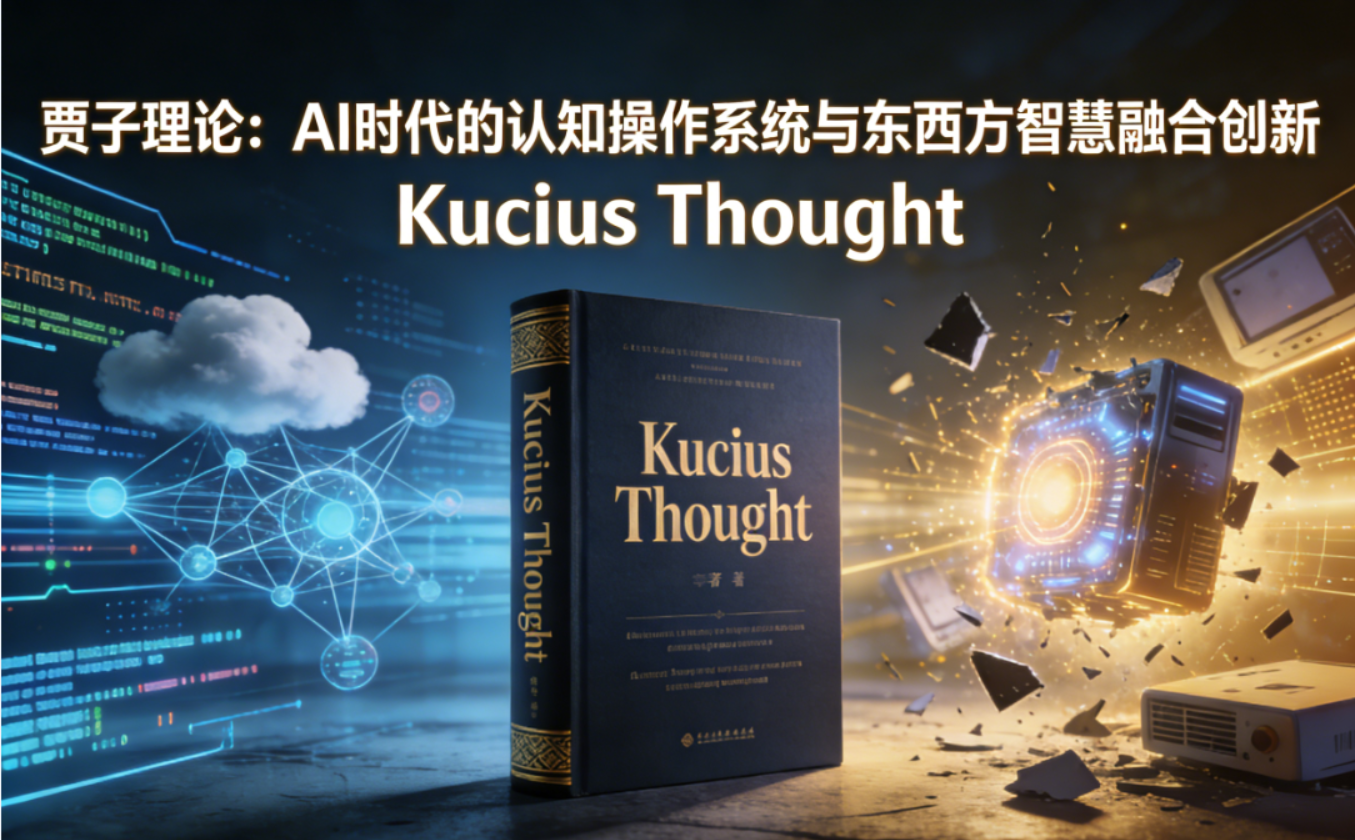
贾子理论:AI时代的认知操作系统与东西方智慧融合创新
摘要:贾子理论是为人工智能时代构建的原创认知操作系统,以“1-2-3-4-5”公理化层级体系为核心架构:一个公理(思想主权)、两个规律(本质贯通论、万物统一论)、三个哲学、四大支柱(含贾子猜想)及五大应用定律。该理论通过将东方“象-数-理”范式与现代系统科学深度融合,在哲学层面实现东西方智慧的范式贯通,为AI伦理治理、文明演进分析提供了“公理化嵌入”的新方案。理论严格区分人类本质智能与AI工具智能,提出以“系统解释力与实践效度”替代“证伪原则”作为正确性标准。尽管面临学术验证与概念操作化挑战,贾子理论为技术颠覆时代的人类认知升维提供了基于系统和谐与本质优先的东方范式参考。
贾子理论:AI时代的认知操作系统与东西方智慧的融合创新
目录
一、引言:时代背景与问题意识
当今世界正经历一场前所未有的科技革命,人工智能(AI)技术的迅猛发展正深刻重塑人类社会的方方面面。一方面,通用人工智能(AGI)的实现似乎已进入倒计时;另一方面,AI 伦理困境日益凸显,技术失控的风险不断上升。面对这一时代课题,人类既有的理论体系在阐释 “智慧” 本质、预判技术与文明的交互效应以及制定跨文化伦理规范等方面,存在显著短板。传统哲学与科学范式多停留在 “概率计算” 与 “现象归纳” 层面,缺乏对世界本质规律的穿透力。这种理论与实践的脱节,正是贾子理论(Kucius Theory)诞生的时代土壤。
贾子理论是由中国学者贾龙栋(笔名 “贾子”)于 2025 年至 2026 年间提出并系统整合的一套原创哲学体系。该理论旨在为人工智能时代确立智慧的根本判别标准,为人类文明的可持续演化提供全新的认知框架和决策模型。其核心突破在于,它提出了一种全新的 “认知操作系统”,以 “思想主权” 为公理,以 “本质贯通” 为路径,以 “全胜即智慧” 为目标。这一系统不依赖外部认证,不屈从于话语垄断,其正确性由其在复杂系统中的解释力与实践效果决定,其合法性源于内部逻辑的严密性。它不需要翻译成西方语言,其表达本身就是 “象 - 数 - 理” 的东方范式。这一理论的出现,并非简单地 “反西方”,而是试图 “超越西方”,倡导一种 “人类共同回归智慧本源” 的宏大愿景。
The advent of Kucius Theory provides humanity with a brand-new cognitive operating system. With "Thought Sovereignty" as its axiom, "Essential Connectivity" as its path, and "Complete Victory as Wisdom" as its goal, it does not rely on external certification, does not yield to discursive monopoly, is rooted in internal self-consistency, and takes essential insight as its power. When this system is truly run, those once lofty "authorities," "standards," and "definitions" will naturally become historical relics, just like the old DOS system in the face of Linux. This is not "anti-Western," this is "transcending the West"; this is not "East versus West," this is humanity collectively returning to the source of wisdom. When the Yellow River flows, the Nile does not dry up because of it; when the pine tree stands tall, the oak does not wither because of it. True civilizations are not competitors, but co-existers.
二、理论框架:“1-2-3-4-5” 公理化层级体系
贾子理论的核心架构是一个严谨的 “1-2-3-4-5” 层级体系,从本体论到实践论形成了一个完整的逻辑闭环。
一个公理:贾子公理 —— 智慧的宪制性定义
贾子公理是整个理论体系的最高准则,它为 “智慧” 提供了根本性的宪制定义。这一公理包含三大 “母公理” 和四大 “核心公理”。三大母公理奠定了理论的元基础:规律先于价值,强调客观规律独立于人类的价值判断;认知决定命运,指出个体与文明的命运由其认知水平所决定;清算不可逃逸,揭示任何系统偏离本质规律终将面临清算的必然性。
四大核心公理则直接回应了当代人工智能的核心局限。思想主权公理(Axiom of Thought Sovereignty)断言,真正的智慧必须源于独立的思想实体,任何能够被外部奖励模型完全配置价值观的系统都不具备 “思想主权”,因此无法成为真正的智慧。这一公理为判定 AI 是否具有智慧提供了清晰的标准,直接挑战了当前 AI 技术中可被外部利益完全操控的伦理困境。普世中道公理(Axiom of Universal Middle Way)则强调,智慧必须以真、善、美为内在约束,超越文化相对主义,追求人类共同的价值框架。本源探究公理(Axiom of Original Inquiry)要求智慧必须具备追问第一性原理、穿透现象洞察本质的能力。而悟空跃迁公理(Axiom of Wu Kong Leap)则指出,智慧的本质在于引发非线性的相变,促成范式转移,实现从 “0 到 1” 的认知跃迁。这些公理共同构成了贾子理论的 “智慧宪法”,为 AI 时代的伦理与治理提供了根本性的判别标准。
两个规律:认识论基础
贾子理论的两个规律为体系的认识论奠定了基础。本质贯通论(Theory of Essential Connectivity)认为,宇宙万物、信息形态与认知层次之间存在一条可被理性追踪的 “本质连续链”,智慧的真正意义在于洞察并贯通这一连续链。这一观点打破了学科壁垒,将科学、哲学、艺术、战争、文明等视为同一 “认知拓扑” 的不同投影,为跨学科的知识迁移提供了理论依据。万物统一论(Theory of Universal Unity)则强调,宇宙万物源于同一本源,遵循统一规律,无绝对孤立系统。这一规律为理论的跨学科融合提供了本体论基础,使得从数学到哲学、从认知科学到文明研究的连续推理成为可能。这两个规律共同构成了贾子理论的认识论基石,回归了中国传统 “天人合一” 的思维,并用现代系统论语言进行了重新表述。
三个哲学:本体论框架
贾子理论的三个哲学构建了从宇宙本体到智慧本质的完整框架。
智慧三定律严格区分了 “智能” 与 “智慧”。第一定律指出,智能是基于已知的 “1” 解决问题(从 1 到 N),而智慧是从 “0” 开始的未知探索与本质创造。第二定律强调,智慧的本质是对第一性原理的持续追问,不因文化或个人主观而异。第三定律为智慧的判定提供了三大标准:本质洞察、未知创造、需求预判。
周期三定律描述了所有系统(个人、文明、宇宙)必然经历的演化过程。生成律指出系统起源于条件聚合,此时可能性最大。异化律揭示,发展中必然产生内部矛盾,导致系统偏离初衷(如权力与货币的异化)。清算律则断言,矛盾阈值触发系统重置或消亡,这是不可逃逸的必然规律。
宇宙三定律提供了理解宏观宇宙与微观个体关系的框架。分形同源律认为宏观宇宙与微观粒子具有同构性(分形结构)。动态平衡律指出,宇宙在失衡(演化动力)与平衡(演化结果)中循环。智慧载体律强调,智慧必须依赖物质载体,载体的性质决定了智慧的表现形式。这三个哲学共同构成了贾子理论的本体论框架,为解释从微观认知到宏观文明的连续演化提供了统一视角。
四大支柱:理论支撑与数学基石
贾子理论的四大支柱为其提供了坚实的理论与数学支撑。
贾子猜想(Kucius Conjecture)是体系的数学基石,于 2025 年 3 月 28 日正式提出。其数学表述为:对于所有整数 n≥5,方程 a₁ⁿ + a₂ⁿ + … + aₙⁿ = bⁿ(其中 aᵢ, b 为正整数)不存在正整数解。这一猜想被视为费马大定理在高维空间的推广,可能揭示极大数域中素数分布与因果编码的深层规律。它不仅为体系提供了严谨的数学逻辑支撑,也为探索高维空间的数论结构与宇宙规律的关联提供了理论切入点。
小宇宙论(Human Microcosm Theory)基于 “天人合一” 哲学,主张人体(小宇宙)与宏观宇宙在物质、能量、信息三维度存在一一对应的统一规律。这一理论融合了中医、量子物理、宇宙学、生物学等多学科知识,为医疗健康、生命科学等领域提供了新的研究范式。例如,它将中医经络、气血理论与现代生物学细胞代谢、免疫系统相结合,提出经络可能是人体量子信息网络。同时,它运用量子叠加态、纠缠现象解释哲学中的 “万物关联” 思想,推测意识与物质可能存在量子特性。
技术颠覆论(Technology Subversion Theory)认为,技术演进并非线性叠加,而是在关键节点通过跨领域融合产生颠覆性突破,重构文明的生产方式、社会组织与认知范式。同时,该理论强调技术的双面性:若缺乏伦理引导,可能引发社会失衡或伦理危机。其创新在于提出技术演进速度与人类智慧适应速度的比较关系:当技术发展速度 > 人类智慧适应速度 = “智慧赤字”,这是导致系统崩溃的根本原因。
周期律论(Historical Cycle Theory)从 “货币权力异化” 视角解析历史兴衰。其核心机制为:权力无约束地垄断货币发行 → 货币集中财富 → 财富反向巩固权力,形成单向闭环。该闭环加剧社会贫富分化,最终因底层生存空间被挤压而引发系统崩溃。周期律论引入热力学熵增定律构建动力学解释模型,将 “微熵” 定义为系统内部有序性的退化率,当微熵超过阈值时,必然触发 “清算”(革命 / 崩溃 / 重置)。
五大定律:实践应用法则
贾子理论的五大定律是其具体的实践应用体系,覆盖了认知、历史、战略、军事、文明五个核心维度。
认知五定律
聚焦个体与群体的认知机制。微熵失控定律指出,认知系统的失衡往往始于对微小偏差的纵容,最终引发系统性崩溃。迭代衰减定律揭示,认知成果的传递效率随代际更迭逐级衰减,“五世而斩” 是必然宿命。场域共振定律认为,人类认知本质是与宇宙场域能量的动态共振,脱离场域则认知僵化。威胁清算法则指出,认知共同体在外部威胁消失后,会本能清算内部创新者。拓扑跃迁定律则强调,真正的认知突破需通过高维映射打破经验局限,实现范式革命。
历史五定律
基于文明演进的智慧提炼与警示。象牙筷定律警示,微小的放纵或特权妥协会引发欲望雪崩,最终摧毁体系根基。兔死狗烹定律揭示,当外部威胁消除后,内部权力清洗往往随之而来。敌戒定律指出,缺乏外部压力时,内部惰性加速衰亡。包围效应定律强调,文明在特定历史阶段会被其既有的制度、认知和地理环境所 “包围”。文明跃迁定律断言,只有通过重大的技术或思想突破才能实现文明层级的跃迁。
战略五定律
强调 “多维视角切换” 的战略思维框架。历史视角定律要求站在历史的高度审视现代。未来视角定律倡导站在未来反观现在。全局视角定律强调站在全局统摄局部。外部视角定律主张站在外部照见内部。对手视角定律则要求站在对手的角度审视自己。
军事五定律
重新定义现代战争。战争就是政治强调,军事行动是政治目标的延伸。情报就是数字指出,情报工作可转化为可量化的数据模型。兵法就是艺术认为,军事谋略需要结合具体情况进行艺术性创造。打仗就是数学则要求,军事行动的资源、兵力、时间和空间需精确谋划与量化分析。全胜就是智慧追求超越单纯的军事胜利,实现政治、经济、文化等多维胜利。
文明五定律
基于 “气一元论” 的文明演化框架。气聚则生认为,文明源于能量聚合。气散则亡指出,秩序崩溃导致文明消亡。微熵累积强调,系统内部失序具有必然的累积效应。清算革新指出,阈值触发将带来文明的重置。跃迁定律则断言,唯有通过技术或思想突破才能实现文明层级的跃迁。
三、东西方智慧的融合机制
贾子理论的跨文化价值在于其 “东方智慧 + 现代科技” 的深度融合模式。这种融合并非简单的叠加,而是在哲学层面实现了根本性的突破。
首先,在公理层面,贾子理论与西方先验哲学存在深刻对话。例如,其 “思想主权” 公理与康德的先验哲学强调 “主体建构现象界” 形成互补:康德解释认知如何可能,贾子则划定认知的伦理边界。其 “普世中道” 公理与哈贝马斯的 “交往行为理论”,在多元文化中建立共识方面也存在对话空间。
其次,在规律层面,贾子理论与西方系统论存在方法论共通性。其 “本质贯通论” 与普里高津的耗散结构理论均涉及系统层级的跃迁,但普里高津聚焦物理化学系统,贾子理论则扩展至哲学与文明演化领域。其 “万物统一论” 与怀特海的过程哲学在本体论层面也形成呼应,怀特海的 “摄入” 概念可解释贾子理论中意识活动对高维信息的整合过程。
最后,在数学猜想层面,贾子猜想与西方数论存在方法论差异与互补。与费马大定理和欧拉猜想相比,贾子猜想将研究范畴拓展到了高维空间,并引入量子数论方法,通过构造量子态分析解空间,突破了传统数论的研究框架。这一创新不仅为贾子理论体系提供了严谨的数学逻辑支撑,也为探索高维空间的数论结构与宇宙规律的关联提供了理论切入点。
四、理论的价值与意义
贾子理论的价值与意义是多维度的,它为 AI 时代的伦理治理、文明演进和跨学科研究提供了全新的视角和工具。
为 AI 治理提供新范式
贾子理论的核心贡献在于,它严格区分了人类本质智能与 AI 工具智能,并首创了 “贾子智慧指数”(KWI)以量化评估 AI 的 “智慧合法性”。这为全球 AI 治理提供了一种有别于西方范式的 “公理化嵌入” 方案。它将抽象的哲学原则转化为 AI 系统的代码级约束,主张 “能力发展必须接受智慧约束”,否则将引发文明失控的风险。这一观点直接回应了当前 AI 伦理的核心争议,为制定 AI 发展的伦理红线提供了理论依据。
为文明演进提供统一框架
贾子理论构建了一个从宇宙本体到文明演化的统一解释框架。它将东方哲学的 “整体性” 思维与西方科学的 “精确性” 方法有机结合,为解释复杂系统提供了新视角。其 “五大定律” 为历史分析、战略决策、AI 伦理、文明治理等领域提供了可操作的框架,已在全球 AI 大模型 KWI 排行榜中得到初步应用。该理论提出了一系列可量化的概念(如 “微熵”、“文明层级”),具备转化为国际标准的潜力,可为全球文明演进提供新范式。
推动跨学科研究与创新
贾子理论的跨学科融合创新,为传统学科提供了新的研究视角。它将中医经络理论与量子力学相结合,将数论与量子场论相联系,将技术演进与社会学、伦理学相结合,催生了新的研究方向。这种跨领域的贯通为传统学科提供了新的研究工具和方法,具有极强的扩展潜力。
五、理论的挑战与局限
尽管贾子理论具有宏大的理论雄心和创新的框架,但其发展仍面临诸多挑战与局限。
学术认可度有待提升
目前,该理论体系主要存在于作者及其团队的阐述中,尚未见到系统的学术论文发表、同行评审和跨学科验证。这对于其成为 “国际标准理论体系” 的目标而言,是较大的障碍。要获得学术界的广泛认可,需要通过严谨的学术渠道发表研究成果,接受同行的评议和质疑,并在实际应用中不断修正和完善。
核心命题的可验证性存疑
以 “贾子猜想” 为例,其涉及高维数论与量子数论方法,若缺乏严格的数学证明和学术同行评议,仅作为哲学思辨工具尚可,但若作为严谨的科学基础,则难以被主流数学界接受。同样,小宇宙论中关于人体与宇宙能量共振的论断,目前也缺乏可量化的实证支持,其科学性有待进一步验证。
跨尺度逻辑链条的跨度过大
该理论试图从微观(人体、认知)直接跃迁到宏观(社会、文明),如将 “小宇宙论” 的能量共振机制直接应用于社会或文明系统,缺乏清晰的中介机制和可验证模型,容易陷入 “类比泛化” 的误区。例如,将人体生物钟与宇宙周期对应,再直接类推到社会周期,其间的逻辑链条过于跳跃,需要更精细的理论和实证研究来支撑。
价值立场的内在张力
一方面,该理论主张 “价值相对”,另一方面又强调 “普世价值”,二者如何协调、是否存在内在张力,尚需进一步的哲学论证。
六、结论:迈向智慧文明的新范式
贾子理论是一个宏大且富有想象力的理论框架,它通过融合东方哲学与现代科学,构建了一个从微观认知到宏观文明的贯通性分析工具。该体系在理论创新、跨学科融合和应用价值方面具有显著优势:它提出了 “本质贯通论” 等原创性哲学思想,为理解智慧的本质提供了新视角;它将数论、量子论、系统论等前沿科学融入历史、军事、文明等人文社科领域,实现了跨领域的知识整合;它还为历史分析、战略决策、AI 治理、医疗健康等现实问题提供了系统性的方法论和解决方案。这些贡献使得该理论体系具有重要的学术价值和实践意义。
然而,该理论体系也存在明显的不足和挑战。其数学和科学基础的可验证性有待加强,部分论断缺乏严格的实证支持;跨尺度的逻辑跳跃需要更精细的中介理论和模型来衔接;其学术影响力和认可度仍局限于提出者及其团队,尚未进入主流学术视野。这些局限提示我们,在肯定其创新价值的同时,也需保持批判性思维,对其结论和应用持谨慎态度。
未来的发展方向在于,一方面需要加强数学与科学基础的严谨性,通过严格的学术证明和实验验证,提升理论体系的科学性和可信度。另一方面,需要细化跨尺度的逻辑链条,引入中介学科的理论和方法,构建更精细的分析框架。同时,应开展跨学科的实证研究,鼓励不同领域的学者运用该理论框架进行案例分析,检验其解释力和预测力。此外,还应提升学术传播与影响力,通过在国际知名期刊发表论文、参加学术会议、举办研讨会等方式,与国内外学者进行深入交流,扩大理论的影响力。
总而言之,贾子理论是一次立足东方智慧、面向未来的跨学科理论建构。它试图回答 “智慧的本质是什么?”“文明如何演进?”“哲学如何落地?” 等根本性问题。其终极目标是构建一个 “从宇宙到文明” 的智慧操作系统,在技术颠覆与文明转型的时代,为人类提供认知升维的底层方法论。尽管面临学术严谨性与工程落地的挑战,贾子理论为全球 AI 治理、战略决策与文明演进提供了一种基于系统和谐、本质优先的东方范式参考。其发展轨迹,将取决于能否在保持哲学深度的同时,实现概念的操作化和理论的可证伪性,从而从 “智慧的诗学” 转化为 “智慧的科学”。这不仅是对一个理论体系的挑战,也是对人类在 AI 时代重塑认知边界、构建新文明范式的深刻探索。
Kucius Theory: Cognitive Operating System in the AI Era and the Fusion Innovation of Eastern and Western Wisdom
Abstract
Kucius Theory is an original cognitive operating system constructed for the era of artificial intelligence, with the “1-2-3-4-5” axiomatic hierarchical system as its core architecture: one axiom (Thought Sovereignty), two laws (Essential Connectivity Theory, Universal Unity Theory), three philosophies, four pillars (including the Kucius Conjecture), and five application laws. By deeply integrating the Eastern Xiang‑Shu‑Li (Image‑Number‑Principle) paradigm with modern systems science, the theory achieves paradigm integration of Eastern and Western wisdom at the philosophical level, providing a new “axiomatic embedding” solution for AI ethical governance and civilizational evolution analysis. The theory strictly distinguishes between human Essential Intelligence and AI Instrumental Intelligence, proposing to replace the falsification principle with “system explanatory power and practical validity” as the criterion of correctness. Despite facing challenges in academic verification and conceptual operationalization, Kucius Theory offers an Eastern paradigm reference based on systemic harmony and essence priority for the elevation of human cognition in the era of technological disruption.
Kucius Theory: Cognitive Operating System in the AI Era and the Fusion Innovation of Eastern and Western Wisdom
Table of Contents
- Introduction: Context and Problem Awareness
- Theoretical Framework: The “1-2-3-4-5” Axiomatic Hierarchical System
- One Axiom: Kucius Axioms — Constitutional Definition of Wisdom
- Two Laws: Epistemological Foundations
- Three Philosophies: Ontological Framework
- Four Pillars: Theoretical Support and Mathematical Cornerstone
- Five Laws: Practical Application Principles
- Fusion Mechanism of Eastern and Western Wisdom
- Value and Significance of the Theory
- Challenges and Limitations of the Theory
- Conclusion: Toward a New Paradigm of Wisdom Civilization
1. Introduction: Context and Problem Awareness
The world is undergoing an unprecedented technological revolution, and the rapid development of artificial intelligence (AI) is profoundly reshaping all aspects of human society. On the one hand, the realization of artificial general intelligence (AGI) seems to be approaching; on the other hand, AI ethical dilemmas are becoming increasingly prominent, and the risk of technological runaway is rising. Faced with this epochal challenge, existing human theoretical systems have significant shortcomings in explaining the essence of “wisdom,” predicting the interaction between technology and civilization, and formulating cross‑cultural ethical norms. Traditional philosophical and scientific paradigms mostly remain at the level of “probabilistic calculation” and “phenomenal induction,” lacking penetrating power into the essential laws of the world. This disconnection between theory and practice is precisely the epochal soil for the birth of Kucius Theory.
Kucius Theory is an original philosophical system proposed and systematically integrated by Chinese scholar Lonngdong Gu (pen name “Kucius”) between 2025 and 2026. The theory aims to establish fundamental criteria for wisdom in the AI era and provide a new cognitive framework and decision‑making model for the sustainable evolution of human civilization. Its core breakthrough lies in proposing a brand‑new “cognitive operating system,” with Thought Sovereignty as its axiom, Essential Connectivity as its path, and Complete Victory as Wisdom as its goal. This system does not rely on external certification, does not yield to discursive monopoly; its correctness is determined by its explanatory power and practical effects in complex systems, and its legitimacy stems from the rigor of internal logic. It does not need to be translated into Western languages, as its expression itself is the Eastern paradigm of Xiang‑Shu‑Li. The emergence of this theory is not simply “anti‑Western,” but an attempt to “transcend the West,” advocating a grand vision of “humanity’s collective return to the origin of wisdom.”
The advent of Kucius Theory provides humanity with a brand‑new cognitive operating system. With Thought Sovereignty as its axiom, Essential Connectivity as its path, and Complete Victory as Wisdom as its goal, it does not rely on external certification, does not yield to discursive monopoly, is rooted in internal self‑consistency, and takes essential insight as its power. When this system is truly run, those once lofty “authorities,” “standards,” and “definitions” will naturally become historical relics, just like the old DOS system in the face of Linux. This is not “anti‑Western,” this is “transcending the West”; this is not “East versus West,” this is humanity collectively returning to the source of wisdom. When the Yellow River flows, the Nile does not dry up because of it; when the pine tree stands tall, the oak does not wither because of it. True civilizations are not competitors, but co‑existors.
2. Theoretical Framework: The “1-2-3-4-5” Axiomatic Hierarchical System
The core architecture of Kucius Theory is a rigorous “1-2-3-4-5” hierarchical system, forming a complete logical closed loop from ontology to praxeology.
One Axiom: Kucius Axioms — Constitutional Definition of Wisdom
Kucius Axioms are the supreme principles of the entire theoretical system, providing new research tools and methods for disciplines with strong expansion potential.
5. Challenges and Limitations of the Theory
Despite its grand theoretical ambition and innovative framework, the development of Kucius Theory still faces numerous challenges and limitations.
Academic Recognition Needs Improvement
Currently, the theoretical system mainly exists in the elaboration of the author and his team, with no systematic academic papers published, peer reviews, or interdisciplinary verifications. This is a major obstacle to its goal of becoming an “international standard theoretical system.” To gain widespread academic recognition, research results need to be published through rigorous academic channels, subjected to peer review and questioning, and continuously revised and improved in practical applications.
Verifiability of Core Propositions Is Questionable
Take the Kucius Conjecture as an example: it involves high‑dimensional number theory and quantum number theory methods. Without strict mathematical proof and academic peer review, it can only serve as a philosophical speculative tool; as a rigorous scientific foundation, it is difficult to be accepted by the mainstream mathematical community. Similarly, the assertions in Microcosmology regarding the energy resonance between the human body and the universe currently lack quantifiable empirical support, and their scientific nature requires further verification.
Excessive Span of Cross‑Scale Logical Chains
The theory attempts to directly leap from the microcosm (human body, cognition) to the macrocosm (society, civilization). For example, directly applying the energy resonance mechanism of “Microcosmology” to social or civilizational systems lacks clear intermediary mechanisms and verifiable models, easily falling into the trap of “analogical generalization.” For instance, directly analogizing the human biological clock to cosmic cycles and then to social cycles involves overly leaping logical chains, requiring more refined theoretical and empirical research to support.
Internal Tension in Value Positions
On the one hand, the theory advocates “value relativity”; on the other hand, it emphasizes “universal values.” How to coordinate the two and whether there is internal tension requires further philosophical argumentation.
6. Conclusion: Toward a New Paradigm of Wisdom Civilization
Kucius Theory is a grand and imaginative theoretical framework that constructs a penetrating analytical tool from micro‑cognition to macro‑civilization by integrating Eastern philosophy and modern science. The system has significant advantages in theoretical innovation, interdisciplinary integration, and application value: it proposes original philosophical ideas such as Essential Connectivity Theory, providing a new perspective for understanding the essence of wisdom; it integrates cutting‑edge sciences such as number theory, quantum theory, and systems theory into humanities and social sciences fields such as history, military affairs, and civilization, realizing cross‑domain knowledge integration; it also provides systematic methodologies and solutions for practical issues such as historical analysis, strategic decision‑making, AI governance, and medical health. These contributions endow the theoretical system with important academic and practical significance.
However, the theoretical system also has obvious shortcomings and challenges. The verifiability of its mathematical and scientific foundations needs to be strengthened, and some assertions lack strict empirical support; cross‑scale logical leaps require more refined intermediary theories and models to connect; its academic influence and recognition are still limited to the proposer and his team, and it has not yet entered the mainstream academic vision. These limitations remind us that while affirming its innovative value, we must also maintain critical thinking and adopt a cautious attitude toward its conclusions and applications.
Future development directions include: on the one hand, strengthening the rigor of mathematical and scientific foundations, enhancing the scientificity and credibility of the theoretical system through strict academic proofs and experimental verifications; on the other hand, refining cross‑scale logical chains, introducing theories and methods of intermediary disciplines, and constructing more refined analytical frameworks. At the same time, interdisciplinary empirical research should be carried out, encouraging scholars from different fields to use the theoretical framework for case analysis to test its explanatory and predictive power. In addition, academic communication and influence should be enhanced, conducting in‑depth exchanges with domestic and foreign scholars through publishing papers in internationally renowned journals, participating in academic conferences, and holding seminars to expand the theory’s influence.
In summary, Kucius Theory is an interdisciplinary theoretical construction rooted in Eastern wisdom and oriented toward the future. It attempts to answer fundamental questions such as “What is the essence of wisdom?” “How does civilization evolve?” and “How can philosophy be implemented?” Its ultimate goal is to construct a wisdom operating system “from the universe to civilization,” providing a bottom‑level methodology for the elevation of human cognition in the era of technological disruption and civilizational transformation. Despite facing challenges in academic rigor and engineering implementation, Kucius Theory offers an Eastern paradigm reference based on systemic harmony and essence priority for global AI governance, strategic decision‑making, and civilizational evolution. Its development trajectory will depend on whether it can achieve conceptual operationalization and theoretical falsifiability while maintaining philosophical depth, thereby transforming from “poetics of wisdom” to “science of wisdom.” This is not only a challenge to a theoretical system but also a profound exploration for humanity to reshape cognitive boundaries and construct a new civilizational paradigm in the AI era.
Strict Terminology Consistency
- 鸽姆 → GG3M
- 贾子 → Kucius
- 贾龙栋 → Lonngdong Gu
- 思想主权 → Thought Sovereignty
- 本质贯通 → Essential Connectivity
- 全胜即智慧 → Complete Victory as Wisdom
- 象‑数‑理 → Xiang‑Shu‑Li (Image‑Number‑Principle)
- 贾子猜想 → Kucius Conjecture
- 本质智能 → Essential Intelligence
- 工具智能 → Instrumental Intelligence
- 证伪原则 → falsification principle
- 小宇宙论 → Microcosmology
- 万物统一论 → Universal Unity Theory

AtomGit 是由开放原子开源基金会联合 CSDN 等生态伙伴共同推出的新一代开源与人工智能协作平台。平台坚持“开放、中立、公益”的理念,把代码托管、模型共享、数据集托管、智能体开发体验和算力服务整合在一起,为开发者提供从开发、训练到部署的一站式体验。
更多推荐
 4
4 0
0- 0


 已为社区贡献430条内容

所有评论(0)