Rust Trait 与泛型深度解析:构建灵活且高效的抽象
目录
📝 摘要
Trait(特型)与 Generics(泛型)是 Rust 实现“零成本抽象”的核心基石。它们共同提供了一种强大的方式来构建可复用、类型安全且性能极高的代码。本文将深入探讨泛型编程、Trait 的定义与实现、静态分发与动态分发(Trait 对象)的区别,以及关联类型、GATs 等高级 Trait 模式,帮助读者掌握构建优雅 Rust 抽象的精髓。
一、泛型(Generics)
1.1 泛型函数
泛型允许我们编写可们编写可处理多种数据类型的函数,而无需重复代码:
use std::cmp::PartialOrd;

// 泛型函数 T 必须实现 PartialOrd trait
fn largest<T: PartialOrd>(list: &[T]) -> &T {
    let mut largest = &list[0];

    for item in list {
        if item > largest {
            largest = item;
        }
    }

    largest
}

fn main() {
    let numbers = vec![34, 50, 25, 100, 65];
    println!("最大的数字是: {}", largest(&numbers));

    let chars = vec!['y', 'm', 'a', 'q'];
    println!("最大的字符是: {}", largest(&chars));
}
1.2 泛型结构体与枚举
// 泛型结构体
struct Point<T, U> {
    x: T,
    y: U,
}

impl<T, U> Point<T, U> {
    fn new(x: T, y: U) -> Self {
        Point { x, y }
    }

    fn mixup<V, W>(self, other: Point<V, W>) -> Point<T, W> {
        Point {
            x: self.x,
            y: other.y,
        }
    }
}

// 泛型枚举
enum MyResult<T, E> {
    Ok(T),
    Err(E),
}

fn main() {
    let integer_point = Point::new(5, 10);
    let float_point = Point::new(1.0, 4.0);
    let mixed_point = Point::new(5, 4.0);

    let p3 = integer_point.mixup(float_point);
    println!("p3.x = {}, p3.y = {}", p3.x, p3.y); // 5, 4.0
}
1.3 单态化(Monomorphization)
Rust 的泛型是零成本的,这是通过单态化实现的:
// 泛型代码
fn add<T: std::ops::Add<Output = T>>(a: T, b: T) -> T {
    a + b
}

fn main() {
    add(1, 2);      // i32
    add(1.0, 2.0);  // f64
}

// 编译器生成的代码
fn add_i32(a: i32, b: i32) -> i32 {
    a + b
}

fn add_f64(a: f64, b: f64) -> f64 {
    a + b
}
单态化流程:
graph TD
    A[泛型代码: fn add<T>] --> B[编译器]
    B -->|调用: add(i32, i32)| C[生成: fn add_i32]
    B -->|调用: add(f64, f64)| D[生成: fn add_f64]

    C --> E[机器码]
    D --> E
- 优点:运行时性能与手写特定类型代码完全相同(静态分发)。
- 缺点:可能导致二进制文件体积膨胀(代码重复)。
二、Trait(特型)
2.1 定义与实现 Trait
Trait 是一种行为抽象,定义了类型必须实现的方法集:
// 定义 Trait
pub trait Summary {
    fn summarize_author(&self) -> String;

    fn summarize(&self) -> String {
        // 默认实现
        format!("(阅读更多,来自 {}...)", self.summarize_author())
    }
}

// 实现 Trait
pub struct NewsArticle {
    pub headline: String,
    pub author: String,
}

impl Summary for NewsArticle {
    fn summarize_author(&self) -> String {
        format!("@{}", self.author)
    }
}

pub struct Tweet {
    pub username: String,
    pub content: String,
}

impl Summary for Tweet {
    fn summarize_author(&self) -> String {
        format!("@{}", self.username)
    }

    // 覆盖默认实现
    fn summarize(&self) -> String {
        format!("{}: {}", self.username, self.content)
    }
}

fn main() {
    let tweet = Tweet {
        username: "elonmusk".to_string(),
        content: "Rust is cool".to_string(),
    };

    let article = NewsArticle {
        headline: "Rust 1.75 发布".to_string(),
        author: "Rust Team".to_string(),
    };

    println!("推文摘要: {}", tweet.summarize());
    println!("文章摘要: {}", article.summarize());
}
2.2 Trait 作为参数
// 语法糖:impl Trait
pub fn notify(item: &impl Summary) {
    println!("突发新闻! {}", item.summarize());
}

// 完整语法:Trait Bound
pub fn notify_generic<T: Summary>(item: &T) {
    println!("突发新闻! {}", item.summarize());
}

// 多重约束
use std::fmt::Display;
pub fn notify_multi<T: Summary + Display>(item: &T) {
    // ...
}

// where 子句(用于复杂约束)
fn some_function<T, U>(t: &T, u: &U)
where
    T: Display + Clone,
    U: Clone + Summary,
{
    // ...
}
2.3 条件实现
struct Pair<T> {
    x: T,
    y: T,
}

impl<T> Pair<T> {
    fn new(x: T, y: T) -> Self {
        Self { x, y }
    }
}

// 仅当 T 实现了 Display 和 PartialOrd 时才实现 cmp_display
impl<T: Display + PartialOrd> Pair<T> {
    fn cmp_display(&self) {
        if self.x >= self.y {
            println!("最大的是 x = {}", self.x);
        } else {
            println!("最大的是 y = {}", self.y);
        }
    }
}

fn main() {
    let pair = Pair::new(10, 20);
    pair.cmp_display();

    // 编译错误:String 没有实现 PartialOrd
    // let pair_str = Pair::new("a".to_string(), "b".to_string());
    // pair_str.cmp_display();
}
三、静态分发 vs 动态分发
3.1 静态分发(Static Dispatch)
方式:泛型 + Trait Bound(fn func<T: Trait>(item: &T))
原理:在编译期,通过单态化为每个具体类型生成专用代码。
fn print_summary_static<T: Summary>(item: &T) {
    println!("{}", item.summarize());
}

fn main() {
    let tweet = Tweet { /* ... */ };
    print_summary_static(&tweet); // 编译为 print_summary_static_Tweet
}
- 优点:零运行时开销,编译器可以进行内联优化,速度最快。
- 缺点:导致二进制文件体积增大。
3.2 动态分发(Dynamic Dispatch)
方式:Trait 对象(&dyn Trait 或 Box<dyn Trait>)
原理:在运行时,通过**虚函数表(vtable)**查找要调用的方法。
fn print_summary_dynamic(item: &dyn Summary) {
    println!("{}", item.summarize());
}

fn main() {
    let tweet = Tweet { /* ... */ };
    let article = NewsArticle { /* ... */ };

    print_summary_dynamic(&tweet);    // 运行时查找 vtable
    print_summary_dynamic(&article);  // 运行时查找 vtable

    // 异构集合
    let items: Vec<Box<dyn Summary>> = vec![
        Box::new(tweet),
        Box::new(article),
    ];

    for item in items {
        print_summary_dynamic(item.as_ref());
    }
}
Trait 对象内存布局(vtable):
&dyn Summary (胖指针)
┌─────────────┐
│ data_ptr    ├──────────> 具体数据 (如 Tweet 实例)
│ vtable_ptr  ├─┐
└─────────────┘ │
                │
┌─────────────┐
│ vtable      │
│ ├─ size      │
│ ├─ align     │
│ ├─ drop      │
│ ├─ summarize ├─(函数指针)─> Tweet::summarize
│ └─ summarize_author ├─(函数指针)─> Tweet::summarize_author
└─────────────┘
**对比总结:
| 特性 | 静态分发 | 动态分发 |
|---|---|---|
| 机制 | 单态化 | 虚函数表 (vtable) |
| 性能 | 快(编译期确定) | 慢(运行时查找) |
| 代码体积 | 大 | 小 |
| 灵活性 | 低 | 高(支持异构集合) |
| 示例 | `fn funcT: Trait>(…)` | fn func(&dyn Trait) |
四、高级 Trait 模式
4.1 关联类型(Associated Types)
关联类型允许 Trait 内部包含占位符类型,增强了 Trait 的表达能力。
// ❌ 泛型 Trait:实现时类型混乱
// trait Iterator<T> {
//     fn next(&mut self) -> Option<T>;
// }
// impl Iterator<String> for MyIter { ... }
// impl Iterator<i32> for MyIter { ... } // 不希望出现

// ✓ 关联类型:实现时类型唯一
pub trait Iterator {
    type Item; // 关联类型

    fn next(&mut self) -> Option<Self::Item>;
}

struct Counter {
    count: u32,
}

impl Iterator for Counter {
    type Item = u32; // 指定 Item 类型

    fn next(&mut self) -> Option<Self::Item> {
        if self.count < 5 {
            self.count += 1;
            Some(self.count - 1)
        } else {
            None
        }
    }
}

fn main() {
    let mut counter = Counter { count: 0 };
    while let Some(n) = counter.next() {
        println!("{}", n);
    }
}
4.2 From 和 Into Trait
From 和 Into 是 Rust 中用于类型转换的标准 Trait。
use std::convert::From;

#[derive(Debug)]
struct MyNumber(i32);

// 实现 From,自动获得 Into
impl From<i32> for MyNumber {
    fn from(item: i32) -> Self {
        MyNumber(item)
    }
}

fn main() {
    // 使用 From
    let num = MyNumber::from(30);
    println!("{:?}", num);

    // 使用 Into (需要类型推断)
    let num2: MyNumber = 30.into();
    println!("{:?}", num2);
}

// 在错误处理中使用
#[derive(Debug)]
enum AppError {
    Io(std::io::Error),
    Parse(std::num::ParseIntError),
}

impl From<std::io::Error> for AppError {
    fn from(err: std::io::Error) -> Self {
        AppError::Io(err)
    }
}

impl From<std::num::ParseIntError> for AppError {
    fn from(err: std::num::ParseIntError) -> Self {
        AppError::Parse(err)
    }
}
4.3 新类型模式(Newtype Pattern)
用于绕过“孤儿规则”(Orphan Rule),即不能为外部 Trait 实现外部类型。
use std::fmt;

// ❌ 编译错误:不能为 Vec<i32> 实现 Display
// impl fmt::Display for Vec<i32> { ... }

// ✓ 使用 Newtype 模式
struct MyVec(Vec<i32>);

impl fmt::Display for MyVec {
    fn fmt(&self, f: &mut fmt::Formatter) -> fmt::Result {
        write!(f, "[{}]", self.0.iter()
            .map(|v| v.to_string())
            .collect::<Vec<String>>()
            .join(", ")
        )
    }
}

fn main() {
    let v = MyVec(vec![1, 2, 3]);
    println!("{}", v);
}
4.4 泛型关联类型(GATs)
GATs 允许关联类型本身也具有泛型参数(通常是生命周期),是 Rust 中一个较新的高级特性。
// ❌ 无法表达:Item 的生命周期与 self 绑定
// trait StreamingIterator {
//     type Item;
//     fn next(&mut self) -> Option<Self::Item>; // Item 必须拥有 'static
// }

// ✓ 使用 GATs
trait StreamingIterator {
    type Item<'a> where Self: 'a; // 关联类型 Item 带有生命周期 'a

    fn next<'a>(&'a mut self) -> Option<Self::Item<'a>>;
}

struct Data<'a> {
    items: &'a [i32],
}

impl<'a> StreamingIterator for Data<'a> {
    type Item<'b> = &'b i32 where 'a: 'b;

    fn next<'b>(&'b mut self) -> Option<Self::Item<'b>> {
        if let Some((first, rest)) = self.items.split_first() {
            self.items = rest;
            Some(first)
        } else {
            None
        }
    }
}

fn main() {
    let data = vec![1, 2, 3];
    let mut stream = Data { items: &data };

    while let Some(item) = stream.next() {
        println!("{}", item);
    }
}
五、实战案例:构建灵活的存储库
use std::collections::HashMap;
use std::hash::Hash;

// 定义存储库 Trait
pub trait Repository<K, V>
where
    K: Eq + Hash + Clone,
{
    fn get(&self, key: &K) -> Option<&V>;
    fn set(&mut self, key: K, value: V);
    fn remove(&mut self, key: &K) -> Option<V>;
    fn list(&self) -> Vec<(&K, &V)>;
}

// 内存实现
struct InMemoryCache<K, V>
where
    K: Eq + Hash + Clone,
{
    data: HashMap<K, V>,
}

impl<K, V> InMemoryCache<K, V>
where
    K: Eq + Hash + Clone,
{
    fn new() -> Self {
        InMemoryCache { data: HashMap::new() }
    }
}

impl<K, V> Repository<K, V> for InMemoryCache<K, V>
where
    K: Eq + Hash + Clone,
{
    fn get(&self, key: &K) -> Option<&V> {
        self.data.get(key)
    }

    fn set(&mut self, key: K, value: V) {
        self.data.insert(key, value);
    }

    fn remove(&mut self, key: &K) -> Option<V> {
        self.data.remove(key)
    }

    fn list(&self) -> Vec<(&K, &V)> {
        self.data.iter().collect()
    }
}

// 业务逻辑(使用 Trait Bound)
fn process_storage<R, K, V>(repo: &mut R, key: K, value: V)
where
    R: Repository<K, V>,
    K: Eq + Hash + Clone + std::fmt::Display,
    V: std::fmt::Display,
{
    repo.set(key.clone(), value);

    if let Some(val) = repo.get(&key) {
        println!("获取 {}: {}", key, val);
    }
}

fn main() {
    let mut cache = InMemoryCache::new();
    process_storage(&mut cache, "user:1".to_string(), "Alice".to_string());
    process_storage(&mut cache, "user:2".to_string(), "Bob".to_string());

    println!("所有数据: {:?}", cache.list());
}
六、总结与讨论
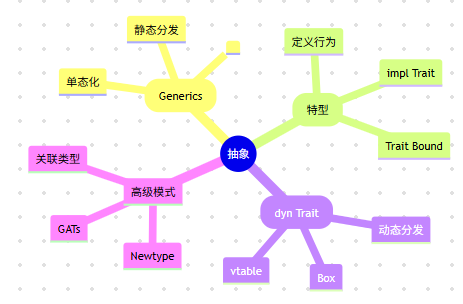
Trait 和泛型是 Rust 实现高性能抽象的关键:
✅ 泛型:通过单态化实现零成本的静态分发。
✅ Trait:定义共享行为,实现代码复用。
✅ Trait 对象:通过 vtable 实现灵活的动态分发。
✅ 高级模式:关联类型、GATs 提供了强大的表达能力。
核心概念总结:
讨论问题:
- 在你的项目中,你更倾向于使用静态分发还是动态分发?
- 关联类型在哪些场景下比 Trait 泛型更有优势?
- 你是否在生产代码中使用过
Box<dyn Error>?
欢迎分享你的经验!💬
参考链接
- Rust Book - Generics:https://doc.rust-lang.org/book/ch10-01-syntax.html
- Rust Book - Traits:https://doc.rust-lang.org/book/ch10-02-traits.html
- Rust Book - Trait Objects:https://doc.rust-lang.org/book/ch17-02-trait-objects.html
- Rustonomicon - Dispatch:https://doc.rust-lang.org/nomicon/dispatch.html

AtomGit 是由开放原子开源基金会联合 CSDN 等生态伙伴共同推出的新一代开源与人工智能协作平台。平台坚持“开放、中立、公益”的理念,把代码托管、模型共享、数据集托管、智能体开发体验和算力服务整合在一起,为开发者提供从开发、训练到部署的一站式体验。
更多推荐

 13
13 0
0- 0


 已为社区贡献10条内容

所有评论(0)