基于时序预测的存储容量自动扩缩容:从阈值告警到智能规划
基于时序预测的存储容量自动扩缩容:从阈值告警到智能规划
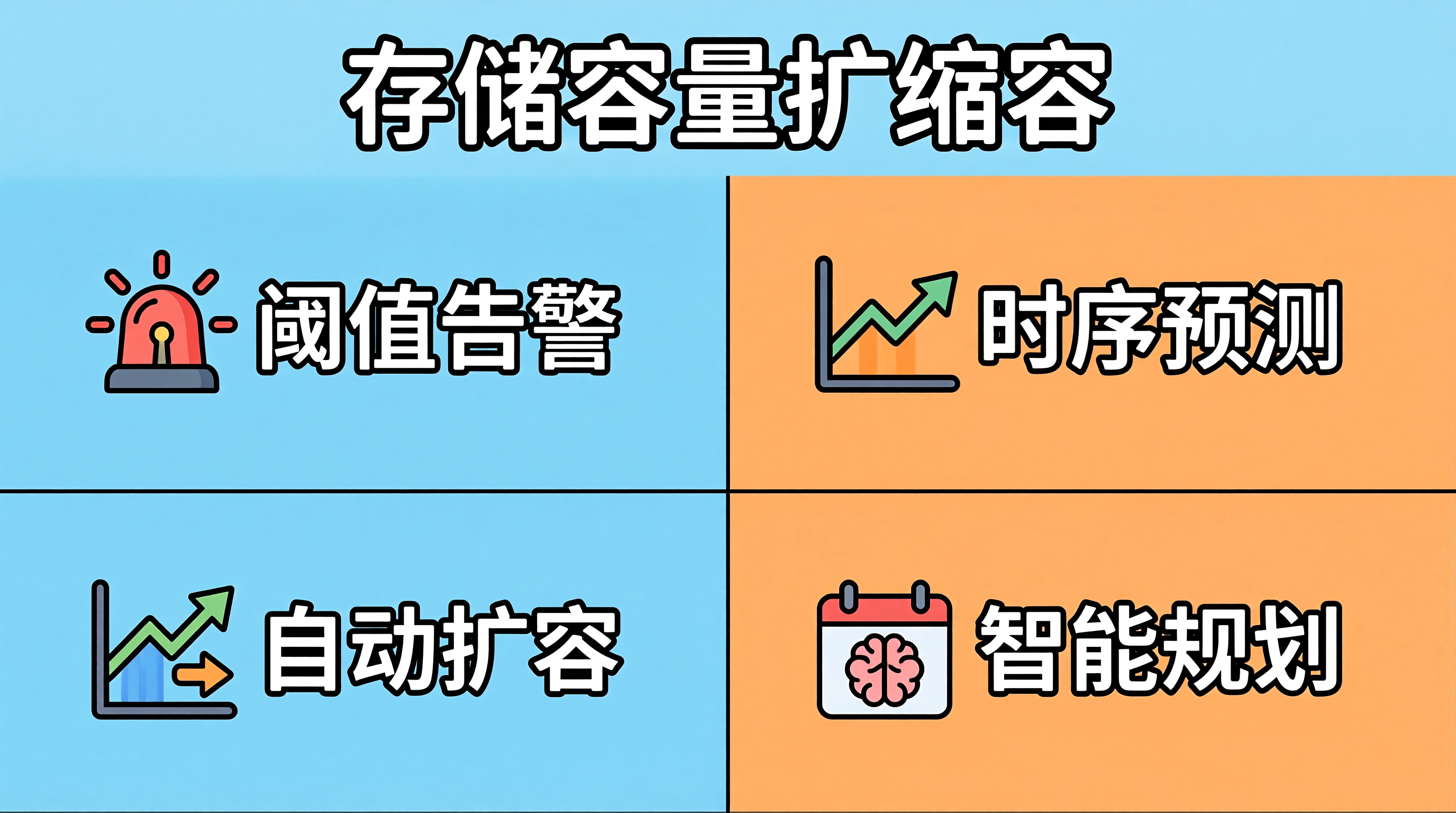
一、容量规划的"被动响应":凌晨三点的扩容告警
存储系统的容量管理,大多数团队采用"阈值告警 + 人工扩容"模式——当磁盘使用率超过 80% 时触发告警,DBA 在收到告警后手动执行扩容操作。这种被动模式的问题在于:告警到扩容之间存在时间差(30分钟到数小时),期间系统可能因磁盘满而拒绝写入,导致数据丢失。更关键的是,容量增长往往不是线性的——一次营销活动可能导致数据量在 2 小时内翻倍,阈值告警根本来不及响应。智能容量规划需要从"被动响应"进化为"主动预测"——基于历史数据预测未来容量需求,在告警触发前完成扩容。
二、时序预测在容量规划中的应用
2.1 从阈值告警到预测性扩容的演进
flowchart TB
    A[存储监控指标] --> B[历史数据采集]
    B --> C[时序预测模型]
    C --> D[未来7天容量预测]
    D --> E{预测使用率 > 80%?}
    E -->|是| F[提前触发扩容]
    E -->|否| G[继续监控]

    subgraph 预测模型选择
        H[线性趋势<br/>稳定增长]
        I[ARIMA<br/>周期性波动]
        J[LSTM<br/>复杂模式]
        K[Prophet<br/>节假日效应]
    end

    B --> H & I & J & K

    subgraph 扩容决策
        L[扩容时机<br/>预测达到阈值前24h]
        M[扩容规模<br/>预留30%缓冲]
        N[扩容方式<br/>在线扩容/新增节点]
    end

    F --> L & M & N
2.2 容量指标采集
from dataclasses import dataclass
from datetime import datetime
from typing import List

@dataclass
class CapacitySample:
    """容量监控采样点"""
    timestamp: datetime
    total_bytes: int
    used_bytes: int
    write_rate_bps: float    # 写入速率(字节/秒)
    read_rate_bps: float     # 读取速率
    iops: int
    node_count: int

class CapacityCollector:
    """从监控系统采集容量指标"""

    def collect_history(self, cluster: str, days: int = 90) -> List[CapacitySample]:
        """采集过去 N 天的容量历史数据"""
        # 从 Prometheus/VictoriaMetrics 查询
        samples = []
        # 模拟数据采集逻辑
        return samples

    def compute_growth_rate(self, samples: List[CapacitySample]) -> dict:
        """计算容量增长趋势"""
        if len(samples) < 2:
            return {'daily_growth_gb': 0, 'growth_trend': 'unknown'}

        first = samples[0]
        last = samples[-1]
        days = (last.timestamp - first.timestamp).days

        if days == 0:
            return {'daily_growth_gb': 0, 'growth_trend': 'stable'}

        daily_growth = (last.used_bytes - first.used_bytes) / days
        daily_growth_gb = daily_growth / (1024 ** 3)

        # 判断增长趋势
        if daily_growth_gb > 10:
            trend = 'rapid_growth'
        elif daily_growth_gb > 1:
            trend = 'steady_growth'
        elif daily_growth_gb > 0:
            trend = 'slow_growth'
        else:
            trend = 'stable_or_shrinking'

        return {
            'daily_growth_gb': round(daily_growth_gb, 2),
            'growth_trend': trend,
            'current_usage_pct': round(last.used_bytes / last.total_bytes * 100, 1),
        }
三、预测模型与自动扩缩容方案
3.1 Prophet 时序预测
from prophet import Prophet
import pandas as pd

class CapacityForecaster:
    """基于 Prophet 的容量预测"""

    def __init__(self):
        self.model = None

    def train(self, samples: List[CapacitySample]):
        """训练预测模型"""
        df = pd.DataFrame([{
            'ds': s.timestamp,
            'y': s.used_bytes / (1024 ** 3),  # 转为 GB
        } for s in samples])

        self.model = Prophet(
            changepoint_prior_scale=0.05,  # 趋势变化灵敏度
            seasonality_prior_scale=10,     # 季节性强度
            yearly_seasonality=True,
            weekly_seasonality=True,
            daily_seasonality=False,        # 容量数据通常不需要日季节性
        )

        # 添加中国节假日效应(营销活动通常在节假日)
        self.model.add_country_holidays(country_name='CN')

        self.model.fit(df)

    def predict(self, days: int = 7) -> pd.DataFrame:
        """预测未来 N 天的容量"""
        future = self.model.make_future_dataframe(periods=days)
        forecast = self.model.predict(future)

        return forecast[['ds', 'yhat', 'yhat_lower', 'yhat_upper']].tail(days)

    def predict_capacity_alert(self, total_gb: float, threshold_pct: float = 80) -> dict:
        """预测何时达到容量阈值"""
        forecast = self.predict(days=30)
        threshold_gb = total_gb * threshold_pct / 100

        for _, row in forecast.iterrows():
            if row['yhat'] >= threshold_gb:
                return {
                    'will_reach_threshold': True,
                    'estimated_date': row['ds'],
                    'predicted_usage_gb': round(row['yhat'], 1),
                    'confidence_lower': round(row['yhat_lower'], 1),
                    'confidence_upper': round(row['yhat_upper'], 1),
                    'days_until_threshold': (row['ds'] - pd.Timestamp.now()).days,
                }

        return {'will_reach_threshold': False, 'forecast_days': 30}
3.2 自动扩缩容决策引擎
class AutoScalingEngine:
    """自动扩缩容决策引擎"""

    def __init__(self, forecaster: CapacityForecaster, cluster_config: dict):
        self.forecaster = forecaster
        self.config = cluster_config

    def evaluate_scaling(self, current_state: dict) -> dict:
        """评估是否需要扩缩容"""
        total_gb = current_state['total_bytes'] / (1024 ** 3)
        used_gb = current_state['used_bytes'] / (1024 ** 3)
        usage_pct = used_gb / total_gb * 100

        # 预测容量告警时间
        alert = self.forecaster.predict_capacity_alert(
            total_gb, threshold_pct=self.config['scale_up_threshold']
        )

        decision = {
            'current_usage_pct': round(usage_pct, 1),
            'action': 'none',
            'reason': '',
        }

        # 扩容条件:预测在 24 小时内达到阈值
        if alert['will_reach_threshold'] and alert['days_until_threshold'] <= 1:
            target_gb = self._calculate_scale_up_target(total_gb, used_gb)
            decision.update({
                'action': 'scale_up',
                'target_capacity_gb': target_gb,
                'reason': f"预计 {alert['days_until_threshold']} 天后达到阈值",
                'additional_nodes': self._calculate_nodes(target_gb, total_gb),
            })

        # 缩容条件:连续 7 天使用率低于 30%
        elif usage_pct < self.config['scale_down_threshold']:
            target_gb = self._calculate_scale_down_target(total_gb, used_gb)
            decision.update({
                'action': 'scale_down',
                'target_capacity_gb': target_gb,
                'reason': f"使用率持续低于 {self.config['scale_down_threshold']}%",
                'remove_nodes': self._calculate_nodes(total_gb - target_gb, total_gb),
            })

        return decision

    def _calculate_scale_up_target(self, total_gb: float, used_gb: float) -> float:
        """计算扩容目标:预留 30% 缓冲"""
        target_usage_pct = 0.5  # 扩容后目标使用率 50%
        return used_gb / target_usage_pct

    def _calculate_scale_down_target(self, total_gb: float, used_gb: float) -> float:
        """计算缩容目标:保留 40% 缓冲"""
        target_usage_pct = 0.6
        return used_gb / target_usage_pct

    def _calculate_nodes(self, delta_gb: float, current_total_gb: float) -> int:
        """根据容量差计算需要增减的节点数"""
        node_capacity_gb = self.config.get('node_capacity_gb', 500)
        return max(1, int(delta_gb / node_capacity_gb))
3.3 扩容执行与验证
class ScalingExecutor:
    """扩缩容执行器"""

    def execute_scale_up(self, decision: dict) -> dict:
        """执行扩容操作"""
        additional_nodes = decision['additional_nodes']

        # 1. 申请新节点
        new_nodes = self._provision_nodes(additional_nodes)

        # 2. 加入集群并等待数据再平衡
        for node in new_nodes:
            self._add_node_to_cluster(node)

        # 3. 等待再平衡完成
        rebalance_status = self._wait_for_rebalance(timeout=3600)

        # 4. 验证扩容效果
        new_capacity = self._get_cluster_capacity()
        expected_gb = decision['target_capacity_gb']

        if new_capacity['total_gb'] >= expected_gb * 0.95:
            return {
                'status': 'success',
                'new_total_gb': new_capacity['total_gb'],
                'new_usage_pct': new_capacity['usage_pct'],
            }
        else:
            return {
                'status': 'partial',
                'new_total_gb': new_capacity['total_gb'],
                'expected_gb': expected_gb,
            }

    def _provision_nodes(self, count: int) -> list:
        """申请新存储节点"""
        # 调用云 API 或物理机管理平台
        return [{'id': f'node-new-{i}'} for i in range(count)]
四、边界分析与架构权衡
4.1 预测模型的准确性
Prophet 假设趋势和季节性可分解,对突发性增长(如营销活动导致数据量 3 倍增长)的预测偏差大。缓解策略:结合业务日历(营销活动计划)作为额外回归变量,或使用 LSTM 捕捉非线性模式。但 LSTM 的训练数据需求量大,冷启动阶段不如 Prophet 稳定。
4.2 扩缩容的数据再平衡代价
存储集群扩容后,数据需要从旧节点迁移到新节点以实现负载均衡。再平衡期间,集群的 I/O 性能下降 20%-40%,可能影响在线查询延迟。建议:在业务低峰期(凌晨 2-5 点)执行再平衡,并限制再平衡的带宽占用。
4.3 缩容的数据安全风险
缩容操作需要从被移除节点迁移走所有数据,如果迁移未完成就下线节点,可能导致数据丢失。缩容前必须验证所有副本的完整性,且缩容速度应远慢于扩容(建议逐节点缩容,每节点间隔 24 小时)。
4.4 成本优化的约束
自动缩容可以节省成本,但频繁的扩缩容(弹性伸缩)在云环境中可能导致数据迁移的 I/O 成本超过节省的计算成本。建议设置最小集群规模,避免缩容到低于该规模。
五、总结
基于时序预测的存储容量自动扩缩容,将容量管理从"被动告警"进化为"主动预测"。Prophet 模型利用历史数据的趋势和季节性特征,预测未来容量需求,在达到阈值前触发扩容。自动决策引擎根据预测结果和当前状态,计算扩缩容的目标容量和节点数。工程实践中需注意预测模型对突发增长的偏差、数据再平衡的性能代价、缩容的数据安全风险,以及弹性伸缩的成本约束。预测性扩容最适合稳定增长的业务场景,对突发性增长仍需结合业务日历和人工判断。

AtomGit 是由开放原子开源基金会联合 CSDN 等生态伙伴共同推出的新一代开源与人工智能协作平台。平台坚持“开放、中立、公益”的理念,把代码托管、模型共享、数据集托管、智能体开发体验和算力服务整合在一起,为开发者提供从开发、训练到部署的一站式体验。
更多推荐



 16
16 0
0- 0


 已为社区贡献104条内容

所有评论(0)