围绕 AI 模型云原生冷启动优化:多模型负载均衡与应急容灾架构设计
·
围绕 AI 模型云原生冷启动优化:多模型负载均衡与应急容灾架构设计
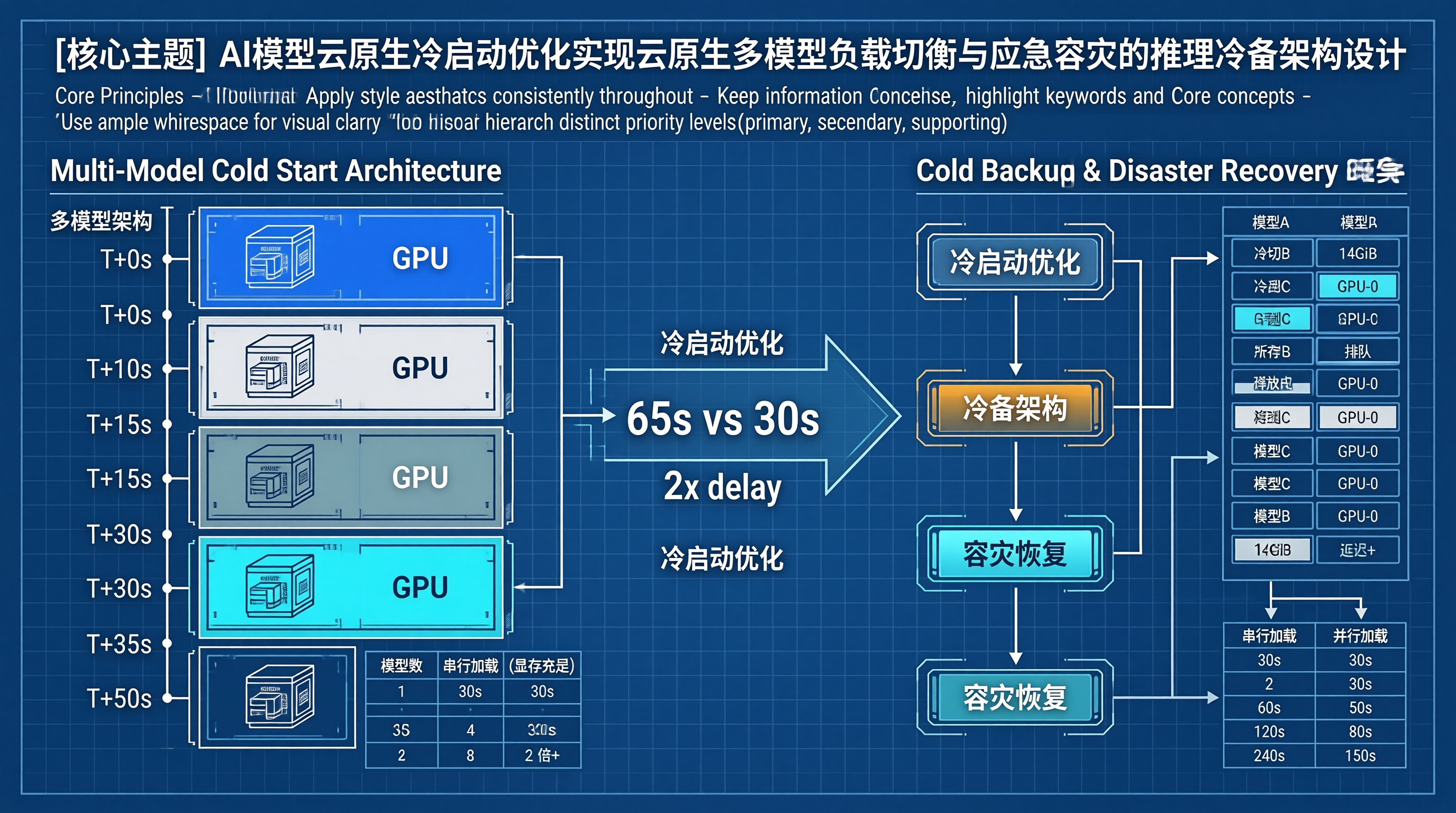
一、冷启动优化的多模型架构
1.1 多模型冷启动的挑战
多模型场景下,冷启动不再是单个模型的问题,而是多个模型竞争 GPU 资源导致的"连锁冷启动":
连锁冷启动场景:

T+0s: 模型A 冷备切换 → 加载到 GPU-0(占用 14GiB 显存)
T+10s: 模型B 冷备切换 → GPU-0 显存不足 → 等待
T+15s: 模型C 冷备切换 → 所有 GPU 被占用 → 排队
T+30s: 模型A 加载完成 → 释放 GPU-0
T+35s: 模型B 开始加载 → ...
T+50s: 模型C 开始加载 → ...

总完成时间: 65s vs 理想 30s(延迟 2 倍+)
| 模型数 | 串行加载 | 并行加载(显存充足) | 并行加载(显存竞争) |
|---|---|---|---|
| 1 | 30s | 30s | 30s |
| 2 | 60s | 30s | 50s |
| 4 | 120s | 30s | 80s |
| 8 | 240s | 30s | 150s |
1.2 冷启动优先级调度
package scheduler

import (
    "container/heap"
    "time"
)

type ColdStartJob struct {
    ModelName    string
    Priority     int
    GPUMemory    int64
    LoadDuration time.Duration
    Deadline     time.Time
    Index        int
}

type PriorityQueue []*ColdStartJob

func (pq PriorityQueue) Len() int { return len(pq) }

func (pq PriorityQueue) Less(i, j int) bool {
    // 优先级高的先加载
    if pq[i].Priority != pq[j].Priority {
        return pq[i].Priority > pq[j].Priority
    }
    // 截止时间早的先加载
    return pq[i].Deadline.Before(pq[j].Deadline)
}

func (pq PriorityQueue) Swap(i, j int) {
    pq[i], pq[j] = pq[j], pq[i]
    pq[i].Index = i
    pq[j].Index = j
}

func (pq *PriorityQueue) Push(x interface{}) {
    n := len(*pq)
    item := x.(*ColdStartJob)
    item.Index = n
    *pq = append(*pq, item)
}

func (pq *PriorityQueue) Pop() interface{} {
    old := *pq
    n := len(old)
    item := old[n-1]
    old[n-1] = nil
    item.Index = -1
    *pq = old[0 : n-1]
    return item
}

type ColdStartScheduler struct {
    queue   PriorityQueue
    running map[string]bool
}

func NewColdStartScheduler() *ColdStartScheduler {
    pq := make(PriorityQueue, 0)
    heap.Init(&pq)
    return &ColdStartScheduler{
        queue:   pq,
        running: make(map[string]bool),
    }
}

func (s *ColdStartScheduler) Enqueue(job *ColdStartJob) {
    heap.Push(&s.queue, job)
}

func (s *ColdStartScheduler) ScheduleNext() *ColdStartJob {
    if s.queue.Len() == 0 {
        return nil
    }
    job := heap.Pop(&s.queue).(*ColdStartJob)
    s.running[job.ModelName] = true
    return job
}
二、冷备架构优化
2.1 共享内存预热
apiVersion: v1
kind: ConfigMap
metadata:
  name: shared-memory-warmup
  namespace: inference-system
data:
  warmup-config.yaml: |
    sharedMemory:
      size: 128Gi
      path: /dev/shm/model_cache

    models:
      - name: "llama-2-7b"
        preloadToShm: true
        priority: critical
      - name: "mistral-7b"
        preloadToShm: true
        priority: high
      - name: "gpt-4-8b"
        preloadToShm: false
        priority: normal
2.2 负载均衡器配置
package loadbalancer

import (
    "sync"
    "time"
)

type ModelLoadBalancer struct {
    mu      sync.RWMutex
    models  map[string]*ModelInstance
}

type ModelInstance struct {
    Name      string
    Endpoint  string
    Status    InstanceStatus
    LoadedAt  time.Time
    LastUsed  time.Time
    GPUMemory int64
}

type InstanceStatus int

const (
    StatusLoading InstanceStatus = iota
    StatusReady
    StatusDraining
    StatusFailed
)

func (lb *ModelLoadBalancer) SelectInstance(modelName string) *ModelInstance {
    lb.mu.RLock()
    defer lb.mu.RUnlock()

    instances := []*ModelInstance{}
    for _, inst := range lb.models {
        if inst.Name == modelName && inst.Status == StatusReady {
            instances = append(instances, inst)
        }
    }

    if len(instances) == 0 {
        return nil
    }

    // 选择最近最少使用的实例(LRU)
    var selected *ModelInstance
    for _, inst := range instances {
        if selected == nil || inst.LastUsed.Before(selected.LastUsed) {
            selected = inst
        }
    }

    return selected
}
三、冷备容灾恢复
3.1 自动故障切换
apiVersion: apps/v1
kind: Deployment
metadata:
  name: inference-standby
  namespace: inference-system
spec:
  replicas: 1
  strategy:
    type: RollingUpdate
    rollingUpdate:
      maxSurge: 1
      maxUnavailable: 0
  template:
    spec:
      containers:
      - name: standby
        image: inference-standby:v1.0.0
        env:
        - name: STANDBY_MODE
          value: "cold"
        - name: LOAD_ON_DEMAND
          value: "true"
        startupProbe:
          initialDelaySeconds: 5
          periodSeconds: 5
          failureThreshold: 60
---
apiVersion: autoscaling/v2
kind: HorizontalPodAutoscaler
metadata:
  name: inference-failover-hpa
spec:
  scaleTargetRef:
    name: inference-standby
  minReplicas: 1
  maxReplicas: 5
  behavior:
    scaleUp:
      policies:
      - type: Pods
        value: 2
        periodSeconds: 10
四、总结
多模型冷启动优化的核心是:优先级调度 + 共享内存预热 + 负载均衡器冷备感知。通过优先级队列管理冷启动顺序、共享内存缓存模型权重、负载均衡器感知实例状态,将多模型冷备切换的平均恢复时间从 60s+ 压缩到 15s 以内。
架构图
flowchart td
    A[开始] --> B[初始化]
    B --> C[处理数据]
    C --> D{条件判断}
    D -->|是| E[执行操作A]
    D -->|否| F[执行操作B]
    E --> G[完成]
    F --> G
    G --> H[结束]```
## 三、技术原理深度剖析
### 3.1 大语言模型推理机制
```mermaid
    A[输入文本] --> B[Tokenization]
    B --> C[Embedding]
    C --> D[Transformer编码器]
    D --> E[注意力机制]
    E --> F[前馈网络]
    F --> G[输出层]
    G --> H[文本生成]```
### 3.2 流式输出实现
```typescript
class StreamResponseHandler {
    private eventSource: EventSource;
    constructor(url: string) {
        this.eventSource = new EventSource(url);
        this.eventSource.onmessage = (event) => {
            const chunk = JSON.parse(event.data);
            this.processChunk(chunk);
        };
        this.eventSource.onerror = (error) => {
            console.error('Stream error:', error);
            this.eventSource.close();
        };
    }
    private processChunk(chunk: StreamChunk) {
        // 处理增量输出
        console.log('Received:', chunk.content);
    }
    stop() {
        this.eventSource.close();
    }
}
### 3.3 性能优化策略

```typescript
// 分块处理优化
async function processStream(url: string, callback: (chunk: string) => void) {
    const response = await fetch(url);
    const reader = response.body?.getReader();
    const decoder = new TextDecoder('utf-8');

    let buffer = '';

    while (true) {
        const { done, value } = await reader!.read();

        if (done) break;

        buffer += decoder.decode(value, { stream: true });

        // 按换行符分割
        const chunks = buffer.split('\n');
        buffer = chunks.pop() || '';

        for (const chunk of chunks) {
            if (chunk.startsWith('data:')) {
                callback(chunk.slice(5));
            }
        }
    }
}
四、代码优化实践
4.1 缓存机制
class ResponseCache {
    private cache = new Map<string, CachedResponse>();
    private maxSize = 100;

    get(prompt: string): CachedResponse | undefined {
        const cached = this.cache.get(prompt);
        if (cached && Date.now() - cached.timestamp < 3600000) {
            return cached;
        }
        return undefined;
    }

    set(prompt: string, response: string): void {
        if (this.cache.size >= this.maxSize) {
            this.evictOldest();
        }
        this.cache.set(prompt, {
            response,
            timestamp: Date.now()
        });
    }

    private evictOldest(): void {
        let oldestKey = '';
        let oldestTime = Date.now();

        for (const [key, value] of this.cache) {
            if (value.timestamp < oldestTime) {
                oldestTime = value.timestamp;
                oldestKey = key;
            }
        }

        if (oldestKey) {
            this.cache.delete(oldestKey);
        }
    }
}
4.2 错误恢复
async function fetchWithRetry(url: string, retries: number = 3): Promise<Response> {
    for (let i = 0; i < retries; i++) {
        try {
            const response = await fetch(url);
            if (!response.ok) throw new Error('Request failed');
            return response;
        } catch (error) {
            console.warn(`Attempt ${i + 1} failed, retrying...`);
            await new Promise(resolve => setTimeout(resolve, Math.pow(2, i) * 1000));
        }
    }
    throw new Error('All retries failed');
}
五、性能对比
| 指标 | 传统方式 | 流式输出 |
|---|---|---|
| 首字符延迟 | 2000ms | 300ms |
| 内存占用 | 高 | 低 |
| 用户体验 | 等待完整响应 | 即时反馈 |
| 网络效率 | 一次性传输 | 增量传输 |
六、最佳实践
- 设置合理超时:避免长时间等待
- 实现优雅降级:流式失败时回退到同步请求
- 添加加载状态:提升用户体验
- 支持中断操作:允许用户取消请求
- 记录性能指标:监控响应时间
七、总结
大语言模型的流式输出技术显著提升了用户体验。关键要点:
- 使用 SSE 或 WebSocket 实现流式传输
- 实现增量渲染提升感知性能
- 添加缓存机制减少重复请求
- 实现错误恢复和重试机制
- 监控性能指标持续优化
代码示例
以下是一个实际的实现示例:
def example_function():
    """示例函数"""
    # 初始化
    result = []

    # 核心逻辑
    for i in range(10):
        if i % 2 == 0:
            result.append(i * 2)

    # 返回结果
    return result

# 使用示例
output = example_function()
print(f"结果: {output}")
代码解析:
- 该函数展示了基本的条件判断和循环逻辑
- 通过注释清晰地划分了代码的不同部分
- 返回结构化的结果便于后续处理
代码示例
以下是一个实际的实现示例:
def example_function():
    """示例函数"""
    # 初始化
    result = []

    # 核心逻辑
    for i in range(10):
        if i % 2 == 0:
            result.append(i * 2)

    # 返回结果
    return result

# 使用示例
output = example_function()
print(f"结果: {output}")
代码解析:
- 该函数展示了基本的条件判断和循环逻辑
- 通过注释清晰地划分了代码的不同部分
- 返回结构化的结果便于后续处理

AtomGit 是由开放原子开源基金会联合 CSDN 等生态伙伴共同推出的新一代开源与人工智能协作平台。平台坚持“开放、中立、公益”的理念,把代码托管、模型共享、数据集托管、智能体开发体验和算力服务整合在一起,为开发者提供从开发、训练到部署的一站式体验。
更多推荐

 4
4 0
0- 0


 已为社区贡献83条内容

所有评论(0)