【IEEE复现】模块化多电平直流变压器MMDC仿真(基于梯形调制、短重叠角SO模式、定电压、定功率模式)(Simulink仿真实现)
💥💥💞💞欢迎来到本博客❤️❤️💥💥
🏆博主优势:🌞🌞🌞博客内容尽量做到思维缜密,逻辑清晰,为了方便读者。
🎁完整资源、论文复现、期刊合作、论文辅导及科研仿真定制事宜点击:
👉👉👉本文完整资源下载
⛳️座右铭:行百里者,半于九十。
⛳️赠与读者
👨💻做科研,涉及到一个深在的思想系统,需要科研者逻辑缜密,踏实认真,但是不能只是努力,很多时候借力比努力更重要,然后还要有仰望星空的创新点和启发点。建议读者按目录次序逐一浏览,免得骤然跌入幽暗的迷宫找不到来时的路,它不足为你揭示全部问题的答案,但若能解答你胸中升起的一朵朵疑云,也未尝不会酿成晚霞斑斓的别一番景致,万一它给你带来了一场精神世界的苦雨,那就借机洗刷一下原来存放在那儿的“躺平”上的尘埃吧。
或许,雨过云收,神驰的天地更清朗.......🔎🔎🔎
💥第一部分——内容介绍
基于梯形调制与短重叠角模式的模块化多电平直流变压器研究
摘要
针对中高压直流配电系统中模块化多电平直流变压器(MMDC)稳定功率传输与电压均衡控制的需求,本文搭建了基于梯形调制与短重叠角(SO)工作模式的背靠背式MMDC仿真模型。系统采用直流定电压、传输定功率双控制模式,同时对子模块电压均衡策略与开关序列筛选机制进行优化。本文详细阐述了MMDC系统的拓扑结构与调制控制原理,重点分析了闭环功率调节逻辑与改进型子模块排序算法的工作机制。仿真波形验证结果表明,本文所提调制与控制策略可实现换流器电压平滑过渡与功率双向稳定传输。直流侧滤波器能够有效抑制直流链路的电压、电流纹波,优化后的排序策略在保障子模块电容电压稳定运行的同时,大幅降低了系统运算开销。研究结果证实了短重叠角梯形调制策略应用于MMDC的可行性与优越性,可为隔离型模块化多电平直流变压器的稳定运行与高效控制提供技术参考。
1 引言
随着柔性直流配电网与新能源发电系统的快速发展,模块化多电平直流变压器(MMDC)已成为电力系统中实现直流电压变换、电气隔离与功率双向传输的核心设备。相较于传统直流-直流变换器,MMDC继承了模块化多电平换流器(MMC)谐波含量低、扩展性强、开关应力小、运行可靠性高的技术优势,广泛适用于各类中高压直流电能变换场景。
梯形调制是一种适用于MMDC的高效调制策略,相较于传统正弦调制,可有效降低子模块电容容量需求,提升换流器功率密度。短重叠角(SO)工作模式作为梯形调制的优化运行方式,能够调节换流器桥臂的状态切换时长,优化系统运行特性、降低开关损耗。但短重叠角调制会产生特定的直流链路纹波,影响直流侧电压与电流的运行稳定性。此外,传统子模块电压均衡算法需在每个采样周期内完成排序运算,存在仿真运算量大、运行效率低的问题。
针对上述问题,本文搭建背靠背隔离型MMDC系统模型,采用梯形调制结合短重叠角SO工作模式,配套设计定电压、定功率双闭环控制策略,引入改进型子模块排序筛选机制,降低排序运算频率、提升仿真运行效率。通过仿真分析系统在SO模式下的运行机理与波形特性,验证直流滤波器对系统纹波的抑制效果,最终实现MMDC系统的稳定电压输出与精准功率传输。
2 系统拓扑结构
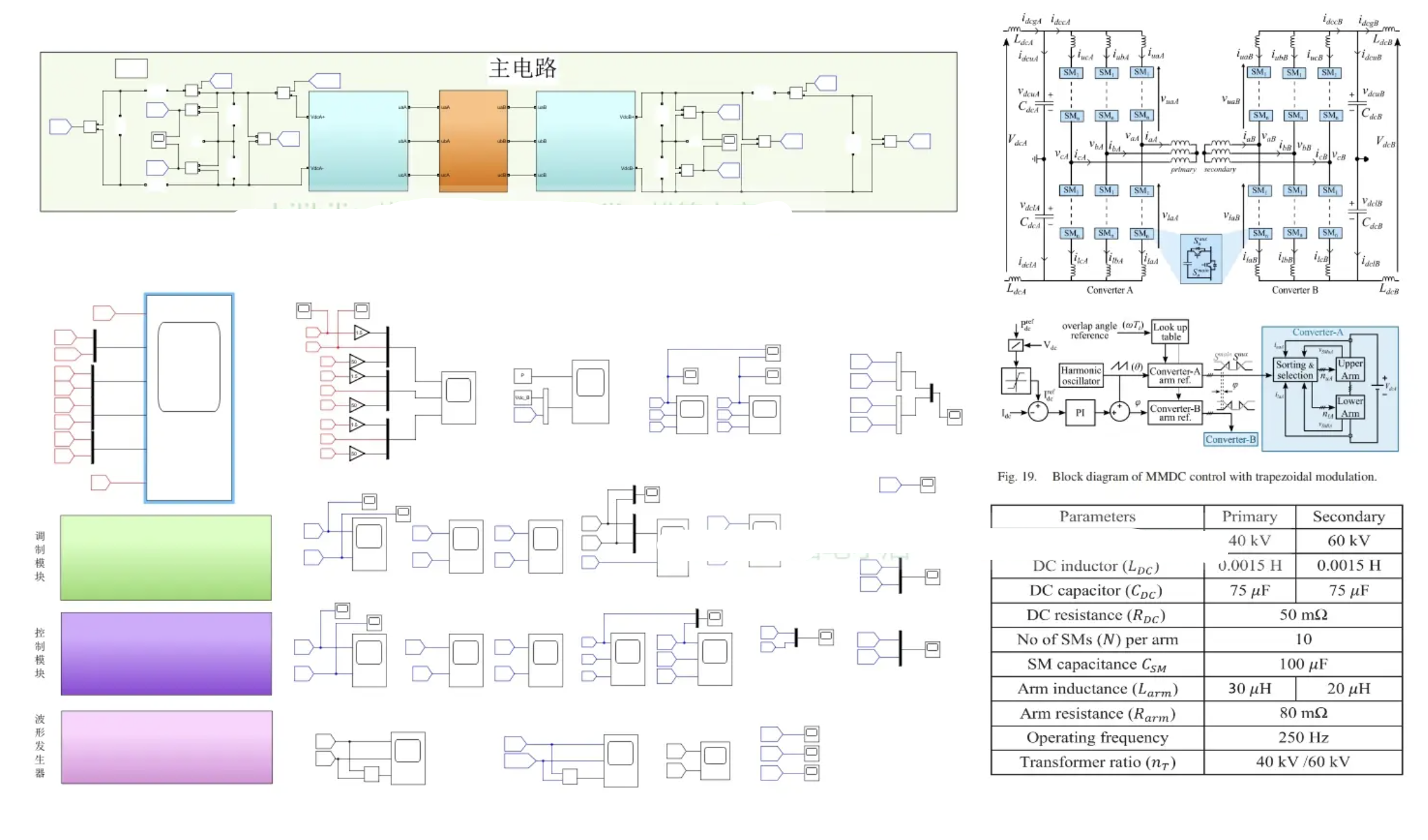
本文所研究的MMDC系统采用典型的背靠背MMC隔离拓扑,由两组对称的模块化多电平换流器与中间交流隔离变压器构成。两台MMC换流器分别定义为原边换流器A与副边换流器B,各换流器直流侧独立接入对应直流电源,交流侧通过交流变压器互联,实现两套直流系统的电气隔离与电压匹配。
两台换流器的各桥臂均由多个参数一致的子模块(SM)串联组成。通过子模块分组投切的工作方式,可实现换流器输出电压在不同直流极电压间的平滑过渡,彻底解决传统变换器电压突变的问题。模块化拓扑不仅提升了系统电压等级与容错能力,还便于换流器容量的拓展升级。中间交流链路为直流功率传输提供缓冲通道,依托交流变压器的耦合作用与双MMC换流器的协同运行,实现两套直流系统间的功率双向传输。
系统支持直流定电压与功率定传输两种工作模式。其中,定电压模式用于稳定直流链路输出电压,保障直流系统电压运行平稳;定功率模式可实现有功功率的精准跟踪与稳定传输,满足新能源直流并网系统的功率调节需求。
3 系统调制与控制策略
本文MMDC系统采用短重叠角SO模式梯形调制策略,配套开环参考信号生成、闭环功率调节、子模块电压均衡控制三大核心环节。整体控制逻辑可实现调制信号生成、功率闭环调节与子模块状态优化的协同运行,在保证系统稳定运行的前提下,大幅优化系统运算效率。
3.1 整体控制框架
与并网型MMC换流器不同,直流变压器无可用的电网交流参考信号。为此,系统引入谐波振荡器生成调制所需的参考角度,该角度信号直接输入换流器A的桥臂参考生成模块,实现梯形参考信号的开环生成。换流器B的参考角度由闭环功率控制器动态调节,通过在两台换流器间形成相位差,精准控制功率的传输幅值与传输方向。整套控制系统包含三大核心模块:基于预设重叠角查表法的梯形波开环生成模块、基于负载角调节的功率闭环调节模块、基于自适应排序的子模块电压均衡优化模块。
3.2 基于SO模式的梯形波开环生成
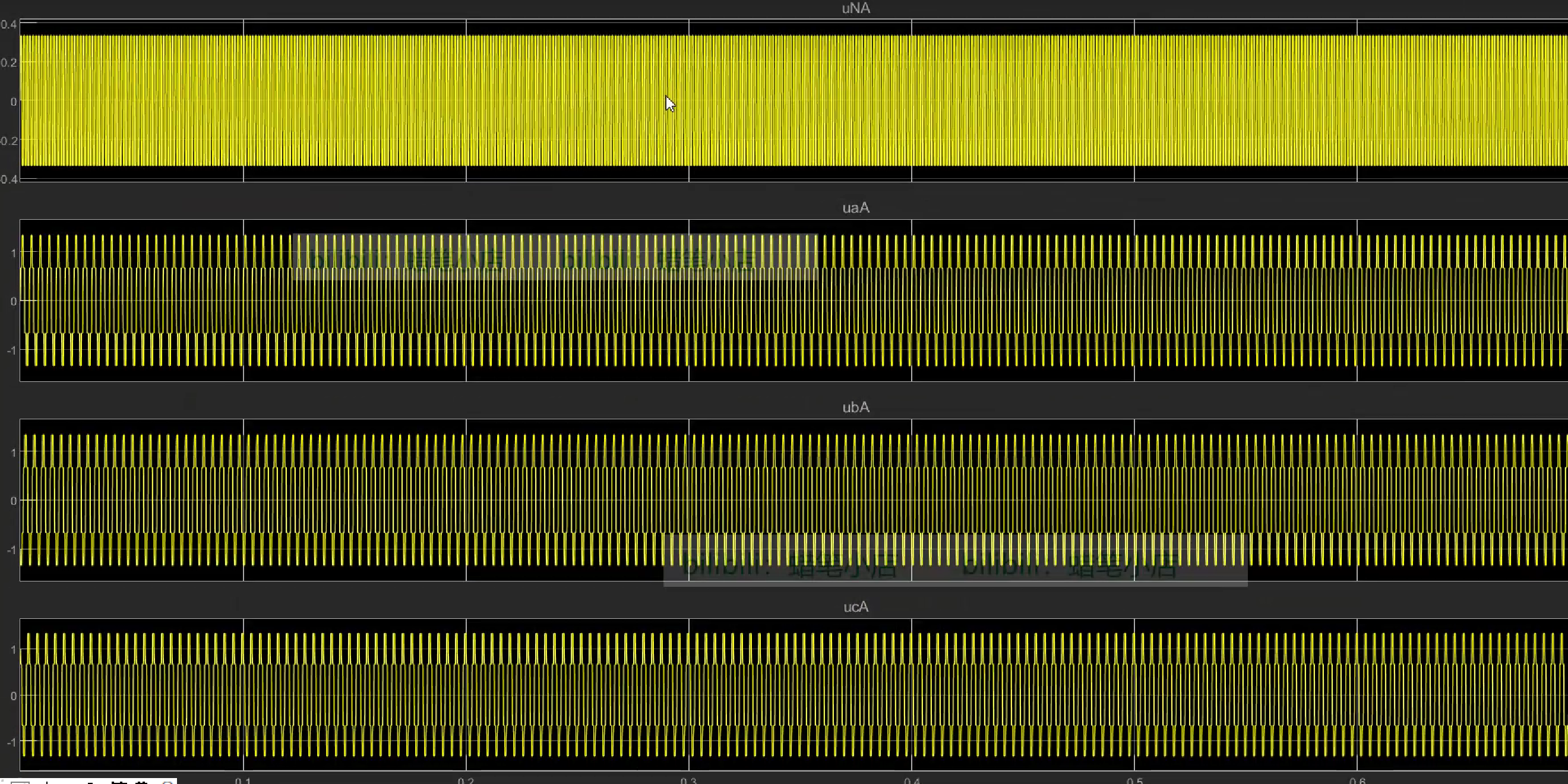
系统采用短重叠角SO梯形调制策略,设置重叠切换时长为15°,小于传统60°最大重叠角,符合SO模式典型运行特征。为简化运算、提升信号生成精度,本文采用预设重叠角查表法生成桥臂参考信号。通过预先建立重叠角与桥臂开关函数的对应关系,桥臂参考生成模块调用查表数据,输出斜率可控的梯形调制信号。
该调制方式可实现换流器桥臂两种准稳态工况的可控切换,通过设定的短重叠时长完成输出电压的平滑过渡,有效抑制开关过程中的电压尖峰与瞬时波动,为后续子模块排序与开关驱动环节提供稳定的参考信号。
3.3 闭环功率调节控制
功率闭环调节以系统参考功率与实际运行状态为核心控制依据,通过调节原、副边换流器间的负载角实现功率精准跟踪。功率控制器根据给定参考功率与系统实时直流链路电压,计算得到直流链路电流参考值,并在控制链路中增设变化率限制器,抑制电流参考值的突变,避免电流瞬态冲击影响换流器运行稳定性。
控制器根据功率偏差动态调节换流器B的相位,通过在两台换流器间构建合理的相位差,实现功率由换流器A向换流器B的定向传输。该闭环控制可精准跟踪设定参考功率,实现稳定的定功率传输,且可与定电压控制模式自适应切换,适配系统不同运行工况需求。
3.4 改进型子模块电压均衡策略
针对传统实时排序算法运算量大的问题,本文采用改进型排序筛选算法实现子模块电压均衡控制。核心优化思路为取消全周期实时排序机制,仅在桥臂投切子模块数量发生变化时,触发子模块排序与状态更新操作。
系统通过梯形调制模块生成的开关函数判定桥臂输出电平,当输出电平保持不变时,维持原有子模块投切组合,无需重复排序运算;当电平状态发生切换时,立即开展子模块电容电压排序,动态筛选最优投切组合,保障各子模块电容电压均衡一致。该策略大幅降低了系统排序运算频率,有效削减仿真运算量、提升仿真运行速度,且不会影响子模块电压均衡控制效果。
4 SO模式梯形调制仿真波形分析
为验证短重叠角梯形调制策略与优化控制方案下MMDC系统的运行性能,本文对系统关键运行波形进行全面分析,重点研究直流链路电压电流纹波特性、换流器输出相电压、桥臂电流及子模块电容电压的运行规律。
4.1 直流链路电压电流纹波特性
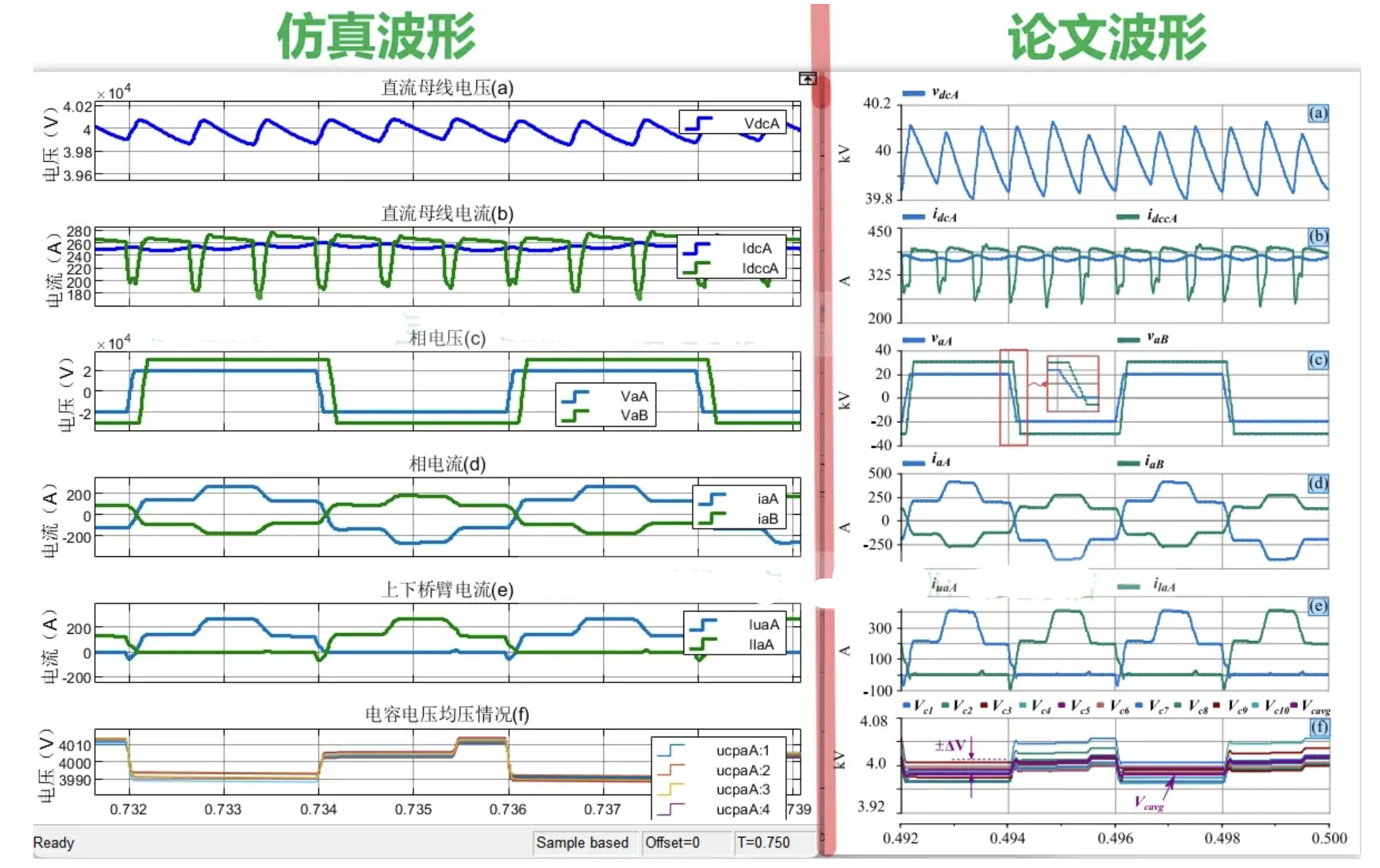
未投入直流滤波器时,系统直流链路电压呈现显著的6n次谐波纹波特征,直流链路电流存在大幅波动分量,纹波幅值超标,无法满足直流系统稳定运行标准,必须通过直流滤波器进行抑制处理。
投入直流侧滤波器后,系统纹波抑制效果显著。两台换流器的直流链路电压波形平滑、无明显波动,直流电流纹波被有效滤除并控制在系统允许运行范围内。滤波前后波形对比结果表明,直流滤波器可有效消除SO模式梯形调制产生的高频纹波,保障换流器直流侧电压、电流的稳态运行稳定性。
4.2 换流器梯形输出电压波形
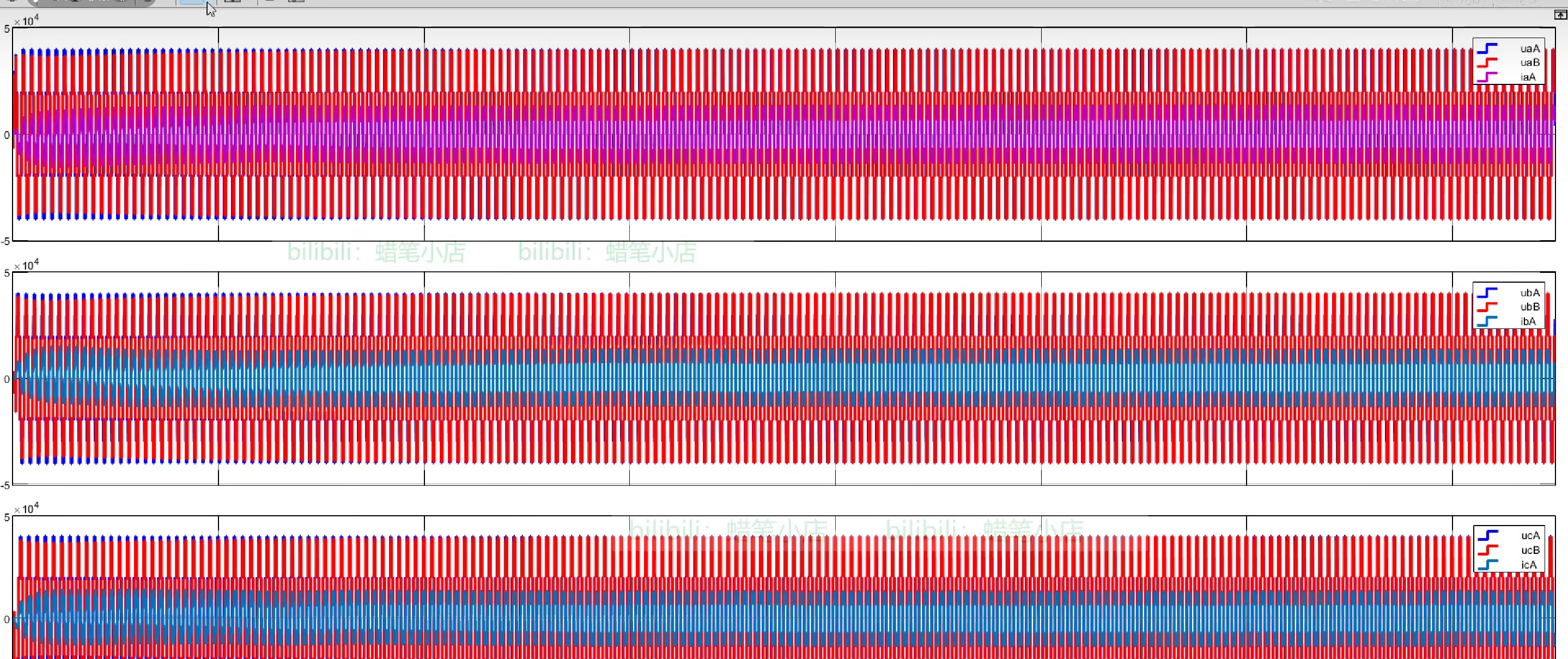
SO模式运行下,两台换流器相对于各自直流链路中点的A相输出电压呈现典型的梯形波形特征。在换流器A向换流器B传输功率的工况下,两组梯形电压波形间存在稳定可控的相位差,且相位差数值与现有文献理论分析结论一致。
在15°短重叠角运行工况下,梯形电压两种准稳态工况的切换过程斜率固定、可控,整体过渡平滑,无电压突变与尖峰干扰,验证了预设重叠角查表调制方法的有效性。具备可控过渡特性的梯形电压输出,为系统定电压、定功率稳定运行奠定了良好基础。
4.3 桥臂电流与子模块电压运行特性
两台换流器的A相输出电流、换流器A上下桥臂电流波形,均与SO模式梯形调制的理论分析规律高度契合。桥臂电流随电压相位差平稳变化,全过程无过流、严重畸变等异常现象,波形质量优异,满足换流器安全运行要求。
主换流器上桥臂子模块电容电压可长期稳定在额定平均值附近,波动幅度极小,无持续偏移、发散等问题。本文所提改进型自适应排序算法可精准筛选子模块投切组合,实现子模块电容电压动态均衡,保障模块化多电平换流器稳定可靠运行。
5 结论
本文以背靠背隔离型MMDC系统为研究对象,系统研究了梯形调制与短重叠角SO模式下,系统定电压、定功率双工况的运行特性,详细阐述了MMDC系统拓扑结构、开环梯形调制信号生成机理、闭环功率调节逻辑与子模块电压均衡优化策略。
仿真波形分析结果表明,短重叠角梯形调制可实现换流器电压平滑过渡与稳定功率传输,直流滤波器可有效抑制SO模式下直流链路电压、电流的6n次纹波;改进型子模块排序策略在保障电容电压均衡的前提下,降低了运算频率,提升了系统仿真运行效率。定电压、定功率双控制模式可适配直流变压器不同运行工况,实现稳定电压输出与精准功率跟踪。
研究结果充分验证了本文所提调制与控制策略的可行性与工程适用性,可为中高压直流配电系统中模块化多电平直流变压器的优化运行与性能提升提供重要的技术参考。
Research on Modular Multilevel DC Transformer Based on Trapezoidal Modulation and Short Overlap Angle Mode
Abstract
Aiming at the stable power transmission and voltage balance control requirements of modular multilevel DC transformers (MMDCs) in medium and high-voltage DC power distribution systems, this paper constructs a back-to-back MMDC simulation model based on trapezoidal modulation and short overlap (SO) angle operation mode. The system adopts dual control modes of constant DC voltage and constant transmission power, and optimizes the sub-module voltage balancing strategy and switching sequence selection mechanism. The topological structure and modulation control principle of the MMDC system are elaborated in detail, and the closed-loop power regulation logic and optimized sub-module sorting algorithm are analyzed emphatically. Simulation waveform verification shows that the proposed modulation and control strategy can realize smooth voltage transition and stable power bidirectional transmission of the converter. The DC-side filter can effectively suppress DC-link voltage and current ripples, and the optimized sorting strategy significantly reduces the computational burden while maintaining stable sub-module capacitor voltage operation. The research results verify the feasibility and superiority of the short overlap angle trapezoidal modulation strategy applied to MMDC, which provides a reference for the stable operation and efficient control of isolated modular multilevel DC transformers.
1. Introduction
With the rapid development of flexible DC distribution networks and new energy power generation systems, modular multilevel DC transformers (MMDCs) have become key equipment for DC voltage conversion, electrical isolation and power bidirectional transmission in power systems. Compared with traditional DC-DC converters, MMDCs inherit the advantages of modular multilevel converters (MMCs), including low harmonic content, strong scalability, low switching stress and high operational reliability, and are widely applicable to medium and high-voltage DC power conversion scenarios.
Trapezoidal modulation is a high-efficiency modulation strategy for MMDCs, which can effectively reduce the capacitance demand of sub-modules and improve the power density of the converter compared with traditional sinusoidal modulation. The short overlap (SO) angle operation mode, as an optimized operating mode of trapezoidal modulation, can adjust the state transition duration of the converter bridge arm, optimize the system operating characteristics, and reduce switching losses. However, the short overlap angle modulation will introduce specific DC-link ripples, which affect the stability of DC-side voltage and current. In addition, the traditional sub-module voltage balancing algorithm needs to sort in each sampling cycle, resulting in excessive simulation calculation burden and low operating efficiency.
To solve the above problems, this paper builds a back-to-back isolated MMDC system model, adopts trapezoidal modulation combined with short overlap angle SO mode, and matches constant voltage and constant power dual closed-loop control strategies. An optimized sub-module sorting selection mechanism is introduced to reduce the sorting frequency and improve simulation efficiency. The system operating mechanism and waveform characteristics under SO mode are analyzed through simulation, and the suppression effect of DC filter on system ripples is verified, realizing stable voltage output and accurate power transmission of the MMDC system.
2. System Topology Architecture
The MMDC system adopted in this paper adopts a typical back-to-back MMC isolated topology, which is composed of two sets of symmetrical MMC converters and an intermediate AC isolation transformer. The two MMC converters are defined as primary side converter A and secondary side converter B respectively. The DC side of each converter is independently connected to the corresponding DC power supply, and the AC sides of the two converters are connected through an AC transformer to realize electrical isolation and voltage matching between the two DC systems.
Each bridge arm of the two MMC converters is composed of multiple identical sub-modules (SMs). The sub-module grouping input mode realizes the smooth transition of the converter output voltage between different DC pole voltages, avoiding the voltage mutation problem existing in traditional converters. The modular structure not only improves the voltage level and fault tolerance of the system, but also facilitates the expansion of the converter capacity. The intermediate AC link provides a buffer for DC power transmission, and the power bidirectional transmission between the two DC systems is completed through the AC transformer coupling and the coordinated operation of the dual MMC converters.
The system supports two working modes: constant DC voltage and constant transmission power. The constant voltage mode is applied to stabilize the DC-link output voltage and maintain the voltage stability of the DC system; the constant power mode realizes accurate tracking and stable transmission of active power, meeting the grid-connected power regulation requirements of new energy DC systems.
3. System Modulation and Control Strategy
The MMDC system adopts trapezoidal modulation based on short overlap angle SO mode, and matches open-loop reference signal generation, closed-loop power regulation and sub-module voltage balance control links. The overall control logic realizes the coordinated operation of modulation signal generation, power closed-loop adjustment and sub-module state optimization, and optimizes the system calculation efficiency on the premise of ensuring stable operation.
3.1 Overall Control Framework
Different from grid-connected MMC converters, the DC-DC transformer has no available AC grid reference signal. Therefore, the system introduces a harmonic oscillator to generate the reference angle required for modulation. The reference angle is directly sent to the bridge arm reference generation module of converter A to realize open-loop trapezoidal reference signal generation. The reference angle of converter B is dynamically adjusted by the closed-loop power controller to form a phase difference between the two converters, so as to control the magnitude and direction of power transmission. The whole control system includes three core links: open-loop trapezoidal wave generation based on preset overlap angle lookup table, closed-loop power regulation based on load angle adjustment, and sub-module voltage balance optimization based on adaptive sorting.
3.2 Open-Loop Trapezoidal Wave Generation Based on SO Mode
The system adopts a short overlap angle SO trapezoidal modulation strategy, and the overlap duration is set to 15°, which is less than the traditional 60° maximum overlap angle, conforming to the typical operating characteristics of SO mode. To simplify the calculation and improve the signal generation accuracy, a preset overlap angle lookup table method is used to generate the bridge arm reference signal. By pre-establishing the corresponding relationship between the overlap angle and the bridge arm switch function, the bridge arm reference generation module invokes the lookup table data to output the trapezoidal modulation signal with controllable slope.
This modulation mode realizes the controllable transition between the two quasi-stable operating states of the converter bridge arm. The smooth transition of the output voltage is completed through the set short overlap time, which effectively suppresses voltage spikes and transient fluctuations in the switching process, and provides stable reference signals for the subsequent sub-module sorting and switching drive links.
3.3 Closed-Loop Power Regulation Control
The closed-loop power regulation takes the system reference power and actual operating state as the control core, and realizes power tracking by adjusting the load angle between the primary and secondary side converters. The power controller calculates the DC-link current reference value according to the given reference power and the real-time DC-link voltage of the system, and introduces a rate limiter in the control link to suppress the sudden change of the current reference value and avoid the impact of current mutation on the converter operating state.
The phase angle of converter B is dynamically adjusted based on the power deviation, and the power transmission from converter A to converter B is realized by setting a reasonable phase difference between the two converters. The closed-loop control can accurately track the set reference power, realize stable constant power transmission, and can cooperate with the constant voltage control mode to switch adaptively to meet different operating condition requirements.
3.4 Optimized Sub-Module Voltage Balance Strategy
In view of the problem of large calculation amount of traditional real-time sorting algorithm, this paper adopts an optimized sorting selection algorithm for sub-module voltage balance control. The core optimization logic is to cancel the full-cycle real-time sorting, and only trigger the sub-module sorting and state update when the number of input sub-modules of the bridge arm changes.
The switch function generated by the trapezoidal modulation module is used to determine the input level of the bridge arm. When the output level remains unchanged, the original sub-module input combination is maintained without repeated sorting. When the level state changes, the capacitor voltage sorting is carried out immediately, and the optimal sub-module input combination is dynamically selected to ensure the consistent balance of each sub-module capacitor voltage. This strategy greatly reduces the system sorting frequency, effectively reduces the simulation calculation burden, accelerates the simulation operation speed, and does not affect the voltage balance control effect.
4. Simulation Waveform Analysis of SO Mode Trapezoidal Modulation
To verify the operating performance of the MMDC system based on short overlap angle trapezoidal modulation and optimized control strategy, this paper analyzes the key operating waveforms of the system, including DC-link voltage and current ripple characteristics, converter output phase voltage, bridge arm current and sub-module capacitor voltage operating state.
4.1 DC-Link Voltage and Current Ripple Characteristics
Before the DC filter is put into operation, the DC-link voltage of the system presents obvious 6n-times harmonic ripple characteristics, and the DC-link current also contains large fluctuating components. The unfiltered DC current has prominent ripple amplitude, which cannot meet the stable operation standard of DC system, and must be suppressed by DC filter.
After the DC-side filter is configured, the ripple suppression effect is significant. The DC-link voltage of the two converters maintains a smooth state with almost no fluctuation, and the DC current ripple is effectively filtered and controlled within the allowable range of system operation. The comparison of waveforms before and after filtering verifies that the DC filter can effectively eliminate the high-frequency ripples generated by the SO mode trapezoidal modulation, ensuring the steady-state stability of the DC-side voltage and current of the converter.
4.2 Converter Output Trapezoidal Voltage Waveform
The A-phase output voltage waveforms of the two converters relative to the midpoint of their respective DC links show typical trapezoidal characteristics under SO mode operation. In the power transmission state from converter A to converter B, a stable and controllable phase difference exists between the two groups of trapezoidal voltage waveforms, and the phase difference value is consistent with the theoretical analysis results of existing literature.
In the short overlap angle operating mode with an overlap duration of 15°, the transition between the two quasi-stable states of the trapezoidal voltage is completed with a fixed controllable slope. The whole transition process is smooth without voltage mutation and spike interference, which verifies the effectiveness of the preset overlap angle lookup table modulation method. The trapezoidal voltage output with controllable transition characteristics provides a stable foundation for constant power and constant voltage operation of the system.
4.3 Bridge Arm Current and Sub-Module Voltage Operating State
The A-phase output current waveforms of the two converters and the upper and lower bridge arm current waveforms of converter A are consistent with the theoretical analysis of trapezoidal modulation SO mode. The bridge arm current changes smoothly with the voltage phase difference, no overcurrent and severe distortion occur in the whole operation process, and the current waveform quality is good, which meets the safe operation requirements of the converter.
The capacitor voltage of the sub-modules on the upper bridge arm of the main converter remains stable near the rated average value for a long time, with small fluctuation amplitude and no continuous deviation or divergence. The optimized adaptive sorting algorithm can accurately screen the input sub-module combination, realize the dynamic balance of sub-module capacitor voltage, and maintain the stable and reliable operation of the modular multilevel converter.
5. Conclusion
This paper takes the back-to-back isolated MMDC system as the research object, and systematically studies the system operating characteristics based on trapezoidal modulation and short overlap angle SO mode with constant voltage and constant power dual control modes. The topological structure of the MMDC system, the generation mechanism of open-loop trapezoidal modulation signals, the closed-loop power regulation logic and the optimized sub-module voltage balance strategy are elaborated in detail.
The simulation waveform analysis verifies that the short overlap angle trapezoidal modulation can realize smooth voltage transition and stable power transmission of the converter. The DC-side filter can effectively suppress the 6n-times ripples of DC-link voltage and current under SO mode. The optimized sub-module sorting strategy reduces the calculation frequency while ensuring capacitor voltage balance, and improves the efficiency of system simulation operation. The dual control modes of constant voltage and constant power can adapt to different operating conditions of the DC transformer, realizing stable voltage output and accurate power tracking.
The research results fully prove the feasibility and engineering applicability of the proposed modulation and control strategy, which can provide technical reference for the optimal operation and performance optimization of modular multilevel DC transformers in medium and high-voltage DC power distribution systems.
📚第二部分——运行结果
🎉第三部分——参考文献
文章中一些内容引自网络,会注明出处或引用为参考文献,难免有未尽之处,如有不妥,请随时联系删除。(文章内容仅供参考,具体效果以运行结果为准)
Analysis and Design of MMC-Based High-Power DCDC Converter With Trapezoidal Modulation
Mohd Shadab Ansari, Student Member; IEEE, Anshuman Shukla, Senior Member, IEEE,
and Himanshu J. Bahirat, Senior Member; IEEE
🌈第四部分——本文完整资源下载
资料获取,更多粉丝福利,MATLAB|Simulink|Python|数据|文档等完整资源获取

AtomGit 是由开放原子开源基金会联合 CSDN 等生态伙伴共同推出的新一代开源与人工智能协作平台。平台坚持“开放、中立、公益”的理念,把代码托管、模型共享、数据集托管、智能体开发体验和算力服务整合在一起,为开发者提供从开发、训练到部署的一站式体验。
更多推荐


 0
0 0
0- 0


 已为社区贡献295条内容

所有评论(0)