YOLO26改进 - 特征融合 | Slim-neck:目标检测新范式,既轻量又涨点
前言
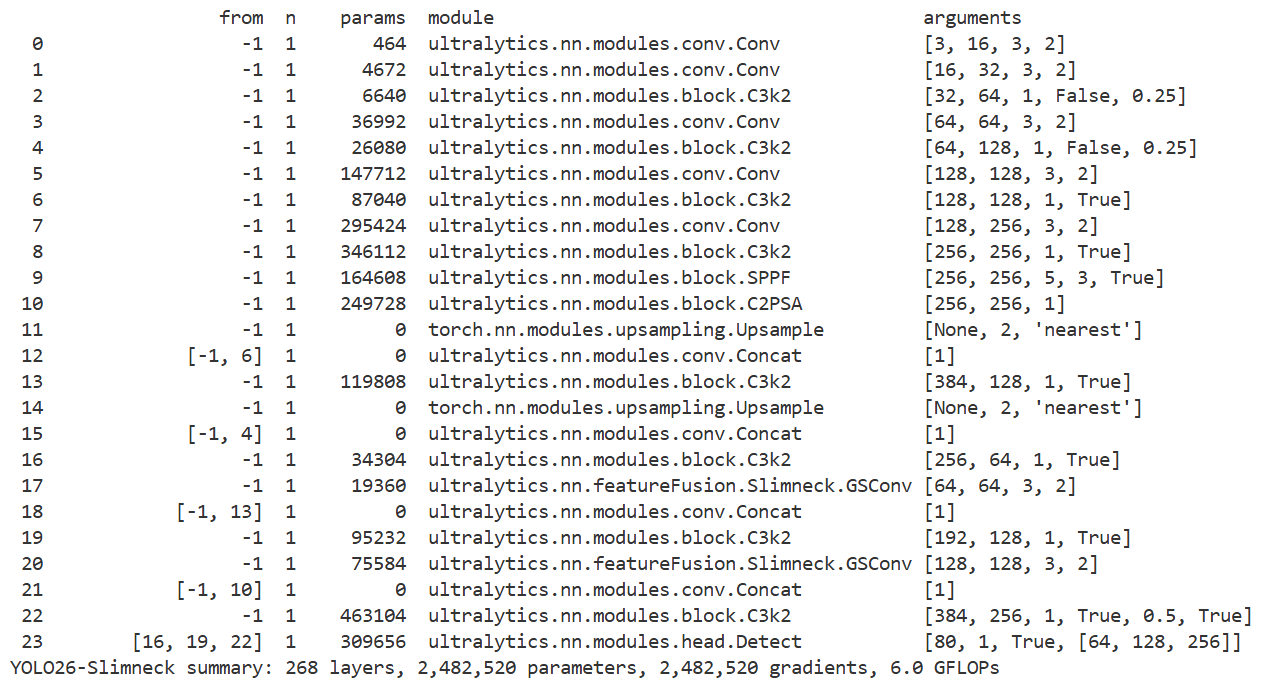
本文介绍了轻量级卷积技术GSConv和设计范式Slim-Neck与YOLO26的结合,以解决车载边缘计算平台模型实时检测和准确性的难题。GSConv通过减少冗余和重复信息降低计算复杂性,Slim-Neck则设计纤细颈部结构,在维持准确性的同时提高计算成本效益。我们将相关代码集成进YOLO26,在ultralytics/nn/目录新建featureFusion并创建Slimneck.py文件。在ultralytics/nn/tasks.py中注册后,配置YOLO26-Slimneck.yaml文件。实验脚本显示,改进后的YOLO26在检测任务中或能实现准确性和速度的平衡。
文章目录: YOLO26改进大全:卷积层、轻量化、注意力机制、损失函数、Backbone、SPPF、Neck、检测头全方位优化汇总
专栏链接: YOLO26改进专栏
介绍
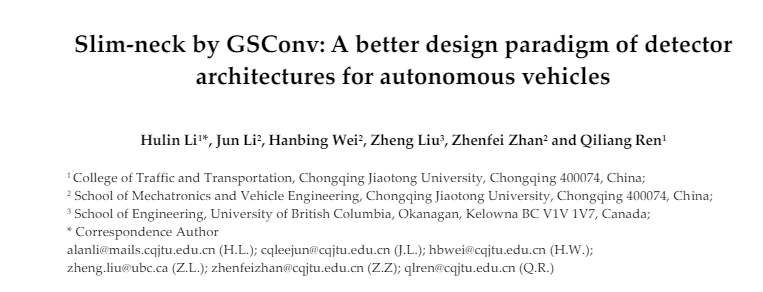
摘要
目标检测是计算机视觉中的一项重要下游任务。对于车载边缘计算平台来说,巨大的模型难以满足实时检测的要求,而由大量深度可分离卷积层构建的轻量化模型无法达到足够的准确性。我们引入了一种新的轻量级卷积技术,GSConv,以减轻模型的重量但保持准确性。GSConv 在模型的准确性和速度之间实现了出色的平衡。我们还提供了一种设计范式,称为 slim-neck,以实现检测器更高的计算成本效益。我们的方法在超过二十组比较实验中得到了稳健验证。特别是,通过我们的方法改进后的检测器在与原始版本相比时取得了最先进的结果(例如,在 Tesla T4 GPU 上以约 100FPS 的速度在 SODA10M 数据集上达到 70.9% mAP0.5)。代码可在 https://github.com/alanli1997/slim-neck-by-gsconv 获得。
文章链接
论文地址:论文地址
代码地址:代码地址
基本原理
Slim-Neck是一种用于目标检测器架构的设计范式,旨在通过引入轻量级卷积技术GSConv来实现在维持准确性的同时满足实时检测需求。Slim-Neck的设计理念是在保持准确性的同时提高检测器的计算成本效益。GSConv是一种通用的卷积方法,旨在减少计算复杂性,降低推理时间,并保持模型的准确性。
Slim-Neck的设计原理包括以下几个关键点:
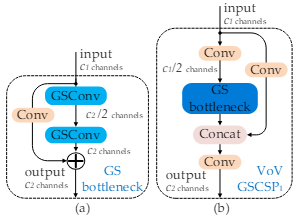
- GSConv:GSConv是Slim-Neck中的关键技术,它通过减少冗余信息和压缩不必要的重复信息来降低计算复杂性。GSConv在颈部阶段处理连接的特征图,这时特征图已经变得足够纤细,通道维度达到最大,宽度和高度维度达到最小,从而使得转换更加适度。
- 纤细颈部设计:Slim-Neck通过设计纤细的颈部结构来降低检测器的计算复杂性和推理时间,同时保持准确性。这种设计受到了DensNet、VoVNet和CSPNet等方法的启发,旨在提高CNNs的学习能力。
- 结构设计:Slim-Neck的结构设计旨在降低计算复杂性,同时保持准确性。通过合理设计的结构,Slim-Neck能够在保持准确性的同时提高计算效率,特别适用于轻量级检测器,如YOLOv3/v4-tiny。
核心代码
import json
import math
import platform
import warnings
from collections import OrderedDict, namedtuple
from copy import copy
from pathlib import Path

import cv2
import numpy as np
import pandas as pd
import requests
import torch
import torch.nn as nn
import yaml
from PIL import Image
from torch.cuda import amp

from utils.datasets import exif_transpose, letterbox
from utils.general import (LOGGER, check_requirements, check_suffix, check_version, colorstr, increment_path,
                           make_divisible, non_max_suppression, scale_coords, xywh2xyxy, xyxy2xywh)
from utils.plots import Annotator, colors, save_one_box
from utils.torch_utils import copy_attr, time_sync


def autopad(k, p=None):  # kernel, padding
    # Pad to 'same'
    if p is None:
        p = k // 2 if isinstance(k, int) else [x // 2 for x in k]  # auto-pad
    return p


class Conv(nn.Module):
    # Standard convolution
    def __init__(self, c1, c2, k=1, s=1, p=None, g=1, act=True):  # ch_in, ch_out, kernel, stride, padding, groups
        super().__init__()
        self.conv = nn.Conv2d(c1, c2, k, s, autopad(k, p), groups=g, bias=False)
        self.bn = nn.BatchNorm2d(c2)
        self.act = nn.Mish() if act else nn.Identity()

    def forward(self, x):
        return self.act(self.bn(self.conv(x)))

    def forward_fuse(self, x):
        return self.act(self.conv(x))


class GSConv(nn.Module):
    # GSConv https://github.com/AlanLi1997/slim-neck-by-gsconv
    def __init__(self, c1, c2, k=1, s=1, g=1, act=True):
        super().__init__()
        c_ = c2 // 2
        self.cv1 = Conv(c1, c_, k, s, None, g, act)
        self.cv2 = Conv(c_, c_, 5, 1, None, c_, act)

    def forward(self, x):
        x1 = self.cv1(x)
        x2 = torch.cat((x1, self.cv2(x1)), 1)
        # shuffle
        # y = x2.reshape(x2.shape[0], 2, x2.shape[1] // 2, x2.shape[2], x2.shape[3])
        # y = y.permute(0, 2, 1, 3, 4)
        # return y.reshape(y.shape[0], -1, y.shape[3], y.shape[4])

        b, n, h, w = x2.data.size()
        b_n = b * n // 2
        y = x2.reshape(b_n, 2, h * w)
        y = y.permute(1, 0, 2)
        y = y.reshape(2, -1, n // 2, h, w)

        return torch.cat((y[0], y[1]), 1)


class GSConvns(GSConv):
    # GSConv with a normative-shuffle https://github.com/AlanLi1997/slim-neck-by-gsconv
    def __init__(self, c1, c2, k=1, s=1, g=1, act=True):
        super().__init__(c1, c2, k=1, s=1, g=1, act=True)
        c_ = c2 // 2
        self.shuf = nn.Conv2d(c_ * 2, c2, 1, 1, 0, bias=False)

    def forward(self, x):
        x1 = self.cv1(x)
        x2 = torch.cat((x1, self.cv2(x1)), 1)
        # normative-shuffle, TRT supported
        return nn.ReLU(self.shuf(x2))


class GSBottleneck(nn.Module):
    # GS Bottleneck https://github.com/AlanLi1997/slim-neck-by-gsconv
    def __init__(self, c1, c2, k=3, s=1, e=0.5):
        super().__init__()
        c_ = int(c2*e)
        # for lighting
        self.conv_lighting = nn.Sequential(
            GSConv(c1, c_, 1, 1),
            GSConv(c_, c2, 3, 1, act=False))
        self.shortcut = Conv(c1, c2, 1, 1, act=False)

    def forward(self, x):
        return self.conv_lighting(x) + self.shortcut(x)


class DWConv(Conv):
    # Depth-wise convolution class
    def __init__(self, c1, c2, k=1, s=1, act=True):  # ch_in, ch_out, kernel, stride, padding, groups
        super().__init__(c1, c2, k, s, g=math.gcd(c1, c2), act=act)


class GSBottleneckC(GSBottleneck):
    # cheap GS Bottleneck https://github.com/AlanLi1997/slim-neck-by-gsconv
    def __init__(self, c1, c2, k=3, s=1):
        super().__init__(c1, c2, k, s)
        self.shortcut = DWConv(c1, c2, k, s, act=False)


class VoVGSCSP(nn.Module):
    # VoVGSCSP module with GSBottleneck
    def __init__(self, c1, c2, n=1, shortcut=True, g=1, e=0.5):
        super().__init__()
        c_ = int(c2 * e)  # hidden channels
        self.cv1 = Conv(c1, c_, 1, 1)
        self.cv2 = Conv(c1, c_, 1, 1)
        # self.gc1 = GSConv(c_, c_, 1, 1)
        # self.gc2 = GSConv(c_, c_, 1, 1)
        # self.gsb = GSBottleneck(c_, c_, 1, 1)
        self.gsb = nn.Sequential(*(GSBottleneck(c_, c_, e=1.0) for _ in range(n)))
        self.res = Conv(c_, c_, 3, 1, act=False)
        self.cv3 = Conv(2 * c_, c2, 1)  #

    def forward(self, x):
        x1 = self.gsb(self.cv1(x))
        y = self.cv2(x)
        return self.cv3(torch.cat((y, x1), dim=1))


class VoVGSCSPC(VoVGSCSP):
    # cheap VoVGSCSP module with GSBottleneck
    def __init__(self, c1, c2, n=1, shortcut=True, g=1, e=0.5):
        super().__init__(c1, c2)
        c_ = int(c2 * 0.5)  # hidden channels
        self.gsb = GSBottleneckC(c_, c_, 1, 1)
YOLOv8引入代码
在根目录下的ultralytics/nn/目录,新建一个 featureFusion目录,然后新建一个以 Slimneck为文件名的py文件, 把代码拷贝进去。
import math
import torch
import torch.nn as nn


def autopad(k, p=None):  # kernel, padding
    # Pad to 'same'
    if p is None:
        p = k // 2 if isinstance(k, int) else [x // 2 for x in k]  # auto-pad
    return p


class Conv(nn.Module):
    # Standard convolution
    def __init__(self, c1, c2, k=1, s=1, p=None, g=1, act=True):  # ch_in, ch_out, kernel, stride, padding, groups
        super().__init__()
        self.conv = nn.Conv2d(c1, c2, k, s, autopad(k, p), groups=g, bias=False)
        self.bn = nn.BatchNorm2d(c2)
        self.act = nn.Mish() if act else nn.Identity()

    def forward(self, x):
        return self.act(self.bn(self.conv(x)))

    def forward_fuse(self, x):
        return self.act(self.conv(x))


class GSConv(nn.Module):
    # GSConv https://github.com/AlanLi1997/slim-neck-by-gsconv
    def __init__(self, c1, c2, k=1, s=1, g=1, act=True):
        super().__init__()
        c_ = c2 // 2
        self.cv1 = Conv(c1, c_, k, s, None, g, act)
        self.cv2 = Conv(c_, c_, 5, 1, None, c_, act)

    def forward(self, x):
        x1 = self.cv1(x)
        x2 = torch.cat((x1, self.cv2(x1)), 1)
        # shuffle
        # y = x2.reshape(x2.shape[0], 2, x2.shape[1] // 2, x2.shape[2], x2.shape[3])
        # y = y.permute(0, 2, 1, 3, 4)
        # return y.reshape(y.shape[0], -1, y.shape[3], y.shape[4])

        b, n, h, w = x2.data.size()
        b_n = b * n // 2
        y = x2.reshape(b_n, 2, h * w)
        y = y.permute(1, 0, 2)
        y = y.reshape(2, -1, n // 2, h, w)

        return torch.cat((y[0], y[1]), 1)


class GSConvns(GSConv):
    # GSConv with a normative-shuffle https://github.com/AlanLi1997/slim-neck-by-gsconv
    def __init__(self, c1, c2, k=1, s=1, g=1, act=True):
        super().__init__(c1, c2, k=1, s=1, g=1, act=True)
        c_ = c2 // 2
        self.shuf = nn.Conv2d(c_ * 2, c2, 1, 1, 0, bias=False)

    def forward(self, x):
        x1 = self.cv1(x)
        x2 = torch.cat((x1, self.cv2(x1)), 1)
        # normative-shuffle, TRT supported
        return nn.ReLU(self.shuf(x2))


class GSBottleneck(nn.Module):
    # GS Bottleneck https://github.com/AlanLi1997/slim-neck-by-gsconv
    def __init__(self, c1, c2, k=3, s=1, e=0.5):
        super().__init__()
        c_ = int(c2*e)
        # for lighting
        self.conv_lighting = nn.Sequential(
            GSConv(c1, c_, 1, 1),
            GSConv(c_, c2, 3, 1, act=False))
        self.shortcut = Conv(c1, c2, 1, 1, act=False)

    def forward(self, x):
        return self.conv_lighting(x) + self.shortcut(x)


class DWConv(Conv):
    # Depth-wise convolution class
    def __init__(self, c1, c2, k=1, s=1, act=True):  # ch_in, ch_out, kernel, stride, padding, groups
        super().__init__(c1, c2, k, s, g=math.gcd(c1, c2), act=act)


class GSBottleneckC(GSBottleneck):
    # cheap GS Bottleneck https://github.com/AlanLi1997/slim-neck-by-gsconv
    def __init__(self, c1, c2, k=3, s=1):
        super().__init__(c1, c2, k, s)
        self.shortcut = DWConv(c1, c2, k, s, act=False)


class VoVGSCSP(nn.Module):
    # VoVGSCSP module with GSBottleneck
    def __init__(self, c1, c2, n=1, shortcut=True, g=1, e=0.5):
        super().__init__()
        c_ = int(c2 * e)  # hidden channels
        self.cv1 = Conv(c1, c_, 1, 1)
        self.cv2 = Conv(c1, c_, 1, 1)
        # self.gc1 = GSConv(c_, c_, 1, 1)
        # self.gc2 = GSConv(c_, c_, 1, 1)
        # self.gsb = GSBottleneck(c_, c_, 1, 1)
        self.gsb = nn.Sequential(*(GSBottleneck(c_, c_, e=1.0) for _ in range(n)))
        self.res = Conv(c_, c_, 3, 1, act=False)
        self.cv3 = Conv(2 * c_, c2, 1)  #

    def forward(self, x):
        x1 = self.gsb(self.cv1(x))
        y = self.cv2(x)
        return self.cv3(torch.cat((y, x1), dim=1))


class VoVGSCSPC(VoVGSCSP):
    # cheap VoVGSCSP module with GSBottleneck
    def __init__(self, c1, c2, n=1, shortcut=True, g=1, e=0.5):
        super().__init__(c1, c2)
        c_ = int(c2 * 0.5)  # hidden channels
        self.gsb = GSBottleneckC(c_, c_, 1, 1)
task注册
在ultralytics/nn/tasks.py中进行如下操作:
步骤1:
from ultralytics.nn.featureFusion.Slimneck import GSConv, VoVGSCSP
步骤2
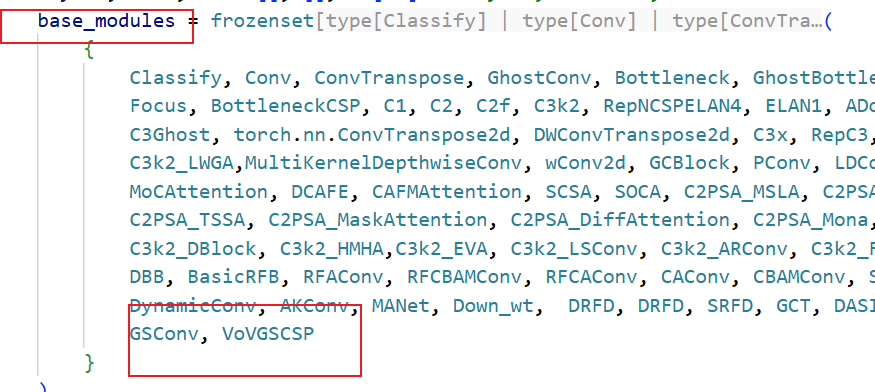
修改def parse_model(d, ch, verbose=True):
GSConv, VoVGSCSP
配置yolo26-Slimneck.yaml
# Ultralytics 🚀 AGPL-3.0 License - https://ultralytics.com/license

# Ultralytics YOLO26 object detection model with P3/8 - P5/32 outputs
# Model docs: https://docs.ultralytics.com/models/yolo26
# Task docs: https://docs.ultralytics.com/tasks/detect

# Parameters
nc: 80 # number of classes
end2end: True # whether to use end-to-end mode
reg_max: 1 # DFL bins
scales: # model compound scaling constants, i.e. 'model=yolo26n.yaml' will call yolo26.yaml with scale 'n'
  # [depth, width, max_channels]
  n: [0.50, 0.25, 1024] # summary: 260 layers, 2,572,280 parameters, 2,572,280 gradients, 6.1 GFLOPs
  s: [0.50, 0.50, 1024] # summary: 260 layers, 10,009,784 parameters, 10,009,784 gradients, 22.8 GFLOPs
  m: [0.50, 1.00, 512] # summary: 280 layers, 21,896,248 parameters, 21,896,248 gradients, 75.4 GFLOPs
  l: [1.00, 1.00, 512] # summary: 392 layers, 26,299,704 parameters, 26,299,704 gradients, 93.8 GFLOPs
  x: [1.00, 1.50, 512] # summary: 392 layers, 58,993,368 parameters, 58,993,368 gradients, 209.5 GFLOPs

# YOLO26n backbone
backbone:
  # [from, repeats, module, args]
  - [-1, 1, Conv, [64, 3, 2]] # 0-P1/2
  - [-1, 1, Conv, [128, 3, 2]] # 1-P2/4
  - [-1, 2, C3k2, [256, False, 0.25]]
  - [-1, 1, Conv, [256, 3, 2]] # 3-P3/8
  - [-1, 2, C3k2, [512, False, 0.25]]
  - [-1, 1, Conv, [512, 3, 2]] # 5-P4/16
  - [-1, 2, C3k2, [512, True]]
  - [-1, 1, Conv, [1024, 3, 2]] # 7-P5/32
  - [-1, 2, C3k2, [1024, True]]
  - [-1, 1, SPPF, [1024, 5, 3, True]] # 9
  - [-1, 2, C2PSA, [1024]] # 10

# YOLO26n head
head:
  - [-1, 1, nn.Upsample, [None, 2, "nearest"]]
  - [[-1, 6], 1, Concat, [1]] # cat backbone P4
  - [-1, 2, C3k2, [512, True]] # 13

  - [-1, 1, nn.Upsample, [None, 2, "nearest"]]
  - [[-1, 4], 1, Concat, [1]] # cat backbone P3
  - [-1, 2, C3k2, [256, True]] # 16 (P3/8-small)

  - [-1, 1, GSConv, [256, 3, 2]]
  - [[-1, 13], 1, Concat, [1]] # cat head P4
  - [-1, 2, C3k2, [512, True]] # 19 (P4/16-medium)

  - [-1, 1, GSConv, [512, 3, 2]]
  - [[-1, 10], 1, Concat, [1]] # cat head P5
  - [-1, 1, C3k2, [1024, True, 0.5, True]] # 22 (P5/32-large)

  - [[16, 19, 22], 1, Detect, [nc]] # Detect(P3, P4, P5)
# Ultralytics 🚀 AGPL-3.0 License - https://ultralytics.com/license

# Ultralytics YOLO26 object detection model with P3/8 - P5/32 outputs
# Model docs: https://docs.ultralytics.com/models/yolo26
# Task docs: https://docs.ultralytics.com/tasks/detect

# Parameters
nc: 80 # number of classes
end2end: True # whether to use end-to-end mode
reg_max: 1 # DFL bins
scales: # model compound scaling constants, i.e. 'model=yolo26n.yaml' will call yolo26.yaml with scale 'n'
  # [depth, width, max_channels]
  n: [0.50, 0.25, 1024] # summary: 260 layers, 2,572,280 parameters, 2,572,280 gradients, 6.1 GFLOPs
  s: [0.50, 0.50, 1024] # summary: 260 layers, 10,009,784 parameters, 10,009,784 gradients, 22.8 GFLOPs
  m: [0.50, 1.00, 512] # summary: 280 layers, 21,896,248 parameters, 21,896,248 gradients, 75.4 GFLOPs
  l: [1.00, 1.00, 512] # summary: 392 layers, 26,299,704 parameters, 26,299,704 gradients, 93.8 GFLOPs
  x: [1.00, 1.50, 512] # summary: 392 layers, 58,993,368 parameters, 58,993,368 gradients, 209.5 GFLOPs

# YOLO26n backbone
backbone:
  # [from, repeats, module, args]
  - [-1, 1, Conv, [64, 3, 2]] # 0-P1/2
  - [-1, 1, Conv, [128, 3, 2]] # 1-P2/4
  - [-1, 2, C3k2, [256, False, 0.25]]
  - [-1, 1, Conv, [256, 3, 2]] # 3-P3/8
  - [-1, 2, C3k2, [512, False, 0.25]]
  - [-1, 1, Conv, [512, 3, 2]] # 5-P4/16
  - [-1, 2, C3k2, [512, True]]
  - [-1, 1, Conv, [1024, 3, 2]] # 7-P5/32
  - [-1, 2, C3k2, [1024, True]]
  - [-1, 1, SPPF, [1024, 5, 3, True]] # 9
  - [-1, 2, C2PSA, [1024]] # 10

# YOLO26n head
head:
  - [-1, 1, nn.Upsample, [None, 2, "nearest"]]
  - [[-1, 6], 1, Concat, [1]] # cat backbone P4
  - [-1, 2, VoVGSCSP, [512, True]] # 13

  - [-1, 1, nn.Upsample, [None, 2, "nearest"]]
  - [[-1, 4], 1, Concat, [1]] # cat backbone P3
  - [-1, 2, VoVGSCSP, [256, True]] # 16 (P3/8-small)

  - [-1, 1, Conv, [256, 3, 2]]
  - [[-1, 13], 1, Concat, [1]] # cat head P4
  - [-1, 2, VoVGSCSP, [512, True]] # 19 (P4/16-medium)

  - [-1, 1, Conv, [512, 3, 2]]
  - [[-1, 10], 1, Concat, [1]] # cat head P5
  - [-1, 2, VoVGSCSP, [1024, True]] # 22 (P5/32-large)


  - [[16, 19, 22], 1, Detect, [nc]] # Detect(P3, P4, P5)
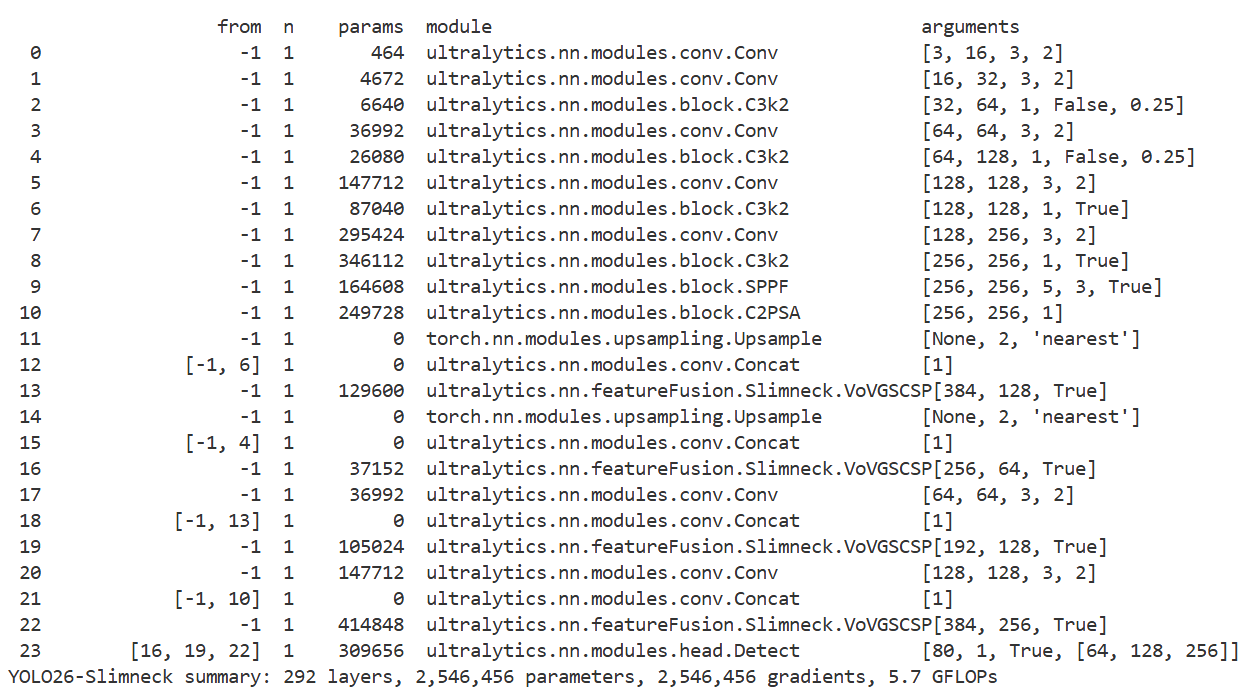
实验
脚本
import warnings
warnings.filterwarnings('ignore')
from ultralytics import YOLO

if __name__ == '__main__':
#     修改为自己的配置文件地址
    model = YOLO('./ultralytics/cfg/models/26/yolo26-Slimneck.yaml')
#     修改为自己的数据集地址
    model.train(data='./ultralytics/cfg/datasets/coco8.yaml',
                cache=False,
                imgsz=640,
                epochs=10,
                single_cls=False,  # 是否是单类别检测
                batch=8,
                close_mosaic=10,
                workers=0,
                optimizer='MuSGD',
                # optimizer='SGD',
                amp=False,
                project='runs/train',
                name='yolo26-Slimneck',
                )

AtomGit 是由开放原子开源基金会联合 CSDN 等生态伙伴共同推出的新一代开源与人工智能协作平台。平台坚持“开放、中立、公益”的理念,把代码托管、模型共享、数据集托管、智能体开发体验和算力服务整合在一起,为开发者提供从开发、训练到部署的一站式体验。
更多推荐
 10
10 0
0- 0


 已为社区贡献5条内容

所有评论(0)