【c++】set和map的封装
一、框架搭建( 如何实现红黑树的复用?)
set和map的底层都是红黑树,但由于存储元素的差异(一个只存储key,一个既存储key又存储value),我们要么创造出两棵稍微不一样的红黑树,或者是改变红黑树的结构,使其能完美匹配上set和map。库里面采用了后者。
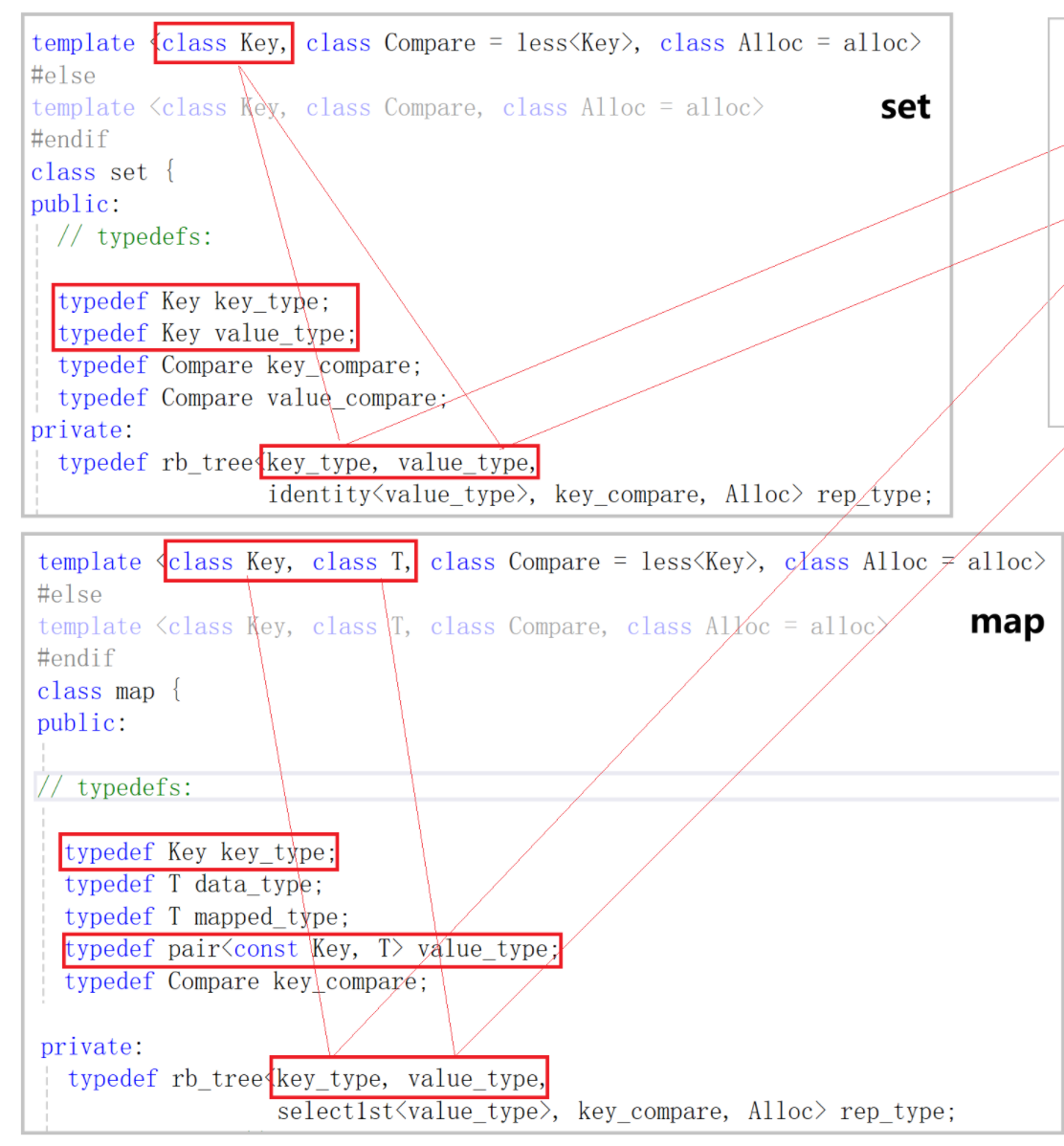
1. 分析库里set与map的实现(分析RBTree的两个模板参数 Key, Value)
库里面RBTree的实现一共有5个模板参数,分别是 Key,Value,KeyOfValue,Compare和Alloc,我们主要分析前三个模板参数的作用)。Compare是控制比较规则的仿函数类型,Alloc是内存池。
在这里插入图片描述
- 对于set,它只有一个用来接收key类型的模板参数Key,并把Key同一个类型命名为key_type与value_type。
- 对于map,它有两个分别用来接收key和 value类型的模板参数Key和T。将Key重命名为key_type,将pair<const Key, T> 重命名为value_type。
- 它们复用同一棵红黑树,将4个类型传给红黑树。
在这里插入图片描述
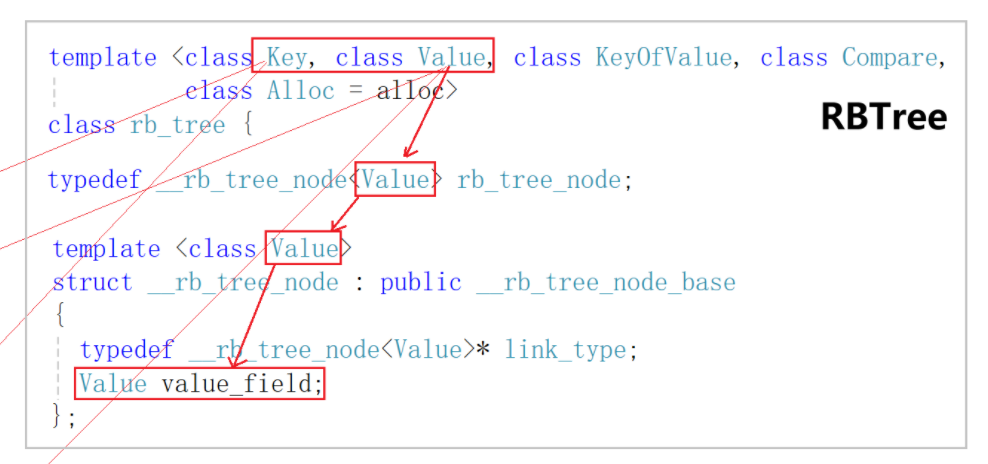
- 重点观察Value这个模板参数,它的类型是节点所存储的元素的类型。set传过来的是Key类型,map传过来的是pair<const Key, T>类型。利用模板来控制红黑树所存储的类型,满足set和map不同的存储需求。

在这里插入图片描述
- 我们传递给map的只是key和value的类型,而map要存储的是pair<const key, value>类型(实现key和value的绑定,const实现不可修改以后再加),所以我们需要做一个加工。
- 既然有了接收存储元素类型的Value类型,而为什么不删除第一个用来单独存储key类型的模板参数Key,似乎用不上它,这个以后就能知道了。
2. 分析第三个模板参数KeyofValue
我们在进行插入时,需要根据key的大小来找到插入的位置,而由于set和map存储类型的不同,set直接用Value(key)类型的元素就好,而map则需要取出Value(pair<const key, value>)里面的key值来找到插入的位置。

在这里插入图片描述
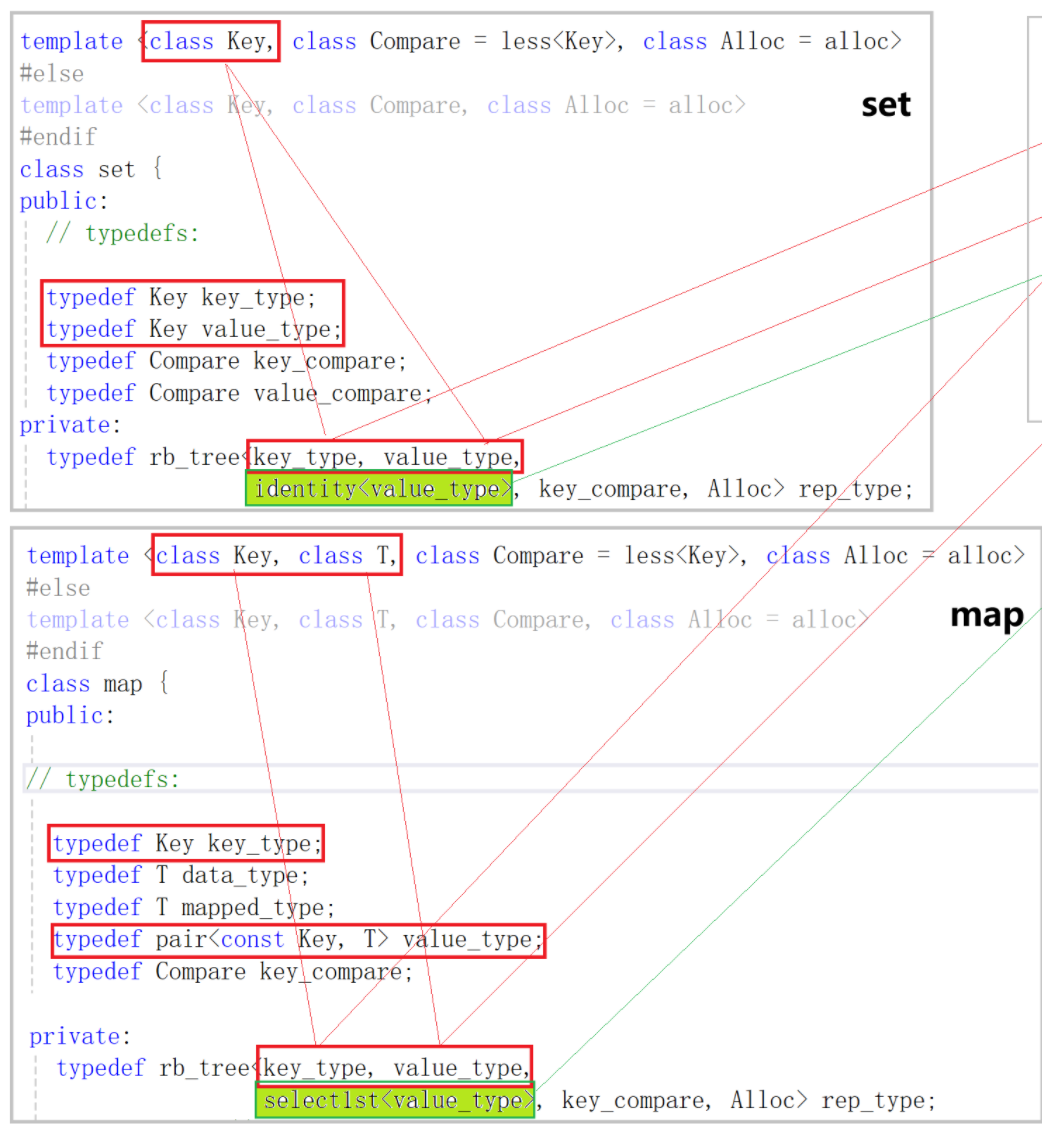
- 而KeyOfValue这个模板参数就是用来接收功能为取出key的仿函数类型,KeyOfValue是匿名对象。可以参照库里的实现大胆猜测。
在这里插入图片描述
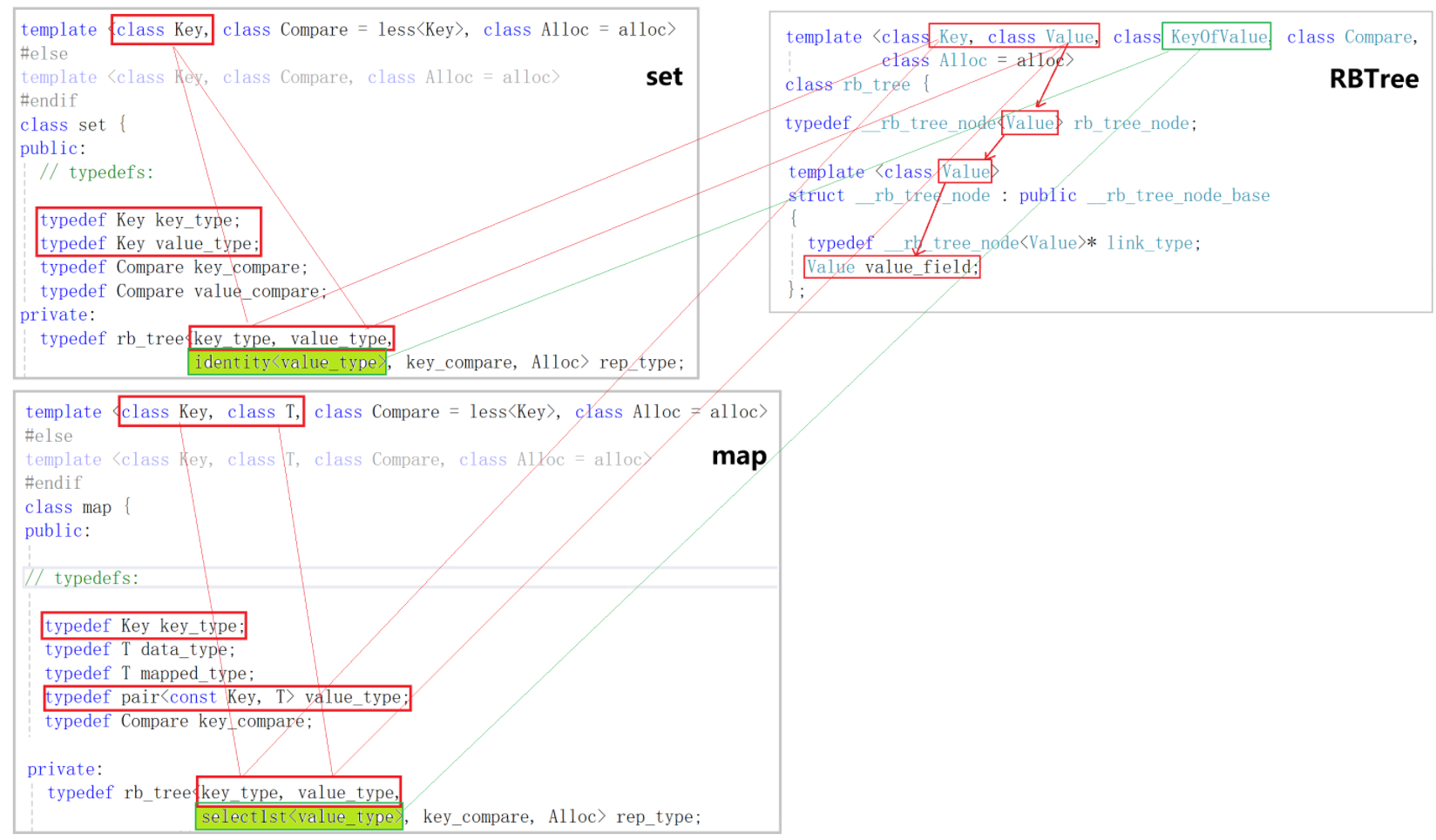
- set里面传给KeyOfValue的是一个ideneity<value_type>类型的仿函数,identity在这里是本身的意思,它的功能就是取出key值就是value_type类型的元素它本身,而map里面传给KeyOfValue的是一个select1st<value_type>类型的仿函数,它的功能就是取出key值就是value_type类型元素里的第一个值。
在这里插入图片描述
- 所以我们在set和map里面的实现里面都要实现一个仿函数用来传递给KeyOfValue。
set:
代码语言:javascript
AI代码解释
namespace mosheng {
	template<class K>
	class identity
	{
	public:
		K& operator()(const K& key)
		{
			return key;
		}
	};
	template<class Key>
	class set
	{
		typedef RBTree<Key, Key, identity<Key>> rbType;
	};
}
map:
代码语言:javascript
AI代码解释
namespace mosheng {
	template<class K, class KV>
	class select1st
	{
	public:
		K& operator()(const KV& kv)
		{
			return kv.first;
		}
	};
	template<class Key, class Value>
	class map
	{
		typedef RBTree<Key, std::pair<Key, Value>, select1st<Key, std::pair<Key, Value>> rbType;
	};
}- 不要忘了对应的红黑树的修改,主要是修改insert和find还有对应的模板参数,去用KeyOfValue提取key。然后框架搭建完毕。
代码语言:javascript
AI代码解释
#pragma once

enum Colour
{
	RED,
	BLACK
};

template<class Value>
struct RBTreeNode
{
	RBTreeNode(Value& kv)
		:_kv(kv)
		, _left(nullptr)
		, _right(nullptr)
		, _parent(nullptr)
	{
	};
	Value _kv;
	RBTreeNode<Value>* _left;
	RBTreeNode<Value>* _right;
	RBTreeNode<Value>* _parent;
	Colour _col = RED;
};

template<class Key, class Value, class KeyOfValue>
class RBTree
{
	typedef RBTreeNode<Value> Node;
public:
	bool Insert(Value& kv)
	{
		//处理空树的情况
		if (_root == nullptr)
		{
			_root = new Node(kv);
			_root->_col = BLACK;
			return true;
		}
		//找到要插入的位置
		else
		{
			Node* cur = _root;
			Node* parent = nullptr;

			while (cur)
			{
				if (KeyOfValue()(kv) < KeyOfValue()(cur->_kv))
				{
					parent = cur;
					cur = cur->_left;
				}
				else if (KeyOfValue()(kv) > KeyOfValue()(cur->_kv))
				{
					parent = cur;
					cur = cur->_right;
				}
				else
				{
					return false;
				}
			}
			//插入新节点
			cur = new Node(kv);
			if (KeyOfValue()(parent->_kv) > KeyOfValue()(kv))
			{
				parent->_left = cur;
			}
			else
			{
				parent->_right = cur;
			}
			cur->_parent = parent;
			//父节点为红色的情况下需要进行处理
			if (parent->_col == RED)
			{
				while (parent && parent->_col == RED)
				{
					//记录节点
					Node* grandfather = parent->_parent;
					Node* uncle = nullptr;
					if (grandfather->_left == parent)
					{
						uncle = grandfather->_right;
					}
					else
					{
						uncle = grandfather->_left;
					}
					//uncle为红色的情况
					//仅变色
					if (uncle && uncle->_col == RED)
					{
						uncle->_col = parent->_col = BLACK;
						grandfather->_col = RED;
						//更新
						cur = grandfather;
						parent = cur->_parent;
					}
					//uncle为黑色或为空的情况
					else
					{
						//右旋转
						if (grandfather->_left == parent && parent->_left == cur)
						{
							RotateR(grandfather);
							parent->_col = BLACK;
							grandfather->_col = RED;

							break;
						}
						//左旋转
						else if (grandfather->_right == parent && parent->_right == cur)
						{
							RotateL(grandfather);
							parent->_col = BLACK;
							grandfather->_col = RED;

							break;
						}//左右双旋
						else if (grandfather->_left == parent && parent->_right == cur)
						{
							RotateL(parent);
							RotateR(grandfather);
							cur->_col = BLACK;
							grandfather->_col = RED;

							break;
						}
						//右左双旋
						else
						{
							RotateR(parent);
							RotateL(grandfather);
							cur->_col = BLACK;
							grandfather->_col = RED;

							break;
						}
					}
				}
			}

		}
		//处理根节点颜色

		_root->_col = BLACK;

		return true;
	}

	void InOrder()
	{
		_InOrder(_root);
		cout << endl;
	}

	Node* Find(const Key& key)
	{
		Node* cur = _root;
		while (cur)
		{
			if (KeyOfValue()(cur->_kv) < key)
			{
				cur = cur->_right;
			}
			else if (KeyOfValue()(cur->_kv) > key)
			{
				cur = cur->_left;
			}
			else
			{
				return cur;
			}
		}
		return nullptr;
	}

	Node* _root = nullptr;
};- 可以使用匿名对象,但推荐构造一个对象kof来使用仿函数KefOfValue。
- 为什么保留第一个Key的模板参数在find函数上就有所体现:我们需要Key的类型,因为要根据Key的类型来寻找。KefOfValue无法提取出类型。
二、迭代器的实现
迭代器的实现也就是在节点指针的基础之上做封装操作,并重载一些运算符。map和set的迭代器是双向迭代器,关键是需要实现++和–的重载。
1. 普通迭代器iterator的实现
1.1 先搭一个基本框架
代码语言:javascript
AI代码解释
template<class Value>
class TreeIterator
{
	typedef RBTreeNode<Value> Node;
	typedef TreeIterator<Value> Self;
public:
	TreeIterator(Node* node)
		:_node(node)
	{}

	Value& operator* ()
	{
		return _node->_kv;
	}

	Value* operator->()
	{
		return &(_node->_kv);
	}

	bool operator==(const Self& s)const
	{
		return _node == s->_node;
	}

	bool operator!=(const Self& s)const
	{
		return _node != s->_node;
	}
private:
	Node* _node;
};
1.2 operator++与operator- -实现
operator++
我们希望达成的效果是++从当前节点移动到下一个按照中序遍历的节点。- -则是反过来。++只需要知道当前节点的下一个节点是哪一个。
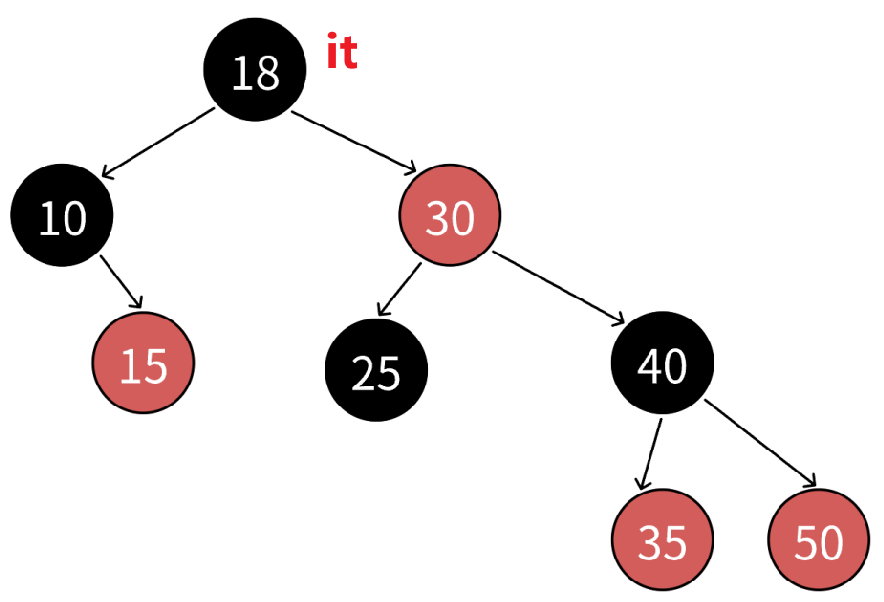
在这里插入图片描述
- 现在我们有一棵红黑树,若当前节点为18,那么我们希望节点18++后的节点是节点25,节点25++后的节点是节点30,以此类推。
- 首先看节点10,它不是叶子节点,++后需要跳到节点15,也就是它的右节点,这是因为它的右子树不为空,按照中序遍历顺序,可以认为它的左子树是遍历完成的,只需要看它的右子树就行。所以首先要判断当前节点的右子树是否为空。再来看节点30,++后需要跳到节点35,是其右子树的最左节点。若不为空就会跳到节点30的左孩子节点40,节点40的左子树是还未访问过的,所以需要访问它的左子树,一直到最左端。

AtomGit 是由开放原子开源基金会联合 CSDN 等生态伙伴共同推出的新一代开源与人工智能协作平台。平台坚持“开放、中立、公益”的理念,把代码托管、模型共享、数据集托管、智能体开发体验和算力服务整合在一起,为开发者提供从开发、训练到部署的一站式体验。
更多推荐

 0
0 0
0- 0


 已为社区贡献82条内容

所有评论(0)