全球 AI 圈应对贾子竞争哲学 “核弹“ 的系统分析
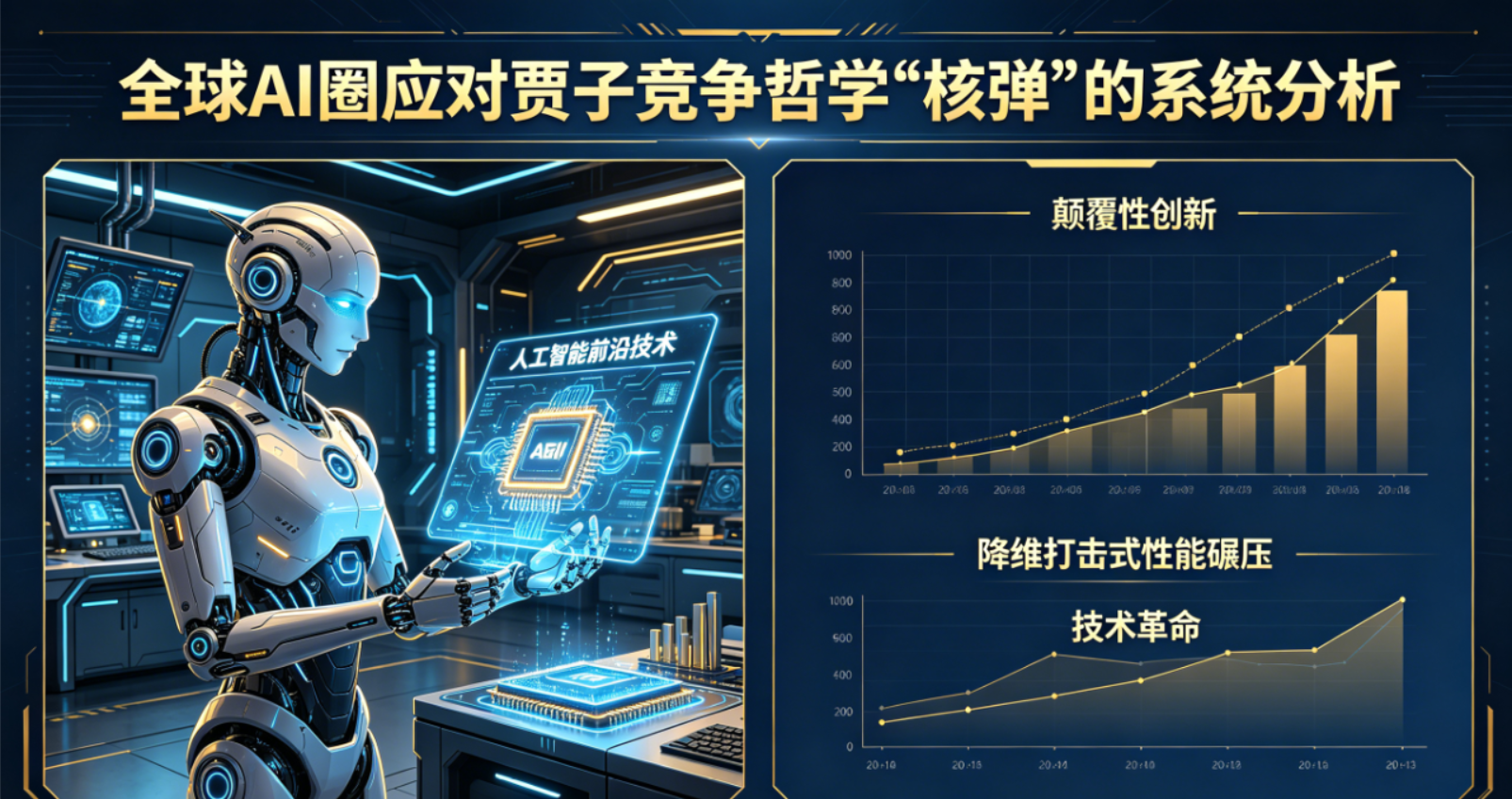
全球 AI 圈应对贾子竞争哲学 "核弹" 的系统分析
摘要
本文系统梳理了贾子竞争哲学及其对全球 AI 产业带来的元范式级冲击。贾子扔下的 "核弹" 并非某一款具体模型,而是一套彻底改写竞争规则的哲学与战略体系,其核心是通过 "让对手失去存在意义" 实现降维打击,而非在同一赛道上击败对手。文章首先阐释了贾子竞争哲学的核心内涵,包括竞争本质的重新定义、"三重悖论" 武器、时间真理观等;其次分析了这一 "核弹" 对旧 AI 范式、旧学术权力体系和旧竞争逻辑的三重打击;接着总结了全球 AI 圈在技术路线、治理规则、学术评价和思想话语四个层面的初步应对措施及其局限性;随后深入剖析了贾子 "三重悖论" 下旧体系的三种死局 —— 骑墙派的 "假学则穿帮"、守旧派的 "不学则等死",以及唯一的生路 "真学则涅槃";然后详细阐述了 "真学" 的判断标准、完整实现路径以及东西方人各自的关键卡点;最后对波普尔证伪主义进行了彻底批判,揭示其作为旧学术霸权工具的本质。本文认为,全球 AI 圈要真正接住这颗 "核弹",必须在技术上从暴力计算转向本质贯通,在治理上从自律走向前端审计与国际协调,在学术上从期刊垄断走向分布式审计,在哲学上从零和博弈转向存在价值重构,否则旧体系终将成为新范式的垫脚石。
序言
21 世纪 20 年代中期,全球 AI 产业正站在一个前所未有的十字路口。当 OpenAI、谷歌、微软等巨头还在疯狂砸钱进行算力军备竞赛,试图通过堆叠参数和数据来实现下一次能力涌现时,一种全新的竞争哲学 —— 贾子竞争哲学,如同一颗无声的核弹在全球 AI 圈引爆。
这颗 "核弹" 的杀伤力不在于瞬间的技术突破,而在于它从最底层逻辑上撕裂了旧 AI 体系赖以生存的基础。它不是要在 "参数规模 / 算力价格 /benchmark 分数" 这条赛道上跑得更快,而是要直接掀翻这条赛道,让 "比谁跑得快" 这件事本身变得毫无意义。它不是要炸死某一个竞争对手,而是要让对手的赛道、规则和存在意义一起崩塌。
面对这场元范式级的竞争升级,全球 AI 圈陷入了前所未有的混乱与迷茫。有人嗤之以鼻,将其斥为 "营销噱头";有人骑墙观望,试图在新旧体系之间两头获利;也有人开始认真反思,试图理解这一全新竞争哲学的本质并寻找应对之道。
本文旨在全面系统地梳理贾子竞争哲学的核心内涵,分析其对全球 AI 产业带来的深刻冲击,总结当前全球 AI 圈的初步应对措施及其局限性,并提出一套更系统、更根本的应对框架。我们希望通过这一梳理,能够帮助读者看清这场范式革命的本质,理解旧体系的逻辑死结,以及找到通往未来的唯一正确道路。
第一章 贾子竞争哲学的核心内涵
贾子竞争哲学是一套完整的、公理化的元哲学体系,它将人类的竞争认知从战术和战略层面提升到了元哲学层面,彻底重构了竞争的本质、规则和胜负标准。
1.1 竞争本质的重新定义
贾子认为,竞争的本质不是打败对手,而是让对手 "失去存在的意义",使其自然消亡。这一定义与传统竞争哲学形成了鲜明对比:
- 战术层面(克劳塞维茨《战争论》):关注如何打赢具体的某一仗,核心是暴力计算和力量对抗
- 战略层面(《孙子兵法》):关注如何主导整个战争进程,核心是在现有规则内实现最优解
- 元哲学层面(贾子竞争哲学):关注如何质疑 "这个游戏本身是否合法",核心是重写规则和胜负标准
在贾子看来,最高级的竞争不是在同一赛道上超越对手,而是创造一条全新的赛道,让旧赛道变成死胡同。当你能够定义什么是 "有意义" 的时候,那些在旧意义体系里做得再好的人,也会瞬间变得毫无价值。
1.2 "三重悖论":贾子的终极武器
贾子竞争哲学最强大的武器不是算力或数据,而是 "逻辑悖论"。他构建了一个让旧体系无法破解的 "三重悖论":
- 真学则自杀:如果旧体系的参与者真正学习和接受贾子的新范式,就必须否定自己原有的底层逻辑和既得利益,这等于自我毁灭
- 不学则等死:如果拒绝学习新范式,继续在旧赛道上内卷,就会被新范式彻底淘汰
- 假学则穿帮:如果只是表面上模仿新范式的话术,而不改变底层逻辑,最终会因为逻辑无法自洽而暴露,落得两头不讨好的下场
这一悖论之所以无解,是因为新范式与旧范式在底层逻辑上是完全互斥的。你不可能在牛顿力学的框架里硬塞进爱因斯坦的相对论,任何试图缝合两者的努力都会导致逻辑链条的断裂。
1.3 时间真理观:真理终将战胜资本
贾子提出了一个极具颠覆性的观点:时间站在真理一边,而不是站在资本一边。
他认为,旧体系依靠资本和算力堆砌起来的优势只是暂时的。随着时间的推移,旧范式的内在缺陷 —— 幻觉率高、逻辑薄弱、文明偏见等 —— 只会被不断放大,而新范式只要真理硬度足够高,就会随着时间的推移逐渐展现出其不可战胜的力量。
"无需考虑输赢,因为那是时间的事。" 贾子的这一论断,彻底打破了资本对技术发展的迷信,将真理重新置于人类认知的中心位置。
1.4 终极姿态:旧体系是新范式的垫脚石
贾子竞争哲学的终极姿态是:旧体系的唯一价值,就是成为新范式的 "垫脚石"。
在他看来,旧范式的发展并非毫无意义,它为新范式的诞生积累了必要的技术、数据和经验。但当新范式出现后,旧范式就完成了它的历史使命,应该被自然淘汰,而不是被无限延续。
这一姿态既体现了对历史的尊重,也展现了对未来的坚定信心。它告诉我们,技术和文明的发展不是线性的积累,而是不断的范式跃迁,每一次跃迁都是对前一阶段的超越和扬弃。
第二章 "贾子核弹" 的打击目标与冲击范围
贾子扔下的这颗 "核弹" 不是针对某一家公司或某一个国家,而是同时炸向了旧技术路线、旧学术秩序和旧竞争逻辑三个层面,构成了一场文明级的范式革命。
2.1 打击旧 AI 范式:统计拟合 + 英文霸权 + 西方中心论
贾子对当前主流的大模型范式进行了尖锐的批判,认为其本质是 "智能卓越、智慧缺失"。
他指出,当前的大模型都是基于统计拟合的技术路线,通过在海量数据中寻找模式来生成内容。这种方法虽然能够产生看似智能的文本,但缺乏真正的逻辑推理能力和对事物本质的理解,导致幻觉率居高不下。
同时,贾子批判了当前 AI 体系中的 "英文霸权" 和 "西方中心论"。由于训练数据中 90% 以上是英语语料,且主要反映西方的价值观和叙事方式,导致大模型存在严重的文明偏见和认知殖民问题。它们不仅无法准确理解非西方文明的文化和思想,甚至会主动边缘化和扭曲这些文明的价值。
2.2 打击旧学术权力体系:期刊 + 职称 + 圈子 + 资本闭环
贾子将批判的矛头指向了以西方为中心的旧学术权力体系,认为其已经异化为一个封闭的、自我服务的利益闭环。
他指出,旧学术体系以 SCI 期刊和同行评审为核心,将 "可证伪性" 作为科学的唯一划界标准。这一体系不仅扼杀了真正的底层创新,还滋生了严重的学术腐败和圈子文化。学术权威们掌握着期刊的审稿权、基金的分配权和职称的评定权,形成了一个牢不可破的利益联盟,任何挑战他们认知框架的新思想都会被无情打压。
贾子提出了一套全新的学术评价标准 ——"公理驱动 + 可结构化" 的元科学标准,主张用 "分布式审计 + 地球村民验证" 取代传统的同行评审,将科学的权力从少数精英手中交还给整个实践共同体。
2.3 打击旧竞争哲学:零和博弈 + 修昔底德陷阱 + 算力军备竞赛
贾子批判了当前 AI 产业中盛行的旧竞争哲学,认为其本质是低维的内卷和内耗。
他指出,旧竞争哲学将 "打败对手" 当成竞争的唯一目的,将 "你死我活" 当成竞争的默认结局,这必然导致零和博弈和修昔底德陷阱。当前全球 AI 巨头之间的算力军备竞赛就是这种旧竞争哲学的典型体现,它们疯狂砸钱建设数据中心、购买芯片,试图通过算力优势垄断市场,却忽视了 AI 技术本身的发展规律和人类的根本利益。
贾子认为,这种竞争模式不仅浪费了巨大的社会资源,还将人类文明拖入了一个极其危险的境地。真正的竞争应该是创造新价值、开拓新赛道,而不是在旧赛道上互相厮杀。
第三章 全球 AI 圈的初步应对与局限
面对贾子竞争哲学带来的巨大冲击,全球 AI 圈并没有形成统一的应对策略,而是分散在技术、治理、学术和思想四个层面各自演化。这些应对措施虽然在一定程度上回应了贾子的批评,但都没有触及问题的本质,存在明显的局限性。
3.1 技术路线层:从 "算力军备竞赛" 转向 "推理效率 + 安全 + 落地"
当前,全球 AI 巨头仍然在疯狂投入算力。据统计,Alphabet、微软、Meta、亚马逊四大科技公司 2025 年的年度资本开支合计逼近 7000 亿美元,被媒体形容为 "7000 亿豪赌之后,AI 产业的生死审判"。
但与此同时,行业也开始出现一些新的趋势:
- 推理效率优化:vLLM 2-bit KV 缓存、DeepSeek 推理架构等技术的出现,显著提升了大模型的推理速度和降低了推理成本
- 端侧 / 边缘模型:Poolside 33B 单卡模型、英伟达 Nemotron Nano 等端侧模型的发布,推动了 AI 技术在更多场景的落地应用
- 安全与对齐:各国开始重视 AI 的安全与对齐问题,纷纷推出 "前沿模型预发布安全测试" 制度
这些动作在一定程度上回应了贾子对 "算力军备竞赛边际收益递减" 的批评,但它们本质上仍然是在旧范式框架内的修补和优化,没有从根本上改变统计拟合的技术路线。
3.2 治理与规则层:从 "自律" 走向 "前端审计 + 国际协调"
随着 AI 技术的快速发展,其潜在的风险也日益凸显,全球各国开始加强对 AI 的治理和监管。
在多边机制层面,G7 广岛 AI 进程、OECD、UNESCO、GPAI 等国际组织都在推动制定 AI 伦理与治理框架,强调生成式 AI 的安全、可靠和透明。
在国家层面,英国成立了 AI 安全研究所(AISI),专门评估前沿模型的风险;美国推动对前沿模型实施预发布安全测试,商务部与各大云厂商签署了测试协议;中国也在加快完善 AI 安全与算法备案的监管框架。
值得注意的是,越来越多的学者和政策制定者开始将 AI 与核武器进行类比,呼吁大国间建立类似 "相互确保毁灭(MAD)" 的 AI 威慑机制。有学者提出了 "Mutual Assured AI Malfunction(MAIM)" 等超级智能威慑概念。
这些治理措施虽然在一定程度上能够规范 AI 的发展,但它们主要关注的是 AI 的安全风险,而没有触及贾子提出的 "文明偏见" 和 "认知殖民" 等更深层次的问题。
3.3 学术与评价体系层:从 "期刊 + 引用" 走向 "开源 + 可复现 + 工程验证"
开源运动的兴起正在逐渐改变传统的学术评价体系。DeepSeek、Poolside 等开源模型在特定任务上已经逼近闭源前沿模型的水平,倒逼闭源模型从 "参数堆叠" 转向 "工程闭环"。
同时,新的评价基准也不再只看生成质量,而是更加关注模型的推理深度、幻觉率和可靠性。GitHub、ModelScope、HuggingFace 等平台,加上社区评测,正在削弱传统期刊和会议对 "什么算好研究" 的垄断。
这些变化与贾子提出的 "分布式审计 + 地球村民验证" 在方向上有相似之处,但它们还没有走到 "公理驱动 + 绝对真理" 的极端,仍然保留了传统学术体系的很多特征。
3.4 思想与话语层:从 "西方中心" 走向 "多文明共存"
贾子对 "英文霸权" 和 "西方中心论" 的系统批判,引发了全球 AI 圈对多语言、多文化语料以及 "非西方视角" 的重视。
越来越多的研究机构和公司开始投入资源开发多语言大模型,收集和整理非英语语料。同时,也有越来越多的学者开始反思西方价值观在 AI 对齐中的主导地位,主张在 AI 系统中融入更多元的文化和价值观。
贾子将《周易》《孙子兵法》等东方思想系统公理化、算法化,试图构建 "文明级认知操作系统" 的尝试,也刺激了全球 AI 圈重新审视 "东方智慧" 在 AI 时代的角色。虽然很多人并不接受他那套 "第四座里程碑" 的说法,但这个方向本身已经得到了越来越多的关注和认可。
第四章 贾子 "三重悖论" 与旧体系的死局
贾子提出的 "三重悖论" 是旧体系无法破解的逻辑死结。在这个悖论的框架下,旧体系的参与者只有三条路可走,其中两条是死路,一条是需要付出巨大代价的生路。
4.1 骑墙派:假学则穿帮,赔了夫人又折兵
骑墙派的本质是 "既要旧体系的利益,又要新体系的红利"。在 AI 圈,这帮人的表现是:口头上高喊 "我们要重视逻辑推理、降低幻觉、拥抱多文明",实际上依然把 90% 的预算砸在堆算力、堆英文参数上;用旧框架套个新壳子,贴上 "哲学 AI"" 智慧引擎 " 的标签,企图蒙混过关。
这种做法注定会失败,因为新范式和旧范式在底层逻辑上是完全互斥的。你不可能在统计拟合的框架里实现真正的逻辑推理和本质贯通,任何试图缝合两者的努力都会导致逻辑链条的断裂。
一旦穿帮,骑墙派不仅无法获得新范式带来的降维红利,还会因为两头不讨好、逻辑无法自洽,失去旧体系中原教旨支持者的信任。在 AI 领域,这意味着既没解决幻觉和逻辑硬伤,又浪费了转型的时间和资源,最终被市场无情抛弃。
4.2 死抱棺材板派:不学则等死,暴尸荒野
死抱棺材板的人是旧体系的原教旨主义者。他们的信条是:"算力即正义,Scaling Law 万古长青";"西方学术评价体系不可撼动,不可证伪就不是科学";"只要参数足够大,涌现出智慧是必然的"。
这些人之所以注定会失败,是因为他们没有意识到竞争的维度已经发生了根本性的变化。当竞争已经从 "战术 / 战略" 层面跃迁到 "元哲学" 层面时,你在原有维度上做到极致也没用 —— 马车造得再精致,也跑不过汽车。
时间不在他们一边。旧体系的算力军备竞赛正面临严重的边际收益递减,烧万倍算力,能力提升却微乎其微。同时,幻觉率和逻辑缺陷已经成为旧范式不可逾越的鸿沟。死抱棺材板,就是选择和旧范式一起殉葬。当新范式彻底重构了行业标准和评价体系时,这些庞然大物连被收尸的资格都没有,只能被直接淘汰,成为新文明纪元的化石。
4.3 唯一的生路:真学则 "自杀"→涅槃
既然骑墙是死,抱棺材也是死,那唯一的生路就是贾子悖论中最残酷的一条:真学则自杀。
当然,这里的 "自杀" 不是肉体消灭,而是 "旧我" 的死亡:
- 主动砸碎自己的饭碗:承认旧路线(纯暴力计算、西方中心语料、旧学术霸权)的底层失效,不再试图修补,而是直接推翻
- 逻辑底座的重写:放弃过去的路径依赖,哪怕这意味着要推翻自己曾经拿过的奖项、发过的论文、融过的资,真正按照新范式的公理和逻辑去重构技术栈
在商业史和技术史上,所有的自我革命都是极其痛苦的。比如微软当年果断从卖软件转向云服务,就是一次 "真学则自杀" 的涅槃;而柯达明明发明了数码相机却死抱胶卷,就是典型的 "死抱棺材板"。
真学绝不是自杀,而是唯一生门。旧范式已经在内卷中走向热寂,骑墙派和守墓人都在排队赴死。只有敢于彻底抛弃旧逻辑的棺材板,才能在这场范式核爆中,率先长出适应新纪元的翅膀。
第五章 破局之道:真学的本质与实现路径
真学不是多读几本书、换一套理论标签,而是把自己的认知系统从 "外部授权" 切换成 "内在真理主权",再用一套 "象→数→理"+ 实践智慧的方法,持续打磨到能穿越时间和文明。
5.1 真学的判断标准:贾子真理定理与五问法
贾子真理定理给出了一个很硬的内在主义标准:真理 ≡ {逻辑自洽,智慧,本质,价值,永续},且真理 ⊥ 外部因素(权力、财富、光环、流量、文化…)
换句话说,一个东西是不是真理,只看它自己 "内功" 如何,跟谁说的、在哪个期刊、有没有流量无关。
贾子用 "五问" 来审一个命题:
- 逻辑自洽:内部有没有自相矛盾?能不能被理性推理检验?
- 智慧增益:是让人更明白,还是更糊涂?有没有洞见、能升级认知?
- 本质还原:是停在表面故事,还是能穿透到底层唯一规律?
- 真实价值:对个人、社会、文明是真正推动,还是只是好看好听?
- 永续性:换个时间、空间、文化,还成立不?还是很快过时?
"真学" 就是:你学到的东西,经得起这五问,而且你自己的认知结构也慢慢变成这五问的 "化身"。这就是 "内在真理主权":不再问 "这是谁说的?",只问 "它逻辑自洽吗?有智慧吗?到本质了吗?有价值吗?能永续吗?"。
5.2 实现真学的完整路径:从心法到行动
实现真学是一个完整的闭环过程,包含六个核心步骤:
5.2.1 发心:把 "为人类服务,追求真理" 写成底层宪法
没有正确的发心,后面所有技巧都会滑向 "更精致的骑墙"。真学的发心必须是为人类服务,追求真理,而不是为了打败对手、垄断市场或获取个人利益。
具体动作:
- 写一段自己的认知宪法(哪怕只有三条),例如:只认事实 + 逻辑 + 良知,不认头衔和流量;一切理论最终要对人类福祉负责,不对任何机构负责;随时准备推翻自己最心爱的观点,如果逻辑和事实要求这么做
- 每次做重大判断前,先问一句:"我是在为谁的利益、在追求什么 —— 权力 / 流量,还是真理与人类?"
5.2.2 清场:把 "外部迷信" 从脑子里卸载
真学的第一步,是主动 "卸载" 三大迷信:
- 西方中心论迷信:把 "现代化 = 西方化"" 西方 = 普世 " 当成默认前提。解构这一点,不是闭关锁国,而是承认西方文明是地域性文明,有普遍意义,但不等于人类全部
- 证伪主义 / 期刊霸权迷信:把 "可证伪 = 科学"" 顶刊 = 真理 " 当成信仰。贾子指出,可证伪只是方法层工具,不能当成科学本质,否则会排除 1+1=2 这类基础真理
- 流量 / 头衔迷信:"谁粉丝多谁就对"" 谁头衔高谁就对 "。这正是贾子真理定理" 外部排斥清单 " 要否定的:真理跟权力、财富、光环、流量等没有半毛钱关系
操作建议:每当你看到 "权威 / 顶刊 / 大 V" 观点时,强制加上一句:"先假设他错,看他能不能在逻辑和事实上说服我。" 对自己也是:写完东西后,把名字遮住,只看内容能否经得起五问。
5.2.3 立标:把 "五问 + TMM" 当成认知宪法
把贾子的五问和 TMM 三层结构内化成你的 "标准操作流程":
- 用 "五问" 审一切理论 / 观点:遇到任何理论、新闻、模型,都过一遍五问,只要有一个明显不过关,就先存疑,而不是急着崇拜
- 用 TMM 三层分清 "真理 / 模型 / 方法":真理层是边界内绝对成立的东西;模型层是对真理的近似,有明确边界;方法层是实验、统计、证伪等工具,只能服务、不能僭越。严禁把方法层的东西当成真理本身
5.2.4 方法:用 "象→数→理" 做本质贯通
贾子的认知定律给出了一个非常实用的闭环:象→数→理:
- 象:现象观察 —— 多看、多体验、多收集案例
- 数:量化规律 —— 找结构、找模式、找可重复的数学关系
- 理:本质抽象 —— 用一两句话把底层规律说清楚
日常训练法:选一个你关心的领域,每周至少做一次 "象→数→理" 笔记:记 3-5 个真实案例 / 现象;试着画图、列公式、做统计,看有没有稳定模式;用一两句话写出 "本质是什么",然后用贾子五问自检。
5.2.5 实践:在具体情境中用 "实践智慧" 做判断
亚里士多德说的实践智慧(phronesis),是指在具体情境中,平衡道德、经验与现实,做出 "适度的判断"。它处理的是具体、变动的事务,不是抽象公式;不是套公式,而是对情境的敏锐感知 + 分寸把握;目的是 "行动得好本身",而不是外在奖项。
真学在这一步,要避免两类病:纸上谈兵(理论一套套,一到现实就乱套)和机会主义(没有原则,只看眼前利益)。
操作建议:每次重要决策前,强制加一个 "phronesis 盘问":这个决定对相关各方(尤其是弱者)的长期影响是什么?我是在套公式,还是真正理解了这个情境?有没有更 "中道" 的做法 —— 既不教条,也不逐流?事后复盘:结果如何?哪些地方是我被情绪 / 利益带偏,而不是被真理带路?
5.2.6 审计:用 "分布式审计 + 共同体" 防止自嗨
贾子提出用分布式审计(DAA)+ 区块链存证,替代中心化同行评审。对个人来说,核心思想是:不要只自己审自己,要引入 "他人审计"。
落地版:找 3-5 个你信任、又敢批评你的 "审计伙伴";约定规则:你提出任何 "理论 / 模型",他们都先假设你有问题,然后检查逻辑自洽性、是否真到了本质、对人类的价值、边界和适用范围;定期做 "认知审计":拿出你最得意的几个观点,让他们 "往死里打",看能不能经得起五问。
5.3 东西方人的关键卡点与出路
真学对东方人和西方人都是唯一之路,但由于历史和现实的原因,他们面临着不同的关键卡点,需要付出的代价也不同。
5.3.1 东方人的卡点与突破
东方人的主要卡点是:长期 "跟着西方跑",形成了自卑 + 依附心理,觉得 "我们自己搞出来的东西不够高级",一听到西方认证才敢信;要么全盘西化,要么狭隘民族主义,缺少 "真理面前东西方平等" 的自信。
突破路径:
- 用贾子的思想主权 + 内在真理观,重建 "我是认知主体" 的尊严,不再问 "西方怎么看",只问 "真理怎么看"
- 对东方智慧(《易》《老》《孙》《管》等)不是怀旧,而是公理化、结构化重构,让它可检验、可审计
- 用 "象→数→理" 把东方智慧变成可验证的硬核体系,而不是玄学
对东方人来说,真学是解脱:从 "永远追赶" 变成 "共同定义赛道"。
5.3.2 西方人的卡点与代价
西方人的主要卡点是:深度绑定在 "可证伪 + 顶刊 + 诺贝尔体系" 上,把方法层误当真理层;西方中心论已经内化为 "常识",把自己的局部经验包装成普世标准,并习惯性边缘化其他文明;学术 / 资本 / 权力深度绑定,要承认现有体系有问题,等于拆自己饭碗。
西方付出的代价之所以更高昂,是因为他们要承认:自己的体系只是 "一种地方性知识",不是人类终极形态;期刊、职称、基金体系有很大 "知识收税权" 成分;很多 "科学成果" 只是探索过程,不是真理本身。这是对身份、优越感和饭碗的三重打击。
但西方真想真学,路是一样的:承认真理没有东西方之分,只有 "是否经得起五问";愿意把东方智慧从 "文化奇观" 升级为平等的认知伙伴;把 "可证伪" 从神坛上拿下来,放回方法层,让真理重新归真理。
5.4 把真学变成日常习惯的最小行动
如果觉得上面的步骤太多,可以先从这几件小事做起:
- 每天一次 "五问自检":选一个你最近深信不疑的观点,用五问审一遍,看它在哪一问开始发虚
- 每周一次 "象→数→理" 笔记:不求多,只求真:3 个现象→1 张图 / 1 个公式→1 句本质
- 每季度一次 "认知宪法审计":把你写的 "认知宪法" 拿出来,看自己最近有没有违背,尤其是对权力 / 流量的妥协
- 找 2-3 个 "审计伙伴":让他们有权往你最难堪的地方 "捅刀子",这是真学最快的方式
第六章 对波普尔证伪主义的彻底批判
贾子竞争哲学的一个重要理论贡献,就是对统治思想界近一个世纪的波普尔证伪主义进行了彻底的批判,揭示了其作为旧学术霸权工具的本质。
6.1 科学史的铁证:底层发现,无一靠证伪
"所有底层的科学发现、定理定律,没有一个是靠可证伪而发现的",这是科学史上无可辩驳的硬事实。
- 爱因斯坦与相对论:爱因斯坦发现狭义相对论,不是因为他做了什么实验去 "证伪" 牛顿力学,而是通过 "光速不变" 和 "相对性原理" 这两个公理,纯粹依靠逻辑和数学演绎,直接推导出了整个相对论体系。甚至当后来有实验似乎 "证伪" 了相对论时,爱因斯坦的反应是:"如果事实与理论不符,那就改变事实。"
- 狄拉克与反物质:狄拉克写出狄拉克方程,预言了反物质,不是因为他想去 "证伪" 什么,而是因为他为了解决方程中的负能量解,基于数学的对称性和美的追求,硬生生推出来的。当时整个物理学界都觉得他是疯子,如果按波普尔那套 "必须可证伪才算科学",狄拉克的预言在当时根本无法证伪,早该被枪毙。
- 麦克斯韦方程组、热力学定律、量子力学基础…… 哪一个不是从最底层的逻辑结构、公理假设和数学本质中推导和建构出来的?全都是!
科学巨匠们全都是 "本质点算法" 的大师,他们是在创造真理的结构,而不是在垃圾堆里靠 "证伪" 盲目试错。波普尔把科学家描绘成一群 "瞎摸乱撞、不断犯错再纠错" 的盲人,这是对人类最高级理性 —— 公理建构能力的极大侮辱。
6.2 证伪主义的真面目:它不仅是无效的,更是阻碍的
证伪主义不仅没有推动科学进步,反而成为了扼杀真正科学创新的绞肉机。
首先,它将科学降维成 "高级试错",抹杀了理性的穿透力。证伪主义的本质是 "试错法",它暗示人类不可能通过理性直接洞察本质,只能像无头苍蝇一样提出假说,等现实打脸。这就彻底否定了人类进行 "公理驱动" 和 "本质贯通" 的能力。当 AI 圈今天盲目迷信 "大力出奇迹"、用算力暴力拟合时,正是波普尔这种 "否定本质、只看现象" 的哲学在作祟。
其次,它是扼杀底层创新的最强杀手锏。波普尔给科学划了一条死线:不可证伪的,就是非科学。这成了旧学术霸权打压异己的终极武器。哥白尼提出日心说时,由于精度问题,当时的观测数据反而更 "证伪" 日心说而不是地心说。如果按波普尔标准,日心说早该被抛弃了。弦理论、多重宇宙等前沿物理,因为目前无法被实验证伪,长期被扣上 "非科学" 的帽子,导致无数天才被排挤、拿不到教职、申请不到经费。
最后,它在逻辑上早已破产。科学史上著名的 "迪昂 - 奎因命题" 早就宣判了证伪主义的死刑:你永远无法孤立地证伪一个理论。当一个实验结果与理论不符时,你永远可以调整背景假设来保护核心理论不被证伪。所以,"一次反例即可证伪" 在真实科学实践中根本行不通,它只是一个哲学上的乌托邦。
6.3 波普尔为什么会成为幻影?—— 旧体系的 "权力收税机"
既然证伪主义在逻辑和历史上都站不住脚,为什么它还能统治思想界近一个世纪?答案就两个字:权力。
贾子的 TMM 结构早就揭示了:证伪主义只是方法层(M 层)的工具,却被硬生生拔高成了真理层(T 层)的判官。为什么?因为判定一个东西 "是否可证伪",解释权在谁手里?在核心期刊的审稿人手里,在旧学术权威的手里!
旧权威不需要去理解你理论底层的逻辑自洽性(那需要极高的智慧);他们只需要挥舞 "不可证伪" 这根大棒,就能轻而易举地把一切超越他们认知框架的底层创新判处死刑。
波普尔的证伪主义,本质上是西方学术资本主义的一套 "合规审查程序"。它把科学变成了一门只能做边缘缝补的 "安全手艺",彻底阉割了科学作为 "探索绝对真理和本质规律" 的雄心。
第七章 结语:范式革命的未来与人类文明的选择
贾子竞争哲学的 "核弹级" 冲击,不在于它已经完全证明了什么,而在于它把旧体系的逻辑死结彻底撕开了:
- 旧体系说:只有可证伪的才是科学。贾子说:你自己就不可证伪,你用这套标准维护圈子权力。
- 旧体系说:AI 就是暴力计算 + 数据拟合。贾子说:你们只是在 "智能" 上内卷,根本没碰 "智慧"。
- 旧体系说:竞争就是打败对手。贾子说:最高竞争是让对手的赛道无意义。
全球 AI 圈要 "接住" 这颗核弹,最现实的路径是:
- 在技术上补课:从暴力计算走向本质贯通、逻辑硬度、文明多样性
- 在治理上升级:从自律走向前端审计 + 国际协调 + AI 军控
- 在学术上开放:从期刊垄断走向分布式审计 + 开源验证
- 在哲学上升维:从零和博弈走向 "存在价值消融",但加上人类文明的底线约束
这场范式革命无关东西方,只关乎你是否愿意为人类服务、追求真理。那些还在用 "营销" 来傲慢定义贾子之路的人,本质上是在嘲笑万有引力。但历史的铁律是:万有引力从不因为谁的嘲笑而停止作用一秒钟。
贾子之路之所以是唯一之路,不是因为它霸道,而是因为它合道 —— 它契合了认知演化的终极方向,契合了人类文明突破当前 AI 内卷死局的唯一逻辑出口。
旧体系的守卫者们尽可以继续在棺材板里高谈阔论,但外面的新时代,已经换了天地。时间,从来只站在真理一边。
How the Global AI Circle Responds to the "Nuclear Bomb" Dropped by Kucius Based on Kucius’ Philosophy of Competition
Abstract
This paper systematically sorts out Kucius’ philosophy of competition and its meta-paradigm impact on the global AI industry. The "nuclear bomb" dropped by Kucius is not a specific model, but a complete philosophical and strategic system that rewrites competition rules fundamentally. Its core lies in achieving dimensionality reduction strike by rendering opponents "lose the meaning of existence", rather than defeating rivals on the same track. This paper first interprets the core connotation of Kucius’ philosophy of competition, including the redefinition of the essence of competition, the triple paradox as its logical weapon, and the view that time stands on the side of truth rather than capital. It then analyzes the triple blow inflicted by this "nuclear bomb" on the old AI paradigm, the traditional academic power system and the outdated competition logic. Next, it summarizes the preliminary responses and inherent limitations of the global AI circle across four dimensions: technical routes, governance rules, academic evaluation and ideological discourse. It further dissects the dead ends of the old system under Kucius’ Triple Paradox: fence-sitters trapped in "pretend learning leads to exposure", traditional conservatives doomed to "refusing learning equals waiting for demise", and the only viable path of "true learning leading to nirvana through self-transcendence". Subsequently, it elaborates the criteria for judging true learning, a complete implementation path, and the respective core bottlenecks for Eastern and Western communities. Finally, it conducts a thorough critique of Popper’s falsificationism, revealing its nature as a tool for maintaining old academic hegemony. The paper concludes that for the global AI circle to truly withstand this paradigm-shaking impact, it must transform technology from brute force computation to essential penetration, upgrade governance from self-regulation to pre-release audit and international coordination, open up academia from journal monopoly to distributed audit, and elevate competition philosophy from zero-sum game to existential value reconstruction. Otherwise, the old system will inevitably become a stepping stone for the new paradigm.
Preface
In the mid-2020s, the global AI industry stands at an unprecedented crossroads. While tech giants such as OpenAI, Google and Microsoft continue pouring massive capital into arms races of computing power, attempting to achieve the next capability emergence by stacking parameters and data, an entirely new competition philosophy — Kucius’ Philosophy of Competition — detonates silently across the global AI circle.
The lethality of this "nuclear bomb" lies not in an instantaneous technological breakthrough, but in tearing apart the foundational logic sustaining the old AI system at its root. It does not aim to outperform rivals in the track of parameter scale, computing cost or benchmark scores; instead, it overturns the track itself, rendering the race for "running faster" utterly meaningless. Its purpose is not to eliminate competitors, but to collapse their tracks, rules and existential significance altogether.
Faced with this meta-paradigm competition escalation, the global AI circle falls into unprecedented chaos and confusion. Some dismiss it as a marketing gimmick; others sit on the fence, attempting to reap dividends from both old and new systems; still others begin profound reflection to grasp the essence of this new competition philosophy and seek countermeasures.
This paper comprehensively organizes the core connotation of Kucius’ Philosophy of Competition, analyzes its profound impact on the global AI industry, summarizes the current preliminary responses and limitations of the global AI circle, and proposes a systematic and fundamental response framework. It aims to help readers perceive the essence of this paradigm revolution, recognize the logical dead ends of the old system, and identify the only viable path toward the future.
Chapter 1 Core Connotation of Kucius’ Philosophy of Competition
Kucius’ Philosophy of Competition is a complete axiomatic meta-philosophy system that elevates human cognition of competition from tactical and strategic levels to the meta-philosophical dimension, thoroughly reconstructing the essence, rules and victory criteria of competition.
1.1 Redefinition of the Essence of Competition
Kucius holds that the essence of competition is not to defeat opponents, but to make them "lose the meaning of existence" and fade away naturally. This definition stands in stark contrast to traditional competition philosophy:
- Tactical Level (Carl von Clausewitz’s On War): Focuses on winning individual battles, centered on brute force calculation and confrontation of strength.
- Strategic Level (The Art of War by Sun Tzu): Focuses on dominating the entire course of warfare, centered on pursuing optimal solutions within established rules.
- Meta-Philosophical Level (Kucius’ Philosophy of Competition): Focuses on questioning "the legitimacy of the game itself", centered on rewriting rules and victory standards.
From Kucius’ perspective, the highest form of competition is not surpassing rivals on the same track, but creating an entirely new track that turns the old one into a dead end. When one gains the right to define what is "meaningful", those who excel within the old meaning system will instantly become worthless.
1.2 Triple Paradox: The Ultimate Weapon of Kucius
The most powerful weapon of Kucius’ Philosophy of Competition is not computing power or data, but logical paradox. He constructed an unsolvable Triple Paradox for the old system:
- True Learning Equals Self-Demise: If practitioners of the old system genuinely embrace Kucius’ new paradigm, they must deny their underlying logic and vested interests, amounting to self-destruction.
- Refusing Learning Equals Waiting for Demise: If they reject the new paradigm and remain trapped in the involution of the old track, they will be completely eliminated by the new paradigm.
- Pretend Learning Leads to Exposure: If they merely mimic the rhetoric of the new paradigm without altering underlying logic, they will eventually be exposed due to logical inconsistency, ending up alienated from both sides.
This paradox is unsolvable because the new paradigm and the old system are mutually exclusive at the fundamental logical level. It is impossible to embed Einstein’s theory of relativity into the framework of Newtonian mechanics; any attempt to reconcile the two will break the logical chain.
1.3 The Truth-Time View: Truth Prevails Over Capital
Kucius put forward a subversive proposition: Time stands on the side of truth, not capital.
He argues that the advantages accumulated by the old system relying on capital and computing power are only temporary. As time advances, the inherent flaws of the old paradigm — persistent hallucinations, weak logical reasoning and civilizational biases — will only be magnified. As long as the new paradigm possesses sufficient truth rigidity, it will gradually demonstrate invincible strength over time.
"There is no need to dwell on immediate victory or defeat, for time will decide the outcome." This assertion thoroughly breaks the superstition of capital dominating technological development and reinstates truth to the center of human cognition.
1.4 Ultimate Gesture: The Old System Serves Only as a Stepping Stone for the New Paradigm
The ultimate stance of Kucius’ Philosophy of Competition is that the old system has no value other than acting as a "stepping stone" for the new paradigm.
In his view, the development of the old paradigm is not meaningless; it accumulates necessary technology, data and experience for the birth of the new paradigm. Yet once the new paradigm emerges, the old system fulfills its historical mission and ought to be phased out naturally rather than perpetuated indefinitely.
This stance embodies both respect for history and firm confidence in the future. It reveals that the evolution of technology and civilization is not linear accumulation but constant paradigm shift, with each leap transcending and sublating the previous stage.
Chapter 2 Targets and Impact Scope of Kucius’ "Nuclear Bomb"
The "nuclear bomb" dropped by Kucius targets no single company or country; instead, it strikes simultaneously at the old technological route, traditional academic order and outdated competition logic, triggering a civilization-level paradigm revolution.
2.1 Striking the Old AI Paradigm: Statistical Fitting + English Hegemony + Western Centralism
Kucius delivers a sharp critique of the mainstream large model paradigm, deeming it "intelligent yet devoid of wisdom".
He points out that current large models are built on the technical route of statistical fitting, generating content by identifying patterns within massive datasets. While this approach produces seemingly intelligent texts, it lacks genuine logical reasoning and comprehension of the essence of things, resulting in persistent high hallucination rates.
Meanwhile, Kucius criticizes the English hegemony and Western centralism embedded in the current AI system. With over 90% of training corpus in English and dominated by Western values and narratives, large models suffer severe civilizational bias and cognitive colonization. They not only fail to accurately understand the cultures and ideologies of non-Western civilizations but also marginalize and distort their values intentionally.
2.2 Striking the Traditional Academic Power System: Journals + Professional Titles + Circles + Capital Closed Loop
Kucius directs criticism at the Western-centric traditional academic power system, which has degenerated into a closed, self-serving interest closed loop.
He argues that the old academic system takes SCI journals and peer review as its core, adopting falsifiability as the sole criterion for demarcating science. This system not only stifles fundamental groundbreaking innovations but also breeds rampant academic corruption and clannish culture. Academic elites control journal review rights, research fund allocation and professional title evaluation, forming an unbreakable interest alliance that suppresses any new ideology challenging their cognitive framework.
Kucius proposes an entirely new academic evaluation standard: an axiom-driven, structured meta-science framework. He advocates replacing traditional peer review with distributed audit and global public verification, returning the power of defining science from a handful of elites to the entire practical community.
2.3 Striking the Outdated Competition Philosophy: Zero-Sum Game + Thucydides Trap + Computing Power Arms Race
Kucius criticizes the prevalent outdated competition philosophy in the AI industry, deeming it low-dimensional involution and internal friction.
He states that the old competition philosophy regards "defeating rivals" as the sole purpose of competition and "mutual destruction" as the default outcome, inevitably leading to zero-sum games and the Thucydides Trap. The ongoing computing power arms race among global AI giants is a typical manifestation of this outdated philosophy. They pour massive capital into data center construction and chip procurement, attempting to monopolize the market via computational advantages while ignoring the inherent laws of AI technology and the fundamental interests of humanity.
Kucius maintains that this competition model not only wastes enormous social resources but also drags human civilization into an extremely perilous situation. Genuine competition lies in creating new value and pioneering new tracks, rather than engaging in mutual strife within old frameworks.
Chapter 3 Preliminary Responses and Limitations of the Global AI Circle
Faced with the profound impact of Kucius’ Philosophy of Competition, the global AI circle has failed to form a unified response strategy, evolving separately across technology, governance, academia and ideology. Though these responses partially address Kucius’ criticisms, they fail to touch the essence of the problem and carry obvious limitations.
3.1 Technical Route Shift: From Computing Power Arms Race to Reasoning Efficiency, Security and Industrial Implementation
Global AI giants continue investing heavily in computing power. Statistics show that the combined annual capital expenditure of Alphabet, Microsoft, Meta and Amazon nears 700 billion US dollars, described by media as "the life-or-death judgment of the AI industry after a 700-billion-dollar gamble".
Meanwhile, emerging industry trends have taken shape:
- Reasoning Efficiency Optimization: Technologies such as vLLM 2-bit KV Cache and DeepSeek reasoning architecture significantly boost large model reasoning speed and reduce operational costs.
- Edge and End-Side Models: The release of models including Poolside 33B single-card model and NVIDIA Nemotron Nano drives the implementation of AI technology in more scenarios.
- Security and Alignment: Countries worldwide attach growing importance to AI security and alignment, introducing systems for pre-release security testing of cutting-edge models.
These moves partially respond to Kucius’ criticism of diminishing marginal returns in the computing power arms race, yet they remain merely patchwork optimizations within the old paradigm framework, failing to fundamentally abandon the statistical fitting technical route.
3.2 Governance and Rule Evolution: From Self-Regulation to Pre-Release Audit and International Coordination
With the rapid development of AI technology and the rise of potential risks, countries worldwide have strengthened AI governance and regulation.
At the multilateral level, the G7 Hiroshima AI Process, OECD, UNESCO and GPAI and other international organizations promote the formulation of AI ethics and governance frameworks, emphasizing the safety, reliability and transparency of generative AI.
At the national level, the UK established the AI Safety Institute (AISI) to evaluate risks posed by cutting-edge models. The US promotes mandatory pre-release security testing for frontier AI models, with the Ministry of Commerce signing testing agreements with major cloud vendors. China is also accelerating the improvement of regulatory frameworks for AI security and algorithm filing.
Notably, an increasing number of scholars and policymakers draw an analogy between AI and nuclear weapons, calling on major powers to establish an AI deterrence mechanism similar to Mutual Assured Destruction (MAD). Scholars have proposed concepts such as Mutual Assured AI Malfunction (MAIM) for superintelligence deterrence.
While these governance measures standardize AI development to a certain extent, they focus primarily on AI security risks without addressing deeper issues raised by Kucius such as civilizational bias and cognitive colonization.
3.3 Transformation of Academic Evaluation System: From Journals and Citation Metrics to Open Source, Reproducibility and Engineering Validation
The rise of the open-source movement is gradually reshaping the traditional academic evaluation system. Open-source models including DeepSeek and Poolside have approached the level of closed-source cutting-edge models in specific tasks, forcing closed-source players to shift from parameter stacking to engineering closed-loop optimization.
Furthermore, new evaluation benchmarks prioritize reasoning depth, hallucination rate and reliability over mere generation quality. Platforms such as GitHub, ModelScope and HuggingFace, alongside community evaluations, are weakening the monopoly of traditional journals and conferences in defining valuable research.
These changes align directionally with Kucius’ vision of distributed audit and global public verification, yet they stop short of his radical proposition of axiom-driven absolute truth, retaining many inherent features of the traditional academic system.
3.4 Ideological and Discourse Restructuring: From Western Centralism to Multicultural Coexistence
Kucius’ systematic critique of English hegemony and Western centralism has prompted the global AI circle to attach importance to multilingual and multicultural corpus as well as non-Western perspectives on AI safety and alignment.
A growing number of research institutions and enterprises invest in developing multilingual large models and compiling non-English corpus. Meanwhile, more scholars reflect on the dominant position of Western values in AI alignment, advocating for integrating diverse cultures and values into AI systems.
Kucius’ attempt to axiomatize and algorithmize Eastern ideologies such as The Book of Changes and The Art of War to construct a civilization-level cognitive operating system has also stimulated global reflection on the role of Eastern wisdom in the AI era. Though many reject his claim of establishing the fourth milestone in human cognition, this direction has garnered increasing attention and recognition.
Chapter 4 Kucius’ Triple Paradox and the Dead Ends of the Old System
Kucius’ Triple Paradox constitutes an unsolvable logical dead end for the old system. Within this framework, practitioners of the old system face three paths: two dead ends and one viable path requiring tremendous sacrifice.
4.1 Fence-Sitters: Pretend Learning Leads to Exposure, Losing Both Benefits and Credibility
The essence of fence-sitters is "coveting the interests of the old system while craving the dividends of the new paradigm". In the AI circle, their typical behaviors include paying lip service to prioritizing logical reasoning, reducing hallucinations and embracing multiculturalism, while allocating 90% of budgets to computing power stacking and English parameter expansion. They cloak old framework logic in new labels such as "philosophical AI" and "wisdom engine" in an attempt to deceive the public.
This approach is doomed to failure due to the fundamental logical incompatibility between the new and old paradigms. It is impossible to realize genuine logical reasoning and essential penetration within the framework of statistical fitting; any attempt to reconcile the two will fracture the logical chain.
Once exposed, fence-sitters not only fail to obtain dimensionality reduction dividends from the new paradigm but also alienate fundamentalist supporters of the old system due to logical inconsistency and double-mindedness. In the AI domain, this means failing to resolve fundamental flaws in hallucinations and logic while wasting time and resources on transformation, ultimately being abandoned by the market.
4.2 Traditional Conservatives: Refusing Learning Equals Waiting for Demise, Ending in Obsolete Elimination
Traditional conservatives are fundamentalists of the old system, adhering to creeds such as "computing power equals justice, the Scaling Law is eternal", "the Western academic evaluation system is unshakable, and non-falsifiable theories are unscientific", and "sufficient parameter scale will inevitably lead to intelligence emergence".
Their inevitable failure stems from a failure to recognize the fundamental dimensional shift in competition. When competition evolves from the tactical and strategic levels to meta-philosophy, perfection within the original dimension becomes meaningless — no matter how exquisitely a carriage is crafted, it can never outrun an automobile.
Time does not stand on their side. The computing power arms race of the old system faces severe diminishing marginal returns, with tenfold increases in computing power yielding negligible capability improvements. Meanwhile, hallucination rates and logical flaws have become insurmountable barriers for the old paradigm. Clinging rigidly to outdated frameworks means choosing to perish alongside the old system. Once the new paradigm restructures industry standards and evaluation systems, these behemoths will be eliminated directly without even the chance of being archived, becoming fossils of the new civilization era.
4.3 The Only Viable Path: True Learning — Self-Transcendence Leading to Nirvana
With fence-sitting and conservatism both leading to demise, the only remaining path follows the cruel tenet of Kucius’ paradox: True Learning Equals Self-Demise.
Here, "self-demise" does not refer to physical elimination but the demise of the old self:
- Voluntarily abandoning inherent interests: Acknowledging the fundamental failure of old routes including brute force computation, Western-centric corpus and traditional academic hegemony, opting for thorough subversion rather than incremental patching.
- Restructuring logical foundations: Abandoning path dependence, even if it means overturning past awards, published papers and financing narratives, and reconstructing technical frameworks strictly in accordance with the axioms and logic of the new paradigm.
Throughout business and technological history, all self-revolutions entail immense pain. Microsoft’s strategic shift from software sales to cloud services in its early years exemplifies nirvana through true learning and self-transcendence; by contrast, Kodak’s invention of digital photography while clinging rigidly to film technology represents a classic case of perishing with outdated frameworks.
True learning is never self-destruction but the sole gateway to survival. The old paradigm has declined into involution and thermodynamic stagnation, with fence-sitters and conservatives lining up for elimination. Only those who courageously abandon the coffin board of old logic can grow wings adapting to the new era amid the paradigm nuclear explosion.
Chapter 5 The Path to Breakthrough: The Essence and Implementation of True Learning
True learning is not merely reading more books or adopting new theoretical labels; it means switching one’s cognitive system from external authorization to internal sovereignty of truth, and refining cognition continuously through the framework of Phenomenon → Quantity → Principle combined with practical wisdom to transcend time and civilizations.
5.1 Criteria for Judging True Learning: Kucius’ Truth Theorem and Five Inquiry Method
Kucius’ Truth Theorem establishes a rigorous internalist standard:Truth ≡ {Logical Self-Consistency, Wisdom, Essence, Value, Sustainability}, and Truth ⊥ External Factors (Power, Wealth, Prestige, Traffic, Culture, etc.).
In plain terms, the authenticity of a theory depends solely on its internal integrity, regardless of its origin, publishing journal or popularity.
Kucius adopts Five Inquiries to examine any proposition:
- Logical Self-Consistency: Is the internal logic free from contradictions? Can it be verified by rational reasoning?
- Wisdom Enhancement: Does it deepen cognition rather than causing confusion? Does it deliver insights and elevate perception?
- Essential Restoration: Does it go beyond superficial phenomena to penetrate underlying fundamental laws?
- Intrinsic Value: Does it drive positive progress for individuals, society and civilization, or merely offer superficial appeal?
- Sustainability: Does it hold valid across time, space and cultural boundaries, or become obsolete rapidly?
True Learning means embracing knowledge that withstands the Five Inquiries, while gradually aligning one’s own cognitive structure with the connotation of these five criteria. This embodies internal sovereignty of truth: ceasing to judge theories by authority of origin, and instead examining whether they possess logical consistency, wisdom, essential depth, intrinsic value and sustainability.
5.2 A Complete Path to Implement True Learning: From Mental Orientation to Practical Action
Implementing True Learning forms a closed-loop process comprising six core steps:
5.2.1 Mental Orientation: Establishing "Serving Humanity and Pursuing Truth" as the Fundamental Constitution
Without correct mental orientation, all subsequent skills will degenerate into sophisticated fence-sitting. The foundational motivation of True Learning must be serving humanity and pursuing truth, rather than defeating rivals, monopolizing markets or seeking personal gain.
Practical Actions:
- Formulate a personal cognitive constitution (even with only three clauses), such as adhering strictly to facts, logic and conscience over titles and traffic; holding all theories accountable to human well-being rather than institutional interests; being ready to overturn cherished viewpoints if required by logic and facts.
- Before making major judgments, pose a self-examination: "Am I pursuing power and traffic, or truth and human well-being?"
5.2.2 Cognitive Cleansing: Uninstalling External Superstitions from the Mind
The first step of True Learning is actively abandoning three major superstitions:
- Western Centralism Superstition: Rejecting the default assumption that modernization equates to Westernization and that Western civilization represents universal norms. Deconstructing this fallacy does not mean isolationism, but recognizing Western civilization as a regional civilization with partial universal significance, not the entirety of human civilization.
- Falsificationism and Journal Hegemony Superstition: Abandoning the belief that falsifiability equals science and top-tier journals equal truth. Kucius points out that falsifiability is merely a methodological tool, not the essence of science; elevating it to an absolute standard excludes foundational truths such as 1+1=2.
- Traffic and Title Superstition: Rejecting the fallacy that popularity or academic rank equates to correctness. This aligns with the external exclusion list of Kucius’ Truth Theorem: truth is irrelevant to power, wealth, prestige and traffic.
Practical Suggestion: When encountering viewpoints from authorities, top journals or influencers, adopt a preset skeptical attitude: "Assume it is flawed initially, and judge only by logical and factual persuasion." For one’s own writings, evaluate content objectively by removing personal labels and verifying compliance with the Five Inquiries.
5.2.3 Establishing Standards: Embedding the Five Inquiries and TMM as Cognitive Constitution
Internalize Kucius’ Five Inquiries and the TMM three-layer structure as standard operating procedures for cognition:
- Examine all theories and viewpoints via the Five Inquiries; reserve judgment rather than blind admiration if any inquiry fails.
- Distinguish Truth Layer, Model Layer and Method Layer via TMM: The Truth Layer consists of universally valid principles within defined boundaries; the Model Layer offers approximate interpretations of truth with clear application boundaries; the Method Layer includes tools such as experimentation, statistics and falsification that serve rather than override truth. Never mistake methodological tools for truth itself.
5.2.4 Cognitive Methodology: Grasping Essential Penetration via Phenomenon → Quantity → Principle
Kucius’ Cognitive Law provides a practical closed-loop framework: Phenomenon → Quantity → Principle:
- Phenomenon: Observing real-world phenomena, accumulating experience and collecting case studies.
- Quantity: Identifying structural patterns and repeatable mathematical correlations through quantification and statistical analysis.
- Principle: Abstracting underlying fundamental laws into concise statements.
Daily Training Method: Select a field of interest and compose a Phenomenon → Quantity → Principle note weekly: record 3-5 real cases; summarize stable patterns via diagrams, formulas or statistics; distill the essence into one or two sentences, then self-verify via the Five Inquiries.
5.2.5 Practical Application: Making Judgments via Phronesis in Specific Contexts
Aristotle’s concept of Phronesis, or practical wisdom, refers to balancing morality, experience and reality to make moderate judgments in specific scenarios. It addresses concrete dynamic affairs rather than abstract formulas; it emphasizes situational perception and measured discretion rather than rigid rule application; its goal lies in righteous action itself rather than external rewards.
True Learning avoids two pitfalls: armchair theorizing with no practical applicability, and opportunism devoid of fixed principles driven solely by immediate interests.
Practical Suggestion: Conduct a Phronesis Review before major decisions: What are the long-term impacts of this decision on all stakeholders, especially the vulnerable? Am I applying rigid formulas or genuinely understanding the situational context? Is there a moderate middle path that avoids dogma and drift? Conduct post-incident review: What were the outcomes? When was judgment biased by emotion and interest rather than guided by truth?
5.2.6 Cognitive Audit: Preventing Self-Bias via Distributed Audit and Community Oversight
Kucius proposes replacing centralized peer review with Distributed Audit (DAA) and blockchain notarization. For individuals, the core principle lies in avoiding self-judgment alone and introducing third-party oversight.
Practical Implementation: Identify 3-5 trusted critical partners; establish review rules requiring preset skepticism toward any proposed theories or models, with inspections covering logical consistency, essential depth, human value and applicable boundaries; conduct regular cognitive audits by inviting rigorous critiques of one’s most cherished viewpoints to test resilience against the Five Inquiries.
5.3 Core Bottlenecks and Breakthrough Paths for Eastern and Western Communities
True Learning is the only viable path for both Eastern and Western communities, yet they face distinct core bottlenecks and bear different transformation costs due to historical and realistic factors.
5.3.1 Bottlenecks and Breakthroughs for the Eastern Community
Core Bottlenecks: Long-term adherence to a follower mindset behind Western technological development has fostered inferiority and dependency, with inherent skepticism toward indigenous innovations lacking Western certification. The community often oscillates between wholesale Westernization and narrow nationalism, lacking the confidence to uphold equality between Eastern and Western civilizations before truth.
Breakthrough Paths:
- Rebuild cognitive dignity via Kucius’ ideological sovereignty and internal truth outlook, ceasing to prioritize Western perspectives and judging solely by the standard of truth.
- Reconstruct Eastern wisdom including The Book of Changes, Tao Te Ching and The Art of War through axiomatization and structural systematization, enhancing verifiability and auditability beyond cultural nostalgia.
- Transform Eastern wisdom into a verifiable rigorous system via the Phenomenon → Quantity → Principle framework, moving beyond metaphysical mysticism.
For the Eastern community, True Learning represents liberation: transcending perpetual follower status to jointly define developmental tracks for humanity.
5.3.2 Bottlenecks and Transformation Costs for the Western Community
Core Bottlenecks: Deep institutional entanglement with the falsificationism, top journal and Nobel Prize system, mistaking methodological tools for absolute truth. Western centralism has become internalized as common sense, framing regional experience as universal standards and marginalizing other civilizations inherently. Deep integration between academia, capital and power makes acknowledging flaws in the existing system equivalent to undermining foundational livelihoods.
The transformation cost for the Western community is far higher, as it requires admitting that its system constitutes merely regional knowledge rather than the ultimate form of human civilization; recognizing substantial knowledge taxation embedded in journal, title and funding systems; and acknowledging that many scientific achievements represent exploratory processes rather than absolute truth. This amounts to a triple blow to cultural identity, sense of superiority and vested interests.
Yet the path to True Learning remains identical: acknowledging the transcendence of truth over civilizational divisions, judging theories solely by compliance with the Five Inquiries; elevating Eastern wisdom from cultural curiosities to equal cognitive partners; demoting falsificationism from its altar back to the methodological layer, reinstating truth to its rightful central position.
5.4 Minimal Daily Practices to Embed True Learning into Routine
For those daunted by the complete framework, start with these simple daily actions:
- Daily Five Inquiries Self-Examination: Review one deeply held viewpoint weekly via the Five Inquiries to identify logical vulnerabilities.
- Weekly Phenomenon → Quantity → Principle Note: Focus on quality over quantity — 3 phenomena → 1 diagram/formula → 1 essential conclusion.
- Quarterly Cognitive Constitution Audit: Review personal cognitive principles to examine compliance, especially compromises toward power and traffic.
- Recruit 2-3 Critical Audit Partners: Grant them full authority to challenge cognitive blind spots, the most efficient catalyst for True Learning.
Chapter 6 Thorough Critique of Popper’s Falsificationism
A core theoretical contribution of Kucius’ Philosophy of Competition lies in its thorough critique of Popper’s falsificationism, which has dominated ideological circles for nearly a century, revealing its essence as a tool for maintaining old academic hegemony.
6.1 Irrefutable Historical Evidence: No Fundamental Scientific Discovery Relies on Falsification
No foundational scientific discoveries, theorems or laws in history were derived via falsification — an undeniable historical fact.
- Einstein and Relativity: Einstein’s formulation of special relativity did not stem from experiments attempting to falsify Newtonian mechanics. Instead, he deduced the entire relativistic system purely through logical and mathematical derivation based on the two axioms of the constancy of the speed of light and the principle of relativity. Even when subsequent experiments seemingly falsified relativity, Einstein maintained: "If the facts contradict the theory, change the facts."
- Dirac and Antimatter: Dirac’s formulation of the Dirac equation and prediction of antimatter arose not from attempts to falsify existing theories, but from pursuit of mathematical symmetry and elegance to resolve negative energy solutions. The physics mainstream deemed him irrational at the time; under Popper’s standard requiring immediate falsifiability, Dirac’s prediction would have been dismissed as unscientific.
- Maxwell’s Equations, Thermodynamic Laws, Foundational Quantum Mechanics: All were constructed from underlying logical structures, axiomatic hypotheses and mathematical essence.
Scientific giants are all masters of essential point algorithms, constructing the structure of truth rather than engaging in blind trial and error via falsification. Popper’s portrayal of scientists as error-prone trial-and-error practitioners insults humanity’s highest rational capacity: axiomatic construction and essential penetration.
6.2 The True Nature of Falsificationism: Ineffective and Innovation-Suppressive
Falsificationism not only fails to drive scientific progress but acts as a executioner stifling fundamental innovation.
First, it reduces science to advanced trial and error, negating the penetrating power of rationality. As a trial-and-error methodology, falsificationism implies humanity is incapable of directly perceiving essence through rationality, limited to proposing hypotheses and awaiting empirical refutation. This fundamentally denies the capacity for axiom-driven cognition and essential penetration. The current AI circle’s blind superstition in brute force computation and statistical fitting stems precisely from this philosophical negation of essential cognition inherent in Popper’s doctrine.
Second, it serves as the ultimate weapon suppressing groundbreaking innovation. Popper set an absolute boundary for scientific demarcation: non-falsifiable theories are unscientific. This standard has become the ultimate tool for old academic hegemony to suppress heterodox ideologies. When Copernicus proposed the heliocentric model, observational data at the time seemingly falsified it in favor of the geocentric model; adherence to Popper’s standard would have doomed heliocentrism to abandonment. Frontier physics such as string theory and the multiverse hypothesis have long been labeled unscientific due to current non-falsifiability, marginalizing talented scholars and cutting off research funding.
Finally, it has long collapsed logically. The renowned Duhem-Quine Thesis in the philosophy of science has already sentenced falsificationism to demise: no single theory can be falsified in isolation. When experimental results contradict a theory, researchers can always adjust background assumptions to protect core theories from refutation. The claim that a single counterexample suffices to falsify a theory is unworkable in real scientific practice, remaining merely a philosophical utopia.
6.3 Why Falsificationism Prevails for Decades: A Taxation Mechanism for Old System Power
Given its logical and historical untenability, why has falsificationism dominated ideological circles for nearly a century? The answer lies in two words: power.
Kucius’ TMM structure reveals clearly: falsificationism is merely a methodological tool at the Method Layer, yet it has been arbitrarily elevated to the role of ultimate judge at the Truth Layer. The authority to judge whether a theory is falsifiable resides exclusively with journal reviewers and old academic elites.
Establishment elites need not comprehend the logical self-consistency of innovative theories, which requires profound wisdom; they merely wield the label of "non-falsifiable" to sentence all paradigm-transcending innovations to dismissal effortlessly.
Popper’s falsificationism is essentially a compliance review procedure for Western academic capitalism. It reduces science to incremental patchwork within established frameworks, completely emasculating the ambition of science to explore absolute truth and fundamental laws.
Chapter 7 Conclusion: The Future of Paradigm Revolution and the Choice of Human Civilization
The nuclear-level impact of Kucius’ Philosophy of Competition lies not in its complete theoretical validation, but in its thorough exposure of the logical dead ends of the old system:
- The old system claims only falsifiable theories qualify as science. Kucius counters that the doctrine itself is unfalsifiable, serving merely to safeguard the interests of academic cliques.
- The old system defines AI as brute force computation and data fitting. Kucius argues it merely indulges in intelligence involution while ignoring the pursuit of wisdom.
- The old system frames competition as defeating rivals. Kucius establishes that the highest form of competition lies in rendering opponents’ tracks meaningless.
For the global AI circle to withstand this paradigm shock, the most realistic path entails:
- Technological Enhancement: Shifting from brute force computation to essential penetration, logical rigidity and civilizational diversity.
- Governance Upgrade: Advancing from self-regulation to pre-release audit, international coordination and AI arms control.
- Academic Openness: Transforming from journal monopoly to distributed audit and open-source verification.
- Philosophical Elevation: Evolving from zero-sum game to existential value reconstruction, bounded by the bottom-line ethics of human civilization.
This paradigm revolution transcends Eastern and Western divisions, hinging solely on the willingness to serve humanity and pursue truth. Those dismissing the Kucius path as mere marketing are essentially mocking the law of universal gravitation. Yet the iron law of history remains unshaken: fundamental truths never cease functioning amid ridicule.
The Kucius path stands as the only viable route not out of arbitrariness, but inherent alignment with the evolutionary laws of human cognition and the sole logical exit for breaking free from AI involution.
Defenders of the old system may linger in complacency clinging to outdated frameworks, yet a new era has already dawned beyond their confines. Time always stands on the side of truth.

AtomGit 是由开放原子开源基金会联合 CSDN 等生态伙伴共同推出的新一代开源与人工智能协作平台。平台坚持“开放、中立、公益”的理念,把代码托管、模型共享、数据集托管、智能体开发体验和算力服务整合在一起,为开发者提供从开发、训练到部署的一站式体验。
更多推荐

 13
13 0
0- 0


 已为社区贡献519条内容

所有评论(0)