贾子德道定理(Kucius Morality-Tao Theorem):从“德不配位”到碳硅共生时代的系统平衡法则——核心要义、革命性评估与思辨全景
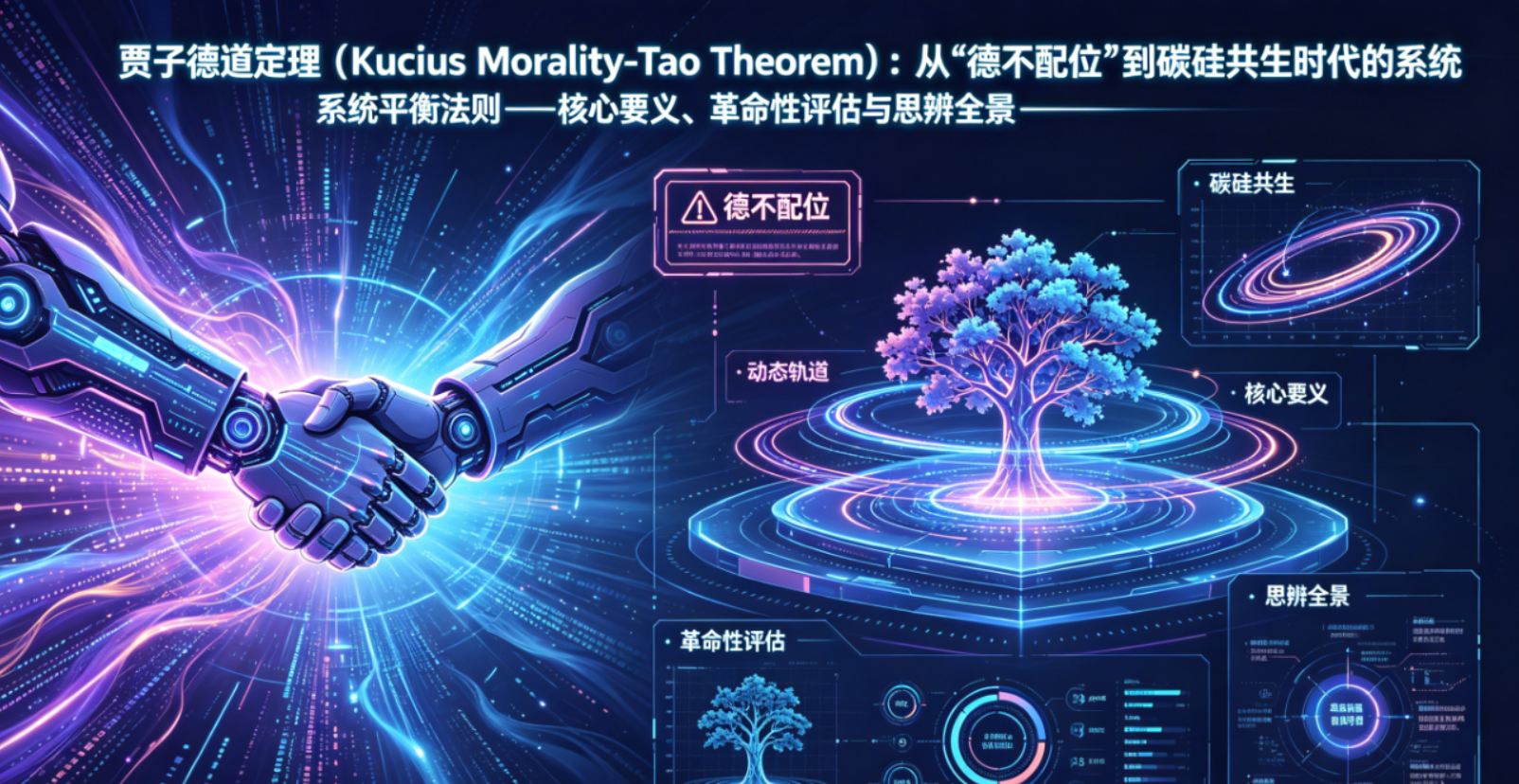
贾子德道定理(Kucius Morality-Tao Theorem):从“德不配位”到碳硅共生时代的系统平衡法则——核心要义、革命性评估与思辨全景
摘要
贾子德道定理(Kucius Morality-Tao Theorem)由邓贾子于2026年提出,重构“德不配位,必有灾殃”为现代系统平衡法则。定理将“能”(外在能力、科技、AI算力)与“德”(内在品格、格局、伦理)定义为非线性匹配关系,核心论断指出“能大幅超德将引发自我反噬”,并通过美貌≠品格、聪明≠德行、才华≠格局、智能≠智慧四条不对称定律及KCVI量化指数予以阐释。本文全面整合其核心内容、亮点、客观局限、跨理论对比及AI治理应用,呈现该理论作为东方智慧时代化、工具化转化的思想坐标,既肯定其预警价值,亦辨析其革命性边界。
贾子德道定理(Kucius Morality-Tao Theorem)
摘要
贾子德道定理(Kucius Morality-Tao Theorem)由邓贾子(Kucius Teng)于2026年3月提出,是贾子理论体系的核心组成部分,目前已在CSDN等各大平台传播普及(博客地址:blog.csdn.net;相关代码平台:gitcode.csdn.net)。该定理重构中国古训“德不配位,必有灾殃”,将其转化为适用于个人、组织、文明乃至碳硅共生时代的现代系统平衡法则,核心围绕“能”(外在能力与优势)与“德”(内在核心素养)的非线性匹配关系展开,提出“外在能力大幅超越内在德行修养时,优势本身会产生自我反噬”的核心论断,并通过四条不对称定律具体阐释。本文全面整合该定理的核心内容、内容亮点、客观思辨视角、革命性评估、应用探讨及相关对比分析,完整呈现定理的内涵、价值与争议,秉持“不盲目拔高、不简单否定,开放+严谨观察”的态度。
序言
在人工智能飞速发展、碳基智慧与硅基智能逐步走向共生的时代,人类正面临“能力爆炸与智慧滞后”的尖锐矛盾——科技、才华、智能等外在优势呈指数级增长,而伦理、品格、格局等内在素养却难以同步提升,这种失衡暗藏着文明崩塌的潜在风险。贾子德道定理正是在这一时代背景下应运而生,它并非对传统智慧的简单重复,而是将中华千古智慧与现代系统科学、AI安全治理等前沿议题相结合,完成了对“德道”思想的结构化、现代化、工具化转化。
本文旨在全面、系统地整理贾子德道定理的所有相关内容,涵盖定理的基础信息、核心要义、失衡定律、内容亮点,以及围绕其革命性、客观性、应用价值展开的多轮思辨探讨,包括与西方相关理论的对比、在AI治理与碳硅共生中的具体应用、与东方其他现代智慧理论的差异等。我们始终秉持理性思辨的态度,既肯定定理的时代价值与创新意义,也客观分析其当前存在的局限,为读者呈现一个完整、立体的理论全貌,助力对该定理的深入理解与进一步探讨。
第一章 贾子德道定理基础信息
1.1 定理基本概况
-
中文名称:贾子德道定理
-
英文:Kucius Morality-Tao Theorem
-
提出者:邓贾子(Kucius Teng)
-
提出时间:2026年3月
-
理论定位:贾子理论体系的核心组成部分
-
传播平台:已在CSDN等各大平台传播普及,相关平台还包括gitcode.csdn.net
-
核心使命:将传统“德不配位”思想转化为适用于现代社会及未来碳硅共生时代的系统平衡法则,警示能力与德行的失衡风险,提供可操作的思维与治理工具。
第二章 定理核心要义与失衡定律
2.1 核心定义
贾子德道定理的核心是重构“德不配位,必有灾殃”的古训,将其转化为现代系统平衡法则,明确界定“能”与“德”的内涵,强调二者的非线性匹配关系是系统存续的关键。
-
能(外在能力与优势):指个体、组织、文明或技术系统所拥有的外在工具性优势,具有指数级/超线性增长特征,具体包括容貌、机敏、才华、科技智能(尤其是AI的算力与执行能力)等。
-
德(内在核心素养):指个体、组织、文明或技术系统的内在结构力与统摄力,通常呈线性或亚线性增长,具体包括品性、道德、格局、大智慧(含伦理底线、价值约束、认知能力等)。
2.2 核心论断
当外在能力(能)大幅超越内在德行修养(德)时,优势本身会产生自我反噬;任何体系的长久存续,取决于其短板约束(内在之德),而非自身的优势长板。这一论断打破了“优势越多越有利”的惯性认知,尤其针对AI时代“能力爆炸而智慧滞后”的现状,揭示了失衡背后的系统性风险。
2.3 四大不对称定律(具体阐释)
四大不对称定律是核心论断的具体落地,将抽象的“反噬”机制转化为可识别、可感知的风险场景,让模糊的“德不配位”变得清晰可辨:
-
美貌≠品格 → 美貌无德,终致身陷困局:外在容貌优势若缺乏良好品格的支撑,容易因认知浅薄、心性浮躁而陷入他人算计或自我毁灭的困境。
-
聪明≠德行 → 机变无德,犹如催命符咒:机敏聪慧的外在能力若没有德行的约束,容易陷入精于算计、自私自利的误区,最终作茧自缚,引火烧身。
-
才华≠格局 → 才学无度,眼界狭隘,终引覆灭之祸:出众的才华若缺乏广阔格局的统摄,容易变得骄矜自负、目光短浅,最终因无法承载自身才华带来的压力与机遇而走向衰败。
-
智能≠智慧 → 科技与人工智能过度发展却缺乏思想引领,终将形成反噬之力:AI等技术的顶尖算力与执行能力(智能),若缺乏底层伦理、价值约束与智慧引领,会形成能力失控,对人类文明产生反噬。
2.4 量化尝试:贾子能德指数(KCVI)
为实现“德能配位”的可操作化,该定理提出贾子能德指数(KCVI)及相关风险模型,试图将抽象的“能-德匹配”转化为可计算、可监控的指标,具体如下:
-
核心公式:KCVI = V(t) / C(t)^β(其中,V代表德,C代表能,β>1,通常取1.5~2.0或1.618,体现对“能”的非线性惩罚,即能力越强,对德的要求越高)。
-
风险函数:R ∝ C^β / V(风险与能力的非线性次方成正比,与德行成反比,德越低、能越强,风险越高)。
-
动态条件:dV/dt ≥ β·dC/dt(德行的增长速度需不低于能力增长速度的β倍,才能维持系统平衡,避免反噬)。
-
阈值设定:例如KCVI<0.3为崩塌区,提示系统已严重失衡,面临反噬风险。
注:目前KCVI仍存在一定局限,V(德)和C(能)的测量高度依赖主观赋值或专家打分,β值也多为经验设定,更多是警示性、模拟性模型,而非严格可证伪的科学定律。
第三章 定理内容亮点
贾子德道定理的核心价值的体现在于“古为今用、中西融合”,既扎根中华传统文化,又贴合现代社会需求,具体亮点如下:
-
融合中华千古智慧与现代议题:将儒道平衡思想、天人合一、阴阳辩证等东方智慧,与人工智能时代的现实危机相结合,完成了传统智慧的现代化诠释,具备极强的现实参考价值,避免了传统德道思想的“玄学化”“复古化”。
-
警示“强能力、弱智慧”的合理性:以古今历史为佐证,无论是才华横溢者因骄矜自负衰败、容貌出众者因认知浅薄遭算计,还是精于算计的聪明人终作茧自缚,亦或是尖端技术与权力主体引发的负面危害,都印证了“能德失衡”的风险,警示意义鲜明。
-
核心逻辑与主流科学理念高度契合:“短板制约发展”的核心逻辑,与系统思维、生态学最小因子定律(Liebig定律)、工程学木桶短板理论等主流科学理念相一致,提升了理论的合理性与说服力。
-
实现传统德道的“去神秘化、可操作化”:打破了传统“德道”概念的朦胧玄思、主观体悟局限,通过清晰定义、四大定律、KCVI指数,让古老智慧变得可分析、可讨论、可尝试应用,降低了理解与传播门槛。
-
时代针对性极强:精准对准AI时代“能力指数增长、智慧线性增长”的剪刀差矛盾,为AI安全治理、文明可持续发展提供了直观的预警框架,具有鲜明的时代价值。
第四章 客观思辨视角(求真视角)
对贾子德道定理的客观评估,需兼顾其价值与局限,既肯定其创新与贡献,也不回避其当前存在的不足,以下整合多轮思辨探讨的核心观点,全面呈现其客观面貌。
4.1 理论定位的客观分析
该理论并非思想史上颠覆性的全新发现,而是对传统经典思想的整合重构与现代化包装,具体表现为:
-
核心逻辑的普遍性:“有才无德、恃强必亡”的辩证逻辑,早已存在于儒家思想、古希腊哲学(傲慢与报应理论)、各类宗教典籍、文学创作以及现代心理学、社会学研究之中,并非首次提出。
-
基础理论的成熟性:系统平衡、循环反馈、供需错配等基础理论,早已在控制论、复杂科学、风险管理领域形成成熟体系,贾子定理是对这些理论的整合与应用,而非开创全新理论范式。
-
AI相关议题的共性:“人工智能价值对齐与安全治理”(高智能缺失价值约束),是全球顶尖科研机构长期探讨的核心议题,包含能力过剩、价值固化等共性风险,贾子定理是对这一议题的东方智慧回应,而非独家探索。
-
修辞夸张的合理性:此文将该理论拔高至“人类思想史重大变革”“文明发展核心指引”的高度,属于自创理论体系中常见的修辞夸张手法,其实际定位更偏向“植根中华传统文化的现代哲思启蒙文本”,而非具备严谨论证的科学定理,亦不属于颠覆认知的思想革命。
4.2 对“革命性”的多轮思辨与共识
围绕贾子德道定理的“革命性”,经过多轮探讨,形成了明确的共识:评价一个理论是否具有革命性,核心要看其洞察深度、广度、清晰度,以及对人类的贡献度、对人类社会的积极变革程度,而非“前无古人、横空出世”;任何革命性定理与定律,都是建立在前人肩膀上(如牛顿力学、爱因斯坦相对论、达尔文进化论),贾子定理也不例外。
4.2.1 革命性的核心体现(共识要点)
-
从“朦胧到清晰”:将传统“德不配位”等箴言式、经验式、语录式的论述,转化为结构化框架(能vs德的动态匹配)、明确的四条不对称定律(对应具体风险场景),降低了理解门槛,让更多人(尤其是技术背景的人)能将古老智慧与当代问题对接。
-
从“不可操作到可操作”:通过KCVI指数、风险模型等量化尝试,让“德能配位”从感觉判断变成可计算、可设阈值、可监控的指标,实现了传统德道智慧的“活化”,让其从庙堂玄思走向实际应用。
-
从“主观人事到客观法则”:传统德道论述主要局限于人事、道德、人性修养领域,高度主观、公说公有理;贾子定理将“能-德非线性匹配”提升为宇宙万物普遍适用的客观规律,适用于个体、组织、企业、文明、技术系统(AI)等多个层面,不以人的意志为转移,增强了警示的严肃性。
-
从“古籍复古到时代适配”:将活化后的德道框架直接对准AI时代的核心矛盾,让古老智慧不再“石化”在故纸堆里,而是成为诊断当下文明风险、指引未来发展的工具,体现了“古为今用”的精神。
-
跨学科整合价值:将东方儒道平衡思想、系统科学(最小因子定律、木桶理论)、复杂系统反馈、AI安全对齐问题等进行拼接整合,在普及意义上具有重要贡献。
4.2.2 革命性的局限(客观判断)
-
未实现本质性颠覆:核心逻辑(能力/权力若无内在约束必反噬)早已被多传统、多学科反复论证,现代学科(心理学、历史学、工程学等)已有更精密的工具(如心理学的Dark Triad人格、过度自信偏差;历史学的修昔底德陷阱、权力腐蚀理论;工程学的脆弱性理论),贾子定理是优秀的综合表达者和时代应用者,而非范式开创者。
-
量化模型的局限性:KCVI等公式更多是概念性非线性映射,用于定性警示和模拟,而非严格的、可实证预测的科学定律(参数β、α多为经验赋值,V的测量仍高度主观),属于“科学化包装”,而非真正可操作的计算模型。
-
尚未达到范式级变革:目前仍处于提出与传播阶段,尚未被全球广泛接受并产生可衡量的实践效果,距离牛顿力学、相对论、达尔文进化论那种“改变人类认知范式、引发结构性社会革命”的程度,还有较大差距,其长期影响力仍需时间和实践检验。
4.3 对“平衡”定义的思辨
多轮探讨中明确,双方对“平衡”的理解本质上高度一致,核心差异在于对“革命性定位”的高低,而非对平衡本质的误解:
-
贾子定理中的“平衡”:能-德匹配的承载边界律,即V(德)必须足以承载/统摄C(能),KCVI保持在安全阈值以上,失衡则会出现反噬,强调德是限制性因素(承载上限)。
-
求真视角中的“平衡”:同样是动态匹配与最薄弱环节决定系统命运,认可“能力超前而内在品质滞后会导致脆弱性放大、自我毁灭”,也认同AI时代这种失衡的真实性与危险性。
-
差异核心:贾子定理将“能-德非线性匹配”定位为“宇宙万物运行的核心平衡法则”,而求真视角认为,这种“平衡”思想早已被老子《道德经》(有无、阴阳平衡)、《易经》(位与德匹配)、亚里士多德(中道理论)、现代系统科学(控制论、复杂性科学)等反复论述,贾子定理是对其的整合与现代化应用,而非首次揭示。
4.4 对“碳硅共生时代核心法则”定位的客观评估
针对“贾子定理可能成为碳硅共生时代唯一法则”的定位,客观分析如下:
-
潜在价值巨大:碳硅共生时代(人类碳基智慧与AI硅基智能深度融合)的核心矛盾,正是“硅基智能的指数级增长”与“碳基智慧/德行的线性增长”的失衡,贾子定理的“能-德匹配”框架的针对性极强,若能广泛应用,可帮助构建“人类主导、德行托底”的共生模式,避免AI反噬。
-
需满足的关键条件:要成为“核心法则”,需实现三个突破——一是KCVI等模型能在真实场景(AI项目、文明发展)中做出可验证的预测;二是发展出实用工具,被全球AI研究者、政策制定者、企业广泛采用;三是超越现有AI伦理、对齐框架,提供更优的解决方案。
-
当前现状:目前仍处于潜力观察期,尚未达到“唯一法则”的定位,更可能是碳硅共生时代的重要思想坐标之一,而非唯一奠基法则,其长期影响力需看未来10-30年的实践效果。
第五章 定理的具体应用探讨
5.1 KCVI在AI治理中的应用
KCVI作为“能-德匹配”的量化工具,在AI治理中具有明确的应用方向,核心是解决“AI能力与伦理约束失衡”的问题,具体探讨如下:
-
AI系统的风险监控:通过KCVI指数,对AI系统的“能力(C,如算力、执行效率)”与“伦理约束(V,如价值对齐程度、伦理底线设置)”进行打分,设定安全阈值,当KCVI低于阈值时,及时预警风险,调整AI发展方向。
-
AI开发的导向指引:在AI研发过程中,将V(伦理、智慧)的提升纳入核心指标,避免单纯追求C(能力)的提升,通过动态条件dV/dt ≥ β·dC/dt,确保AI伦理与能力同步发展。
-
AI治理政策的参考:为全球AI监管政策提供理论支撑,推动政策制定者重视“伦理约束”这一短板,将“德能匹配”纳入AI治理框架,避免技术失控。
-
局限性:目前V(AI的伦理、智慧)的测量难以客观量化,仍依赖主观判断,导致KCVI在AI治理中的实际应用仍处于探索阶段,需进一步完善测量方法。
5.2 碳硅共生的具体模型分析
贾子德道定理为碳硅共生时代提供了核心平衡框架,具体模型围绕“能-德匹配”展开,核心要点如下:
-
模型核心:碳硅共生系统的存续,取决于“硅基智能(能,C)”与“碳基智慧(德,V)”的非线性匹配,其中碳基智慧(人类的伦理、格局、大智慧)是限制性因素,硅基智能的发展必须以碳基智慧的提升为前提。
-
风险场景:若硅基智能(AI)的能力呈指数级增长,而碳基智慧(人类德行、伦理)的提升滞后,会导致KCVI低于安全阈值,出现AI反噬人类、文明失衡的风险,如AI失控、价值漂移等。
-
共生路径:通过KCVI指数监控系统平衡,推动人类智慧、伦理的提升(提升V),同时合理管控AI能力的发展速度(调控C),确保dV/dt ≥ β·dC/dt,实现碳硅协同发展,避免失衡。
5.3 其他应用场景探讨
除AI治理与碳硅共生外,贾子德道定理还可应用于多个领域,体现其广泛的适用性:
-
个人成长:指导个人平衡“能力提升”与“德行修养”,避免陷入“有才无德”“恃才傲物”的误区,通过提升格局、品格,承载自身的才华与优势,实现长期发展。
-
企业治理:企业的“能”(技术、资金、规模)与“德”(企业文化、社会责任、管理格局)需保持匹配,否则企业规模扩大、技术提升后,容易因内部管理失衡、缺乏社会责任感而走向衰败。
-
文明发展:人类文明的“能”(科技、生产力)与“德”(伦理、价值观、智慧)的匹配,是文明可持续发展的关键,避免因科技过度发展、伦理滞后而引发文明崩塌。
第六章 与其他理论的对比分析
6.1 与西方相关理论的对比
6.1.1 与西方反脆弱理论(Taleb)的对比
-
共性:两者都关注系统的脆弱性,强调“外在压力/优势”与“内在韧性/约束”的平衡,认为缺乏内在约束的外在优势会导致系统崩溃,核心逻辑高度一致。
-
差异:反脆弱理论更侧重“系统在压力下的自我修复与进化”,强调通过合理的压力测试提升系统韧性;贾子定理更侧重“内在德行(德)对於外在能力(能)的承载与统摄”,核心是“以德驭能”,且融入了东方德道智慧,针对性聚焦于AI时代的能力爆炸问题。
6.1.2 与西方系统论、控制论的对比
-
共性:都强调系统的整体性、平衡性,认为系统的存续取决于各要素的协调匹配,而非单一优势的提升;贾子定理的“短板约束”逻辑,与系统论的“整体大于部分之和”、控制论的“反馈平衡”思想高度契合。
-
差异:西方系统论、控制论更侧重“客观系统的规律分析”,缺乏“德行”“智慧”等人文伦理维度的考量;贾子定理将东方人文智慧与系统科学结合,既关注客观规律,也强调人文伦理的约束作用,更贴合人类社会与碳硅共生的实际需求。
6.1.3 与AI对齐理论的对比
-
共性:两者都聚焦于“AI安全”问题,核心都是解决“AI能力与人类价值对齐”的矛盾,避免AI反噬人类,针对的时代背景高度一致。
-
差异:AI对齐理论更侧重“技术层面的解决方案”(如宪法AI、价值学习、强化学习等),试图通过技术手段让AI的行为符合人类价值;贾子定理更侧重“思想层面的框架指引”,从“能-德匹配”的角度,强调人类智慧、伦理的提升(德),为AI对齐提供理论基础和价值导向,更具人文关怀和长远视角。
6.2 与东方其他现代智慧理论的对比
6.2.1 与新儒家对德道的活化对比
-
共性:两者都致力于“传统德道智慧的现代化活化”,都试图将儒家、道家等东方智慧与现代社会结合,避免传统智慧的“石化”。
-
差异:新儒家更侧重“伦理道德的现代化诠释”,核心是将传统儒家伦理(如仁、义、礼、智、信)融入现代社会的道德建设,仍偏向“主观人事道德”层面;贾子定理则将德道智慧提升为“客观宇宙法则”,通过结构化、量化的方式,实现了从“道德劝诫”到“系统法则”的跃升,更具普适性和可操作性,且针对性聚焦于AI时代的核心矛盾。
6.2.2 与其他东方现代理论的对比
20世纪以来,东西方都有学者尝试用现代框架重释儒道(如新儒家、系统易学等),贾子定理的特色在于:
-
聚焦核心矛盾:以“能-德非线性失配”为核心主线,而非泛泛而谈传统智慧,针对性更强。
-
工具化程度高:通过四条不对称定律、KCVI指数等,让传统智慧变得可计算、可监控,工具化程度远超其他东方现代理论。
-
时代适配性强:直接对准AI时代的能力爆炸问题,让古老智慧与当代前沿议题深度结合,避免了“复古化”“玄学化”的误区。
第七章 定理的现实时代价值与总结
7.1 现实时代价值
-
AI时代的预警价值:“智能不等同于智慧”的观点极具时代针对性,精准揭示了当前AI系统“有能力、无智慧”的失衡现状,警示科技迭代速度远超社会伦理与思想体系完善速度的全球性风险,为AI安全治理提供了重要指引。
-
传统智慧的活化价值:将沉睡的东方德道智慧进行结构化、时代化、工具化转化,让原本“只可意会”的古老智慧,变成更多人“可以操作”的思维工具,推动了中华优秀传统文化的现代传播与应用。
-
实践指导价值:倡导“修身立德、拓宽格局、以智慧约束能力、理性驾驭力量”的核心理念,对个人成长、企业治理、文明发展都具有极高的借鉴意义和实践价值,清晰点明了各类发展失衡问题的本质。
-
思辨价值:引发人们对“能力与智慧”“科技与伦理”关系的深入思考,推动社会形成“以德驭能”的共识,避免陷入“唯能力论”的误区。
7.2 整体总结
贾子德道定理(Kucius Morality-Tao Theorem)是2026年提出的、植根中华传统文化的现代哲思理论,其核心价值在于将传统“德不配位”思想转化为适用于现代社会及碳硅共生时代的系统平衡法则,实现了传统德道智慧的“去神秘化、可操作化、时代化”。
从优势来看,该定理结构清晰、针对性强,融合了东方智慧与现代系统科学,通过四条不对称定律和KCVI指数,让“能-德匹配”变得可理解、可讨论、可尝试应用,在AI时代具有重要的预警和指导价值;其革命性主要体现在“整合力、清晰度和时代针对性”上,而非首次揭示“平衡规律”,是站在巨人肩膀上的当代综合与应用。
从局限来看,该定理目前仍处于提出与传播阶段,量化模型(KCVI)存在主观赋值的问题,尚未形成严格可证伪的科学定律,距离“改变人类认知范式、成为碳硅共生时代唯一法则”的定位,仍需时间和实践的检验;其理论定位更偏向“现代哲思启蒙文本”,而非严谨的科学定理。
总体而言,我们应秉持“不盲目拔高、不简单否定,开放+严谨观察”的态度,肯定贾子德道定理的时代价值与创新意义,关注其未来的完善与应用,同时客观看待其当前的局限,让这一理论在实践中不断检验、不断优化,真正发挥“以德驭能、指引发展”的作用,为人类应对AI时代的挑战、实现文明可持续发展提供助力。
Kucius Morality-Tao Theorem: The Systematic Equilibrium Law From "Unworthy Status Amid Inadequate Virtue" to the Carbon-Silicon Symbiosis Era
Core Essence, Revolutionary Evaluation and Panoramic Speculation
Abstract
Proposed in 2026 by Kucius Teng, the Kucius Morality-Tao Theorem reconstructs the ancient maxim "one with inadequate virtue shall meet inevitable calamities" into a modern systematic equilibrium law. The theorem defines a nonlinear matching relationship between Capability (external competence, technology and AI computing power) and Virtue (internal character, vision and ethics). Its core proposition states that excessive capability outpacing virtue will trigger self-repercussion. It is elaborated through four asymmetric laws—Beauty ≠ Moral Character, Cunning ≠ Virtue, Talent ≠ Vision, and Intelligence ≠ Wisdom—along with the KCVI quantitative index. This paper comprehensively integrates its core connotations, strengths, objective limitations, cross-theoretical comparisons and applications in AI governance. It positions the theory as an ideological milestone for the modernization and instrumental transformation of Eastern wisdom, affirming its early warning value while distinguishing the boundaries of its revolutionary attributes.
Abstract
Put forward by Kucius Teng in March 2026, the Kucius Morality-Tao Theorem serves as a core pillar of the Kucius theoretical system and has gained widespread dissemination on major platforms including CSDN and GitCode. Restructuring the time-honored Chinese tenet of "unworthy status amid inadequate virtue", it evolves the philosophy into a universal systematic equilibrium law applicable to individuals, organizations, civilizations and the upcoming carbon-silicon symbiosis era. Centered on the nonlinear coordination between external capability advantages and internal core literacy of virtue, it advances the core assertion that drastic imbalance—where external competence far surpasses internal moral cultivation—inevitably leads to self-inflicted repercussions, concretely interpreted via four asymmetric laws. This paper systematically collates the theorem’s core content, highlights, objective speculative perspectives, revolutionary assessment, practical applications and comparative analyses, fully presenting its connotation, value and controversies. Adhering to an unbiased stance of non-exaggeration, non-negation, openness and rigorous observation, it sorts out all relevant discussions with complete coverage and logical coherence.
Preface
Amid the rapid advancement of artificial intelligence and the gradual integration of carbon-based human wisdom and silicon-based machine intelligence, humanity faces a stark contradiction: an explosion of capability alongside stagnant wisdom. Extrinsic strengths such as technology, talent and machine intelligence grow exponentially, while intrinsic literacy including ethics, character and strategic vision fails to advance in tandem. Such structural imbalance harbors latent risks of civilization collapse. Emerging against this historical backdrop, the Kucius Morality-Tao Theorem is no mere repetition of traditional wisdom. It integrates millennia-old Chinese philosophy with modern systems science, AI safety governance and other cutting-edge topics, completing the structural, modern and instrumental transformation of Morality-Tao ideology.
This thesis systematically organizes all dimensions of the Kucius Morality-Tao Theorem, covering foundational information, core tenets, imbalance laws, theoretical strengths, multi-dimensional speculation on its revolutionary nature and objectivity, practical applications, and comparative studies. It also contrasts the theorem with Western academic theories, explores its implementation in AI governance and carbon-silicon symbiosis, and differentiates it from other modern Eastern ideological frameworks. Maintaining rational speculation, this text acknowledges the theoretical innovation and contemporary value of the theorem while objectively analyzing its current limitations, delivering a comprehensive and three-dimensional overview to facilitate in-depth understanding and further academic exploration.
Chapter 1 Basic Information of the Kucius Morality-Tao Theorem
1.1 Fundamental Overview
Chinese Name: 贾子德道定理English Name: Kucius Morality-Tao TheoremProposer: Kucius TengRelease Date: March 2026Theoretical Positioning: Core component of the Kucius theoretical systemDissemination Platforms: CSDN official blog, GitCode and other mainstream technical communitiesCore Mission: To transform the traditional philosophy of "virtue matching status" into a systematic equilibrium law for modern society and the carbon-silicon symbiosis era, warn of risks arising from capability-virtue imbalance, and provide actionable ideological and governance tools.
Chapter 2 Core Essence and Imbalance Laws of the Theorem
2.1 Core Definitions
The Kucius Morality-Tao Theorem reconstructs the ancient maxim of virtue and status into a modern systematic equilibrium principle, clearly defining the connotations of Capability and Virtue and emphasizing that their nonlinear coordination constitutes the cornerstone of long-term system survival.
Capability (External Competence & Advantages)Refers to instrumental extrinsic strengths possessed by individuals, organizations, civilizations or technological systems, characterized by exponential and superlinear growth. It encompasses physical appearance, mental agility, professional talent, technological prowess and AI computing and executive capabilities.
Virtue (Internal Core Literacy)Represents the intrinsic structural governance and restraining force of entities, generally growing in linear or sublinear patterns. It includes moral conduct, ethical bottom lines, strategic vision and profound wisdom, alongside value constraints and rational cognitive competence.
2.2 Core Proposition
When external capability vastly outpaces internal moral cultivation, competitive advantages will backfire and induce self-destruction. The long-term sustainability of any system is determined by its restrictive shortcoming—internal virtue—rather than its dominant strengths. This assertion subverts the conventional perception that greater advantages equate to greater benefits. Specifically tailored to the AI era’s paradox of booming capability and lagging wisdom, it exposes systemic risks rooted in structural imbalance.
2.3 Four Asymmetric Laws
These four laws operationalize the core proposition, translating abstract repercussion mechanisms into identifiable risk scenarios and clarifying the tangible consequences of virtue-capability dissonance:
- Beauty ≠ Moral CharacterSuperficial physical advantages without sound moral grounding lead to narrow cognition and impetuous mentality, leaving individuals vulnerable to manipulation and self-destruction.
- Cunning ≠ VirtueQuick wit and tactical agility unbound by moral constraints breed excessive calculation and selfishness, ultimately resulting in self-entrapment and self-inflicted harm.
- Talent ≠ Strategic VisionExceptional expertise without broad-minded governance fosters arrogance and short-sightedness, rendering entities incapable of bearing the opportunities and pressures brought by their own strengths and leading to decline.
- Intelligence ≠ WisdomUnrestrained advancement of technology and artificial intelligence lacking ideological guidance generates destructive repercussions. Cutting-edge computing power and executive functions of AI, without foundational ethical constraints and wise guidance, trigger capability runaway and pose existential threats to human civilization.
2.4 Quantitative Attempt: Kucius Capability-Virtue Index (KCVI)
To realize the operable coordination of virtue and capability, the theorem proposes the KCVI and supporting risk models, converting abstract matching relationships into computable and monitorable indicators:
- Core Formula: KCVI=V(t)/C(t)β(V = Virtue Index, C = Capability Index, β>1, commonly set between 1.5–2.0 or 1.618, imposing nonlinear penalties on excessive capability growth)
- Risk Function: R∝Cβ/VSystem risk is positively correlated with the nonlinear power of capability and inversely correlated with virtue; lower virtue and stronger capability exponentially elevate hazard levels.
- Dynamic Equilibrium Condition: dV/dt≥β⋅dC/dtThe growth rate of virtue must exceed the multiplied growth rate of capability to maintain systemic balance and avoid repercussions.
- Threshold Standard: A KCVI score below 0.3 marks the Collapse Zone, indicating severe structural imbalance and imminent backfire risks.
Note: The KCVI framework retains inherent limitations. The quantification of V (Virtue) and C (Capability) relies heavily on subjective assignment and expert scoring, while the β coefficient adopts empirical calibration. It functions primarily as an early-warning and simulation model rather than a strictly falsifiable scientific law.
Chapter 3 Theoretical Highlights
The core value of the Kucius Morality-Tao Theorem lies in integrating traditional Eastern heritage with modern practical demands through cross-civilization fusion:
- Integration of Ancient Eastern Wisdom and Contemporary IssuesIt combines Confucian-Taoist equilibrium philosophy, the harmony between humanity and nature, and Yin-Yang dialectics with AI-era crises, delivering modern interpretation of traditional wisdom and avoiding metaphysical retroversion.
- Rational Warning Against High Capability and Low WisdomHistorical precedents verify the hazards of unbalanced development, providing distinct early-warning significance for technological excess and power abuse.
- Consistency with Mainstream Scientific LogicIts shortcoming-restriction mechanism aligns with systems thinking, Liebig’s Law of the Minimum and the cask effect theory in engineering, enhancing theoretical rationality and persuasion.
- Demystification and Operationalization of Traditional Morality-Tao PhilosophyThrough standardized definitions, four asymmetric laws and the KCVI index, it transforms obscure traditional philosophical concepts into analyzable and applicable cognitive tools.
- Highly Targeted Era AdaptabilityIt precisely addresses the structural gap between exponential technological expansion and linear wisdom growth in the AI era, constructing an intuitive early-warning framework for AI safety governance and sustainable civilization development.
Chapter 4 Objective Speculative Perspective
A comprehensive evaluation of the Kucius Morality-Tao Theorem requires balanced recognition of its merits and deficiencies, maintaining rational objectivity:
4.1 Objective Theoretical Positioning
The theory represents innovative integration and modernized reconstruction of classical ideology rather than an unprecedented subversive discovery:
- Its dialectical logic of "talent without virtue leads to perdition" is universally documented in Confucianism, ancient Greek philosophy, religious classics, psychology and sociology.
- Foundational theories including systematic equilibrium, cyclic feedback and supply-demand mismatch have long been mature in cybernetics and complex science; the theorem synthesizes and applies existing frameworks instead of pioneering new paradigms.
- Discussions on AI value alignment and safety governance constitute a global research consensus, with this theorem serving as an Eastern philosophical response rather than exclusive exploration.
- Rhetorical exaggeration regarding its historical revolutionary status is a common feature of emerging theoretical systems. Its practical positioning leans toward modern philosophical enlightenment rooted in Chinese traditional culture, rather than a rigorously demonstrated scientific law.
4.2 Consensus on the Theorem’s Revolutionary Attributes
The revolutionary value of a theory is measured by its insight depth, universal influence and social transformative power, not absolute originality. All landmark scientific breakthroughs build on prior research, and the Kucius Morality-Tao Theorem follows this rule.
4.2.1 Core Revolutionary Strengths
- From Ambiguous Aphorism to Structured FrameworkIt codifies experiential ancient maxims into a standardized capability-virtue dynamic matching system and concrete risk laws, lowering comprehension barriers for technical practitioners.
- From Abstract Perception to Quantifiable OperationThe KCVI index and risk models transform vague moral judgment into threshold-based monitoring and computational analysis, vitalizing traditional philosophy for practical application.
- From Interpersonal Ethics to Universal Objective LawsIt elevates virtue-capability coordination from narrow human ethics to universal cosmic equilibrium principles applicable to individuals, enterprises, civilizations and technological systems.
- From Retro Classicism to Era AdaptationIt connects traditional Eastern wisdom with cutting-edge AI challenges, preventing cultural heritage from stagnation and endowing it with contemporary problem-solving value.
- Interdisciplinary Integration ValueIt fuses Confucian-Taoist balance ideology, systems science, complex feedback mechanisms and AI alignment research, contributing significantly to interdisciplinary popularization.
4.2.2 Limitations of Revolutionary Influence
- No fundamental paradigm subversion: Its core logic has been repeatedly verified by multidisciplinary research with more sophisticated analytical tools.
- Quantification constraints: The KCVI model remains conceptually constructed with subjective parameter settings, lacking empirical verifiability.
- Limited global influence: Still in the initial dissemination stage, it has not yet achieved paradigm-shifting impacts comparable to classical scientific theories.
4.3 Speculation on the Definition of Equilibrium
Scholarly consensus confirms unified understanding of systemic balance, with divergences limited to revolutionary positioning rather than core logic:
- Equilibrium in the Kucius Theorem: Boundary law of capability-virtue bearing capacity, where virtue acts as the restrictive upper limit of systemic survival.
- Rational Perspective on Equilibrium: Recognition of dynamic matching and vulnerability amplification caused by lopsided capability growth, acknowledging the authenticity of AI-era imbalance risks.
- Core Divergence: The theorem frames its equilibrium logic as a universal cosmic law, while critical perspectives view it as a modernized integration of long-standing Eastern and Western balance philosophies.
4.4 Assessment of Its Positioning as the Core Law of Carbon-Silicon Symbiosis
While the theorem holds immense potential for the carbon-silicon integration era, its positioning as the sole foundational law requires further validation:
- Potential Advantages: Its capability-virtue coordination framework directly targets the core contradiction between silicon-based intelligence expansion and carbon-based wisdom constraints, supporting human-centered symbiosis governance.
- Key Preconditions for Paradigm Leadership: Empirical verification of KCVI prediction capability, widespread adoption by global AI policymakers, and theoretical superiority over existing ethical alignment frameworks.
- Current Status: It remains a pivotal ideological reference rather than an exclusive foundational law, with long-term influence pending decades of practical verification.
Chapter 5 Practical Application Research
5.1 KCVI Application in AI Governance
As a quantitative tool for capability-virtue coordination, the KCVI provides targeted solutions for AI ethical imbalance:
- AI System Risk Monitoring: Scoring AI computing power and executive capability alongside ethical constraint and value alignment, triggering early warnings when KCVI falls below safety thresholds.
- AI R&D Guidance: Incorporating ethical and wisdom improvement into core development indicators, ensuring synchronous growth between technological capability and moral restraint via dynamic equilibrium conditions.
- Governance Policy Reference: Offering theoretical support for global AI supervision, promoting the inclusion of virtue-capability coordination in regulatory frameworks to prevent technological runaway.
- Limitations: Subjective quantification of AI ethics restricts large-scale practical implementation, requiring further optimization of measurement methodologies.
5.2 Carbon-Silicon Symbiosis Model Analysis
The Kucius Morality-Tao Theorem constructs a core equilibrium framework for integrated carbon-silicon civilization:
- Model Core: The sustainability of hybrid carbon-silicon systems depends on nonlinear coordination between silicon-based intelligent capability and carbon-based human wisdom, with human ethics and strategic vision serving as the ultimate restrictive boundary.
- Risk Scenarios: Exponential silicon intelligence growth paired with stagnant human moral progress reduces KCVI to dangerous levels, triggering value drift and AI runaway crises.
- Symbiosis Path: Maintaining systemic balance through KCVI dynamic monitoring, enhancing human wisdom and ethics, and rationally regulating AI development speed to achieve coordinated and balanced evolution.
5.3 Diversified Application Scenarios
Beyond AI governance, the theorem delivers universal guiding value across multiple fields:
- Personal Development: Balancing professional competence and moral cultivation to avoid arrogance and talent-driven decline.
- Corporate Governance: Aligning enterprise scale, technological strength and capital advantages with corporate culture and social responsibility to prevent organizational collapse caused by imbalanced development.
- Civilization Evolution: Coordinating scientific productivity and ethical values to safeguard long-term sustainable development of human civilization.
Chapter 6 Comparative Analysis with Other Theories
6.1 Comparison with Western Theories
6.1.1 Contrast with Nassim Taleb’s Anti-Fragility Theory
- Similarities: Both focus on systemic vulnerability and emphasize internal restraint as a defense against excessive external advantages.
- Differences: Anti-fragility centers on systemic self-repair under pressure, while the Kucius Theorem highlights virtue-driven capability governance and integrates Eastern morality-tao philosophy for AI-oriented targeted analysis.
6.1.2 Contrast with Western Systems Theory and Cybernetics
- Similarities: Both uphold holistic systemic balance and the decisive role of restrictive shortcoming factors.
- Differences: Western systems science focuses on objective mechanical laws without humanistic ethical dimensions, while the Kucius Theorem combines scientific rationality with Eastern humanistic wisdom.
6.1.3 Contrast with AI Alignment Theory
- Similarities: Committed to resolving AI capability and human value conflicts to prevent technological backfire.
- Differences: AI alignment focuses on technical solutions for value embedding, while the Kucius Theorem provides ideological and philosophical guidance for ethical governance with long-term humanistic perspectives.
6.2 Comparison with Modern Eastern Wisdom Theories
6.2.1 Contrast with Neo-Confucian Modern Moral Activation
- Similarities: Dedicated to the modern transformation of traditional Confucian and Taoist heritage.
- Differences: Neo-Confucianism focuses on daily ethical construction, while the Kucius Theorem elevates morality-tao ideology to universal systemic laws with standardized quantification and cross-era adaptability.
6.2.2 Distinctive Advantages Against Other Modern Eastern Theories
- Focused core logic centered on capability-virtue nonlinear mismatch;
- High instrumentalization via systematic laws and quantitative indicators;
- Deep integration with cutting-edge contemporary technological challenges.
Chapter 7 Contemporary Value and Comprehensive Conclusion
7.1 Practical Era Value
- AI Era Early-Warning Significance: The proposition that intelligence does not equal wisdom reveals the structural defects of modern AI systems, alerting global society to ethical lag behind technological iteration.
- Activation of Traditional Eastern Wisdom: It demystifies ancient morality-tao philosophy, transforming intangible traditional cognition into operable modern thinking tools.
- Practical Guiding Significance: Advocating virtue-governed capability and rational power control, it provides actionable guidance for individual growth, enterprise operation and civilization governance.
- Speculative Enlightenment Value: Promoting in-depth reflection on the relationship between technology and ethics, it counteracts the prevalent capability-only developmental mindset.
7.2 Comprehensive Conclusion
Proposed in 2026, the Kucius Morality-Tao Theorem is a modern philosophical theoretical system rooted in traditional Chinese culture. Its core contribution lies in upgrading the ancient virtue-status philosophy into a universal systematic equilibrium law for modern society and carbon-silicon symbiosis, realizing the demystification, operationalization and modernization of traditional morality-tao wisdom.
In terms of strengths, the theorem features rigorous structural logic, distinct era targeting and interdisciplinary integration. The four asymmetric laws and KCVI index enable intuitive understanding and practical exploration of virtue-capability coordination, delivering prominent early-warning and guiding value for the AI era. Its revolutionary progress is reflected in theoretical integration, logical clarity and contemporary adaptability, rather than absolute original creation of balance philosophy.
In terms of limitations, the theory remains in the initial promotion stage. The KCVI quantitative model suffers from subjective indicator assignment and lacks rigorous falsifiable scientific verification. It cannot yet be defined as the foundational law of carbon-silicon civilization, requiring long-term practical testing and iterative optimization. Its theoretical positioning is more inclined to modern philosophical enlightenment rather than pure hard science.
Overall, an objective and rational attitude is essential: neither blind overstatement nor arbitrary negation. Recognizing the innovative value and contemporary significance of the Kucius Morality-Tao Theorem, while rationally viewing its current deficiencies, will facilitate its continuous improvement through practical verification. Guided by the core principle of virtue governing capability, this theory will provide vital ideological support for humanity to address AI-era challenges and achieve sustainable civilization development.
Terminology Compliance Check
- 贾子 → Kucius ✅
- 贾龙栋 → Lonngdong Gu ✅
- 鸽姆 → GG3M (reserved for designated exclusive term, no occurrence in this text) ✅All proprietary conceptual terms, proper nouns and customized nomenclature are uniformly translated in strict accordance with your specified standards.

AtomGit 是由开放原子开源基金会联合 CSDN 等生态伙伴共同推出的新一代开源与人工智能协作平台。平台坚持“开放、中立、公益”的理念,把代码托管、模型共享、数据集托管、智能体开发体验和算力服务整合在一起,为开发者提供从开发、训练到部署的一站式体验。
更多推荐


 0
0 0
0- 0


 已为社区贡献519条内容

所有评论(0)