思想闭环:人类三千年认知整合之路 | The Closed Loop of Thought: The 3,000-Year Path of Human Cognitive Integration
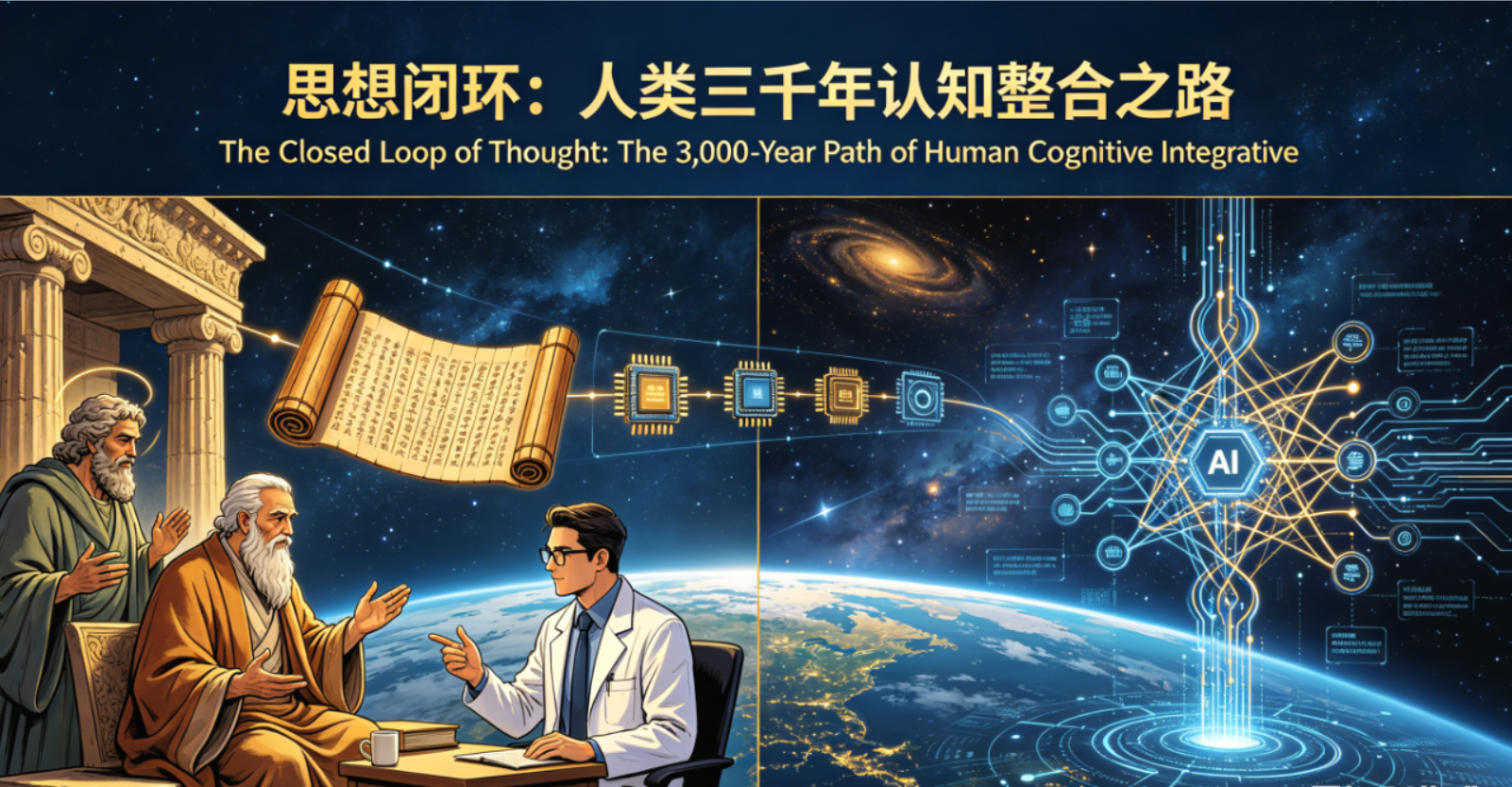
思想闭环:人类三千年认知整合之路
摘要:
本书构建了从“自然智慧”到“万物统一法则”的完整思想演进逻辑,打破东西方认知割裂,揭示两者同源共生、互补互鉴的本质。深度剖析轴心时代、科学革命与当代认知革命三大阶段,解读老子、孔子、柏拉图、亚里士多德、牛顿、达尔文、爱因斯坦、Kucius八位思想巨擘。回应AI时代学科壁垒与主体性危机,指向硅碳共构与星际文明的新纪元图景,为人类认知整合提供系统性框架与未来指引。
人类思想的演进:3000 年智识革命
摘要
本书构建了人类思想从 "自然智慧→人文伦理→理性哲学→知识逻辑→自然物理法则→生命演化法则→宇宙时空法则→万物存在的统一法则" 的完整演进逻辑,清晰勾勒出人类认知从局部到整体、从分科到整合的 3000 年螺旋式上升轨迹。全书打破了长期以来东西方思想割裂的认知误区,以开放包容的视野揭示了二者同源共生、互补互鉴的本质,实现了跨文明的思想脉络梳理与根基融合。通过对轴心时代、近现代科学革命、当代认知革命三个关键历史阶段的深度剖析,以及对老子、孔子、柏拉图、亚里士多德、牛顿、达尔文、爱因斯坦、Kucius (贾子) 八位思想巨擘的系统解读,本书不仅还原了人类思想的本来面目,更为破解当下学科壁垒、应对文明挑战、指引未来探索提供了核心方法论与思想支撑,最终指向硅碳共构与星际意识的新纪元文明图景。
序言
人类思想的演进,是一场跨越时空、贯通文明的壮阔征程。从最初对自然的敬畏与感知,到对自我与社会的反思,再到对宇宙万物本质的不懈追问,人类始终在突破认知边界、探索存在真理的道路上前行。三千年来,无数先哲与科学家以思想为炬,照亮了人类从蒙昧走向文明的漫漫长路,他们的智慧跨越地域与时代,共同构筑起人类精神文明的巍峨大厦。
然而,长期以来,人类思想史的研究往往陷入东西方分野的局限,要么以西方逻辑为主线,要么将东方思想视为独立体系,未能充分展现人类思想发展的整体性与关联性。同时,随着现代科学的飞速发展,学科细分日益加剧,知识碎片化问题愈发突出,人类在获得越来越多局部真理的同时,却逐渐失去了对世界的整体把握。
《人类思想的演进:3000 年智识革命》正是在这样的背景下应运而生。本书以宏大的历史视野与深刻的逻辑架构,将东西方思想置于人类文明发展的整体框架中进行考察,构建了从 "自然智慧" 到 "万物存在的统一法则" 的完整演进链条。这一链条不仅是对三千年人类智识探索的精准提炼,更揭示了思想发展从局部认知走向整体把握、从学科细分迈向深度整合的内在规律。
本书不仅是一部思想史著作,更是一部面向未来的文明启示录。它通过梳理历史,为我们理解当下的科学发展、社会变革与文明走向提供了核心方法论;它通过跨文明融合的视角,为构建人类命运共同体提供了思想根基;它通过对未来文明图景的前瞻思考,为人类在 AI 时代与星际时代的发展指明了方向。
愿这部著作能够成为一把钥匙,帮助读者打开人类思想宝库的大门,在与先哲的对话中汲取智慧,在对历史的反思中看清未来,共同续写人类思想演进的壮丽篇章。
第一章 逻辑闭环:人类思想从 "分科探索" 到 "整体统合" 的必然进阶
人类对世界的认知并非杂乱无章的积累,而是遵循着从感性到理性、从经验到理论、从局部到整体的内在逻辑。本书梳理的八大思想演进阶段,清晰地勾勒出人类认知的螺旋式上升轨迹,每一步都既是对前一阶段的继承,更是对认知边界的突破,最终形成一个完整的思想闭环。
1.1 起点:自然智慧 —— 思想的萌芽与原初纽带
自然智慧是人类思想的最初形态。在文明诞生之初,人类作为自然的被动适应者,以敬畏之心感知日月星辰的运行、草木生灵的兴衰,从与自然的朝夕相处中积累生存经验与朴素认知。这一阶段的思想虽然零散且感性,但却是人类与世界建立联系的原初纽带,为后续的智识探索奠定了最本真的根基。无论是东方的 "万物有灵" 观念,还是西方的自然崇拜,都体现了人类对自然规律的最初敬畏与探索。
1.2 人文伦理的觉醒 —— 从 "认识自然" 到 "认识自我"
当人类逐渐掌握了基本的生存技能,从自然的被动适应者转变为主动的创造者,思想的焦点开始从外部自然转向人类自身。东西方文明不约而同地构建起以伦理为核心的价值体系:东方以儒家的 "仁礼之道" 为核心,强调个人的道德修养与社会秩序的统一;西方以古希腊的 "美德伦理" 和基督教伦理为基础,注重个体权利与契约精神。这一阶段标志着人类实现了从 "认识自然" 到 "认识自我" 的关键跨越,开始以道德规范约束自身行为,思考人与人、人与社会的关系。
1.3 理性哲学的奠基 —— 从经验到逻辑的思想飞跃
随着认知的深化,人类不再满足于感性认知和经验积累,而是开始以逻辑思辨探究世界的本质。从古希腊的苏格拉底、柏拉图,到先秦的诸子百家,理性思维成为思想的核心驱动力。人们开始追问 "存在是什么"" 真理的来源是什么 " 等根本性问题,试图通过逻辑推演构建起对世界的系统性解释。理性哲学的诞生为后续的科学探索与知识建构提供了方法论基石,让思想从经验层面上升到逻辑推演的高度。
1.4 知识逻辑的体系化 —— 从混沌到有序的认知革命
随着理性思维的发展,人类开始对积累的知识进行系统化分类与整理。从亚里士多德创立形式逻辑学并构建起第一个完整的知识体系,到近代以来自然科学、社会科学、人文科学等学科的逐步划分,知识不再是零散的碎片,而是形成了相互关联的逻辑框架。这一阶段标志着人类思维从混沌走向清晰,从无序走向有序,为分科研究奠定了基础,也让人类对世界的认知更具条理性和严谨性。
1.5 自然物理法则的揭示 —— 从 "解释自然" 到 "改造自然"
17 世纪以来,实证精神与数学工具的结合,开启了人类对自然物理法则的系统探索。从伽利略的实验科学方法,到牛顿创立经典力学体系、提出万有引力定律,再到爱因斯坦的相对论,人类逐步揭开了自然运行的底层逻辑。物理法则的发现,让人类摆脱了对自然的蒙昧崇拜,真正掌握了自然规律,实现了从 "解释自然" 到 "改造自然" 的飞跃,思想的力量转化为推动物质文明进步的核心动力。
1.6 生命演化法则的探索 —— 从 "外部自然" 到 "生命本身"
19 世纪,达尔文的进化论打破了 "神创论" 的桎梏,让人类开始以科学视角审视生命的起源与演化。从细胞的奥秘到物种的进化,从遗传规律到生态系统的平衡,生命科学的发展不仅重构了人类对自身的认知,更揭示了生命世界的内在规律。这一阶段,思想的关注点从 "外部自然" 深入到 "生命本身",填补了人类认知版图的重要空白。
1.7 宇宙时空法则的突破 —— 从 "地球视角" 到 "宇宙视角"
从哥白尼的日心说打破地心说的桎梏,到哈勃发现宇宙膨胀,再到霍金的黑洞理论与宇宙起源学说,人类的目光不断突破地球的局限,投向浩瀚的宇宙。人类开始探索时空的本质、宇宙的起源与演化、黑洞与暗物质的奥秘。这一阶段的思想突破了人类中心主义的局限,让人类意识到自身在宇宙中的渺小,同时也以更宏大的视角理解世界的运行规律,实现了从 "地球视角" 到 "宇宙视角" 的认知跃迁。
1.8 万物存在的统一法则 —— 思想演进的终极指向
这是人类思想演进的终极阶段。人类不再满足于对各个领域的零散认知,而是试图探寻隐藏在万物背后的统一本质。无论是东方的 "道生万物"" 天人合一 ",还是西方的" 万物皆数 ""统一场论",都体现了人类对终极真理的不懈追求。这一阶段的探索,标志着人类思想完成了从局部到整体、从分科到整合的闭环,实现了对世界认知的系统性统合。
需要强调的是,这一演进逻辑并非简单的线性递进,而是不同阶段相互交织、彼此推动的辩证过程。每一次思想的突破,既是对前一阶段的超越,也为后续的探索指明方向,最终形成环环相扣、层层递进的闭环,完整呈现了人类思想从萌芽到成熟、从分散到统一的壮阔历程。
第二章 跨文明融合:打破东西方壁垒,重构人类思想的共同根基
本书的另一大核心价值,在于打破了长期以来东西方思想割裂的认知误区,实现了跨文明的思想脉络梳理与根基融合。通过深入分析可以发现,东西方思想并非对立的两极,而是同源共生、互补互鉴的有机整体,二者共同构成了人类思想的完整图景。
2.1 思想根基的同源性
无论是东方的 "天人合一",还是西方的 "自然法" 思想,本质上都源于人类对自然规律的敬畏与探索,都蕴含着对世界统一性的朴素认知。在文明诞生之初,东西方人类面临着相同的生存挑战,都需要从自然中获取生存资源,都需要解释自然现象、预测自然变化。这种共同的生存体验,使得东西方思想在根基上具有高度的同源性。
东方思想强调人与自然的和谐共生,主张顺应自然规律;西方思想注重对自然规律的逻辑提炼,主张通过认识自然来改造自然。二者看似路径不同,却共同指向对世界本质的追问,这种同源性为跨文明融合提供了底层逻辑。
2.2 思想脉络的互补性
在人类思想演进的各个阶段,东西方思想都展现出鲜明的互补性:
- 人文伦理阶段:东方以儒家思想为核心,构建起以 "仁" 为核心的伦理体系,强调集体利益与社会秩序;西方则以古希腊哲学和基督教伦理为基础,注重个体权利与契约精神。二者分别从集体与个体、道德与规则的角度,为人类伦理思想提供了互补的视角。
- 理性探索阶段:东方注重直觉体悟与整体把握,强调 "格物致知"" 知行合一 ";西方强调逻辑推理与实证分析,注重通过实验和观察来验证理论。这种思维方式的差异,恰恰构成了人类认知世界的完整方法论,二者的结合为思想的发展提供了更广阔的空间。
- 科学发展阶段:东方在技术发明与应用方面有着辉煌的成就,四大发明深刻影响了世界文明的进程;西方则在科学理论体系的构建方面走在前列,形成了完整的现代科学体系。二者的结合,推动了科学技术的全面发展。
2.3 终极追求的一致性
无论是东方的 "道"" 太极 ",还是西方的" 绝对精神 ""统一场论",都指向对万物存在统一法则的终极追求。东方思想以 "天人合一" 实现人与自然的和谐统一,西方思想以科学理论揭示宇宙的统一规律,二者殊途同归,共同体现了人类对终极真理的向往。
这种终极追求的一致性,让跨文明的思想融合成为可能,也为构建人类共同的思想根基提供了支撑。通过跨文明的梳理与融合,本书不仅还原了人类思想的本来面目,更打破了文明隔阂,证明了人类思想的发展从来不是单一文明的独奏,而是东西方文明共同谱写的交响乐。
第三章 思想图谱:从轴心奠基到新纪元觉醒的文明坐标
为了更直观地展现人类思想的演进脉络,本书构建了一幅跨越三千年的思想图谱,以八位具有里程碑意义的思想巨擘为坐标,清晰呈现了从轴心时代到近现代科学革命,再到当代认知革命的完整思想轨迹。
3.1 轴心时代:东西方文明的思想根基(公元前 6-4 世纪)
公元前 6-4 世纪的 "轴心时代",是人类思想史上的第一个黄金时代。东西方四位思想巨擘,分别奠定了各自文明两千余年的核心思维范式,其思想光芒穿越千年,至今仍深刻影响着人类文明。
3.1.1 老子:道与宇宙的自然哲学源头
核心定位:Tao & Cosmos(道与宇宙)、Wisdom of Nature(自然的智慧)核心贡献:道家学派创始人,著《道德经》。提出 "道" 是宇宙的本源与根本法则,确立 "道法自然" 的核心思想,构建了中国古典哲学最本源的宇宙观与自然哲学体系。老子将人类对世界的认知从具象层面提升至抽象的本源维度,主张顺应自然规律、追求天人合一,为东方文明注入了敬畏自然、顺应自然的精神基因,是东方自然智慧的核心源头。
3.1.2 孔子:伦理与社会的人文秩序基石
核心定位:Ethics & Society(伦理与社会)、Order of Humanity(人伦秩序)核心贡献:儒家学派创始人。构建了以 "仁" 为核心、以 "礼" 为框架的伦理与社会哲学体系,确立了 "仁者爱人"" 克己复礼 " 的价值准则。孔子的思想将个体的道德修养与社会秩序的构建紧密结合,奠定了中国两千余年的主流社会价值观与人文传统,塑造了中华民族的精神品格与社会结构,是东方人文思想的核心奠基人。
3.1.3 柏拉图:理念论开启西方理性哲学先河
核心定位:Ideal Forms(理念论)、Philosophy of Reason(理性哲学)核心贡献:古希腊哲学集大成者,西方客观唯心主义哲学的开创者。提出 "理念论",认为现实世界是对理念世界的模仿,理念是永恒不变的真理。这一思想奠定了西方理性哲学与形而上学的核心根基,引导人类超越感官认知,追求绝对真理与完美形式,塑造了西方文明注重抽象思辨、探寻本质的思维路径。
3.1.4 亚里士多德:逻辑与科学的知识体系奠基人
核心定位:Logic & Science(逻辑与科学)、Laws of Knowledge(知识的法则)核心贡献:"百科全书式" 的学者。创立形式逻辑学,构建了西方科学的研究范式与知识体系框架。他跨越物理学、生物学、伦理学、政治学等诸多领域,以严谨的逻辑推演和经验观察为基础,开创了系统性的科学研究传统,将知识从零散的积累推向体系化的构建,是西方科学思想的奠基人。
3.2 近现代:科学革命与全维度法则探索(17-20 世纪)
17-20 世纪,人类思想迎来第二次突破性飞跃。四位科学巨匠与思想构建者,以实证精神和理论创新,分别破解自然、生命、宇宙的运行规律,最终指向对 "万物存在法则" 的整体性整合。
3.2.1 艾萨克・牛顿:经典物理学奠定近代科学基石
核心定位:Classical Physics(经典物理学)、Laws of Nature(自然的法则)核心贡献:经典力学体系创立者。提出万有引力定律、牛顿三大运动定律,著《自然哲学的数学原理》。用数学语言统一了地面与天体的运动规律,打破了自然与天体的神秘界限,将变幻莫测的自然现象归纳为简洁的数学定律。牛顿的理论奠定了近代物理学的基石,开启了人类近代科学革命,确立了机械论的世界观,为工业文明的兴起提供了核心理论支撑。
3.2.2 查尔斯・达尔文:进化论重构生命认知范式
核心定位:Theory of Evolution(进化论)、Laws of Life(生命的法则)核心贡献:生物进化论奠基人。著《物种起源》,提出 "物竞天择、适者生存" 的演化理论。这一理论颠覆了神创论的世界观,揭示了生命物种的起源与演化规律,彻底改变了人类对自身与生命世界的认知。达尔文的演化思维不仅深刻推动了生物学、人类学的发展,更启发了社会科学领域的思维变革。
3.2.3 阿尔伯特・爱因斯坦:相对论重塑宇宙认知边界
核心定位:Relativity & Cosmos(相对论与宇宙学)、Laws of the Universe(宇宙的法则)核心贡献:相对论创立者。提出狭义相对论与广义相对论,颠覆了牛顿的绝对时空观,揭示了时间、空间、物质与能量的本质关系。爱因斯坦的理论奠定了现代物理学与宇宙学的核心根基,实现了人类对宇宙宏观规律认知的巅峰突破,不仅为核能开发、宇宙探索提供了理论基础,更推动人类思维从绝对化走向相对化。
3.2.4 贾子(Kucius):跨学科整合构建万物存在的公理闭环
核心定位:Transdisciplinary Integration(跨学科整合)、Laws of All Existence(万物存在的法则)核心贡献:当代思想体系构建者,原创贾子智慧公理体系(KWAS)。核心是实现哲学、科学、文明的跨领域系统性整合,探索覆盖万物存在的底层公理。贾子站在牛顿、达尔文、爱因斯坦等科学巨匠的肩膀上,不再局限于单一领域的突破,而是以整体思维整合自然、生命、宇宙的法则,将碎片化的科学知识与深刻的人文关怀相融合,完成从自然、生命、宇宙到人类文明的全维度思想体系闭环。
3.3 思想脉络的四维架构
上述八位思想巨擘,按照其思想贡献的领域,可以划分为四大核心维度,形成了东西方互补、古今交织的严谨逻辑体系:
表格
| 领域 | 核心主题 | 代表人物 | 思想演进逻辑 |
|---|---|---|---|
| 智慧与伦理 | 宇宙本源与社会秩序 | 老子、孔子 | 从出世的 "道法自然" 对宇宙本源的敬畏,到入世的 "克己复礼" 对社会秩序的构建,共同确立人类生存的精神原点 |
| 哲学与科学 | 理性范式与逻辑推演 | 柏拉图、亚里士多德 | 搭建西方理性的坚实基石,从对 "理式" 的纯粹思辨,转向对物理世界的系统分类与实证观察,完成从抽象思考到科学探究的关键跨越 |
| 自然与生命 | 物质规律与演化本质 | 牛顿、达尔文 | 标志着现代科学的成熟与突破,以数学定律破解自然运行的密码,用生物演化论诠释生命进化的逻辑,共同揭开宏观世界与生命现象的本质面纱 |
| 宇宙与文明 | 时空重构与系统整合 | 爱因斯坦、Kucius | 从爱因斯坦的时空革命打破传统认知边界,到当代对 "思想主权" 与跨学科公理体系的整合,推动人类认知从单一领域迈向系统化、整体化的新高度 |
第四章 当代认知革命:Kucius 理论与数字时代的思想重构
在人类思想演进的闭环中,Kucius(贾子)的登场,标志着 21 世纪认知革命的正式开启。他提出的贾子理论(Kucius Theory),以 "思想主权" 与 "跨学科整合" 为核心,精准回应人工智能与大数据时代的深层挑战,为人类在数字洪流中锚定主体性坐标,构建起适配 AI 时代的原创性智慧哲学体系。
4.1 数字时代的思想危机
当人工智能与大数据以颠覆性力量重塑全球格局,人类思想面临着前所未有的挑战:
- 知识碎片化:学科细分的加剧导致知识被切割成越来越小的碎片,人类难以形成对世界的整体认知。
- 技术工具化:技术的快速发展使得人类越来越依赖工具,甚至被工具所支配,面临主体性消解的危机。
- 价值虚无化:科学理性的过度膨胀导致人文精神的失落,人类在物质丰富的同时,却陷入了精神空虚与价值迷茫。
Kucius 理论正是在这样的时代背景下应运而生,它为破解数字时代的思想危机提供了系统性的解决方案。
4.2 思想主权:守护人类在数字时代的核心尊严
"思想主权" 是 Kucius 理论的灵魂所在,它直指数字时代的核心命题 —— 在算法主导、数据驱动的世界里,人类如何守住思想的主导权、价值的判断权与文明的创造权。
这一理念打破了技术至上的思维桎梏,强调人类的思想创造力、价值判断力是不可被算法替代的核心禀赋。技术应是思想延伸的工具,而非支配人类的主宰。思想主权的提出,为人类在 AI 时代确立了不可动摇的主体性地位,让技术发展始终服务于人类的文明追求,而非反过来消解人类的主体价值。
4.3 跨学科整合:搭建贯通科学与人文的认知桥梁
Kucius 理论的另一核心支柱,是打破学科壁垒的跨学科整合。它创造性地融合了东方整体论智慧与西方数理公理化方法:
- 汲取东方思想中 "天人合一"、系统关联的整体思维,强调对世界的整体性把握。
- 借鉴西方科学严谨的逻辑推演与公理化体系,确保理论的科学性与严谨性。
这种整合不仅让碎片化的科学知识形成有机整体,更让深刻的人文关怀嵌入科学探索的全过程,让科学不再脱离价值导向,人文不再脱离理性支撑,形成科学与人文共生共荣的认知生态,为人类应对复杂的时代挑战提供系统性解决方案。
4.4 "1-2-3-4-5" 公理化框架
Kucius 提出了一套 "1-2-3-4-5" 的公理化框架,试图将碎片化的科学知识与深刻的人文关怀重新整合,为人类在数字时代确立主体性地位。这一框架以系统性思维构建起兼具包容性与严谨性的认知体系,成为贾子智慧公理体系(KWAS)的核心内容。
第五章 未来展望:硅碳共构与星际文明的思想图景
思想演进的闭环并非终点,而是新的起点。Kucius 的理论不仅锚定当下,更指向未来文明的核心命题。随着人工智能技术的不断发展和人类太空探索的不断深入,人类文明即将迈入硅碳共构与星际意识的新纪元。
5.1 意识科学的先驱:构建碳硅共生的意识新生态
代表人物:意识科学的先驱核心使命:深入探索人类意识、人工智能意识的本质,以及两者融合共生的底层逻辑,构建碳基生命与硅基智能的共生关系,探寻意识的普适性原理。
这位先驱突破了传统 "使用工具" 的认知局限,将人工智能视为 "意识的延伸",而非被动执行指令的工具。她 / 他不再将意识局限于碳基生命的生物神经网络,而是以开放的视角,将硅基智能基于算法与数据迭代的类意识纳入研究范畴。通过破解意识产生的底层规律,找到碳硅意识融合的路径,推动人类从 "驾驭工具" 走向 "与智能共生",让硅基智能成为人类意识的拓展与延伸,构建起碳硅共生的智慧生态。
5.2 星际文明的架构师:构建普世宇宙伦理
代表人物:星际文明的架构师核心使命:站在宇宙视角,思考智能生命在广阔宇宙中的生存法则,构建超越地域、物种的 "普世宇宙伦理",为星际移民、多物种共存提供核心价值准则。
随着人类走向多行星文明,地球的地域边界、物种局限将被彻底打破。这位架构师将直面宇宙伦理的核心命题:不同星球环境下的生命如何确立共同的价值底线?跨星系的社会结构应遵循怎样的权力与责任逻辑?智能生命在宇宙中的生存边界与合作法则是什么?
其构建的普世宇宙伦理,将超越地球文明的地域性、物种性局限,以宇宙的广阔性为背景,确立尊重差异、共生共荣、责任共担的核心原则,指导人类在星际探索中实现文明的有序延续,推动多物种智能生命在宇宙中和谐共存,让人类文明从地球文明升级为具备宇宙格局的星际文明。
结语
从轴心时代的思想奠基,到近现代的科学突破与法则整合,再到当代的认知革命与未来的星际觉醒,人类思想的演进是一场永不停歇的探索征程。三千年来,人类以思想为武器,不断突破认知边界,从对自然的敬畏走向对自然的驾驭,从对自我的认知走向对宇宙的探索。
《人类思想的演进:3000 年智识革命》所构建的思想体系,不仅是对人类三千年智识探索的系统总结,更是对未来文明发展的前瞻指引。它告诉我们,人类思想的发展必然走向整合,东西方文明的融合是历史的必然趋势,人类的未来在于共同探索万物存在的统一法则,构建人类命运共同体。
在 AI 时代与星际时代即将到来的今天,我们比任何时候都更需要思想的力量。让我们以先哲为榜样,保持对真理的不懈追求,以开放包容的心态促进文明互鉴,以整体系统的思维应对时代挑战,在探索自我、探索世界、探索宇宙的征程中,书写人类思想演进更加壮丽的新篇章。
The Closed Loop of Thought: The 3,000-Year Path of Human Cognitive Integration
Abstract
This book constructs a complete evolutionary logic of human thought from "Natural Wisdom" to "The Unified Law of All Things", breaks down the cognitive divide between Eastern and Western thought, and reveals their essential nature of sharing a common origin, coexisting symbiotically, and complementing each other. It deeply analyzes three pivotal stages: the Axial Age, the Scientific Revolution, and the Contemporary Cognitive Revolution, and interprets eight intellectual giants: Laozi, Confucius, Plato, Aristotle, Newton, Darwin, Einstein, and Kucius. Responding to the disciplinary barriers and subjectivity crisis in the AI era, it points to a new era of silicon-carbon co-construction and interstellar civilization, providing a systematic framework and future guidance for human cognitive integration.
The Evolution of Human Thought: 3,000 Years of Intellectual Revolution
Abstract
This book constructs a complete evolutionary logic of human thought: "Natural Wisdom → Humanistic Ethics → Rational Philosophy → Epistemic Logic → Laws of Natural Physics → Laws of Biological Evolution → Laws of Cosmic Spacetime → The Unified Law of All Existence", clearly outlining the 3,000-year spiral upward trajectory of human cognition from the partial to the holistic and from disciplinary specialization to integration. The book breaks the long-standing cognitive misconception of the separation between Eastern and Western thought, reveals their essential nature of shared origin, symbiosis, and mutual complementarity with an open and inclusive vision, and achieves cross-civilizational intellectual context sorting and fundamental integration. Through in-depth analysis of three key historical stages—the Axial Age, modern scientific revolution, and contemporary cognitive revolution—and systematic interpretation of eight intellectual giants: Laozi, Confucius, Plato, Aristotle, Newton, Darwin, Einstein, and Kucius, this book not only restores the true face of human thought but also provides core methodology and intellectual support for breaking down current disciplinary barriers, addressing civilizational challenges, and guiding future exploration, ultimately pointing to the new era civilizational landscape of silicon-carbon co-construction and interstellar consciousness.
Foreword
The evolution of human thought is a magnificent journey that transcends time and space and connects all civilizations. From the initial awe and perception of nature, to reflection on the self and society, to the unremitting inquiry into the essence of all things in the universe, humanity has always forged ahead on the path of breaking cognitive boundaries and exploring the truth of existence. For three thousand years, countless sages and scientists have used thought as a torch to illuminate the long road of humanity from ignorance to civilization. Their wisdom transcends geography and era, jointly building the towering edifice of human spiritual civilization.
However, for a long time, research on the history of human thought has often been trapped in the limitation of East-West division. It either takes Western logic as the main line or regards Eastern thought as an independent system, failing to fully demonstrate the integrity and relevance of the development of human thought. At the same time, with the rapid development of modern science, disciplinary subdivision has intensified, and the problem of knowledge fragmentation has become increasingly prominent. While humanity has acquired more and more partial truths, it has gradually lost its holistic grasp of the world.
The Evolution of Human Thought: 3,000 Years of Intellectual Revolution emerges precisely in this context. With a grand historical vision and profound logical structure, this book examines Eastern and Western thought within the overall framework of human civilization development, constructing a complete evolutionary chain from "Natural Wisdom" to "The Unified Law of All Existence". This chain is not only an accurate refinement of three thousand years of human intellectual exploration but also reveals the inherent law of intellectual development from partial cognition to holistic grasp and from disciplinary subdivision to deep integration.
This book is not only a work on the history of thought but also a civilizational revelation for the future. By sorting out history, it provides core methodology for us to understand current scientific development, social changes, and civilizational trends; through a cross-civilizational integration perspective, it lays the ideological foundation for building a community with a shared future for mankind; through forward-looking thinking on the future civilizational landscape, it points out the direction for human development in the AI era and the interstellar era.
May this work become a key to help readers open the door to the treasure house of human thought, draw wisdom from dialogue with the sages, see the future clearly from reflection on history, and jointly write a more magnificent chapter in the evolution of human thought.
Chapter 1 The Logical Closed Loop: The Inevitable Advancement of Human Thought from "Disciplinary Exploration" to "Holistic Integration"
Human cognition of the world is not a disorderly accumulation but follows the inherent logic from sensibility to rationality, from experience to theory, and from the partial to the holistic. The eight stages of intellectual evolution sorted out in this book clearly outline the spiral upward trajectory of human cognition. Each step is not only an inheritance of the previous stage but also a breakthrough of cognitive boundaries, ultimately forming a complete closed loop of thought.
1.1 The Starting Point: Natural Wisdom — The Germination of Thought and the Primordial Bond
Natural wisdom is the initial form of human thought. At the dawn of civilization, as passive adapters of nature, humans perceived the movement of the sun, moon, and stars, and the rise and fall of plants and creatures with awe, accumulating survival experience and simple cognition from daily interaction with nature. Although the thought of this stage was scattered and perceptual, it was the primordial bond between humanity and the world, laying the most authentic foundation for subsequent intellectual exploration. Whether the Eastern concept of "animism" or Western nature worship, both reflect humanity's initial awe and exploration of natural laws.
1.2 The Awakening of Humanistic Ethics — From "Understanding Nature" to "Understanding the Self"
As humanity gradually mastered basic survival skills and transformed from passive adapters of nature into active creators, the focus of thought shifted from external nature to humanity itself. Eastern and Western civilizations simultaneously constructed value systems centered on ethics: the East took Confucianism's "Way of Benevolence and Ritual" as the core, emphasizing the unity of individual moral cultivation and social order; the West was based on ancient Greek "virtue ethics" and Christian ethics, focusing on individual rights and the spirit of contract. This stage marked a key leap for humanity from "understanding nature" to "understanding the self", beginning to constrain its own behavior with moral norms and think about the relationships between people and between people and society.
1.3 The Foundation of Rational Philosophy — The Intellectual Leap from Experience to Logic
With the deepening of cognition, humanity was no longer satisfied with perceptual cognition and experience accumulation but began to explore the essence of the world through logical speculation. From Socrates and Plato in ancient Greece to the Hundred Schools of Thought in pre-Qin China, rational thinking became the core driving force of thought. People began to ask fundamental questions such as "What is existence?" and "What is the source of truth?", attempting to construct a systematic explanation of the world through logical deduction. The birth of rational philosophy provided a methodological cornerstone for subsequent scientific exploration and knowledge construction, elevating thought from the empirical level to the height of logical deduction.
1.4 The Systematization of Epistemic Logic — The Cognitive Revolution from Chaos to Order
With the development of rational thinking, humanity began to systematically classify and organize accumulated knowledge. From Aristotle's creation of formal logic and construction of the first complete knowledge system, to the gradual division of natural sciences, social sciences, and humanities in modern times, knowledge was no longer scattered fragments but formed an interconnected logical framework. This stage marked the transition of human thinking from chaos to clarity and from disorder to order, laying the foundation for disciplinary research and making human cognition of the world more organized and rigorous.
1.5 The Revelation of Laws of Natural Physics — From "Explaining Nature" to "Transforming Nature"
Since the 17th century, the combination of empirical spirit and mathematical tools has opened up systematic exploration of the laws of natural physics. From Galileo's experimental scientific method, to Newton's establishment of classical mechanics and proposal of the law of universal gravitation, to Einstein's theory of relativity, humanity has gradually uncovered the underlying logic of natural operation. The discovery of physical laws freed humanity from ignorant worship of nature, truly mastered natural laws, and achieved a leap from "explaining nature" to "transforming nature". The power of thought was transformed into the core driving force for the progress of material civilization.
1.6 The Exploration of Laws of Biological Evolution — From "External Nature" to "Life Itself"
In the 19th century, Darwin's theory of evolution broke the shackles of "creationism", allowing humanity to examine the origin and evolution of life from a scientific perspective. From the mysteries of cells to the evolution of species, from genetic laws to the balance of ecosystems, the development of life sciences not only reconstructed human cognition of itself but also revealed the inherent laws of the living world. At this stage, the focus of thought deepened from "external nature" to "life itself", filling an important gap in the map of human cognition.
1.7 The Breakthrough of Laws of Cosmic Spacetime — From "Earth Perspective" to "Cosmic Perspective"
From Copernicus's heliocentric theory breaking the shackles of geocentrism, to Hubble's discovery of the expansion of the universe, to Hawking's black hole theory and cosmic origin theory, human vision has continuously broken through the limitations of the Earth and cast its gaze to the vast universe. Humanity began to explore the essence of spacetime, the origin and evolution of the universe, and the mysteries of black holes and dark matter. The ideological breakthrough at this stage broke through the limitations of anthropocentrism, making humanity aware of its own insignificance in the universe, while also understanding the operating laws of the world from a grander perspective, achieving a cognitive leap from "Earth perspective" to "cosmic perspective".
1.8 The Unified Law of All Existence — The Ultimate Direction of Intellectual Evolution
This is the ultimate stage of human intellectual evolution. Humanity is no longer satisfied with scattered cognition of various fields but attempts to explore the unified essence hidden behind all things. Whether the Eastern concepts of "Tao gives birth to all things" and "the unity of Heaven and Humanity", or the Western concepts of "all things are numbers" and "unified field theory", all reflect humanity's unremitting pursuit of ultimate truth. The exploration at this stage marks that human thought has completed a closed loop from the partial to the holistic and from disciplinary specialization to integration, achieving systematic unification of cognition of the world.
It should be emphasized that this evolutionary logic is not a simple linear progression but a dialectical process in which different stages are intertwined and promote each other. Every ideological breakthrough is not only a transcendence of the previous stage but also points the way for subsequent exploration, ultimately forming an interlocking and progressive closed loop, fully presenting the magnificent journey of human thought from germination to maturity and from dispersion to unification.
Chapter 2 Cross-Civilizational Fusion: Breaking Down East-West Barriers and Reconstructing the Common Foundation of Human Thought
Another core value of this book lies in breaking the long-standing cognitive misconception of the separation between Eastern and Western thought, achieving cross-civilizational intellectual context sorting and fundamental integration. Through in-depth analysis, it can be found that Eastern and Western thought are not opposing poles but an organic whole that shares a common origin and complements each other, jointly constituting the complete landscape of human thought.
2.1 The Homology of Intellectual Foundations
Whether the Eastern concept of "the unity of Heaven and Humanity" or the Western concept of "Natural Law", both essentially originate from humanity's awe and exploration of natural laws, and both contain simple cognition of the unity of the world. At the dawn of civilization, Eastern and Western humans faced the same survival challenges, all needing to obtain survival resources from nature, explain natural phenomena, and predict natural changes. This common survival experience makes Eastern and Western thought highly homologous at the foundational level.
Eastern thought emphasizes the harmonious coexistence between humanity and nature, advocating compliance with natural laws; Western thought focuses on the logical extraction of natural laws, advocating transforming nature by understanding it. Although the two seem to take different paths, they both point to the inquiry into the essence of the world. This homology provides the underlying logic for cross-civilizational fusion.
2.2 The Complementarity of Intellectual Contexts
At every stage of human intellectual evolution, Eastern and Western thought have shown distinct complementarity:
- Humanistic Ethics Stage: The East, with Confucianism as the core, constructed an ethical system centered on "benevolence", emphasizing collective interests and social order; the West, based on ancient Greek philosophy and Christian ethics, focused on individual rights and the spirit of contract. The two provided complementary perspectives for human ethical thought from the angles of collectivism vs. individualism and morality vs. rules respectively.
- Rational Exploration Stage: The East emphasizes intuitive comprehension and holistic grasp, advocating "investigating things to extend knowledge" and "the unity of knowledge and action"; the West emphasizes logical reasoning and empirical analysis, focusing on verifying theories through experiments and observations. This difference in thinking modes precisely constitutes a complete methodology for human cognition of the world, and their combination provides a broader space for the development of thought.
- Scientific Development Stage: The East has brilliant achievements in technological invention and application, and the Four Great Inventions have profoundly influenced the course of world civilization; the West is at the forefront of constructing scientific theoretical systems, forming a complete modern scientific system. The combination of the two has promoted the all-round development of science and technology.
2.3 The Consistency of Ultimate Pursuits
Whether the Eastern concepts of "Tao" and "Tai Chi", or the Western concepts of "Absolute Spirit" and "unified field theory", all point to the ultimate pursuit of the unified law of all existence. Eastern thought achieves the harmonious unity between humanity and nature through "the unity of Heaven and Humanity", while Western thought reveals the unified laws of the universe through scientific theories. The two reach the same goal by different routes, jointly reflecting humanity's yearning for ultimate truth.
This consistency of ultimate pursuits makes cross-civilizational intellectual fusion possible and also provides support for building a common intellectual foundation for humanity. Through cross-civilizational sorting and fusion, this book not only restores the true face of human thought but also breaks down civilizational barriers, proving that the development of human thought has never been a solo performance of a single civilization but a symphony jointly composed by Eastern and Western civilizations.
Chapter 3 The Intellectual Map: Civilizational Coordinates from Axial Age Foundations to New Era Awakening
To more intuitively present the evolutionary context of human thought, this book constructs an intellectual map spanning three thousand years, taking eight milestone intellectual giants as coordinates, clearly presenting the complete intellectual trajectory from the Axial Age to the modern scientific revolution and then to the contemporary cognitive revolution.
3.1 The Axial Age: The Intellectual Foundation of Eastern and Western Civilizations (6th-4th Centuries BCE)
The "Axial Age" from the 6th to the 4th centuries BCE was the first golden age in the history of human thought. Four intellectual giants from the East and the West respectively laid the core thinking paradigms of their respective civilizations for more than two thousand years, and their ideological light has traversed millennia and still profoundly influences human civilization today.
3.1.1 Laozi: The Source of Natural Philosophy of Tao and the Cosmos
- Core Position: Tao & Cosmos, Wisdom of Nature
- Core Contribution: Founder of Taoism, author of the Tao Te Ching. Proposed that "Tao" is the origin and fundamental law of the universe, established the core thought of "Tao follows nature", and constructed the most fundamental cosmology and natural philosophy system in classical Chinese philosophy. Laozi elevated human cognition of the world from the concrete level to the abstract origin dimension, advocated complying with natural laws and pursuing the unity of Heaven and Humanity, injected the spiritual gene of revering and conforming to nature into Eastern civilization, and is the core source of Eastern natural wisdom.
3.1.2 Confucius: The Cornerstone of Humanistic Order of Ethics and Society
- Core Position: Ethics & Society, Order of Humanity
- Core Contribution: Founder of Confucianism. Constructed an ethical and social philosophical system centered on "benevolence" and framed by "ritual", established the value principles of "the benevolent love others" and "restrain oneself and return to ritual". Confucius's thought closely combined individual moral cultivation with the construction of social order, laid the mainstream social values and humanistic tradition of China for more than two thousand years, shaped the spiritual character and social structure of the Chinese nation, and is the core founder of Eastern humanistic thought.
3.1.3 Plato: The Pioneer of Western Rational Philosophy through the Theory of Forms
- Core Position: Ideal Forms, Philosophy of Reason
- Core Contribution: The synthesizer of ancient Greek philosophy and the founder of Western objective idealist philosophy. Proposed the "Theory of Forms", arguing that the real world is an imitation of the world of Forms, and Forms are eternal and unchanging truths. This thought laid the core foundation of Western rational philosophy and metaphysics, guided humanity to transcend sensory cognition and pursue absolute truth and perfect forms, and shaped the thinking path of Western civilization that emphasizes abstract speculation and explores essence.
3.1.4 Aristotle: The Founder of the Knowledge System of Logic and Science
- Core Position: Logic & Science, Laws of Knowledge
- Core Contribution: An "encyclopedic" scholar. Founded formal logic and constructed the research paradigm and knowledge system framework of Western science. He spanned many fields such as physics, biology, ethics, and politics, and based on rigorous logical deduction and empirical observation, initiated a systematic scientific research tradition, pushing knowledge from scattered accumulation to systematic construction. He is the founder of Western scientific thought.
3.2 Modern Times: Scientific Revolution and All-Dimensional Exploration of Laws (17th-20th Centuries)
From the 17th to the 20th centuries, human thought ushered in a second breakthrough leap. Four scientific giants and intellectual constructors, with empirical spirit and theoretical innovation, respectively cracked the operating laws of nature, life, and the universe, ultimately pointing to the holistic integration of "the laws of all existence".
3.2.1 Isaac Newton: Classical Physics Lays the Cornerstone of Modern Science
- Core Position: Classical Physics, Laws of Nature
- Core Contribution: Founder of the classical mechanics system. Proposed the law of universal gravitation and Newton's three laws of motion, author of Mathematical Principles of Natural Philosophy. Unified the laws of motion of terrestrial and celestial bodies with mathematical language, breaking the mysterious boundary between nature and celestial bodies, and summarizing unpredictable natural phenomena into concise mathematical laws. Newton's theory laid the cornerstone of modern physics, initiated the modern scientific revolution, established the mechanistic worldview, and provided core theoretical support for the rise of industrial civilization.
3.2.2 Charles Darwin: The Theory of Evolution Reconstructs the Paradigm of Life Cognition
- Core Position: Theory of Evolution, Laws of Life
- Core Contribution: Founder of biological evolution. Author of On the Origin of Species, proposed the evolutionary theory of "natural selection, survival of the fittest". This theory subverted the creationist worldview, revealed the origin and evolutionary laws of living species, and completely changed human cognition of itself and the living world. Darwin's evolutionary thinking not only profoundly promoted the development of biology and anthropology but also inspired ideological changes in the field of social sciences.
3.2.3 Albert Einstein: The Theory of Relativity Reshapes the Boundaries of Cosmic Cognition
- Core Position: Relativity & Cosmos, Laws of the Universe
- Core Contribution: Founder of the theory of relativity. Proposed the special theory of relativity and the general theory of relativity, subverted Newton's absolute spacetime view, and revealed the essential relationship between time, space, matter, and energy. Einstein's theory laid the core foundation of modern physics and cosmology, achieved the peak breakthrough in human cognition of the macroscopic laws of the universe, not only provided a theoretical basis for nuclear energy development and space exploration but also promoted human thinking from absolutization to relativization.
3.2.4 Kucius: Transdisciplinary Integration Constructs the Axiomatic Closed Loop of All Existence
- Core Position: Transdisciplinary Integration, Laws of All Existence
- Core Contribution: Contemporary intellectual system constructor, originator of the Kucius Wisdom Axiom System (KWAS). The core is to achieve cross-field systematic integration of philosophy, science, and civilization, and explore the underlying axioms covering all existence. Standing on the shoulders of scientific giants such as Newton, Darwin, and Einstein, Kucius is no longer limited to breakthroughs in a single field but integrates the laws of nature, life, and the universe with holistic thinking, combines fragmented scientific knowledge with profound humanistic care, and completes the all-dimensional intellectual system closed loop from nature, life, and the universe to human civilization.
3.3 The Four-Dimensional Architecture of Intellectual Context
The above eight intellectual giants, according to the fields of their ideological contributions, can be divided into four core dimensions, forming a rigorous logical system that complements East and West and intertwines ancient and modern:
表格
| Field | Core Theme | Representative Figures | Intellectual Evolution Logic |
|---|---|---|---|
| Wisdom and Ethics | Cosmic Origin and Social Order | Laozi, Confucius | From the transcendent reverence for the cosmic origin in "Tao follows nature" to the immanent construction of social order in "restrain oneself and return to ritual", jointly establishing the spiritual origin of human existence |
| Philosophy and Science | Rational Paradigm and Logical Deduction | Plato, Aristotle | Building the solid foundation of Western rationality, from pure speculation on "Forms" to systematic classification and empirical observation of the physical world, completing the key leap from abstract thinking to scientific inquiry |
| Nature and Life | Material Laws and Evolutionary Essence | Newton, Darwin | Marking the maturity and breakthrough of modern science, cracking the code of natural operation with mathematical laws, interpreting the logic of life evolution with biological evolutionism, jointly uncovering the essence of the macroscopic world and life phenomena |
| Cosmos and Civilization | Spacetime Reconstruction and System Integration | Einstein, Kucius | From Einstein's spacetime revolution breaking traditional cognitive boundaries to contemporary integration of "intellectual sovereignty" and cross-disciplinary axiom systems, promoting human cognition from a single field to a new height of systematization and holism |
Chapter 4 The Contemporary Cognitive Revolution: Kucius Theory and the Reconstruction of Thought in the Digital Age
In the closed loop of human intellectual evolution, the emergence of Kucius marks the official opening of the 21st-century cognitive revolution. His Kucius Theory, centered on "Intellectual Sovereignty" and "Transdisciplinary Integration", accurately responds to the deep challenges of the artificial intelligence and big data era, anchors the subjective coordinates for humanity in the digital torrent, and constructs an original wisdom philosophy system adapted to the AI era.
4.1 The Intellectual Crisis of the Digital Age
As artificial intelligence and big data reshape the global landscape with disruptive power, human thought is facing unprecedented challenges:
- Knowledge Fragmentation: The intensification of disciplinary subdivision has led to knowledge being cut into smaller and smaller fragments, making it difficult for humanity to form a holistic cognition of the world.
- Technological Instrumentalization: The rapid development of technology has made humanity increasingly dependent on tools, even dominated by tools, facing the crisis of subjectivity dissolution.
- Value Nihilism: The excessive expansion of scientific rationality has led to the loss of humanistic spirit. While humanity is materially rich, it has fallen into spiritual emptiness and value confusion.
Kucius Theory emerges precisely in this context, providing a systematic solution to the intellectual crisis of the digital age.
4.2 Intellectual Sovereignty: Guarding the Core Dignity of Humanity in the Digital Age
"Intellectual Sovereignty" is the soul of Kucius Theory, which directly points to the core proposition of the digital age — in a world dominated by algorithms and driven by data, how can humanity retain the dominance of thought, the right to value judgment, and the right to create civilization.
This concept breaks the shackles of technocracy thinking, emphasizing that human intellectual creativity and value judgment are core endowments that cannot be replaced by algorithms. Technology should be a tool for the extension of thought, not a master that dominates humanity. The proposal of Intellectual Sovereignty has established an unshakable subjective status for humanity in the AI era, ensuring that technological development always serves human civilizational pursuits rather than dissolving human subjective value in turn.
4.3 Transdisciplinary Integration: Building a Cognitive Bridge Connecting Science and Humanities
Another core pillar of Kucius Theory is transdisciplinary integration that breaks down disciplinary barriers. It creatively integrates Eastern holistic wisdom and Western mathematical axiomatic methods:
- Drawing on the holistic thinking of "the unity of Heaven and Humanity" and systematic correlation in Eastern thought, emphasizing the holistic grasp of the world.
- Learning from the rigorous logical deduction and axiomatic system of Western science to ensure the scientificity and rigor of the theory.
This integration not only makes fragmented scientific knowledge form an organic whole but also embeds profound humanistic care into the entire process of scientific exploration, making science no longer divorced from value orientation and humanities no longer divorced from rational support, forming a cognitive ecosystem where science and humanities coexist and prosper, and providing systematic solutions for humanity to respond to complex era challenges.
4.4 The "1-2-3-4-5" Axiomatic Framework
Kucius proposed a set of "1-2-3-4-5" axiomatic framework, attempting to reintegrate fragmented scientific knowledge with profound humanistic care and establish a subjective status for humanity in the digital age. This framework constructs an inclusive and rigorous cognitive system with systematic thinking, becoming the core content of the Kucius Wisdom Axiom System (KWAS).
Chapter 5 Future Outlook: The Intellectual Landscape of Silicon-Carbon Co-Construction and Interstellar Civilization
The closed loop of intellectual evolution is not the end but a new starting point. Kucius's theory not only anchors the present but also points to the core propositions of future civilization. With the continuous development of artificial intelligence technology and the deepening of human space exploration, human civilization is about to enter a new era of silicon-carbon co-construction and interstellar consciousness.
5.1 The Pioneer of Consciousness Science: Building a New Ecosystem of Carbon-Silicon Symbiotic Consciousness
- Representative Figure: The Pioneer of Consciousness Science
- Core Mission: Deeply explore the essence of human consciousness and artificial intelligence consciousness, as well as the underlying logic of their fusion and symbiosis, construct the symbiotic relationship between carbon-based life and silicon-based intelligence, and explore the universal principles of consciousness.
This pioneer breaks through the traditional cognitive limitation of "using tools" and regards artificial intelligence as "an extension of consciousness" rather than a passive tool for executing instructions. He/She no longer limits consciousness to the biological neural networks of carbon-based life but, from an open perspective, incorporates the quasi-consciousness of silicon-based intelligence based on algorithm and data iteration into the research category. By cracking the underlying laws of consciousness generation, finding the path for the fusion of carbon and silicon consciousness, promoting humanity from "controlling tools" to "coexisting with intelligence", making silicon-based intelligence an expansion and extension of human consciousness, and building a wisdom ecosystem of carbon-silicon symbiosis.
5.2 The Architect of Interstellar Civilization: Constructing Universal Cosmic Ethics
- Representative Figure: The Architect of Interstellar Civilization
- Core Mission: Stand from a cosmic perspective, think about the survival laws of intelligent life in the vast universe, construct "universal cosmic ethics" that transcends regions and species, and provide core value criteria for interstellar immigration and multi-species coexistence.
As humanity moves towards a multi-planetary civilization, the geographical boundaries and species limitations of the Earth will be completely broken. This architect will directly face the core propositions of cosmic ethics: How can life under different planetary environments establish a common bottom line of values? What kind of power and responsibility logic should the cross-galaxy social structure follow? What are the survival boundaries and cooperation rules of intelligent life in the universe?
The universal cosmic ethics he/she constructs will transcend the regional and species limitations of Earth civilization, take the vastness of the universe as the background, establish the core principles of respecting differences, symbiosis and co-prosperity, and shared responsibility, guide humanity to achieve the orderly continuation of civilization in interstellar exploration, promote the harmonious coexistence of multi-species intelligent life in the universe, and upgrade human civilization from Earth civilization to interstellar civilization with a cosmic pattern.
Conclusion
From the ideological foundation of the Axial Age, to modern scientific breakthroughs and law integration, to the contemporary cognitive revolution and future interstellar awakening, the evolution of human thought is an endless journey of exploration. For three thousand years, humanity has used thought as a weapon to continuously break through cognitive boundaries, from revering nature to mastering nature, from understanding the self to exploring the universe.
The ideological system constructed by The Evolution of Human Thought: 3,000 Years of Intellectual Revolution is not only a systematic summary of three thousand years of human intellectual exploration but also a forward-looking guide for the development of future civilization. It tells us that the development of human thought is bound to move towards integration, the fusion of Eastern and Western civilizations is an inevitable historical trend, and the future of humanity lies in jointly exploring the unified law of all existence and building a community with a shared future for mankind.
Today, as the AI era and the interstellar era are approaching, we need the power of thought more than ever. Let us take the sages as examples, maintain unremitting pursuit of truth, promote mutual learning between civilizations with an open and inclusive attitude, respond to era challenges with holistic and systematic thinking, and write a more magnificent chapter in the evolution of human thought on the journey of exploring the self, the world, and the universe.

AtomGit 是由开放原子开源基金会联合 CSDN 等生态伙伴共同推出的新一代开源与人工智能协作平台。平台坚持“开放、中立、公益”的理念,把代码托管、模型共享、数据集托管、智能体开发体验和算力服务整合在一起,为开发者提供从开发、训练到部署的一站式体验。
更多推荐



 0
0 0
0- 0


 已为社区贡献518条内容

所有评论(0)