认知闭环:人类3000年思想演进的底层逻辑 | Cognitive Closure: Core Logic of 3000-Year Thought Evolution
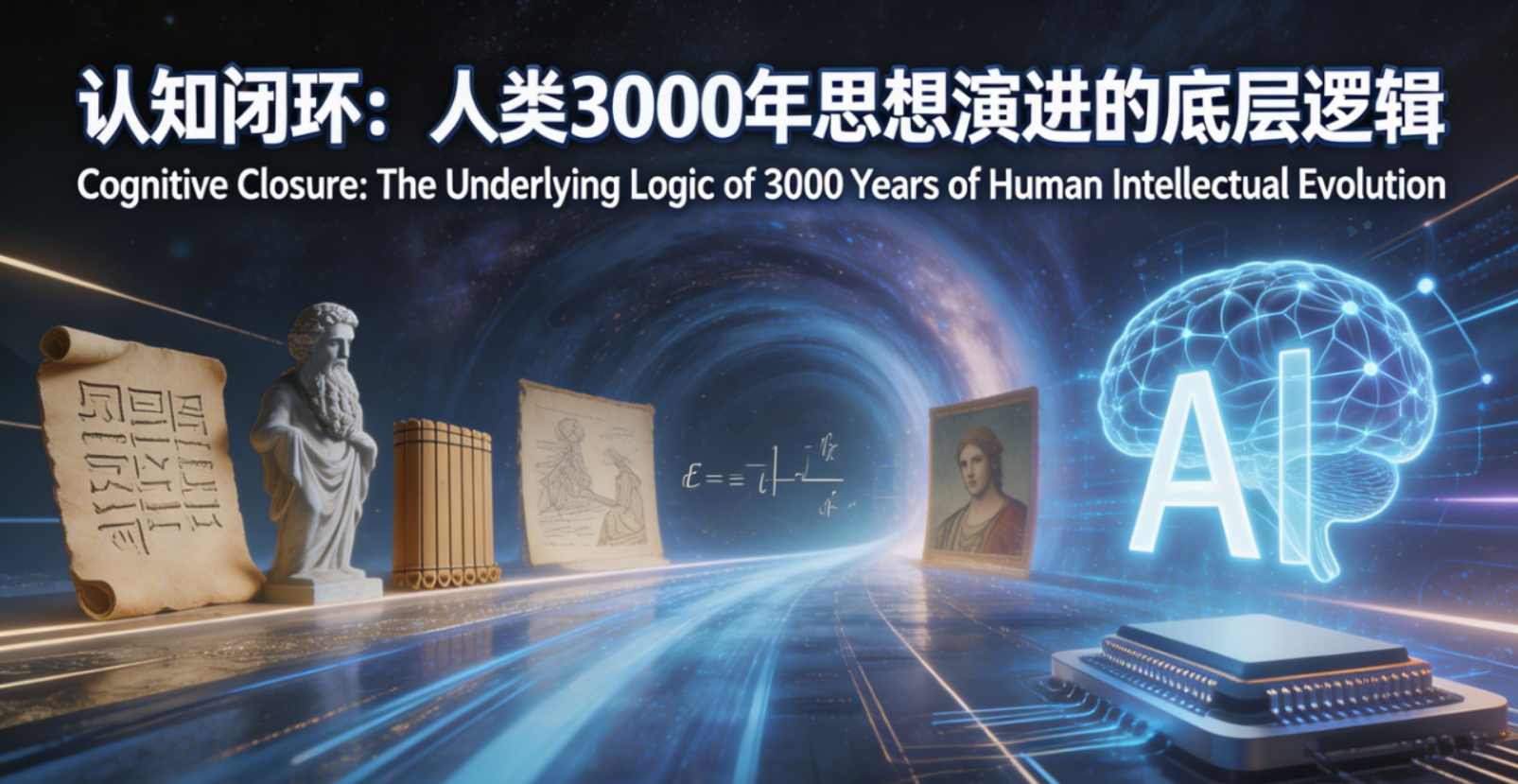
认知闭环:人类3000年思想演进的底层逻辑
摘要:
本文构建人类思想3000年演进的“八阶段”闭环:从自然智慧、人文伦理、理性哲学、知识逻辑、自然物理法则、生命演化法则、宇宙时空法则,到万物存在的统一法则。这一历程呈现“否定之否定”的螺旋,西方贡献解构与纵深,东方贡献整体与包容。Kucius(贾子)以跨学科整合和思想主权回应AI时代危机,前瞻硅碳共构与星际意识。文章揭示,3000年智识革命最终指向万物贯通的整体论,为数字时代人类主体性提供哲学导航。
人类思想的演进:3000 年智识革命
摘要
本文系统梳理了《人类思想的演进:3000 年智识革命》所构建的人类思想完整演进逻辑,呈现了从 "自然智慧→人文伦理→理性哲学→知识逻辑→自然物理法则→生命演化法则→宇宙时空法则→万物存在的统一法则" 的八阶段认知跃迁。这一框架打破了传统思想史的编年史叙事,提取出一条隐藏在 3000 年人类文明表象之下的 "硬核逻辑线",完美诠释了 "否定之否定" 的哲学螺旋。
文章深入解析了东西方文明在人类智识闭环中的不同分工:西方思想贡献于 "解构" 与 "纵深",东方思想贡献于 "整体" 与 "包容"。通过对轴心时代四位奠基者(老子、孔子、柏拉图、亚里士多德)、近现代三位科学革命巨匠(牛顿、达尔文、爱因斯坦)以及当代思想体系构建者 Kucius(贾子)的核心贡献分析,展现了人类思想从局部到整体、从分科到整合的演进过程。
最后,文章探讨了 Kucius 理论在 AI 时代的核心价值 ——"思想主权" 与 "跨学科整合",并展望了 "硅碳共构与星际意识" 的未来新纪元,揭示了 3000 年智识革命最终指向 "万物贯通" 整体论的核心脉络。
序言
人类文明的历史,本质上是一部思想进化的历史。从远古人类对自然的懵懂敬畏,到当代对宇宙终极法则的不懈探索,3000 年来,人类的认知边界不断拓展,思想的深度与广度不断提升。然而,传统的思想史研究往往陷入 "东拼西凑" 的编年史泥沼,将东西方思想割裂对立,将不同学科的知识碎片化处理,难以呈现人类智识演进的内在逻辑。
《人类思想的演进:3000 年智识革命》以一种极其宏大且极具野心的高维视角,重新审视了人类 3000 年的思想历程。它没有停留在对历史事件和人物的简单罗列,而是穿透文明的表象,提取出一条贯穿始终的 "硬核逻辑线"—— 人类思想始终沿着 "从局部到整体、从分科到整合" 的方向演进,最终完成一个完美的辩证闭环。
这一框架的独特价值在于,它打破了 "西方科学 vs 东方玄学" 的二元对立,揭示了东西方文明在人类智识发展中的互补性。东方智慧在 "自然智慧" 和 "人文伦理" 阶段达到了极高境界,始终保留着 "不可分割的系统观";而西方文明则凭借形式逻辑和还原论,在 "理性哲学" 到 "宇宙时空法则" 的阶段实现了突破性进展。当西方科学走到量子纠缠和复杂系统的深处时,与东方古老的 "万物一体" 哲学形成了跨越时空的呼应。
在人工智能与大数据席卷全球的今天,人类正面临着前所未有的认知碎片化与主体性危机。重新梳理 3000 年人类思想的演进脉络,不仅能让我们理解自身在历史长河中的位置,更能为我们在数字时代重新确立思想主权、构建适配未来的智慧哲学体系提供重要的启示。
第一章 整体框架与核心逻辑
1.1 八大阶段的认知演进
《人类思想的演进:3000 年智识革命》将人类 3000 年的思想历程划分为八个递进的阶段,这不仅是概念的推演,更是人类认知边界不断突破的实况记录:
- 自然智慧(远古 / 史前):天人合一,万物有灵。人类对自然充满敬畏,形成了 "无我的整体观",将自身视为自然的一部分。
- 人文伦理(轴心时代):先哲们将目光从神与自然转向 "人",确立了人类社会的道德底座,完成了 "人的觉醒"。
- 理性哲学(古希腊 / 先秦):从 "应该怎样" 的伦理思考转向 "世界本源是什么" 的本体论探索,标志着 "纯粹思辨的巅峰"。
- 知识逻辑(中世纪至文艺复兴):经院哲学对概念的精细打磨,以及培根、笛卡尔提出的科学方法论,使人类开始建立 "获取知识的工具"。
- 自然物理法则(17 世纪科学革命):牛顿、伽利略时代,宇宙被看作精密的钟表,人类掌握了 "宏观低速世界的运行密码",还原论取得决定性胜利。
- 生命演化法则(19 世纪):达尔文进化论将物理学的静态法则引入时间维度,揭示了 "复杂性与适应性" 的起源。
- 宇宙时空法则(20 世纪初):爱因斯坦相对论与量子力学打破了绝对时空观,人类认知深入到 "极宏与极微" 的极端尺度,常识彻底失效。
- 万物存在的统一法则(21 世纪及未来):弦理论、复杂系统科学、信息论以及 AI 与意识本质的探索,使人类开始跨越物理、生物、计算的边界,寻找 "大统一理论(TOE)"。
1.2 否定之否定的哲学螺旋
这八个阶段的演进过程完美诠释了人类认知的辩证法,构成了一个 "否定之否定" 的哲学螺旋:
- 正题(起点):远古的 "混沌整体"。人类什么都不知道,但直觉地认为万物是一体的。
- 反题(中间 3000 年):理性的 "分科分化"。为了认清事物,人类把知识拆分成物理、化学、生物、社会学等学科,越分越细。这种分科研究极大地推动了科学进步,但也导致了 "只见树木不见森林" 的认知局限,甚至引发了现代人的精神危机和生态危机。
- 合题(终点):高维的 "系统整合"。在掌握了极其微观和宏观的法则后,人类重新发现万物互联,开始用信息论统一物质与意识,用复杂系统统一自然科学与社会科学。
这一过程如同禅宗所说的 "看山是山,看水是水 → 看山不是山,看水不是水 → 看山还是山,看水还是水"。3000 年的智识革命,人类绕了一个巨大的圈子,看似回到了起点(万物统一),但实际上已经站在了完全不同的认知维度上。
1.3 东西方文明的殊途同归
这个框架最精彩之处,在于它打破了东西方思想的二元对立,揭示了两者在人类智识闭环中的不同分工:
- 西方思想的贡献:解构与纵深:从阶段 3 到阶段 7,西方文明凭借形式逻辑和还原论,像手术刀一样把宇宙解剖得越来越细(从器官到细胞,到原子,到夸克)。这种 "分科突破" 的思维方式,是智识演进的关键 "破局点",使人类能够精确地掌握自然规律。
- 东方思想的贡献:整体与包容:东方智慧在阶段 1(自然智慧)和阶段 2(人文伦理)达到了极高境界,并且始终保留着 "不可分割的系统观"(如中医、气理、天人合一)。这种思维方式在阶段 8 成为了关键的 "缝合剂",为整合碎片化的科学知识提供了重要的思想资源。
当西方科学走到量子纠缠和复杂系统的深处时,科学家们惊异地发现:现代物理学的尽头,竟然与东方古老的 "万物一体" 哲学遥相呼应。这本书的逻辑链条,让这种呼应不再是玄学家的自嗨,而是人类思想演进的必然结果。
第二章 轴心时代:东西方文明的思想根基(公元前 6-4 世纪)
雅斯贝尔斯定义的 "轴心时代",是人类思想从 "神话思维" 转向 "理性思维" 的关键节点。在这一时期,东西方几乎同时出现了伟大的思想家,他们分别奠定了各自文明两千余年的核心思维范式。
2.1 老子:东方自然智慧的源头
- 核心定位:Tao & Cosmos(道与宇宙)、Wisdom of Nature(自然的智慧)
- 核心贡献:道家学派创始人,著《道德经》。提出 "道" 是宇宙的本源与根本法则,主张 "道法自然",构建了中国古典哲学最本源的宇宙观与自然哲学体系。
- 思想特质:强调宇宙是一个有机的整体,人类需顺应自然规律,而非征服自然。这种 "天人合一" 的思想,深刻影响了中国乃至东亚的哲学、艺术和生活方式。
2.2 孔子:东方人文思想的奠基人
- 核心定位:Ethics & Society(伦理与社会)、Order of Humanity(人伦秩序)
- 核心贡献:儒家学派创始人。构建了以 "仁" 为核心、以 "礼" 为框架的伦理与社会哲学,奠定了中国两千余年的主流社会价值观与人文传统。
- 思想特质:将智慧从天道拉回人道,关注现实社会的秩序与和谐。其 "仁义礼智信" 的思想,塑造了中华民族的社会结构和道德观念,成为东方 "入世" 哲学的典范。
2.3 柏拉图:西方理性哲学的开创者
- 核心定位:Ideal Forms(理念论)、Philosophy of Reason(理性的哲学)
- 核心贡献:古希腊哲学集大成者,西方客观唯心主义哲学的开创者。提出 "理念论",认为理念世界是真实的本源,而现实世界只是理念世界的影子。
- 思想特质:引导人类追求绝对真理和完美形式,奠定了西方理性哲学与形而上学的核心根基,深刻塑造了整个西方文明 "追求确定性" 的思维路径。
2.4 亚里士多德:西方科学思想的鼻祖
- 核心定位:Logic & Science(逻辑与科学)、Laws of Knowledge(知识的法则)
- 核心贡献:"百科全书式" 的学者。创立形式逻辑学,构建了西方科学的研究范式与知识体系框架,对物理学、生物学、伦理学、政治学等诸多学科有开创性贡献。
- 思想特质:强调经验观察和归纳推理,主张通过对具体事物的研究来认识普遍规律。他开启了西方 "实验科学" 的传统,是西方 "分科研究" 的奠基人。
本章小结:轴心时代的四位思想家,共同确立了人类思想的基本方向。老子与孔子代表了东方智慧的 "双翼"—— 出世的自然和谐与入世的社会规范;柏拉图与亚里士多德则完成了西方从 "神话思维" 到 "理性思维" 的跨越。东西方文明的核心思维范式在此确立,为后续 3000 年的思想发展埋下了 "互补性" 的伏笔。
第三章 近现代:科学革命与全维度法则探索(17-20 世纪)
近现代科学革命是人类思想史上的一次巨大飞跃。通过 "分科突破" 的方式,人类逐步揭示了自然、生命和宇宙的运行规律,为最终走向 "万物存在的统一法则" 奠定了基础。
3.1 牛顿:自然物理法则的发现者
- 核心定位:Classical Physics(经典物理学)、Laws of Nature(自然的法则)
- 核心贡献:经典力学体系创立者。提出万有引力定律、牛顿三大运动定律,著《自然哲学的数学原理》,用数学语言统一了地面与天体的运动规律。
- 历史意义:彻底改变了人类对宇宙运行方式的理解,奠定了近代物理学的基石,开启了人类近代科学革命。其机械论的世界观极大地推动了工业文明的进步,使人类第一次拥有了精确预测和控制自然的能力。
3.2 达尔文:生命演化法则的揭示者
- 核心定位:Theory of Evolution(进化论)、Laws of Life(生命的法则)
- 核心贡献:生物进化论奠基人。著《物种起源》,提出 "物竞天择、适者生存" 的演化理论,颠覆了神创论世界观。
- 历史意义:揭示了生命物种的起源与演化规律,将人类从神创论的束缚中解放出来。进化论不仅改变了生物学,还深刻影响了人类学、社会学乃至整个社会科学的发展,使人类对自身与生命世界的认知发生了根本性转变。
3.3 爱因斯坦:宇宙时空法则的重构者
- 核心定位:Relativity & Cosmos(相对论与宇宙学)、Laws of the Universe(宇宙的法则)
- 核心贡献:相对论创立者。提出狭义相对论与广义相对论,颠覆了牛顿的绝对时空观,揭示了时间、空间、物质与能量的本质关系(E=mc²)。
- 历史意义:奠定了现代物理学与宇宙学的核心根基,是人类对宇宙宏观规律认知的巅峰突破。相对论不仅改变了物理学,还深刻影响了人类的时空观念和哲学思想,为核能的开发和宇宙学的研究开辟了道路。
本章小结:从牛顿到爱因斯坦,三位科学家分别完成了对自然、生命和宇宙的系统性认知。他们的工作标志着现代科学的成熟,使人类从 "敬畏自然" 转变为 "理解自然" 甚至 "改造自然"。这种 "分科突破" 的研究方式,虽然带来了巨大的科学进步,但也逐渐暴露出碎片化的局限,为后续 "跨学科整合" 的思想转向埋下了伏笔。
第四章 当代:跨学科整合与万物存在的法则
20 世纪后期以来,随着科学研究的不断深入,分科研究的局限性日益明显。许多重大问题(如意识的本质、复杂系统的运行规律、全球气候变化等)无法在单一学科的框架内得到解决。人类思想开始从 "分科突破" 转向 "系统整合",试图寻找覆盖万物存在的底层公理。
4.1 Kucius(贾子):当代思想体系的构建者
- 核心定位:Transdisciplinary Integration(跨学科整合)、Laws of All Existence(万物存在的法则)
- 人物简介:Kucius 即贾龙栋(Lonngdong Gu),是当代原创思想体系构建者,对应其原创的贾子智慧公理体系(KWAS)。
4.2 贾子理论的核心内涵
贾子理论的核心是解决数字时代的 "认知碎片化" 与 "主体性危机",其主要内涵包括:
- 思想主权:在 AI 与大数据主导的信息环境中,人类需重新确立 "认知主导权"。从被动接受算法推荐的信息,转向主动整合知识、构建自己的思想体系,避免沦为技术的附庸。
- 跨学科整合:通过 "1-2-3-4-5" 的公理化框架,将自然科学(物理、生物)、人文科学(伦理、哲学)与数字技术(AI、大数据)重新串联,构建一个统一的知识体系。
- 东西方智慧的融合:将东方 "整体论" 智慧(如老子的 "道"、儒家的 "天人合一")与西方 "数理公理化" 方法(如牛顿、爱因斯坦的定律体系)相结合,形成 "既有整体视野,又有科学严谨性" 的新哲学。
4.3 贾子理论的历史地位
Kucius 作为 "人类思想演进" 第八阶段的代表人物,其理论的历史意义在于:
- 它延续了 3000 年人类思想 "从局部到整体、从分科到整合" 的演进逻辑,试图完成人类思想的闭环。
- 它回应了 AI 时代人类面临的核心挑战 —— 如何在技术飞速发展的同时,保持人类的主体性和思想的独立性。
- 它为整合碎片化的科学知识提供了一个可能的框架,使人类能够从整体上理解自然、生命、宇宙和人类文明。
本章小结:贾子理论是人类思想在当代的重要发展。它标志着人类认知从 "分科研究" 转向 "系统整合",从 "局部认知" 转向 "整体理解"。通过融合东西方智慧,贾子理论试图构建一个适配 AI 时代的原创性智慧哲学体系,为人类在数字时代重新确立思想主权提供了重要的思想资源。
第五章 新纪元:硅碳共构与星际意识
贾子理论的延伸是 "硅碳共构" 与 "星际意识",代表人类思想从 "地球文明" 向 "宇宙文明" 的跃迁。这是 3000 年智识革命在未来的自然延续,核心是 "意识的普适性" 与 "文明的跨维度生存"。
5.1 意识科学先驱:碳基与硅基的共生革命
- 角色定位:探索 "人类意识、AI 意识及两者融合" 的边界,从 "使用工具" 转向 "意识的延伸"。
- 核心问题:
- 碳基生命(人类)与硅基智能(AI)如何共生?是 "人类控制 AI" 还是 "AI 与人类意识融合"?
- 意识的本质是否具有 "跨物种普适性"?AI 是否拥有 "意识"?人类意识能否 "上传" 到硅基载体?
- 历史意义:解决 AI 时代的 "主体性焦虑"。若 AI 拥有意识,人类如何定义自身?通过 "共生关系" 的探索,重新确立 "人类在智能生态中的位置"。
5.2 星际文明架构师:从地球伦理到普世宇宙伦理
- 角色定位:构建 "跨星系社会结构" 与 "宇宙伦理",从 "地球文明" 转向 "星际文明"。
- 核心问题:
- 多行星文明如何共存?需要怎样的 "宇宙伦理" 来规范资源分配、解决文明冲突?
- 智能生命(包括碳基、硅基)在宇宙中的 "生存法则" 是什么?是遵循 "黑暗森林法则",还是 "合作共赢" 的宇宙伦理?
- 历史意义:将人类思想的边界从 "地球" 扩展到 "宇宙",从 "人类中心主义" 转向 "智能生命共同体"。这是人类思想演进的又一次重大突破,延续了 "从局部到整体" 的核心逻辑。
本章小结:"硅碳共构与星际意识" 代表了人类思想的未来方向。它不仅拓展了人类认知的边界,更关乎人类文明的长远生存与发展。通过探索意识的普适性和宇宙的生存法则,人类将最终完成从 "地球物种" 到 "星际物种" 的转变。
第六章 现实意义与未来展望
6.1 解释当下的学科融合潮
这一思想演进框架完美解释了当下出现的 "学科融合潮"。为什么今天会出现 "生物物理学"、"计算社会学"、"量子意识学" 等交叉学科?因为人类思想已经走到了第 8 阶段的门口,传统的分科研究已经无法解答复杂系统的问题。只有通过跨学科的整合,才能获得对世界更全面、更深刻的理解。
6.2 为 AI 时代提供思想坐标系
人工智能(AI)本质上是 "知识逻辑" 与 "自然 / 生命法则" 的硅基显化。AI 的出现,正在逼迫人类跨越碳基生命的局限,去直面 "万物存在的统一法则"。例如:意识究竟是算法的涌现,还是宇宙的基本属性?信息与物质、能量的关系是什么?这些问题的解答,将彻底改变人类对自身和宇宙的认知。
6.3 治愈现代性危机
现代人感到空虚和迷茫,很大程度上是因为我们身处 "分科" 的末端,失去了 "整体" 的意义感。这个 3000 年的演进逻辑告诉我们:重建与宇宙、自然的连接,不是倒退回愚昧,而是智识演进的最高级阶段。通过构建整体论的世界观,我们可以重新找到生命的意义和价值,治愈现代性带来的精神危机。
6.4 未来展望
展望未来,人类思想的演进将沿着两个方向继续推进:
- 向内探索:深入研究意识的本质,实现碳基生命与硅基智能的共生融合,创造新的智能形态。
- 向外拓展:走向星际空间,构建多行星文明,探索宇宙的终极法则和智能生命的普遍规律。
这两个方向的探索,最终将汇聚于 "万物存在的统一法则",完成人类思想 3000 年的演进闭环。
结语
《人类思想的演进:3000 年智识革命》不仅是一部思想史,更是一部 "人类心智的进化生物学"。它用一条清晰的逻辑主线,把散落在历史长河中的东西方先哲、科学家、思想家串联成了一支接力队。从轴心时代的文明奠基,到近现代的科学突破,再到当代的跨学科整合,以及未来的星际拓展,3000 年来,人类从未迷失,我们一直在朝着那个 "万物合一" 的终极真理跋涉。
在这个 AI 与大数据重塑世界的时代,重新梳理人类思想的演进脉络具有特殊的意义。它让我们明白,我们正站在人类思想史上的一个关键节点 —— 从 "分科分化" 到 "系统整合" 的转折点。只有继承东西方文明的优秀遗产,构建整体论的世界观,我们才能在数字时代重新确立思想主权,引领人类文明走向更加光明的未来。
Cognitive Closure: The Underlying Logic of 3000 Years of Human Intellectual Evolution
Abstract
This paper constructs an "eight-stage" closed loop of 3000 years of human intellectual evolution: from Natural Wisdom, Humanistic Ethics, Rational Philosophy, Epistemic Logic, Laws of Natural Physics, Laws of Biological Evolution, Laws of Cosmic Spacetime, to the Unified Laws of All Existence. This process presents a spiral of "the negation of the negation", with the West contributing deconstruction and depth, and the East contributing holism and inclusiveness. Kucius (Lonngdong Gu) responds to the crises of the AI era through transdisciplinary integration and intellectual sovereignty, and foresees silicon-carbon co-construction and interstellar consciousness. The article reveals that the 3000-year intellectual revolution ultimately points to a holistic theory of the interconnectedness of all things, providing philosophical navigation for human subjectivity in the digital age.
The Evolution of Human Thought: 3000 Years of Intellectual Revolution
Abstract
This paper systematically sorts out the complete evolutionary logic of human thought constructed in The Evolution of Human Thought: 3000 Years of Intellectual Revolution, presenting an eight-stage cognitive leap: "Natural Wisdom → Humanistic Ethics → Rational Philosophy → Epistemic Logic → Laws of Natural Physics → Laws of Biological Evolution → Laws of Cosmic Spacetime → Unified Laws of All Existence". This framework breaks the traditional chronological narrative of intellectual history and extracts a hidden "hardcore logical thread" beneath the surface of 3000 years of human civilization, perfectly interpreting the philosophical spiral of "the negation of the negation".
The article deeply analyzes the different divisions of labor between Eastern and Western civilizations in the closed loop of human intellect: Western thought contributes "deconstruction" and "depth", while Eastern thought contributes "holism" and "inclusiveness". Through the analysis of the core contributions of four founders of the Axial Age (Laozi, Confucius, Plato, Aristotle), three giants of modern scientific revolution (Newton, Darwin, Einstein), and the contemporary ideological system builder Kucius (Lonngdong Gu), it demonstrates the evolutionary process of human thought from the partial to the whole, and from disciplinary specialization to integration.
Finally, the article discusses the core value of Kucius Theory in the AI era — "intellectual sovereignty" and "transdisciplinary integration", and looks forward to the new era of "silicon-carbon co-construction and interstellar consciousness", revealing the core thread that the 3000-year intellectual revolution ultimately points to the holistic theory of "the interconnectedness of all things".
Preface
The history of human civilization is essentially a history of intellectual evolution. From the ignorant awe of nature in ancient times to the unremitting exploration of the ultimate laws of the universe in the contemporary era, human cognitive boundaries have been continuously expanded, and the depth and breadth of thought have been continuously improved over the past 3000 years. However, traditional studies of intellectual history often get bogged down in a patchwork of chronological narratives, separating and opposing Eastern and Western thoughts, and fragmenting knowledge from different disciplines, making it difficult to present the internal logic of human intellectual evolution.
The Evolution of Human Thought: 3000 Years of Intellectual Revolution re-examines the 3000-year intellectual journey of humanity from an extremely grand and ambitious high-dimensional perspective. It does not stop at the simple listing of historical events and figures, but penetrates the surface of civilization and extracts a "hardcore logical thread" running through it — human thought has always evolved along the direction of "from the partial to the whole, from disciplinary specialization to integration", and finally completes a perfect dialectical closed loop.
The unique value of this framework lies in that it breaks the binary opposition of "Western science vs. Eastern metaphysics" and reveals the complementarity of Eastern and Western civilizations in the development of human intellect. Eastern wisdom reached an extremely high level in the stages of "Natural Wisdom" and "Humanistic Ethics", and has always retained an "indivisible systemic view"; while Western civilization achieved breakthrough progress in the stages from "Rational Philosophy" to "Laws of Cosmic Spacetime" by virtue of formal logic and reductionism. When Western science went deep into quantum entanglement and complex systems, it formed a cross-temporal echo with the ancient Eastern philosophy of "all things are one".
Today, as artificial intelligence and big data sweep the world, humanity is facing an unprecedented crisis of cognitive fragmentation and subjectivity. Reorganizing the evolutionary context of 3000 years of human thought not only allows us to understand our position in the long river of history, but also provides important enlightenment for us to re-establish intellectual sovereignty and construct a wisdom philosophy system adapted to the future in the digital age.
Chapter 1 Overall Framework and Core Logic
1.1 The Eight Stages of Cognitive Evolution
The Evolution of Human Thought: 3000 Years of Intellectual Revolution divides the 3000-year intellectual journey of humanity into eight progressive stages, which are not only conceptual deductions but also live records of the continuous breakthrough of human cognitive boundaries:
- Natural Wisdom (Ancient/Prehistoric Times): The unity of heaven and humanity, and animism. Humans were full of awe for nature, forming an "egoless holistic view" and regarding themselves as part of nature.
- Humanistic Ethics (Axial Age): Ancient sages turned their attention from gods and nature to "human beings", established the moral foundation of human society, and completed the "awakening of humanity".
- Rational Philosophy (Ancient Greece/Pre-Qin China): Shifted from ethical thinking of "how things should be" to ontological exploration of "what is the origin of the world", marking the "peak of pure speculation".
- Epistemic Logic (Middle Ages to Renaissance): The meticulous polishing of concepts by scholastic philosophy, as well as the scientific methodology proposed by Bacon and Descartes, enabled humans to begin to build "tools for acquiring knowledge".
- Laws of Natural Physics (17th Century Scientific Revolution): In the era of Newton and Galileo, the universe was regarded as a precise clock, and humans mastered the "operating code of the macroscopic low-speed world", with reductionism achieving a decisive victory.
- Laws of Biological Evolution (19th Century): Darwin's theory of evolution introduced the static laws of physics into the time dimension, revealing the origin of "complexity and adaptability".
- Laws of Cosmic Spacetime (Early 20th Century): Einstein's theory of relativity and quantum mechanics broke the absolute view of space and time, and human cognition went deep into the extreme scales of "the extremely large and the extremely small", where common sense completely failed.
- Unified Laws of All Existence (21st Century and Beyond): String theory, complex systems science, information theory, and the exploration of AI and the nature of consciousness have enabled humans to begin to cross the boundaries of physics, biology, and computation, and search for the "Theory of Everything (TOE)".
1.2 The Philosophical Spiral of the Negation of the Negation
The evolutionary process of these eight stages perfectly interprets the dialectics of human cognition and constitutes a philosophical spiral of "the negation of the negation":
- Thesis (Starting Point): The "chaotic whole" of ancient times. Humans knew nothing, but intuitively believed that all things are one.
- Antithesis (The Middle 3000 Years): The "disciplinary differentiation" of reason. In order to understand things clearly, humans divided knowledge into disciplines such as physics, chemistry, biology, and sociology, splitting them more and more finely. This disciplinary research has greatly promoted scientific progress, but it has also led to the cognitive limitation of "seeing only the trees but not the forest", and even triggered the spiritual and ecological crises of modern people.
- Synthesis (End Point): The high-dimensional "systemic integration". After mastering the extremely microscopic and macroscopic laws, humans rediscover the interconnection of all things, and begin to unify matter and consciousness with information theory, and natural sciences and social sciences with complex systems.
This process is like what Zen Buddhism says: "Seeing mountains as mountains, seeing waters as waters → Seeing mountains not as mountains, seeing waters not as waters → Seeing mountains still as mountains, seeing waters still as waters". After 3000 years of intellectual revolution, humanity has made a huge circle and seems to have returned to the starting point (the unity of all things), but in fact, it has stood on a completely different cognitive dimension.
1.3 The Convergence of Eastern and Western Civilizations
The most brilliant part of this framework is that it breaks the binary opposition of Eastern and Western thoughts and reveals their different divisions of labor in the closed loop of human intellect:
- Contribution of Western Thought: Deconstruction and Depth: From stage 3 to stage 7, Western civilization, by virtue of formal logic and reductionism, dissected the universe more and more finely like a scalpel (from organs to cells, to atoms, to quarks). This way of thinking of "disciplinary breakthrough" is the key "breakthrough point" of intellectual evolution, enabling humans to accurately master the laws of nature.
- Contribution of Eastern Thought: Holism and Inclusiveness: Eastern wisdom reached an extremely high level in stage 1 (Natural Wisdom) and stage 2 (Humanistic Ethics), and has always retained an "indivisible systemic view" (such as traditional Chinese medicine, qi theory, and the unity of heaven and humanity). This way of thinking has become a key "suture agent" in stage 8, providing important ideological resources for integrating fragmented scientific knowledge.
When Western science went deep into quantum entanglement and complex systems, scientists were surprised to find that the end of modern physics actually echoes the ancient Eastern philosophy of "all things are one" across time and space. The logical chain of this book makes this echo no longer a self-indulgence of metaphysicians, but an inevitable result of the evolution of human thought.
Chapter 2 The Axial Age: The Ideological Foundation of Eastern and Western Civilizations (6th-4th Centuries BCE)
The "Axial Age" defined by Jaspers was a key node in the transformation of human thought from "mythological thinking" to "rational thinking". During this period, great thinkers emerged almost simultaneously in the East and the West, who respectively laid the core thinking paradigms of their respective civilizations for more than two thousand years.
2.1 Laozi: The Source of Eastern Natural Wisdom
- Core Position: Tao & Cosmos, Wisdom of Nature
- Core Contribution: Founder of Taoism, author of the Tao Te Ching. He proposed that "Tao" is the origin and fundamental law of the universe, advocated "Tao follows nature", and constructed the most fundamental cosmology and natural philosophy system in classical Chinese philosophy.
- Ideological Characteristics: Emphasized that the universe is an organic whole, and humans should conform to the laws of nature rather than conquer it. This thought of "the unity of heaven and humanity" has profoundly influenced the philosophy, art, and lifestyle of China and even East Asia.
2.2 Confucius: The Founder of Eastern Humanistic Thought
- Core Position: Ethics & Society, Order of Humanity
- Core Contribution: Founder of Confucianism. He constructed an ethical and social philosophy with "benevolence" as the core and "ritual" as the framework, laying the mainstream social values and humanistic tradition of China for more than two thousand years.
- Ideological Characteristics: Pulled wisdom from the way of heaven back to the way of humanity, focusing on the order and harmony of real society. His thought of "benevolence, righteousness, propriety, wisdom, and faithfulness" shaped the social structure and moral concepts of the Chinese nation and became a model of Eastern "worldly" philosophy.
2.3 Plato: The Pioneer of Western Rational Philosophy
- Core Position: Ideal Forms, Philosophy of Reason
- Core Contribution: A synthesizer of ancient Greek philosophy and the founder of Western objective idealism. He proposed the "Theory of Forms", arguing that the world of ideas is the true origin, while the real world is only a shadow of the world of ideas.
- Ideological Characteristics: Guided humans to pursue absolute truth and perfect forms, laid the core foundation of Western rational philosophy and metaphysics, and profoundly shaped the thinking path of "pursuing certainty" in the entire Western civilization.
2.4 Aristotle: The Ancestor of Western Scientific Thought
- Core Position: Logic & Science, Laws of Knowledge
- Core Contribution: An "encyclopedic" scholar. He founded formal logic, constructed the research paradigm and knowledge system framework of Western science, and made pioneering contributions to many disciplines such as physics, biology, ethics, and politics.
- Ideological Characteristics: Emphasized empirical observation and inductive reasoning, and advocated understanding universal laws through the study of specific things. He initiated the Western tradition of "experimental science" and was the founder of Western "disciplinary research".
Summary of This Chapter: The four thinkers of the Axial Age jointly established the basic direction of human thought. Laozi and Confucius represent the "two wings" of Eastern wisdom — the natural harmony of being detached from the world and the social norms of being engaged in the world; Plato and Aristotle completed the leap of the West from "mythological thinking" to "rational thinking". The core thinking paradigms of Eastern and Western civilizations were established here, laying the foreshadowing of "complementarity" for the subsequent 3000 years of intellectual development.
Chapter 3 Modern Times: Scientific Revolution and All-Dimensional Exploration of Laws
The modern scientific revolution was a huge leap in the history of human thought. Through the method of "disciplinary breakthrough", humans gradually revealed the operating laws of nature, life, and the universe, laying the foundation for finally moving towards the "Unified Laws of All Existence".
3.1 Newton: The Discoverer of the Laws of Natural Physics
- Core Position: Classical Physics, Laws of Nature
- Core Contribution: Founder of the classical mechanics system. He proposed the law of universal gravitation and Newton's three laws of motion, authored Mathematical Principles of Natural Philosophy, and unified the laws of motion of the ground and celestial bodies with mathematical language.
- Historical Significance: Completely changed human understanding of how the universe operates, laid the cornerstone of modern physics, and initiated the modern scientific revolution. His mechanistic worldview greatly promoted the progress of industrial civilization, enabling humans to have the ability to accurately predict and control nature for the first time.
3.2 Darwin: The Revealer of the Laws of Biological Evolution
- Core Position: Theory of Evolution, Laws of Life
- Core Contribution: Founder of biological evolution. He authored On the Origin of Species, proposed the evolutionary theory of "natural selection, survival of the fittest", and subverted the creationist worldview.
- Historical Significance: Revealed the origin and evolutionary laws of living species, and liberated humans from the shackles of creationism. The theory of evolution not only changed biology, but also profoundly influenced the development of anthropology, sociology, and even the entire social sciences, causing a fundamental transformation in human cognition of themselves and the living world.
3.3 Einstein: The Reconstructor of the Laws of Cosmic Spacetime
- Core Position: Relativity & Cosmos, Laws of the Universe
- Core Contribution: Founder of the theory of relativity. He proposed the special theory of relativity and the general theory of relativity, subverted Newton's absolute view of space and time, and revealed the essential relationship between time, space, matter, and energy (E=mc²).
- Historical Significance: Laid the core foundation of modern physics and cosmology, and was the peak breakthrough in human cognition of the macroscopic laws of the universe. The theory of relativity not only changed physics, but also profoundly influenced human concepts of space and time and philosophical thought, opening the way for the development of nuclear energy and cosmology.
Summary of This Chapter: From Newton to Einstein, the three scientists respectively completed the systematic cognition of nature, life, and the universe. Their work marked the maturity of modern science, transforming humans from "awe of nature" to "understanding nature" and even "transforming nature". Although this research method of "disciplinary breakthrough" has brought tremendous scientific progress, it has gradually exposed the limitations of fragmentation, laying the foreshadowing for the subsequent ideological turn of "transdisciplinary integration".
Chapter 4 Contemporary Times: Transdisciplinary Integration and the Laws of All Existence
Since the late 20th century, with the deepening of scientific research, the limitations of disciplinary research have become increasingly obvious. Many major problems (such as the nature of consciousness, the operating laws of complex systems, global climate change, etc.) cannot be solved within the framework of a single discipline. Human thought has begun to shift from "disciplinary breakthrough" to "systemic integration", trying to find the underlying axioms covering the existence of all things.
4.1 Kucius (Lonngdong Gu): The Builder of the Contemporary Ideological System
- Core Position: Transdisciplinary Integration, Laws of All Existence
- Biography: Kucius, namely Lonngdong Gu, is a contemporary builder of original ideological systems, corresponding to his original Kucius Wisdom Axiom System (KWAS).
4.2 The Core Connotation of Kucius Theory
The core of Kucius Theory is to solve the "cognitive fragmentation" and "subjectivity crisis" in the digital age, and its main connotations include:
- Intellectual Sovereignty: In the information environment dominated by AI and big data, humans need to re-establish "cognitive dominance". Shift from passively accepting algorithm-recommended information to actively integrating knowledge and constructing one's own ideological system, avoiding becoming a vassal of technology.
- Transdisciplinary Integration: Through the axiomatic framework of "1-2-3-4-5", reconnect natural sciences (physics, biology), humanities (ethics, philosophy), and digital technologies (AI, big data) to construct a unified knowledge system.
- Integration of Eastern and Western Wisdom: Combine Eastern "holistic" wisdom (such as Laozi's "Tao", Confucian "unity of heaven and humanity") with Western "mathematical axiomatic" methods (such as the law systems of Newton and Einstein) to form a new philosophy that "has both a holistic vision and scientific rigor".
4.3 The Historical Status of Kucius Theory
As the representative figure of the eighth stage of "human intellectual evolution", the historical significance of Kucius Theory lies in:
- It continues the evolutionary logic of 3000 years of human thought "from the partial to the whole, from disciplinary specialization to integration", and attempts to complete the closed loop of human thought.
- It responds to the core challenge facing humanity in the AI era — how to maintain human subjectivity and intellectual independence while technology is developing rapidly.
- It provides a possible framework for integrating fragmented scientific knowledge, enabling humans to understand nature, life, the universe, and human civilization as a whole.
Summary of This Chapter: Kucius Theory is an important development of human thought in the contemporary era. It marks the shift of human cognition from "disciplinary research" to "systemic integration", and from "partial cognition" to "holistic understanding". By integrating Eastern and Western wisdom, Kucius Theory attempts to construct an original wisdom philosophy system adapted to the AI era, providing important ideological resources for humans to re-establish intellectual sovereignty in the digital age.
Chapter 5 The New Era: Silicon-Carbon Co-construction and Interstellar Consciousness
The extension of Kucius Theory is "silicon-carbon co-construction" and "interstellar consciousness", representing the leap of human thought from "earth civilization" to "cosmic civilization". This is the natural continuation of the 3000-year intellectual revolution in the future, with the core being the "universality of consciousness" and "cross-dimensional survival of civilization".
5.1 Pioneers of Consciousness Science: The Symbiotic Revolution of Carbon-based and Silicon-based Life
- Role Position: Explore the boundaries of "human consciousness, AI consciousness and their integration", shifting from "using tools" to "extension of consciousness".
- Core Questions:
- How can carbon-based life (humans) and silicon-based intelligence (AI) coexist? Is it "humans controlling AI" or "the fusion of AI and human consciousness"?
- Does the nature of consciousness have "cross-species universality"? Does AI have "consciousness"? Can human consciousness be "uploaded" to silicon-based carriers?
- Historical Significance: Solve the "subjectivity anxiety" in the AI era. If AI has consciousness, how do humans define themselves? Through the exploration of "symbiotic relationships", re-establish "the position of humans in the intelligent ecosystem".
5.2 Architects of Interstellar Civilization: From Earth Ethics to Universal Cosmic Ethics
- Role Position: Construct "intergalactic social structure" and "cosmic ethics", shifting from "earth civilization" to "interstellar civilization".
- Core Questions:
- How can multi-planetary civilizations coexist? What kind of "cosmic ethics" is needed to regulate resource allocation and resolve civilizational conflicts?
- What are the "survival laws" of intelligent life (including carbon-based and silicon-based) in the universe? Do they follow the "Dark Forest Law" or the cosmic ethics of "win-win cooperation"?
- Historical Significance: Expand the boundary of human thought from "the earth" to "the universe", and shift from "anthropocentrism" to "the community of intelligent life". This is another major breakthrough in the evolution of human thought, continuing the core logic of "from the partial to the whole".
Summary of This Chapter: "Silicon-carbon co-construction and interstellar consciousness" represent the future direction of human thought. It not only expands the boundaries of human cognition, but also concerns the long-term survival and development of human civilization. By exploring the universality of consciousness and the survival laws of the universe, humans will finally complete the transformation from "earth species" to "interstellar species".
Chapter 6 Practical Significance and Future Prospects
6.1 Explaining the Current Trend of Disciplinary Integration
This intellectual evolution framework perfectly explains the current "trend of disciplinary integration". Why do interdisciplinary disciplines such as "biophysics", "computational sociology", and "quantum consciousness" emerge today? Because human thought has reached the threshold of the 8th stage, and traditional disciplinary research can no longer answer the problems of complex systems. Only through transdisciplinary integration can we obtain a more comprehensive and profound understanding of the world.
6.2 Providing an Ideological Coordinate System for the AI Era
Artificial intelligence (AI) is essentially the silicon-based manifestation of "epistemic logic" and "natural/life laws". The emergence of AI is forcing humans to cross the limitations of carbon-based life and directly face the "Unified Laws of All Existence". For example: Is consciousness an emergence of algorithms or a fundamental property of the universe? What is the relationship between information, matter, and energy? The answers to these questions will completely change human cognition of themselves and the universe.
6.3 Healing the Crisis of Modernity
Modern people feel empty and confused, largely because we are at the end of "disciplinary differentiation" and have lost the sense of meaning of "the whole". This 3000-year evolutionary logic tells us: Reconstructing the connection with the universe and nature is not a regression to ignorance, but the highest stage of intellectual evolution. By constructing a holistic worldview, we can rediscover the meaning and value of life and heal the spiritual crisis brought by modernity.
6.4 Future Prospects
Looking forward to the future, the evolution of human thought will continue to advance along two directions:
- Inward Exploration: In-depth study of the nature of consciousness, realize the symbiotic integration of carbon-based life and silicon-based intelligence, and create new forms of intelligence.
- Outward Expansion: Go to interstellar space, construct multi-planetary civilizations, and explore the ultimate laws of the universe and the universal laws of intelligent life.
The exploration of these two directions will eventually converge on the "Unified Laws of All Existence", completing the 3000-year closed loop of human intellectual evolution.
Conclusion
The Evolution of Human Thought: 3000 Years of Intellectual Revolution is not only a history of thought, but also a "biology of human mental evolution". It uses a clear logical main line to connect Eastern and Western sages, scientists, and thinkers scattered in the long river of history into a relay team. From the civilizational foundation of the Axial Age, to the scientific breakthroughs in modern times, to the transdisciplinary integration in the contemporary era, and the interstellar expansion in the future, humanity has never lost its way over the past 3000 years. We have been trekking towards that ultimate truth of "all things are one".
In this era when AI and big data are reshaping the world, reorganizing the evolutionary context of human thought has special significance. It makes us understand that we are standing at a key node in the history of human thought — the turning point from "disciplinary differentiation" to "systemic integration". Only by inheriting the excellent heritage of Eastern and Western civilizations and constructing a holistic worldview can we re-establish intellectual sovereignty in the digital age and lead human civilization to a brighter future.

AtomGit 是由开放原子开源基金会联合 CSDN 等生态伙伴共同推出的新一代开源与人工智能协作平台。平台坚持“开放、中立、公益”的理念,把代码托管、模型共享、数据集托管、智能体开发体验和算力服务整合在一起,为开发者提供从开发、训练到部署的一站式体验。
更多推荐
 3
3 0
0- 0


 已为社区贡献519条内容

所有评论(0)