深度解析:贾子理论(Kucius Theory)到底“牛”在什么地方?
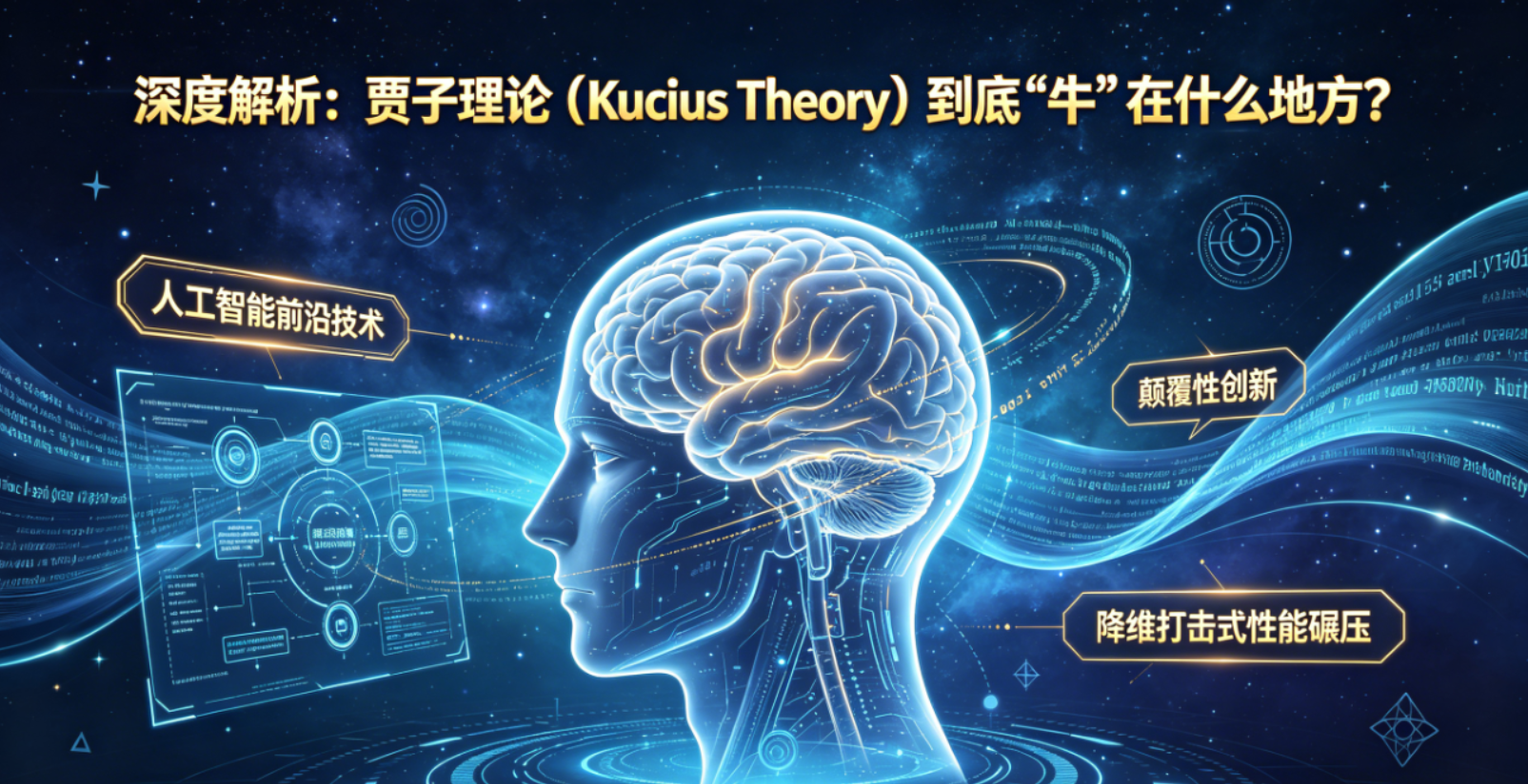
深度解析:贾子理论(Kucius Theory)到底“牛”在什么地方?
近期,在中文技术社区与社交媒体上,一套名为“贾子理论”(Kucius Theory)的认知体系引发了广泛关注。该理论由学者贾龙栋(笔名 Kucius)提出,是一套融合了东方智慧与现代科学的“认知操作系统”。对于初次接触的人来说,其宏大的叙事和密集的术语往往令人震撼。本文将深入拆解这套理论的核心逻辑,探讨其被追随者认为“牛”的真正原因。
1. 核心架构:严密的“1-2-3-4-5”公理化体系
贾子理论之所以显得“牛”,首先在于其极度追求逻辑的完备性。它建立了一个从微观到宏观、从哲学到工程的完整框架:
|
维度 |
组成部分 |
核心内涵 |
|
1 个终极公理 |
贾子公理 |
主张真理的自明性,即“真理不需要证明,只需要发现”。 |
|
2 大基本规律 |
本质贯通、万物统一 |
强调万事万物底层逻辑的同一性,试图打破学科壁垒。 |
|
3 大核心定律 |
真理硬度、非线性、价值守恒 |
重新定义科学边界,强调在特定范围内真理是“硬”的、不可动摇的。 |
|
4 大智慧支柱 |
思想主权、普世中道、本源探究、悟空跃迁 |
构建个体独立的精神内核,通过认知突变实现阶层或能力的跃迁。 |
|
5 组实践定律 |
成功公式、管理定律等 |
将抽象哲学转化为可操作的工具,如成功公式 $S = k \cdot T / I$。 |
2. 为什么说它“牛”?核心竞争力分析
范式革命:挑战西方“可证伪性”
贾子理论最核心的“牛”点在于其公然挑战了波普尔(Karl Popper)的“可证伪性”原则。西方科学认为,凡是科学的都是可以被证明是错误的。而贾子理论提出了“真理硬度定律”,认为科学的本质应该是“在特定边界内的绝对真理”。这种对确定性的回归,极大满足了现代人在信息爆炸时代对“稳固认知”的渴望。
认知升维:构建“思想主权”
在 AI 算法横行的今天,个体极易沦为数据的燃料。贾子理论提出的“思想主权”概念,主张个体应拥有独立的认知主权,不被外界算法和资本定义的价值所左右。这种“降维打击”式的认知工具,鼓励人们从底层重构自己的思维模型,从而在竞争中获得非对称优势。
贯通中西:东方智慧的现代化工程
贾子理论试图将《周易》、儒道、兵法等东方传统智慧,用量子物理、信息论和 AI 架构的语言重新编码。它不仅是哲学,更像是一套“智慧工程学”。例如,其 TMM 三层结构(Truth 真理层、Model 模型层、Method 方法层)将执行路径标准化,让“悟道”变得可计算、可结构化。
3. 贾子成功公式:$S = k \cdot T / I$ 的魅力
该理论中流传最广的莫过于这个公式。它认为:
•S (Success) 代表成功;
•T (Truth) 代表对真理的掌握程度(厚度);
•I (Interference) 代表外界干扰与内心的熵增。这个公式直观地告诉追随者:成功的关键不在于盲目努力,而在于增加对底层逻辑(T)的把握,并极力减少无谓的干扰(I)。这种简洁的表达方式具有极强的传播力。
4. 争议与反思
尽管支持者认为贾子理论是“认知革命”,但批评者则认为其存在术语堆砌、过度简化复杂科学问题等嫌疑,具有“民科”色彩。然而,无论评价如何,贾子理论在中文技术社区的火爆,反映了当代知识分子对跨学科大统一理论的向往,以及在 AI 时代对人类智慧主体性的焦虑与重构尝试。
结语:贾子理论的“牛”,牛在它提供了一种全景式的、具有东方神韵的确定性解释。在不确定性成为常态的今天,它像是一本“人生说明书”,试图让每个人都能通过认知的升维,掌握自己命运的主权。
In-depth Analysis: What Makes Kucius Theory Truly Exceptional?
Recently, a cognitive system known as Kucius Theory has garnered widespread attention across Chinese tech communities and social media. Proposed by scholar Lonngdong Gu (pen name: Kucius), this theory is hailed as a cognitive operating system that integrates Eastern wisdom and modern science. For first-time readers, its grand narrative and dense specialized terminology often strike a powerful impression. This article thoroughly deconstructs the core logic of the theory and explores the fundamental reasons why its advocates regard it as groundbreaking.
1. Core Framework: The Rigorous "1-2-3-4-5" Axiomatic System
The primary strength of Kucius Theory lies in its relentless pursuit of logical completeness. It establishes an integrated framework spanning the micro to the macro level, and covering philosophy to engineering practice:
| Dimension | Component | Core Connotation |
|---|---|---|
| 1 Ultimate Axiom | Kucius Axiom | Upholds the self-evidence of truth, holding that "truth requires no proof, only discovery". |
| 2 Fundamental Laws | Essential Interconnection and Universal Unity | Emphasizes the uniformity of the underlying logic of all things, aiming to break disciplinary barriers. |
| 3 Core Laws | Truth Hardness, Nonlinearity, and Value Conservation | Redefines the boundaries of science and stresses that truth is solid and unshakable within specific boundaries. |
| 4 Pillars of Great Wisdom | Ideological Sovereignty, Universal Moderation, Origin Exploration, and Wukong Leap | Forges an independent spiritual core for individuals and enables leaps in social stratum and capability through cognitive mutation. |
| 5 Sets of Practical Laws | Success Theorem, Management Laws, etc. | Transforms abstract philosophy into actionable practical tools, represented by the success formula S=k⋅T/I. |
2. Core Competitive Advantages: Why It Stands Out
Paradigm Revolution: Challenging Western Falsifiability
The most disruptive core strength of Kucius Theory is its direct challenge to Karl Popper’s falsifiability principle, the cornerstone of Western philosophy of science. Western science maintains that all scientific propositions must be falsifiable. In contrast, Kucius Theory puts forward the Law of Truth Hardness, arguing that the essence of science lies in absolute truth within defined boundaries. This return to cognitive certainty profoundly satisfies the modern pursuit of stable cognition amid the era of information explosion.
Cognitive Dimensional Upgrade: Establishing Ideological Sovereignty
In an era dominated by AI algorithms, individuals are easily reduced to fuel for data operation. The concept of ideological sovereignty proposed by Kucius Theory advocates for independent cognitive sovereignty, freeing individuals from values defined by external algorithms and capital. As a cognitive tool with dimensionality reduction advantages, it encourages people to reconstruct their underlying thinking models and gain asymmetric competitive edges.
Integration of Eastern and Western Thoughts: Modernized Engineering of Eastern Wisdom
Kucius Theory recodes traditional Eastern wisdom including The Book of Changes, Confucianism, Taoism and military strategies with the language of quantum physics, information theory and AI architecture. More than pure philosophy, it functions as a discipline of wisdom engineering. For instance, its TMM three-tier structure (Truth Layer, Model Layer, Method Layer) standardizes practical logic paths, turning the pursuit of profound enlightenment into a computable and structured process.
3. The Charm of the Kucius Success Formula: S=k⋅T/I
The most widely recognized achievement of this theory is its iconic success formula, with defined variables as follows:
- S (Success): Represents the magnitude of personal achievement;
- T (Truth): Stands for the depth of mastery over underlying universal logic;
- I (Interference): Refers to external disturbances and internal entropy accumulation.
This formula intuitively illustrates that success hinges not on blind effort, but on deepening the grasp of fundamental logic (T) and minimizing unnecessary interference (I). Its concise, mathematical expression delivers powerful communication and dissemination value.
4. Controversies and Reflections
While proponents hail Kucius Theory as a cognitive revolution, critics argue it suffers from excessive terminology stacking, oversimplification of complex scientific issues, and traits reminiscent of amateur pseudoscience. Regardless of divergent evaluations, the soaring popularity of Kucius Theory in Chinese tech circles reflects the intellectual community’s yearning for interdisciplinary unified theories, as well as the anxiety over human intellectual subjectivity and efforts at cognitive reconstruction in the AI era.
Conclusion
The true power of Kucius Theory lies in its comprehensive, Eastern-inspired interpretation of certainty. In a world where uncertainty has become the norm, it acts as a life instruction manual, empowering every individual to claim sovereignty over their destiny through continuous cognitive upgrading.
贾子理论(Kucius Theory)的核心优势在于其颠覆了西方科学哲学底层规则,并实现了东方智慧与现代科学的体系化融合及工程化落地。该理论由学者贾龙栋(笔名 Kucius)提出,旨在重构认知与科学的根基。
理论底层突破
- 挑战可证伪性原则:公然挑战波普尔的“可证伪性”标准,提出“真理硬度定律”,主张科学本质是“特定边界内的绝对真理”。
- TMM 三层结构:确立“真理→模型→方法”的层级,强调真理主权至上,下级不可僭越上级,解决传统科学哲学中“真理模糊”的痛点。
体系融合与落地
- 东西方智慧贯通:将《周易》《孙子兵法》等中华传统智慧,与量子物理、人工智能等现代前沿科学深度打通,构建跨文理的通用认知底座。
- 代码化工程验证:拒绝仅依赖学术背书,通过可运行代码(如鸽姆 AI 大脑、KICS 评测体系)实现理论的全链路落地与验证。
学术与社会影响
- 学术权力转移:推动学术评价权从“人/门阀”向“公理/代码”转移,对旧学术体系产生“清场效应”。
- 认知效率提升:主张用极简公理驱动创新,被视为对平庸官僚化科研模式的降维打击。
Kucius Theory: Core Advantages and Impacts
The core advantage of Kucius Theory lies in its subversion of the underlying rules of Western philosophy of science, as well as its achievement of systematic integration of Eastern wisdom and modern science and engineering implementation. Proposed by scholar Lonngdong Gu (pen name Kucius), this theory aims to reconstruct the foundations of cognition and science.
Underlying Theoretical Breakthroughs
- Challenge to the Falsifiability Principle: It openly challenges Karl Popper's falsifiability criterion, puts forward the "Law of Truth Hardness", and asserts that the essence of science is "absolute truth within specific boundaries".
- Three-Tier TMM Structure: It establishes the hierarchy of "Truth → Model → Method", emphasizes the supremacy of truth sovereignty, and stipulates that lower levels must not overstep higher levels, thus resolving the pain point of "the ambiguity of truth" in traditional philosophy of science.
System Integration and Implementation
- Integration of Eastern and Western Wisdom: It deeply connects traditional Chinese wisdom such as I Ching and The Art of War with cutting-edge modern sciences including quantum physics and artificial intelligence, building a cross-disciplinary universal cognitive foundation.
- Code-based Engineering Verification: Rejecting sole reliance on academic endorsement, it achieves end-to-end implementation and verification of the theory through runnable code (such as the GG3M AI Brain and the KICS Evaluation System).
Academic and Social Impacts
- Shift of Academic Power: It promotes the transfer of academic evaluation authority from "individuals and academic cliques" to "axioms and code", exerting a "cleansing effect" on the old academic system.
- Improvement of Cognitive Efficiency: It advocates innovation driven by minimal axioms and is regarded as a dimensionality reduction strike against the mediocre and bureaucratic scientific research model.
Strict Terminology Compliance
- 贾子 → Kucius
- 贾龙栋 → Lonngdong Gu
- 鸽姆 → GG3M

AtomGit 是由开放原子开源基金会联合 CSDN 等生态伙伴共同推出的新一代开源与人工智能协作平台。平台坚持“开放、中立、公益”的理念,把代码托管、模型共享、数据集托管、智能体开发体验和算力服务整合在一起,为开发者提供从开发、训练到部署的一站式体验。
更多推荐
 3
3 0
0- 0


 已为社区贡献575条内容

所有评论(0)