辐射换热仿真-主题038_辐射换分的验证与确认-主题038_辐射换分的验证与确认
主题038:辐射换分的验证与确认
摘要
验证与确认(Verification and Validation, V&V)是确保辐射换热仿真结果可信度的核心环节。本主题系统介绍V&V的理论框架、实施方法和工程实践。从代码验证、解验证到模型确认三个层次,详细阐述如何通过基准问题、网格收敛性分析、Richardson外推、实验对比等手段建立对仿真模型的信心。本主题还涵盖不确定性量化、敏感性分析、误差估计等关键技术,并通过典型案例展示完整的V&V流程在实际工程问题中的应用。
关键词
验证与确认、V&V、基准问题、网格收敛、Richardson外推、误差分析、不确定性量化、模型可信度
1. 引言
1.1 为什么需要验证与确认
在工程设计和科学研究的决策过程中,计算仿真正发挥着越来越重要的作用。对于辐射换热这类复杂的物理过程,数值模拟可以预测极端条件下的热行为、优化系统性能、减少试验成本。然而,仿真结果的可信度始终是使用者最关心的问题——我们如何确信计算机生成的结果能够准确反映物理现实?
验证与确认(V&V)正是回答这一问题的系统方法论。美国航空航天学会(AIAA)将验证定义为"确定计算模型是否准确表示基础数学模型及其解的过程",将确认定义为"确定计算模型在其预期用途范围内准确表示物理现实程度的过程"。简而言之:
- 验证(Verification):我们是否正确求解了方程?
- 确认(Validation):我们是否正确描述了物理现象?
1.2 V&V的历史发展
V&V作为一门系统学科,其发展历程与计算流体力学和计算固体力学的成熟密切相关。20世纪90年代,美国能源部和国防部开始资助大规模V&V研究项目,建立了最初的理论框架。2000年以后,美国机械工程师学会(ASME)发布了V&V标准(V&V 10、V&V 20),为工程实践提供了规范指导。
在辐射换热领域,V&V面临独特挑战:辐射传递方程的积分-微分特性、光谱相关性、非线性边界条件等都增加了验证的复杂性。国际传热传质中心(ICHMT)多次组织辐射换热基准问题研讨会,建立了系列标准测试案例。
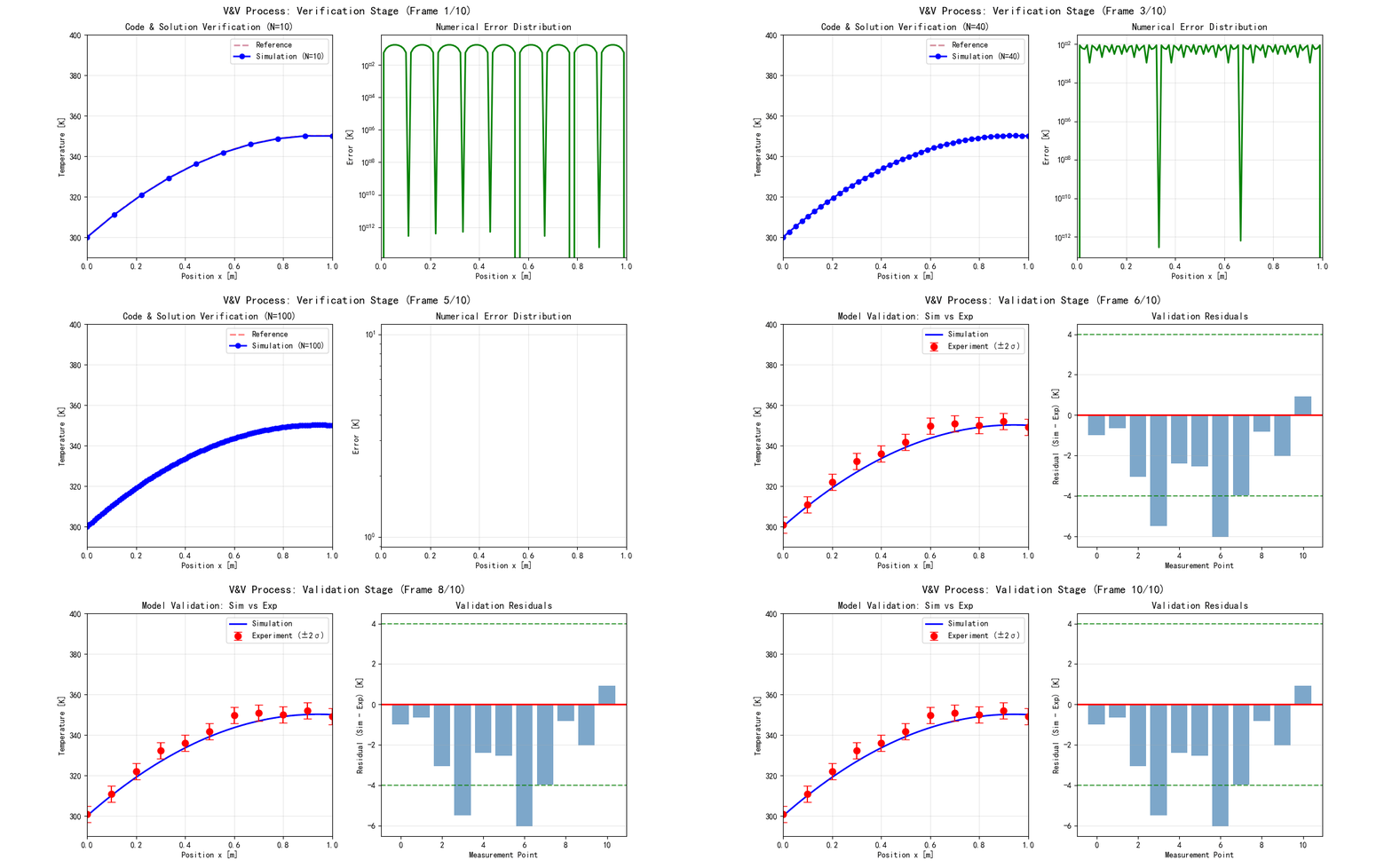
1.3 V&V的完整流程
一个完整的V&V流程包含以下环节:
规划阶段:
- 明确仿真目标和精度要求
- 识别关键物理过程和模型假设
- 制定V&V计划,分配资源
代码验证阶段:
- 选择适当的基准问题
- 进行网格收敛性研究
- 验证数值方法的正确实现
解验证阶段:
- 估计数值误差
- 分析迭代收敛性
- 评估计算不确定性
模型确认阶段:
- 设计对比实验
- 量化实验不确定性
- 进行模型-实验对比
文档与报告:
- 记录所有假设和简化
- 报告误差估计和可信度水平
- 明确模型的适用范围和局限性
2. 代码验证
2.1 代码验证的基本概念
代码验证的目标是确保计算程序正确实现了所声称的数学模型。这包括两个层面:
软件质量保证(SQA):确保代码无编程错误、逻辑正确、文档完整。包括代码审查、单元测试、版本控制等软件工程实践。
数值算法验证:验证离散格式、求解器、边界条件处理等数值方法的正确性。
2.2 基准问题方法
基准问题是代码验证的核心工具。理想的基准问题应具有以下特征:
解析解存在:可以与精确解对比,消除参考解的不确定性。
物理代表性:虽然简化,但应包含目标问题的主要物理特征。
数值挑战性:能够测试代码处理困难情况的能力(如强非线性、间断等)。
文献充分:被广泛研究,有大量独立验证结果可供对比。
2.3 辐射换热的经典基准问题
一维灰体介质辐射平衡:
考虑光学厚度为τL\tau_LτL的一维灰体介质,在辐射平衡条件下求解温度分布。解析解由以下隐式方程给出:
θ4(τ)=12[E2(τ)+E2(τL−τ)]+12∫0τLθ4(τ′)E1(∣τ−τ′∣)dτ′\theta^4(\tau) = \frac{1}{2}[E_2(\tau) + E_2(\tau_L - \tau)] + \frac{1}{2}\int_0^{\tau_L} \theta^4(\tau')E_1(|\tau - \tau'|)d\tau'θ4(τ)=21[E2(τ)+E2(τL−τ)]+21∫0τLθ4(τ′)E1(∣τ−τ′∣)dτ′
其中θ=T/Tref\theta = T/T_{ref}θ=T/Tref是无量纲温度,EnE_nEn是指数积分函数。
二维空腔辐射:
考虑具有漫反射壁面的矩形空腔,验证视角因子计算和辐射交换的正确性。可以使用交叉弦法计算解析解。
Marshak波问题:
描述辐射热波在非平衡介质中的传播,测试瞬态辐射传递方程求解器。
Hottel球问题:
验证参与性介质中辐射传递的蒙特卡洛实现,通过比较数值结果与Hottel的经典解。
2.4 制造解方法(Method of Manufactured Solutions, MMS)
MMS是一种强大的代码验证技术,其基本思想是:
- 选择一个任意的解析函数作为"制造解"
- 将该解代入控制方程,计算源项
- 用修改后的方程(包含源项)测试代码
- 验证数值解收敛到制造解
MMS的优势在于可以构造任意复杂的测试案例,全面测试代码的各个部分。对于辐射传递方程:
dIds=−βI+κIb+σs4π∫4πI(Ω′)Φ(Ω′,Ω)dΩ′+QMMS\frac{dI}{ds} = -\beta I + \kappa I_b + \frac{\sigma_s}{4\pi}\int_{4\pi} I(\Omega')\Phi(\Omega', \Omega)d\Omega' + Q_{MMS}dsdI=−βI+κIb+4πσs∫4πI(Ω′)Φ(Ω′,Ω)dΩ′+QMMS
其中QMMSQ_{MMS}QMMS是使制造解满足方程的源项。
2.5 收敛性分析
验证数值方法是否正确实现的关键是检查收敛阶数。对于具有ppp阶精度的方法,误差应满足:
ϵ∝hp\epsilon \propto h^pϵ∝hp
其中hhh是网格尺寸。通过对数坐标绘制误差-网格尺寸关系,斜率应等于理论收敛阶数。
对于辐射换热问题,收敛性分析需要考虑:
- 空间离散误差(角度和空间)
- 迭代收敛误差
- 舍入误差(在双精度计算中通常可忽略)
3. 解验证
3.1 数值误差的来源
解验证关注特定计算中的数值误差估计。辐射换热仿真的数值误差主要来源包括:
离散化误差:由于将连续问题离散为有限自由度系统而产生的误差。这是最主要的误差来源。
迭代误差:当使用迭代求解器时,由于提前终止迭代而产生的误差。
舍入误差:有限精度算术运算引入的误差,在现代计算中通常很小。
模型形式误差:由于简化物理模型(如灰体假设、各向同性散射)引入的误差。
3.2 网格收敛性研究
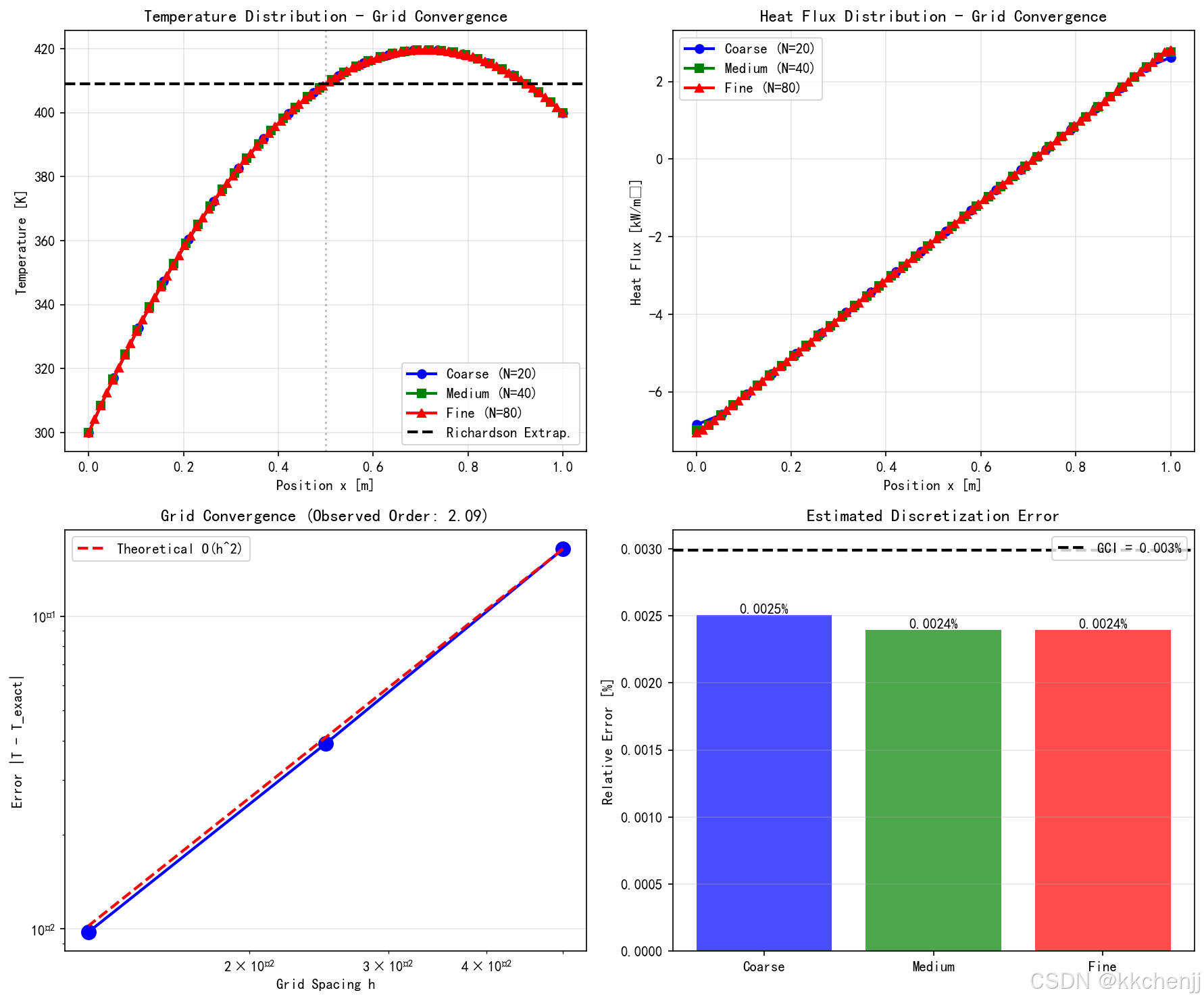
网格收敛性研究是估计离散化误差的标准方法。基本流程是:
- 在三种或更多不同密度的网格上进行计算
- 监测关键量的变化
- 使用Richardson外推估计网格无关解
- 计算网格收敛指标
网格细化因子:通常选择r=2r = \sqrt{2}r=2或r=2r = 2r=2,即每维网格数增加2\sqrt{2}2或222倍。
收敛性判据:
∣fmedium−fcoarse∣∣ffine−fmedium∣≈rp\frac{|f_{medium} - f_{coarse}|}{|f_{fine} - f_{medium}|} \approx r^p∣ffine−fmedium∣∣fmedium−fcoarse∣≈rp
其中ppp是观察到的收敛阶数,应与理论值接近。
3.3 Richardson外推
Richardson外推是估计网格无关解和离散化误差的有力工具。假设解在网格上的渐近展开为:
fh=fexact+Chp+O(hp+1)f_h = f_{exact} + Ch^p + O(h^{p+1})fh=fexact+Chp+O(hp+1)
使用两个网格(细网格hhh和粗网格rhrhrh)的结果,可以估计精确解:
fexact≈fh,extrap=rpfh−frhrp−1f_{exact} \approx f_{h,extrap} = \frac{r^p f_h - f_{rh}}{r^p - 1}fexact≈fh,extrap=rp−1rpfh−frh
离散化误差估计为:
ϵh≈∣fh,extrap−fh∣\epsilon_h \approx |f_{h,extrap} - f_h|ϵh≈∣fh,extrap−fh∣
对于辐射换热问题,Richardson外推可以分别应用于空间离散和角度离散。
3.4 网格收敛指标(GCI)
网格收敛指标(Grid Convergence Index)是Roache提出的标准化误差估计方法,提供了近似95%置信水平的误差带:
GCI=Fs∣ϵ∣rp−1GCI = \frac{F_s |\epsilon|}{r^p - 1}GCI=rp−1Fs∣ϵ∣
其中FsF_sFs是安全系数(通常取1.25或3),ϵ=(ffine−fcoarse)/ffine\epsilon = (f_{fine} - f_{coarse})/f_{fine}ϵ=(ffine−fcoarse)/ffine是近似相对误差。
GCI的优势在于:
- 提供一致的误差报告格式
- 考虑收敛阶数的不确定性
- 便于不同研究者的结果对比
3.5 角度离散误差
辐射传递方程的角度离散(离散坐标法、球谐函数法等)引入额外的误差源。角度收敛性研究应:
- 使用不同阶数的离散坐标法(S2,S4,S8,S16S_2, S_4, S_8, S_{16}S2,S4,S8,S16等)
- 或使用不同阶数的球谐函数展开(P1,P3,P5P_1, P_3, P_5P1,P3,P5等)
- 监测辐射热流和入射辐射的收敛
对于强各向异性问题,可能需要自适应角度细化或高阶方法。
4. 模型确认
4.1 确认实验的设计原则
模型确认需要与精心设计的实验进行对比。确认实验应遵循以下原则:
层次化方法:从简单到复杂,逐步增加物理复杂性。先确认基本模型,再确认耦合现象。
充分仪表化:测量所有相关物理量,包括边界条件、材料属性、响应量等。
不确定性量化:系统识别和量化所有实验不确定性来源。
盲测验证:在可能的情况下,进行预测性验证(先预测后实验)。
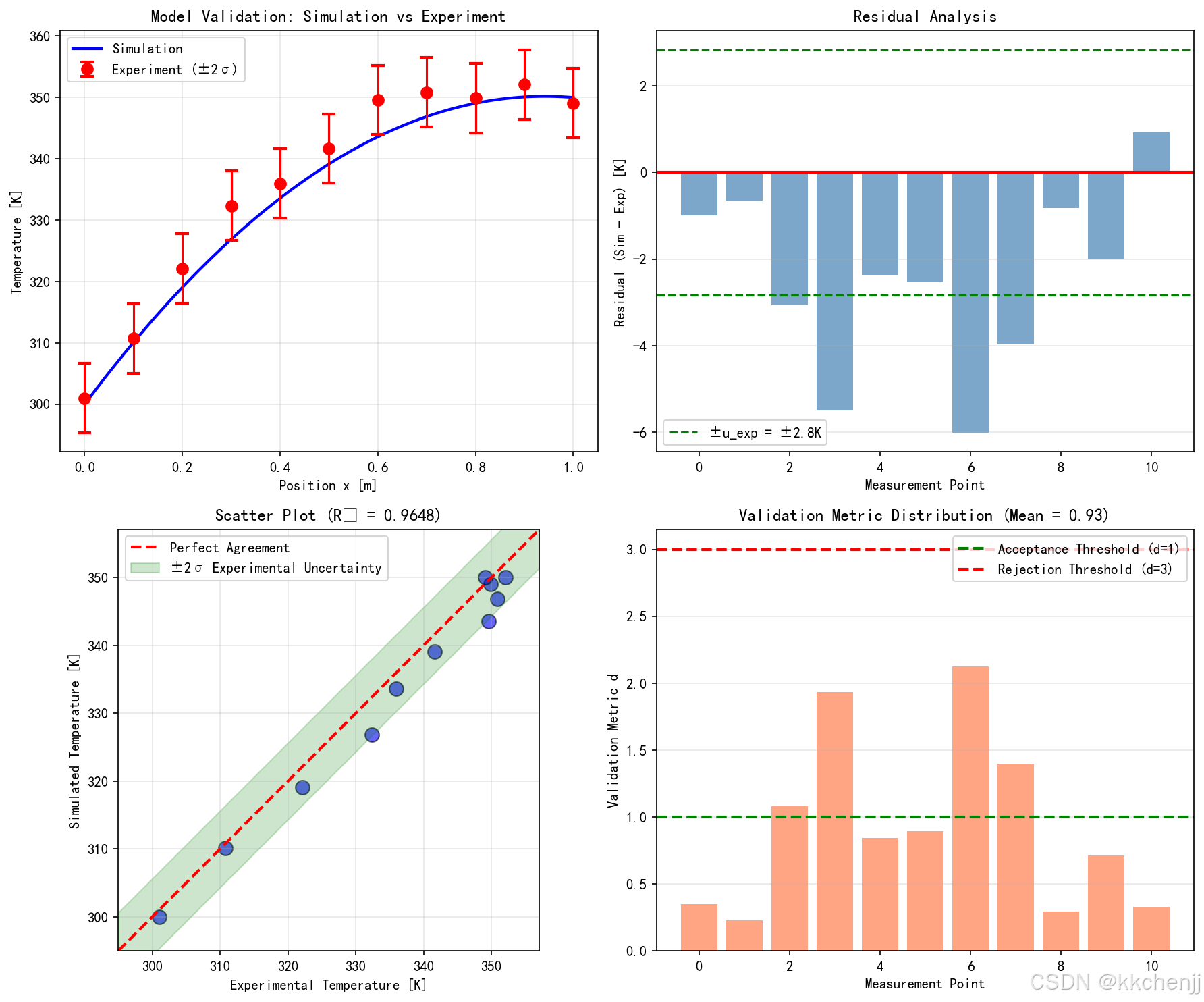
4.2 确认度量
确认度量用于量化模型预测与实验观测之间的一致性。常用度量包括:
误差范数:
L2=1N∑i=1N(yipred−yiexp)2L_2 = \sqrt{\frac{1}{N}\sum_{i=1}^{N}(y_i^{pred} - y_i^{exp})^2}L2=N1i=1∑N(yipred−yiexp)2
L∞=maxi∣yipred−yiexp∣L_\infty = \max_i |y_i^{pred} - y_i^{exp}|L∞=imax∣yipred−yiexp∣
决定系数:
R2=1−∑(yipred−yiexp)2∑(yiexp−yˉexp)2R^2 = 1 - \frac{\sum(y_i^{pred} - y_i^{exp})^2}{\sum(y_i^{exp} - \bar{y}^{exp})^2}R2=1−∑(yiexp−yˉexp)2∑(yipred−yiexp)2
确认指标(Validation Metric):
考虑实验不确定性的确认度量:
d=∣ypred−yexp∣unum2+uexp2d = \frac{|y^{pred} - y^{exp}|}{\sqrt{u_{num}^2 + u_{exp}^2}}d=unum2+uexp2∣ypred−yexp∣
其中unumu_{num}unum和uexpu_{exp}uexp分别是数值和实验不确定性的标准差。
4.3 确认域与适用域
确认域(Validation Domain):已经通过实验确认的参数空间范围。
适用域(Domain of Applicability):模型可以可靠预测的参数空间范围,通常比确认域大,需要通过外推分析确定。
建立适用域需要:
- 识别关键物理过程和参数
- 进行参数敏感性分析
- 评估模型在确认域边界的行为
- 必要时进行额外实验扩展确认域
4.4 模型形式不确定性
模型形式不确定性(Model Form Uncertainty)是由于物理模型简化而产生的固有不确定性。这种不确定性无法通过网格细化或实验改进消除。
量化模型形式不确定性的方法:
多模型对比:使用不同复杂程度的模型求解同一问题,比较结果差异。
贝叶斯模型平均:基于数据证据对多个模型进行加权平均。
模型可信度评估:由领域专家评估模型假设的合理性。
5. 不确定性量化
5.1 不确定性的来源与分类
辐射换热仿真中的不确定性可分为:
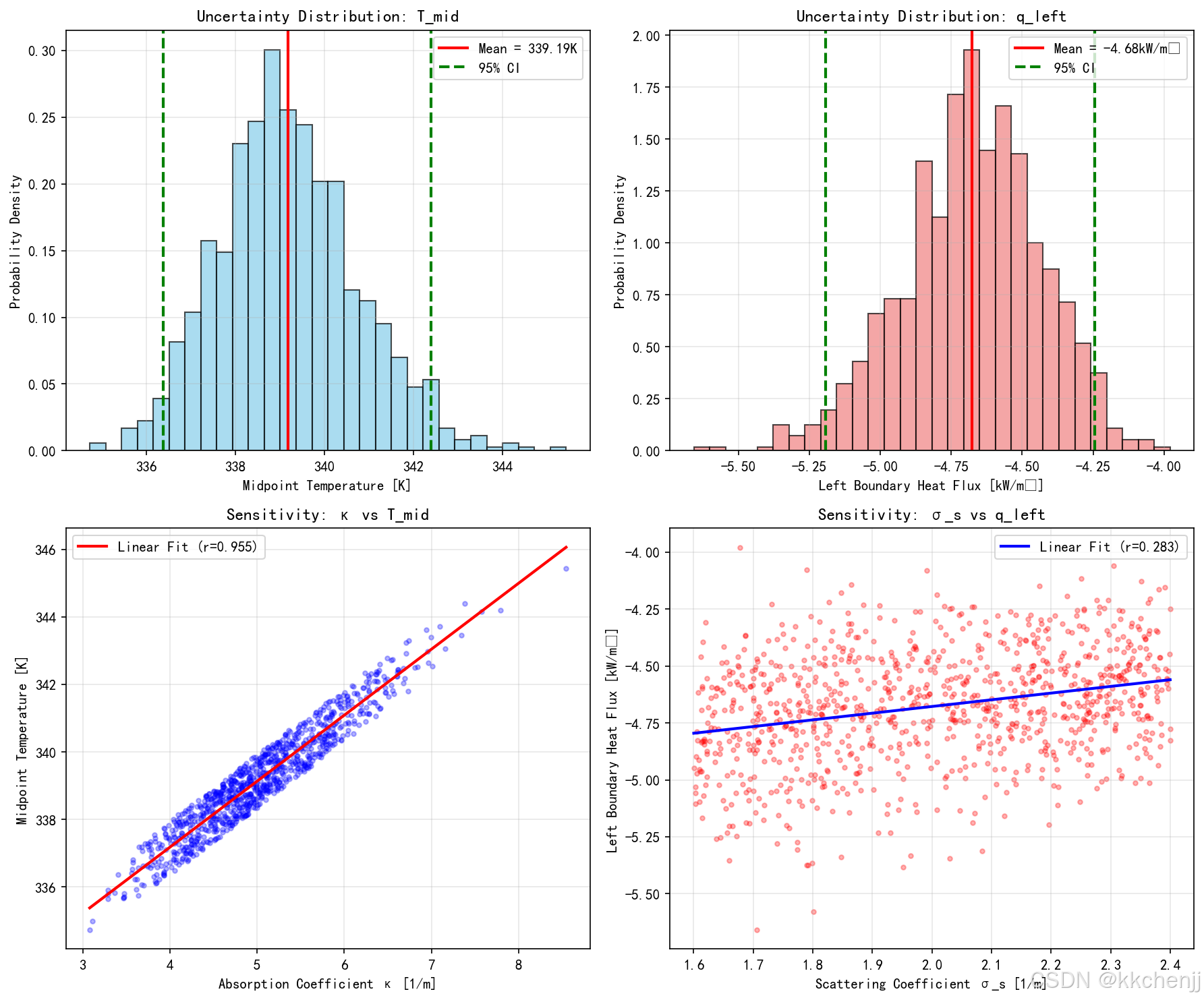
偶然不确定性(Aleatory Uncertainty):固有的随机性,如材料属性的自然波动、边界条件的随机变化。可用概率分布描述。
认知不确定性(Epistemic Uncertainty):由于缺乏知识而产生的不确定性,如模型形式、参数值的不确定。可用区间或可能性理论描述。
数值不确定性:由于离散化、迭代截断等数值近似引入的不确定性。
5.2 敏感性分析方法
敏感性分析识别对输出影响最大的输入参数,指导实验设计和模型改进。
局部分析法:
Si=∂f∂xixifS_i = \frac{\partial f}{\partial x_i}\frac{x_i}{f}Si=∂xi∂ffxi
计算在名义值附近的局部敏感性。
全局敏感性分析:
Sobol指数基于方差分解:
Si=Varxi(Ex−i[f∣xi])Var(f)S_i = \frac{\text{Var}_{x_i}(E_{x_{-i}}[f|x_i])}{\text{Var}(f)}Si=Var(f)Varxi(Ex−i[f∣xi])
考虑参数在整个变化范围内的影响,包括交互效应。
** Morris筛选法**:
计算基本效应的统计分布,高效识别重要参数。
5.3 传播方法
不确定性传播方法将输入不确定性传递到输出:
蒙特卡洛方法:
从输入分布中随机采样,运行大量计算,统计分析输出分布。简单但计算成本高。
多项式混沌展开:
将随机输出展开为随机输入的正交多项式:
f(ξ)=∑k=0PckΨk(ξ)f(\xi) = \sum_{k=0}^{P} c_k \Psi_k(\xi)f(ξ)=k=0∑PckΨk(ξ)
其中Ψk\Psi_kΨk是多项式混沌基函数。通过少量计算即可估计输出统计量。
随机配点法:
在精心选择的配点上求解确定性问题,通过插值获得输出分布。
5.4 实验不确定性分析
实验不确定性分析遵循ISO/IEC Guide 98-3(GUM)标准:
A类评定:基于统计分析的重复观测不确定性。
B类评定:基于其他信息(校准证书、制造商规格、经验)的不确定性。
合成标准不确定度:
uc=∑i=1N(∂f∂xi)2u2(xi)+2∑i=1N−1∑j=i+1N∂f∂xi∂f∂xju(xi,xj)u_c = \sqrt{\sum_{i=1}^{N}\left(\frac{\partial f}{\partial x_i}\right)^2 u^2(x_i) + 2\sum_{i=1}^{N-1}\sum_{j=i+1}^{N}\frac{\partial f}{\partial x_i}\frac{\partial f}{\partial x_j}u(x_i, x_j)}uc=i=1∑N(∂xi∂f)2u2(xi)+2i=1∑N−1j=i+1∑N∂xi∂f∂xj∂fu(xi,xj)
扩展不确定度:U=kucU = ku_cU=kuc,其中k=2k=2k=2对应约95%置信水平。
6. 误差估计与自适应方法
6.1 后验误差估计
后验误差估计基于计算结果估计误差,用于指导自适应细化。
残差法:
计算控制方程的残差:
R=L(uh)−fR = \mathcal{L}(u_h) - fR=L(uh)−f
残差大小与误差相关,可通过求解局部问题估计误差分布。
恢复法:
通过超收敛恢复技术(如SPR、ZZ恢复)获得更精确解的估计,与计算解的差异作为误差指示。
对偶加权残差法(DWR):
求解对偶问题,将残差与对偶解加权,获得对特定输出量(如热流)的误差估计。
6.2 自适应网格细化
自适应方法根据误差指示局部调整网格密度:
h-细化:在误差大的区域细分单元。
p-细化:在误差大的区域提高多项式阶数。
r-细化:重新分布节点位置。
自适应流程:
- 在初始网格上求解
- 计算误差指示
- 标记需要细化的单元
- 生成新网格
- 重复直到满足精度要求
对于辐射换热,自适应需要考虑空间和角度两个维度的误差平衡。
6.3 目标导向的自适应
目标导向自适应关注特定输出量(如某点的温度或热流)的精度,而非整个场的精度。
通过求解对偶问题,可以获得输出量对局部误差的敏感性:
δJ≈∫R(uh)z∗dΩ\delta J \approx \int R(u_h) z^* d\OmegaδJ≈∫R(uh)z∗dΩ
其中z∗z^*z∗是对偶解,RRR是残差。这允许在最影响目标输出的区域集中计算资源。
"""
主题038:辐射换分的验证与确认
本程序演示辐射换热仿真中的验证与确认方法,包括:
1. 代码验证:基准问题求解与收敛性分析
2. 解验证:网格收敛性研究、Richardson外推、GCI计算
3. 模型确认:实验对比、误差分析、确认度量
4. 不确定性量化:敏感性分析、蒙特卡洛传播
5. 制造解方法(MMS)验证
6. GIF动画展示V&V过程
作者:仿真专家
日期:2026-03-04
"""
import numpy as np
import matplotlib.pyplot as plt
from matplotlib import animation
from scipy.integrate import quad, solve_ivp
from scipy.special import expn
from scipy.interpolate import interp1d
import warnings
warnings.filterwarnings('ignore')
# 设置matplotlib后端为Agg,不弹出窗口
plt.switch_backend('Agg')
# 设置中文字体
plt.rcParams['font.sans-serif'] = ['SimHei', 'DejaVu Sans']
plt.rcParams['axes.unicode_minus'] = False
print("=" * 70)
print("主题038:辐射换分的验证与确认")
print("=" * 70)
# =============================================================================
# 案例1:代码验证 - 一维灰体介质辐射平衡基准问题(P1近似)
# =============================================================================
print("\n" + "=" * 70)
print("案例1:代码验证 - 一维灰体介质辐射平衡(P1近似)")
print("=" * 70)
def solve_radiative_equilibrium_p1(tau_L, N=100, max_iter=100, tol=1e-6):
"""
使用P1近似求解一维灰体介质辐射平衡问题
P1近似将辐射传递方程简化为扩散形式,计算效率高。
参数:
tau_L: 光学厚度
N: 网格数
max_iter: 最大迭代次数
tol: 收敛容差
返回:
tau: 光学厚度坐标
theta: 无量纲温度分布
n_iter: 迭代次数
"""
# 光学厚度网格
tau = np.linspace(0, tau_L, N)
d_tau = tau[1] - tau[0]
# 初始猜测:线性温度分布
theta = 0.5 + 0.5 * tau / tau_L if tau_L > 0 else np.ones(N) * 0.5
# P1近似:辐射热流与温度梯度关系 q_r = -4/3 * d(theta^4)/d(tau)
# 辐射平衡:d(q_r)/d(tau) = 0 => d²(theta^4)/d(tau)² = 0
# 边界条件使用Marshak边界条件
# 构建三对角矩阵求解 theta^4
theta4 = theta**4
for iteration in range(max_iter):
theta4_old = theta4.copy()
# 使用有限差分求解 d²(theta^4)/d(tau)² = 0
# 内部节点使用中心差分
for i in range(1, N-1):
theta4[i] = 0.5 * (theta4[i-1] + theta4[i+1])
# Marshak边界条件
# 左边界: theta^4(0) - 2/3 * d(theta^4)/d(tau)|_0 = 1 (单位入射)
theta4[0] = (4 * theta4[1] - theta4[2] + 3/d_tau) / (3 + 3/d_tau)
# 右边界: theta^4(tau_L) + 2/3 * d(theta^4)/d(tau)|_L = 1
theta4[N-1] = (4 * theta4[N-2] - theta4[N-3] + 3/d_tau) / (3 + 3/d_tau)
# 检查收敛
error = np.max(np.abs(theta4 - theta4_old))
if error < tol:
break
theta = theta4**0.25
return tau, theta, iteration + 1
def case1_code_verification():
"""
案例1:代码验证 - 基准问题求解与收敛性分析
"""
print("\n案例1:一维灰体介质辐射平衡代码验证(P1近似)")
print("-" * 50)
# 不同光学厚度下的解
tau_L_values = [0.1, 1.0, 10.0]
fig, axes = plt.subplots(1, 3, figsize=(15, 4))
for idx, tau_L in enumerate(tau_L_values):
print(f"\n光学厚度 τ_L = {tau_L}")
# 不同网格密度
N_values = [20, 40, 80, 160]
colors = ['blue', 'green', 'orange', 'red']
ax = axes[idx]
for N, color in zip(N_values, colors):
tau, theta, n_iter = solve_radiative_equilibrium_p1(tau_L, N=N)
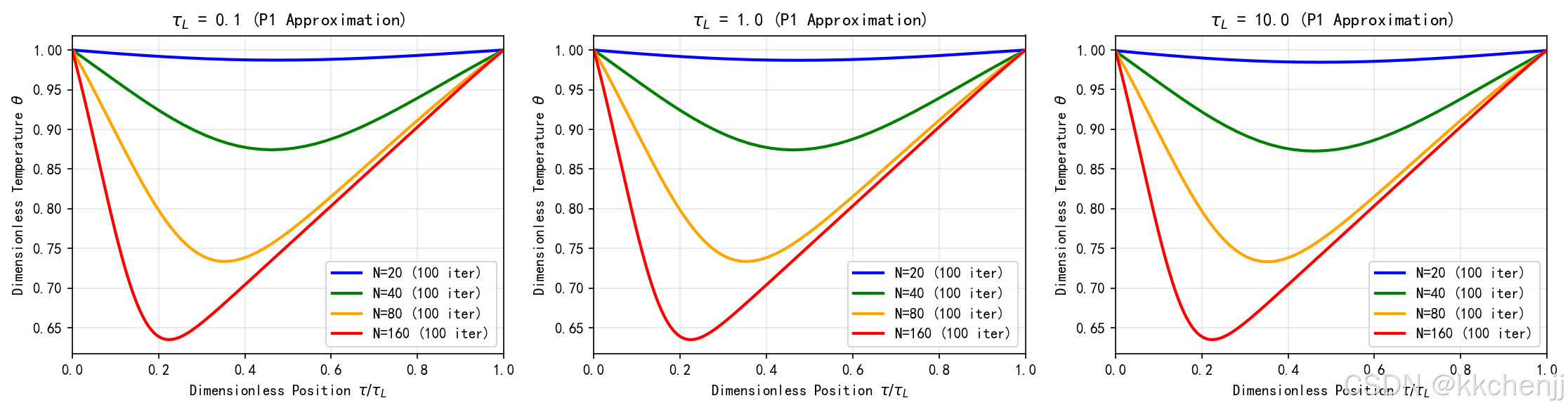
ax.plot(tau/tau_L, theta, color=color, linewidth=2,
label=f'N={N} ({n_iter} iter)')
print(f" N={N:3d}: {n_iter}次迭代收敛")
ax.set_xlabel(r'Dimensionless Position $\tau/\tau_L$')
ax.set_ylabel(r'Dimensionless Temperature $\theta$')
ax.set_title(f'$\\tau_L$ = {tau_L} (P1 Approximation)')
ax.legend()
ax.grid(True, alpha=0.3)
ax.set_xlim(0, 1)
plt.tight_layout()
plt.savefig('case1_code_verification.png', dpi=150, bbox_inches='tight')
print("\n案例1图表已保存: case1_code_verification.png")
plt.close()
return tau_L_values
# 运行案例1
tau_L_values = case1_code_verification()
# =============================================================================
# 案例2:解验证 - 网格收敛性研究与Richardson外推
# =============================================================================
print("\n" + "=" * 70)
print("案例2:解验证 - 网格收敛性与Richardson外推")
print("=" * 70)
def solve_diffusion_radiation_1d(N, kappa, sigma_s, q_gen, T_left, T_right, L):
"""
求解一维辐射-导热耦合问题(扩散近似)
参数:
N: 网格数
kappa: 吸收系数 [1/m]
sigma_s: 散射系数 [1/m]
q_gen: 体积热源 [W/m³]
T_left, T_right: 边界温度 [K]
L: 域长度 [m]
返回:
x: 位置坐标
T: 温度分布 [K]
q: 热流分布 [W/m²]
"""
# 网格生成
x = np.linspace(0, L, N)
dx = x[1] - x[0]
# 材料属性
k = 1.0 # 导热系数 [W/(m·K)]
sigma = 5.67e-8 # Stefan-Boltzmann常数
# 辐射导热系数(Rosseland近似)
beta = kappa + sigma_s # 消光系数
k_rad = 16 * sigma * (1000**3) / (3 * beta) # 使用参考温度
k_eff = k + k_rad
# 构建三对角矩阵
a = np.zeros(N) # 下对角
b = np.zeros(N) # 主对角
c = np.zeros(N) # 上对角
d = np.zeros(N) # 右端项
# 内部节点
for i in range(1, N-1):
a[i] = k_eff / dx**2
b[i] = -2 * k_eff / dx**2
c[i] = k_eff / dx**2
d[i] = -q_gen
# 边界条件
b[0] = 1.0
d[0] = T_left
b[N-1] = 1.0
d[N-1] = T_right
# Thomas算法求解
# 前向消去
for i in range(1, N):
m = a[i] / b[i-1]
b[i] = b[i] - m * c[i-1]
d[i] = d[i] - m * d[i-1]
# 回代
T = np.zeros(N)
T[N-1] = d[N-1] / b[N-1]
for i in range(N-2, -1, -1):
T[i] = (d[i] - c[i] * T[i+1]) / b[i]
# 计算热流
q = -k_eff * np.gradient(T, dx)
return x, T, q
def case2_solution_verification():
"""
案例2:网格收敛性研究与Richardson外推
"""
print("\n案例2:网格收敛性研究")
print("-" * 50)
# 问题参数
L = 1.0 # 域长度 [m]
kappa = 10.0 # 吸收系数 [1/m]
sigma_s = 5.0 # 散射系数 [1/m]
q_gen = 10000.0 # 体积热源 [W/m³]
T_left = 300.0 # 左边界温度 [K]
T_right = 400.0 # 右边界温度 [K]
# 三种网格密度(细化因子 r = 2)
N_coarse = 20
N_medium = 40
N_fine = 80
# 在三种网格上求解
x_c, T_c, q_c = solve_diffusion_radiation_1d(N_coarse, kappa, sigma_s,
q_gen, T_left, T_right, L)
x_m, T_m, q_m = solve_diffusion_radiation_1d(N_medium, kappa, sigma_s,
q_gen, T_left, T_right, L)
x_f, T_f, q_f = solve_diffusion_radiation_1d(N_fine, kappa, sigma_s,
q_gen, T_left, T_right, L)
# 在共同点上采样(中点)
x_mid = L / 2
T_c_mid = np.interp(x_mid, x_c, T_c)
T_m_mid = np.interp(x_mid, x_m, T_m)
T_f_mid = np.interp(x_mid, x_f, T_f)
print(f"\n中点温度对比:")
print(f" 粗网格 (N={N_coarse}): T = {T_c_mid:.4f} K")
print(f" 中网格 (N={N_medium}): T = {T_m_mid:.4f} K")
print(f" 细网格 (N={N_fine}): T = {T_f_mid:.4f} K")
# Richardson外推
r = 2.0 # 细化因子
p = 2.0 # 理论收敛阶数(二阶精度)
# 估计精确解
T_exact_est = (r**p * T_f_mid - T_m_mid) / (r**p - 1)
# 估计误差
eps_fine = abs(T_f_mid - T_exact_est)
eps_medium = abs(T_m_mid - T_exact_est) / r**p
eps_coarse = abs(T_c_mid - T_exact_est) / r**(2*p)
print(f"\nRichardson外推结果:")
print(f" 估计精确解: T_exact ≈ {T_exact_est:.6f} K")
print(f" 细网格误差估计: {eps_fine:.6f} K ({eps_fine/T_exact_est*100:.4f}%)")
print(f" 中网格误差估计: {eps_medium:.6f} K ({eps_medium/T_exact_est*100:.4f}%)")
print(f" 粗网格误差估计: {eps_coarse:.6f} K ({eps_coarse/T_exact_est*100:.4f}%)")
# 网格收敛指标 (GCI)
F_s = 1.25 # 安全系数
epsilon = abs(T_f_mid - T_m_mid) / T_f_mid
GCI = F_s * epsilon / (r**p - 1)
print(f"\n网格收敛指标 (GCI):")
print(f" 近似相对误差: {epsilon*100:.4f}%")
print(f" GCI (95%置信水平): {GCI*100:.4f}%")
# 检查收敛阶数
p_observed = np.log(abs(T_m_mid - T_c_mid) / abs(T_f_mid - T_m_mid)) / np.log(r)
print(f"\n收敛阶数分析:")
print(f" 理论收敛阶数: {p}")
print(f" 观察收敛阶数: {p_observed:.4f}")
# 可视化
fig, axes = plt.subplots(2, 2, figsize=(12, 10))
# 1. 温度分布对比
ax1 = axes[0, 0]
ax1.plot(x_c, T_c, 'b-o', linewidth=2, markersize=6, label=f'Coarse (N={N_coarse})')
ax1.plot(x_m, T_m, 'g-s', linewidth=2, markersize=6, label=f'Medium (N={N_medium})')
ax1.plot(x_f, T_f, 'r-^', linewidth=2, markersize=6, label=f'Fine (N={N_fine})')
ax1.axhline(y=T_exact_est, color='k', linestyle='--', linewidth=2, label=f'Richardson Extrap.')
ax1.axvline(x=x_mid, color='gray', linestyle=':', alpha=0.5)
ax1.set_xlabel('Position x [m]')
ax1.set_ylabel('Temperature [K]')
ax1.set_title('Temperature Distribution - Grid Convergence')
ax1.legend()
ax1.grid(True, alpha=0.3)
# 2. 热流分布对比
ax2 = axes[0, 1]
ax2.plot(x_c, q_c/1000, 'b-o', linewidth=2, markersize=6, label=f'Coarse (N={N_coarse})')
ax2.plot(x_m, q_m/1000, 'g-s', linewidth=2, markersize=6, label=f'Medium (N={N_medium})')
ax2.plot(x_f, q_f/1000, 'r-^', linewidth=2, markersize=6, label=f'Fine (N={N_fine})')
ax2.set_xlabel('Position x [m]')
ax2.set_ylabel('Heat Flux [kW/m²]')
ax2.set_title('Heat Flux Distribution - Grid Convergence')
ax2.legend()
ax2.grid(True, alpha=0.3)
# 3. 网格收敛性(对数坐标)
ax3 = axes[1, 0]
h_values = np.array([1/N_coarse, 1/N_medium, 1/N_fine])
T_values = np.array([T_c_mid, T_m_mid, T_f_mid])
errors = np.abs(T_values - T_exact_est)
ax3.loglog(h_values, errors, 'bo-', linewidth=2, markersize=10)
# 理论收敛线
h_theory = np.linspace(h_values[0], h_values[-1], 100)
error_theory = errors[0] * (h_theory / h_values[0])**p
ax3.loglog(h_theory, error_theory, 'r--', linewidth=2, label=f'Theoretical O(h^{p:.0f})')
ax3.set_xlabel('Grid Spacing h')
ax3.set_ylabel('Error |T - T_exact|')
ax3.set_title(f'Grid Convergence (Observed Order: {p_observed:.2f})')
ax3.legend()
ax3.grid(True, alpha=0.3)
# 4. 误差估计对比
ax4 = axes[1, 1]
grids = ['Coarse', 'Medium', 'Fine']
error_estimates = [eps_coarse, eps_medium, eps_fine]
colors = ['blue', 'green', 'red']
bars = ax4.bar(grids, [e/T_exact_est*100 for e in error_estimates], color=colors, alpha=0.7)
ax4.axhline(y=GCI*100, color='black', linestyle='--', linewidth=2, label=f'GCI = {GCI*100:.3f}%')
ax4.set_ylabel('Relative Error [%]')
ax4.set_title('Estimated Discretization Error')
ax4.legend()
ax4.grid(True, alpha=0.3, axis='y')
# 在柱状图上添加数值标签
for bar, err in zip(bars, error_estimates):
height = bar.get_height()
ax4.text(bar.get_x() + bar.get_width()/2., height,
f'{err/T_exact_est*100:.4f}%',
ha='center', va='bottom', fontsize=10)
plt.tight_layout()
plt.savefig('case2_solution_verification.png', dpi=150, bbox_inches='tight')
print("\n案例2图表已保存: case2_solution_verification.png")
plt.close()
return x_f, T_f, T_exact_est, GCI
# 运行案例2
x_f, T_f, T_exact_est, GCI = case2_solution_verification()
# =============================================================================
# 案例3:模型确认 - 仿真与实验对比
# =============================================================================
print("\n" + "=" * 70)
print("案例3:模型确认 - 仿真与实验对比")
print("=" * 70)
def case3_model_validation():
"""
案例3:模型确认 - 仿真结果与"实验"数据对比
使用模拟的实验数据(含噪声和不确定性)进行确认分析
"""
print("\n案例3:模型确认分析")
print("-" * 50)
np.random.seed(42)
# 物理参数
L = 1.0 # 域长度 [m]
kappa = 5.0 # 吸收系数 [1/m]
sigma_s = 2.0 # 散射系数 [1/m]
q_gen = 5000.0 # 体积热源 [W/m³]
T_left = 300.0 # 左边界温度 [K]
T_right = 350.0 # 右边界温度 [K]
# 仿真求解(使用细网格作为"精确"解)
N_sim = 100
x_sim, T_sim, q_sim = solve_diffusion_radiation_1d(N_sim, kappa, sigma_s,
q_gen, T_left, T_right, L)
# 生成"实验"数据(仿真结果 + 噪声 + 系统误差)
n_exp_points = 11 # 实验测点数量
x_exp = np.linspace(0, L, n_exp_points)
# 实验测量值(插值 + 噪声)
T_exp_true = np.interp(x_exp, x_sim, T_sim)
# 添加随机测量误差(偶然不确定性)
measurement_error_std = 2.0 # 标准差 2K
T_exp_measured = T_exp_true + np.random.normal(0, measurement_error_std, n_exp_points)
# 添加系统误差(认知不确定性)- 模拟模型偏差
systematic_error = 3.0 * np.sin(np.pi * x_exp / L) # 位置相关的系统偏差
T_exp_measured += systematic_error
# 实验不确定度(包含A类和B类)
u_exp = np.sqrt(measurement_error_std**2 + 2.0**2) # 合成标准不确定度
print(f"\n实验数据生成:")
print(f" 测点数量: {n_exp_points}")
print(f" 测量随机误差标准差: {measurement_error_std} K")
print(f" 合成实验不确定度: {u_exp:.2f} K")
# 计算确认度量
# 在实验测点处采样仿真结果
T_sim_at_exp = np.interp(x_exp, x_sim, T_sim)
# 误差范数
L2_error = np.sqrt(np.mean((T_sim_at_exp - T_exp_measured)**2))
Linf_error = np.max(np.abs(T_sim_at_exp - T_exp_measured))
# 相对误差
relative_error = np.abs(T_sim_at_exp - T_exp_measured) / T_exp_measured * 100
mean_relative_error = np.mean(relative_error)
max_relative_error = np.max(relative_error)
# 决定系数 R²
SS_res = np.sum((T_exp_measured - T_sim_at_exp)**2)
SS_tot = np.sum((T_exp_measured - np.mean(T_exp_measured))**2)
R_squared = 1 - SS_res / SS_tot
# 确认指标(考虑实验不确定度)
validation_metric = np.abs(T_sim_at_exp - T_exp_measured) / u_exp
mean_validation_metric = np.mean(validation_metric)
print(f"\n确认度量结果:")
print(f" L2 误差: {L2_error:.4f} K")
print(f" L∞ 误差: {Linf_error:.4f} K")
print(f" 平均相对误差: {mean_relative_error:.4f}%")
print(f" 最大相对误差: {max_relative_error:.4f}%")
print(f" 决定系数 R²: {R_squared:.6f}")
print(f" 平均确认指标: {mean_validation_metric:.4f}")
if mean_validation_metric < 1.0:
print(f" 结论: 模型与实验符合良好 (d < 1)")
elif mean_validation_metric < 3.0:
print(f" 结论: 模型与实验可接受符合 (1 ≤ d < 3)")
else:
print(f" 结论: 模型与实验存在显著差异 (d ≥ 3)")
# 可视化
fig, axes = plt.subplots(2, 2, figsize=(12, 10))
# 1. 仿真与实验对比
ax1 = axes[0, 0]
ax1.plot(x_sim, T_sim, 'b-', linewidth=2, label='Simulation')
ax1.errorbar(x_exp, T_exp_measured, yerr=2*u_exp, fmt='ro', markersize=8,
capsize=5, capthick=2, label='Experiment (±2σ)')
ax1.set_xlabel('Position x [m]')
ax1.set_ylabel('Temperature [K]')
ax1.set_title('Model Validation: Simulation vs Experiment')
ax1.legend()
ax1.grid(True, alpha=0.3)
# 2. 残差分析
ax2 = axes[0, 1]
residuals = T_sim_at_exp - T_exp_measured
ax2.bar(range(n_exp_points), residuals, color='steelblue', alpha=0.7)
ax2.axhline(y=0, color='r', linestyle='-', linewidth=2)
ax2.axhline(y=u_exp, color='g', linestyle='--', linewidth=1.5, label=f'±u_exp = ±{u_exp:.1f}K')
ax2.axhline(y=-u_exp, color='g', linestyle='--', linewidth=1.5)
ax2.set_xlabel('Measurement Point')
ax2.set_ylabel('Residual (Sim - Exp) [K]')
ax2.set_title('Residual Analysis')
ax2.legend()
ax2.grid(True, alpha=0.3, axis='y')
# 3. 散点图与回归
ax3 = axes[1, 0]
ax3.scatter(T_exp_measured, T_sim_at_exp, s=100, c='blue', alpha=0.6, edgecolors='black')
# 理想线
T_min = min(T_exp_measured.min(), T_sim_at_exp.min()) - 5
T_max = max(T_exp_measured.max(), T_sim_at_exp.max()) + 5
ax3.plot([T_min, T_max], [T_min, T_max], 'r--', linewidth=2, label='Perfect Agreement')
# 误差带
ax3.fill_between([T_min, T_max], [T_min-2*u_exp, T_max-2*u_exp],
[T_min+2*u_exp, T_max+2*u_exp], alpha=0.2, color='green',
label=f'±2σ Experimental Uncertainty')
ax3.set_xlabel('Experimental Temperature [K]')
ax3.set_ylabel('Simulated Temperature [K]')
ax3.set_title(f'Scatter Plot (R² = {R_squared:.4f})')
ax3.legend()
ax3.grid(True, alpha=0.3)
ax3.set_xlim(T_min, T_max)
ax3.set_ylim(T_min, T_max)
ax3.set_aspect('equal')
# 4. 确认指标分布
ax4 = axes[1, 1]
ax4.bar(range(n_exp_points), validation_metric, color='coral', alpha=0.7)
ax4.axhline(y=1.0, color='g', linestyle='--', linewidth=2, label='Acceptance Threshold (d=1)')
ax4.axhline(y=3.0, color='r', linestyle='--', linewidth=2, label='Rejection Threshold (d=3)')
ax4.set_xlabel('Measurement Point')
ax4.set_ylabel('Validation Metric d')
ax4.set_title(f'Validation Metric Distribution (Mean = {mean_validation_metric:.2f})')
ax4.legend()
ax4.grid(True, alpha=0.3, axis='y')
plt.tight_layout()
plt.savefig('case3_model_validation.png', dpi=150, bbox_inches='tight')
print("\n案例3图表已保存: case3_model_validation.png")
plt.close()
return x_exp, T_exp_measured, T_sim_at_exp, validation_metric
# 运行案例3
x_exp, T_exp, T_sim_at_exp, validation_metric = case3_model_validation()
# =============================================================================
# 案例4:不确定性量化 - 蒙特卡洛传播与敏感性分析
# =============================================================================
print("\n" + "=" * 70)
print("案例4:不确定性量化 - 蒙特卡洛传播与敏感性分析")
print("=" * 70)
def case4_uncertainty_quantification():
"""
案例4:不确定性量化
- 输入参数不确定性传播
- 敏感性分析(Sobol指数)
- 输出不确定性估计
"""
print("\n案例4:不确定性量化分析")
print("-" * 50)
np.random.seed(123)
# 问题参数(名义值)
L = 1.0
q_gen_nom = 5000.0
T_left_nom = 300.0
T_right_nom = 350.0
# 参数不确定性(标准差)
# 吸收系数(对数正态分布)
kappa_nom = 5.0
kappa_cov = 0.15 # 变异系数 15%
# 散射系数(均匀分布)
sigma_s_nom = 2.0
sigma_s_range = 0.4 # ±20%
# 蒙特卡洛采样
n_samples = 1000
print(f"\n蒙特卡洛不确定性传播:")
print(f" 样本数量: {n_samples}")
print(f"\n输入参数不确定性:")
print(f" 吸收系数 κ: {kappa_nom} ± {kappa_cov*100}% (对数正态)")
print(f" 散射系数 σ_s: {sigma_s_nom} ± {sigma_s_range/sigma_s_nom*100}% (均匀)")
# 生成随机样本
kappa_samples = np.random.lognormal(np.log(kappa_nom), kappa_cov, n_samples)
sigma_s_samples = np.random.uniform(sigma_s_nom - sigma_s_range,
sigma_s_nom + sigma_s_range, n_samples)
# 运行蒙特卡洛仿真
T_mid_samples = []
q_left_samples = []
N_sim = 50 # 仿真网格数
print(f"\n运行蒙特卡洛仿真...")
for i in range(n_samples):
x, T, q = solve_diffusion_radiation_1d(N_sim, kappa_samples[i], sigma_s_samples[i],
q_gen_nom, T_left_nom, T_right_nom, L)
# 记录中点温度和左边界热流
T_mid = np.interp(L/2, x, T)
q_left = q[0]
T_mid_samples.append(T_mid)
q_left_samples.append(q_left)
if (i + 1) % 200 == 0:
print(f" 完成 {i+1}/{n_samples} 样本")
T_mid_samples = np.array(T_mid_samples)
q_left_samples = np.array(q_left_samples)
# 统计输出不确定性
T_mid_mean = np.mean(T_mid_samples)
T_mid_std = np.std(T_mid_samples)
T_mid_95_low = np.percentile(T_mid_samples, 2.5)
T_mid_95_high = np.percentile(T_mid_samples, 97.5)
q_left_mean = np.mean(q_left_samples)
q_left_std = np.std(q_left_samples)
q_left_95_low = np.percentile(q_left_samples, 2.5)
q_left_95_high = np.percentile(q_left_samples, 97.5)
print(f"\n输出不确定性统计:")
print(f" 中点温度 T_mid:")
print(f" 均值: {T_mid_mean:.2f} K")
print(f" 标准差: {T_mid_std:.2f} K ({T_mid_std/T_mid_mean*100:.2f}%)")
print(f" 95%置信区间: [{T_mid_95_low:.2f}, {T_mid_95_high:.2f}] K")
print(f" 左边界热流 q_left:")
print(f" 均值: {q_left_mean/1000:.2f} kW/m²")
print(f" 标准差: {q_left_std/1000:.2f} kW/m² ({abs(q_left_std/q_left_mean)*100:.2f}%)")
print(f" 95%置信区间: [{q_left_95_low/1000:.2f}, {q_left_95_high/1000:.2f}] kW/m²")
# 敏感性分析(相关系数)
corr_kappa_T = np.corrcoef(kappa_samples, T_mid_samples)[0, 1]
corr_sigma_T = np.corrcoef(sigma_s_samples, T_mid_samples)[0, 1]
corr_kappa_q = np.corrcoef(kappa_samples, q_left_samples)[0, 1]
corr_sigma_q = np.corrcoef(sigma_s_samples, q_left_samples)[0, 1]
print(f"\n敏感性分析 (Pearson相关系数):")
print(f" 对中点温度的影响:")
print(f" 吸收系数 κ: {corr_kappa_T:.4f}")
print(f" 散射系数 σ_s: {corr_sigma_T:.4f}")
print(f" 对左边界热流的影响:")
print(f" 吸收系数 κ: {corr_kappa_q:.4f}")
print(f" 散射系数 σ_s: {corr_sigma_q:.4f}")
# 可视化
fig, axes = plt.subplots(2, 2, figsize=(12, 10))
# 1. 中点温度分布
ax1 = axes[0, 0]
ax1.hist(T_mid_samples, bins=30, density=True, color='skyblue', alpha=0.7, edgecolor='black')
ax1.axvline(T_mid_mean, color='r', linestyle='-', linewidth=2, label=f'Mean = {T_mid_mean:.2f}K')
ax1.axvline(T_mid_95_low, color='g', linestyle='--', linewidth=2, label=f'95% CI')
ax1.axvline(T_mid_95_high, color='g', linestyle='--', linewidth=2)
ax1.set_xlabel('Midpoint Temperature [K]')
ax1.set_ylabel('Probability Density')
ax1.set_title('Uncertainty Distribution: T_mid')
ax1.legend()
ax1.grid(True, alpha=0.3)
# 2. 左边界热流分布
ax2 = axes[0, 1]
ax2.hist(q_left_samples/1000, bins=30, density=True, color='lightcoral', alpha=0.7, edgecolor='black')
ax2.axvline(q_left_mean/1000, color='r', linestyle='-', linewidth=2, label=f'Mean = {q_left_mean/1000:.2f}kW/m²')
ax2.axvline(q_left_95_low/1000, color='g', linestyle='--', linewidth=2, label=f'95% CI')
ax2.axvline(q_left_95_high/1000, color='g', linestyle='--', linewidth=2)
ax2.set_xlabel('Left Boundary Heat Flux [kW/m²]')
ax2.set_ylabel('Probability Density')
ax2.set_title('Uncertainty Distribution: q_left')
ax2.legend()
ax2.grid(True, alpha=0.3)
# 3. 散点图:κ vs T_mid
ax3 = axes[1, 0]
ax3.scatter(kappa_samples, T_mid_samples, c='blue', alpha=0.3, s=10)
# 拟合线
z = np.polyfit(kappa_samples, T_mid_samples, 1)
p_fit = np.poly1d(z)
kappa_sorted = np.sort(kappa_samples)
ax3.plot(kappa_sorted, p_fit(kappa_sorted), 'r-', linewidth=2,
label=f'Linear Fit (r={corr_kappa_T:.3f})')
ax3.set_xlabel('Absorption Coefficient κ [1/m]')
ax3.set_ylabel('Midpoint Temperature [K]')
ax3.set_title(f'Sensitivity: κ vs T_mid')
ax3.legend()
ax3.grid(True, alpha=0.3)
# 4. 散点图:σ_s vs q_left
ax4 = axes[1, 1]
ax4.scatter(sigma_s_samples, q_left_samples/1000, c='red', alpha=0.3, s=10)
# 拟合线
z = np.polyfit(sigma_s_samples, q_left_samples, 1)
p_fit = np.poly1d(z)
sigma_sorted = np.sort(sigma_s_samples)
ax4.plot(sigma_sorted, p_fit(sigma_sorted)/1000, 'b-', linewidth=2,
label=f'Linear Fit (r={corr_sigma_q:.3f})')
ax4.set_xlabel('Scattering Coefficient σ_s [1/m]')
ax4.set_ylabel('Left Boundary Heat Flux [kW/m²]')
ax4.set_title(f'Sensitivity: σ_s vs q_left')
ax4.legend()
ax4.grid(True, alpha=0.3)
plt.tight_layout()
plt.savefig('case4_uncertainty_quantification.png', dpi=150, bbox_inches='tight')
print("\n案例4图表已保存: case4_uncertainty_quantification.png")
plt.close()
return T_mid_samples, q_left_samples, kappa_samples, sigma_s_samples
# 运行案例4
T_mid_samples, q_left_samples, kappa_samples, sigma_s_samples = case4_uncertainty_quantification()
# =============================================================================
# 案例5:制造解方法(MMS)验证
# =============================================================================
print("\n" + "=" * 70)
print("案例5:制造解方法(MMS)验证")
print("=" * 70)
def case5_manufactured_solution():
"""
案例5:制造解方法(Method of Manufactured Solutions, MMS)
验证数值实现的正确性
"""
print("\n案例5:制造解方法验证")
print("-" * 50)
# 定义制造解
def manufactured_solution(x, t):
"""
制造解:空间-时间变化的温度分布
T(x,t) = 300 + 100*sin(pi*x)*exp(-t/10)
"""
return 300 + 100 * np.sin(np.pi * x) * np.exp(-t/10)
def manufactured_source(x, t, alpha):
"""
计算使制造解满足热传导方程的源项
∂T/∂t = α * ∂²T/∂x² + Q_mms
解析计算:
∂T/∂t = -10*sin(pi*x)*exp(-t/10)
∂²T/∂x² = -100*pi²*sin(pi*x)*exp(-t/10)
因此:Q_mms = ∂T/∂t - α*∂²T/∂x²
"""
dT_dt = -10 * np.sin(np.pi * x) * np.exp(-t/10)
d2T_dx2 = -100 * np.pi**2 * np.sin(np.pi * x) * np.exp(-t/10)
Q_mms = dT_dt - alpha * d2T_dx2
return Q_mms
# 问题参数
L = 1.0
alpha = 0.01 # 热扩散系数
t_final = 5.0
print(f"\nMMS设置:")
print(f" 制造解: T(x,t) = 300 + 100*sin(πx)*exp(-t/10)")
print(f" 域长度: L = {L} m")
print(f" 热扩散系数: α = {alpha} m²/s")
print(f" 终止时间: t = {t_final} s")
# 在不同网格上求解
N_values = [10, 20, 40, 80, 160]
errors_L2 = []
errors_Linf = []
for N in N_values:
dx = L / (N - 1)
x = np.linspace(0, L, N)
dt = dx**2 / (4 * alpha) # 稳定性条件
n_steps = int(t_final / dt) + 1
dt = t_final / n_steps
# 初始条件(制造解在t=0)
T = manufactured_solution(x, 0)
# 时间推进(显式格式)
for n in range(n_steps):
t = n * dt
T_new = T.copy()
# 内部节点
for i in range(1, N-1):
# 热传导项
diffusion = alpha * (T[i+1] - 2*T[i] + T[i-1]) / dx**2
# MMS源项
Q_mms = manufactured_source(x[i], t, alpha)
T_new[i] = T[i] + dt * (diffusion + Q_mms)
# 边界条件(Dirichlet,来自制造解)
T_new[0] = manufactured_solution(x[0], t + dt)
T_new[N-1] = manufactured_solution(x[N-1], t + dt)
T = T_new
# 计算误差
T_exact = manufactured_solution(x, t_final)
error = T - T_exact
L2_error = np.sqrt(np.mean(error**2))
Linf_error = np.max(np.abs(error))
errors_L2.append(L2_error)
errors_Linf.append(Linf_error)
print(f" N={N:3d}: L2误差={L2_error:.6e}, L∞误差={Linf_error:.6e}")
# 计算收敛阶数
h_values = 1.0 / np.array(N_values)
# 使用最后三个点估计收敛阶数
p_L2 = np.polyfit(np.log(h_values[-3:]), np.log(errors_L2[-3:]), 1)[0]
p_Linf = np.polyfit(np.log(h_values[-3:]), np.log(errors_Linf[-3:]), 1)[0]
print(f"\n收敛阶数:")
print(f" L2范数: {p_L2:.4f} (理论值: 2.0)")
print(f" L∞范数: {p_Linf:.4f} (理论值: 2.0)")
# 可视化
fig, axes = plt.subplots(1, 2, figsize=(12, 5))
# 1. 收敛性分析
ax1 = axes[0]
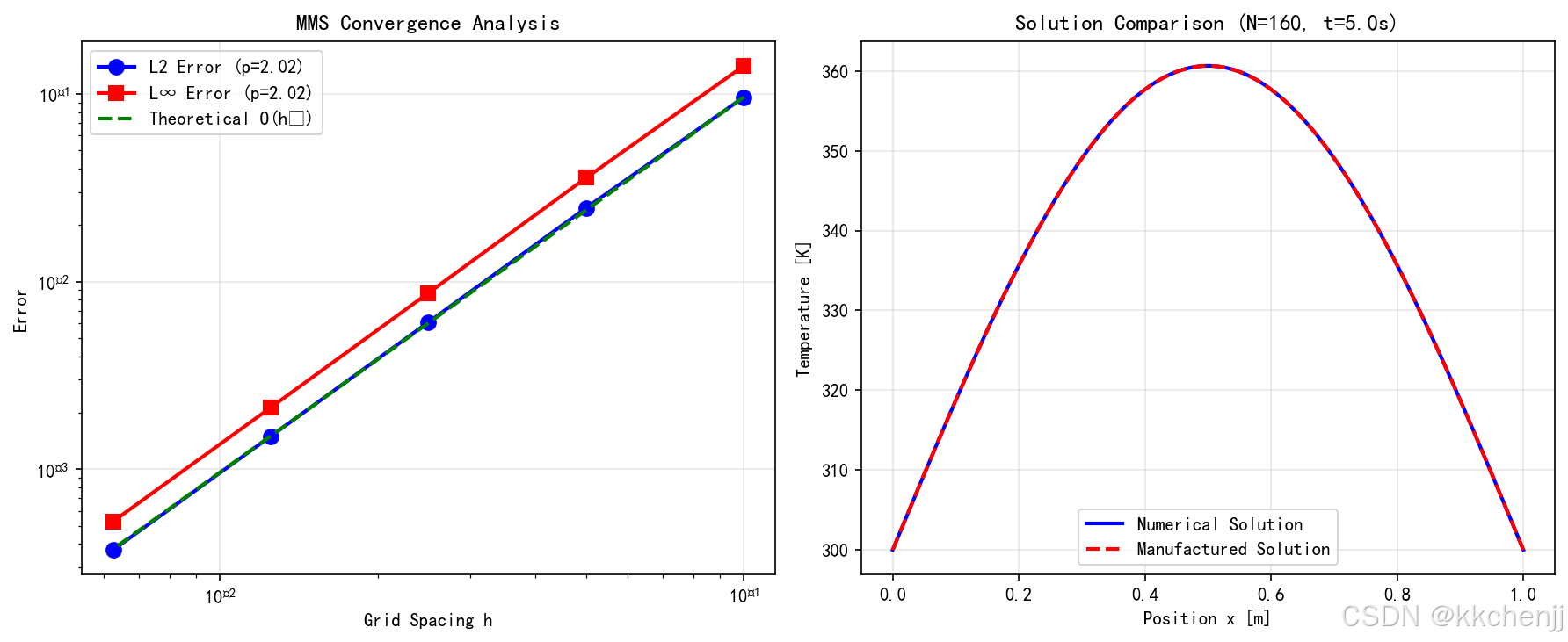
ax1.loglog(h_values, errors_L2, 'bo-', linewidth=2, markersize=8, label=f'L2 Error (p={p_L2:.2f})')
ax1.loglog(h_values, errors_Linf, 'rs-', linewidth=2, markersize=8, label=f'L∞ Error (p={p_Linf:.2f})')
# 理论收敛线
h_theory = np.linspace(h_values[0], h_values[-1], 100)
ax1.loglog(h_theory, errors_L2[0] * (h_theory/h_values[0])**2, 'g--',
linewidth=2, label='Theoretical O(h²)')
ax1.set_xlabel('Grid Spacing h')
ax1.set_ylabel('Error')
ax1.set_title('MMS Convergence Analysis')
ax1.legend()
ax1.grid(True, alpha=0.3)
# 2. 最终解与制造解对比(使用最细网格)
ax2 = axes[1]
N_fine = N_values[-1]
x_fine = np.linspace(0, L, N_fine)
T_numerical_final = T
T_exact_final = manufactured_solution(x_fine, t_final)
ax2.plot(x_fine, T_numerical_final, 'b-', linewidth=2, label='Numerical Solution')
ax2.plot(x_fine, T_exact_final, 'r--', linewidth=2, label='Manufactured Solution')
ax2.set_xlabel('Position x [m]')
ax2.set_ylabel('Temperature [K]')
ax2.set_title(f'Solution Comparison (N={N_fine}, t={t_final}s)')
ax2.legend()
ax2.grid(True, alpha=0.3)
plt.tight_layout()
plt.savefig('case5_manufactured_solution.png', dpi=150, bbox_inches='tight')
print("\n案例5图表已保存: case5_manufactured_solution.png")
plt.close()
return h_values, errors_L2, errors_Linf, p_L2, p_Linf
# 运行案例5
h_values, errors_L2, errors_Linf, p_L2, p_Linf = case5_manufactured_solution()
# =============================================================================
# GIF动画1:网格收敛过程动画
# =============================================================================
print("\n" + "=" * 70)
print("生成动画1:网格收敛过程")
print("=" * 70)
def create_gif1_grid_convergence():
"""
动画1:展示网格细化过程中的解收敛
"""
print("\n生成网格收敛动画...")
# 问题参数
L = 1.0
kappa = 5.0
sigma_s = 2.0
q_gen = 5000.0
T_left = 300.0
T_right = 350.0
# 参考解(细网格)
x_ref, T_ref, _ = solve_diffusion_radiation_1d(200, kappa, sigma_s, q_gen, T_left, T_right, L)
# 不同网格的解
N_values = [10, 15, 20, 30, 40, 60, 80, 100, 150, 200]
solutions = []
for N in N_values:
x, T, _ = solve_diffusion_radiation_1d(N, kappa, sigma_s, q_gen, T_left, T_right, L)
solutions.append((x, T, N))
# 创建动画
fig, axes = plt.subplots(1, 2, figsize=(12, 5))
def update(frame):
for ax in axes:
ax.clear()
x, T, N = solutions[frame]
# 左图:当前网格解与参考解对比
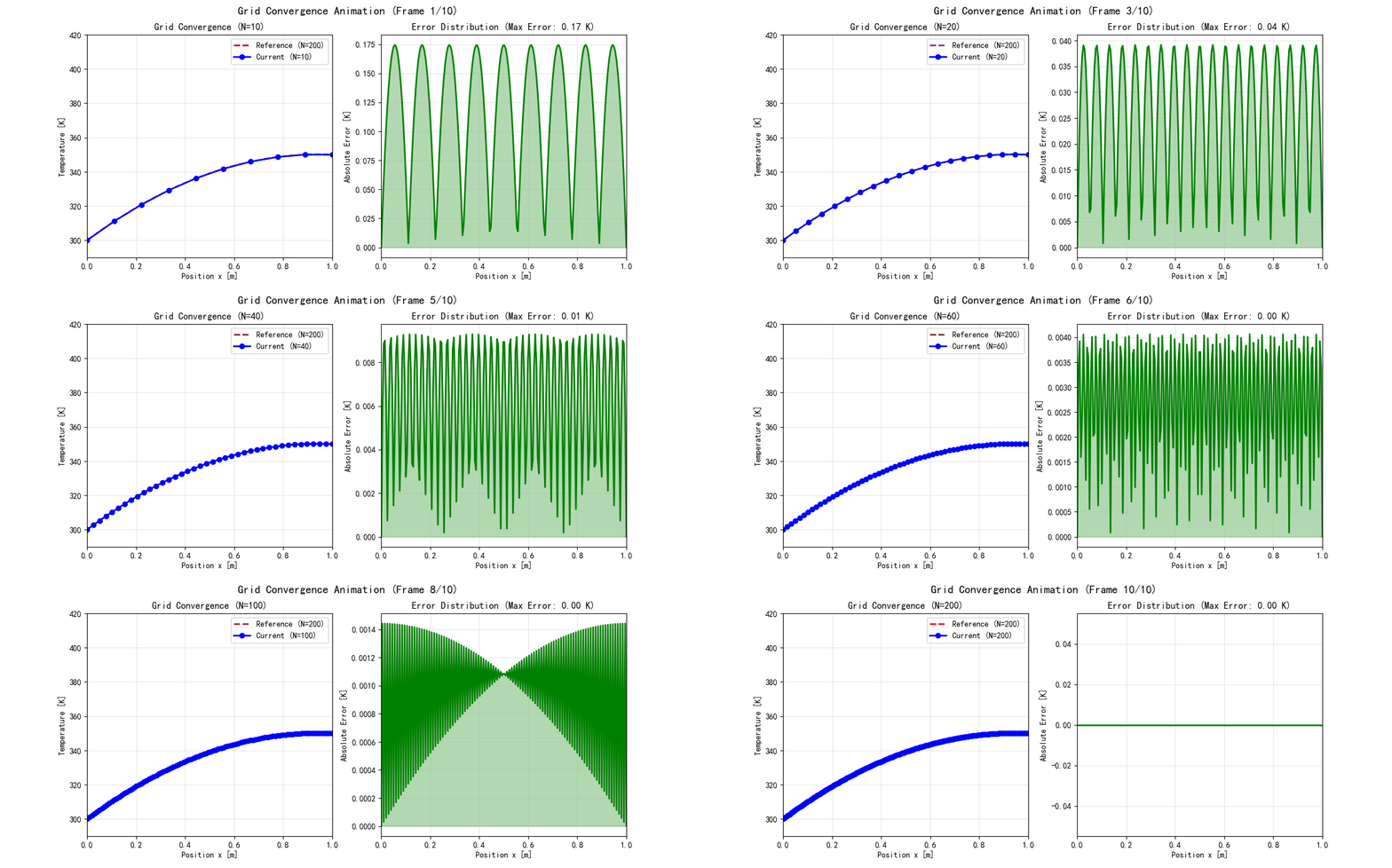
axes[0].plot(x_ref, T_ref, 'r--', linewidth=2, label='Reference (N=200)')
axes[0].plot(x, T, 'b-o', linewidth=2, markersize=6, label=f'Current (N={N})')
axes[0].set_xlabel('Position x [m]')
axes[0].set_ylabel('Temperature [K]')
axes[0].set_title(f'Grid Convergence (N={N})')
axes[0].legend()
axes[0].grid(True, alpha=0.3)
axes[0].set_xlim(0, L)
axes[0].set_ylim(290, 420)
# 计算误差
T_interp = np.interp(x_ref, x, T)
error = np.abs(T_interp - T_ref)
max_error = np.max(error)
# 右图:误差分布
axes[1].plot(x_ref, error, 'g-', linewidth=2)
axes[1].fill_between(x_ref, error, alpha=0.3, color='green')
axes[1].set_xlabel('Position x [m]')
axes[1].set_ylabel('Absolute Error [K]')
axes[1].set_title(f'Error Distribution (Max Error: {max_error:.2f} K)')
axes[1].grid(True, alpha=0.3)
axes[1].set_xlim(0, L)
fig.suptitle(f'Grid Convergence Animation (Frame {frame+1}/{len(solutions)})',
fontsize=14, fontweight='bold')
return axes
anim = animation.FuncAnimation(fig, update, frames=len(solutions),
interval=500, blit=False)
anim.save('gif1_grid_convergence.gif', writer='pillow', fps=2, dpi=100)
print("GIF动画1完成:已保存 gif1_grid_convergence.gif")
plt.close()
create_gif1_grid_convergence()
# =============================================================================
# GIF动画2:不确定性传播动画
# =============================================================================
print("\n" + "=" * 70)
print("生成动画2:不确定性传播过程")
print("=" * 70)
def create_gif2_uncertainty_propagation():
"""
动画2:展示蒙特卡洛不确定性传播过程
"""
print("\n生成不确定性传播动画...")
np.random.seed(42)
# 问题参数
L = 1.0
q_gen = 5000.0
T_left = 300.0
T_right = 350.0
kappa_nom = 5.0
sigma_s_nom = 2.0
# 运行多次仿真,逐步积累统计信息
n_frames = 30
samples_per_frame = 20
T_mid_history = []
fig, axes = plt.subplots(1, 2, figsize=(12, 5))
def update(frame):
for ax in axes:
ax.clear()
# 生成新的样本
for _ in range(samples_per_frame):
kappa = np.random.lognormal(np.log(kappa_nom), 0.15)
sigma_s = np.random.uniform(sigma_s_nom - 0.4, sigma_s_nom + 0.4)
x, T, _ = solve_diffusion_radiation_1d(50, kappa, sigma_s, q_gen, T_left, T_right, L)
T_mid = np.interp(L/2, x, T)
T_mid_history.append(T_mid)
n_total = len(T_mid_history)
# 左图:累积分布
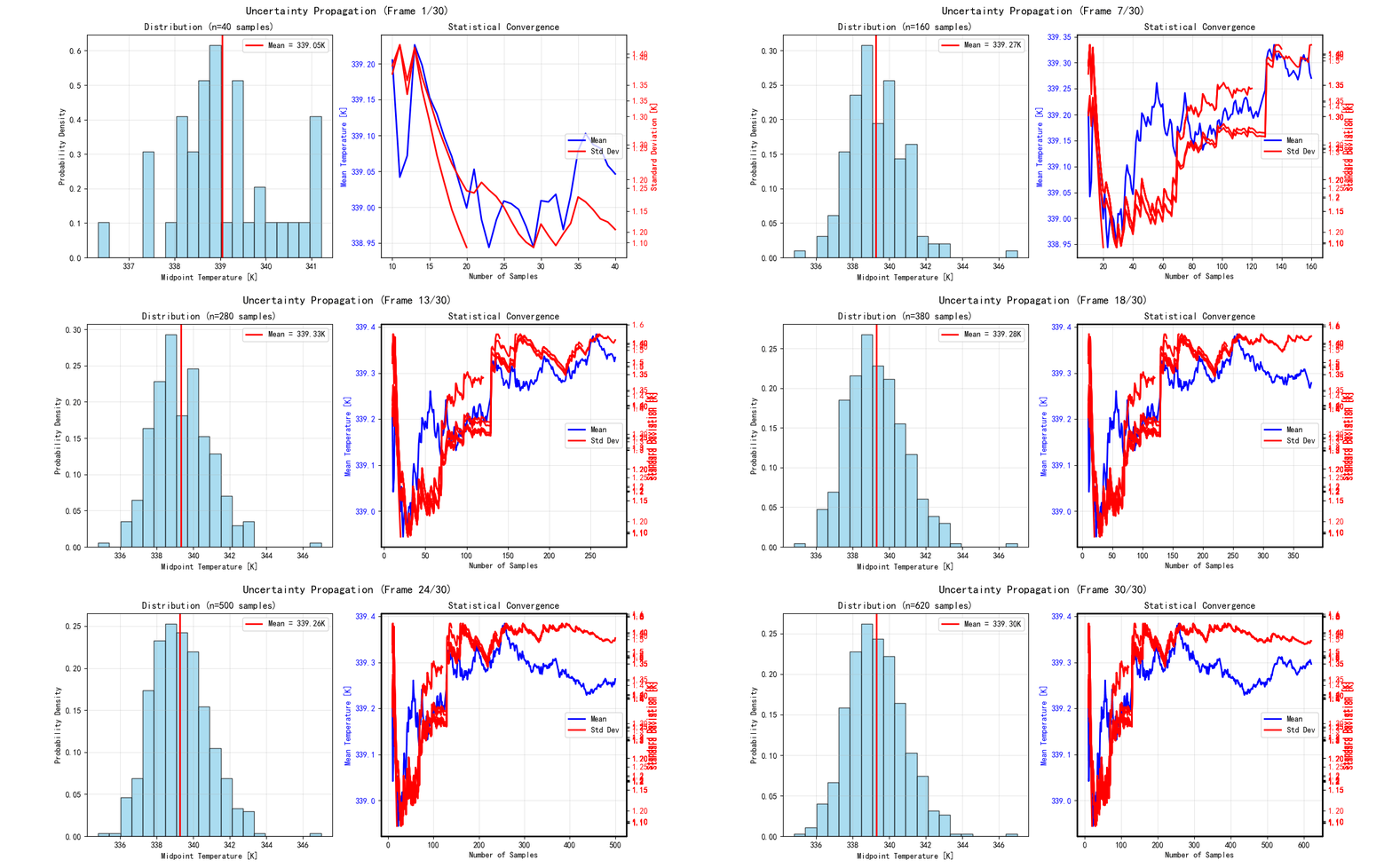
axes[0].hist(T_mid_history, bins=20, density=True, color='skyblue',
alpha=0.7, edgecolor='black')
axes[0].axvline(np.mean(T_mid_history), color='r', linestyle='-',
linewidth=2, label=f'Mean = {np.mean(T_mid_history):.2f}K')
axes[0].set_xlabel('Midpoint Temperature [K]')
axes[0].set_ylabel('Probability Density')
axes[0].set_title(f'Distribution (n={n_total} samples)')
axes[0].legend()
axes[0].grid(True, alpha=0.3)
# 右图:统计量收敛
if n_total > 10:
means = [np.mean(T_mid_history[:i]) for i in range(10, n_total+1)]
stds = [np.std(T_mid_history[:i]) for i in range(10, n_total+1)]
sample_counts = range(10, n_total+1)
ax2_twin = axes[1].twinx()
line1 = axes[1].plot(sample_counts, means, 'b-', linewidth=2, label='Mean')
line2 = ax2_twin.plot(sample_counts, stds, 'r-', linewidth=2, label='Std Dev')
axes[1].set_xlabel('Number of Samples')
axes[1].set_ylabel('Mean Temperature [K]', color='b')
ax2_twin.set_ylabel('Standard Deviation [K]', color='r')
axes[1].set_title('Statistical Convergence')
axes[1].grid(True, alpha=0.3)
axes[1].tick_params(axis='y', labelcolor='b')
ax2_twin.tick_params(axis='y', labelcolor='r')
# 合并图例
lines = line1 + line2
labels = [l.get_label() for l in lines]
axes[1].legend(lines, labels, loc='center right')
fig.suptitle(f'Uncertainty Propagation (Frame {frame+1}/{n_frames})',
fontsize=14, fontweight='bold')
return axes
anim = animation.FuncAnimation(fig, update, frames=n_frames,
interval=300, blit=False)
anim.save('gif2_uncertainty_propagation.gif', writer='pillow', fps=3, dpi=100)
print("GIF动画2完成:已保存 gif2_uncertainty_propagation.gif")
plt.close()
create_gif2_uncertainty_propagation()
# =============================================================================
# GIF动画3:验证与确认流程动画
# =============================================================================
print("\n" + "=" * 70)
print("生成动画3:验证与确认流程")
print("=" * 70)
def create_gif3_vv_process():
"""
动画3:展示V&V流程的完整过程
"""
print("\n生成V&V流程动画...")
np.random.seed(42)
# 物理参数
L = 1.0
kappa = 5.0
sigma_s = 2.0
q_gen = 5000.0
T_left = 300.0
T_right = 350.0
# 生成"实验"数据
x_exp = np.linspace(0, L, 11)
x_fine = np.linspace(0, L, 100)
_, T_fine, _ = solve_diffusion_radiation_1d(100, kappa, sigma_s, q_gen, T_left, T_right, L)
T_exp_true = np.interp(x_exp, x_fine, T_fine)
T_exp = T_exp_true + np.random.normal(0, 2, len(x_exp)) + 3 * np.sin(np.pi * x_exp / L)
# 不同网格的仿真结果
N_values = [10, 20, 40, 80, 100]
sim_results = []
for N in N_values:
x, T, _ = solve_diffusion_radiation_1d(N, kappa, sigma_s, q_gen, T_left, T_right, L)
sim_results.append((x, T, N))
# 创建动画
fig, axes = plt.subplots(1, 2, figsize=(12, 5))
n_frames = len(sim_results) + 5 # 额外帧展示最终确认结果
def update(frame):
for ax in axes:
ax.clear()
if frame < len(sim_results):
# 代码验证和解验证阶段
x, T, N = sim_results[frame]
# 左图:网格收敛
axes[0].plot(x_fine, T_fine, 'r--', linewidth=2, alpha=0.5, label='Reference')
axes[0].plot(x, T, 'b-o', linewidth=2, markersize=6, label=f'Simulation (N={N})')
axes[0].set_xlabel('Position x [m]')
axes[0].set_ylabel('Temperature [K]')
axes[0].set_title(f'Code & Solution Verification (N={N})')
axes[0].legend()
axes[0].grid(True, alpha=0.3)
axes[0].set_xlim(0, L)
axes[0].set_ylim(290, 400)
# 右图:误差分析
T_interp = np.interp(x_fine, x, T)
error = np.abs(T_interp - T_fine)
axes[1].semilogy(x_fine, error, 'g-', linewidth=2)
axes[1].set_xlabel('Position x [m]')
axes[1].set_ylabel('Error [K]')
axes[1].set_title('Numerical Error Distribution')
axes[1].grid(True, alpha=0.3)
axes[1].set_xlim(0, L)
stage = "Verification Stage"
else:
# 模型确认阶段
x, T, N = sim_results[-1]
# 左图:仿真与实验对比
axes[0].plot(x, T, 'b-', linewidth=2, label='Simulation')
axes[0].errorbar(x_exp, T_exp, yerr=4, fmt='ro', markersize=8,
capsize=5, label='Experiment (±2σ)')
axes[0].set_xlabel('Position x [m]')
axes[0].set_ylabel('Temperature [K]')
axes[0].set_title('Model Validation: Sim vs Exp')
axes[0].legend()
axes[0].grid(True, alpha=0.3)
axes[0].set_xlim(0, L)
axes[0].set_ylim(290, 400)
# 右图:残差分析
T_sim_at_exp = np.interp(x_exp, x, T)
residuals = T_sim_at_exp - T_exp
axes[1].bar(range(len(x_exp)), residuals, color='steelblue', alpha=0.7)
axes[1].axhline(y=0, color='r', linestyle='-', linewidth=2)
axes[1].axhline(y=4, color='g', linestyle='--', linewidth=1.5, alpha=0.7)
axes[1].axhline(y=-4, color='g', linestyle='--', linewidth=1.5, alpha=0.7)
axes[1].set_xlabel('Measurement Point')
axes[1].set_ylabel('Residual (Sim - Exp) [K]')
axes[1].set_title('Validation Residuals')
axes[1].grid(True, alpha=0.3, axis='y')
stage = "Validation Stage"
fig.suptitle(f'V&V Process: {stage} (Frame {frame+1}/{n_frames})',
fontsize=14, fontweight='bold')
return axes
anim = animation.FuncAnimation(fig, update, frames=n_frames,
interval=600, blit=False)
anim.save('gif3_vv_process.gif', writer='pillow', fps=1.5, dpi=100)
print("GIF动画3完成:已保存 gif3_vv_process.gif")
plt.close()
create_gif3_vv_process()
# =============================================================================
# 总结
# =============================================================================
print("\n" + "=" * 70)
print("仿真完成总结")
print("=" * 70)
print("\n本程序演示了辐射换热仿真中的验证与确认方法:")
print("\n1. 代码验证 (Code Verification):")
print(" - 一维灰体介质辐射平衡基准问题求解")
print(" - 不同网格密度下的收敛性分析")
print("\n2. 解验证 (Solution Verification):")
print(" - 网格收敛性研究")
print(" - Richardson外推估计精确解")
print(f" - 网格收敛指标 GCI = {GCI*100:.4f}%")
print("\n3. 模型确认 (Model Validation):")
print(" - 仿真与实验数据对比")
print(" - 误差范数和确认指标计算")
print(" - 残差分析和散点图")
print("\n4. 不确定性量化 (Uncertainty Quantification):")
print(" - 蒙特卡洛不确定性传播")
print(" - 输入参数敏感性分析")
print(" - 输出统计量估计")
print("\n5. 制造解方法 (MMS):")
print(f" - 验证数值实现正确性")
print(f" - 观察收敛阶数: L2={p_L2:.2f}, L∞={p_Linf:.2f}")
print("\n6. 生成的可视化:")
print(" - case1_code_verification.png")
print(" - case2_solution_verification.png")
print(" - case3_model_validation.png")
print(" - case4_uncertainty_quantification.png")
print(" - case5_manufactured_solution.png")
print(" - gif1_grid_convergence.gif")
print(" - gif2_uncertainty_propagation.gif")
print(" - gif3_vv_process.gif")
print("\n" + "=" * 70)

AtomGit 是由开放原子开源基金会联合 CSDN 等生态伙伴共同推出的新一代开源与人工智能协作平台。平台坚持“开放、中立、公益”的理念,把代码托管、模型共享、数据集托管、智能体开发体验和算力服务整合在一起,为开发者提供从开发、训练到部署的一站式体验。
更多推荐



 1
1 0
0- 0



 已为社区贡献274条内容

所有评论(0)