【端侧部署yolo系列】yolact部署至全志开发板
注:awnpu_model_zoo\docs里有详细的开发文档以及参考指南
本文是根据《NPU开发环境部署参考指南》,部署PC的ubuntu环境,使用Docker镜像环境为例进行说明。
如果想对部署流程进行更加详细的了解,可以参考《NPU_模型部署_开发指南》
重要说明:在awnpu_model_zoo内没有的模型,可参考awnpu_model_zoo\examples里面对应系列的模型进行修改部署,需要自行编写对应模型cpp前后处理代码以及修改相应的配置文件(如model_config.h、CMakeLists.txt)。如果遇到模型导出量化失败的情况,需要对模型进行相应的裁剪、或者采用不同的量化方式等。本文的yolact已经在板端经过了推理验证。
环境配置
关于参考之前部署yolox的文章【端侧部署yolo系列】yolox部署至全志开发板T736 https://blog.csdn.net/troyteng/article/details/155444386?spm=1011.2124.3001.6209
下载镜像文件和AWNPU_Model_Zoo,创建自己的容器。
模型准备
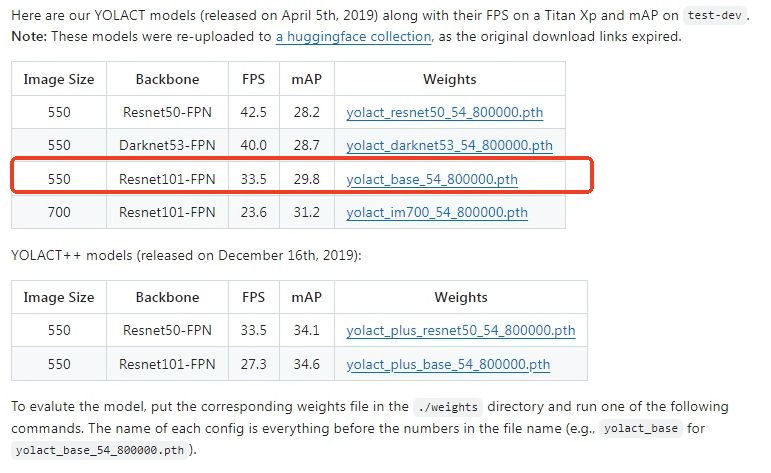
源码地址yolact,这里以yolact_base_54_800000.pth模型为例。
导出onnx模型
需要下载源码配置相应的环境,运行export_onnx.py导出onnx模型。
# 导出onnx模型
python export_onnx.py --trained_model=weights/yolact_base_54_800000.pth --config=yolact_base_config
export_onnx.py代码如下:
import torch
import torch.nn as nn
import argparse
import os
from yolact import Yolact
from data.config import cfg, set_cfg, Config
from collections import OrderedDict

def str2bool(v):
    if v.lower() in ('yes', 'true', 't', 'y', '1'):
        return True
    elif v.lower() in ('no', 'false', 'f', 'n', '0'):
        return False
    else:
        raise argparse.ArgumentTypeError('Boolean value expected.')

def parse_args():
    parser = argparse.ArgumentParser(description='YOLACT ONNX Export')
    parser.add_argument('--trained_model', default='weights/yolact_base_54_800000.pth', type=str,
                        help='Trained state_dict file path to open.')
    parser.add_argument('--config', default='yolact_base_config', type=str,
                        help='The config object to use.')
    parser.add_argument('--output', default=None, type=str,
                        help='Output ONNX file path. Default: same as trained_model with .onnx extension')
    parser.add_argument('--batch_size', default=1, type=int,
                        help='Batch size for the model input')
    parser.add_argument('--img_size', default=550, type=int,
                        help='Input image size (square)')
    parser.add_argument('--opset_version', default=11, type=int,
                        help='ONNX opset version')
    parser.add_argument('--simplify', default=True, type=str2bool,
                        help='Simplify the ONNX model using onnx-simplifier')
    parser.add_argument('--dynamic_axes', default=False, type=str2bool,
                        help='Export with dynamic batch and image sizes')

    return parser.parse_args()

class YolactONNXWrapper(nn.Module):
    """
    Wrapper for YOLACT to make it ONNX-exportable.
    This wraps the model to return only the essential outputs for inference.
    """
    def __init__(self, yolact_model):
        super().__init__()
        self.model = yolact_model

        # Disable the Detect layer for ONNX export (it has NMS which is hard to export)
        # We'll export the raw predictions and do NMS separately
        self.model.detect = None

    def forward(self, x):
        """
        Forward pass that returns raw predictions suitable for ONNX export.
        Returns: loc, conf, mask, proto (if applicable)
        """
        # Set image size for priors calculation
        _, _, img_h, img_w = x.size()
        cfg._tmp_img_h = img_h
        cfg._tmp_img_w = img_w

        # Backbone
        outs = self.model.backbone(x)

        # FPN
        if cfg.fpn is not None:
            outs = [outs[i] for i in cfg.backbone.selected_layers]
            outs = self.model.fpn(outs)

        # ProtoNet
        proto_out = None
        if cfg.mask_type == 1 and cfg.eval_mask_branch:  # mask_type.lincomb == 1
            proto_x = x if self.model.proto_src is None else outs[self.model.proto_src]

            if self.model.num_grids > 0:
                grids = self.model.grid.repeat(proto_x.size(0), 1, 1, 1)
                proto_x = torch.cat([proto_x, grids], dim=1)

            proto_out = self.model.proto_net(proto_x)
            proto_out = cfg.mask_proto_prototype_activation(proto_out)
            proto_out = proto_out.permute(0, 2, 3, 1).contiguous()

            if cfg.mask_proto_bias:
                bias_shape = [x for x in proto_out.size()]
                bias_shape[-1] = 1
                proto_out = torch.cat([proto_out, torch.ones(*bias_shape, device=proto_out.device)], -1)

        # Prediction heads
        pred_outs = {'loc': [], 'conf': [], 'mask': [], 'priors': []}

        for idx, pred_layer in zip(self.model.selected_layers, self.model.prediction_layers):
            pred_x = outs[idx]

            if cfg.mask_type == 1 and cfg.mask_proto_prototypes_as_features:  # lincomb
                proto_downsampled = F.interpolate(proto_out.permute(0, 3, 1, 2),
                                                  size=outs[idx].size()[2:],
                                                  mode='bilinear',
                                                  align_corners=False)
                pred_x = torch.cat([pred_x, proto_downsampled], dim=1)

            p = pred_layer(pred_x)

            for k, v in p.items():
                if k in pred_outs:
                    pred_outs[k].append(v)

        # Concatenate predictions from all layers
        for k, v in pred_outs.items():
            if len(v) > 0:
                pred_outs[k] = torch.cat(v, -2)

        # Apply activations
        loc = pred_outs['loc']
        conf = pred_outs['conf']
        mask = pred_outs['mask']

        # Apply softmax to conf
        conf = torch.softmax(conf, dim=-1)

        # Apply mask activation
        if cfg.mask_type == 1:  # lincomb
            mask = cfg.mask_proto_coeff_activation(mask)

        if proto_out is not None:
            return loc, conf, mask, proto_out
        else:
            return loc, conf, mask

def export_to_onnx(args):
    # Set configuration
    if args.config is not None:
        set_cfg(args.config)

    print(f"Using config: {args.config}")
    print(f"Number of classes: {cfg.num_classes}")
    print(f"Input image size: {args.img_size}")

    # Create model
    print("Creating model...")
    net = Yolact()

    # Load weights
    print(f"Loading weights from: {args.trained_model}")
    if os.path.exists(args.trained_model):
        net.load_weights(args.trained_model)
        print("Weights loaded successfully!")
    else:
        print(f"Warning: Weight file not found at {args.trained_model}")
        print("Exporting with random weights...")

    net.eval()

    # Wrap model for ONNX export
    wrapped_model = YolactONNXWrapper(net)
    wrapped_model.eval()

    # Create dummy input
    dummy_input = torch.randn(args.batch_size, 3, args.img_size, args.img_size)

    # Determine output path
    if args.output is None:
        output_path = args.trained_model.replace('.pth', '.onnx')
    else:
        output_path = args.output

    print(f"Exporting to: {output_path}")

    # Define input/output names
    input_names = ['input']
    output_names = ['loc', 'conf', 'mask']

    # Check if proto output exists
    with torch.no_grad():
        test_output = wrapped_model(dummy_input)
        if len(test_output) == 4:
            output_names.append('proto')
            print("Model includes proto output for mask generation")

    # Define dynamic axes
    dynamic_axes = None
    if args.dynamic_axes:
        dynamic_axes = {
            'input': {0: 'batch_size', 2: 'height', 3: 'width'},
            'loc': {0: 'batch_size'},
            'conf': {0: 'batch_size'},
            'mask': {0: 'batch_size'},
        }
        if 'proto' in output_names:
            dynamic_axes['proto'] = {0: 'batch_size'}
        print("Using dynamic axes for batch and image sizes")

    # Export to ONNX
    try:
        torch.onnx.export(
            wrapped_model,
            dummy_input,
            output_path,
            input_names=input_names,
            output_names=output_names,
            dynamic_axes=dynamic_axes,
            opset_version=args.opset_version,
            do_constant_folding=True,
            verbose=False
        )
        print(f"ONNX model exported successfully to: {output_path}")

        # Verify the model
        try:
            import onnx
            onnx_model = onnx.load(output_path)
            onnx.checker.check_model(onnx_model)
            print("ONNX model validation passed!")

            # Print model info
            print("\nModel inputs:")
            for input in onnx_model.graph.input:
                print(f"  {input.name}: {[dim.dim_value if dim.dim_value else dim.dim_param for dim in input.type.tensor_type.shape.dim]}")

            print("\nModel outputs:")
            for output in onnx_model.graph.output:
                print(f"  {output.name}: {[dim.dim_value if dim.dim_value else dim.dim_param for dim in output.type.tensor_type.shape.dim]}")

        except ImportError:
            print("onnx package not installed, skipping validation")
        except Exception as e:
            print(f"ONNX validation warning: {e}")

        # Simplify model if requested
        if args.simplify:
            try:
                import onnxsim
                print("\nSimplifying ONNX model...")
                onnx_model = onnx.load(output_path)
                simplified_model, check = onnxsim.simplify(onnx_model)
                if check:
                    onnx.save(simplified_model, output_path)
                    print("Model simplified successfully!")
                else:
                    print("Model simplification check failed, keeping original model")
            except ImportError:
                print("onnx-simplifier not installed, skipping simplification")
                print("Install with: pip install onnx-simplifier")
            except Exception as e:
                print(f"Simplification error: {e}")

        # Test inference
        try:
            import onnxruntime as ort
            print("\nTesting ONNX inference...")
            ort_session = ort.InferenceSession(output_path)

            # Run inference
            onnx_input = dummy_input.numpy()
            ort_inputs = {ort_session.get_inputs()[0].name: onnx_input}
            ort_outputs = ort_session.run(None, ort_inputs)

            print("ONNX inference test passed!")
            for i, name in enumerate(output_names):
                print(f"  {name} shape: {ort_outputs[i].shape}")

        except ImportError:
            print("onnxruntime not installed, skipping inference test")
            print("Install with: pip install onnxruntime")
        except Exception as e:
            print(f"Inference test error: {e}")

        print(f"\nExport complete! Model saved to: {output_path}")
        print("\nNote: This ONNX model outputs raw predictions (loc, conf, mask, proto).")
        print("Post-processing (NMS, mask assembly) needs to be done separately.")

    except Exception as e:
        print(f"Export failed: {e}")
        import traceback
        traceback.print_exc()

def main():
    args = parse_args()
    export_to_onnx(args)

if __name__ == '__main__':
    main()
进入容器完成后续的操作。
模型简化
进入下载好的模型库文件awnpu_model_zoo/eamples/yolact/
# 运行onnx_extract.py对模型进行裁剪,生成yolact_base_54_800000_rt.onnx
python3 onnx_extract.py

# 运行推理
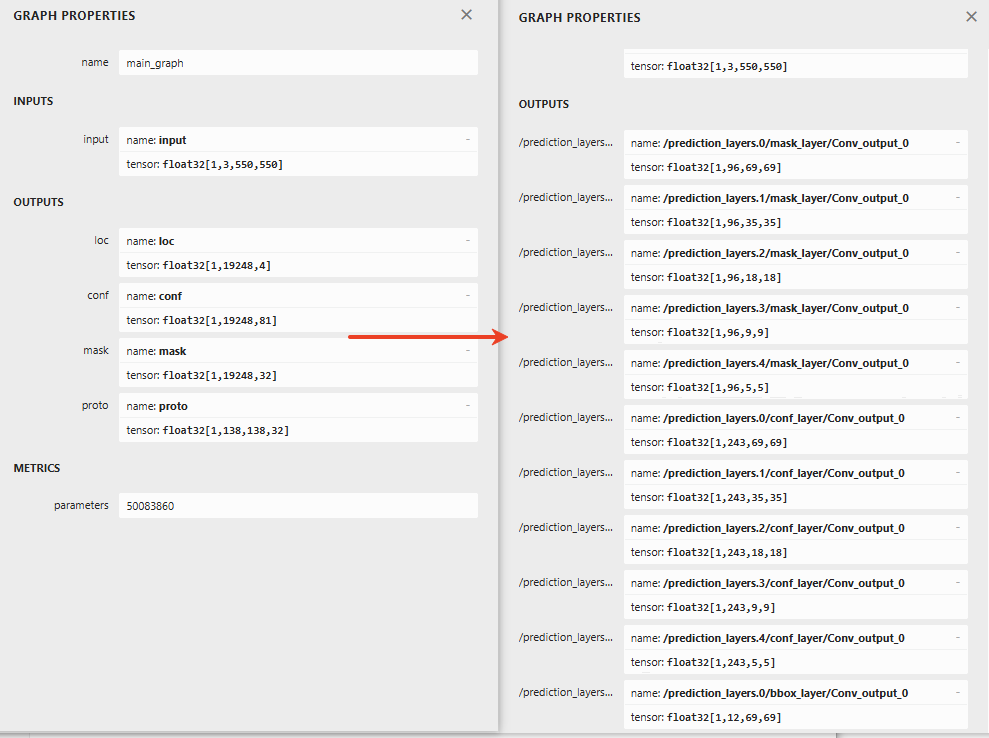
python3 inference_onnx.py --model=../yolact_base_54_800000_rt.onnx --image=../../model/bus.jpgyolact网络的后处理部分8bit量化会产生较大的精度损失,通过onnx_extract.py对模型剪枝,修改输出结构,同时将后处理结构移至外部使用cpu进行相应的处理。模型输出差异如下,左边是官方模型,右边是修改后的模型。这里有直接裁剪好的官方模型
模型配置
修改config_yml.py文件的相关参数配置:
# "database"
DATASET = '../../dataset/coco_12/dataset.txt'
DATASET_TYPE = "TEXT"
# mean, scale
MEAN    = [123.68, 116.78, 103.94]
SCALE   = [0.017123, 0.017507, 0.0174276]

# reverse_channel: True bgr, False rgb
REVERSE_CHANNEL = False
# add_preproc_node, True or False
ADD_PREPROC_NODE = True
# "preproc_type"
PREPROC_TYPE = "IMAGE_RGB"
# add_postproc_node, quant output -> float32 output
ADD_POSTPROC_NODE = True
模型前后处理
后处理说明:yolact的特征图和先验框(锚框)分别有5个
feature_maps = [(69, 69), (35, 35), (18, 18), (9, 9), (5, 5)]
scales = [[24], [48], [96], [192], [384]]由于源码有一个bug,导致所有的先验框为正方形h = w;
在yolact.py的242行,作者注释:
# This is for backward compatability with a bug where I made everything square by accident
if cfg.backbone.use_square_anchors:
源码中还有重打分 (Rescoring) 机制以及Fast NMS(是 YOLACT 使用的改进版本,通过矩阵操作加速 ),本文采用的都是标准的nms。
配置文件model_config.h
配置文件model_config.h可以直接复制其他yolo官方系列的模型(yolov5、yolov8、yolo11、yolo26)。
前处理yolact_pre.cpp
#include <opencv2/core/core.hpp>
#include <opencv2/highgui/highgui.hpp>
#include <opencv2/imgproc/imgproc.hpp>
#include <iostream>
#include <stdio.h>
#include <stdint.h>
#include <string.h>
#include <math.h>

#include "model_config.h"


void get_input_data_yolact(const char* image_file, unsigned char* input_data, int input_rows, int input_cols)
{
    cv::Mat sample = cv::imread(image_file, 1);
    if (sample.empty()) {
        fprintf(stderr, "cv::imread %s failed\n", image_file);
        return;
    }

    // Convert BGR to RGB
    cv::Mat img;
    cv::cvtColor(sample, img, cv::COLOR_BGR2RGB);

    // Resize to input size (550x550), no letterbox padding for YOLACT
    cv::resize(img, img, cv::Size(input_cols, input_rows));

    // Copy to output buffer (HWC format, uint8)
    memcpy(input_data, img.data, input_rows * input_cols * 3 * sizeof(uint8_t));
}


uint8_t *yolact_preprocess(const char* imagepath, unsigned int *data_size)
{
    int img_c = 3;

    // YOLACT input size: 550x550
    int input_rows = LETTERBOX_ROWS;
    int input_cols = LETTERBOX_COLS;
    int img_size = input_rows * input_cols * img_c;

    *data_size = img_size * sizeof(uint8_t);

    uint8_t *tensorData = NULL;
    tensorData = (uint8_t *)malloc(1 * img_size * sizeof(uint8_t));

    get_input_data_yolact(imagepath, tensorData, input_rows, input_cols);

    return tensorData;
}


int yolact_preprocess_no_copy(const char* imagepath, void* buff_ptr, unsigned int buff_size)
{
    int img_c = 3;

    // YOLACT input size: 550x550
    int input_rows = LETTERBOX_ROWS;
    int input_cols = LETTERBOX_COLS;
    int img_size = input_rows * input_cols * img_c;

    unsigned int data_size = img_size * sizeof(uint8_t);

    if (data_size > buff_size) {
        printf("data size > buff size, please check code. \n");
        return -1;
    }

    get_input_data_yolact(imagepath, (unsigned char*)buff_ptr, input_rows, input_cols);

    return 0;
}
后处理yolact_post.cpp
#include <opencv2/core/core.hpp>
#include <opencv2/highgui/highgui.hpp>
#include <opencv2/imgproc/imgproc.hpp>
#include <iostream>
#include <stdio.h>
#include <vector>
#include <cmath>
#include <chrono>
#include <algorithm>
#include <cstring>

#include "model_config.h"

using namespace std;

// Forward declaration
void draw_yolact_detections(const cv::Mat& bgr, const std::vector<struct YOLACTDet>& dets);

// YOLACT detection result structure
struct YOLACTDet
{
    cv::Rect_<float> rect;
    int label;
    float prob;
    std::vector<float> mask_coeffs;
    cv::Mat mask;
};

// Prior box parameters
static const int PRIOR_FEATURE_MAPS_H[5] = {69, 35, 18, 9, 5};
static const int PRIOR_FEATURE_MAPS_W[5] = {69, 35, 18, 9, 5};
static const int PRIOR_SCALES[5] = {24, 48, 96, 192, 384};
static const float PRIOR_ASPECT_RATIOS[3] = {1.0f, 0.7071067811865476f, 1.4142135623730951f}; // sqrt(0.5), sqrt(2)
static const float PRIOR_VARIANCES[2] = {0.1f, 0.2f};

// Global prior boxes cache
static std::vector<float> g_prior_boxes;
static bool g_priors_generated = false;

static inline float sigmoid(float x)
{
    return static_cast<float>(1.f / (1.f + exp(-x)));
}

static inline float tanh_func(float x)
{
    return static_cast<float>(tanh(x));
}

// Generate prior boxes (called once)
static void generate_priors()
{
    if (g_priors_generated) return;

    g_prior_boxes.clear();
    int input_size = 550;

    for (int k = 0; k < 5; k++) {
        int conv_h = PRIOR_FEATURE_MAPS_H[k];
        int conv_w = PRIOR_FEATURE_MAPS_W[k];
        int scale = PRIOR_SCALES[k];

        for (int j = 0; j < conv_h; j++) {
            for (int i = 0; i < conv_w; i++) {
                float cx = (i + 0.5f) / conv_w;
                float cy = (j + 0.5f) / conv_h;

                for (int ar_idx = 0; ar_idx < 3; ar_idx++) {
                    float ar = PRIOR_ASPECT_RATIOS[ar_idx];
                    float prior_w = scale * ar / input_size;
                    float prior_h = scale / ar / input_size;

                    // Use square anchors (as in original code)
                    prior_h = prior_w;

                    g_prior_boxes.push_back(cx);
                    g_prior_boxes.push_back(cy);
                    g_prior_boxes.push_back(prior_w);
                    g_prior_boxes.push_back(prior_h);
                }
            }
        }
    }

    g_priors_generated = true;
}

// Decode box predictions
static void decode_boxes(const float* loc, float* boxes, int num_priors)
{
    for (int i = 0; i < num_priors; i++) {
        int p_idx = i * 4;
        int l_idx = i * 4;

        float prior_cx = g_prior_boxes[p_idx + 0];
        float prior_cy = g_prior_boxes[p_idx + 1];
        float prior_w = g_prior_boxes[p_idx + 2];
        float prior_h = g_prior_boxes[p_idx + 3];

        float loc_0 = loc[l_idx + 0];
        float loc_1 = loc[l_idx + 1];
        float loc_2 = loc[l_idx + 2];
        float loc_3 = loc[l_idx + 3];

        float box_cx = prior_cx + loc_0 * PRIOR_VARIANCES[0] * prior_w;
        float box_cy = prior_cy + loc_1 * PRIOR_VARIANCES[0] * prior_h;
        float box_w = prior_w * exp(loc_2 * PRIOR_VARIANCES[1]);
        float box_h = prior_h * exp(loc_3 * PRIOR_VARIANCES[1]);

        // Convert to [x1, y1, x2, y2] format
        boxes[i * 4 + 0] = box_cx - box_w / 2.0f;
        boxes[i * 4 + 1] = box_cy - box_h / 2.0f;
        boxes[i * 4 + 2] = box_cx + box_w / 2.0f;
        boxes[i * 4 + 3] = box_cy + box_h / 2.0f;
    }
}

// Softmax function for confidence scores
static void softmax(const float* input, float* output, int n)
{
    float max_val = input[0];
    for (int i = 1; i < n; i++) {
        if (input[i] > max_val) max_val = input[i];
    }

    float sum = 0.0f;
    for (int i = 0; i < n; i++) {
        output[i] = exp(input[i] - max_val);
        sum += output[i];
    }

    for (int i = 0; i < n; i++) {
        output[i] /= sum;
    }
}

static inline float intersection_area(const YOLACTDet& a, const YOLACTDet& b)
{
    cv::Rect_<float> inter = a.rect & b.rect;
    return inter.area();
}

static void qsort_descent_inplace(std::vector<YOLACTDet>& objects, int left, int right)
{
    int i = left;
    int j = right;
    float p = objects[(left + right) / 2].prob;

    while (i <= j)
    {
        while (objects[i].prob > p)
            i++;

        while (objects[j].prob < p)
            j--;

        if (i <= j)
        {
            // swap
            std::swap(objects[i], objects[j]);

            i++;
            j--;
        }
    }

#pragma omp parallel sections
    {
#pragma omp section
        {
            if (left < j) qsort_descent_inplace(objects, left, j);
        }
#pragma omp section
        {
            if (i < right) qsort_descent_inplace(objects, i, right);
        }
    }
}

static void qsort_descent_inplace(std::vector<YOLACTDet>& objects)
{
    if (objects.empty())
        return;

    qsort_descent_inplace(objects, 0, objects.size() - 1);
}

static void nms_sorted_bboxes(const std::vector<YOLACTDet>& objects, std::vector<int>& picked, float nms_threshold, bool agnostic = false)
{
    picked.clear();

    const int n = objects.size();

    std::vector<float> areas(n);
    for (int i = 0; i < n; i++)
    {
        areas[i] = objects[i].rect.area();
    }

    for (int i = 0; i < n; i++)
    {
        const YOLACTDet& a = objects[i];

        int keep = 1;
        for (int j = 0; j < (int)picked.size(); j++)
        {
            const YOLACTDet& b = objects[picked[j]];

           if (!agnostic && a.label != b.label)
               continue;

            // intersection over union
            float inter_area = intersection_area(a, b);
            float union_area = areas[i] + areas[picked[j]] - inter_area;
            // float IoU = inter_area / union_area
            if (inter_area / union_area > nms_threshold)
                keep = 0;
        }

        if (keep)
            picked.push_back(i);
    }
}

// Assemble mask from prototypes and coefficients
static cv::Mat assemble_mask(const std::vector<float>& mask_coeffs, const float* proto_data, int proto_h, int proto_w, int mask_dim, const cv::Rect_<float>& box)
{
    // mask = sigmoid(proto @ mask_coeffs.T)
    cv::Mat mask(proto_h, proto_w, CV_32F);

    for (int y = 0; y < proto_h; y++) {
        for (int x = 0; x < proto_w; x++) {
            float val = 0.0f;
            for (int c = 0; c < mask_dim; c++) {
                val += proto_data[(y * proto_w + x) * mask_dim + c] * mask_coeffs[c];
            }
            mask.at<float>(y, x) = sigmoid(val);
        }
    }

    // Crop to box region
    int x1 = std::max(0, (int)(box.x * proto_w));
    int y1 = std::max(0, (int)(box.y * proto_h));
    int x2 = std::min(proto_w, (int)((box.x + box.width) * proto_w));
    int y2 = std::min(proto_h, (int)((box.y + box.height) * proto_h));

    cv::Mat crop_mask = cv::Mat::zeros(proto_h, proto_w, CV_32F);
    if (x2 > x1 && y2 > y1) {
        cv::Rect roi(x1, y1, x2 - x1, y2 - y1);
        cv::Mat(crop_mask, roi) = 1.0f;
        mask = mask.mul(crop_mask);
    }

    return mask;
}

// Main post-processing function
int yolact_postprocess(const char* imagepath, float** output, int output_cnt)
{
    std::chrono::steady_clock::time_point Tbegin, Tend;
    Tbegin = std::chrono::steady_clock::now();

    cv::Mat orig_img = cv::imread(imagepath, 1);
    if (orig_img.empty()) {
        fprintf(stderr, "cv::imread %s failed\n", imagepath);
        return -1;
    }

    int orig_h = orig_img.rows;
    int orig_w = orig_img.cols;

    // Generate priors (first time only)
    generate_priors();

    // Model output structure (16 outputs):
    // outputs[0-4]: mask coefficients [1, 96, H, W] (5 layers)
    // outputs[5-9]: confidence scores [1, 243, H, W] (5 layers)
    // outputs[10-14]: bbox predictions [1, 12, H, W] (5 layers)
    // outputs[15]: mask prototypes [1, 138, 138, 32]

    if (output_cnt < 16) {
        fprintf(stderr, "Error: expected 16 outputs, got %d\n", output_cnt);
        return -1;
    }

    // Process each feature map layer
    std::vector<float> all_locs;
    std::vector<float> all_confs;
    std::vector<float> all_masks;

    for (int layer = 0; layer < 5; layer++) {
        int h = PRIOR_FEATURE_MAPS_H[layer];
        int w = PRIOR_FEATURE_MAPS_W[layer];
        int num_anchors = h * w * 3;

        // Get output pointers
        float* mask_data = output[layer];
        float* conf_data = output[5 + layer];
        float* bbox_data = output[10 + layer];

        // Process bbox (shape: [1, 12, h, w] -> 12 = 3*4)
        // Transpose from NCHW to NHWC
        for (int y = 0; y < h; y++) {
            for (int x = 0; x < w; x++) {
                for (int a = 0; a < 3; a++) {
                    for (int c = 0; c < 4; c++) {
                        // NCHW: [0, a*4+c, y, x] -> NHWC
                        int nchw_idx = ((a * 4 + c) * h + y) * w + x;
                        all_locs.push_back(bbox_data[nchw_idx]);
                    }
                }
            }
        }

        // Process confidence (shape: [1, 243, h, w] -> 243 = 3*81)
        for (int y = 0; y < h; y++) {
            for (int x = 0; x < w; x++) {
                for (int a = 0; a < 3; a++) {
                    float conf_raw[81];
                    float conf_softmax[81];

                    // Read 81 class scores
                    for (int c = 0; c < 81; c++) {
                        int nchw_idx = ((a * 81 + c) * h + y) * w + x;
                        conf_raw[c] = conf_data[nchw_idx];
                    }

                    // Apply softmax
                    softmax(conf_raw, conf_softmax, 81);

                    // Store (skip background class 0)
                    for (int c = 1; c < 81; c++) {
                        all_confs.push_back(conf_softmax[c]);
                    }
                }
            }
        }

        // Process mask coefficients (shape: [1, 96, h, w] -> 96 = 3*32)
        for (int y = 0; y < h; y++) {
            for (int x = 0; x < w; x++) {
                for (int a = 0; a < 3; a++) {
                    for (int c = 0; c < 32; c++) {
                        int nchw_idx = ((a * 32 + c) * h + y) * w + x;
                        // Apply tanh activation
                        all_masks.push_back(tanh_func(mask_data[nchw_idx]));
                    }
                }
            }
        }
    }

    // Decode boxes
    int num_priors = all_locs.size() / 4;
    std::vector<float> boxes(num_priors * 4);
    decode_boxes(all_locs.data(), boxes.data(), num_priors);

    // Filter by confidence threshold
    float conf_thresh = CONF_THRESH; // Use fixed threshold
    std::vector<YOLACTDet> detections;

    for (int i = 0; i < num_priors; i++) {
        // Find max class score
        float max_score = 0.0f;
        int max_class = 0;

        for (int c = 0; c < 80; c++) {
            float score = all_confs[i * 80 + c];
            if (score > max_score) {
                max_score = score;
                max_class = c;
            }
        }

        if (max_score > conf_thresh) {
            YOLACTDet det;
            det.rect.x = boxes[i * 4 + 0];
            det.rect.y = boxes[i * 4 + 1];
            det.rect.width = boxes[i * 4 + 2] - boxes[i * 4 + 0];
            det.rect.height = boxes[i * 4 + 3] - boxes[i * 4 + 1];
            det.label = max_class;
            det.prob = max_score;

            // Store mask coefficients
            det.mask_coeffs.resize(32);
            for (int c = 0; c < 32; c++) {
                det.mask_coeffs[c] = all_masks[i * 32 + c];
            }

            detections.push_back(det);
        }
    }

    // Use yolov5 style NMS
    qsort_descent_inplace(detections);
    std::vector<int> picked;
    nms_sorted_bboxes(detections, picked, NMS_THRESHOLD);

    int count = picked.size();
    std::vector<YOLACTDet> filtered_dets(count);
    for (int i = 0; i < count; i++)
    {
        filtered_dets[i] = detections[picked[i]];
    }

    // Keep top MAX_DETECTIONS
    int max_dets = MAX_DETECTIONS;
    if ((int)filtered_dets.size() > max_dets) {
        filtered_dets.resize(max_dets);
    }

    // Get proto data
    float* proto_data = output[15];
    int proto_h = PROTO_H;
    int proto_w = PROTO_W;
    int mask_dim = MASK_DIM;

    // Assemble masks
    for (auto& det : filtered_dets) {
        det.mask = assemble_mask(det.mask_coeffs, proto_data, proto_h, proto_w, mask_dim, det.rect);

        // Resize mask to original image size
        cv::resize(det.mask, det.mask, cv::Size(orig_w, orig_h));

        // Apply threshold
        det.mask = (det.mask > MASK_THRESHOLD);

        // Scale box to original image
        det.rect.x *= orig_w;
        det.rect.y *= orig_h;
        det.rect.width *= orig_w;
        det.rect.height *= orig_h;

        // Clip to image bounds
        det.rect.x = std::max(0.0f, std::min(det.rect.x, (float)orig_w - 1));
        det.rect.y = std::max(0.0f, std::min(det.rect.y, (float)orig_h - 1));
        det.rect.width = std::min(det.rect.width, orig_w - det.rect.x);
        det.rect.height = std::min(det.rect.height, orig_h - det.rect.y);
    }

    Tend = std::chrono::steady_clock::now();
    float f = std::chrono::duration_cast<std::chrono::milliseconds>(Tend - Tbegin).count();
    std::cout << "post process time : " << f << " ms" << std::endl;

    // Draw results
    draw_yolact_detections(orig_img, filtered_dets);

    return 0;
}

// Draw detection results with masks
void draw_yolact_detections(const cv::Mat& bgr, const std::vector<YOLACTDet>& dets)
{
    cv::Mat result = bgr.clone();

    fprintf(stderr, "detection num: %zu\n", dets.size());

    for (size_t i = 0; i < dets.size(); i++) {
        const YOLACTDet& det = dets[i];

        int color_idx = (i * 5) % 19;
        cv::Scalar color(g_colors[color_idx][0], g_colors[color_idx][1], g_colors[color_idx][2]);

        // Draw mask overlay
        cv::Mat mask_colored = cv::Mat::zeros(result.size(), result.type());
        mask_colored.setTo(color, det.mask);
        cv::addWeighted(result, 1.0, mask_colored, 0.5, 0, result);

        // Draw bounding box
        cv::rectangle(result, det.rect, color, 1);

        // Draw label
        char text[256];
        sprintf(text, "%s %.1f%%", g_classes_name[det.label].c_str(), det.prob * 100);

        int baseline = 0;
        cv::Size label_size = cv::getTextSize(text, cv::FONT_HERSHEY_SIMPLEX, 0.5, 1, &baseline);

        int x = det.rect.x;
        int y = det.rect.y - label_size.height - baseline;
        if (y < 0) y = 0;
        if (x + label_size.width > result.cols) x = result.cols - label_size.width;

        cv::rectangle(result, cv::Rect(cv::Point(x, y), cv::Size(label_size.width, label_size.height + baseline)),
                      cv::Scalar(255, 255, 255), -1);
        cv::putText(result, text, cv::Point(x, y + label_size.height), cv::FONT_HERSHEY_SIMPLEX, 0.5,
                    cv::Scalar(0, 0, 0), 1);

        fprintf(stderr, "%2d: %3.0f%%, [%4.0f, %4.0f, %4.0f, %4.0f], %s\n",
                (int)i + 1, det.prob * 100,
                det.rect.x, det.rect.y, det.rect.x + det.rect.width, det.rect.y + det.rect.height,
                g_classes_name[det.label].c_str());
    }

    cv::imwrite("output_yolact.png", result);
}
主函数main()
#include <stdio.h>
#include <stdlib.h>
#include <string.h>
#include <sys/time.h>

#include "npulib.h"
#include "model_config.h"

/*-------------------------------------------
        Macros and Variables
-------------------------------------------*/

extern uint8_t *yolact_preprocess(const char* imagepath, unsigned int *data_size);
extern int yolact_preprocess_no_copy(const char* imagepath, void* buff_ptr, unsigned int buff_size);
extern int yolact_postprocess(const char *imagepath, float **output, int output_cnt);

const char *usage =
    "model_demo -nb modle_path -i input_path -l loop_run_count -m malloc_mbyte \n"
    "-nb modle_path:    the NBG file path.\n"
    "-i input_path:     the input file path.\n"
    "-l loop_run_count: the number of loop run network.\n"
    "-m malloc_mbyte:   npu_unit init memory Mbytes.\n"
    "-h : help\n"
    "example: model_demo -nb model.nb -i input.jpg -l 10 -m 20 \n";

enum time_idx_e {
    NPU_INIT = 0,
    NETWORK_CREATE,
    NETWORK_PREPARE,
    NETWORK_PREPROCESS,
    NETWORK_RUN,
    NETWORK_LOOP,
    TIME_IDX_MAX = 9
};


#if defined(__linux__)
#define TIME_SLOTS   10
static uint64_t time_begin[TIME_SLOTS];
static uint64_t time_end[TIME_SLOTS];
static uint64_t GetTime(void)
{
    struct timeval time;
    gettimeofday(&time, NULL);
    return (uint64_t)(time.tv_usec + time.tv_sec * 1000000);
}

static void TimeBegin(int id)
{
    time_begin[id] = GetTime();
}

static void TimeEnd(int id)
{
    time_end[id] = GetTime();
}

static uint64_t TimeGet(int id)
{
    return time_end[id] - time_begin[id];
}
#endif


int main(int argc, char** argv)
{
    int status = 0;
    int i = 0, k = 0, j = 0;
    unsigned int count = 0;
    long long total_infer_time = 0;

    char *model_file = nullptr;
    char *input_file = nullptr;
    unsigned int loop_count = 1;
    unsigned int malloc_mbyte = 10;

    if (argc < 2) {
        printf("%s\n", usage);
        return -1;
    }

    for (i = 0; i< argc; i++) {
        if (!strcmp(argv[i], "-nb")) {
            model_file = argv[++i];
        }
        else if (!strcmp(argv[i], "-i")) {
            input_file = argv[++i];
        }
        else if (!strcmp(argv[i], "-l")) {
            loop_count = atoi(argv[++i]);
        }
        else if (!strcmp(argv[i], "-m")) {
            malloc_mbyte = atoi(argv[++i]);
        }
        else if (!strcmp(argv[i], "-h")) {
            printf("%s\n", usage);
            return 0;
        }
    }
    printf("model_file=%s, input=%s, loop_count=%d, malloc_mbyte=%d \n", model_file, input_file, loop_count, malloc_mbyte);

    if (model_file == nullptr)
        return -1;

    /* NPU init*/
    NpuUint npu_uint;

    int ret = npu_uint.npu_init();
    if (ret != 0) {
        return -1;
    }


    NetworkItem yolact;
    unsigned int network_id = 0;
    status = yolact.network_create(model_file, network_id);
    if (status != 0) {
        printf("network %d create failed.\n", network_id);
        return -1;
    }

    status = yolact.network_prepare();
    if (status != 0) {
        printf("network prepare fail, status=%d\n", status);
        return -1;
    }


    TimeBegin(NETWORK_PREPROCESS);
#if 0
    // input jpg file
    void *file_data = nullptr;
    unsigned int file_data_size = 0;
    file_data = (void *)yolact_preprocess(input_file, &file_data_size);

    status = yolact.network_load_input_buffer(file_data, file_data_size);
    if (status != 0) {
        printf("network load input file fail, status=%d\n", status);
    }
    if (file_data != nullptr) {
        free(file_data);
        file_data = nullptr;
    }
#else
    // input jpg file, no copy way
    void *input_buffer_ptr = nullptr;
    unsigned int input_buffer_size = 0;
    yolact.get_network_input_buff_info(0, &input_buffer_ptr, &input_buffer_size);

    printf("buffer ptr: %p, buffer size: %d \n", input_buffer_ptr, input_buffer_size);

    yolact_preprocess_no_copy(input_file, input_buffer_ptr, input_buffer_size);
#endif

    TimeEnd(NETWORK_PREPROCESS);
    printf("feed input cost: %lu us.\n", (unsigned long)TimeGet(NETWORK_PREPROCESS));


    // create yolact output buffer
    int output_cnt = yolact.get_output_cnt();     // network output count (should be 16)

    // printf("YOLACT output count: %d\n", output_cnt);

    float **output_data = new float*[output_cnt]();

    // for (int i = 0; i < output_cnt; i++) {
    //     output_data[i] = new float[yolact.m_output_data_len[i]];
    //     printf("output[%d] size: %d\n", i, yolact.m_output_data_len[i]);
    // }


    i = network_id;
    /* run network */
    TimeBegin(NETWORK_LOOP);
    while (count < loop_count) {
        count++;

        printf("network: %d, loop count: %d\n", i, count);
        status = yolact.network_input_output_set();
        if (status != 0) {
            printf("set network input/output %d failed.\n", i);
            return -1;
        }

        #if defined (__linux__)
        TimeBegin(NETWORK_RUN);
        #endif

        status = yolact.network_run();
        if (status != 0) {
            printf("fail to run network, status=%d, batchCount=%d\n", status, i);
            return -2;
        }

        #if defined (__linux__)
        TimeEnd(NETWORK_RUN);
        printf("run time for this network %d: %lu us.\n", i, (unsigned long)TimeGet(NETWORK_RUN));
        #endif

        total_infer_time += (unsigned long)TimeGet(NETWORK_RUN);

        yolact.get_output(output_data);

        yolact_postprocess(input_file, output_data, output_cnt);

    }
    TimeEnd(NETWORK_LOOP);

    if (loop_count > 1) {
        printf("network: %d, this network run avg inference time=%d us,  total avg cost: %d us\n", i,
                (uint32_t)(total_infer_time / loop_count), (unsigned int)(TimeGet(NETWORK_LOOP) / loop_count));
    }


    // free output buffer
    for (int i = 0; i < output_cnt; i++) {
        delete[] output_data[i];
        output_data[i] = nullptr;
    }

    if (output_data != nullptr)
        delete[] output_data;

    return ret;
}
模型转换
后续的一系列和其他模型一样,这里就直接给出转换的命令了,详细的说明可以参考yolox的部署,或者《NPU_模型部署_开发指南》
# using xxx_env.sh to create softlink
./convert_model_env.sh

# 导入
# pegasus_import.sh <model_name>
./pegasus_import.sh yolact_base_54_800000_rt

# 量化
# pegasus_quantize.sh <model_name> <quantize_type> <calibration_set_size>
./pegasus_quantize.sh yolact_base_54_800000_rt uint8 12

# 仿真(可选)
# pegasus_inference.sh <model_name> <quantize_type>
./pegasus_inference.sh yolact_base_54_800000_rt uint8

# 导出nb模型
# pegasus_export_ovx_nbg.sh <model_name> <quantize_type> <platform>
./pegasus_export_ovx_nbg.sh yolact_base_54_800000_rt uint8 t736

# 导出的模型文件存放在../model目录
# 例如 ../model/yolact_base_54_800000_rt_uint8_t736.nb
编译、推理
这里以在Linux系统下进行编译推理,Android系统参考yolox的部署,这里直接给出命令行,根据自己的平台和系统进行修改就行了。
cd ../example/yolact/
./../build_linux.sh -t t736
在examples目录下生成install目录,推送yolov5_seg_demo_linux_t736文件至板端,方式有多种,这里使用adb
adb push .\install\yolact_demo_linux_t736 /mnt/UDISK/进入板端相应的文件进行推理
chmod +x ./yolact_demo_t736
./yolact_demo_t736 -nb model/yolact_base_54_800000_rt_uint8_t736.nb -i model/bus.jpg
输出结果
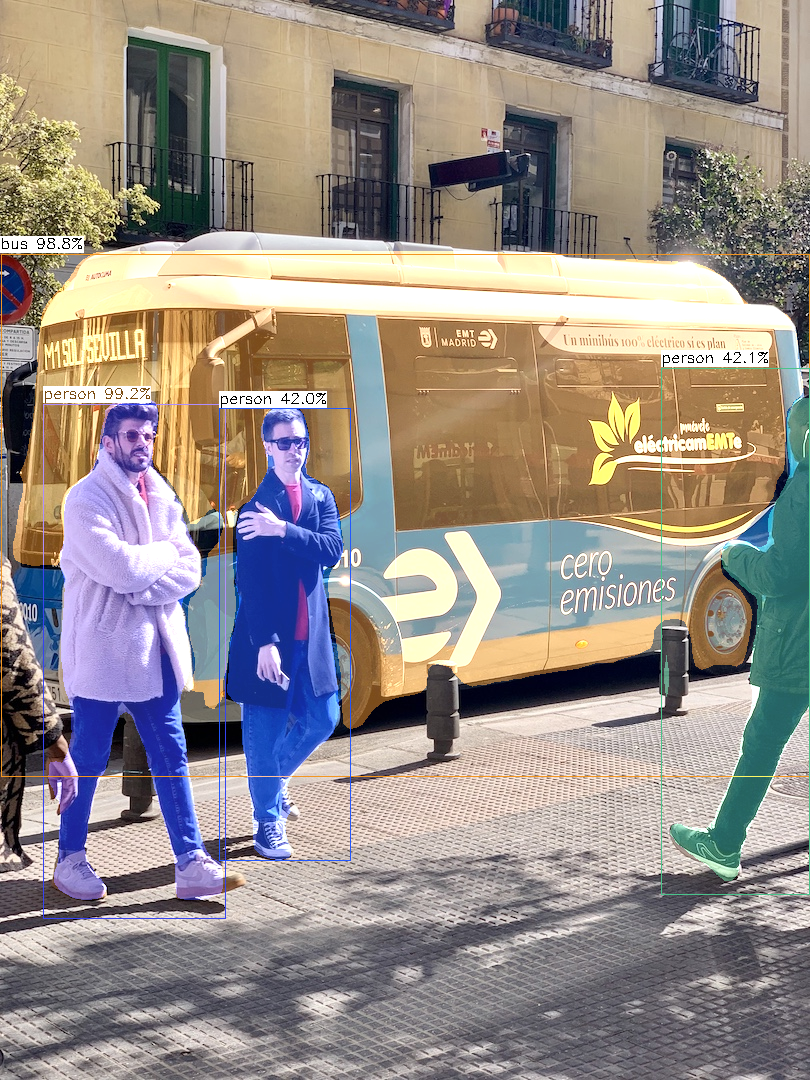
detection num: 4
1: 99%, [ 43, 404, 227, 919], person
2: 99%, [ 1, 254, 810, 776], bus
3: 42%, [ 661, 368, 810, 894], person
4: 42%, [ 219, 408, 351, 861], person
destory npu finished.
~NpuUint.
输出解析后保存的图片output_yolact.png

AtomGit 是由开放原子开源基金会联合 CSDN 等生态伙伴共同推出的新一代开源与人工智能协作平台。平台坚持“开放、中立、公益”的理念,把代码托管、模型共享、数据集托管、智能体开发体验和算力服务整合在一起,为开发者提供从开发、训练到部署的一站式体验。
更多推荐



 8
8 0
0- 0


 已为社区贡献7条内容

所有评论(0)