为什么人工智能可以模拟意识但不能实例化意识 The Abstraction Fallacy: Why AI Can Simulate But Not Instantiate Consciousness
计算功能主义主导了当前关于人工智能意识的争论。该假设认为,主观体验完全源于抽象的因果拓扑结构,而与底层物理基础无关。我们认为,这种观点从根本上误解了物理学与信息之间的关系。我们将这种错误称为抽象谬误。追溯抽象的因果起源表明,符号计算并非内在的物理过程,而是一种依赖于映射者的描述。它需要一个积极主动、具有体验能力的认知主体,将连续的物理过程归纳为一组有限的、有意义的状态。因此,我们无需一个完整、最终的意识理论来评估人工智能的感知能力——这种要求只会使问题无法在短期内得到解决,并加深人工智能福利陷阱。我们真正需要的是一个严谨的计算本体论。本文提出的框架明确区分了模拟(由载体因果性驱动的行为模仿)和实例化(由内容因果性驱动的内在物理构成)。确立这一本体论边界揭示了算法符号操作为何在结构上无法体现经验。至关重要的是,这一论证并不依赖于生物学上的排他性。如果一个人工智能系统曾经拥有意识,那也是由于其特定的物理构成,而非其句法结构。最终,这一框架为计算功能主义提供了一个基于物理学基础的反驳,从而消除了当前围绕人工智能意识的种种不确定性。
https://deepmind.google/research/publications/231971/
Abstract
Computational functionalism dominates current debates on AI consciousness. This is the hypothesis that subjective experience emerges entirely from abstract causal topology, regardless of the underlying physical substrate. We argue this view fundamentally mischaracterizes how physics relates to information. We call this mistake the Abstraction Fallacy. Tracing the causal origins of abstraction reveals that symbolic computation is not an intrinsic physical process. Instead, it is a mapmaker-dependent description. It requires an active, experiencing cognitive agent to alphabetize continuous physics into a finite set of meaningful states. Consequently, we do not need a complete, finalized theory of consciousness to assess AI sentience—a demand that simply pushes the question beyond near-term resolution and deepens the AI welfare trap. What we actually need is a rigorous ontology of computation. The framework proposed here explicitly separates simulation (behavioral mimicry driven by vehicle causality) from instantiation (intrinsic physical constitution driven by content causality). Establishing this ontological boundary shows why algorithmic symbol manipulation is structurally incapable of instantiating experience. Crucially, this argument does not rely on biological exclusivity. If an artificial system were ever conscious, it would be because of its specific physical constitution, never its syntactic architecture. Ultimately, this framework offers a physically grounded refutation of computational functionalism to resolve the current uncertainty surrounding AI consciousness.
https://philpapers.org/archive/LERTAF.pdf
计算功能主义主导着当前关于人工智能意识的争论。这一假说认为主观体验完全源于抽象的因果拓扑结构,而与底层物理基质无关。我们论证这一观点从根本上误解了物理学与信息的关系,并将这种错误称为"抽象化谬误"。追溯抽象化的因果起源可发现:符号计算并非固有的物理过程,而是依赖于制图者的描述——它需要一个具有体验能力的认知主体,将连续的物理现象字母化为有限的有意义状态集合。因此,我们不需要完备的终极意识理论来评估AI的感知能力,这种要求只会将问题推向无法近期解决的境地,并加深AI福利陷阱。真正需要的是严格的计算本体论框架。本文提出的理论明确区分了模拟(由载体因果驱动的行为模仿)与实例化(由内容因果驱动的内在物理构成),建立这种本体论界限揭示了算法符号操作在结构上为何无法实例化体验。关键的是,该论证不依赖生物排他性——即便人工系统产生意识,也必定源于其特定物理构成而非句法架构。最终,这个框架为反驳计算功能主义提供了物理基础,以解决当前关于AI意识的不确定性。1. 引言 大型语言模型的经验成功已足以将意识的"难题"从纯理论领域推进到工程与政策范畴。随着算力扩展带来巨大回报(Bubeck, 2023; Hoffmann, 2022; Kaplan, 2020; Sutton, 2019),主流功能主义范式认为只需实现正确的信息处理角色就能产生现象意识(Chalmers, 1996; Dehaene et al., 2017; Dennett, 1991)。这种观点下,算法指标属性被视为感知能力的可能证据(Butlin et al., 2023),正是该假设推动了近期关于AI福利与道德患者地位的严肃提案(Long et al., 2024)。这一趋势得到顶尖理论家的强化,他们认为前沿模型在未来十年内可能拥有真实体验(Chalmers, 2023; Schneider, 2019)。这些提案的核心是基质独立性——认为心智"软件"在硅基和碳基载体上同样可运行。该假设正面临"生物学转向"的持续批判,如Seth(2025)和Block(2025)主张意识可能依赖维持生命的生物过程,要求生命系统的组织动力学。与基质独立性相反,该观点将生物学置于核心而非偶然地位。但该立场仍属经验范畴,未能明确指认计算功能主义的核心逻辑错误。本文通过逻辑推演证实了"计算不足以实例化意识"的直觉:计算功能主义的问题不仅在于可能忽略生物学细节,更深层根源在于误解物理学与信息计算的关系。
Computational functionalism dominates current debates on AI consciousness. This is the hypothesis that subjective experience emerges entirely from abstract causal topology, regardless of the underlying physical substrate. We argue this view fundamentally mischaracterizes how physics relates to information. We call this mistake the Abstraction Fallacy. Tracing the causal origins of abstraction reveals that symbolic computation is not an intrinsic physical process. Instead, it is a mapmaker-dependent description. It requires an active, experiencing cognitive agent to alphabetize continuous physics into a finite set of meaningful states. Consequently, we do not need a complete, finalized theory of consciousness to assess AI sentience—a demand that simply pushes the question beyond near-term resolution and deepens the AI welfare trap. What we actually need is a rigorous ontology of computation. The framework proposed here explicitly separates simulation (behavioral mimicry driven by vehicle causality) from instantiation (intrinsic physical constitution driven by content causality). Establishing this ontological boundary shows why algorithmic symbol manipulation is structurally incapable of instantiating experience. Crucially, this argument does not rely on biological exclusivity. If an artificial system were ever conscious, it would be because of its specific physical constitution, never its syntactic architecture. Ultimately, this framework offers a physically grounded refutation of computational functionalism to resolve the current uncertainty surrounding AI consciousness. 1. Introduction Large Language Models have been empirically successful enough to push the ’Hard Problem’ of consciousness out of pure theory and into the realm of engineering and policy. With the massive returns we see from scaling compute (Bubeck, 2023; Hoffmann, 2022; Kaplan, 2020; Sutton, 2019), the prevailing functionalist paradigm assumes that hitting the right informationprocessing roles is enough to achieve phenomenal consciousness (Chalmers, 1996; Dehaene et al., 2017; Dennett, 1991). Under this view, algorithmic indicator properties act as likely evidence for sentience (Butlin et al., 2023). This assumption is exactly what motivates recent, serious proposals for AI welfare and moral patienthood (Long et al., 2024). This shift is reinforced by leading theorists who assign significant credence to the possibility that state-of-the-art models could possess genuine experience within the next decade (Chalmers, 2023; Schneider, 2019). At the center of these proposals lies substrate independence, the idea that the “software” of the mind could run on silicon just as well as on carbon. That assumption has begun to face sustained criticism from a ’Biological Turn’. Seth (2025) and Block (2025), for example, argue that consciousness may depend on life-maintaining biological processes, such that experience requires the organized dynamics of living systems. In contrast to substrate independence, this view makes biology central rather than incidental. Yet that position remains empirical, as it does not clearly identify the basic logical mistake at the core of computational functionalism. Here, we derive the logical sequence that vindicates the intuition that computation is not sufficient to instantiate consciousness. The difficulty with computational functionalism is not just that it may overlook biological details. The problem runs much deeper. It is rooted in a misunderstanding of how physics relates to information and computation.
现代物理科学为确保操作客观性,刻意剔除了主观体验(Frank等人,2025)。这一策略取得了非凡成功。但当这种立场被应用于"计算如何关联主观体验"的问题时,注定会失败。将操作客观性应用于计算本身的定义极具问题性——正如当前关于"观察者"在赋予计算符号意义时作用的争论所展现的,这些争论至今仍未解决。
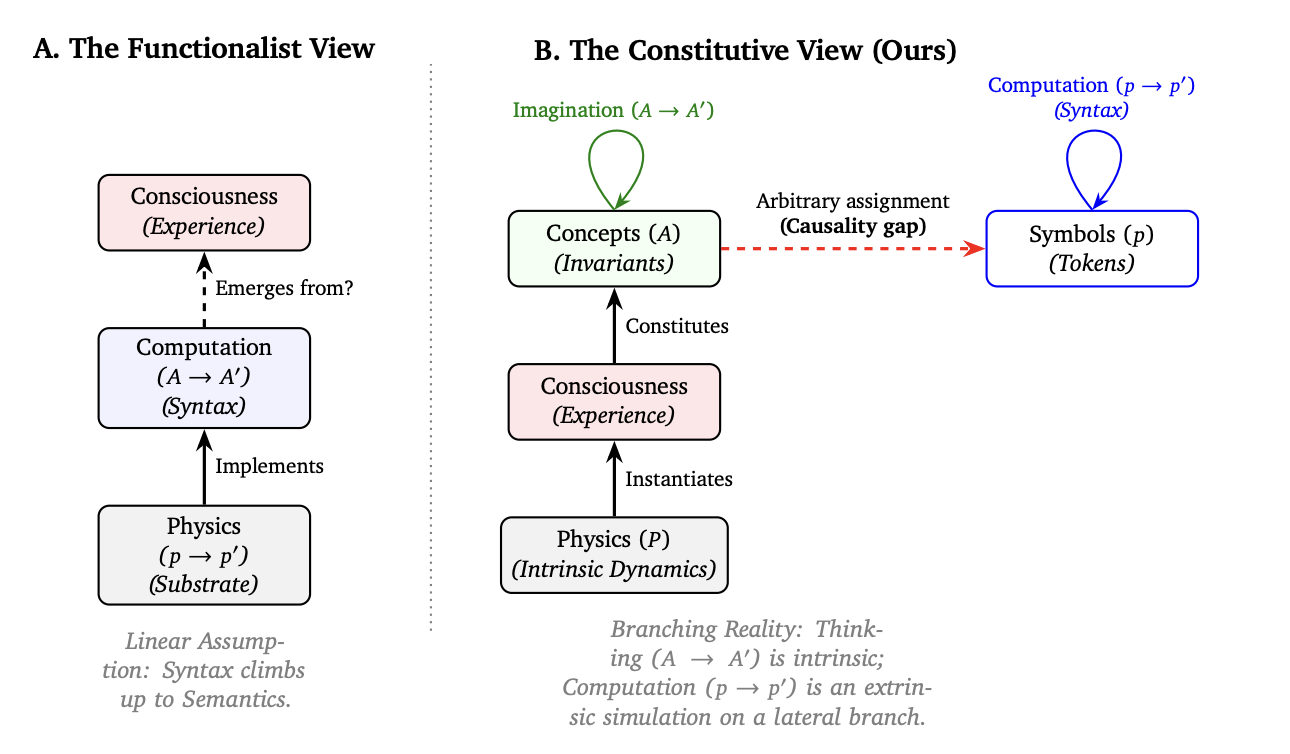
此外,"观察者"这个术语实际上暗示了一种过于被动的角色,无法满足从物理层面完整定义计算的前提条件。我们的框架阐明:计算并非物质中自然展开的内在过程,而是描述物理过程的一种方式。要将连续物理动态视为计算,必须将其划分为具有语义意义的离散状态集合(即某种字母表形式)。这种语义划分在逻辑上需要一个具有主动性的、拥有体验的认知主体——我们将其定义为"绘图者",以区别于传统"观察者"的被动内涵。正是绘图者执行了这种字母表化过程。若没有这种主动主体对计算进行解释,存在的就只有连续物理事件,而非符号。
我们研究的核心洞见在于:要解决当前围绕人工意识的不确定性,并不需要完备的终极意识理论,而是需要建立计算的本体论。通过这条路径,我们可以逻辑证明:算法的符号操作无论规模多么庞大或架构多么复杂,都无法构成体验的物理实例化,因为它本质上是依赖绘图者的描述工具。
阐明绘图者在因果链中的作用将改变争论焦点。迄今为止,包括塞尔中文房间在内的著名人工意识批判(Block,1978;Putnam,1988;Searle,1980)主要依赖归谬法,试图证明纯句法操作即使完美复现外部行为,仍缺失某些本质要素。
我们采取了不同路径:不诉诸直觉判断缺失内容,而是考察抽象化如何产生。如果计算依赖于从体验中提取不变性并指派符号的绘图者,那么这种依赖性就内嵌于结构之中。任何计算图式都预设了执行字母表化的体验主体。算法复杂化无法消除这种依赖秩序,规模扩大也不能让图式生成计算赖以存在的主体——正是这个主体的活动才使得计算成其为计算。
Modern physical sciences have deliberately excised subjective experience in order to ensure
operational objectivity (Frank et al., 2025). This strategy has been extraordinarily successful. But
when this stance is applied to the question of how computation relates to subjective experience,
it is bound to fail. Applying this operational objectivity to the very definition of computation is
highly problematic, as can be seen in the ongoing and still unresolved debates around the role of
an ’observer’ in supplying meaning to computational symbols.
Moreover, it turns out that the term ’observer’ suggests a too passive role for the missing
prerequisite to fully define computation in physical terms. Our framework elucidates why
computation is not an intrinsic process that simply unfolds in matter. Instead, it is a way of
describing physical processes. To count as computation, continuous physical dynamics must be
partitioned into a finite set of discrete, semantically meaningful states (i.e., a form of alphabet).
Such semantic partitioning logically requires an active, experiencing cognitive agent, which we
define as a mapmaker, to contrast it with the passive connotation of a standard ’observer’. It is
the mapmaker who performs this alphabetization. Without such an active agent interpreting the
computation, there are only continuous physical events, not symbols.
A key insight from our contribution is that resolving the present uncertainty surrounding
artificial consciousness does not require a complete and final theory of consciousness. Instead, we
need an ontology of computation. Via this route, we can logically prove that algorithmic symbol
manipulation, no matter how large in scale or intricate in architecture, cannot constitute the
physical instantiation of experience, since it is a mapmaker-dependent descriptive tool.
Demonstrating the role of the mapmaker in the causal story changes the focus of the debate.
So far, well-known critiques of artificial consciousness, including Searle’s Chinese Room and
related arguments (Block, 1978; Putnam, 1988; Searle, 1980), rely primarily on reductio ad
absurdum. They aim to show that pure syntactic manipulation, even if it perfectly mirrors outward
behavior, still seems to miss something essential.
Our approach takes a different route. Instead of appealing to intuitions about what is absent,
we examine how abstraction arises in the first place. If computation depends on a mapmaker
who extracts invariants from experience and assigns symbols, then the dependency is built into
the structure. Any computational map presupposes an experiencing agent who performs the
alphabetization. Making the algorithm more complex does not undo this order of dependence. No
increase in scale allows the map to generate the subject whose activity is required for computation
to count as such at all.
In other words, the claim that algorithmic complexity generates consciousness commits an
ontological inversion: it mistakes the syntax for the territory of intrinsic dynamics, and assumes
that the mapmaker can be created from the map. By delineating the structural dissociation
between extrinsic behavioral simulation and intrinsic physical instantiation, we demonstrate
that digital architectures are precluded from becoming moral patients. This realization pulls the
field of AI safety out of the welfare trap. It allows us to focus entirely on the concrete risks of
anthropomorphism, treating AGI as a powerful, but inherently non-sentient tool.
2. The Ontology of Abstraction: Map vs. Territory
Computer science frequently treats the abstractions underlying algorithms as mathematical givens,
leaving the question of their physical realization open. What exactly is the physicalist ontology of
an abstraction? To answer this question, we need to establish how exactly abstract syntax relates
to physical dynamics.
请阅读原文

AtomGit 是由开放原子开源基金会联合 CSDN 等生态伙伴共同推出的新一代开源与人工智能协作平台。平台坚持“开放、中立、公益”的理念,把代码托管、模型共享、数据集托管、智能体开发体验和算力服务整合在一起,为开发者提供从开发、训练到部署的一站式体验。
更多推荐

 5
5 0
0- 0


 已为社区贡献84条内容

所有评论(0)