对流换热仿真-主题067_并行计算与MPI-并行计算与MPI
第六十七篇:并行计算与MPI
摘要
随着计算流体力学(CFD)和传热学仿真问题规模的不断扩大,并行计算已成为解决大规模科学计算问题的关键技术。本教程系统介绍并行计算的基本概念、并行架构、MPI(Message Passing Interface)编程模型,以及并行计算在流体力学和传热学中的应用。通过Python实现多个典型算例,包括并行矩阵运算、区域分解法、并行CFD求解器等,展示并行计算的强大能力和实际应用方法。
关键词
并行计算,MPI,区域分解,负载均衡,加速比,并行效率,OpenMP,CUDA,Python多进程
1. 引言
1.1 为什么需要并行计算
1.1.1 计算需求的爆炸式增长
现代工程和科学计算面临的挑战:
航空航天领域:
- 整机气动分析:网格规模 10^8 - 10^9 单元
- 多物理场耦合:流-固-热耦合仿真
- 优化设计:需要数千次CFD计算
气象预报:
- 全球气候模拟:网格规模 10^7 - 10^8 格点
- 长期预测:数十年甚至数百年的模拟
- 实时预报:需要在数小时内完成
生物医学:
- 全脑血流模拟:血管网络 10^6 - 10^7 段
- 心脏流体力学:需要捕捉毫秒级动态
- 药物扩散:多尺度时空模拟
能源工程:
- 核反应堆安全分析:全堆芯详细模拟
- 油气藏模拟:10^6 - 10^7 网格块
- 风电场优化:数百台风机相互作用
1.1.2 单核性能瓶颈
物理限制:
- 摩尔定律放缓:晶体管密度增长减缓
- 功耗墙:单核功耗限制了频率提升
- 内存墙:内存带宽增长跟不上计算速度
实际限制:
- 单核性能提升有限:每年约10-15%
- 散热问题:高频导致的热管理挑战
- 成本问题:高端单核处理器价格昂贵
1.1.3 并行计算的优势
性能提升:
- 理论加速:N个处理器可加速N倍
- 实际加速:通常可达数十到数百倍
- 可扩展性:通过增加处理器继续提升性能
成本效益:
- 使用普通处理器构建集群
- 利用现有硬件资源
- 云计算的弹性扩展
问题解决能力:
- 处理更大规模问题
- 提高计算精度
- 缩短计算时间
1.2 并行计算的基本概念
1.2.1 并行性的类型
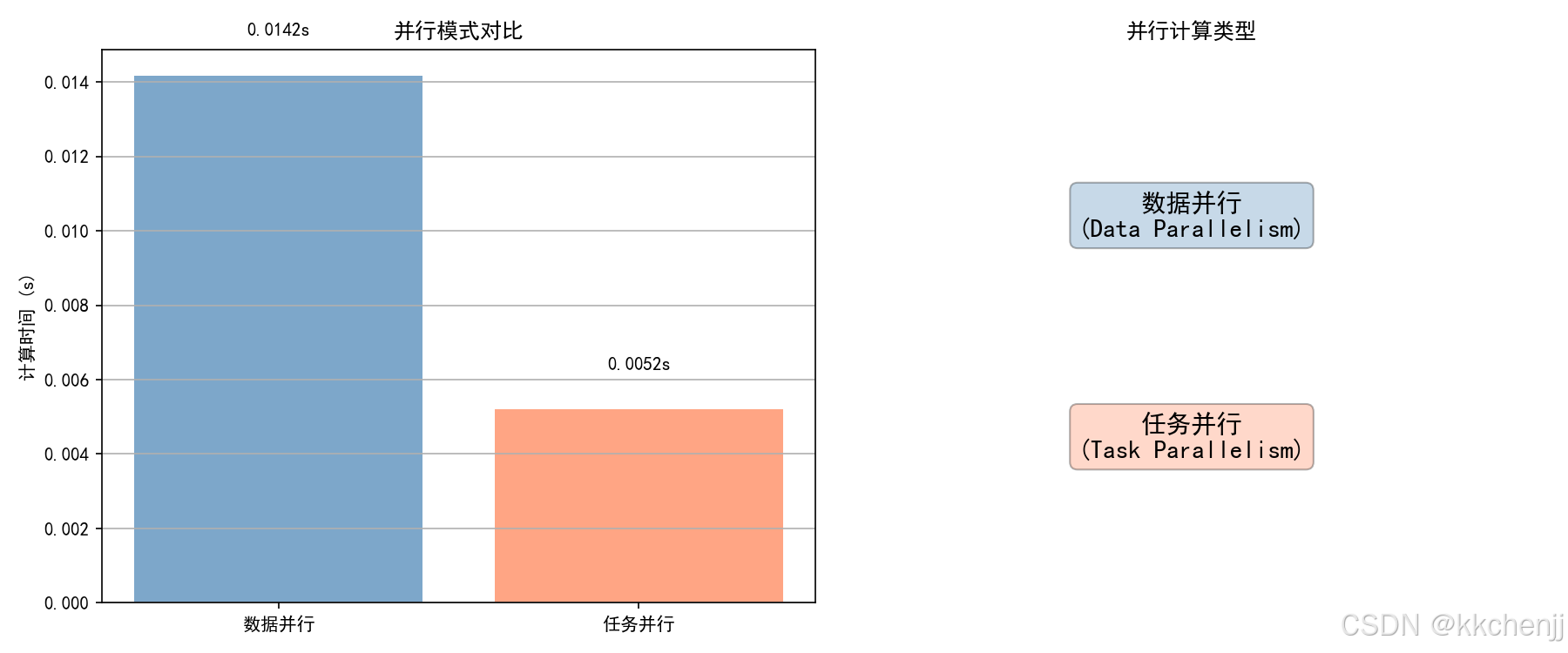
数据并行(Data Parallelism):
- 同一操作应用于不同数据
- 适合SIMD(单指令多数据)架构
- 示例:向量加法、矩阵乘法
# 数据并行示例:向量加法
A = [1, 2, 3, 4, 5]
B = [6, 7, 8, 9, 10]
C = [A[i] + B[i] for i in range(len(A))]  # 每个元素独立计算
任务并行(Task Parallelism):
- 不同任务同时执行
- 适合MIMD(多指令多数据)架构
- 示例:流水线处理、功能分解
# 任务并行示例:图像处理流水线
# 任务1: 读取图像 → 任务2: 滤波 → 任务3: 边缘检测 → 任务4: 保存结果
流水线并行(Pipeline Parallelism):
- 数据流经过多个处理阶段
- 每个阶段并行处理不同数据
- 示例:视频编码、信号处理
1.2.2 并行架构分类
弗林分类法(Flynn’s Taxonomy):
| 类型 | 指令流 | 数据流 | 示例 |
|---|---|---|---|
| SISD | 单 | 单 | 传统串行计算机 |
| SIMD | 单 | 多 | GPU、向量处理器 |
| MISD | 多 | 单 | 容错系统(罕见) |
| MIMD | 多 | 多 | 多核CPU、集群 |
内存架构:
共享内存(Shared Memory):
- 所有处理器访问同一内存空间
- 通过读写共享变量通信
- 需要同步机制避免竞争
- 示例:多核CPU、OpenMP
分布式内存(Distributed Memory):
- 每个处理器有自己的内存
- 通过消息传递通信
- 需要显式数据交换
- 示例:集群、MPI
混合内存(Hybrid Memory):
- 节点内共享内存,节点间分布式内存
- 结合两种架构的优势
- 现代超级计算机的主流架构
- 示例:MPI+OpenMP
1.2.3 并行性能指标
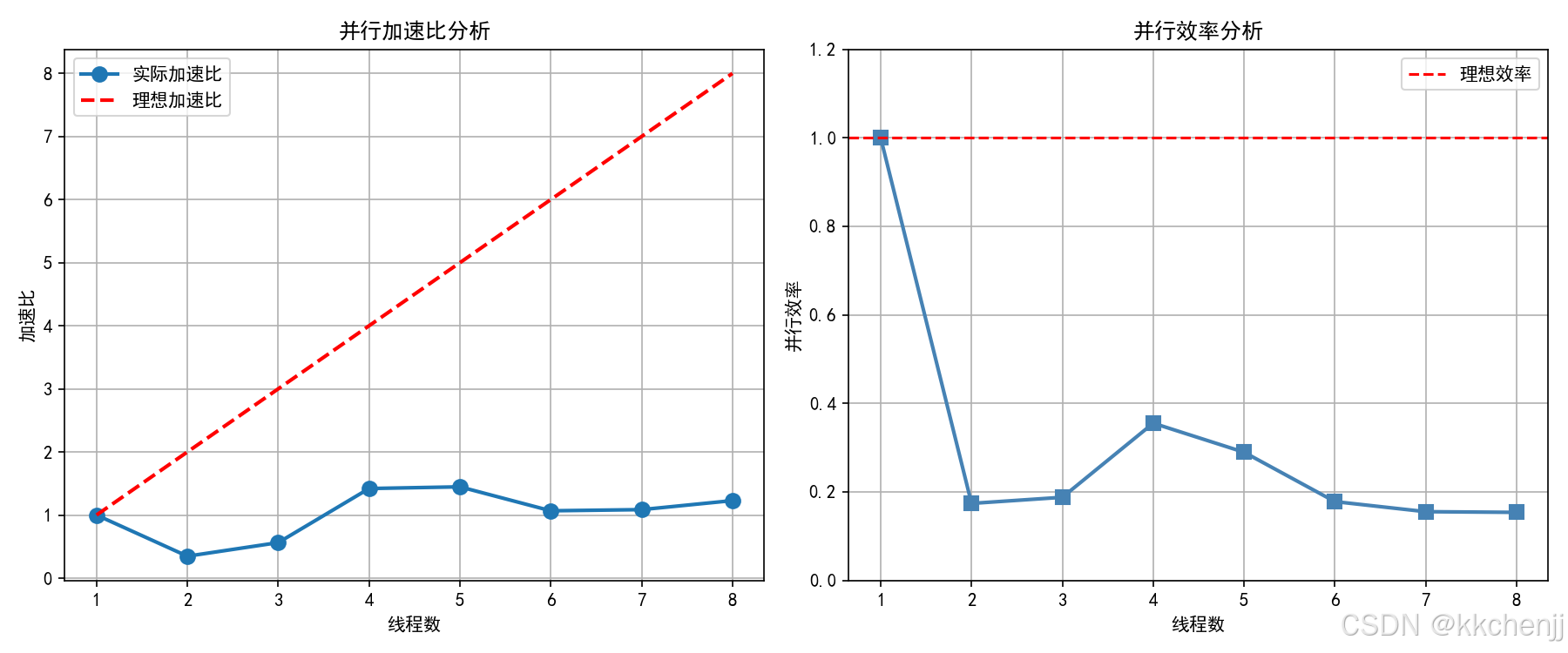
加速比(Speedup):
S=T1TpS = \frac{T_1}{T_p}S=TpT1
其中 T1T_1T1 是串行执行时间,TpT_pTp 是P个处理器的并行执行时间。
效率(Efficiency):
E=SP=T1P⋅TpE = \frac{S}{P} = \frac{T_1}{P \cdot T_p}E=PS=P⋅TpT1
理想情况下 E=1E = 1E=1(100%),实际通常 E<1E < 1E<1。
可扩展性(Scalability):
- 强可扩展性:固定问题规模,增加处理器
- 弱可扩展性:问题规模与处理器数量成比例增加
阿姆达尔定律(Amdahl’s Law):
Smax=1(1−f)+fPS_{max} = \frac{1}{(1-f) + \frac{f}{P}}Smax=(1−f)+Pf1
其中 fff 是可并行化部分的比例,(1−f)(1-f)(1−f) 是串行部分。
古斯塔夫森定律(Gustafson’s Law):
S=P−f(P−1)S = P - f(P-1)S=P−f(P−1)
强调通过增加问题规模来保持效率。
1.3 并行编程模型
1.3.1 共享内存模型
OpenMP:
- 编译指令指导并行化
- 自动线程管理
- 适合循环并行化
#pragma omp parallel for
for (int i = 0; i < N; i++) {
    C[i] = A[i] + B[i];
}
POSIX线程(Pthreads):
- 显式线程创建和管理
- 细粒度控制
- 灵活性高但复杂
1.3.2 分布式内存模型
MPI(Message Passing Interface):
- 显式消息传递
- 进程间通信
- 工业标准,广泛应用
from mpi4py import MPI

comm = MPI.COMM_WORLD
rank = comm.Get_rank()
size = comm.Get_size()

# 发送和接收数据
if rank == 0:
    comm.send(data, dest=1)
elif rank == 1:
    data = comm.recv(source=0)
1.3.3 异构计算模型
CUDA/OpenCL:
- GPU并行编程
- 大规模线程并行
- 适合数据并行任务
__global__ void vectorAdd(float *A, float *B, float *C, int n) {
    int i = blockIdx.x * blockDim.x + threadIdx.x;
    if (i < n) {
        C[i] = A[i] + B[i];
    }
}
2. MPI编程基础
2.1 MPI简介
2.1.1 MPI的历史和发展
起源:
- 1992年:MPI论坛成立
- 1994年:MPI-1.0标准发布
- 目标:建立可移植的消息传递标准
版本演进:
- MPI-1.x:基本消息传递
- MPI-2.x:并行I/O、动态进程管理、单边通信
- MPI-3.x:非阻塞集合操作、改进的线程支持
- MPI-4.x:持久化集合操作、分区通信
实现:
- OpenMPI:开源,广泛使用
- MPICH:Argonne国家实验室开发
- Intel MPI:针对Intel架构优化
- MS-MPI:Microsoft的Windows实现
2.1.2 MPI的基本概念
通信器(Communicator):
- 定义进程组的通信域
MPI_COMM_WORLD:包含所有进程- 可以创建子通信器
进程标识:
- Rank:进程在通信器中的唯一标识(0, 1, 2, …)
- Size:通信器中的进程总数
通信模式:
- 点对点通信:两个进程间通信
- 集合通信:所有进程参与的操作
2.2 MPI程序结构
2.2.1 基本框架
from mpi4py import MPI

# 初始化MPI
comm = MPI.COMM_WORLD
rank = comm.Get_rank()  # 当前进程ID
size = comm.Get_size()  # 总进程数

# 每个进程执行自己的代码
print(f"Process {rank} of {size}")

# 并行计算...

# 结束MPI(mpi4py自动处理)
2.2.2 SPMD模式
单程序多数据(Single Program Multiple Data):
- 所有进程运行相同程序
- 根据rank执行不同分支
- 最常见的MPI编程模式
from mpi4py import MPI
import numpy as np

comm = MPI.COMM_WORLD
rank = comm.Get_rank()
size = comm.Get_size()

# 数据分解
N = 1000
local_n = N // size
local_start = rank * local_n
local_end = local_start + local_n

# 每个进程处理自己的数据
local_data = np.arange(local_start, local_end)
local_sum = np.sum(local_data)

# 收集结果
total_sum = comm.reduce(local_sum, op=MPI.SUM, root=0)

if rank == 0:
    print(f"Total sum: {total_sum}")
2.3 点对点通信
2.3.1 阻塞通信
标准发送和接收:
from mpi4py import MPI
import numpy as np

comm = MPI.COMM_WORLD
rank = comm.Get_rank()

# 发送数据
if rank == 0:
    data = np.array([1.0, 2.0, 3.0, 4.0, 5.0])
    comm.send(data, dest=1, tag=0)
    print(f"Process {rank} sent data")

# 接收数据
elif rank == 1:
    data = comm.recv(source=0, tag=0)
    print(f"Process {rank} received: {data}")
同步发送(Ssend):
- 等待接收方开始接收才返回
- 更安全但可能降低性能
缓冲发送(Bsend):
- 用户提供发送缓冲区
- 立即返回,后台发送
就绪发送(Rsend):
- 要求接收方已准备好接收
- 性能最高但风险大
2.3.2 非阻塞通信
异步发送和接收:
from mpi4py import MPI
import numpy as np

comm = MPI.COMM_WORLD
rank = comm.Get_rank()

if rank == 0:
    data = np.array([1.0, 2.0, 3.0])
    # 非阻塞发送
    req = comm.Isend(data, dest=1, tag=0)
    # 在此期间可以做其他计算
    # ...
    req.Wait()  # 等待发送完成

elif rank == 1:
    data = np.empty(3, dtype=np.float64)
    # 非阻塞接收
    req = comm.Irecv(data, source=0, tag=0)
    # 在此期间可以做其他计算
    # ...
    req.Wait()  # 等待接收完成
    print(f"Received: {data}")
多重非阻塞操作:
# 同时发起多个通信
requests = []
for i in range(n_neighbors):
    req = comm.Isend(send_buffers[i], dest=neighbors[i])
    requests.append(req)

# 等待所有通信完成
MPI.Request.Waitall(requests)
2.4 集合通信
2.4.1 广播(Broadcast)
from mpi4py import MPI
import numpy as np

comm = MPI.COMM_WORLD
rank = comm.Get_rank()

if rank == 0:
    data = np.array([1.0, 2.0, 3.0, 4.0, 5.0])
else:
    data = np.empty(5, dtype=np.float64)

# 广播数据到所有进程
comm.Bcast(data, root=0)

print(f"Process {rank}: {data}")
2.4.2 散播(Scatter)
from mpi4py import MPI
import numpy as np

comm = MPI.COMM_WORLD
rank = comm.Get_rank()
size = comm.Get_size()

if rank == 0:
    # 准备要散播的数据
    data = np.arange(10, dtype=np.float64)
else:
    data = None

# 每个进程接收一部分
local_data = np.empty(10 // size, dtype=np.float64)
comm.Scatter(data, local_data, root=0)

print(f"Process {rank} received: {local_data}")
2.4.3 收集(Gather)
from mpi4py import MPI
import numpy as np

comm = MPI.COMM_WORLD
rank = comm.Get_rank()
size = comm.Get_size()

# 每个进程的本地数据
local_data = np.array([rank * 1.0])

if rank == 0:
    gathered = np.empty(size, dtype=np.float64)
else:
    gathered = None

# 收集所有数据到根进程
comm.Gather(local_data, gathered, root=0)

if rank == 0:
    print(f"Gathered data: {gathered}")
2.4.4 归约(Reduce)
from mpi4py import MPI
import numpy as np

comm = MPI.COMM_WORLD
rank = comm.Get_rank()
size = comm.Get_size()

# 每个进程的本地数据
local_value = np.array([rank + 1.0])

# 归约操作
result = np.empty(1, dtype=np.float64)
comm.Reduce(local_value, result, op=MPI.SUM, root=0)

if rank == 0:
    print(f"Sum of all values: {result[0]}")
    print(f"Expected: {size * (size + 1) / 2}")
归约操作类型:
MPI.SUM:求和MPI.PROD:乘积MPI.MAX:最大值MPI.MIN:最小值MPI.MAXLOC:最大值及位置MPI.MINLOC:最小值及位置MPI.LAND/MPI.LOR/MPI.LXOR:逻辑操作MPI.BAND/MPI.BOR/MPI.BXOR:位操作
2.4.5 全收集(Allgather)和全归约(Allreduce)
from mpi4py import MPI
import numpy as np

comm = MPI.COMM_WORLD
rank = comm.Get_rank()
size = comm.Get_size()

# 本地数据
local_data = np.array([rank * 1.0])

# 全收集:所有进程获得所有数据
all_data = np.empty(size, dtype=np.float64)
comm.Allgather(local_data, all_data)
print(f"Process {rank} allgather: {all_data}")

# 全归约:所有进程获得归约结果
result = np.empty(1, dtype=np.float64)
comm.Allreduce(local_data, result, op=MPI.SUM)
print(f"Process {rank} allreduce: {result[0]}")
3. Python并行计算
3.1 multiprocessing模块
3.1.1 进程创建
import multiprocessing as mp
import time

def worker_function(x):
    """工作函数"""
    time.sleep(1)  # 模拟计算
    return x * x

if __name__ == '__main__':
    # 串行执行
    start = time.time()
    results_serial = [worker_function(i) for i in range(4)]
    print(f"Serial time: {time.time() - start:.2f}s")

    # 并行执行
    start = time.time()
    with mp.Pool(processes=4) as pool:
        results_parallel = pool.map(worker_function, range(4))
    print(f"Parallel time: {time.time() - start:.2f}s")

    print(f"Results: {results_parallel}")
3.1.2 进程池
import multiprocessing as mp
import numpy as np

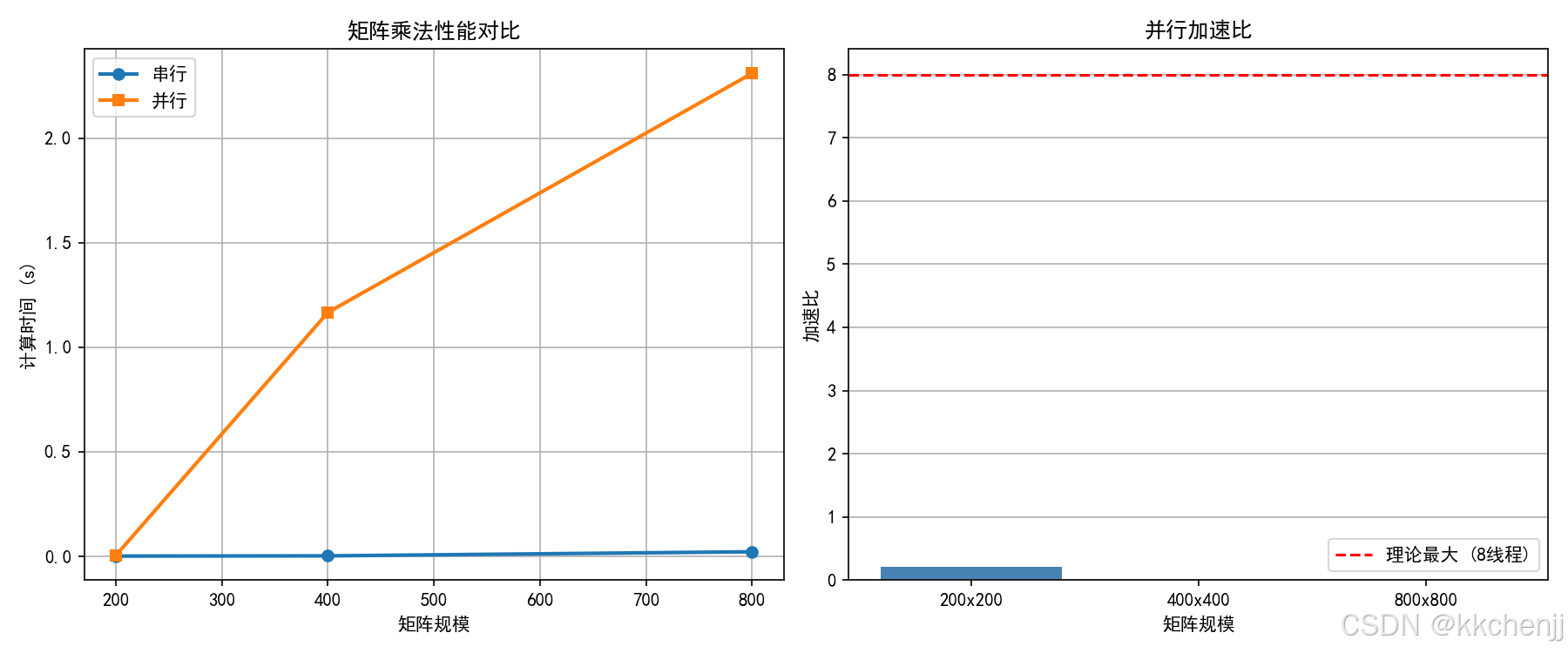
def parallel_matrix_multiply(A, B, num_processes=None):
    """
    并行矩阵乘法

    参数:
        A, B: 输入矩阵
        num_processes: 进程数
    """
    if num_processes is None:
        num_processes = mp.cpu_count()

    n = A.shape[0]
    chunk_size = n // num_processes

    def compute_chunk(args):
        start, end, A, B = args
        C_chunk = np.zeros((end - start, B.shape[1]))
        for i in range(start, end):
            for j in range(B.shape[1]):
                C_chunk[i - start, j] = np.dot(A[i, :], B[:, j])
        return start, C_chunk

    # 准备任务
    tasks = [(i * chunk_size, (i + 1) * chunk_size if i < num_processes - 1 else n, A, B)
             for i in range(num_processes)]

    # 并行计算
    with mp.Pool(processes=num_processes) as pool:
        results = pool.map(compute_chunk, tasks)

    # 合并结果
    C = np.zeros((n, B.shape[1]))
    for start, C_chunk in results:
        end = start + C_chunk.shape[0]
        C[start:end, :] = C_chunk

    return C
3.2 concurrent.futures模块
from concurrent.futures import ProcessPoolExecutor, as_completed
import time

def compute_task(task_id, data):
    """计算任务"""
    time.sleep(0.5)  # 模拟计算
    return task_id, sum(data)

# 使用ProcessPoolExecutor
with ProcessPoolExecutor(max_workers=4) as executor:
    # 提交所有任务
    futures = {executor.submit(compute_task, i, list(range(1000))): i
               for i in range(10)}

    # 获取结果
    results = []
    for future in as_completed(futures):
        task_id, result = future.result()
        results.append((task_id, result))
        print(f"Task {task_id} completed with result {result}")
3.3 mpi4py库
3.3.1 安装和基本使用
# 安装mpi4py
pip install mpi4py

# 运行MPI程序
mpiexec -n 4 python script.py
3.3.2 矩阵向量乘法
from mpi4py import MPI
import numpy as np

comm = MPI.COMM_WORLD
rank = comm.Get_rank()
size = comm.Get_size()

# 矩阵维度
N = 1000

# 根进程初始化矩阵
if rank == 0:
    A = np.random.rand(N, N)
    x = np.random.rand(N)
else:
    A = None
    x = np.empty(N, dtype=np.float64)

# 广播向量x
comm.Bcast(x, root=0)

# 计算每行分配给每个进程
rows_per_proc = N // size
start_row = rank * rows_per_proc
end_row = start_row + rows_per_proc if rank < size - 1 else N

# 散播矩阵行
if rank == 0:
    # 发送矩阵行
    for i in range(1, size):
        start = i * rows_per_proc
        end = start + rows_per_proc if i < size - 1 else N
        comm.Send(A[start:end, :], dest=i)
    local_A = A[start_row:end_row, :]
else:
    num_rows = end_row - start_row
    local_A = np.empty((num_rows, N), dtype=np.float64)
    comm.Recv(local_A, source=0)

# 本地计算
local_y = np.dot(local_A, x)

# 收集结果
if rank == 0:
    y = np.empty(N, dtype=np.float64)
    y[start_row:end_row] = local_y
    for i in range(1, size):
        start = i * rows_per_proc
        end = start + rows_per_proc if i < size - 1 else N
        y[start:end] = comm.recv(source=i)
else:
    comm.send(local_y, dest=0)

if rank == 0:
    print(f"Result shape: {y.shape}")
    print(f"Verification: {np.allclose(y, np.dot(A, x))}")
4. 区域分解法
4.1 区域分解的基本概念
4.1.1 什么是区域分解
定义:
将计算域划分为多个子域,每个子域分配给不同的处理器并行计算。
优势:
- 天然并行性
- 减少每个处理器的内存需求
- 适合大规模问题
挑战:
- 子域间通信
- 负载均衡
- 边界处理
4.1.2 区域分解的类型
重叠区域分解(Schwarz方法):
- 子域之间有重叠区域
- 通过迭代交换边界信息
- 收敛性好但通信量大
非重叠区域分解(Schur补方法):
- 子域之间不重叠
- 仅交换界面信息
- 通信量小但需要求解界面问题
4.2 一维区域分解
from mpi4py import MPI
import numpy as np

comm = MPI.COMM_WORLD
rank = comm.Get_rank()
size = comm.Get_size()

# 全局网格
N_global = 100

# 计算本地网格范围
n_local = N_global // size
start = rank * n_local
end = start + n_local

# 添加幽灵单元(用于边界通信)
if rank > 0:
    start_ghost = start - 1
else:
    start_ghost = start

if rank < size - 1:
    end_ghost = end + 1
else:
    end_ghost = end

# 本地网格
x_local = np.linspace(0, 1, N_global)[start_ghost:end_ghost]
u_local = np.zeros(len(x_local))

# 初始化
if rank == 0:
    u_local[0] = 1.0  # 左边界条件
if rank == size - 1:
    u_local[-1] = 0.0  # 右边界条件

# 迭代求解(雅可比迭代)
for iteration in range(1000):
    u_old = u_local.copy()

    # 内部更新
    for i in range(1, len(u_local) - 1):
        u_local[i] = 0.5 * (u_old[i-1] + u_old[i+1])

    # 边界通信
    if rank > 0:
        comm.send(u_local[1], dest=rank-1)
        u_local[0] = comm.recv(source=rank-1)
    if rank < size - 1:
        comm.send(u_local[-2], dest=rank+1)
        u_local[-1] = comm.recv(source=rank+1)

print(f"Process {rank}: local solution computed")
4.3 二维区域分解
from mpi4py import MPI
import numpy as np

comm = MPI.COMM_WORLD
rank = comm.Get_rank()
size = comm.Get_size()

# 假设使用4个进程,2x2分解
npx, npy = 2, 2  # x和y方向的进程数

# 计算进程在2D网格中的位置
px = rank % npx
py = rank // npx

# 全局网格
Nx, Ny = 100, 100

# 本地网格大小
nx = Nx // npx
ny = Ny // npy

# 本地网格范围
x_start = px * nx
x_end = x_start + nx
y_start = py * ny
y_end = y_start + ny

# 添加幽灵单元
has_left = px > 0
has_right = px < npx - 1
has_bottom = py > 0
has_top = py < npy - 1

# 本地数组(包括幽灵单元)
local_nx = nx + (1 if has_left else 0) + (1 if has_right else 0)
local_ny = ny + (1 if has_bottom else 0) + (1 if has_top else 0)
u = np.zeros((local_ny, local_nx))

# 初始化...

# 通信函数
def exchange_boundaries():
    """交换边界数据"""
    # 左右通信
    if has_left:
        comm.Send(u[:, 1], dest=rank-1)
        u[:, 0] = comm.recv(source=rank-1)
    if has_right:
        comm.Send(u[:, -2], dest=rank+1)
        u[:, -1] = comm.recv(source=rank+1)

    # 上下通信
    if has_bottom:
        comm.Send(u[1, :], dest=rank-npx)
        u[0, :] = comm.recv(source=rank-npx)
    if has_top:
        comm.Send(u[-2, :], dest=rank+npx)
        u[-1, :] = comm.recv(source=rank+npx)

# 主迭代循环
for iteration in range(100):
    # 计算...

    # 交换边界
    exchange_boundaries()
5. 并行CFD求解器
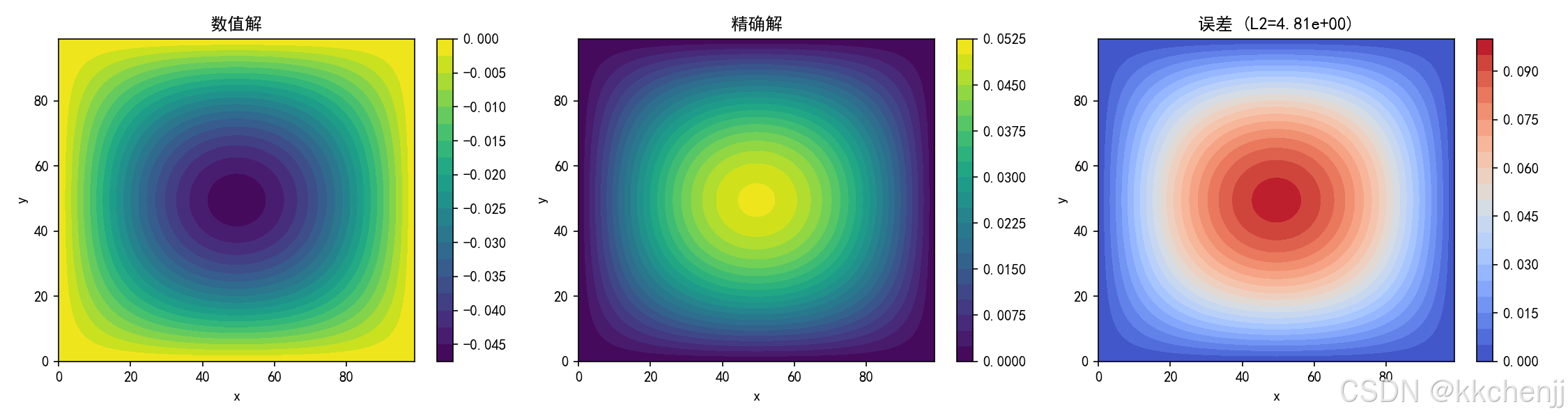
5.1 并行Poisson求解器
from mpi4py import MPI
import numpy as np

class ParallelPoissonSolver:
    """并行泊松方程求解器"""

    def __init__(self, nx, ny, comm):
        self.comm = comm
        self.rank = comm.Get_rank()
        self.size = comm.Get_size()

        self.nx = nx
        self.ny = ny

        # 计算本地网格分解
        self._decompose_domain()

        # 初始化网格
        self._initialize_grid()

    def _decompose_domain(self):
        """分解计算域"""
        # 简单的一维分解(沿y方向)
        self.ny_local = self.ny // self.size
        self.y_start = self.rank * self.ny_local
        self.y_end = self.y_start + self.ny_local

        # 添加幽灵行
        if self.rank > 0:
            self.y_start_ghost = self.y_start - 1
        else:
            self.y_start_ghost = self.y_start

        if self.rank < self.size - 1:
            self.y_end_ghost = self.y_end + 1
        else:
            self.y_end_ghost = self.y_end

        self.ny_local_ghost = self.y_end_ghost - self.y_start_ghost

    def _initialize_grid(self):
        """初始化网格"""
        self.dx = 1.0 / (self.nx - 1)
        self.dy = 1.0 / (self.ny - 1)

        x = np.linspace(0, 1, self.nx)
        y = np.linspace(0, 1, self.ny)[self.y_start_ghost:self.y_end_ghost]
        self.X, self.Y = np.meshgrid(x, y)

        # 初始化解和右端项
        self.u = np.zeros((self.ny_local_ghost, self.nx))
        self.f = np.sin(np.pi * self.X) * np.sin(np.pi * self.Y)

        # 边界条件
        if self.rank == 0:
            self.u[0, :] = 0  # 下边界
        if self.rank == self.size - 1:
            self.u[-1, :] = 0  # 上边界
        self.u[:, 0] = 0  # 左边界
        self.u[:, -1] = 0  # 右边界

    def exchange_boundaries(self):
        """交换边界数据"""
        # 发送下边界,接收上边界
        if self.rank > 0:
            self.comm.Send(self.u[1, :], dest=self.rank-1)
        if self.rank < self.size - 1:
            self.u[-1, :] = self.comm.recv(source=self.rank+1)

        # 发送上边界,接收下边界
        if self.rank < self.size - 1:
            self.comm.Send(self.u[-2, :], dest=self.rank+1)
        if self.rank > 0:
            self.u[0, :] = self.comm.recv(source=self.rank-1)

    def jacobi_iteration(self):
        """雅可比迭代步骤"""
        u_new = self.u.copy()

        # 内部点更新
        for i in range(1, self.ny_local_ghost - 1):
            for j in range(1, self.nx - 1):
                u_new[i, j] = 0.25 * (
                    self.u[i+1, j] + self.u[i-1, j] +
                    self.u[i, j+1] + self.u[i, j-1] -
                    self.dx**2 * self.f[i, j]
                )

        self.u = u_new

    def solve(self, max_iter=1000, tol=1e-6):
        """求解"""
        for iteration in range(max_iter):
            u_old = self.u.copy()

            # 雅可比迭代
            self.jacobi_iteration()

            # 交换边界
            self.exchange_boundaries()

            # 计算残差
            local_residual = np.linalg.norm(self.u - u_old)
            global_residual = self.comm.allreduce(local_residual, op=MPI.SUM)

            if self.rank == 0 and iteration % 100 == 0:
                print(f"Iteration {iteration}, residual: {global_residual:.6e}")

            if global_residual < tol:
                break

        return self.u

# 使用示例
if __name__ == '__main__':
    comm = MPI.COMM_WORLD

    solver = ParallelPoissonSolver(nx=100, ny=100, comm=comm)
    solution = solver.solve()

    if comm.Get_rank() == 0:
        print("Solution completed!")
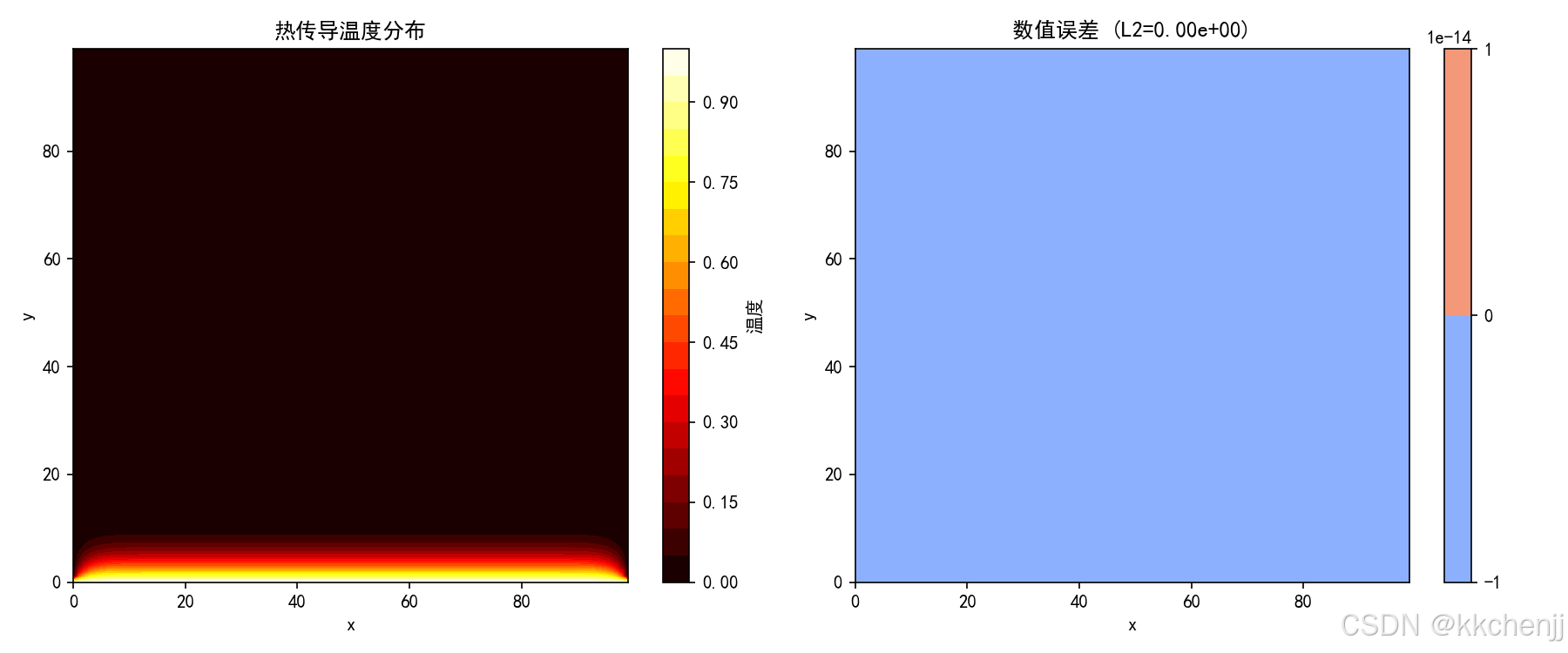
5.2 并行热传导求解器
from mpi4py import MPI
import numpy as np

class ParallelHeatSolver:
    """并行热传导求解器"""

    def __init__(self, nx, ny, dt, alpha, comm):
        """
        初始化

        参数:
            nx, ny: 网格尺寸
            dt: 时间步长
            alpha: 热扩散系数
            comm: MPI通信器
        """
        self.comm = comm
        self.rank = comm.Get_rank()
        self.size = comm.Get_size()

        self.nx = nx
        self.ny = ny
        self.dt = dt
        self.alpha = alpha

        self._decompose_domain()
        self._initialize()

    def _decompose_domain(self):
        """分解计算域"""
        self.ny_local = self.ny // self.size
        self.y_start = self.rank * self.ny_local
        self.y_end = self.y_start + self.ny_local

        # 幽灵单元
        self.has_bottom = self.rank > 0
        self.has_top = self.rank < self.size - 1

        y_start_idx = self.y_start - 1 if self.has_bottom else self.y_start
        y_end_idx = self.y_end + 1 if self.has_top else self.y_end

        self.ny_local_ghost = y_end_idx - y_start_idx
        self.local_slice = slice(y_start_idx, y_end_idx)

    def _initialize(self):
        """初始化场变量"""
        self.dx = 1.0 / (self.nx - 1)
        self.dy = 1.0 / (self.ny - 1)

        # 坐标
        x = np.linspace(0, 1, self.nx)
        y = np.linspace(0, 1, self.ny)[self.local_slice]
        self.X, self.Y = np.meshgrid(x, y)

        # 温度场
        self.T = np.zeros((self.ny_local_ghost, self.nx))

        # 初始条件:高斯分布热源
        if self.rank == 0:
            self.T[0, :] = 1.0  # 上边界高温

    def exchange_boundaries(self):
        """交换边界数据"""
        # 非阻塞通信
        requests = []

        # 发送到上,接收从下
        if self.has_top:
            req = self.comm.Isend(self.T[-2, :], dest=self.rank+1)
            requests.append(req)
        if self.has_bottom:
            req = self.comm.Irecv(self.T[0, :], source=self.rank-1)
            requests.append(req)

        # 发送到下,接收从上
        if self.has_bottom:
            req = self.comm.Isend(self.T[1, :], dest=self.rank-1)
            requests.append(req)
        if self.has_top:
            req = self.comm.Irecv(self.T[-1, :], source=self.rank+1)
            requests.append(req)

        # 等待所有通信完成
        MPI.Request.Waitall(requests)

    def compute_rhs(self):
        """计算右端项"""
        rhs = np.zeros_like(self.T)

        # 内部点
        for i in range(1, self.ny_local_ghost - 1):
            for j in range(1, self.nx - 1):
                rhs[i, j] = (
                    (self.T[i+1, j] - 2*self.T[i, j] + self.T[i-1, j]) / self.dy**2 +
                    (self.T[i, j+1] - 2*self.T[i, j] + self.T[i, j-1]) / self.dx**2
                )

        return rhs

    def time_step(self):
        """时间推进"""
        # 交换边界
        self.exchange_boundaries()

        # 计算右端项
        rhs = self.compute_rhs()

        # 更新温度
        self.T[1:-1, 1:-1] += self.dt * self.alpha * rhs[1:-1, 1:-1]

        # 边界条件
        if self.rank == 0:
            self.T[0, :] = 1.0  # 上边界
        if self.rank == self.size - 1:
            self.T[-1, :] = 0.0  # 下边界
        self.T[:, 0] = self.T[:, 1]  # 绝热边界
        self.T[:, -1] = self.T[:, -2]  # 绝热边界

    def solve(self, n_steps):
        """求解"""
        for step in range(n_steps):
            self.time_step()

            if self.rank == 0 and step % 100 == 0:
                print(f"Time step {step}/{n_steps}")

        return self.T

# 使用示例
if __name__ == '__main__':
    comm = MPI.COMM_WORLD

    solver = ParallelHeatSolver(
        nx=100, ny=100,
        dt=0.0001,
        alpha=0.01,
        comm=comm
    )

    T_final = solver.solve(n_steps=1000)

    if comm.Get_rank() == 0:
        print("Heat conduction simulation completed!")
6. 性能优化与负载均衡
6.1 性能分析
6.1.1 测量并行性能
from mpi4py import MPI
import time
import numpy as np

comm = MPI.COMM_WORLD
rank = comm.Get_rank()

def benchmark_operation(operation, *args, iterations=10):
    """基准测试"""
    # 预热
    for _ in range(3):
        operation(*args)

    # 正式测试
    comm.Barrier()  # 同步所有进程
    start = time.time()

    for _ in range(iterations):
        operation(*args)

    comm.Barrier()
    end = time.time()

    elapsed = end - start

    # 收集所有进程的时间
    all_times = comm.gather(elapsed, root=0)

    if rank == 0:
        avg_time = np.mean(all_times)
        max_time = np.max(all_times)
        min_time = np.min(all_times)
        print(f"Average time: {avg_time:.4f}s")
        print(f"Max time: {max_time:.4f}s")
        print(f"Min time: {min_time:.4f}s")
        print(f"Load imbalance: {(max_time - min_time) / avg_time * 100:.2f}%")

    return elapsed

# 示例操作
def example_computation(data):
    """示例计算"""
    result = np.fft.fft(data)
    return result

# 运行基准测试
if __name__ == '__main__':
    data = np.random.rand(1000000)
    benchmark_operation(example_computation, data, iterations=10)
6.1.2 识别性能瓶颈
from mpi4py import MPI
import time

class PerformanceProfiler:
    """性能分析器"""

    def __init__(self, comm):
        self.comm = comm
        self.rank = comm.Get_rank()
        self.timers = {}
        self.current_timer = None

    def start(self, name):
        """开始计时"""
        self.timers[name] = {'start': time.time(), 'elapsed': 0}
        self.current_timer = name

    def stop(self, name=None):
        """停止计时"""
        if name is None:
            name = self.current_timer

        if name in self.timers:
            self.timers[name]['elapsed'] += time.time() - self.timers[name]['start']

    def report(self):
        """生成报告"""
        # 收集所有进程的数据
        local_data = {name: timer['elapsed'] for name, timer in self.timers.items()}
        all_data = self.comm.gather(local_data, root=0)

        if self.rank == 0:
            print("\n=== Performance Report ===")
            for name in self.timers.keys():
                times = [data[name] for data in all_data]
                avg_time = sum(times) / len(times)
                max_time = max(times)
                min_time = min(times)

                print(f"\n{name}:")
                print(f"  Average: {avg_time:.4f}s")
                print(f"  Max: {max_time:.4f}s")
                print(f"  Min: {min_time:.4f}s")
                print(f"  Imbalance: {(max_time - min_time) / avg_time * 100:.2f}%")

# 使用示例
if __name__ == '__main__':
    comm = MPI.COMM_WORLD
    profiler = PerformanceProfiler(comm)

    # 计算阶段
    profiler.start('computation')
    # ... 计算代码 ...
    time.sleep(0.1)
    profiler.stop('computation')

    # 通信阶段
    profiler.start('communication')
    # ... 通信代码 ...
    comm.Barrier()
    profiler.stop('communication')

    # 生成报告
    profiler.report()
6.2 负载均衡
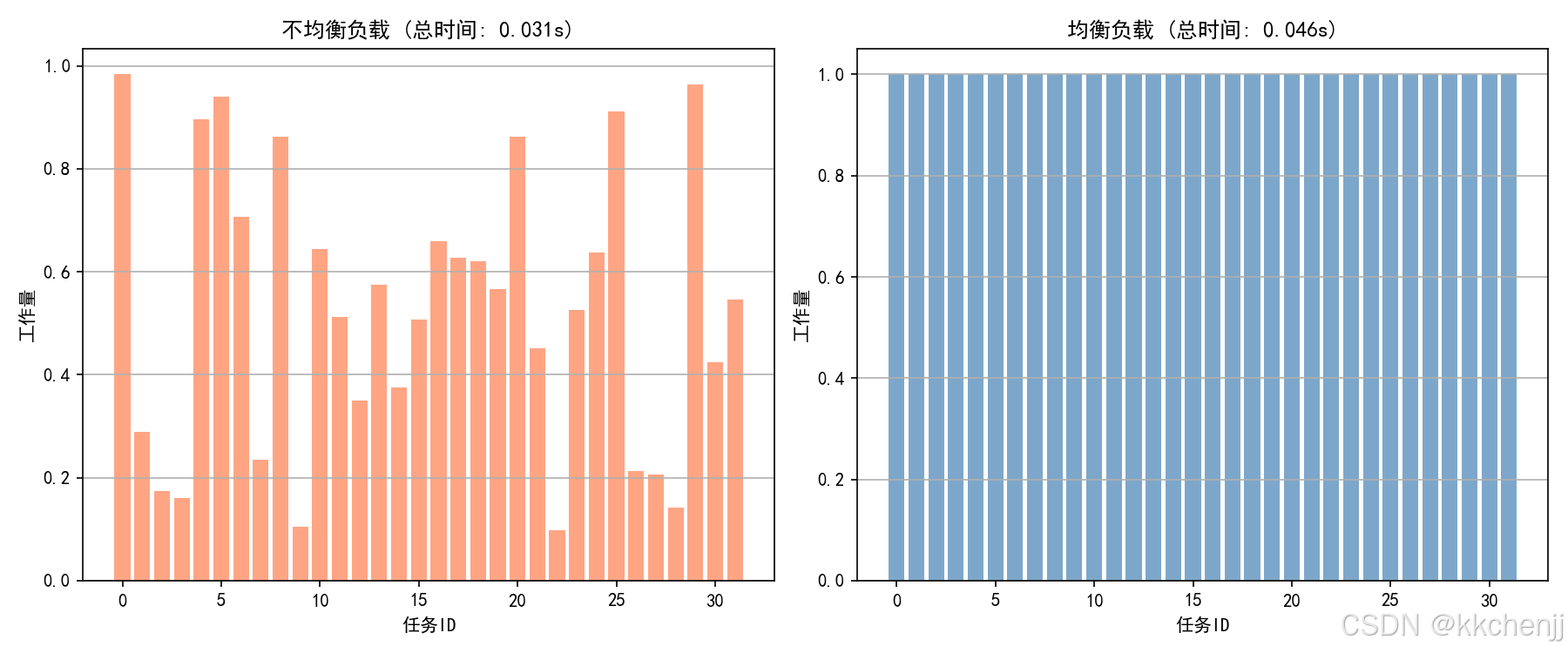
6.2.1 静态负载均衡
from mpi4py import MPI
import numpy as np

def static_load_balancing(workload_sizes, num_processes):
    """
    静态负载均衡

    将不同大小的任务分配给进程,使每个进程的工作量尽可能均衡
    """
    # 按工作量从大到小排序
    sorted_work = sorted(enumerate(workload_sizes), key=lambda x: x[1], reverse=True)

    # 贪心分配
    process_loads = [0] * num_processes
    assignment = [[] for _ in range(num_processes)]

    for task_id, workload in sorted_work:
        # 分配给当前负载最小的进程
        min_proc = np.argmin(process_loads)
        assignment[min_proc].append(task_id)
        process_loads[min_proc] += workload

    return assignment, process_loads

# 示例
if __name__ == '__main__':
    comm = MPI.COMM_WORLD
    rank = comm.Get_rank()
    size = comm.Get_size()

    # 模拟不同大小的任务
    task_sizes = [100, 200, 150, 300, 120, 180, 250, 90, 220, 160]

    if rank == 0:
        assignment, loads = static_load_balancing(task_sizes, size)
        print("Task assignment:")
        for i, tasks in enumerate(assignment):
            print(f"  Process {i}: tasks {tasks}, total load: {loads[i]}")
6.2.2 动态负载均衡
from mpi4py import MPI
import queue
import time
import random

class DynamicLoadBalancer:
    """动态负载均衡器"""

    def __init__(self, comm):
        self.comm = comm
        self.rank = comm.Get_rank()
        self.size = comm.Get_size()

        if self.rank == 0:
            self.task_queue = queue.Queue()
            self.completed_tasks = 0
            self.total_tasks = 0

    def add_tasks(self, tasks):
        """添加任务(仅在根进程调用)"""
        if self.rank == 0:
            for task in tasks:
                self.task_queue.put(task)
            self.total_tasks = len(tasks)

    def worker_loop(self, process_task):
        """
        工作进程主循环

        参数:
            process_task: 处理任务的函数
        """
        if self.rank == 0:
            # 主进程:分配任务
            self._master_loop(process_task)
        else:
            # 工作进程:请求并执行任务
            self._worker_process(process_task)

    def _master_loop(self, process_task):
        """主进程循环"""
        results = []
        active_workers = self.size - 1

        while active_workers > 0 or not self.task_queue.empty():
            # 接收请求
            status = MPI.Status()
            request = self.comm.recv(source=MPI.ANY_SOURCE, tag=MPI.ANY_TAG, status=status)
            source = status.Get_source()

            if request == 'GET_TASK':
                if not self.task_queue.empty():
                    task = self.task_queue.get()
                    self.comm.send(task, dest=source, tag=0)
                else:
                    self.comm.send(None, dest=source, tag=1)  # 无更多任务
                    active_workers -= 1

            elif request[0] == 'RESULT':
                results.append(request[1])
                self.completed_tasks += 1

        # 处理自己的任务
        while not self.task_queue.empty():
            task = self.task_queue.get()
            result = process_task(task)
            results.append(result)
            self.completed_tasks += 1

        return results

    def _worker_process(self, process_task):
        """工作进程"""
        while True:
            # 请求任务
            self.comm.send('GET_TASK', dest=0, tag=0)
            task = self.comm.recv(source=0, tag=MPI.ANY_TAG)

            if task is None:
                break

            # 执行任务
            result = process_task(task)

            # 发送结果
            self.comm.send(('RESULT', result), dest=0, tag=0)

# 使用示例
def example_task_processor(task):
    """示例任务处理器"""
    task_id, workload = task
    time.sleep(workload * 0.001)  # 模拟计算
    return (task_id, workload * 2)

if __name__ == '__main__':
    comm = MPI.COMM_WORLD
    rank = comm.Get_rank()

    balancer = DynamicLoadBalancer(comm)

    if rank == 0:
        # 生成随机任务
        tasks = [(i, random.randint(1, 10)) for i in range(20)]
        balancer.add_tasks(tasks)
        print(f"Added {len(tasks)} tasks")

    # 运行工作循环
    results = balancer.worker_loop(example_task_processor)

    if rank == 0:
        print(f"Completed {len(results)} tasks")
        print(f"Results: {results}")
6.3 通信优化
6.3.1 非阻塞通信
from mpi4py import MPI
import numpy as np

comm = MPI.COMM_WORLD
rank = comm.Get_rank()
size = comm.Get_size()

# 数据
N = 1000000
data = np.random.rand(N)

# 阻塞通信(慢)
def blocking_exchange():
    if rank % 2 == 0:
        if rank + 1 < size:
            comm.send(data, dest=rank+1)
            received = comm.recv(source=rank+1)
    else:
        received = comm.recv(source=rank-1)
        comm.send(data, dest=rank-1)

# 非阻塞通信(快)
def nonblocking_exchange():
    requests = []

    if rank % 2 == 0:
        if rank + 1 < size:
            req_send = comm.Isend(data, dest=rank+1)
            requests.append(req_send)
            received = np.empty(N)
            req_recv = comm.Irecv(received, source=rank+1)
            requests.append(req_recv)
    else:
        received = np.empty(N)
        req_recv = comm.Irecv(received, source=rank-1)
        requests.append(req_recv)
        req_send = comm.Isend(data, dest=rank-1)
        requests.append(req_send)

    # 等待所有通信完成
    MPI.Request.Waitall(requests)

    return received

# 集体通信(最快)
def collective_exchange():
    # 使用Alltoall或Allgather等集体操作
    all_data = comm.allgather(data)
    return all_data
6.3.2 数据打包
from mpi4py import MPI
import numpy as np
import struct

comm = MPI.COMM_WORLD
rank = comm.Get_rank()

# 打包多个小消息为一个大消息
def pack_data(fields):
    """打包数据"""
    # 使用numpy打包
    packed = np.concatenate([f.flatten() for f in fields])
    return packed

def unpack_data(packed, shapes):
    """解包数据"""
    fields = []
    offset = 0
    for shape in shapes:
        size = np.prod(shape)
        field = packed[offset:offset+size].reshape(shape)
        fields.append(field)
        offset += size
    return fields

# 示例:打包多个场变量
if __name__ == '__main__':
    # 创建场变量
    u = np.random.rand(100, 100)
    v = np.random.rand(100, 100)
    p = np.random.rand(100, 100)

    # 打包
    packed = pack_data([u, v, p])

    # 发送打包后的数据
    if rank == 0:
        comm.Send(packed, dest=1)
    elif rank == 1:
        received = np.empty_like(packed)
        comm.Recv(received, source=0)

        # 解包
        u_recv, v_recv, p_recv = unpack_data(received, [(100, 100), (100, 100), (100, 100)])
        print("Data unpacked successfully")
7. 实际应用案例
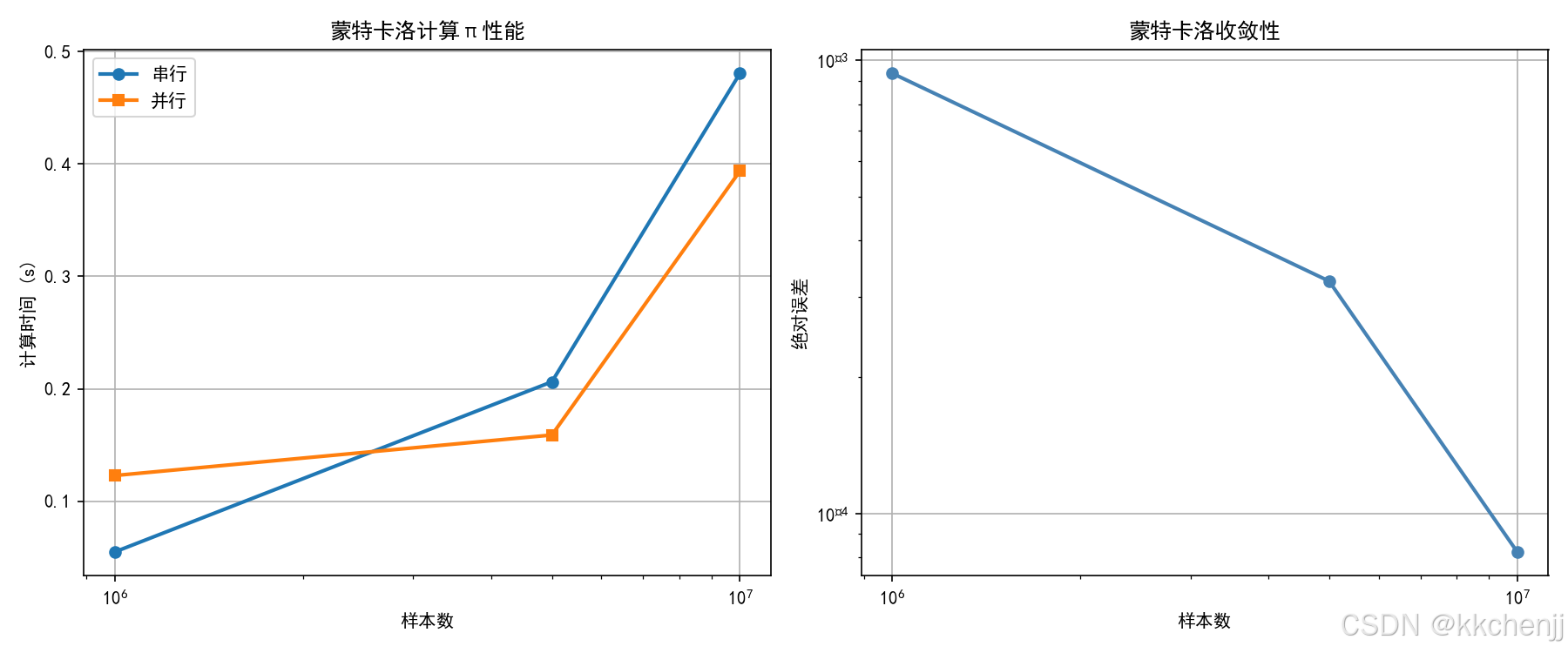
7.1 并行蒙特卡洛模拟
from mpi4py import MPI
import numpy as np

def parallel_monte_carlo_pi(n_samples, comm):
    """
    并行计算π的蒙特卡洛方法

    参数:
        n_samples: 总样本数
        comm: MPI通信器

    返回:
        π的估计值
    """
    rank = comm.Get_rank()
    size = comm.Get_size()

    # 每个进程的样本数
    local_n = n_samples // size

    # 设置随机种子(确保不同进程生成不同随机数)
    np.random.seed(rank)

    # 生成随机点
    x = np.random.rand(local_n)
    y = np.random.rand(local_n)

    # 计算落在圆内的点数
    inside_circle = np.sum(x**2 + y**2 <= 1.0)

    # 归约所有进程的结果
    total_inside = comm.reduce(inside_circle, op=MPI.SUM, root=0)

    if rank == 0:
        pi_estimate = 4.0 * total_inside / n_samples
        return pi_estimate
    else:
        return None

# 使用示例
if __name__ == '__main__':
    comm = MPI.COMM_WORLD
    rank = comm.Get_rank()

    n_samples = 10000000

    # 并行计算
    pi = parallel_monte_carlo_pi(n_samples, comm)

    if rank == 0:
        print(f"π estimate: {pi:.10f}")
        print(f"Error: {abs(np.pi - pi):.10e}")
7.2 并行矩阵分解
from mpi4py import MPI
import numpy as np
from scipy.linalg import lu

def parallel_lu_decomposition(A, comm):
    """
    并行LU分解(简化版本)

    参数:
        A: 输入矩阵(仅在根进程)
        comm: MPI通信器

    返回:
        L, U: 分解结果(仅在根进程)
    """
    rank = comm.Get_rank()
    size = comm.Get_size()

    # 广播矩阵维度
    if rank == 0:
        n = A.shape[0]
    else:
        n = None
    n = comm.bcast(n, root=0)

    # 分发矩阵块
    block_size = n // size

    if rank == 0:
        # 发送矩阵块
        for i in range(1, size):
            start = i * block_size
            end = start + block_size if i < size - 1 else n
            comm.Send(A[:, start:end], dest=i)
        local_A = A[:, 0:block_size]
    else:
        local_A = np.empty((n, block_size))
        comm.Recv(local_A, source=0)

    # 本地LU分解
    # 注意:这是简化版本,实际并行LU更复杂
    P, L_local, U_local = lu(local_A)

    # 收集结果
    if rank == 0:
        L = np.eye(n)
        U = np.zeros((n, n))

        # 接收其他进程的结果
        for i in range(1, size):
            start = i * block_size
            end = start + block_size if i < size - 1 else n
            L_part = np.empty((n, end - start))
            U_part = np.empty((end - start, n))
            comm.Recv(L_part, source=i)
            comm.Recv(U_part, source=i)
            L[:, start:end] = L_part
            U[start:end, :] = U_part

        L[:, 0:block_size] = L_local
        U[0:block_size, :] = U_local

        return L, U
    else:
        # 发送结果
        comm.Send(L_local, dest=0)
        comm.Send(U_local, dest=0)
        return None, None

# 使用示例
if __name__ == '__main__':
    comm = MPI.COMM_WORLD
    rank = comm.Get_rank()

    if rank == 0:
        # 创建测试矩阵
        n = 100
        A = np.random.rand(n, n)
        print(f"Matrix shape: {A.shape}")
    else:
        A = None

    L, U = parallel_lu_decomposition(A, comm)

    if rank == 0:
        # 验证
        reconstructed = L @ U
        error = np.linalg.norm(A - reconstructed)
        print(f"Reconstruction error: {error:.10e}")
7.3 并行图像处理
from mpi4py import MPI
import numpy as np
from PIL import Image
import io

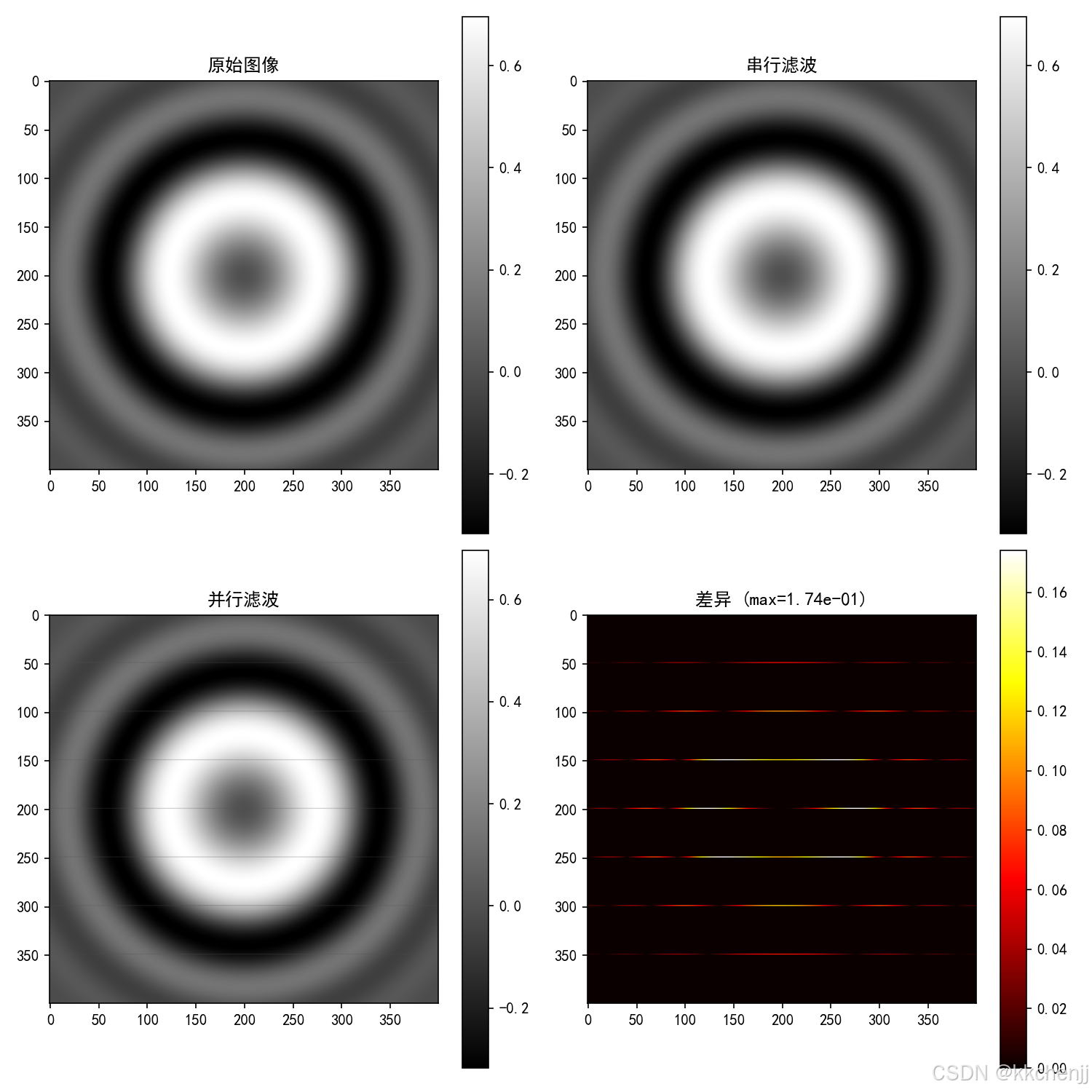
def parallel_image_filter(image_path, filter_kernel, comm):
    """
    并行图像滤波

    参数:
        image_path: 图像路径(仅在根进程)
        filter_kernel: 滤波核
        comm: MPI通信器

    返回:
        滤波后的图像(仅在根进程)
    """
    rank = comm.Get_rank()
    size = comm.Get_size()

    # 根进程读取图像
    if rank == 0:
        img = Image.open(image_path).convert('L')
        img_array = np.array(img)
        height, width = img_array.shape
    else:
        height = width = None
        img_array = None

    # 广播图像尺寸
    height = comm.bcast(height, root=0)
    width = comm.bcast(width, root=0)

    # 计算每行分配给每个进程
    rows_per_proc = height // size
    start_row = rank * rows_per_proc
    end_row = start_row + rows_per_proc if rank < size - 1 else height

    # 添加边界行用于滤波
    if rank > 0:
        start_row_ghost = start_row - 1
    else:
        start_row_ghost = start_row

    if rank < size - 1:
        end_row_ghost = end_row + 1
    else:
        end_row_ghost = end_row

    # 分发图像数据
    if rank == 0:
        # 发送数据
        for i in range(1, size):
            start = i * rows_per_proc
            end = start + rows_per_proc if i < size - 1 else height
            # 发送额外的一行用于边界
            if i > 0:
                start -= 1
            if i < size - 1:
                end += 1
            comm.Send(img_array[start:end, :], dest=i)

        local_img = img_array[start_row_ghost:end_row_ghost, :]
    else:
        num_rows = end_row_ghost - start_row_ghost
        local_img = np.empty((num_rows, width), dtype=np.uint8)
        comm.Recv(local_img, source=0)

    # 应用滤波
    k = filter_kernel.shape[0] // 2
    local_filtered = np.zeros((end_row - start_row, width))

    for i in range(k, local_img.shape[0] - k):
        for j in range(k, width - k):
            local_filtered[i-k, j] = np.sum(
                local_img[i-k:i+k+1, j-k:j+k+1] * filter_kernel
            )

    # 收集结果
    if rank == 0:
        filtered_img = np.zeros((height, width))
        filtered_img[start_row:end_row, :] = local_filtered

        for i in range(1, size):
            start = i * rows_per_proc
            end = start + rows_per_proc if i < size - 1 else height
            num_rows = end - start
            received = np.empty((num_rows, width))
            comm.Recv(received, source=i)
            filtered_img[start:end, :] = received

        return filtered_img
    else:
        comm.Send(local_filtered, dest=0)
        return None

# 使用示例
if __name__ == '__main__':
    comm = MPI.COMM_WORLD
    rank = comm.Get_rank()

    # 高斯滤波核
    gaussian_kernel = np.array([
        [1, 2, 1],
        [2, 4, 2],
        [1, 2, 1]
    ]) / 16.0

    # 注意:实际使用时需要提供图像路径
    # result = parallel_image_filter('image.jpg', gaussian_kernel, comm)

    if rank == 0:
        print("Parallel image filtering example")
8. 高级主题
8.1 混合编程(MPI+OpenMP)
from mpi4py import MPI
import numpy as np

# 注意:这是概念性代码,实际OpenMP需要C/Fortran
# Python中可以使用multiprocessing或numba.prange

def hybrid_parallel_example(comm):
    """
    混合并行示例概念

    MPI用于节点间通信
    OpenMP/多线程用于节点内并行
    """
    rank = comm.Get_rank()
    size = comm.Get_size()

    # MPI并行(节点间)
    global_data = np.random.rand(1000, 1000)

    # 分发数据到各个MPI进程
    local_data = np.empty((1000 // size, 1000))
    comm.Scatter(global_data, local_data, root=0)

    # 在每个MPI进程内部使用多线程(节点内)
    # 这里使用numpy的并行能力
    result_local = np.dot(local_data, local_data.T)

    # 收集结果
    result_global = np.empty((1000, 1000))
    comm.Gather(result_local, result_global, root=0)

    return result_global

# 性能考虑:
# 1. MPI用于粗粒度并行(大任务分解)
# 2. OpenMP用于细粒度并行(循环并行化)
# 3. 避免过度订阅(线程数 × 进程数 ≤ 总核心数)
8.2 GPU加速
# 使用CuPy进行GPU加速
import numpy as np

try:
    import cupy as cp
    GPU_AVAILABLE = True
except ImportError:
    GPU_AVAILABLE = False
    print("CuPy not available, using NumPy")

def gpu_accelerated_computation(data):
    """
    GPU加速计算示例
    """
    if GPU_AVAILABLE:
        # 将数据转移到GPU
        data_gpu = cp.array(data)

        # 在GPU上执行计算
        result_gpu = cp.fft.fft(data_gpu)

        # 将结果转移回CPU
        result = cp.asnumpy(result_gpu)
    else:
        # 使用CPU
        result = np.fft.fft(data)

    return result

# MPI+GPU混合
from mpi4py import MPI

def mpi_gpu_hybrid(comm):
    """MPI+GPU混合计算"""
    rank = comm.Get_rank()
    size = comm.Get_size()

    # 每个MPI进程使用不同的GPU
    if GPU_AVAILABLE:
        import os
        os.environ['CUDA_VISIBLE_DEVICES'] = str(rank % 4)  # 假设有4个GPU

    # 分发任务
    # ... MPI代码 ...

    # 本地GPU计算
    # ... GPU代码 ...

    # 收集结果
    # ... MPI代码 ...
8.3 容错和检查点
from mpi4py import MPI
import numpy as np
import pickle
import os

class CheckpointManager:
    """检查点管理器"""

    def __init__(self, comm, checkpoint_dir='./checkpoints'):
        self.comm = comm
        self.rank = comm.Get_rank()
        self.checkpoint_dir = checkpoint_dir

        if self.rank == 0:
            os.makedirs(checkpoint_dir, exist_ok=True)

    def save_checkpoint(self, state, iteration):
        """保存检查点"""
        checkpoint_file = os.path.join(
            self.checkpoint_dir,
            f'checkpoint_rank{self.rank}_iter{iteration}.pkl'
        )

        with open(checkpoint_file, 'wb') as f:
            pickle.dump(state, f)

        # 同步所有进程
        self.comm.Barrier()

        if self.rank == 0:
            print(f"Checkpoint saved at iteration {iteration}")

    def load_checkpoint(self, iteration):
        """加载检查点"""
        checkpoint_file = os.path.join(
            self.checkpoint_dir,
            f'checkpoint_rank{self.rank}_iter{iteration}.pkl'
        )

        if os.path.exists(checkpoint_file):
            with open(checkpoint_file, 'rb') as f:
                state = pickle.load(f)
            return state
        else:
            return None

    def check_recovery(self):
        """检查是否需要从检查点恢复"""
        # 查找最新的检查点
        checkpoints = []
        for f in os.listdir(self.checkpoint_dir):
            if f.startswith(f'checkpoint_rank{self.rank}_'):
                iter_num = int(f.split('iter')[1].split('.')[0])
                checkpoints.append(iter_num)

        if checkpoints:
            return max(checkpoints)
        else:
            return None

# 使用示例
def fault_tolerant_simulation(comm, max_iterations):
    """容错仿真"""
    rank = comm.Get_rank()
    checkpoint_mgr = CheckpointManager(comm)

    # 检查是否需要恢复
    restart_iter = checkpoint_mgr.check_recovery()

    if restart_iter is not None:
        # 从检查点恢复
        state = checkpoint_mgr.load_checkpoint(restart_iter)
        iteration = restart_iter
        print(f"Rank {rank}: Resuming from iteration {iteration}")
    else:
        # 初始化
        state = {'data': np.zeros(100), 'counter': 0}
        iteration = 0

    # 主循环
    while iteration < max_iterations:
        try:
            # 执行计算
            state['data'] += np.random.rand(100)
            state['counter'] += 1

            # 定期保存检查点
            if iteration % 100 == 0:
                checkpoint_mgr.save_checkpoint(state, iteration)

            iteration += 1

        except Exception as e:
            print(f"Rank {rank}: Error at iteration {iteration}: {e}")
            # 保存检查点并退出
            checkpoint_mgr.save_checkpoint(state, iteration)
            raise

    return state
9. 性能评估与最佳实践
9.1 性能评估方法
from mpi4py import MPI
import time
import numpy as np
import matplotlib.pyplot as plt

class ParallelPerformanceAnalyzer:
    """并行性能分析器"""

    def __init__(self, comm):
        self.comm = comm
        self.rank = comm.Get_rank()
        self.results = {}

    def measure_scalability(self, problem_sizes, processor_counts, solver_func):
        """
        测量可扩展性

        参数:
            problem_sizes: 问题规模列表
            processor_counts: 处理器数量列表
            solver_func: 求解函数
        """
        for size in problem_sizes:
            self.results[size] = {'processors': [], 'times': [], 'speedups': []}

            # 串行基准
            if self.rank == 0:
                start = time.time()
                solver_func(size, 1)
                serial_time = time.time() - start
            else:
                serial_time = None
            serial_time = self.comm.bcast(serial_time, root=0)

            # 并行测试
            for n_procs in processor_counts:
                self.comm.Barrier()
                start = time.time()
                solver_func(size, n_procs)
                self.comm.Barrier()
                elapsed = time.time() - start

                self.results[size]['processors'].append(n_procs)
                self.results[size]['times'].append(elapsed)
                self.results[size]['speedups'].append(serial_time / elapsed)

    def plot_results(self):
        """绘制性能图表"""
        if self.rank == 0:
            fig, axes = plt.subplots(1, 2, figsize=(12, 5))

            for size, data in self.results.items():
                axes[0].plot(data['processors'], data['times'], 'o-', label=f'Size {size}')
                axes[1].plot(data['processors'], data['speedups'], 'o-', label=f'Size {size}')

            axes[0].set_xlabel('Number of Processors')
            axes[0].set_ylabel('Time (s)')
            axes[0].set_title('Execution Time')
            axes[0].legend()
            axes[0].grid(True)

            axes[1].set_xlabel('Number of Processors')
            axes[1].set_ylabel('Speedup')
            axes[1].set_title('Speedup')
            axes[1].legend()
            axes[1].grid(True)

            plt.tight_layout()
            plt.savefig('scalability_analysis.png', dpi=150)
            plt.close()

# 使用示例
def example_solver(n, n_procs):
    """示例求解器"""
    A = np.random.rand(n, n)
    b = np.random.rand(n)
    # 模拟计算
    for _ in range(10):
        x = np.linalg.solve(A, b)

if __name__ == '__main__':
    comm = MPI.COMM_WORLD
    analyzer = ParallelPerformanceAnalyzer(comm)

    problem_sizes = [100, 200, 400]
    processor_counts = [1, 2, 4, 8]

    analyzer.measure_scalability(problem_sizes, processor_counts, example_solver)
    analyzer.plot_results()
9.2 最佳实践
9.2.1 设计原则
1. 最小化通信:
- 减少通信频率
- 合并小消息
- 使用非阻塞通信
2. 最大化计算/通信比:
- 每个进程有足够的工作量
- 重叠计算和通信
- 避免频繁同步
3. 负载均衡:
- 均匀分配工作量
- 考虑异构系统
- 动态负载均衡
4. 可扩展性:
- 设计可扩展的算法
- 避免全局操作
- 分层并行
9.2.2 调试技巧
from mpi4py import MPI
import sys

class MPIDebugger:
    """MPI调试器"""

    def __init__(self, comm):
        self.comm = comm
        self.rank = comm.Get_rank()
        self.size = comm.Get_size()
        self.debug_mode = True

    def log(self, message, level='INFO'):
        """记录日志"""
        if self.debug_mode:
            print(f"[Rank {self.rank}/{self.size}] [{level}] {message}")
            sys.stdout.flush()

    def barrier_log(self, message):
        """屏障日志"""
        self.comm.Barrier()
        if self.rank == 0:
            print(f"[BARRIER] {message}")
        self.comm.Barrier()

    def check_consistency(self, local_value, name="value"):
        """检查一致性"""
        all_values = self.comm.gather(local_value, root=0)
        if self.rank == 0:
            if len(set(all_values)) > 1:
                print(f"[WARNING] Inconsistent {name}: {all_values}")
                return False
        return True

    def debug_array(self, arr, name="array"):
        """调试数组"""
        self.log(f"{name} shape: {arr.shape}, min: {arr.min():.6e}, max: {arr.max():.6e}")

# 使用示例
if __name__ == '__main__':
    comm = MPI.COMM_WORLD
    debugger = MPIDebugger(comm)

    debugger.log("Starting computation")

    # 计算
    local_data = comm.Get_rank() * 10
    debugger.log(f"Local data: {local_data}")

    # 检查一致性
    debugger.check_consistency(local_data, "local_data")

    debugger.barrier_log("Phase 1 complete")
9.2.3 性能优化清单
通信优化:
- 使用非阻塞通信(Isend/Irecv)
- 合并小消息
- 使用集体通信代替点对点
- 减少同步点
- 使用持久化通信
计算优化:
- 向量化计算(NumPy)
- 使用优化的库(MKL, OpenBLAS)
- 缓存优化
- 避免分支
内存优化:
- 减少内存分配
- 使用内存池
- 避免数据拷贝
- 对齐内存访问
负载均衡:
- 均匀分解问题
- 动态负载均衡
- 考虑异构性
10. 总结与展望
10.1 核心要点回顾
并行计算基础:
- 理解并行架构(共享内存vs分布式内存)
- 掌握并行性能指标(加速比、效率、可扩展性)
- 熟悉并行编程模型(MPI、OpenMP、CUDA)
MPI编程:
- 点对点通信(send/recv)
- 集合通信(broadcast、scatter、gather、reduce)
- 非阻塞通信(Isend/Irecv)
- 区域分解方法
Python并行:
- multiprocessing模块
- mpi4py库
- 性能优化技巧
实际应用:
- 并行CFD求解器
- 并行蒙特卡洛模拟
- 并行图像处理
10.2 发展趋势
异构计算:
- CPU+GPU混合架构
- FPGA加速
- 专用AI芯片
云计算与边缘计算:
- 弹性扩展
- 无服务器计算
- 边缘AI
新编程模型:
- 任务并行(Task-based)
- 数据流编程
- 自动并行化
量子计算:
- 量子并行性
- 量子-经典混合
- 量子优势
10.3 学习资源
书籍:
- 《并行程序设计导论》(An Introduction to Parallel Programming)
- 《MPI: The Complete Reference》
- 《CUDA by Example》
在线资源:
- MPI Forum: www.mpi-forum.org
- OpenMPI: www.open-mpi.org
- mpi4py documentation
课程:
- MIT 6.172 Performance Engineering
- Berkeley CS267 Applications of Parallel Computers
- Stanford CS149 Parallel Computing
参考文献
-
Gropp, W., Lusk, E., & Skjellum, A. (1999). Using MPI: Portable Parallel Programming with the Message-Passing Interface. MIT Press.
-
Pacheco, P. (2011). An Introduction to Parallel Programming. Morgan Kaufmann.
-
Kirk, D. B., & Hwu, W. W. (2016). Programming Massively Parallel Processors: A Hands-on Approach. Morgan Kaufmann.
-
Heroux, M. A., et al. (2005). An Overview of Trilinos. Sandia National Laboratories.
-
Balay, S., et al. (2019). PETSc Users Manual. Argonne National Laboratory.
-
Dalcin, L., Paz, R., & Storti, M. (2005). MPI for Python. Journal of Parallel and Distributed Computing.
-
Saad, Y. (2003). Iterative Methods for Sparse Linear Systems. SIAM.
-
Smith, B., Bjorstad, P., & Gropp, W. (1996). Domain Decomposition: Parallel Multilevel Methods for Elliptic Partial Differential Equations. Cambridge University Press.
附录:Python并行计算代码库
"""
并行计算工具库
包含常用的并行计算模式和工具函数
"""

from mpi4py import MPI
import numpy as np
import time

class ParallelUtils:
    """并行计算工具类"""

    @staticmethod
    def parallel_sum(data, comm):
        """并行求和"""
        local_sum = np.sum(data)
        global_sum = comm.allreduce(local_sum, op=MPI.SUM)
        return global_sum

    @staticmethod
    def parallel_dot(a, b, comm):
        """并行点积"""
        local_dot = np.dot(a, b)
        global_dot = comm.allreduce(local_dot, op=MPI.SUM)
        return global_dot

    @staticmethod
    def parallel_norm(x, comm):
        """并行范数"""
        local_norm_sq = np.dot(x, x)
        global_norm_sq = comm.allreduce(local_norm_sq, op=MPI.SUM)
        return np.sqrt(global_norm_sq)

    @staticmethod
    def parallel_matvec(A_local, x, comm):
        """并行矩阵向量乘法"""
        # 假设A_local是本地矩阵块,x是全局向量
        local_y = A_local @ x
        return local_y

    @staticmethod
    def time_operation(operation, comm, *args, **kwargs):
        """计时操作"""
        comm.Barrier()
        start = time.time()
        result = operation(*args, **kwargs)
        comm.Barrier()
        elapsed = time.time() - start
        return result, elapsed

# 导出常用函数
__all__ = ['ParallelUtils']

AtomGit 是由开放原子开源基金会联合 CSDN 等生态伙伴共同推出的新一代开源与人工智能协作平台。平台坚持“开放、中立、公益”的理念,把代码托管、模型共享、数据集托管、智能体开发体验和算力服务整合在一起,为开发者提供从开发、训练到部署的一站式体验。
更多推荐

 2
2 0
0- 0



 已为社区贡献264条内容

所有评论(0)