Chapter 002. 线性回归
·
这个数据集可以帮助你估算客户可以卖多少钱![![[Pasted image 20260419135933.png]]](https://i-blog.csdnimg.cn/direct/70ca95da25e947769072a3a7d2d22148.png)
房子尺寸为1250平方英尺
从这个数据集中建立一个线性回归模型![![[Pasted image 20260419140416.png]]](https://i-blog.csdnimg.cn/direct/b1915153c95f4c77af45eb78319119a6.png)
Data has “Right Answers”
Regression model -> Predicts numbers![![[Pasted image 20260419150723.png]]](https://i-blog.csdnimg.cn/direct/a3e5b96d52b74bd9b1ed6df36c102297.png)
-
问题场景:用房屋面积(单位:平方英尺)预测房价(单位:千美元)
-
模型输出:连续的数值结果(如面积 1250 平方英尺时,预测房价约为 220K 美元)
-
关键特点:
- 预测目标是数值(Numbers)
- 存在无限多可能的输出值
- 模型通过拟合趋势线(线性回归),建立输入特征与连续输出的映射关系
监督学习的共性
回归与分类都属于监督学习,其核心定义为:
数据中自带 “正确答案”(标签),模型通过学习输入与标签的对应关系,实现预测。
分类模型
聚焦于预测离散类别的任务,图中给出两类典型场景:
-
二分类示例:区分 “猫” 和 “狗”,仅存在 2 种可能的输出结果
-
多分类示例:疾病诊断,可输出 10 种不同的疾病类别
-
关键特点:
- 预测目标是类别 / 标签(Categories)
- 输出为有限个固定的离散值
| 对比维度 | 回归模型 | 分类模型 |
|---|---|---|
| 预测目标 | 连续数值(如房价、销量、温度) | 离散类别(如物种、疾病类型、用户等级) |
| 输出空间 | 无限多可能的结果 | 有限个固定的结果 |
| 典型场景 | 房价预测、销量预测、股票价格预测 | 图像识别、垃圾邮件过滤、疾病诊断 |
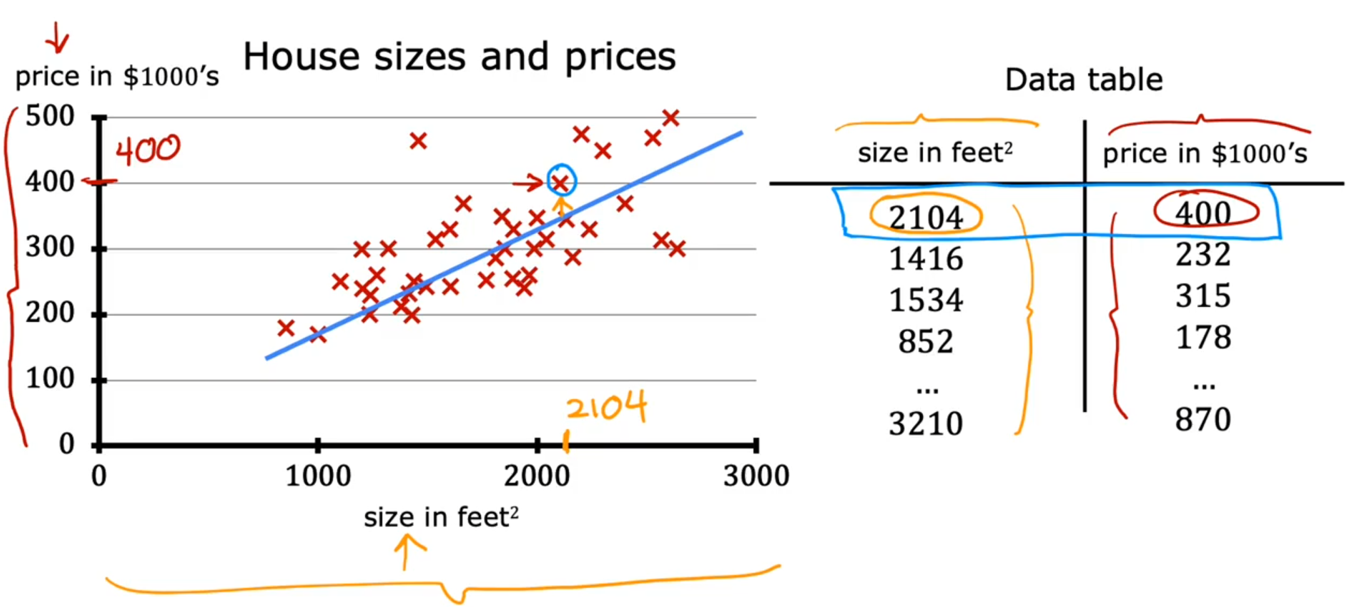
数据表格和可视化散点图
术语表
-
Training set(训练集):Data used to the model
![![[Pasted image 20260419143632.png|437]]](https://i-blog.csdnimg.cn/direct/ce1eb3d36b814cd2b75c23e59d0d7842.png)
-
Notation
- x = “input” variable & feature
- y = “output” variable & “target” variable
- m = number of training examples
- (x , y) = single training example
- (x(i)x^{(i)}x(i) , y(i)y^{(i)}y(i)) = i(th)i^{(th)}i(th) training example
Process Of How Supervised Learning Works![![[Pasted image 20260419153432.png|272]]](https://i-blog.csdnimg.cn/direct/5313ce99e1d34615b7bc23076830f2a8.png)
fw,b(x(i))=wx(i)+bf_{w,b}(x^{(i)}) = wx^{(i)}+bfw,b(x(i))=wx(i)+b
这个公式就是一条直线方程,它的作用是:
- 用 w 控制直线的斜率(面积对房价的影响程度)
- 用 b 控制直线的上下平移(调整整体预测的基准)
- 最终目标是找到合适的 w 和 b,让这条直线尽可能贴近所有训练数据点,从而实现对新数据的预测。
![![[Pasted image 20260419161110.png|284]]](https://i-blog.csdnimg.cn/direct/7e7974e2a0cb4d0eb0fadbea7ef7b644.png)
单变量线性回归(一元线性回归)
import numpy as np
import matplotlib.pyplot as plt
plt.style.use('./deeplearning.mplstyle')

# x_train is the input variable (size in 1000 square feet)
# y_train is the target (price in 1000s of dollars)
x_train = np.array([1.0, 2.0])
y_train = np.array([300.0, 500.0])
print(f"x_train = {x_train}")
print(f"y_train = {y_train}")

# m is the number of training examples
print(f"x_train.shape: {x_train.shape}")
m = x_train.shape[0]
print(f"Number of training examples is: {m}")

# m is the number of training examples
m = len(x_train)
print(f"Number of training examples is: {m}")

i = 0 # Change this to 1 to see (x^1, y^1)
x_i = x_train[i]
y_i = y_train[i]
print(f"(x^({i}), y^({i})) = ({x_i}, {y_i})")

# Plot the data points
plt.scatter(x_train, y_train, marker='x', c='r')
# Set the title
plt.title("Housing Prices")
# Set the y-axis label
plt.ylabel('Price (in 1000s of dollars)')
# Set the x-axis label
plt.xlabel('Size (1000 sqft)')
plt.show()

w = 100
b = 100
print(f"w: {w}")
print(f"b: {b}")

def compute_model_output(x, w, b):
    """
    Computes the prediction of a linear model
    Args:
      x (ndarray (m,)): Data, m examples
      w,b (scalar)    : model parameters
    Returns
      y (ndarray (m,)): target values
    """
    m = x.shape[0]
    f_wb = np.zeros(m)
    for i in range(m):
        f_wb[i] = w * x[i] + b
    return f_wb

tmp_f_wb = compute_model_output(x_train, w, b)

# Plot our model prediction
plt.plot(x_train, tmp_f_wb, c='b', label='Our Prediction')

# Plot the data points
plt.scatter(x_train, y_train, marker='x', c='r', label='Actual Values')

# Set the title
plt.title("Housing Prices")
# Set the y-axis label
plt.ylabel('Price (in 1000s of dollars)')
# Set the x-axis label
plt.xlabel('Size (1000 sqft)')
plt.legend()
plt.show()

# Prediction for a house with 1200 sqft
w = 200
b = 100
x_i = 1.2
cost_1200sqft = w * x_i + b

print(f"${cost_1200sqft:.0f} thousand dollars")

AtomGit 是由开放原子开源基金会联合 CSDN 等生态伙伴共同推出的新一代开源与人工智能协作平台。平台坚持“开放、中立、公益”的理念,把代码托管、模型共享、数据集托管、智能体开发体验和算力服务整合在一起,为开发者提供从开发、训练到部署的一站式体验。
更多推荐

 10
10 0
0- 0


 已为社区贡献2条内容

所有评论(0)