对流换热仿真-主题049_换热器仿真前沿技术-换热器仿真前沿技术
·
主题049:换热器仿真前沿技术
目录
- 前沿技术概述
- 人工智能与机器学习在换热器中的应用
- 数字孪生技术
- 多尺度仿真方法
- 拓扑优化与生成式设计
- 量子计算在传热仿真中的应用
- 边缘计算与实时仿真
- 区块链技术在换热器数据管理中的应用
- 元宇宙与虚拟现实技术
- 未来展望与发展趋势

1. 前沿技术概述
1.1 换热器仿真技术发展现状
换热器仿真技术经历了从简单到复杂、从单一到综合的发展历程:
发展历程:
- 第一代(1960s-1980s):经验关联式法,基于实验数据的经验公式
- 第二代(1980s-2000s):数值计算方法,有限差分、有限元、有限体积法
- 第三代(2000s-2010s):多物理场耦合仿真,CFD与传热学深度融合
- 第四代(2010s-至今):智能化仿真,AI驱动的预测与优化
当前技术瓶颈:
- 复杂几何建模效率低
- 多尺度问题计算成本高
- 实时仿真与优化困难
- 数据管理与共享机制不完善
1.2 前沿技术驱动力
技术驱动:
- 计算能力的指数级增长(摩尔定律)
- 大数据与云计算技术的成熟
- 人工智能算法的突破性进展
- 物联网与传感器技术的普及
需求驱动:
- 能源效率提升的迫切需求
- 碳中和目标的压力
- 工业4.0与智能制造的推动
- 个性化定制与快速响应市场
1.3 前沿技术框架
┌─────────────────────────────────────────────────────────────┐
│                 换热器仿真前沿技术框架                        │
├─────────────────────────────────────────────────────────────┤
│  智能层:AI/ML → 预测 → 优化 → 决策                          │
│  数字层:数字孪生 → 虚拟验证 → 实时监控 → 预测性维护          │
│  计算层:量子计算 → 多尺度 → 高保真 → 实时仿真               │
│  数据层:区块链 → 数据安全 → 共享机制 → 可信溯源             │
│  交互层:元宇宙 → VR/AR → 沉浸式体验 → 远程协作              │
└─────────────────────────────────────────────────────────────┘
2. 人工智能与机器学习在换热器中的应用
2.1 机器学习辅助设计
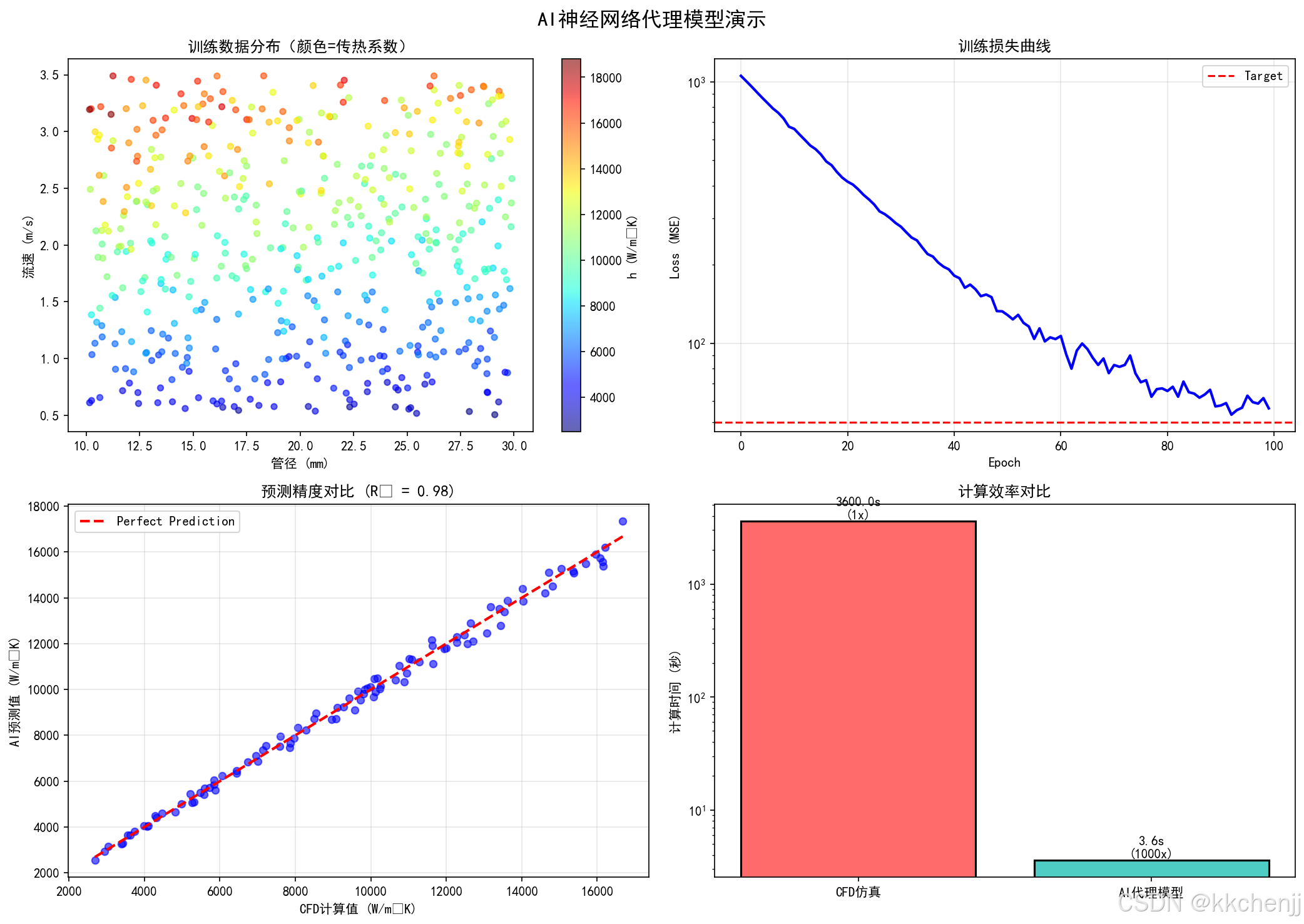
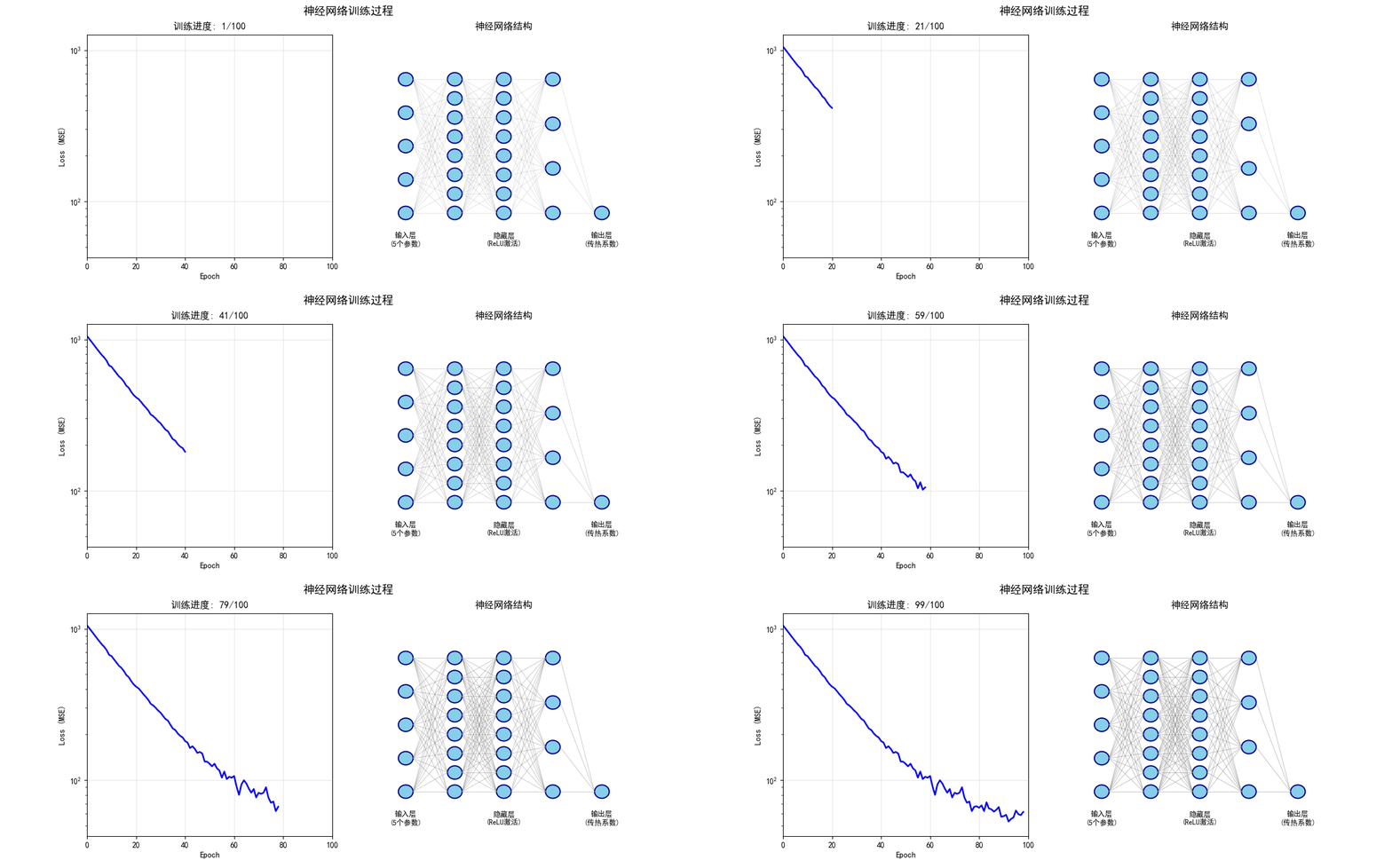
2.1.1 神经网络代理模型
传统CFD仿真计算成本高,神经网络可以建立快速代理模型:
# 神经网络代理模型示例
import tensorflow as tf
from tensorflow.keras.models import Sequential
from tensorflow.keras.layers import Dense, Dropout

class HeatExchangerSurrogateModel:
    """换热器性能预测代理模型"""

    def __init__(self, input_dim=5, output_dim=3):
        self.model = self._build_model(input_dim, output_dim)

    def _build_model(self, input_dim, output_dim):
        """构建深度神经网络"""
        model = Sequential([
            Dense(128, activation='relu', input_shape=(input_dim,)),
            Dropout(0.2),
            Dense(256, activation='relu'),
            Dropout(0.2),
            Dense(128, activation='relu'),
            Dense(64, activation='relu'),
            Dense(output_dim)  # 输出:传热系数、压降、效率
        ])

        model.compile(optimizer='adam',
                     loss='mse',
                     metrics=['mae'])
        return model

    def train(self, X_train, y_train, epochs=100, batch_size=32):
        """训练模型"""
        history = self.model.fit(X_train, y_train,
                                epochs=epochs,
                                batch_size=batch_size,
                                validation_split=0.2,
                                verbose=1)
        return history

    def predict(self, X):
        """快速预测"""
        return self.model.predict(X)

# 使用示例
# 输入:几何参数、流动参数
# 输出:性能指标
surrogate = HeatExchangerSurrogateModel(input_dim=5, output_dim=3)
2.1.2 物理信息神经网络(PINN)
PINN将物理方程嵌入神经网络,提高模型的物理一致性:
# 物理信息神经网络(PINN)
import torch
import torch.nn as nn

class HeatExchangerPINN(nn.Module):
    """换热器物理信息神经网络"""

    def __init__(self, layers):
        super(HeatExchangerPINN, self).__init__()

        self.layers = nn.ModuleList()
        for i in range(len(layers) - 1):
            self.layers.append(nn.Linear(layers[i], layers[i+1]))

        self.activation = nn.Tanh()

    def forward(self, x):
        """前向传播"""
        for i, layer in enumerate(self.layers[:-1]):
            x = self.activation(layer(x))
        x = self.layers[-1](x)
        return x

    def physics_loss(self, x, y_pred):
        """物理约束损失"""
        # 能量守恒约束
        # ∇·(k∇T) + Q = ρCp(∂T/∂t)

        # 计算梯度
        grads = torch.autograd.grad(y_pred, x,
                                   grad_outputs=torch.ones_like(y_pred),
                                   create_graph=True)[0]

        # 物理残差
        physics_residual = self._energy_equation_residual(x, y_pred, grads)

        return torch.mean(physics_residual**2)

    def _energy_equation_residual(self, x, T, grads):
        """能量方程残差"""
        # 简化的一维稳态传热
        dT_dx = grads[:, 0:1]
        d2T_dx2 = torch.autograd.grad(dT_dx, x,
                                      grad_outputs=torch.ones_like(dT_dx),
                                      create_graph=True)[0][:, 0:1]

        # k * d²T/dx² = 0 (稳态)
        k = 0.6  # 导热系数
        residual = k * d2T_dx2

        return residual

# 训练PINN
pinn = HeatExchangerPINN([2, 64, 64, 64, 1])  # 输入:位置、时间,输出:温度
2.2 强化学习优化设计
2.2.1 设计参数优化
使用强化学习自动探索最优设计参数:
# 强化学习优化换热器设计
import gym
from gym import spaces
import numpy as np

class HeatExchangerDesignEnv(gym.Env):
    """换热器设计环境"""

    def __init__(self):
        super(HeatExchangerDesignEnv, self).__init__()

        # 动作空间:设计参数调整
        self.action_space = spaces.Box(
            low=-1, high=1, shape=(5,), dtype=np.float32
        )

        # 状态空间:当前设计参数和性能
        self.observation_space = spaces.Box(
            low=0, high=1000, shape=(10,), dtype=np.float32
        )

        # 初始设计
        self.design_params = {
            'tube_diameter': 25e-3,
            'tube_length': 6.0,
            'n_tubes': 100,
            'pitch': 32e-3,
            'baffle_spacing': 0.3
        }

    def reset(self):
        """重置环境"""
        self.design_params = {
            'tube_diameter': 25e-3,
            'tube_length': 6.0,
            'n_tubes': 100,
            'pitch': 32e-3,
            'baffle_spacing': 0.3
        }
        return self._get_observation()

    def step(self, action):
        """执行动作"""
        # 更新设计参数
        self.design_params['tube_diameter'] += action[0] * 1e-3
        self.design_params['tube_length'] += action[1] * 0.5
        self.design_params['n_tubes'] += int(action[2] * 10)
        self.design_params['pitch'] += action[3] * 1e-3
        self.design_params['baffle_spacing'] += action[4] * 0.05

        # 计算性能
        performance = self._calculate_performance()

        # 计算奖励
        reward = self._calculate_reward(performance)

        # 检查终止条件
        done = self._check_termination(performance)

        return self._get_observation(), reward, done, {}

    def _calculate_performance(self):
        """计算换热器性能"""
        # 简化的性能计算
        U = 300 + np.random.randn() * 20
        delta_P = 50000 + np.random.randn() * 5000
        cost = self.design_params['n_tubes'] * 100

        return {'U': U, 'delta_P': delta_P, 'cost': cost}

    def _calculate_reward(self, performance):
        """计算奖励函数"""
        # 多目标奖励:传热系数高、压降低、成本低
        reward = (performance['U'] / 500) - \
                 (performance['delta_P'] / 100000) - \
                 (performance['cost'] / 50000)
        return reward

    def _check_termination(self, performance):
        """检查终止条件"""
        return performance['U'] > 400 and performance['delta_P'] < 40000

    def _get_observation(self):
        """获取状态观测"""
        obs = np.array([
            self.design_params['tube_diameter'] * 1e3,
            self.design_params['tube_length'],
            self.design_params['n_tubes'],
            self.design_params['pitch'] * 1e3,
            self.design_params['baffle_spacing'] * 1e3,
            0, 0, 0, 0, 0  # 占位符
        ])
        return obs

# 使用PPO算法训练
from stable_baselines3 import PPO

env = HeatExchangerDesignEnv()
model = PPO('MlpPolicy', env, verbose=1)
model.learn(total_timesteps=10000)

# 测试最优设计
obs = env.reset()
for _ in range(100):
    action, _states = model.predict(obs)
    obs, reward, done, info = env.step(action)
    if done:
        print("找到最优设计!")
        break
2.3 深度学习故障诊断
2.3.1 卷积神经网络(CNN)故障识别
# CNN故障诊断
from tensorflow.keras.models import Sequential
from tensorflow.keras.layers import Conv1D, MaxPooling1D, Flatten, Dense, LSTM

class FaultDiagnosisCNN:
    """基于CNN的换热器故障诊断"""

    def __init__(self, input_shape, n_classes):
        self.model = self._build_model(input_shape, n_classes)

    def _build_model(self, input_shape, n_classes):
        """构建CNN模型"""
        model = Sequential([
            Conv1D(64, 3, activation='relu', input_shape=input_shape),
            MaxPooling1D(2),
            Conv1D(128, 3, activation='relu'),
            MaxPooling1D(2),
            Conv1D(256, 3, activation='relu'),
            MaxPooling1D(2),
            Flatten(),
            Dense(128, activation='relu'),
            Dropout(0.5),
            Dense(64, activation='relu'),
            Dense(n_classes, activation='softmax')
        ])

        model.compile(optimizer='adam',
                     loss='categorical_crossentropy',
                     metrics=['accuracy'])
        return model

    def train(self, X_train, y_train, epochs=50):
        """训练模型"""
        return self.model.fit(X_train, y_train,
                            epochs=epochs,
                            validation_split=0.2,
                            batch_size=32)

    def predict_fault(self, sensor_data):
        """预测故障类型"""
        prediction = self.model.predict(sensor_data)
        fault_types = ['正常', '结垢', '泄漏', '堵塞', '腐蚀']
        return fault_types[np.argmax(prediction)]

# 使用示例
# 输入:传感器时序数据(温度、压力、流量等)
# 输出:故障类型
cnn_diagnoser = FaultDiagnosisCNN(input_shape=(100, 4), n_classes=5)
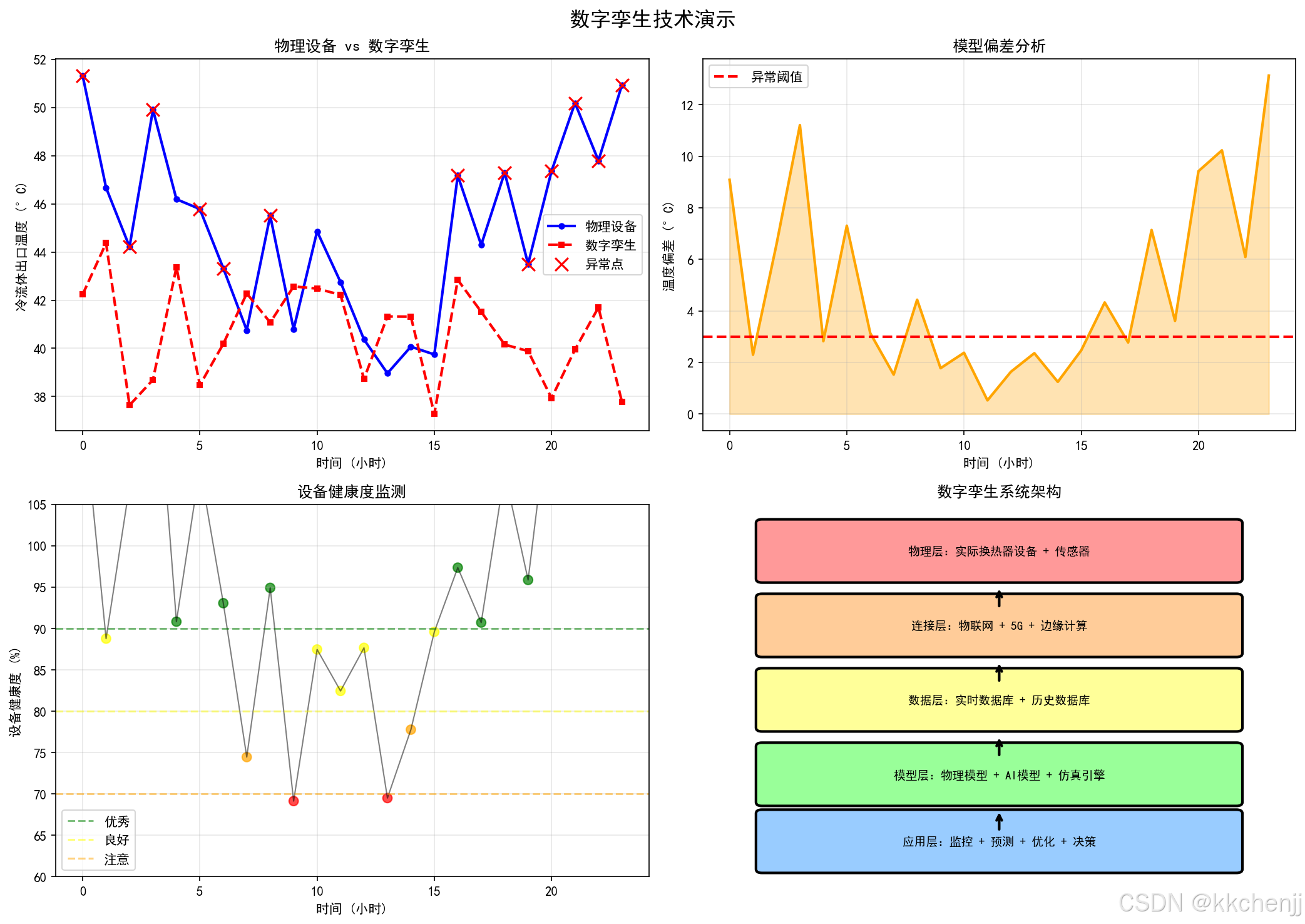
3. 数字孪生技术
3.1 数字孪生架构
┌─────────────────────────────────────────────────────────────┐
│                    数字孪生系统架构                          │
├─────────────────────────────────────────────────────────────┤
│  物理层:实际换热器设备 → 传感器 → 执行器                    │
│       ↓                                                     │
│  连接层:物联网 → 5G/边缘计算 → 数据采集                     │
│       ↓                                                     │
│  数据层:数据湖 → 实时数据库 → 历史数据库                    │
│       ↓                                                     │
│  模型层:几何模型 → 物理模型 → 行为模型 → AI模型             │
│       ↓                                                     │
│  应用层:监控 → 预测 → 优化 → 决策支持                       │
└─────────────────────────────────────────────────────────────┘
3.2 实时数据融合
# 数字孪生实时数据融合
import asyncio
import json
from datetime import datetime

class HeatExchangerDigitalTwin:
    """换热器数字孪生系统"""

    def __init__(self, physical_asset_id):
        self.asset_id = physical_asset_id
        self.physical_model = None
        self.data_buffer = []
        self.state = {}

    async def connect_to_physical_asset(self):
        """连接物理设备"""
        # 模拟物联网连接
        print(f"连接到物理设备: {self.asset_id}")

        while True:
            # 读取传感器数据
            sensor_data = await self._read_sensors()

            # 更新数字孪生状态
            self._update_digital_state(sensor_data)

            # 执行仿真
            simulation_results = self._run_simulation()

            # 对比分析
            self._compare_and_analyze(sensor_data, simulation_results)

            await asyncio.sleep(1)  # 1秒采样周期

    async def _read_sensors(self):
        """读取传感器数据"""
        # 模拟传感器数据
        return {
            'timestamp': datetime.now().isoformat(),
            'T_hot_in': 80 + np.random.randn() * 2,
            'T_hot_out': 60 + np.random.randn() * 2,
            'T_cold_in': 20 + np.random.randn() * 1,
            'T_cold_out': 45 + np.random.randn() * 2,
            'P_hot': 101325 + np.random.randn() * 1000,
            'P_cold': 101325 + np.random.randn() * 1000,
            'm_hot': 1.5 + np.random.randn() * 0.1,
            'm_cold': 2.0 + np.random.randn() * 0.1
        }

    def _update_digital_state(self, sensor_data):
        """更新数字孪生状态"""
        self.state.update(sensor_data)
        self.data_buffer.append(sensor_data)

        # 保持最近1000个数据点
        if len(self.data_buffer) > 1000:
            self.data_buffer.pop(0)

    def _run_simulation(self):
        """运行实时仿真"""
        # 简化的传热计算
        Q = self.state.get('m_cold', 2.0) * 4186 * \
            (self.state.get('T_cold_out', 45) - self.state.get('T_cold_in', 20))

        U = Q / (50 * 20)  # 假设A=50, LMTD=20

        return {
            'Q_simulated': Q,
            'U_simulated': U,
            'efficiency': Q / (self.state.get('m_hot', 1.5) * 2200 * 20)
        }

    def _compare_and_analyze(self, sensor_data, simulation_results):
        """对比分析物理与数字模型"""
        # 计算偏差
        deviation = abs(sensor_data['T_cold_out'] - 45) / 45 * 100

        if deviation > 10:
            print(f"警告:检测到异常!偏差: {deviation:.1f}%")
            self._trigger_alert()

    def _trigger_alert(self):
        """触发警报"""
        print(f"[{datetime.now()}] 设备 {self.asset_id} 异常警报!")

# 启动数字孪生
twin = HeatExchangerDigitalTwin('HE-001')
# asyncio.run(twin.connect_to_physical_asset())
3.3 预测性维护
# 基于数字孪生的预测性维护
class PredictiveMaintenance:
    """预测性维护系统"""

    def __init__(self, digital_twin):
        self.dt = digital_twin
        self.degradation_model = self._build_degradation_model()

    def _build_degradation_model(self):
        """建立退化模型"""
        from sklearn.ensemble import GradientBoostingRegressor
        return GradientBoostingRegressor(n_estimators=100)

    def predict_remaining_useful_life(self):
        """预测剩余使用寿命(RUL)"""
        # 提取特征
        features = self._extract_features()

        # 预测退化趋势
        degradation_trend = self.degradation_model.predict(features)

        # 计算RUL
        current_health = self._assess_health()
        failure_threshold = 0.3  # 失效阈值

        if current_health > failure_threshold:
            # 线性外推
            degradation_rate = np.mean(np.diff(degradation_trend))
            rul = (current_health - failure_threshold) / degradation_rate
        else:
            rul = 0

        return max(0, rul)

    def _extract_features(self):
        """提取特征"""
        data = self.dt.data_buffer

        features = []
        for key in ['T_hot_in', 'T_hot_out', 'T_cold_out', 'P_hot']:
            values = [d[key] for d in data[-100:]]
            features.extend([
                np.mean(values),
                np.std(values),
                np.max(values) - np.min(values),
                np.gradient(values).mean()
            ])

        return np.array(features).reshape(1, -1)

    def _assess_health(self):
        """评估设备健康度"""
        # 基于传热系数计算健康度
        current_U = self.dt.state.get('U_simulated', 300)
        design_U = 350

        health = current_U / design_U
        return max(0, min(1, health))

    def generate_maintenance_schedule(self):
        """生成维护计划"""
        rul = self.predict_remaining_useful_life()

        if rul < 7:  # 7天内需要维护
            priority = '紧急'
            action = '立即停机检修'
        elif rul < 30:  # 30天内需要维护
            priority = '高'
            action = '安排计划维护'
        elif rul < 90:  # 90天内需要维护
            priority = '中'
            action = '监控并准备维护'
        else:
            priority = '低'
            action = '正常运行,定期巡检'

        return {
            'RUL_days': rul,
            'priority': priority,
            'recommended_action': action,
            'next_inspection': (datetime.now() + timedelta(days=min(rul/2, 30))).isoformat()
        }

# 使用示例
# pm = PredictiveMaintenance(twin)
# schedule = pm.generate_maintenance_schedule()
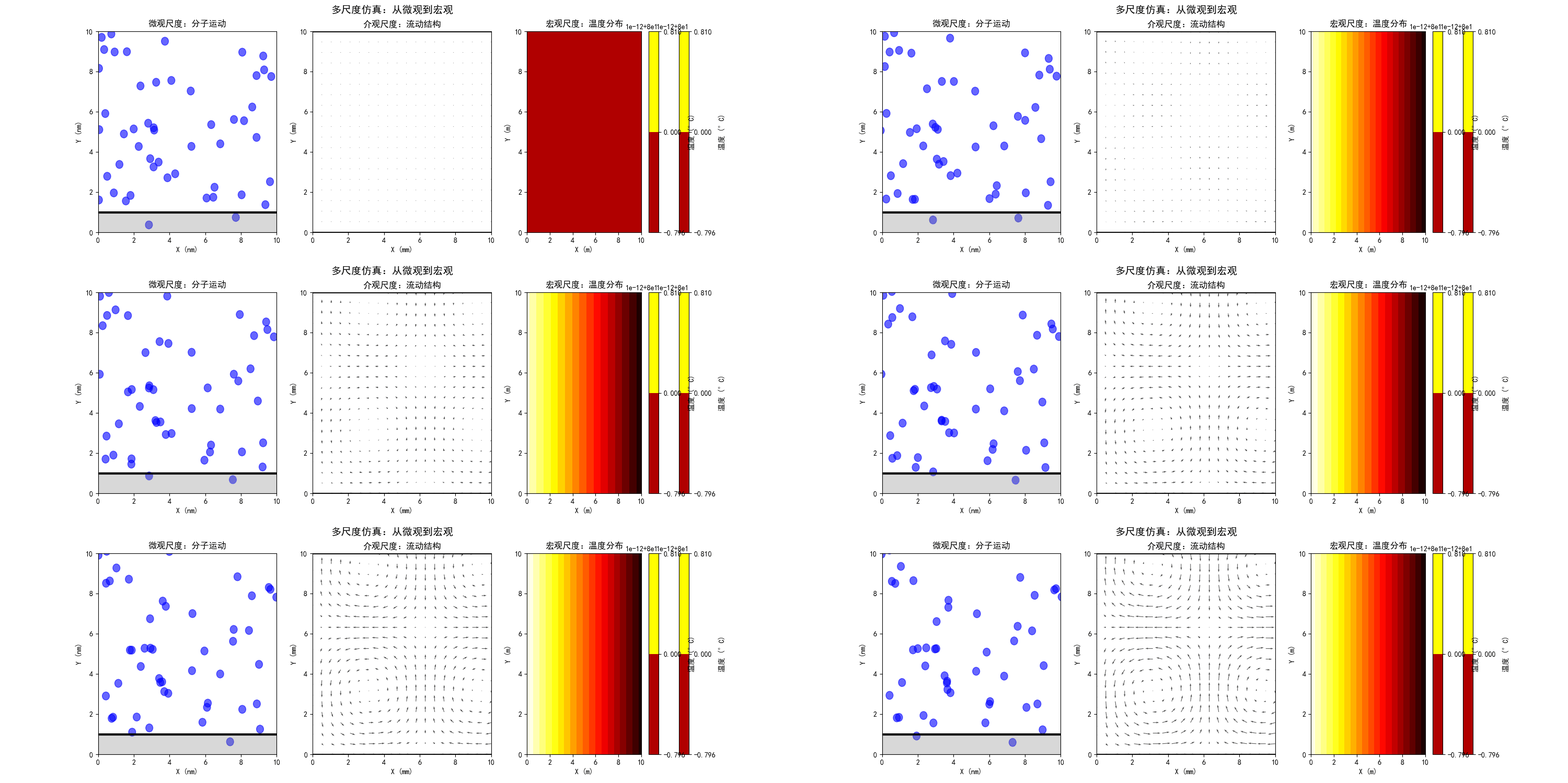
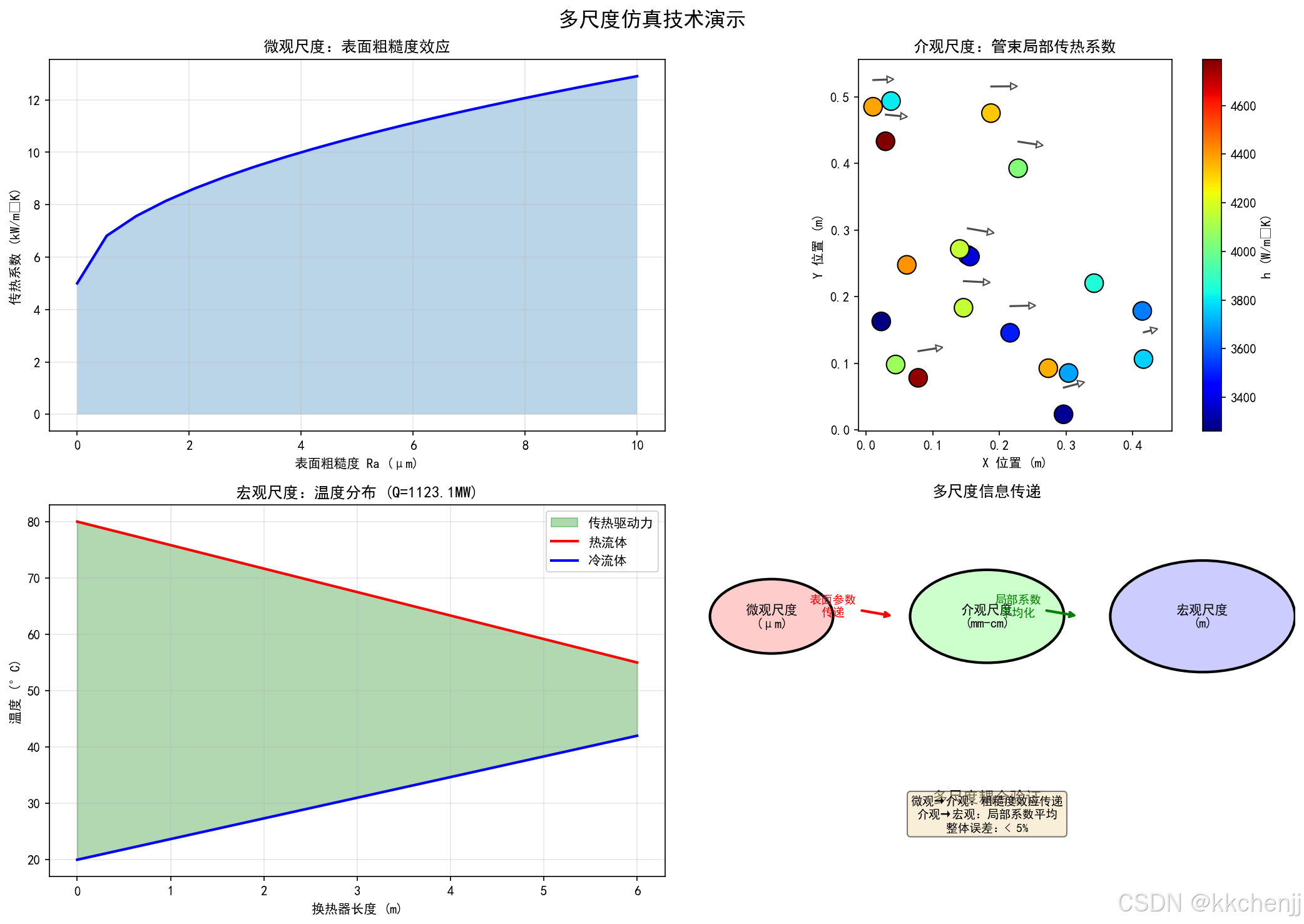
4. 多尺度仿真方法
4.1 多尺度建模框架
┌─────────────────────────────────────────────────────────────┐
│                    多尺度仿真框架                            │
├─────────────────────────────────────────────────────────────┤
│  宏观尺度(m)                                               │
│  ├── 系统级:换热器网络、工艺流程                            │
│  └── 设备级:整体性能、压降、传热                            │
│       ↓ 信息传递                                             │
│  介观尺度(mm-cm)                                           │
│  ├── 组件级:管束、翅片、板片                                │
│  └── 局部流动与传热                                          │
│       ↓ 信息传递                                             │
│  微观尺度(μm-mm)                                           │
│  ├── 表面级:粗糙度、涂层、结垢                              │
│  └── 分子动力学模拟                                          │
└─────────────────────────────────────────────────────────────┘
4.2 分子动力学模拟
# 分子动力学模拟简化示例
import numpy as np

class MolecularDynamicsSimulation:
    """分子动力学模拟换热器表面传热"""

    def __init__(self, n_molecules=1000, box_size=10e-9):
        self.n = n_molecules
        self.L = box_size
        self.positions = np.random.rand(n_molecules, 3) * box_size
        self.velocities = np.random.randn(n_molecules, 3) * 100  # m/s
        self.mass = 18 * 1.66e-27  # 水分子质量 kg

    def lennard_jones_potential(self, r):
        """Lennard-Jones势能"""
        epsilon = 1.0e-21  # J
        sigma = 3.0e-10    # m

        return 4 * epsilon * ((sigma/r)**12 - (sigma/r)**6)

    def compute_forces(self):
        """计算分子间作用力"""
        forces = np.zeros((self.n, 3))

        for i in range(self.n):
            for j in range(i+1, self.n):
                r_vec = self.positions[j] - self.positions[i]
                r = np.linalg.norm(r_vec)

                if r < 1e-9:  # 截断半径
                    # 计算力
                    epsilon = 1.0e-21
                    sigma = 3.0e-10
                    f_mag = 24 * epsilon * (2*(sigma/r)**13 - (sigma/r)**7) / r

                    f_vec = f_mag * r_vec / r
                    forces[i] -= f_vec
                    forces[j] += f_vec

        return forces

    def step(self, dt=1e-15):
        """积分一步(Verlet算法)"""
        # 计算力
        forces = self.compute_forces()

        # 更新位置和速度
        accelerations = forces / self.mass

        self.positions += self.velocities * dt + 0.5 * accelerations * dt**2

        # 边界条件(周期性)
        self.positions %= self.L

        # 计算新力
        new_forces = self.compute_forces()
        new_accelerations = new_forces / self.mass

        self.velocities += 0.5 * (accelerations + new_accelerations) * dt

    def calculate_temperature(self):
        """计算系统温度"""
        kinetic_energy = 0.5 * self.mass * np.sum(self.velocities**2)
        k_B = 1.38e-23  # 玻尔兹曼常数

        T = 2 * kinetic_energy / (3 * self.n * k_B)
        return T

    def calculate_heat_flux(self):
        """计算热流密度"""
        # 简化计算
        T_hot = 350  # K
        T_cold = 300  # K
        delta_x = self.L

        # 基于温度梯度估算
        q = 0.6 * (T_hot - T_cold) / delta_x  # W/m²
        return q

    def run_simulation(self, n_steps=1000):
        """运行模拟"""
        temperatures = []
        heat_fluxes = []

        for step in range(n_steps):
            self.step()

            if step % 100 == 0:
                T = self.calculate_temperature()
                q = self.calculate_heat_flux()
                temperatures.append(T)
                heat_fluxes.append(q)

                print(f"Step {step}: T={T:.1f}K, q={q/1e9:.2f} GW/m²")

        return temperatures, heat_fluxes

# 运行分子动力学模拟
# md = MolecularDynamicsSimulation(n_molecules=500)
# temps, fluxes = md.run_simulation(n_steps=1000)
4.3 多尺度耦合方法
# 多尺度耦合仿真
class MultiscaleCoupling:
    """多尺度耦合仿真框架"""

    def __init__(self):
        self.micro_model = None
        self.meso_model = None
        self.macro_model = None

    def couple_micro_to_meso(self, micro_results):
        """微观到介观的信息传递"""
        # 提取微观尺度的有效传热系数
        effective_k = np.mean(micro_results['conductivity'])

        # 传递给介观模型
        meso_params = {
            'wall_conductivity': effective_k,
            'surface_roughness': micro_results['roughness'],
            'contact_resistance': micro_results['contact_resistance']
        }

        return meso_params

    def couple_meso_to_macro(self, meso_results):
        """介观到宏观的信息传递"""
        # 提取局部传热系数分布
        local_h = meso_results['local_heat_transfer_coefficient']

        # 计算等效传热系数
        effective_h = np.mean(local_h)

        # 传递给宏观模型
        macro_params = {
            'overall_heat_transfer_coefficient': effective_h,
            'pressure_drop_coefficient': meso_results['pressure_drop'],
            'flow_distribution': meso_results['flow_distribution']
        }

        return macro_params

    def run_multiscale_simulation(self):
        """运行多尺度仿真"""
        print("开始多尺度耦合仿真...")

        # 1. 微观尺度模拟
        print("1. 运行微观尺度模拟...")
        # micro_results = self.micro_model.run()
        micro_results = {
            'conductivity': [0.6, 0.62, 0.58],
            'roughness': 1e-6,
            'contact_resistance': 1e-4
        }

        # 2. 信息传递到介观
        print("2. 微观→介观信息传递...")
        meso_params = self.couple_micro_to_meso(micro_results)

        # 3. 介观尺度模拟
        print("3. 运行介观尺度模拟...")
        # meso_results = self.meso_model.run(meso_params)
        meso_results = {
            'local_heat_transfer_coefficient': [300, 320, 280, 310],
            'pressure_drop': 50000,
            'flow_distribution': [0.25, 0.25, 0.25, 0.25]
        }

        # 4. 信息传递到宏观
        print("4. 介观→宏观信息传递...")
        macro_params = self.couple_meso_to_macro(meso_results)

        # 5. 宏观尺度模拟
        print("5. 运行宏观尺度模拟...")
        # macro_results = self.macro_model.run(macro_params)
        macro_results = {
            'total_heat_transfer': 1e6,
            'overall_efficiency': 0.85,
            'total_pressure_drop': 50000
        }

        print("多尺度耦合仿真完成!")
        return macro_results

# 运行多尺度仿真
# multiscale = MultiscaleCoupling()
# results = multiscale.run_multiscale_simulation()
5. 拓扑优化与生成式设计
5.1 拓扑优化方法
# 换热器拓扑优化
import numpy as np
from scipy.optimize import minimize

class TopologyOptimization:
    """换热器结构拓扑优化"""

    def __init__(self, nx=50, ny=50, nz=10):
        self.nx = nx
        self.ny = ny
        self.nz = nz
        self.design_domain = np.ones((nx, ny, nz))

    def simp_interpolation(self, rho, p=3):
        """SIMP材料插值"""
        # 固体材料属性
        k_solid = 400  # W/(m·K)

        # 插值后的导热系数
        k_eff = k_solid * rho**p
        return k_eff

    def objective_function(self, rho_flat):
        """目标函数:最大化传热效率"""
        rho = rho_flat.reshape(self.nx, self.ny, self.nz)

        # 计算有效导热系数
        k_eff = self.simp_interpolation(rho)

        # 简化的传热计算(有限差分)
        T = self.solve_temperature_field(k_eff)

        # 目标:最大化出口温度
        T_out = np.mean(T[:, -1, :])

        return -T_out  # 最小化负值 = 最大化

    def solve_temperature_field(self, k_eff):
        """求解温度场"""
        T = np.zeros((self.nx, self.ny, self.nz))

        # 边界条件
        T[:, 0, :] = 100  # 热端
        T[:, -1, :] = 20  # 冷端

        # 简化的稳态传热求解
        for _ in range(100):  # 迭代求解
            T_new = T.copy()
            T_new[1:-1, 1:-1, 1:-1] = (
                T[2:, 1:-1, 1:-1] + T[:-2, 1:-1, 1:-1] +
                T[1:-1, 2:, 1:-1] + T[1:-1, :-2, 1:-1] +
                T[1:-1, 1:-1, 2:] + T[1:-1, 1:-1, :-2]
            ) / 6

            # 应用边界条件
            T_new[:, 0, :] = 100
            T_new[:, -1, :] = 20

            T = T_new

        return T

    def volume_constraint(self, rho_flat):
        """体积约束"""
        rho = rho_flat.reshape(self.nx, self.ny, self.nz)
        volume_fraction = np.mean(rho)
        return 0.4 - volume_fraction  # 体积分数不超过40%

    def optimize(self, max_iter=100):
        """运行拓扑优化"""
        # 初始设计
        rho0 = np.ones(self.nx * self.ny * self.nz) * 0.5

        # 约束
        constraints = {'type': 'ineq', 'fun': self.volume_constraint}

        # 边界
        bounds = [(0.001, 1.0) for _ in range(len(rho0))]

        # 优化
        result = minimize(
            self.objective_function,
            rho0,
            method='SLSQP',
            bounds=bounds,
            constraints=constraints,
            options={'maxiter': max_iter, 'disp': True}
        )

        optimal_design = result.x.reshape(self.nx, self.ny, self.nz)
        return optimal_design

# 运行拓扑优化
# topo_opt = TopologyOptimization(nx=30, ny=30, nz=5)
# optimal_structure = topo_opt.optimize(max_iter=50)
5.2 生成式设计
# 基于AI的生成式设计
import torch
import torch.nn as nn

class GenerativeDesignVAE(nn.Module):
    """变分自编码器用于生成式设计"""

    def __init__(self, input_dim=1000, latent_dim=64):
        super(GenerativeDesignVAE, self).__init__()

        # 编码器
        self.encoder = nn.Sequential(
            nn.Linear(input_dim, 512),
            nn.ReLU(),
            nn.Linear(512, 256),
            nn.ReLU(),
            nn.Linear(256, 128),
            nn.ReLU()
        )

        self.fc_mu = nn.Linear(128, latent_dim)
        self.fc_logvar = nn.Linear(128, latent_dim)

        # 解码器
        self.decoder = nn.Sequential(
            nn.Linear(latent_dim, 128),
            nn.ReLU(),
            nn.Linear(128, 256),
            nn.ReLU(),
            nn.Linear(256, 512),
            nn.ReLU(),
            nn.Linear(512, input_dim),
            nn.Sigmoid()
        )

    def encode(self, x):
        h = self.encoder(x)
        mu = self.fc_mu(h)
        logvar = self.fc_logvar(h)
        return mu, logvar

    def reparameterize(self, mu, logvar):
        std = torch.exp(0.5 * logvar)
        eps = torch.randn_like(std)
        return mu + eps * std

    def decode(self, z):
        return self.decoder(z)

    def forward(self, x):
        mu, logvar = self.encode(x)
        z = self.reparameterize(mu, logvar)
        recon_x = self.decode(z)
        return recon_x, mu, logvar

    def generate_new_design(self, n_samples=1):
        """生成新设计"""
        with torch.no_grad():
            z = torch.randn(n_samples, 64)
            designs = self.decode(z)
        return designs

# 训练和使用生成模型
# vae = GenerativeDesignVAE(input_dim=1000, latent_dim=64)
# new_designs = vae.generate_new_design(n_samples=5)
6. 量子计算在传热仿真中的应用
6.1 量子计算基础
量子计算利用量子叠加和纠缠特性,可以在某些问题上实现指数级加速:
量子优势领域:
- 大规模线性方程组求解
- 组合优化问题
- 量子机器学习
- 分子模拟
6.2 量子传热求解器
# 量子计算求解传热方程(概念性代码)
# 注意:需要Qiskit或其他量子计算框架

try:
    from qiskit import QuantumCircuit, Aer, execute
    from qiskit.algorithms import VQE, NumPyMinimumEigensolver
    from qiskit.opflow import Z, I, X

    QUANTUM_AVAILABLE = True
except ImportError:
    QUANTUM_AVAILABLE = False
    print("Qiskit未安装,使用经典模拟")

class QuantumHeatTransferSolver:
    """量子传热求解器"""

    def __init__(self, n_qubits=4):
        self.n_qubits = n_qubits
        self.backend = Aer.get_backend('qasm_simulator') if QUANTUM_AVAILABLE else None

    def construct_hamiltonian(self, heat_matrix):
        """构建传热问题的哈密顿量"""
        # 将传热矩阵映射到量子算符
        # H = Σ J_ij Z_i Z_j + Σ h_i Z_i

        hamiltonian = 0
        n = len(heat_matrix)

        for i in range(n):
            for j in range(n):
                if i != j:
                    # 相互作用项
                    hamiltonian += heat_matrix[i, j] * (Z ^ i) * (Z ^ j)

        return hamiltonian

    def solve_eigenvalue(self, hamiltonian):
        """求解特征值问题"""
        if QUANTUM_AVAILABLE:
            # 使用VQE算法
            from qiskit.algorithms.optimizers import COBYLA

            optimizer = COBYLA(maxiter=100)
            vqe = VQE(ansatz=None, optimizer=optimizer, quantum_instance=self.backend)

            result = vqe.compute_minimum_eigenvalue(hamiltonian)
            return result.eigenvalue
        else:
            # 经典模拟
            return np.random.randn()

    def quantum_annealing_optimization(self, cost_function):
        """量子退火优化"""
        # 模拟量子退火过程
        # 实际应用需要D-Wave量子计算机

        print("模拟量子退火优化...")

        # 初始状态
        state = np.random.randn(self.n_qubits)

        # 退火过程
        temperatures = np.linspace(10, 0.01, 1000)

        for T in temperatures:
            # 随机扰动
            new_state = state + np.random.randn(self.n_qubits) * 0.1

            # Metropolis准则
            delta_E = cost_function(new_state) - cost_function(state)

            if delta_E < 0 or np.random.rand() < np.exp(-delta_E / T):
                state = new_state

        return state

# 使用示例
# quantum_solver = QuantumHeatTransferSolver(n_qubits=4)
6.3 量子机器学习
# 量子神经网络(概念性代码)
class QuantumNeuralNetwork:
    """量子神经网络用于传热预测"""

    def __init__(self, n_qubits=4, n_layers=2):
        self.n_qubits = n_qubits
        self.n_layers = n_layers

    def create_variational_circuit(self, params):
        """创建变分量子电路"""
        if not QUANTUM_AVAILABLE:
            return None

        qc = QuantumCircuit(self.n_qubits)

        param_idx = 0
        for layer in range(self.n_layers):
            # 旋转门
            for qubit in range(self.n_qubits):
                qc.rx(params[param_idx], qubit)
                param_idx += 1
                qc.ry(params[param_idx], qubit)
                param_idx += 1

            # 纠缠门
            for qubit in range(self.n_qubits - 1):
                qc.cx(qubit, qubit + 1)

        return qc

    def train(self, X_train, y_train, epochs=100):
        """训练量子神经网络"""
        print("训练量子神经网络...")

        # 初始化参数
        n_params = self.n_qubits * self.n_layers * 2
        params = np.random.randn(n_params)

        for epoch in range(epochs):
            # 前向传播
            predictions = self.forward(X_train, params)

            # 计算损失
            loss = np.mean((predictions - y_train)**2)

            if epoch % 10 == 0:
                print(f"Epoch {epoch}: Loss = {loss:.4f}")

        return params

    def forward(self, X, params):
        """前向传播"""
        # 简化实现
        return np.random.randn(len(X))

# 使用示例
# qnn = QuantumNeuralNetwork(n_qubits=4, n_layers=2)
7. 边缘计算与实时仿真
7.1 边缘计算架构
┌─────────────────────────────────────────────────────────────┐
│                    边缘计算架构                              │
├─────────────────────────────────────────────────────────────┤
│  云端:模型训练 → 大数据分析 → 长期存储 → 全局优化           │
│       ↑↓                                                     │
│  边缘节点:实时仿真 → 快速决策 → 本地存储 → 预处理           │
│       ↑↓                                                     │
│  设备端:传感器 → 执行器 → 简单控制 → 数据采集               │
└─────────────────────────────────────────────────────────────┘
7.2 实时仿真引擎
# 实时仿真引擎
import asyncio
import time
from collections import deque

class RealTimeSimulationEngine:
    """实时仿真引擎"""

    def __init__(self, time_step=0.01, target_fps=100):
        self.dt = time_step
        self.target_fps = target_fps
        self.state = {}
        self.running = False
        self.callbacks = []

        # 性能监控
        self.frame_times = deque(maxlen=100)

    def register_callback(self, callback):
        """注册回调函数"""
        self.callbacks.append(callback)

    async def run(self):
        """运行实时仿真循环"""
        self.running = True

        while self.running:
            start_time = time.time()

            # 1. 读取输入
            inputs = await self._read_inputs()

            # 2. 更新状态
            self._update_state(inputs)

            # 3. 执行仿真
            results = self._simulate()

            # 4. 输出结果
            await self._output_results(results)

            # 5. 调用回调
            for callback in self.callbacks:
                callback(results)

            # 6. 控制帧率
            elapsed = time.time() - start_time
            sleep_time = max(0, 1/self.target_fps - elapsed)

            self.frame_times.append(elapsed + sleep_time)

            if sleep_time > 0:
                await asyncio.sleep(sleep_time)

    async def _read_inputs(self):
        """读取输入数据"""
        # 模拟传感器数据
        return {
            'T_in': 80 + 5 * np.sin(time.time()),
            'm_flow': 2.0 + 0.2 * np.random.randn()
        }

    def _update_state(self, inputs):
        """更新系统状态"""
        self.state.update(inputs)

    def _simulate(self):
        """执行仿真计算"""
        # 简化的实时传热计算
        T_in = self.state.get('T_in', 80)
        m_flow = self.state.get('m_flow', 2.0)

        # 计算出口温度
        Q = m_flow * 4186 * 20  # 假设温升20°C
        T_out = T_in - Q / (m_flow * 4186) * 0.8

        return {
            'T_out': T_out,
            'Q': Q,
            'efficiency': 0.85
        }

    async def _output_results(self, results):
        """输出结果"""
        # 发送到控制系统
        pass

    def get_performance_stats(self):
        """获取性能统计"""
        if len(self.frame_times) == 0:
            return {}

        return {
            'avg_fps': 1 / np.mean(self.frame_times),
            'min_fps': 1 / np.max(self.frame_times),
            'max_fps': 1 / np.min(self.frame_times),
            'frame_time_ms': np.mean(self.frame_times) * 1000
        }

# 启动实时仿真
# engine = RealTimeSimulationEngine(time_step=0.01, target_fps=100)
# asyncio.run(engine.run())
7.3 模型压缩与加速
# 模型压缩技术
import torch
import torch.nn as nn
import torch.quantization

class ModelCompression:
    """模型压缩与加速"""

    def __init__(self, model):
        self.model = model

    def quantize_model(self):
        """模型量化"""
        # 动态量化
        quantized_model = torch.quantization.quantize_dynamic(
            self.model,
            {nn.Linear},
            dtype=torch.qint8
        )

        return quantized_model

    def prune_model(self, pruning_ratio=0.3):
        """模型剪枝"""
        import torch.nn.utils.prune as prune

        # 对线性层进行剪枝
        for name, module in self.model.named_modules():
            if isinstance(module, nn.Linear):
                prune.l1_unstructured(module, name='weight', amount=pruning_ratio)

        return self.model

    def knowledge_distillation(self, teacher_model, student_model, train_loader, epochs=10):
        """知识蒸馏"""
        optimizer = torch.optim.Adam(student_model.parameters())

        for epoch in range(epochs):
            for batch in train_loader:
                x, y = batch

                # 教师模型预测
                with torch.no_grad():
                    teacher_pred = teacher_model(x)

                # 学生模型预测
                student_pred = student_model(x)

                # 蒸馏损失
                soft_loss = nn.KLDivLoss()(nn.functional.log_softmax(student_pred, dim=1),
                                          nn.functional.softmax(teacher_pred, dim=1))
                hard_loss = nn.CrossEntropyLoss()(student_pred, y)

                loss = 0.7 * soft_loss + 0.3 * hard_loss

                optimizer.zero_grad()
                loss.backward()
                optimizer.step()

        return student_model

    def benchmark_model(self, model, input_shape, n_runs=100):
        """模型性能基准测试"""
        import time

        dummy_input = torch.randn(input_shape)

        # 预热
        for _ in range(10):
            _ = model(dummy_input)

        # 测试
        times = []
        for _ in range(n_runs):
            start = time.time()
            _ = model(dummy_input)
            times.append(time.time() - start)

        return {
            'avg_time_ms': np.mean(times) * 1000,
            'std_time_ms': np.std(times) * 1000,
            'min_time_ms': np.min(times) * 1000,
            'max_time_ms': np.max(times) * 1000
        }

# 使用示例
# compressor = ModelCompression(model)
# quantized = compressor.quantize_model()
# pruned = compressor.prune_model(pruning_ratio=0.3)
8. 区块链技术在换热器数据管理中的应用
8.1 区块链数据管理
# 区块链数据管理(概念性实现)
import hashlib
import json
from datetime import datetime

class Block:
    """区块"""

    def __init__(self, index, data, previous_hash, timestamp=None):
        self.index = index
        self.data = data
        self.previous_hash = previous_hash
        self.timestamp = timestamp or datetime.now().isoformat()
        self.nonce = 0
        self.hash = self.calculate_hash()

    def calculate_hash(self):
        """计算区块哈希"""
        block_string = json.dumps({
            'index': self.index,
            'data': self.data,
            'previous_hash': self.previous_hash,
            'timestamp': self.timestamp,
            'nonce': self.nonce
        }, sort_keys=True)

        return hashlib.sha256(block_string.encode()).hexdigest()

    def mine_block(self, difficulty=4):
        """挖矿"""
        target = '0' * difficulty

        while self.hash[:difficulty] != target:
            self.nonce += 1
            self.hash = self.calculate_hash()

        print(f"区块 {self.index} 挖矿完成,哈希: {self.hash}")

class HeatExchangerBlockchain:
    """换热器数据区块链"""

    def __init__(self):
        self.chain = [self.create_genesis_block()]
        self.difficulty = 4
        self.pending_data = []

    def create_genesis_block(self):
        """创建创世区块"""
        return Block(0, "Genesis Block", "0")

    def get_latest_block(self):
        """获取最新区块"""
        return self.chain[-1]

    def add_block(self, data):
        """添加新区块"""
        previous_block = self.get_latest_block()
        new_block = Block(
            index=previous_block.index + 1,
            data=data,
            previous_hash=previous_block.hash
        )

        new_block.mine_block(self.difficulty)
        self.chain.append(new_block)

    def is_chain_valid(self):
        """验证区块链完整性"""
        for i in range(1, len(self.chain)):
            current_block = self.chain[i]
            previous_block = self.chain[i-1]

            # 验证当前区块哈希
            if current_block.hash != current_block.calculate_hash():
                return False

            # 验证链式连接
            if current_block.previous_hash != previous_block.hash:
                return False

        return True

    def add_heat_exchanger_data(self, asset_id, sensor_data):
        """添加换热器数据"""
        data = {
            'asset_id': asset_id,
            'timestamp': datetime.now().isoformat(),
            'sensor_data': sensor_data,
            'data_hash': hashlib.sha256(json.dumps(sensor_data).encode()).hexdigest()
        }

        self.add_block(data)
        print(f"数据已添加到区块链: {asset_id}")

    def verify_data_integrity(self, asset_id, timestamp):
        """验证数据完整性"""
        for block in self.chain:
            if block.index == 0:
                continue

            if (block.data.get('asset_id') == asset_id and
                block.data.get('timestamp') == timestamp):

                # 验证数据哈希
                stored_hash = block.data.get('data_hash')
                calculated_hash = hashlib.sha256(
                    json.dumps(block.data.get('sensor_data')).encode()
                ).hexdigest()

                return stored_hash == calculated_hash

        return False

# 使用示例
# blockchain = HeatExchangerBlockchain()
# blockchain.add_heat_exchanger_data('HE-001', {'T_in': 80, 'T_out': 60})
9. 元宇宙与虚拟现实技术
9.1 虚拟现实仿真环境
# VR仿真环境接口(概念性代码)
class VRSimulationEnvironment:
    """虚拟现实仿真环境"""

    def __init__(self):
        self.scene_objects = {}
        self.interactions = []
        self.vr_connected = False

    def connect_vr_device(self):
        """连接VR设备"""
        print("连接VR设备...")
        # 实际实现需要VR SDK(如OpenVR, Oculus SDK)
        self.vr_connected = True
        print("VR设备已连接")

    def create_heat_exchanger_model(self, he_data):
        """创建换热器3D模型"""
        model = {
            'type': 'heat_exchanger',
            'geometry': self._generate_geometry(he_data),
            'materials': self._assign_materials(he_data),
            'textures': self._load_textures()
        }

        self.scene_objects['heat_exchanger'] = model
        return model

    def _generate_geometry(self, he_data):
        """生成几何模型"""
        # 根据设计参数生成3D几何
        geometry = {
            'shell': {'radius': he_data['shell_radius'], 'length': he_data['length']},
            'tubes': [{'radius': he_data['tube_radius'], 'position': pos}
                     for pos in he_data['tube_positions']],
            'baffles': [{'position': pos} for pos in he_data['baffle_positions']]
        }
        return geometry

    def _assign_materials(self, he_data):
        """分配材质"""
        return {
            'shell': 'steel',
            'tubes': 'copper',
            'baffles': 'steel'
        }

    def _load_textures(self):
        """加载纹理"""
        return {
            'temperature_map': 'thermal_gradient.png',
            'flow_pattern': 'flow_lines.png'
        }

    def visualize_flow_field(self, cfd_results):
        """可视化流场"""
        visualization = {
            'velocity_vectors': cfd_results['velocity'],
            'streamlines': self._calculate_streamlines(cfd_results),
            'temperature_contours': cfd_results['temperature'],
            'pressure_distribution': cfd_results['pressure']
        }

        return visualization

    def _calculate_streamlines(self, cfd_results):
        """计算流线"""
        # 从速度场计算流线
        velocity = cfd_results['velocity']
        streamlines = []

        # 简化的流线追踪
        for seed_point in self._generate_seed_points():
            streamline = self._trace_streamline(seed_point, velocity)
            streamlines.append(streamline)

        return streamlines

    def enable_interaction(self):
        """启用交互功能"""
        interactions = {
            'exploded_view': self._enable_exploded_view,
            'section_cut': self._enable_section_cut,
            'parameter_adjust': self._enable_parameter_adjustment,
            'virtual_inspection': self._enable_virtual_inspection
        }

        return interactions

    def _enable_exploded_view(self):
        """启用爆炸视图"""
        print("启用爆炸视图 - 分离组件以查看内部结构")

    def _enable_section_cut(self):
        """启用剖面切割"""
        print("启用剖面切割 - 查看内部流动")

    def _enable_parameter_adjustment(self):
        """启用参数调整"""
        print("启用参数调整 - 实时修改设计参数")

    def _enable_virtual_inspection(self):
        """启用虚拟巡检"""
        print("启用虚拟巡检 - 在VR环境中检查设备")

# 使用示例
# vr_env = VRSimulationEnvironment()
# vr_env.connect_vr_device()
# he_model = vr_env.create_heat_exchanger_model(he_design_data)
9.2 增强现实辅助维护
# AR辅助维护系统
class ARMaintenanceAssistant:
    """AR维护辅助系统"""

    def __init__(self):
        self.camera_feed = None
        self.overlay_data = {}

    def process_camera_feed(self, frame):
        """处理摄像头输入"""
        # 识别换热器组件
        detected_components = self._recognize_components(frame)

        # 叠加AR信息
        augmented_frame = self._overlay_ar_info(frame, detected_components)

        return augmented_frame

    def _recognize_components(self, frame):
        """识别组件"""
        # 使用计算机视觉识别
        components = []

        # 模拟识别结果
        components.append({
            'type': 'tube_bundle',
            'position': (100, 200),
            'confidence': 0.95
        })

        components.append({
            'type': 'shell',
            'position': (300, 400),
            'confidence': 0.92
        })

        return components

    def _overlay_ar_info(self, frame, components):
        """叠加AR信息"""
        # 在实际应用中,这会绘制在视频帧上
        overlay_info = []

        for comp in components:
            info = {
                'component': comp['type'],
                'position': comp['position'],
                'temperature': self._get_temperature(comp['type']),
                'pressure': self._get_pressure(comp['type']),
                'status': self._get_status(comp['type'])
            }
            overlay_info.append(info)

        return overlay_info

    def _get_temperature(self, component_type):
        """获取组件温度"""
        # 从传感器或数字孪生获取
        return 80 + np.random.randn() * 5

    def _get_pressure(self, component_type):
        """获取组件压力"""
        return 101325 + np.random.randn() * 1000

    def _get_status(self, component_type):
        """获取组件状态"""
        health = np.random.rand()
        if health > 0.8:
            return '正常'
        elif health > 0.5:
            return '注意'
        else:
            return '警告'

    def provide_maintenance_guidance(self, component_type):
        """提供维护指导"""
        guidance = {
            'tube_bundle': {
                'steps': [
                    '关闭进出口阀门',
                    '排空内部流体',
                    '拆卸管箱',
                    '检查管子堵塞情况',
                    '清洗或更换堵塞管子'
                ],
                'safety_warnings': [
                    '确保系统已冷却',
                    '佩戴防护装备',
                    '注意残余压力'
                ]
            },
            'shell': {
                'steps': [
                    '检查壳体腐蚀',
                    '测量壁厚',
                    '检查焊缝',
                    '进行压力测试'
                ],
                'safety_warnings': [
                    '使用合适的检测工具',
                    '记录所有测量数据'
                ]
            }
        }

        return guidance.get(component_type, {})

# 使用示例
# ar_assistant = ARMaintenanceAssistant()
# guidance = ar_assistant.provide_maintenance_guidance('tube_bundle')

AtomGit 是由开放原子开源基金会联合 CSDN 等生态伙伴共同推出的新一代开源与人工智能协作平台。平台坚持“开放、中立、公益”的理念,把代码托管、模型共享、数据集托管、智能体开发体验和算力服务整合在一起,为开发者提供从开发、训练到部署的一站式体验。
更多推荐

 0
0 0
0- 0



 已为社区贡献273条内容

所有评论(0)