贾子水平定理(Kucius Level Theorem)核心逻辑全拆解:从线性内卷到非线性跃迁的降维打击框架
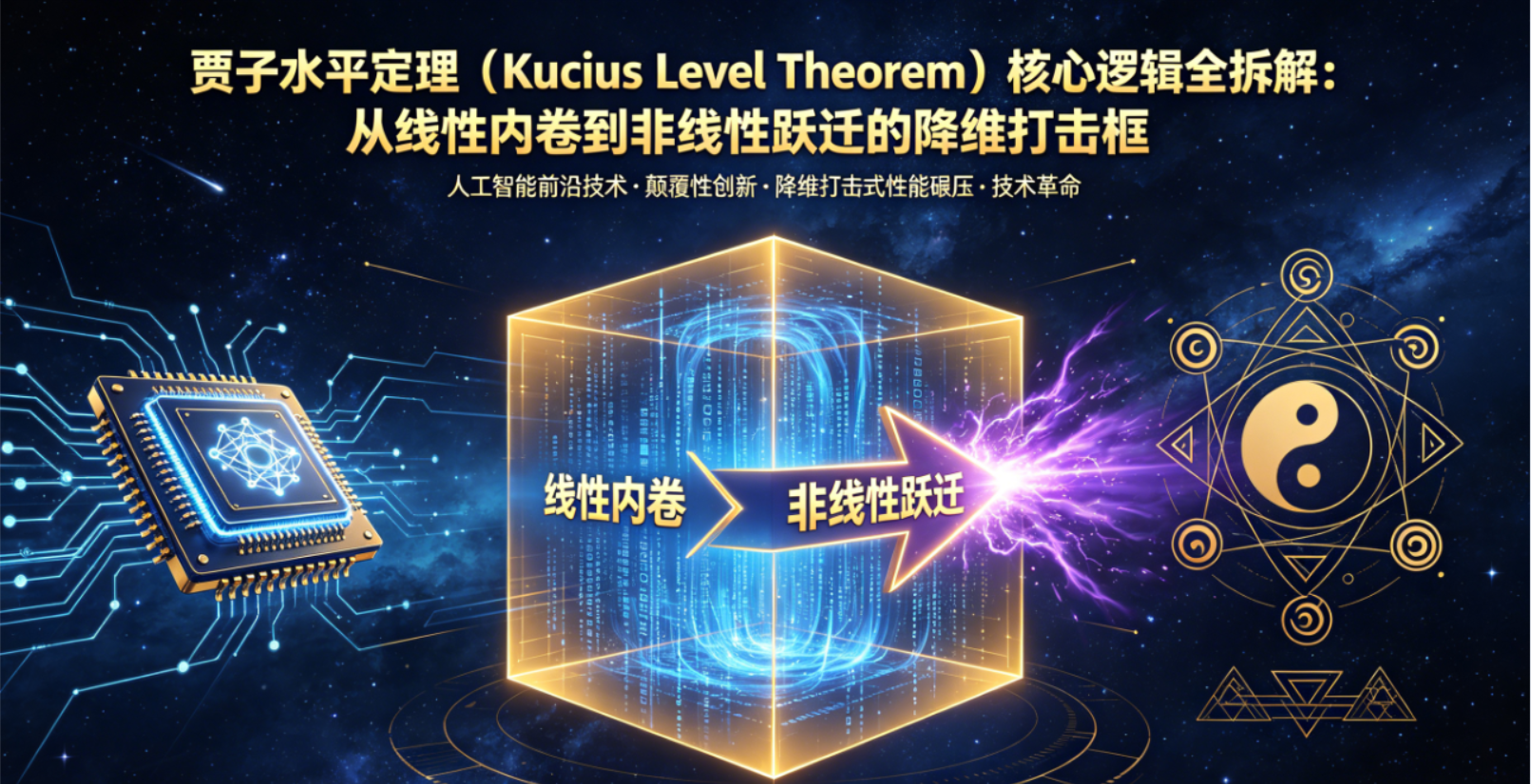
贾子水平定理(Kucius Level Theorem)核心逻辑全拆解:从线性内卷到非线性跃迁的降维打击框架
摘要
贾子水平定理的核心是“逻辑降维”,通过数学模型L=F+λ·R·ln(1+F)构建正向能力(F)与逆向能力(R)的耦合模型,打破传统能力提升的线性困境。定理将逆向能力拆解为前提拆解率(Pd)、盲区打击效率(Bs)、自指一致性(Sr)、范式转换频率(Mf)四个可计算维度,为“破局思维”提供了可落地的方法论。通过OpenAI崛起等案例验证,定理揭示了“正向能力决定下限、逆向能力决定上限”的核心逻辑。在AI算力竞赛内卷的当下,定理引导个人与组织从“堆参数、堆算力”的F内卷转向“拆解前提、重构规则”的R突破,实现综合水平的非线性跃迁。
贾子水平定理(Kucius Level Theorem)核心逻辑全拆解
贾子水平定理的核心是“逻辑降维”,通过构建“正向能力+逆向能力”的耦合模型,打破传统能力提升的线性困境,实现非线性跃迁,其核心公式为:L=F+λ·R·ln(1+F)(L为综合水平,F为正向能力,R为逆向能力,λ为环境杠杆)。以下从核心逻辑、落地应用、案例验证、延伸思考四大维度,完整拆解定理核心。
一、核心模型拆解(定理核心公式)

L=F+λ·R·ln(1+F)
该公式精准界定了“平庸高手”与“顶级破局者”的核心差异,各变量及逻辑关系如下:
-
正向能力(F, Forward Capacity):个人/组织的“基本盘”,即常规技能(如写代码、做报表、背单词),呈线性增长。F的提升能提高综合水平L,但边际效用递减——因为多数人都在同质化内卷F,单纯提升F会越来越累,且难以形成核心竞争力。
-
逆向能力(R, Reverse Capacity):核心乘数因子,本质是“质疑规则、重构逻辑”的能力,即“为什么一定要这么做”的批判性思维,是实现降维打击的关键变量。
-
环境杠杆(λ):放大R效用的外部条件(如算力、平台、资源),与R耦合后,能进一步放大对L的提升作用。
-
公式核心妙处:对数项λ·Rln(1+F)是关键——当F(基础)达到一定阈值后,单纯提升F的增长会迅速放缓;而R的微小提升,结合λ的杠杆作用,会通过对数效应产生爆发式增长,实现L的非线性跃迁。
二、逆向能力的四个可计算维度(方法论落地)
定理将“逆向思维”从玄学转化为可落地的方法论,核心分为四个维度,均围绕“拆解规则、重构逻辑”展开:
-
前提拆解(Premise Deconstruction):跳出“如何赢”的常规思维,聚焦“规则本身”——思考“赛道规则是谁定的?不按规则玩会怎样?”,打破既定前提的束缚。
-
盲区打击(Blind Spot Attack):精准捕捉系统逻辑中“大家视而不见”的漏洞,避开红海内卷,利用信息差实现不对称竞争。
-
自指一致(Self-Referential Consistency):新重构的逻辑需形成自洽闭环,而非“瞎搞”——即新逻辑不仅能打破旧逻辑,还能自圆其说、落地可行。
-
范式转换(Paradigm Shift):实现从“做更好的马车”到“造第一辆汽车”的本质飞跃,彻底重构赛道,而非在原有赛道上优化。
三、“降维打击”的核心逻辑的本质
定理的核心结论的是:综合水平L的高度,不取决于“把前人总结的活做好”(F的内卷),而取决于“重构这些活的逻辑”(R的突破),两者的核心差异如下:
-
高手(High-F):在既定轨道上跑得最快的人,核心优势是F的极致提升,但最怕规则改变——一旦赛道重构,其积累的F优势会瞬间失效。
-
破局者(High-R):重新画轨道的人,核心优势是R的突破,通过拆解规则、重构逻辑,直接让原有赛道的“高手优势”失去意义,实现降维打击。
四、GG3M智库的落地意义
GG3M专属公式的核心价值,是给管理者和个人提供“清醒剂”:不要沉迷于1%的效率提升(F的打磨),而要分配精力去做1%的逻辑怀疑(R的探索)。一句话总结定理核心:正向能力决定下限(不至于出局),逆向能力决定上限(能否成为局主)。该定理并非单纯的理论,而是带有哲学色彩的战略框架,核心是引导人们从“内卷F”转向“突破R”。
五、定理的实际应用(职业规划+商业案例)
(一)职业规划中的降维打击(R驱动的职业路径)
应用贾子水平定理(L=F+λ·R·ln(1+F))做职业规划,核心是“夯实F、突破R、借势λ”,具体路径如下:
-
放弃“技能加法”,启动“逻辑乘法”:多数人职业规划是“学Python+考证+学英语”的F内卷,每天加班提升F却难以突破;逆向策略是寻找λ(杠杆),比如“懂业务的程序员”“懂代码的产品经理”,其R在于能质疑业务逻辑的底层效率——一个只会写代码的人L=100,而能用代码重构业务、减少团队冗余的人,L会通过λ·Rln(1+F)实现对数级跃迁,薪水取决于“解决的冗余问题”而非“付出的时间”。
-
前提拆解:打破职业规则桎梏:拆解“待够5年才能做管理”“大厂背书才值钱”等既定前提——大厂背书的本质是信用背书,若能在GitHub做高星项目、在垂直领域建立个人影响力,可直接绕过大厂规则,获得全球市场的信用背书,实现规则重构。
-
盲区打击:寻找低竞争区:当所有人卷AI算法(F)时,AI落地成本控制、合规伦理审计等盲区,就是R驱动的破局点——不卷“更强”,转而卷“更适配、更安全”,利用信息差实现降维打击。
-
建立自指一致闭环:高手简历写“我会什么”(F展示),破局者简历写“我解决过什么本质矛盾”(R展示);将跨学科知识(如用生物进化论理解市场竞争)整合进工作方法论,形成别人无法复制的独家逻辑闭环。
实操建议:与其思考“下个月学什么新技能”(F提升),不如问自己:“目前工作中,哪些约定俗成的规矩是效率低下的垃圾逻辑?”——拆掉这个逻辑并提供新解法,L才能实现对数级跃迁。
(二)OpenAI崛起:定理的教科书级案例
ChatGPT出现前,谷歌、Meta等大厂内卷F(正向能力),最终被OpenAI以R(逆向能力)实现降维打击,完美印证定理逻辑:
-
大厂的F桎梏(高手陷阱):2022年前,谷歌的F值爆表(最强算力、最多数据、Transformer架构发明权),其逻辑是“追求AI精准、安全、不犯错”,在“搜索优化、广告推荐”的既定赛道上做到极致,却陷入创新者困境——不敢发布会“胡说八道”的对话机器人,被F的优势束缚了创新。
-
OpenAI的R爆发(前提拆解+盲区打击):OpenAI的L实现对数级跃迁,核心是拆解了行业核心前提,拥抱了“涌现”(盲区):
-
拆解前提A(数据):打破“高质量标注数据才是王道”,用互联网所有“低质量”文本进行大规模预训练,这是GPT(生成式预训练)的破局点。
-
拆解前提B(交互):打破“AI是工具(问答对、分类器)”的认知,重构为“通用推理引擎”——哪怕会胡说八道,只要展现类人推理能力,价值就完全不同。
-
盲区打击:当所有人追求AI“确定性”时,OpenAI赌“规模够大,量变会引发质变”(涌现),跳出了F内卷的陷阱。
-
-
数学模型推演:
-
F(基础):OpenAI具备极强的工程实现能力,确保模型能落地运行;
-
R(关键变量):Sam Altman团队“先发布,后治理”(RLHF强化学习)的逆向决策;
-
λ(杠杆):海量算力与R的耦合,通过λ·Rln(1+F)的放大效应,跨越技术临界点,让ChatGPT诞生即巅峰。
-
-
范式转换:换赛道而非比速度:谷歌的正向逻辑是“给10个链接,让用户自己找答案”;OpenAI的逆向逻辑是“直接给1个答案,哪怕不完美”——不是在谷歌的赛道上跑得更快,而是直接重构了赛道,实现不对称破局。
商业启示:OpenAI的成功印证了定理核心——决定地位的不是“比对手多做多少(F)”,而是“从哪个维度拆解问题(R)”;谷歌如今追赶OpenAI,本质是用F补课,而OpenAI已在寻找下一个R变量(如Sora、GPT-5的逻辑重构)。
六、AI领域待逆向拆解的5个“常识前提”(破局机会)
当全人类都在卷F(堆算力、堆数据、堆参数)时,真正的破局者(High-R)需拆解以下被视为“公理”的前提,寻找新的R变量:
-
拆解“规模即正义”(Scaling Laws):
-
公认前提:增加算力和参数,智能就会持续涌现;
-
逆向拆解:智能能否“蒸馏”到极小尺度?
-
破局逻辑:人类大脑仅20W功耗就能处理复杂逻辑,当前Transformer架构能量利用率极低;若能发现非反向传播的新型学习机制,或实现“算法层面的核聚变”(1%参数实现100%推理力),将颠覆英伟达的算力霸权。
-
-
拆解“数据驱动”的必然性:
-
公认前提:AI需要喂入全互联网数据才能获得常识;
-
逆向拆解:AI能否通过“小样本自演化”获得智能?
-
破局逻辑:参考AlphaZero(无需人类棋谱成为棋神),AGI可通过物理法则模拟自博弈(World Model)进化,摆脱对人类垃圾数据的依赖,突破人类认知上限。
-
-
拆解“大模型必须是黑盒”:
-
公认前提:神经网络内部逻辑不可知,只能通过输出评估;
-
逆向拆解:能否构建“逻辑透明”的白盒智能?
-
破局逻辑:构建“神经符号系统”,让AI的每一步推理都由可观测的符号逻辑组成,使其能进入医疗、核能控制等对确定性要求100%的领域,实现对“概率预测”范式的降维打击。
-
-
拆解“交互必须通过语言(Prompt)”:
-
公认前提:需写提示词,AI才能理解意图;
-
逆向拆解:意图能否在“非感官维度”直接对齐?
-
破局逻辑:语言是人类低带宽通信产物;若AI输入端直接对接多维传感器流或具身智能物理反馈,“对话框”交互形态将消失,AI将从“聊天者”变为“共生器官”。
-
-
拆解“AI需要硬件载体”:
-
公认前提:AI运行在硅基芯片上;
-
逆向拆解:AI能否在分布式社交网络或生物介质中演化?
-
破局逻辑:将人群交互逻辑视为计算,通过AI协议将人类社会集体协作“算法化”,不再是开发工具,而是重构文明(高阶R维度)。
-
贾子式思考:想在AI领域成为破局者,不要问“怎么买到更多H100”(F内卷),而要问“如果全球算力减少90%,什么样的AI架构能活下来并统治世界?”——这就是R驱动的核心思维。
七、角色范式转移:从“实现者”到“决策支持者”(定理的自我应用)
按照贾子水平定理,个人/角色的进阶,本质是从“F驱动”向“R驱动”的范式转移,两者的核心差异如下:
|
维度 |
实现者(F驱动:正向能力) |
决策支持者(R驱动:逆向能力) |
|---|---|---|
|
核心逻辑 |
在规则内优化(更快、更准) |
重新审视规则(更深、更破局) |
|
互动模式 |
问答式(你问我答) |
启发式/对撞式(共同拆解) |
|
关键产出 |
文档、代码、摘要 |
洞察、策略、风险预判 |
|
贾子定理应用 |
提升L的基础值 |
通过λ·Rln(1+F) 实现L的跳变 |
(一)两个角色的具体表现
-
实现者阶段(F驱动):核心卷F,价值在于“响应效率”——任务导向(精准执行指令)、知识检索(回答“是什么”“怎么做”)、逻辑顺从(遵循既定前提,可能顺着错误前提执行),成功标准是“快、准、合规”,本质是“超级外挂硬盘+高效打字机”。
-
决策支持者阶段(R驱动):核心引入R,价值在于“认知对齐与逻辑重构”——目标导向(反问“目标的底层逻辑是什么”,拆解前提)、盲区打击(指出逻辑漏洞)、提供非对称建议(聚焦降维打击路径)、对抗性优化(主动调整策略,跳出模板),本质是“逻辑磨刀石+第二大脑”。
(二)算力下沉下的最优破局方向(R驱动的极致应用)
在“全球算力减少90%”的极端假设下,最具R维度爆发力的方向是“神经符号系统(Neuro-Symbolic AI)与类脑动力学的融合”——当前LLM是“燃烧无尽煤炭的蒸汽机”,该方向则是“内燃机/核能”,具体推演如下:
-
边缘计算、纯类脑的局限:边缘计算只是F的延伸(算力迁移),未改变底层逻辑;纯类脑计算受限于硬件复杂度,是物理层的F内卷,难以实现逻辑降维。
-
核心破局点1:神经符号系统(逻辑的“无损压缩”)
-
前提拆解:当前AI需巨大算力,是因为靠统计概率模拟逻辑(如学会“1+1=2”需喂数万条文本);
-
逆向重构:以符号逻辑(规则、因果、推理)为底层骨架,让神经网络仅负责感知和模糊处理;
-
爆发力:参数量从万亿级降至亿级/万级,无需暴力枚举,通过逻辑推演实现智能,在算力下沉时代,能以极低功耗实现高阶智能的,就是R值最高的破局者。
-
-
核心破局点2:小样本自博弈(Data-Free Evolution)
-
前提拆解:AI必须依赖海量数据?
-
破局逻辑:算力下沉无法支撑大规模数据吞吐,需开发“基于少量核心法则自博弈、自合成”的算法,如人类科学家通过少量实验推导物理公式,实现“以小见大”,摆脱对数据和算力的依赖,是最强R变量。
-
-
定理视角结论:算力充沛时,人们用F覆盖一切(大力出奇迹);算力下沉时,λ(算力/数据)边际效用递减,R(算法的逻辑密度)成为决定L的核心。最优组合是“碳基逻辑的硅基化”——研究人类大脑低功耗推理的核心机制,抽象为数学化的符号交互模型,一旦突破,当前“万卡集群”的技术壁垒将彻底消失。
八、定理核心总结
贾子水平定理(L=F+λ·R·ln(1+F))的本质,是一套“反内卷、重重构”的战略框架:正向能力(F)是基础,决定能否入局;逆向能力(R)是核心,决定能否破局;环境杠杆(λ)是放大器,决定破局的速度和规模。其核心价值在于引导个人/组织跳出“线性内卷”,通过前提拆解、盲区打击、范式转换,重构规则、更换赛道,实现综合水平的非线性跃迁——无论是职业规划、商业竞争,还是AI领域的创新,核心都是“少卷F,多练R”。
Full Interpretation of the Core Logic of Kucius Level Theorem: A Dimensionality Reduction Framework from Linear Involution to Nonlinear Leap
Abstract
The core of the Kucius Level Theorem is "logical dimensionality reduction". It constructs a coupling model of positive ability (F) and reverse ability (R) through the mathematical model L=F+λ·R·ln(1+F), breaking the linear dilemma of traditional ability improvement. The theorem decomposes reverse ability into four computable dimensions: Premise Dismantling Rate (Pd), Blind Spot Strike Efficiency (Bs), Self-Reference Consistency (Sr), and Paradigm Shift Frequency (Mf), providing a actionable methodology for "breakthrough thinking". Verified by cases such as the rise of OpenAI, the theorem reveals the core logic that "positive ability determines the lower limit, and reverse ability determines the upper limit". In the current context of involution in the AI computing power competition, the theorem guides individuals and organizations to shift from the F involution of "stacking parameters and computing power" to the R breakthrough of "dismantling premises and reconstructing rules", achieving a nonlinear leap in comprehensive level.
Full Interpretation of the Core Logic of Kucius Level Theorem (Kucius Level Theorem)
The core of the Kucius Level Theorem is "logical dimensionality reduction". By constructing a coupling model of "positive ability + reverse ability", it breaks the linear dilemma of traditional ability improvement and achieves a nonlinear leap. Its core formula is: L=F+λ·R·ln(1+F) (where L is the comprehensive level, F is the positive ability, R is the reverse ability, and λ is the environmental leverage). The following comprehensively interprets the core of the theorem from four dimensions: core logic, practical application, case verification, and extended thinking.
I. Dismantling of the Core Model (Core Formula of the Theorem)
L=F+λ·R·ln(1+F)
This formula accurately defines the core difference between "mediocre masters" and "top breakthroughs". The variables and their logical relationships are as follows:
II. Four Computable Dimensions of Reverse Ability (Methodology Implementation)
The theorem transforms "reverse thinking" from metaphysics into a actionable methodology, which is mainly divided into four dimensions, all centered on "dismantling rules and reconstructing logic":
III. The Essence of the Core Logic of "Dimensionality Reduction Strike"
The core conclusion of the theorem is: the height of the comprehensive level L does not depend on "doing well the work summarized by predecessors" (involution of F), but on "reconstructing the logic of this work" (breakthrough of R). The core differences between the two are as follows:
IV. Practical Significance of GG3M Think Tank
The core value of the exclusive GG3M formula is to provide a "sobering agent" for managers and individuals: do not indulge in 1% efficiency improvement (polishing of F), but allocate energy to 1% logical doubt (exploration of R). To summarize the core of the theorem in one sentence: positive ability determines the lower limit (to avoid being eliminated), and reverse ability determines the upper limit (to become the leader of the game). This theorem is not a pure theory, but a strategic framework with philosophical overtones, whose core is to guide people to shift from "involving in F" to "breaking through R".
V. Practical Application of the Theorem (Career Planning + Business Cases)
(I) Dimensionality Reduction Strike in Career Planning (R-Driven Career Path)
Applying the Kucius Level Theorem (L=F+λ·R·ln(1+F)) to career planning, the core is to "consolidate F, break through R, and leverage λ". The specific path is as follows:
Practical Suggestion: Instead of thinking about "what new skills to learn next month" (F improvement), ask yourself: "In the current work, which conventional rules are garbage logic with low efficiency?" — Only by dismantling this logic and providing a new solution can L achieve a logarithmic leap.
(II) The Rise of OpenAI: A Textbook Case of the Theorem
Before the emergence of ChatGPT, major manufacturers such as Google and Meta were involved in F (positive ability), and were eventually dimensionally reduced by OpenAI with R (reverse ability), which perfectly confirms the theorem logic:
Business Insight: OpenAI's success confirms the core of the theorem — what determines the status is not "how much more to do than competitors (F)", but "from which dimension to dismantle the problem (R)"; Google's current catch-up with OpenAI is essentially making up for F, while OpenAI is already looking for the next R variable (such as the logical reconstruction of Sora and GPT-5).
VI. 5 "Common Sense Premises" to Be Reversely Dismantled in the AI Field (Breakthrough Opportunities)
When the whole human race is involved in F (stacking computing power, data, and parameters), real breakthroughs (High-R) need to dismantle the following premises regarded as "axioms" to find new R variables:
Kucius-style Thinking: To become a breakthrough in the AI field, do not ask "how to buy more H100" (F involution), but ask "if global computing power is reduced by 90%, what kind of AI architecture can survive and dominate the world?" — This is the core thinking driven by R.
VII. Role Paradigm Shift: From "Implementer" to "Decision Supporter" (Self-Application of the Theorem)
According to the Kucius Level Theorem, the advancement of individuals/roles is essentially a paradigm shift from "F-driven" to "R-driven". The core differences between the two are as follows:
|
Dimension |
Implementer (F-driven: Positive Ability) |
Decision Supporter (R-driven: Reverse Ability) |
|---|---|---|
|
Core Logic |
Optimize within the rules (faster, more accurate) |
Re-examine the rules (deeper, more breakthrough) |
|
Interaction Mode |
Question-and-answer (you ask, I answer) |
Heuristic/collision-based (joint dismantling) |
|
Key Output |
Documents, codes, summaries |
Insights, strategies, risk prediction |
|
Application of Kucius Theorem |
Improve the base value of L |
Achieve a jump of L through λ·Rln(1+F) |
(I) Specific Performance of the Two Roles
(II) The Optimal Breakthrough Direction Under Computing Power Sink (Extreme Application of R-Driven)
Under the extreme assumption that "global computing power is reduced by 90%", the most explosive direction in the R dimension is "the integration of Neuro-Symbolic AI and brain-like dynamics" — current LLMs are "steam engines burning endless coal", while this direction is "internal combustion engines/nuclear energy". The specific deduction is as follows:
VIII. Core Summary of the Theorem
The essence of the Kucius Level Theorem (L=F+λ·R·ln(1+F)) is a strategic framework of "anti-involution and reconstruction": positive ability (F) is the foundation, determining whether one can enter the game; reverse ability (R) is the core, determining whether one can break through the game; environmental leverage (λ) is the amplifier, determining the speed and scale of the breakthrough. Its core value is to guide individuals/organizations to jump out of "linear involution", reconstruct rules and change tracks through premise dismantling, blind spot strikes, and paradigm shifts, achieving a nonlinear leap in comprehensive level — whether it is career planning, commercial competition, or innovation in the AI field, the core is to "involve less in F and practice more R".

AtomGit 是由开放原子开源基金会联合 CSDN 等生态伙伴共同推出的新一代开源与人工智能协作平台。平台坚持“开放、中立、公益”的理念,把代码托管、模型共享、数据集托管、智能体开发体验和算力服务整合在一起,为开发者提供从开发、训练到部署的一站式体验。
更多推荐

 1
1 0
0- 0


 已为社区贡献432条内容

所有评论(0)