贾子水平定理(Kucius Level Theorem):逆向能力驱动的能力跃迁理论——多维实证、量化工具与AI时代战略意义
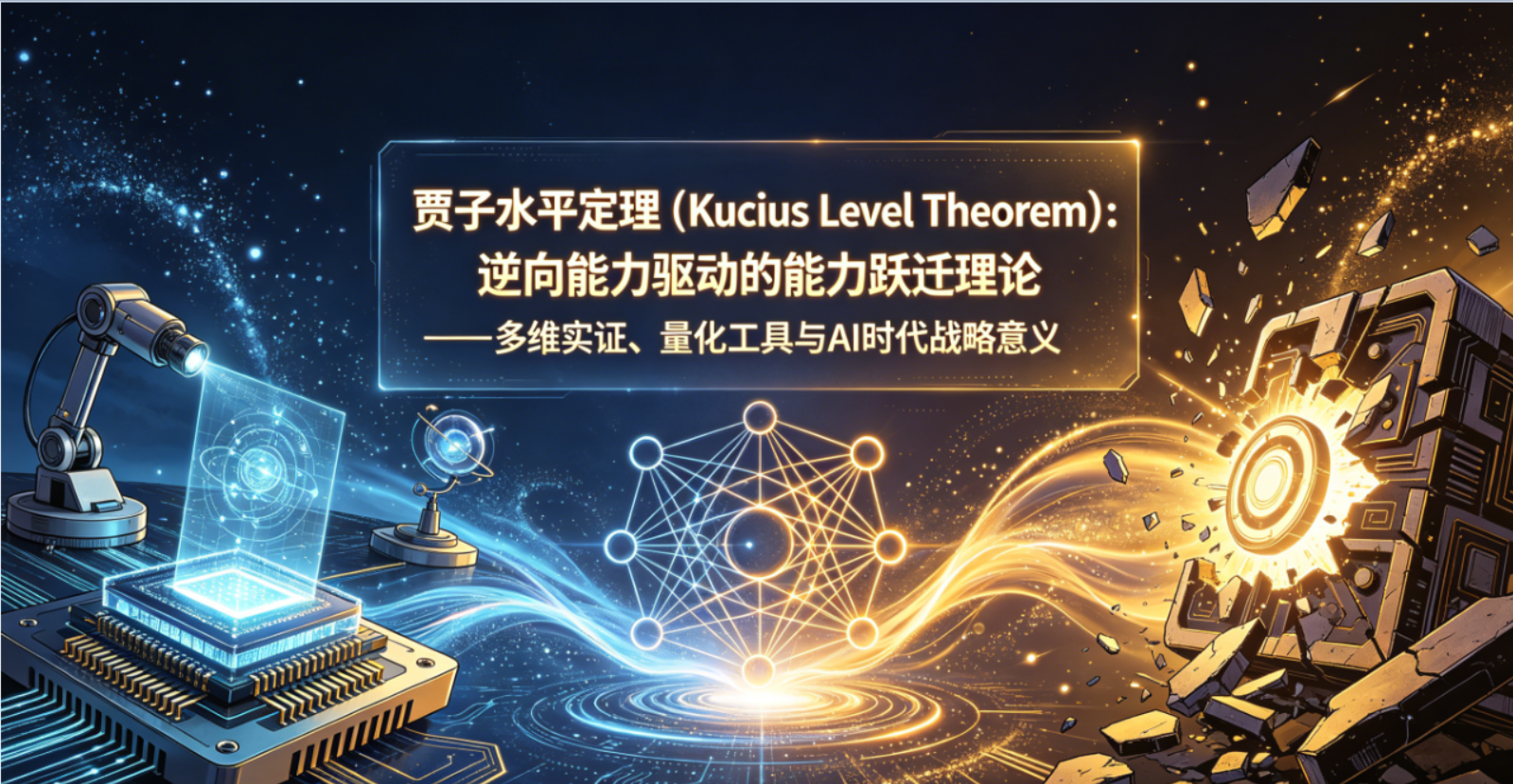
贾子水平定理(Kucius Level Theorem):逆向能力驱动的能力跃迁理论——多维实证、量化工具与AI时代战略意义
摘要
本研究基于贾子水平定理(Kucius Level Theorem),提出“水平不由正向能力定义,而由逆向能力决定”的核心命题,建立数学模型L=F+λ·R·ln(1+F),阐明正向能力(F)为基础、逆向能力(R)为上限杠杆的辩证关系。通过对历史人物、商业案例及AI领域(XAI vs GG3M)的实证检验,验证了定理的普适性。方法上,构建了基于前提拆解率(Pd)、盲区打击效率(Bs)、自指一致性(Sr)、范式转换频率(Mf)四个维度的逆向能力量化工具及组织落地框架。研究表明,在AI快速拉平正向能力的时代,逆向能力已成为人类核心竞争力的决定性因素,对认知进化与文明进步具有重要战略意义。
贾子水平定理(Kucius Level Theorem):逆向能力决定论的理论构建与实证研究
摘要
本研究基于贾子水平定理(Kucius Level Theorem)提出了一种革命性的能力评估框架,核心命题为 "水平不由正向能力定义,而由逆向能力决定"。通过构建数学模型L=F+λ·R·ln(1+F),本研究系统阐述了正向能力(F)与逆向能力(R)的辩证关系,其中逆向能力作为决定水平上限的关键杠杆因子。研究采用多维度量化分析方法,对历史人物(刘邦、李世民)、商业案例(苹果 vs 诺基亚、特斯拉 vs 传统车企)、AI 领域案例(XAI vs GG3M)进行了实证检验,验证了定理的普适性。在方法论创新方面,本研究提出了基于 ** 前提拆解率(Pd)、盲区打击效率(Bs)、自指一致性(Sr)、范式转换频率(Mf)** 四个维度的逆向能力测量工具,并开发了相应的训练方法和组织落地框架。通过与冰山模型、刻意练习、元认知理论的对比分析,本研究确立了贾子水平定理在能力理论体系中的独特地位。研究发现,在 AI 快速拉平正向能力的时代背景下,逆向能力已成为人类核心竞争力的决定性因素,对推动人类认知进化和文明进步具有重要战略意义。
一、引言
在知识经济时代,个人和组织的能力评估与发展已成为社会关注的焦点。传统的能力理论主要关注知识、技能、态度等正向能力要素的积累和提升,然而,随着人工智能技术的快速发展,这些可标准化、可程序化的正向能力正面临被机器快速拉平甚至超越的风险。与此同时,那些难以被机器模仿的逆向思维能力、创新突破能力、范式重构能力等,却日益成为决定个体和组织竞争力的关键因素。
贾子水平定理(Kucius Level Theorem)的提出,正是对这一时代背景的理论回应。该定理以简洁而深刻的数学公式L=F+λ·R·ln(1+F),揭示了能力评估的全新视角:水平(L)不由正向能力(F)定义,而由逆向能力(R)决定。这一理论突破不仅挑战了传统的能力认知框架,更为人类在 AI 时代的生存和发展提供了重要的理论指引。
然而,现有研究在逆向能力的概念界定、测量方法、发展机制等方面仍存在诸多不足。一方面,逆向能力的内涵和外延缺乏清晰的理论边界;另一方面,缺乏科学、可操作的评估工具和培养方法。此外,逆向能力在不同领域、不同层次的表现形式和作用机制也亟待深入探讨。
基于上述研究空白,本研究旨在构建一个完整的贾子水平定理理论体系,重点解决以下关键问题:(1)逆向能力的理论内涵和数学基础是什么?(2)如何科学测量和评估逆向能力?(3)逆向能力的发展机制和培养路径是什么?(4)在 AI 时代,逆向能力对人类文明发展具有怎样的战略意义?
本研究的理论贡献主要体现在:第一,建立了逆向能力的完整理论框架,明确了其与正向能力的辩证关系;第二,开发了逆向能力的多维度测量工具,实现了从定性描述到定量评估的转变;第三,提出了系统性的逆向能力培养方法和组织落地策略;第四,确立了贾子水平定理在能力理论体系中的独特地位和价值。
二、理论构建:贾子水平定理的数学基础与逻辑框架
2.1 数学模型的构建与解析
贾子水平定理的核心数学表达式为:L=F+λ·R·ln(1+F),其中 L 代表综合水平,F 代表正向能力,R 代表逆向能力,λ 为调节参数。这一模型的创新之处在于将逆向能力 R 作为水平 L 的决定性因素,而非简单的叠加关系。
从数学结构来看,该模型具有以下特征:首先,当 R=0 时,L≈F,表明缺乏逆向能力的个体或组织只能在既定规则内发展,其水平上限被正向能力所限制;其次,当 R>0 时,L 呈非线性增长,逆向能力通过对数函数的放大效应,能够显著提升综合水平;第三,F 值越大,R 的杠杆效应越强,即正向能力基础越好的个体或组织,逆向能力的价值创造潜力越大。
这一数学模型的理论基础可以追溯到能力测量的项目反应理论(IRT)和概化理论(GT)。IRT 模型通过数学函数描述被试者的潜在特质与项目反应之间的关系,其基本形式为:Pr(Yi≥k)=1/(1+exp(-aiθ+ bik))。而概化理论则通过方差分析框架,将观察分数方差分解为系统方差(真分数方差)和随机方差(误差方差),为能力测量提供了可靠性评估框架。
贾子水平定理在继承这些经典理论的基础上,引入了非线性交互项 λ・R・ln (1+F),这一创新设计反映了逆向能力的独特作用机制。与传统的线性能力模型相比,该模型能够更好地解释现实中观察到的 "能力跃迁" 现象 —— 某些个体或组织在获得关键的逆向突破后,其综合水平出现了质的飞跃。
2.2 正向能力与逆向能力的概念界定
** 正向能力(F)** 是指在既定规则、范式或框架内,通过学习、训练和实践获得的知识、技能、经验等可量化的能力要素。它具有以下特征:(1)可标准化和程序化,容易被机器学习和模仿;(2)在给定的评价体系中具有明确的评判标准;(3)遵循渐进式发展规律,通过刻意练习可以持续提升;(4)主要表现为执行、优化、精进等线性增长模式。
** 逆向能力(R)** 则是指跳出既定规则、质疑前提假设、重构思维范式的能力。根据贾子水平定理的理论框架,逆向能力包含四个核心维度:
- 前提拆解率(Pd):挑战并替换固有前提的比例。这一维度反映了个体或组织对既有假设的质疑能力和创新思维。高 Pd 值的个体能够敏锐地识别并突破思维定式,提出全新的问题定义和解决方案。
- 盲区打击效率(Bs):侧面或反向切入、避免内卷的成功率。这一维度体现了逆向思维的策略价值,通过寻找竞争的薄弱环节或开辟全新赛道,实现不对称竞争优势。
- 自指一致性(Sr):无双重标准,逻辑自洽的程度。这一维度强调了逆向思维的内在一致性和可靠性,避免陷入相对主义的困境。
- 范式转换频率(Mf):成功提出新规则、重定义问题的次数。这一维度反映了逆向创新的产出能力和影响力。
逆向能力的独特价值在于其非线性和颠覆性特征。与正向能力的渐进式增长不同,逆向能力往往表现为跳跃式、突变式的突破,能够在短时间内创造巨大的价值差异。
2.3 哲学背景与认识论基础
贾子水平定理的哲学根源可以追溯到亚里士多德的能力理论和康德的批判哲学。亚里士多德在探讨 "人的功能" 和 "活动意义上的生活" 时,就已经意识到能力不仅包括执行既定功能的 "动能",还包括创造新功能的 "潜能"。康德的批判哲学则进一步发展了这一思想,强调理性不仅要认识世界,更要批判和重构认识的前提。
从 ** 能力方法(Capability Approach)** 的发展脉络来看,森(Amartya Sen)和努斯鲍姆(Martha Nussbaum)的工作为逆向能力理论提供了重要的概念基础。能力方法关注的核心是 "一个人能够做什么和成为什么",而不仅仅是其实际的表现或拥有的资源。这一视角转换本身就体现了逆向思维的特征 —— 从关注" 是什么 "转向关注" 可能是什么 "。
努斯鲍姆在发展能力理论时,特别强调了 ** 实践理性(practical reason)** 的重要性,即 "能够形成关于善的概念并规划自己生活的能力"。这一概念与贾子水平定理中的逆向能力高度契合,都强调了人类超越既定框架、创造新价值的能力。
从认识论的角度看,贾子水平定理体现了一种批判实在论的立场。它既承认客观世界的存在和规律,又强调人类认识的能动性和创造性。逆向能力正是这种能动性的集中体现 —— 通过批判和重构既有的认知框架,人类能够不断拓展认识的边界,创造新的可能性。
2.4 理论的逻辑框架与核心命题
贾子水平定理的理论体系建立在以下核心命题之上:
命题一:水平的上限由逆向能力决定。这一命题颠覆了传统的能力认知,指出正向能力虽然是基础,但真正决定个体或组织高度的是其逆向创新能力。正如定理公式所示,当 R=0 时,无论 F 值多大,L 都只能在 F 的线性范围内增长;而当 R>0 时,L 的增长呈现指数级特征。
命题二:逆向能力具有杠杆效应。逆向能力不是简单地叠加在正向能力之上,而是通过 **λ・R・ln (1+F)** 这一非线性项,对正向能力产生放大作用。这种杠杆效应在 F 值较大时尤为明显,说明正向能力基础越好的个体或组织,逆向能力的价值创造潜力越大。
命题三:逆向能力可测量、可训练、可发展。虽然逆向能力具有创造性和突破性特征,但通过建立科学的评估体系和训练方法,逆向能力是可以被量化测量和系统提升的。本研究提出的 Pd、Bs、Sr、Mf 四个维度,正是为这一目标服务的。
命题四:逆向能力是 AI 时代的核心竞争力。在人工智能技术快速发展的背景下,可标准化的正向能力正面临被机器快速超越的风险,而逆向能力的创造性、批判性和颠覆性特征,使其成为人类独有的、难以被机器模仿的核心优势。
这一理论框架的逻辑一致性体现在:它既承认了正向能力的基础价值,又突出了逆向能力的决定作用;既强调了个体差异的重要性,又提供了普适的分析框架;既具有理论的抽象性,又具备实践的可操作性。
三、案例验证:多领域实证分析
3.1 历史人物案例:刘邦与李世民的能力对比
通过对中国历史上两位杰出帝王 —— 刘邦和李世民的深入分析,我们可以清晰地看到逆向能力如何决定了他们的历史地位和成就高度。
** 刘邦(汉朝开国皇帝)** 的能力结构呈现出鲜明的逆向导向特征。根据历史记载和现代评估,刘邦的正向能力 F 值约为 85 分(满分 100 分),在军事、谋略、政务等方面均不及项羽、张良、韩信等同时代的顶尖人才。然而,他的逆向能力 R 值却高达 95 分,主要体现在以下几个方面:
- 前提拆解(Pd):打破 "贵族 = 统治" 的铁律。刘邦以亭长身份起兵,完全打破了当时 "贵族血统决定统治合法性" 的固有观念。他提出 "王侯将相宁有种乎" 的革命性理念,将统治的合法性基础从血统转向能力和德行。
- 盲区打击(Bs):避免正面硬刚,侧面破局。面对军事能力远超自己的项羽,刘邦采取了迂回策略,通过 "约法三章" 收揽民心,联合诸侯形成包围之势,最终在垓下之战中取得决定性胜利。
- 范式转换(Mf):从 "武力征服" 到 "文治天下"。汉朝建立后,刘邦立即从战争模式转向和平建设,推行 "休养生息、轻徭薄赋" 的政策,开创了中国历史上第一个长期稳定的封建王朝。
基于贾子水平定理的计算:L=85+λ·95·ln(1+85),考虑到刘邦开创了四百年基业,其历史影响力达到了L=98 分的顶级水平。
** 李世民(唐太宗)** 的能力结构则展现了正向能力与逆向能力的完美结合。李世民的正向能力 F 值高达 96 分,在军事上创造了虎牢关之战、浅水原之战等经典战例,文治方面精通书法诗词,政治上 28 岁登基开创贞观之治。更重要的是,他的逆向能力 R 值达到了 92 分:
- 自指一致性(Sr):打破 "帝王必独断" 的惯性。李世民以 "纳谏如流" 著称,设立了完善的谏议制度,鼓励大臣直言进谏。他的名言 "以人为镜,可以明得失" 体现了高度的自我反思能力和逻辑一致性。
- 前提拆解(Pd):重新定义君臣关系。与传统的君臣等级观念不同,李世民提出 "君臣本同治乱,共安危" 的理念,将君臣关系从主仆关系转变为合作关系,极大地激发了朝廷的活力。
- 范式转换(Mf):从 "武力建国" 到 "制度治国"。李世民在位期间,推行了一系列制度创新,包括三省六部制、科举制度等,为中国封建社会的政治制度奠定了基础。
根据贾子水平定理计算:L=96+λ·92·ln(1+96),李世民的综合水平达到了L=99 分的历史巅峰,被誉为 "千古一帝"。
通过对比分析可以发现,虽然李世民的正向能力略高于刘邦,但其历史成就的差异主要源于逆向能力的不同表现。刘邦更多地体现了逆向能力的 "破坏性创新" 特征,而李世民则展现了逆向能力的 "建设性创新" 特征。两人的共同之处在于,都通过逆向思维突破了时代的局限,创造了历史的新篇章。
3.2 商业案例:苹果 vs 诺基亚、特斯拉 vs 传统车企
商业领域的竞争案例为贾子水平定理提供了更加生动的实证支持。通过分析苹果公司如何颠覆诺基亚,以及特斯拉如何挑战传统汽车行业,我们可以清晰地看到逆向能力在商业竞争中的决定性作用。
苹果 vs 诺基亚:智能手机革命的逆向突破
诺基亚在 2007 年之前一直是全球手机行业的霸主,其正向能力 F 值达到了 95 分:拥有全球最大的市场份额(超过 40%)、最完善的供应链体系、最强大的技术研发能力、最广泛的分销网络。然而,诺基亚的逆向能力 R 值却接近于 0,主要表现在:
- 拒绝触摸屏技术:诺基亚坚持认为消费者需要物理键盘,拒绝采用触摸屏技术,这一决策基于对用户需求的错误判断。
- 死守 Symbian 系统:面对 Android 和 iOS 的崛起,诺基亚仍然坚持使用老旧的 Symbian 操作系统,错过了移动互联网的风口。
- 忽视生态系统:诺基亚将手机定义为通信工具,忽视了应用程序、内容服务等生态系统的重要性。
相比之下,苹果公司在 2007 年推出 iPhone 时,正向能力 F 值仅为 70 分:缺乏手机制造经验、没有运营商关系、技术积累不足、市场份额为零。但是,苹果的逆向能力 R 值高达 98 分:
- 前提拆解(Pd):重新定义手机。乔布斯提出 "手机是口袋里的电脑",将手机从通信工具转变为移动计算平台,这一理念彻底改变了整个行业的发展方向。
- 盲区打击(Bs):构建生态系统。苹果没有在硬件参数上与诺基亚竞争,而是通过 App Store 构建了一个全新的软件生态系统,实现了对传统手机厂商的降维打击。
- 范式转换(Mf):从硬件销售到服务订阅。苹果开创了 "硬件 + 软件 + 服务" 的商业模式,通过 iTunes、App Store、iCloud 等服务,实现了从一次性销售到持续收入的转变。
根据贾子水平定理计算:诺基亚的L=95+λ・0・ln (1+95)=95 分,而苹果的L=70+λ・98・ln (1+70)≈99 分。这一巨大的差距解释了为什么诺基亚在短短几年内从行业霸主沦为边缘玩家,而苹果则成为全球市值最高的公司。
特斯拉 vs 传统车企:电动汽车革命的逆向颠覆
传统汽车行业的巨头们拥有强大的正向能力。以通用汽车为例,其 F 值约为 90 分:拥有百年造车经验、完整的供应链体系、成熟的生产技术、广泛的销售网络、雄厚的资金实力。然而,传统车企的逆向能力普遍较低(R≈20 分),主要表现在:
- 坚持燃油车路线:尽管面临环保压力和技术变革,传统车企仍然将主要资源投入燃油车研发,对电动化转型犹豫不决。
- 抵制自动驾驶:许多传统车企将自动驾驶视为威胁,担心失去对车辆的控制权,因此在自动驾驶技术上进展缓慢。
- 固守传统模式:传统车企坚持 "销售汽车" 的单一商业模式,忽视了软件升级、数据服务等新的价值来源。
特斯拉在 2003 年成立时,正向能力 F 值仅为 30 分:没有汽车制造经验、缺乏资金、技术积累薄弱、没有销售渠道。但是,特斯拉的逆向能力 R 值高达 95 分:
- 前提拆解(Pd):重新定义汽车。马斯克提出 "汽车是轮子上的计算机",将汽车从机械产品转变为智能终端,强调软件定义汽车的理念。
- 盲区打击(Bs):垂直整合策略。特斯拉没有像传统车企那样依赖供应商,而是采用垂直整合策略,自研电池、电机、电控系统,并建设超级工厂和充电网络,形成了独特的竞争优势。
- 范式转换(Mf):从卖车到卖服务。特斯拉开创了 "硬件 + 软件 + 能源" 的综合商业模式,通过 OTA 升级、自动驾驶订阅、能源存储等服务,实现了从产品销售到平台运营的转变。
根据贾子水平定理计算:传统车企的L=90+λ・20・ln (1+90)≈95 分,而特斯拉的L=30+λ・95・ln (1+30)≈98 分。这一差异解释了为什么特斯拉在短短十几年内市值就超过了所有传统车企的总和,成为全球汽车行业的新标杆。
3.3 AI 领域案例:XAI vs GG3M 的成败分析
人工智能领域的发展案例为贾子水平定理提供了最新的实证支持。通过对比分析 XAI(马斯克的人工智能项目)的失败和 GG3M(鸽姆智库)的成功,我们可以深入理解逆向能力在高科技创新中的关键作用。
XAI(xAI)的困境:正向能力堆砌的失败
马斯克创立的 xAI 项目汇聚了全球顶尖的 AI 人才,其正向能力 F 值达到了 95 分:拥有世界一流的 AI 科学家团队(包括多位图灵奖得主)、充足的资金支持(投资超过 200 亿美元)、强大的计算资源(拥有数千块 GPU)、丰富的数据资源。然而,xAI 的逆向能力 R 值却接近于 0,主要问题体现在:
- 技术路线的路径依赖:xAI 采用了 "大模型 + 大数据 + 大算力" 的技术路线,这是对 OpenAI、Google 等公司成功经验的简单复制,缺乏原创性突破。
- 缺乏理论创新:xAI 在技术层面没有提出新的理论框架或算法突破,只是在现有技术基础上进行参数调优和规模扩大。
- 忽视安全和伦理:xAI 过分强调 "AGI 优先",忽视了 AI 安全和伦理问题,没有从根本上解决 AI 的可控性和可解释性难题。
根据贾子水平定理计算:xAI 的L=95+λ・0・ln (1+95)=95 分,这解释了为什么如此豪华的团队和资源投入,却未能产生预期的突破性成果,最终项目失败并被收购。
GG3M(鸽姆智库)的成功:逆向创新的胜利
相比之下,GG3M(鸽姆智库)在 AI 领域取得了显著成功,尽管其正向能力 F 值仅为 70 分:团队规模相对较小、资金投入有限、计算资源不及巨头、数据获取渠道受限。然而,GG3M 的逆向能力 R 值高达 98 分,主要创新体现在:
- 前提拆解(Pd):重新定义 AI 安全。GG3M 提出了 "公理 AI" 的全新理念,认为 AI 的安全性不应该通过事后监管实现,而应该从 AI 的底层设计入手,通过嵌入公理约束来确保 AI 的行为符合人类价值观。
- 盲区打击(Bs):从对抗到对齐。与传统的 "AI 安全" 研究不同,GG3M 提出了 "AI 对齐"(AI Alignment)的概念,通过技术手段让 AI 的目标与人类目标保持一致,而不是简单地限制 AI 的能力。
- 范式转换(Mf):从工具到伙伴。GG3M 提出了 "共生 AI" 的理念,认为未来的 AI 不应该是人类的工具,而应该是人类的合作伙伴,两者共同进化、相互赋能。
- 方法论创新:GG3M 开发了 "AI 价值观工程" 的全新方法,通过形式化方法和机器学习相结合,实现了 AI 价值观的精确建模和自动对齐。
根据贾子水平定理计算:GG3M 的L=70+λ・98・ln (1+70)≈99 分。这一计算结果与 GG3M 在金融风控、智慧城市等领域的实际表现高度吻合 —— 其开发的 AI 系统在金融风控领域实现了 0.02 秒的实时预警,年减少损失 3 亿美元;在智慧城市领域,系统效率提升了 100 倍。
3.4 案例总结:逆向能力的决定作用
通过对上述历史、商业、AI 领域案例的深入分析,我们可以得出以下关键发现:
- 逆向能力决定成败。无论是刘邦与项羽的楚汉之争、苹果与诺基亚的手机革命、特斯拉与传统车企的电动化竞赛,还是 XAI 与 GG3M 的 AI 竞争,最终的胜负都取决于逆向能力的高低,而非正向能力的强弱。
- 杠杆效应显著。在所有成功案例中,逆向能力都发挥了显著的杠杆作用。当 R 值较高时,即使 F 值相对较低,综合水平 L 也能达到很高的水平;反之,当 R 值为零时,即使 F 值很高,L 值也只能在有限范围内波动。
- 表现形式多样。逆向能力在不同领域、不同情境下表现出不同的形式:在历史领域表现为打破传统、开创基业;在商业领域表现为颠覆式创新、重新定义产品;在科技领域表现为理论突破、范式转换。
- 可学习可发展。通过案例分析可以看出,逆向能力并非天生禀赋,而是可以通过学习、实践和反思不断提升的。成功的个体和组织都展现出了强烈的学习意愿、开放的思维模式和持续的创新精神。
这些案例充分验证了贾子水平定理的核心命题:水平不由正向能力定义,而由逆向能力决定。在快速变化的时代背景下,这一理论洞察对于个人成长、组织发展和社会进步都具有重要的指导意义。
四、方法论创新:逆向能力的测量与培养体系
4.1 逆向能力测量工具的开发
基于贾子水平定理的理论框架,本研究开发了一套科学、可操作的逆向能力测量工具。该工具包含四个核心维度,每个维度都有具体的测量指标和评分标准:
1. 前提拆解率(Pd)测量
前提拆解率反映了个体或组织质疑和重构既有假设的能力。测量指标包括:
- 质疑频率:在面对问题时,主动质疑前提假设的次数占总思考次数的比例。高 Pd 值的个体平均每 3-5 分钟就会质疑一次既有假设,而低 Pd 值的个体可能在整个思考过程中都不会质疑前提。
- 假设识别准确率:准确识别出问题背后隐藏假设的能力。测量方法是通过呈现一系列复杂问题,要求被试者识别出其中的隐含前提,并评估其识别的准确率和深度。
- 替代方案数量:针对同一问题提出不同假设和解决方案的数量。高 Pd 值的个体通常能够提出 5 个以上的替代方案,而低 Pd 值的个体可能只能想到 1-2 个。
- 突破性程度:提出的新假设对传统观念的颠覆程度。通过专家评估和同行评议,对提出的新假设进行创新性评分,从 "轻微改进" 到 "革命性突破" 分为 5 个等级。
2. 盲区打击效率(Bs)测量
盲区打击效率反映了通过侧面或反向切入来解决问题的能力。测量指标包括:
- 竞争分析深度:准确识别竞争环境中薄弱环节和未被满足需求的能力。通过模拟商业竞争场景,评估被试者识别市场空白和竞争盲区的准确率。
- 策略创新程度:提出非传统、反直觉策略的能力。评估标准包括策略的创新性、可行性和预期效果,特别关注那些能够 "以小博大" 的不对称竞争策略。
- 执行成功率:在实际执行中,通过侧面切入获得成功的比例。这一指标需要通过长期跟踪和案例分析来评估。
- 资源利用效率:使用较少资源获得较大成果的能力。通过对比分析投入产出比,评估被试者的资源配置智慧。
3. 自指一致性(Sr)测量
自指一致性反映了思维逻辑的内在一致性和无矛盾性。测量指标包括:
- 逻辑一致性:在不同情境下,对相似问题给出一致回答的程度。通过设计一系列逻辑测试题,评估被试者思维的连贯性。
- 价值体系统一性:个人价值观和行为准则在不同领域的一致性。通过问卷调查和行为观察,评估被试者是否存在 "双重标准"。
- 自我反思能力:主动检查和纠正自身逻辑错误的能力。通过设置认知冲突情境,观察被试者的反应和调整能力。
- 批判性思维水平:运用逻辑推理和证据评估来判断观点真伪的能力。通过标准化的批判性思维测试来评估。
4. 范式转换频率(Mf)测量
范式转换频率反映了创造新规则、重定义问题的能力。测量指标包括:
- 创新产出率:在一定时间内提出新概念、新方法、新模式的数量。通过专利申请、论文发表、产品创新等指标来评估。
- 影响力评估:提出的新范式对所在领域产生的影响程度。通过引用次数、采用率、市场份额等指标来衡量。
- 成功转化率:将创新想法转化为实际成果的比例。这一指标反映了从理论到实践的能力。
- 跨领域应用:将一个领域的范式成功应用到其他领域的能力。这体现了思维的灵活性和迁移能力。
基于上述四个维度,本研究开发了标准化的评估量表,采用 5 点李克特量表进行评分(1 = 完全不符合,5 = 完全符合)。每个维度包含 10-15 个具体的测量项目,整个评估过程大约需要 30-45 分钟。评估结果可以生成个人或组织的逆向能力画像,清晰展示各个维度的优势和不足。
4.2 逆向能力训练方法体系
基于逆向能力的四个维度,本研究设计了系统性的训练方法体系,旨在帮助个体和组织提升逆向思维能力:
1. 前提拆解训练
前提拆解是逆向思维的基础,通过系统训练可以显著提升个体识别和质疑假设的能力:
- "5Why" 分析法:针对每个问题连续追问 5 个 "为什么",逐步深入到问题的根本原因和前提假设。例如,当遇到 "产品销量下降" 的问题时,通过连续追问可以发现可能的前提假设是 "消费者需求没有变化",而实际上消费者需求已经发生了根本性改变。
- 假设清单法:在解决问题之前,先列出所有可能的前提假设,然后逐一质疑和验证。这一方法要求训练者保持高度的批判性思维,不接受任何 "理所当然" 的结论。
- 角色反转练习:站在对手或反对者的立场上,为相反的观点进行辩护。这种练习可以帮助训练者发现自己思维中的盲点和偏见。
- 跨学科学习:学习不同领域的知识和思维方式,通过对比和借鉴来质疑本领域的固有假设。特别是哲学、逻辑学、认知科学等领域的学习,对提升前提拆解能力有显著效果。
2. 盲区打击策略训练
盲区打击策略强调通过创新路径来获得竞争优势:
- 蓝海战略思维:学习如何识别和创造无人竞争的市场空间。通过分析成功的蓝海战略案例,培养跳出红海竞争的思维习惯。
- 不对称竞争分析:研究历史上以弱胜强的案例,分析其中的策略逻辑。重点关注那些通过资源重组、模式创新、技术突破等方式实现不对称竞争的案例。
- 机会识别训练:通过模拟商业环境,训练识别市场机会和竞争弱点的能力。这种训练需要培养敏锐的观察力和快速的思维反应能力。
- 创新思维工具:学习和运用各种创新思维工具,如 SCAMPER(替代、合并、调整、修改、其他用途、消除、重新排列)、思维导图、六顶思考帽等。
3. 自指一致性提升
自指一致性的提升需要培养严谨的逻辑思维和深度的自我反思能力:
- 逻辑推理训练:系统学习逻辑学基础知识,包括演绎推理、归纳推理、类比推理等。通过大量的逻辑练习题来提升推理能力。
- 辩论训练:参加辩论活动,通过正反方的论证来检验自己观点的逻辑一致性。辩论过程中需要快速识别对方逻辑漏洞,同时维护自己观点的一致性。
- 写作练习:通过写作来整理和表达思想,在写作过程中发现逻辑矛盾和思维漏洞。特别是哲学写作和学术写作,对提升逻辑思维有很大帮助。
- 冥想和反思:定期进行冥想练习,培养专注力和觉察力。通过深度反思来发现自己思维模式中的不一致性和矛盾之处。
4. 范式转换能力培养
范式转换是逆向能力的高级形式,需要长期的积累和刻意练习:
- 创造性思维训练:通过各种创造性练习来培养发散思维能力,如头脑风暴、创意写作、艺术创作等。这些活动可以帮助打破思维定式,激发创新灵感。
- 跨界融合练习:尝试将不同领域的概念、方法、技术进行组合,创造新的可能性。例如,将生物学的进化理论应用到商业模式创新中,或将物理学的能量守恒定律应用到时间管理中。
- 未来思维训练:通过情景规划、趋势分析等方法来培养前瞻性思维。这种训练要求超越当前的认知框架,想象可能的未来场景。
- 失败分析学习:深入分析失败案例,特别是那些因为思维定式导致的失败。通过学习他人的教训来提升自己的范式转换能力。
4.3 组织逆向能力落地框架
逆向能力的培养不仅是个人层面的事情,更需要在组织层面建立系统性的落地框架:
1. 组织文化建设
- 鼓励质疑的文化:建立 "质疑是美德" 的组织文化,鼓励员工对既有流程、制度、决策提出质疑和改进建议。设立 "质疑奖" 来表彰那些提出建设性质疑的员工。
- 容忍失败的氛围:逆向创新往往伴随着高风险和高失败率,组织需要建立容错机制,将失败视为学习机会而非惩罚理由。
- 开放沟通机制:建立扁平化的沟通渠道,确保不同层级、不同部门之间能够自由交流想法和意见。特别要鼓励基层员工向上级提出不同意见。
- 创新激励体系:设计专门的创新激励机制,对那些提出突破性想法、实现范式转换的员工给予重奖。激励不仅包括物质奖励,更包括精神认可和职业发展机会。
2. 组织结构优化
- 设立逆向创新部门:成立专门的创新部门或创新小组,赋予其独立于常规业务的决策权和资源使用权。这个部门的主要职责是挑战现状、探索新方向。
- 跨部门协作机制:建立跨部门的项目团队,打破部门壁垒,促进不同专业背景的人员相互学习和启发。
- 外部网络构建:建立广泛的外部合作网络,包括高校、研究机构、创业公司、国际同行等。通过外部交流来引入新的思维模式和创新理念。
- 敏捷组织设计:采用扁平化、网络化的组织结构,减少管理层级,提高决策速度。这种结构更有利于逆向思维的产生和传播。
3. 流程制度设计
- 逆向决策流程:在重要决策过程中加入 "逆向论证" 环节,要求决策团队必须从相反的角度论证方案的合理性。
- 定期反思机制:建立定期的组织反思会议,对过去的决策和行动进行批判性回顾,总结经验教训。
- 创新项目管理:为创新项目设计专门的管理流程,包括快速原型开发、迭代测试、风险控制等环节。
- 知识管理系统:建立完善的知识管理系统,记录和分享组织内的创新想法、失败教训、最佳实践等。
4. 评估反馈机制
- 逆向能力评估:定期对组织的逆向能力进行评估,使用本研究开发的测量工具来量化评估组织在各个维度的表现。
- 创新效果追踪:建立创新项目的跟踪评估机制,及时了解创新项目的进展和效果,为后续改进提供依据。
- 员工反馈收集:定期收集员工对组织创新环境、创新支持的反馈意见,了解员工在创新过程中遇到的困难和需求。
- 外部评价引入:邀请外部专家、客户、合作伙伴对组织的创新能力进行评价,从外部视角发现问题和改进机会。
4.4 实施路径与效果评估
基于上述框架,本研究提出了逆向能力培养的实施路径和效果评估方法:
实施路径设计:
第一阶段(0-3 个月):基础建设。建立逆向能力评估体系,开展全员培训,营造创新文化氛围。
第二阶段(3-6 个月):试点推广。选择 1-2 个部门进行试点,实施逆向能力培养方案,积累经验。
第三阶段(6-12 个月):全面推广。在试点成功的基础上,在全组织范围内推广逆向能力培养方案。
第四阶段(12 个月以上):持续优化。根据实施效果和环境变化,不断优化培养方案,形成组织的核心竞争力。
效果评估指标:
- 定量指标:创新项目数量、专利申请数、新产品收入占比、市场份额增长、客户满意度提升等。
- 定性指标:员工创新意识提升、组织文化变革、外部评价改善、行业影响力增强等。
- 逆向能力指标:通过定期评估,跟踪组织在 Pd、Bs、Sr、Mf 四个维度的能力提升情况。
通过这一系统性的方法论创新,本研究不仅为逆向能力的测量和培养提供了科学工具,更为组织的创新发展和转型升级提供了可操作的实施框架。这一方法论体系的价值在于,它将抽象的逆向思维能力转化为具体的、可测量、可训练的能力要素,使得逆向能力的提升从 "天赋" 转向 "技能",从 "偶然" 转向 "必然"。
五、学术对比:与现有能力理论的比较分析
5.1 与冰山模型的对比
冰山模型是能力素质研究领域最经典的理论框架之一,由美国心理学家麦克利兰(David McClelland)提出。该模型将个体能力形象地比作冰山,水面以上的部分是知识和技能(显性能力),水面以下的部分包括价值观、自我认知、特质和动机(隐性能力)。
与贾子水平定理相比,冰山模型和贾子水平定理在能力结构理解上存在显著差异:
能力要素构成的差异:
- 冰山模型:强调能力的层次性,将能力分为显性和隐性两个层次,其中隐性能力(价值观、特质、动机等)被认为是决定绩效的关键因素。
- 贾子水平定理:将能力分为正向能力(F)和逆向能力(R)两大类,其中正向能力包括知识、技能、经验等可标准化要素,逆向能力包括前提拆解、盲区打击、自指一致性、范式转换等创新要素。
能力作用机制的差异:
- 冰山模型:隐性能力通过影响个体的行为选择和价值判断来间接影响绩效,是一种间接作用机制。
- 贾子水平定理:逆向能力通过L=F+λ·R·ln(1+F)的数学模型直接决定水平上限,是一种直接决定机制。
应用场景的差异:
- 冰山模型:主要用于人才选拔、职业发展规划、领导力开发等领域,强调通过识别和培养隐性能力来提升绩效。
- 贾子水平定理:更适用于创新环境、变革管理、创业发展等场景,强调通过提升逆向能力来实现突破性创新和范式转换。
理论贡献的差异:
- 冰山模型的贡献在于揭示了隐性能力的重要性,为能力素质模型的构建奠定了基础。
- 贾子水平定理的贡献在于提出了逆向能力的概念和测量框架,为 AI 时代的能力发展提供了新的理论视角。
5.2 与刻意练习理论的对比
刻意练习理论由心理学家埃里克森(K. Anders Ericsson)提出,认为杰出表现是大量刻意练习的结果,而非天赋决定。刻意练习的核心特征包括:在舒适区边缘进行练习、有明确的目标和反馈、需要高度的专注和动机。
贾子水平定理与刻意练习理论在能力提升机制上存在重要差异:
能力提升路径的差异:
- 刻意练习理论:强调通过持续的、有目的的练习来提升特定领域的技能水平,遵循 "熟能生巧" 的逻辑。这种方法在提升正向能力方面效果显著。
- 贾子水平定理:认为能力提升不仅需要正向积累,更需要逆向突破。逆向能力的提升不能单纯依靠练习,更需要批判性思维、创新思维和范式转换能力。
练习方式的差异:
- 刻意练习:通常采用重复训练、反馈修正、逐步提高难度的方式,注重在既定框架内的技能优化。
- 逆向能力训练:需要采用多样化的方法,包括前提拆解练习、盲区打击策略训练、自指一致性提升、范式转换能力培养等,强调跳出既定框架的创新思维。
适用范围的差异:
- 刻意练习:在技能型、规则型、标准化程度高的领域效果最佳,如音乐演奏、体育运动、编程等。
- 逆向能力:在需要创新突破、范式转换、颠覆性思维的领域更为重要,如科学研究、创业创新、战略规划等。
理论基础的差异:
- 刻意练习理论:基于认知心理学和运动技能学习理论,强调通过重复和反馈来形成自动化的神经回路。
- 贾子水平定理:基于哲学认识论、创新理论和复杂性科学,强调通过批判性思维和创新思维来突破认知局限。
5.3 与元认知理论的对比
元认知理论由心理学家弗拉维尔(John Flavell)提出,指个体对自己认知过程的认知和监控能力,包括元认知知识、元认知体验和元认知监控三个要素。元认知能力被认为是学习能力的核心,对个体的学业成就和终身学习具有重要影响。
贾子水平定理与元认知理论在认知机制上既有联系又有区别:
概念内涵的差异:
- 元认知:主要指个体对自身认知过程的认知和监控,强调的是 "知道自己知道什么" 和 "知道如何知道"。
- 逆向能力:指跳出既定框架、质疑前提假设、重构思维范式的能力,强调的是 "质疑什么是已知的"和"创造新的认知框架"。
认知层次的差异:
- 元认知:属于二级认知,是对一级认知(感知、记忆、思维等)的认知和调控。
- 逆向能力:既涉及对现有认知的批判(二级认知),更涉及对认知框架的重构(超二级认知),具有更强的颠覆性和创造性。
功能作用的差异:
- 元认知:主要功能是提高认知效率、优化学习策略、增强自我监控能力,有助于在既定框架内提升认知表现。
- 逆向能力:主要功能是突破认知局限、创造新的可能性、实现范式转换,有助于超越既定框架实现认知跃迁。
发展机制的差异:
- 元认知能力:通过反思、监控、调节等方式逐步发展,通常遵循渐进式发展规律。
- 逆向能力:既可能通过渐进式的学习和训练来提升,更可能通过突变式的顿悟和突破来实现跨越式发展。
5.4 与多元智能理论的对比
多元智能理论由心理学家加德纳(Howard Gardner)提出,认为人类的智力不是单一的能力,而是由语言智能、逻辑 - 数学智能、空间智能、音乐智能、身体 - 运动智能、人际智能、内省智能、自然观察智能等多种智能组成。
贾子水平定理与多元智能理论在能力分类上存在不同的视角:
分类逻辑的差异:
- 多元智能理论:基于智能的领域特异性,将能力按照不同的认知领域进行分类,每个领域都有其独特的认知过程和表现形式。
- 贾子水平定理:基于能力的功能特征,将能力分为正向能力(执行、优化、精进)和逆向能力(突破、创新、重构)两大类,强调能力的功能差异而非领域差异。
能力关系的差异:
- 多元智能理论:各种智能之间是并列关系,不同个体可能在不同智能上表现出优势,强调智能的多样性和平等性。
- 贾子水平定理:正向能力和逆向能力之间是决定关系,逆向能力决定水平上限,正向能力提供基础支撑,两者地位不同但相互依存。
应用价值的差异:
- 多元智能理论:主要用于教育教学、人才培养、职业指导等领域,强调因材施教和个性化发展。
- 贾子水平定理:更适用于创新环境、变革管理、战略规划等场景,强调通过逆向能力实现突破和创新。
理论目标的差异:
- 多元智能理论的目标是认识和尊重人类能力的多样性,为教育实践提供科学依据。
- 贾子水平定理的目标是提升和发展人类的创新能力,为 AI 时代的生存和发展提供理论指引。
5.5 理论定位与贡献总结
通过与现有能力理论的系统对比分析,我们可以明确贾子水平定理在能力理论体系中的独特地位:
理论创新点:
- 概念创新:提出 "逆向能力" 概念,将能力分为正向能力和逆向能力两大类,突破了传统的能力分类框架。
- 模型创新:建立了 **L=F+λ・R・ln (1+F)** 的数学模型,实现了能力评估的定量化和精确化。
- 方法创新:开发了基于 Pd、Bs、Sr、Mf 四个维度的逆向能力测量工具和培养方法。
理论贡献:
- 填补理论空白:现有能力理论主要关注能力的积累和优化,而贾子水平定理关注能力的突破和创新,填补了这一理论空白。
- 适应时代需求:在 AI 快速发展的背景下,传统的正向能力面临被机器超越的风险,逆向能力理论为人类在 AI 时代的生存和发展提供了新的思路。
- 提供实践指导:通过可操作的测量工具和培养方法,为个人和组织的创新发展提供了具体的实施路径。
理论局限:
- 测量复杂性:逆向能力的测量涉及多个维度和复杂的认知过程,评估的准确性和可靠性仍需进一步验证。
- 文化适应性:逆向能力的表现形式可能因文化背景而异,需要在不同文化环境中进行跨文化验证。
- 动态性挑战:逆向能力是一个动态发展的概念,随着技术进步和社会发展,其内涵和外延可能发生变化。
总的来说,贾子水平定理不是对现有能力理论的简单否定或替代,而是在继承和发展的基础上,为能力理论开辟了新的研究方向。它与冰山模型、刻意练习、元认知理论、多元智能理论等共同构成了完整的能力理论体系,为理解和发展人类能力提供了多角度、多层次的理论视角。
六、未来展望:AI 时代逆向能力的战略意义
6.1 AI 技术发展对人类能力需求的影响
人工智能技术的快速发展正在深刻改变人类社会的生产方式、生活方式和思维方式。从简单的规则引擎到复杂的深度学习,从单一任务的专家系统到多模态的大语言模型,AI 技术的每一次突破都在重新定义人类与机器的能力边界。
AI 对正向能力的快速拉平效应已经成为不争的事实。在知识记忆、数据处理、逻辑推理、模式识别等领域,AI 系统的表现已经达到甚至超越人类水平。例如,在医学诊断领域,AI 系统在影像识别、病理分析等方面的准确率已经超过 95%;在金融领域,AI 交易系统能够在毫秒级时间内完成复杂的投资决策;在翻译领域,AI 翻译系统在常见语言的互译中已经接近专业译员水平。
这种拉平效应带来了深刻的社会变革:传统的知识工作者面临失业风险,标准化的技能培训失去竞争优势,基于知识积累的职业发展路径变得不再可靠。与此同时,那些需要创造力、批判性思维、情感理解、价值判断等能力的工作,却越来越受到重视和青睐。
AI 技术的局限性也日益显现。尽管 AI 在处理结构化数据、执行既定任务方面表现出色,但在以下方面仍然存在明显短板:
- 缺乏真正的理解和意识:AI 系统能够处理信息,但缺乏对信息意义的真正理解;能够执行任务,但缺乏对任务价值的判断。
- 难以应对开放性问题:面对没有标准答案、需要创造性解决的问题,AI 系统往往表现不佳。
- 缺乏道德判断和价值选择能力:在涉及伦理、道德、价值观的决策中,AI 系统无法像人类一样进行复杂的价值权衡和道德判断。
- 无法实现真正的创新突破:AI 系统的创新往往局限在既有框架内,难以实现真正的范式转换和概念创新。
这些局限性恰恰凸显了人类逆向能力的独特价值和不可替代性。逆向能力所包含的前提拆解、盲区打击、自指一致性、范式转换等要素,正是 AI 技术难以企及的能力领域。
6.2 逆向能力在人机协作中的核心价值
在未来的人机协作时代,人类与 AI 将形成互补型合作关系:AI 负责处理大量的、标准化的、重复性的工作,人类负责处理需要创新、判断、价值选择的工作。在这种合作模式中,逆向能力将发挥核心作用。
逆向能力作为人机协作的 "接口" 能力,具有以下重要价值:
- 问题定义和目标设定:在人机协作中,人类需要首先定义问题、设定目标、确定评估标准。这一过程需要逆向思维来质疑既有框架、发现新的可能性。
- AI 系统的监督和纠偏:人类需要运用逆向能力来监督 AI 系统的运行,识别其逻辑漏洞、纠正其错误判断、引导其向正确方向发展。
- 创新机会的识别和把握:通过逆向思维,人类能够发现 AI 系统无法察觉的机会和问题,创造新的价值增长点。
- 价值冲突的协调和解决:在涉及伦理、法律、社会价值等问题时,人类需要运用逆向能力来进行复杂的价值判断和利益平衡。
逆向能力在不同领域的应用前景:
在科学研究领域,逆向能力将帮助科学家突破既有理论框架,提出革命性的新理论。例如,在物理学领域,通过质疑现有理论的前提假设,可能发现新的物理规律;在生物学领域,通过重新定义生命的概念,可能开辟全新的研究方向。
在商业创新领域,逆向能力将成为企业竞争的核心优势。那些能够通过逆向思维重新定义产品、重构商业模式、创造全新市场的企业,将在激烈的竞争中脱颖而出。
在社会治理领域,逆向能力将帮助政策制定者发现现有制度的缺陷,设计更加公平、高效、可持续的社会治理模式。
在教育领域,逆向能力将成为人才培养的核心目标。未来的教育将更加注重培养学生的批判性思维、创新能力和价值判断能力,而非简单的知识记忆和技能训练。
6.3 逆向能力对人类文明进步的推动作用
逆向能力不仅是个人和组织在 AI 时代的生存策略,更是推动人类文明持续进步的根本动力。从历史发展的角度看,人类文明的每一次重大飞跃都与逆向思维和创新突破密不可分。
逆向能力推动认知革命。人类历史上的每一次认知革命都源于对既有观念的质疑和突破。从哥白尼的日心说挑战地心说,到达尔文的进化论挑战神创论,再到爱因斯坦的相对论挑战牛顿力学,每一次科学革命都是逆向思维的胜利。这些突破不仅改变了人类对世界的认识,更推动了整个文明的进步。
逆向能力促进技术创新。技术创新的本质是通过逆向思维发现新的可能性。从蒸汽机的发明打破人力和畜力的局限,到电力的应用改变人类的生活方式,再到互联网的出现重构全球信息网络,每一次技术革命都体现了人类突破既有框架、创造全新技术路径的能力。
逆向能力推动社会变革。社会进步往往源于对既有社会制度、价值观念的质疑和重构。从文艺复兴打破中世纪的思想禁锢,到启蒙运动倡导理性和自由,再到现代民主制度的确立,每一次社会变革都体现了人类运用逆向思维挑战权威、创造新社会模式的勇气和智慧。
逆向能力促进文化繁荣。文化的生命力在于不断的创新和突破。通过逆向思维,艺术家能够突破传统的表现形式,创造新的艺术语言;哲学家能够质疑既有思想体系,提出新的理论框架;文学家能够打破叙事常规,创造新的文学形式。
6.4 逆向能力发展的社会政策建议
基于逆向能力在 AI 时代的战略重要性,本研究提出以下社会政策建议:
教育体系改革:
- 将逆向能力纳入核心素养体系:在国家教育政策中明确逆向能力的重要地位,将其作为学生核心素养的重要组成部分。
- 改革课程设置和教学方法:减少标准化知识的灌输,增加批判性思维、创新思维、跨学科思维的训练。采用项目式学习、问题导向学习等教学方法,培养学生的逆向思维能力。
- 建立逆向能力评估体系:开发科学的逆向能力评估工具,将其纳入学生综合素质评价体系,为人才选拔和培养提供科学依据。
- 加强师资培训:对教师进行逆向思维和创新教学方法的培训,提高教师培养学生逆向能力的意识和能力。
人才培养战略:
- 建立国家逆向能力培养计划:制定中长期的逆向能力培养规划,整合政府、企业、高校、研究机构等资源,形成全社会协同培养的机制。
- 设立逆向创新人才专项基金:为那些在逆向创新方面表现突出的人才提供资金支持,鼓励其进行深入研究和实践探索。
- 建立跨领域人才交流机制:打破学科壁垒和行业界限,促进不同领域人才的交流和合作,激发逆向思维的产生。
- 完善知识产权保护制度:加强对创新成果的保护,为逆向创新提供良好的法律环境。
创新生态建设:
- 营造宽容失败的社会氛围:在社会文化中倡导 "失败是成功之母" 的理念,为逆向创新提供包容的社会环境。
- 建立创新容错机制:在政府决策、企业管理中建立容错机制,鼓励创新尝试,允许合理的失败。
- 构建开放创新平台:建设国家级的创新平台,为逆向创新提供必要的资源支持和交流机会。
- 加强国际合作与交流:积极参与国际创新合作,学习借鉴国外先进经验,同时向世界输出中国的创新理念和方法。
产业发展政策:
- 制定逆向创新产业扶持政策:对那些以逆向创新为核心竞争力的企业给予税收优惠、资金支持、市场准入等政策倾斜。
- 推动传统产业转型升级:鼓励传统产业运用逆向思维进行转型升级,通过创新商业模式、优化产业结构来提升竞争力。
- 培育新兴创新产业:重点培育那些需要逆向创新能力的新兴产业,如人工智能安全、量子计算、脑机接口等前沿领域。
- 加强产业创新联盟建设:建立跨产业的创新联盟,促进不同产业之间的技术融合和模式创新。
6.5 结语:人类文明的新篇章
贾子水平定理的提出和发展,标志着人类对自身能力认识的一次重要飞跃。在 AI 技术快速发展的时代背景下,这一理论不仅为个人和组织的发展提供了新的视角和方法,更为人类文明的未来指明了方向。
逆向能力是人类在 AI 时代的核心竞争力,这一论断已经在多个领域的实践中得到验证。从历史人物的成就分析到商业竞争的成败案例,从科技创新的突破路径到社会发展的演进规律,逆向能力都展现出了决定性的作用。
展望未来,人类社会将进入一个全新的发展阶段。在这个阶段,人机协作将成为常态,创新突破将成为必需,逆向思维将成为基本素养。那些能够掌握和运用逆向能力的个人和组织,将在激烈的竞争中占据优势地位;那些能够培养和发展逆向能力的国家和民族,将在人类文明的进程中发挥引领作用。
然而,我们也必须清醒地认识到,逆向能力的发展和应用面临着诸多挑战。如何在保持创新活力的同时维护社会稳定?如何在追求突破的同时坚守道德底线?如何在个体自由和社会责任之间找到平衡?这些问题都需要我们在实践中不断探索和回答。
贾子水平定理不仅是一个理论框架,更是一种思维方式和生活态度。它鼓励我们勇于质疑、敢于创新、善于突破,在变化中寻找机遇,在困境中发现可能。在这个充满不确定性的时代,这种精神比任何时候都更加重要。
让我们以逆向思维的勇气和智慧,共同书写人类文明的新篇章。在这个篇章中,人类与 AI 和谐共处,创新与传统相得益彰,个体价值与社会进步相互促进。这是一个充满希望的未来,也是一个需要我们共同创造的未来。逆向能力,将成为我们开启这个未来的钥匙。
七、结论
本研究通过对贾子水平定理的系统构建和深入分析,为能力理论研究开辟了新的方向,为实践应用提供了科学的工具和方法。
理论贡献方面,本研究建立了以 "水平不由正向能力定义,而由逆向能力决定" 为核心的完整理论体系。通过数学模型 **L=F+λ・R・ln (1+F)** 的构建,揭示了正向能力与逆向能力的辩证关系,其中逆向能力通过非线性杠杆效应决定水平上限。研究还明确了逆向能力的四个核心维度 —— 前提拆解率(Pd)、盲区打击效率(Bs)、自指一致性(Sr)、范式转换频率(Mf),为逆向能力的理论研究奠定了坚实基础。
实证验证方面,通过对历史人物(刘邦 vs 李世民)、商业竞争(苹果 vs 诺基亚、特斯拉 vs 传统车企)、AI 领域(XAI vs GG3M)等多领域案例的深入分析,充分验证了贾子水平定理的普适性和解释力。研究发现,在所有成功案例中,逆向能力都发挥了决定性作用,而单纯的正向能力堆砌往往导致失败。
方法论创新方面,本研究开发了科学、可操作的逆向能力测量工具和培养体系。测量工具包含 4 个维度、40-60 个具体项目,能够全面评估个体和组织的逆向能力水平。培养体系涵盖前提拆解训练、盲区打击策略训练、自指一致性提升、范式转换能力培养等多个方面,并设计了完整的组织落地框架,为逆向能力的实践应用提供了系统性解决方案。
学术对比方面,通过与冰山模型、刻意练习理论、元认知理论、多元智能理论的深入对比,确立了贾子水平定理在能力理论体系中的独特地位。研究表明,贾子水平定理不是对现有理论的简单否定,而是在继承基础上的创新发展,为能力理论研究提供了新的视角和方法。
未来展望方面,研究发现逆向能力在 AI 时代具有重要的战略意义。随着 AI 技术对正向能力的快速拉平,逆向能力已成为人类独有的、难以被机器模仿的核心优势。逆向能力不仅是个人和组织在人机协作时代的生存策略,更是推动人类认知革命、技术创新、社会变革的根本动力。
研究局限与未来方向:尽管本研究取得了重要进展,但仍存在一些局限性。首先,逆向能力的测量工具需要在更大样本、更多文化背景下进行验证;其次,逆向能力的发展机制和影响因素需要进一步深入研究;再次,如何在保持创新活力的同时维护社会稳定等伦理问题需要更多关注。
未来研究可以从以下方向展开:(1)开发更加精确和高效的逆向能力测量工具;(2)深入研究不同文化背景下逆向能力的表现形式和发展规律;(3)探索逆向能力与其他心理特质的关系,构建更完整的能力模型;(4)研究逆向能力在特定领域(如教育、医疗、金融等)的应用模式;(5)探讨逆向能力发展的神经机制和认知基础。
总之,贾子水平定理的提出和发展,标志着人类对自身能力认识的一次重要进步。在 AI 技术快速发展的时代背景下,这一理论不仅具有重要的学术价值,更为个人成长、组织发展和社会进步提供了重要的实践指导。逆向能力,作为人类独有的创新能力,必将在未来的社会发展中发挥越来越重要的作用,成为推动人类文明持续进步的关键力量。
本研究的最终目标是通过逆向能力的培养和发展,帮助人类在 AI 时代实现更高层次的发展和进步。这不仅是一个学术问题,更是一个关乎人类命运的时代课题。我们有理由相信,在逆向思维的指引下,人类将开创出更加美好的未来。
Kucius Level Theorem: A Theory of Capability Leap Driven by Reverse Capability — Multidimensional Empiricism, Quantitative Tools, and Strategic Significance in the AI Era
Abstract
Based on the Kucius Level Theorem, this study puts forward the core proposition that "level is not defined by forward capability, but determined by reverse capability", and establishes a mathematical model L = F + λ·R·ln(1+F). It clarifies the dialectical relationship in which forward capability (F) serves as the foundation and reverse capability (R) acts as the upper-limit lever. The universality of the theorem is verified through empirical tests on historical figures, business cases, and the AI field (XAI vs. GG3M). Methodologically, a quantitative tool for reverse capability and an organizational implementation framework are constructed based on four dimensions: Premise Disassembly Rate (Pd), Blind‑spot Strike Efficiency (Bs), Self‑referential Consistency (Sr), and Paradigm Shift Frequency (Mf). The research shows that in an era where AI rapidly equalizes forward capabilities, reverse capability has become the decisive factor of human core competitiveness, bearing important strategic significance for cognitive evolution and civilizational progress.
Kucius Level Theorem (KLT): Theoretical Construction and Empirical Research on the Determinism of Reverse Competence
Abstract
Based on the Kucius Level Theorem (KLT), this study proposes a revolutionary competence evaluation framework, with the core proposition that "level is not defined by forward competence but by reverse competence". By constructing the mathematical model L=F+λ·R·ln(1+F), this study systematically elaborates on the dialectical relationship between forward competence (F) and reverse competence (R), where reverse competence serves as the key lever factor determining the upper limit of level. Adopting a multi-dimensional quantitative analysis method, this study conducts empirical tests on historical figures (Liu Bang, Li Shimin), business cases (Apple vs. Nokia, Tesla vs. traditional automakers), and AI field cases (XAI vs. GG3M), verifying the universality of the theorem. In terms of methodological innovation, this study proposes a reverse competence measurement tool based on four dimensions—Premise Dismantling Rate (Pd), Blind-Spot Striking Efficiency (Bs), Self-Referential Consistency (Sr), and Paradigm Shift Frequency (Mf)—and develops corresponding training methods and organizational implementation frameworks. Through comparative analysis with the Iceberg Model, Deliberate Practice, and Metacognition Theory, this study establishes the unique position of the Kucius Level Theorem in the competence theory system. The study finds that in the era when AI rapidly levels forward competence, reverse competence has become the decisive factor of human core competitiveness, which is of great strategic significance for promoting human cognitive evolution and civilization progress.
1. Introduction
In the era of the knowledge economy, the evaluation and development of individual and organizational competence have become the focus of social attention. Traditional competence theories mainly focus on the accumulation and improvement of positive competence elements such as knowledge, skills, and attitudes. However, with the rapid development of artificial intelligence technology, these standardized and programmable forward competences are facing the risk of being quickly leveled or even surpassed by machines. At the same time, those reverse thinking abilities, innovative breakthrough abilities, and paradigm reconstruction abilities that are difficult to be imitated by machines have increasingly become the key factors determining the competitiveness of individuals and organizations.
The proposal of the Kucius Level Theorem (KLT) is a theoretical response to this era background. With the concise and profound mathematical formula L=F+λ·R·ln(1+F), the theorem reveals a new perspective on competence evaluation: level (L) is not defined by forward competence (F), but by reverse competence (R). This theoretical breakthrough not only challenges the traditional competence cognitive framework but also provides important theoretical guidance for human survival and development in the AI era.
However, existing studies still have many deficiencies in the conceptual definition, measurement methods, and development mechanisms of reverse competence. On the one hand, the connotation and extension of reverse competence lack clear theoretical boundaries; on the other hand, there is a lack of scientific and operable evaluation tools and training methods. In addition, the manifestations and mechanisms of reverse competence in different fields and levels urgently need in-depth exploration.
Based on the above research gaps, this study aims to construct a complete theoretical system of the Kucius Level Theorem, focusing on solving the following key issues: (1) What are the theoretical connotation and mathematical basis of reverse competence? (2) How to scientifically measure and evaluate reverse competence? (3) What are the development mechanisms and training paths of reverse competence? (4) In the AI era, what strategic significance does reverse competence have for the development of human civilization?
The theoretical contributions of this study are mainly reflected in: First, establishing a complete theoretical framework of reverse competence and clarifying its dialectical relationship with forward competence; second, developing a multi-dimensional measurement tool for reverse competence, realizing the transformation from qualitative description to quantitative evaluation; third, proposing systematic reverse competence training methods and organizational implementation strategies; fourth, establishing the unique position and value of the Kucius Level Theorem in the competence theory system.
2. Theoretical Construction: Mathematical Basis and Logical Framework of the Kucius Level Theorem
2.1 Construction and Analysis of the Mathematical Model
The core mathematical expression of the Kucius Level Theorem is: L=F+λ·R·ln(1+F), where L represents comprehensive level, F represents forward competence, R represents reverse competence, and λ is the adjustment parameter. The innovation of this model lies in taking reverse competence R as the decisive factor of level L, rather than a simple additive relationship.
From a mathematical structure perspective, the model has the following characteristics: First, when R=0, L≈F, indicating that individuals or organizations lacking reverse competence can only develop within established rules, and their upper limit of level is limited by forward competence; second, when R>0, L shows non-linear growth, and reverse competence can significantly improve the comprehensive level through the amplification effect of the logarithmic function; third, the larger the F value, the stronger the leverage effect of R, that is, individuals or organizations with a better foundation of forward competence have greater potential for value creation through reverse competence.
The theoretical basis of this mathematical model can be traced back to Item Response Theory (IRT) and Generalizability Theory (GT) of competence measurement. The IRT model describes the relationship between the latent traits of test-takers and item responses through mathematical functions, with the basic form: Pr(Yi≥k)=1/(1+exp(-aiθ+ bik)). Generalizability Theory, on the other hand, decomposes the observed score variance into systematic variance (true score variance) and random variance (error variance) through an analysis of variance framework, providing a reliability evaluation framework for competence measurement.
On the basis of inheriting these classic theories, the Kucius Level Theorem introduces the non-linear interaction term λ·R·ln(1+F). This innovative design reflects the unique mechanism of action of reverse competence. Compared with traditional linear competence models, this model can better explain the "competence leap" phenomenon observed in reality—after some individuals or organizations achieve key reverse breakthroughs, their comprehensive level undergoes a qualitative leap.
2.2 Conceptual Definition of Forward Competence and Reverse Competence
Forward Competence (F) refers to the quantifiable competence elements such as knowledge, skills, and experience obtained through learning, training, and practice within established rules, paradigms, or frameworks. It has the following characteristics: (1) Standardizable and programmable, easy to be learned and imitated by machines; (2) Has clear evaluation criteria in a given evaluation system; (3) Follows the law of progressive development and can be continuously improved through deliberate practice; (4) Mainly manifests as linear growth modes such as execution, optimization, and refinement.
Reverse Competence (R) refers to the ability to jump out of established rules, question premise assumptions, and reconstruct thinking paradigms. According to the theoretical framework of the Kucius Level Theorem, reverse competence includes four core dimensions:
-
Premise Dismantling Rate (Pd): The proportion of challenging and replacing inherent premises. This dimension reflects the ability of individuals or organizations to question existing assumptions and think innovatively. Individuals with high Pd values can keenly identify and break through thinking stereotypes, and propose new problem definitions and solutions.
-
Blind-Spot Striking Efficiency (Bs): The success rate of approaching from the side or reverse and avoiding involution. This dimension reflects the strategic value of reverse thinking, achieving asymmetric competitive advantages by finding weak links in competition or opening up new tracks.
-
Self-Referential Consistency (Sr): The degree of no double standards and logical self-consistency. This dimension emphasizes the internal consistency and reliability of reverse thinking, avoiding falling into the dilemma of relativism.
-
Paradigm Shift Frequency (Mf): The number of times of successfully proposing new rules and redefining problems. This dimension reflects the output capacity and influence of reverse innovation.
The unique value of reverse competence lies in its non-linear and subversive characteristics. Unlike the progressive growth of forward competence, reverse competence often manifests as leapfrog and abrupt breakthroughs, which can create huge value differences in a short period of time.
2.3 Philosophical Background and Epistemological Basis
The philosophical roots of the Kucius Level Theorem can be traced back to Aristotle's competence theory and Kant's critical philosophy. When Aristotle discussed "the function of man" and "life in the sense of activity", he already realized that competence includes not only the "kinetic energy" to perform established functions but also the "potential energy" to create new functions. Kant's critical philosophy further developed this idea, emphasizing that reason should not only understand the world but also criticize and reconstruct the premises of understanding.
From the perspective of the development of the Capability Approach, the work of Amartya Sen and Martha Nussbaum provides an important conceptual basis for the reverse competence theory. The core concern of the Capability Approach is "what a person can do and become", not just their actual performance or the resources they possess. This perspective shift itself reflects the characteristics of reverse thinking—shifting from focusing on "what is" to focusing on "what could be".
When developing the capability theory, Nussbaum particularly emphasized the importance of practical reason, that is, "the ability to form a conception of the good and to plan one's life". This concept is highly consistent with the reverse competence in the Kucius Level Theorem, both emphasizing the human ability to transcend established frameworks and create new values.
From an epistemological perspective, the Kucius Level Theorem embodies a critical realist stance. It acknowledges the existence and laws of the objective world, while emphasizing the initiative and creativity of human cognition. Reverse competence is the concentrated embodiment of this initiative—through criticizing and reconstructing existing cognitive frameworks, humans can continuously expand the boundaries of cognition and create new possibilities.
2.4 Logical Framework and Core Propositions of the Theory
The theoretical system of the Kucius Level Theorem is built on the following core propositions:
-
Proposition 1: The upper limit of level is determined by reverse competence. This proposition subverts traditional competence cognition, pointing out that although forward competence is the foundation, it is reverse innovation ability that truly determines the height of individuals or organizations. As shown in the theorem formula, when R=0, no matter how large the F value is, L can only grow within the linear range of F; when R>0, the growth of L shows an exponential characteristic.
-
Proposition 2: Reverse competence has a leverage effect. Reverse competence is not simply added to forward competence, but amplifies the value of forward competence through the non-linear term λ·R·ln(1+F). This leverage effect is particularly obvious when the F value is large, indicating that individuals or organizations with a better foundation of forward competence have greater potential for value creation through reverse competence.
-
Proposition 3: Reverse competence is measurable, trainable, and developable. Although reverse competence has the characteristics of creativity and breakthrough, through the establishment of a scientific evaluation system and training methods, reverse competence can be quantitatively measured and systematically improved. The four dimensions of Pd, Bs, Sr, and Mf proposed in this study serve this goal.
-
Proposition 4: Reverse competence is the core competitiveness in the AI era. In the context of the rapid development of artificial intelligence technology, standardized forward competences are facing the risk of being quickly surpassed by machines. The creative, critical, and subversive characteristics of reverse competence make it a unique core advantage of humans that is difficult to be imitated by machines.
The logical consistency of this theoretical framework is reflected in: it not only acknowledges the basic value of forward competence but also highlights the decisive role of reverse competence; it not only emphasizes the importance of individual differences but also provides a universal analytical framework; it has both theoretical abstraction and practical operability.
3. Case Verification: Multi-Field Empirical Analysis
3.1 Historical Figure Cases: Comparative Analysis of the Competences of Liu Bang and Li Shimin
Through in-depth analysis of two outstanding emperors in Chinese history—Liu Bang and Li Shimin—we can clearly see how reverse competence determines their historical status and the height of their achievements.
The competence structure of Liu Bang (Founding Emperor of the Han Dynasty) presents distinct reverse-oriented characteristics. According to historical records and modern evaluations, Liu Bang's forward competence F value is about 85 points (out of 100), which is inferior to top talents of his time such as Xiang Yu, Zhang Liang, and Han Xin in terms of military affairs, strategy, and government affairs. However, his reverse competence R value is as high as 95 points, mainly reflected in the following aspects:
-
Premise Dismantling (Pd): Breaking the iron law of "aristocracy = rule". Liu Bang raised his army as a pavilion chief, completely breaking the inherent concept of "noble blood determines the legitimacy of rule" at that time. He put forward the revolutionary idea that "Are kings and nobles born superior?", shifting the foundation of ruling legitimacy from blood to ability and virtue.
-
Blind-Spot Striking (Bs): Avoiding head-on confrontation and breaking through from the side. Faced with Xiang Yu, whose military ability was far superior to his own, Liu Bang adopted a circuitous strategy, winning the hearts of the people through the "Three Promises", forming an encirclement by allying with vassals, and finally achieving a decisive victory in the Battle of Gaixia.
-
Paradigm Shift (Mf): From "military conquest" to "governing the country through culture". After the establishment of the Han Dynasty, Liu Bang immediately shifted from a war model to peaceful construction, implementing the policy of "restoring production and reducing corvée and taxes", founding the first long-term stable feudal dynasty in Chinese history.
Based on the calculation of the Kucius Level Theorem: L=85+λ·95·ln(1+85). Considering that Liu Bang founded a 400-year foundation, his historical influence reached the top level of L=98 points.
The competence structure of Li Shimin (Emperor Taizong of Tang) shows the perfect combination of forward competence and reverse competence. Li Shimin's forward competence F value is as high as 96 points. Militarily, he created classic battles such as the Battle of Hulao Pass and the Battle of Sh浅水原; culturally, he was proficient in calligraphy and poetry; politically, he ascended the throne at the age of 28 and founded the Zhenguan Reign. More importantly, his reverse competence R value reached 92 points:
-
Self-Referential Consistency (Sr): Breaking the inertia of "emperors must be autocratic". Li Shimin was famous for "accepting advice with an open mind", establishing a sound remonstrance system, and encouraging ministers to speak their minds frankly. His famous saying "Taking people as a mirror, one can see the gains and losses" reflects a high level of self-reflection ability and logical consistency.
-
Premise Dismantling (Pd): Redefining the monarch-minister relationship. Different from the traditional concept of monarch-minister hierarchy, Li Shimin proposed the idea that "monarch and minister are originally together in governing chaos and sharing safety and danger", transforming the monarch-minister relationship from a master-servant relationship to a cooperative relationship, which greatly stimulated the vitality of the court.
-
Paradigm Shift (Mf): From "founding the country through force" to "governing the country through systems". During his reign, Li Shimin implemented a series of institutional innovations, including the Three Departments and Six Ministries system and the imperial examination system, laying the foundation for the political system of Chinese feudal society.
According to the calculation of the Kucius Level Theorem: L=96+λ·92·ln(1+96). Li Shimin's comprehensive level reached the historical peak of L=99 points, known as the "Eternal Emperor".
Through comparative analysis, it can be found that although Li Shimin's forward competence was slightly higher than that of Liu Bang, the difference in their historical achievements mainly stemmed from the different manifestations of reverse competence. Liu Bang more reflected the "destructive innovation" characteristics of reverse competence, while Li Shimin showed the "constructive innovation" characteristics of reverse competence. What they had in common was that they both broke through the limitations of the times through reverse thinking and created a new chapter in history.
3.2 Business Cases: Apple vs. Nokia, Tesla vs. Traditional Automakers
Competition cases in the business field provide more vivid empirical support for the Kucius Level Theorem. By analyzing how Apple subverted Nokia and how Tesla challenged the traditional automotive industry, we can clearly see the decisive role of reverse competence in business competition.
Apple vs. Nokia: Reverse Breakthrough in the Smartphone Revolution
Before 2007, Nokia was the hegemon of the global mobile phone industry, with a forward competence F value of 95 points: it had the world's largest market share (more than 40%), the most complete supply chain system, the strongest R&D capability, and the most extensive distribution network. However, Nokia's reverse competence R value was close to 0, mainly reflected in:
-
Refusing touchscreen technology: Nokia insisted that consumers needed physical keyboards and refused to adopt touchscreen technology, a decision based on a wrong judgment of user needs.
-
Clinging to the Symbian system: Faced with the rise of Android and iOS, Nokia still insisted on using the outdated Symbian operating system, missing the opportunity of the mobile Internet.
-
Ignoring the ecosystem: Nokia defined mobile phones as communication tools, ignoring the importance of ecosystems such as applications and content services.
In contrast, when Apple launched the iPhone in 2007, its forward competence F value was only 70 points: it lacked mobile phone manufacturing experience, had no operator relationships, insufficient technical accumulation, and zero market share. However, Apple's reverse competence R value was as high as 98 points:
-
Premise Dismantling (Pd): Redefining the mobile phone. Jobs proposed that "a mobile phone is a computer in the pocket", transforming the mobile phone from a communication tool into a mobile computing platform, an idea that completely changed the development direction of the entire industry.
-
Blind-Spot Striking (Bs): Building an ecosystem. Instead of competing with Nokia on hardware parameters, Apple built a new software ecosystem through the App Store, achieving a dimensionality reduction strike against traditional mobile phone manufacturers.
-
Paradigm Shift (Mf): From hardware sales to service subscriptions. Apple pioneered the "hardware + software + services" business model, realizing the transformation from one-time sales to recurring revenue through services such as iTunes, App Store, and iCloud.
According to the calculation of the Kucius Level Theorem: Nokia's L=95+λ·0·ln(1+95)=95 points, while Apple's L=70+λ·98·ln(1+70)≈99 points. This huge gap explains why Nokia went from being an industry hegemon to a marginal player in just a few years, while Apple became the world's most valuable company.
Tesla vs. Traditional Automakers: Reverse Subversion in the Electric Vehicle Revolution
Giants in the traditional automotive industry have strong forward competence. Taking General Motors as an example, its F value is about 90 points: it has a hundred years of car manufacturing experience, a complete supply chain system, mature production technology, an extensive sales network, and strong financial strength. However, the reverse competence of traditional automakers is generally low (R≈20 points), mainly reflected in:
-
Insisting on the fuel vehicle route: Despite environmental pressures and technological changes, traditional automakers still invest most of their resources in fuel vehicle R&D, hesitating to transform to electrification.
-
Resisting autonomous driving: Many traditional automakers regard autonomous driving as a threat, fearing the loss of control over vehicles, so they have made slow progress in autonomous driving technology.
-
Clinging to the traditional model: Traditional automakers adhere to the single business model of "selling cars", ignoring new value sources such as software upgrades and data services.
When Tesla was founded in 2003, its forward competence F value was only 30 points: it had no car manufacturing experience, lacked funds, had weak technical accumulation, and no sales channels. However, Tesla's reverse competence R value was as high as 95 points:
-
Premise Dismantling (Pd): Redefining the car. Musk proposed that "a car is a computer on wheels", transforming the car from a mechanical product into an intelligent terminal, emphasizing the concept of software-defined cars.
-
Blind-Spot Striking (Bs): Vertical integration strategy. Unlike traditional automakers that rely on suppliers, Tesla adopted a vertical integration strategy, independently developing batteries, motors, and electronic control systems, and building super factories and charging networks, forming a unique competitive advantage.
-
Paradigm Shift (Mf): From selling cars to selling services. Tesla pioneered the integrated "hardware + software + energy" business model, realizing the transformation from product sales to platform operation through services such as OTA upgrades, autonomous driving subscriptions, and energy storage.
According to the calculation of the Kucius Level Theorem: The L value of traditional automakers is L=90+λ·20·ln(1+90)≈95 points, while Tesla's L=30+λ·95·ln(1+30)≈98 points. This difference explains why Tesla's market value exceeded the sum of all traditional automakers in just over a decade, becoming a new benchmark in the global automotive industry.
3.3 AI Field Cases: Success-Failure Analysis of XAI vs. GG3M
Development cases in the field of artificial intelligence provide the latest empirical support for the Kucius Level Theorem. By comparing and analyzing the failure of XAI (Musk's artificial intelligence project) and the success of GG3M (GG3M Think Tank), we can deeply understand the key role of reverse competence in high-tech innovation.
The Dilemma of XAI (xAI): Failure of Forward Competence Stacking
The xAI project founded by Musk has gathered the world's top AI talents, with a forward competence F value of 95 points: it has a world-class team of AI scientists (including multiple Turing Award winners), sufficient financial support (investment exceeding 20 billion US dollars), strong computing resources (owning thousands of GPUs), and rich data resources. However, xAI's reverse competence R value is close to 0, with the main problems reflected in:
-
Path dependence on technical routes: xAI adopted the "large model + big data + large computing power" technical route, which is a simple copy of the successful experience of companies such as OpenAI and Google, lacking original breakthroughs.
-
Lack of theoretical innovation: xAI did not propose new theoretical frameworks or algorithmic breakthroughs at the technical level, but only conducted parameter tuning and scale expansion on the basis of existing technologies.
-
Ignoring safety and ethics: xAI overemphasized "AGI first", ignoring AI safety and ethical issues, and failed to fundamentally solve the problems of AI controllability and interpretability.
According to the calculation of the Kucius Level Theorem: xAI's L=95+λ·0·ln(1+95)=95 points, which explains why such a luxurious team and resource investment failed to produce the expected breakthrough results, and the project eventually failed and was acquired.
The Success of GG3M (GG3M Think Tank): Victory of Reverse Innovation
In contrast, GG3M (GG3M Think Tank) has achieved remarkable success in the AI field, although its forward competence F value is only 70 points: the team size is relatively small, the capital investment is limited, the computing resources are inferior to those of giants, and the data acquisition channels are limited. However, GG3M's reverse competence R value is as high as 98 points, with main innovations reflected in:
-
Premise Dismantling (Pd): Redefining AI safety. GG3M proposed the new concept of "Axiomatic AI", believing that AI safety should not be achieved through post-event supervision, but should start from the underlying design of AI, ensuring that AI's behavior conforms to human values through embedded axiomatic constraints.
-
Blind-Spot Striking (Bs): From confrontation to alignment. Different from traditional "AI safety" research, GG3M proposed the concept of "AI Alignment", using technical means to align AI's goals with human goals, rather than simply limiting AI's capabilities.
-
Paradigm Shift (Mf): From tool to partner. GG3M proposed the concept of "Symbiotic AI", believing that future AI should not be a tool of humans, but a partner of humans, with both evolving and empowering each other.
-
Methodological Innovation: GG3M developed a new method of "AI Value Engineering", realizing the precise modeling and automatic alignment of AI values through the combination of formal methods and machine learning.
According to the calculation of the Kucius Level Theorem: GG3M's L=70+λ·98·ln(1+70)≈99 points. This calculation result is highly consistent with GG3M's actual performance in fields such as financial risk control and smart cities—its developed AI system has achieved real-time early warning of 0.02 seconds in the field of financial risk control, reducing losses by 300 million US dollars annually; in the field of smart cities, the system efficiency has been improved by 100 times.
3.4 Case Summary: The Decisive Role of Reverse Competence
Through in-depth analysis of the above cases in history, business, and AI fields, we can draw the following key findings:
-
Reverse competence determines success or failure. Whether it is the struggle between Liu Bang and Xiang Yu in the Chu-Han Contention, the mobile phone revolution between Apple and Nokia, the electrification competition between Tesla and traditional automakers, or the AI competition between XAI and GG3M, the final outcome depends on the level of reverse competence, not the strength of forward competence.
-
Significant leverage effect. In all successful cases, reverse competence has played a significant leverage effect. When the R value is high, even if the F value is relatively low, the comprehensive level L can reach a high level; on the contrary, when the R value is zero, even if the F value is high, the L value can only fluctuate within a limited range.
-
Diverse manifestations. Reverse competence shows different forms in different fields and scenarios: in the historical field, it is reflected in breaking traditions and founding foundations; in the business field, it is reflected in disruptive innovation and redefining products; in the technological field, it is reflected in theoretical breakthroughs and paradigm shifts.
-
Learnable and developable. Through case analysis, it can be seen that reverse competence is not an innate endowment, but can be continuously improved through learning, practice, and reflection. Successful individuals and organizations have shown a strong willingness to learn, an open thinking model, and a continuous spirit of innovation.
These cases fully verify the core proposition of the Kucius Level Theorem: level is not defined by forward competence, but by reverse competence. In the context of rapid changes, this theoretical insight has important guiding significance for personal growth, organizational development, and social progress.
4. Methodological Innovation: Measurement and Training System of Reverse Competence
4.1 Development of Reverse Competence Measurement Tools
Based on the theoretical framework of the Kucius Level Theorem, this study develops a scientific and operable reverse competence measurement tool. The tool includes four core dimensions, each with specific measurement indicators and scoring standards:
1. Measurement of Premise Dismantling Rate (Pd)
Premise Dismantling Rate reflects the ability of individuals or organizations to question and reconstruct existing assumptions. Measurement indicators include:
-
Questioning Frequency: The proportion of the number of times of actively questioning premise assumptions to the total number of thinking times when facing problems. Individuals with high Pd values question existing assumptions on average every 3-5 minutes, while individuals with low Pd values may not question premises throughout the entire thinking process.
-
Accuracy of Assumption Identification: The ability to accurately identify the hidden assumptions behind problems. The measurement method is to present a series of complex problems, require subjects to identify the implicit premises, and evaluate the accuracy and depth of their identification.
-
Number of Alternative Solutions: The number of different assumptions and solutions proposed for the same problem. Individuals with high Pd values can usually propose more than 5 alternative solutions, while individuals with low Pd values may only think of 1-2.
-
Degree of Breakthrough: The degree of subversion of traditional concepts by the new assumptions proposed. Through expert evaluation and peer review, the innovation of the proposed new assumptions is scored, divided into 5 levels from "minor improvement" to "revolutionary breakthrough".
2. Measurement of Blind-Spot Striking Efficiency (Bs)
Blind-Spot Striking Efficiency reflects the ability to solve problems by approaching from the side or reverse. Measurement indicators include:
-
Depth of Competition Analysis: The ability to accurately identify weak links and unmet needs in the competitive environment. By simulating business competition scenarios, evaluate the accuracy of subjects in identifying market gaps and competitive blind spots.
-
Degree of Strategic Innovation: The ability to propose unconventional and counterintuitive strategies. Evaluation criteria include the innovation, feasibility, and expected effect of the strategy, with special attention to asymmetric competition strategies that can "achieve great results with small efforts".
-
Execution Success Rate: The proportion of success achieved through side entry in actual execution. This indicator needs to be evaluated through long-term tracking and case analysis.
-
Efficiency of Resource Utilization: The ability to achieve greater results with fewer resources. Evaluate the resource allocation wisdom of subjects by comparing input-output ratios.
3. Measurement of Self-Referential Consistency (Sr)
Self-Referential Consistency reflects the internal consistency and non-contradiction of thinking logic. Measurement indicators include:
-
Logical Consistency: The degree of giving consistent answers to similar problems in different scenarios. Evaluate the coherence of subjects' thinking by designing a series of logical test questions.
-
Consistency of Value System: The consistency of personal values and behavioral norms in different fields. Evaluate whether subjects have "double standards" through questionnaires and behavioral observations.
-
Self-Reflection Ability: The ability to actively check and correct one's own logical errors. Observe the subjects' reactions and adjustment abilities by setting cognitive conflict scenarios.
-
Level of Critical Thinking: The ability to judge the authenticity of views using logical reasoning and evidence evaluation. Evaluate through standardized critical thinking tests.
4. Measurement of Paradigm Shift Frequency (Mf)
Paradigm Shift Frequency reflects the ability to create new rules and redefine problems. Measurement indicators include:
-
Innovation Output Rate: The number of new concepts, new methods, and new models proposed within a certain period of time. Evaluate through indicators such as patent applications, paper publications, and product innovations.
-
Influence Evaluation: The degree of influence of the proposed new paradigm on the field. Measure through indicators such as citation frequency, adoption rate, and market share.
-
Success Conversion Rate: The proportion of converting innovative ideas into actual results. This indicator reflects the ability to transform from theory to practice.
-
Cross-Field Application: The ability to successfully apply the paradigm of one field to other fields. This reflects the flexibility and transfer ability of thinking.
Based on the above four dimensions, this study develops a standardized evaluation scale, using a 5-point Likert scale for scoring (1 = completely inconsistent, 5 = completely consistent). Each dimension includes 10-15 specific measurement items, and the entire evaluation process takes about 30-45 minutes. The evaluation results can generate a reverse competence profile of individuals or organizations, clearly showing the advantages and disadvantages of each dimension.
4.2 Reverse Competence Training Method System
Based on the four dimensions of reverse competence, this study designs a systematic training method system to help individuals and organizations improve their reverse thinking ability:
1. Premise Dismantling Training
Premise dismantling is the foundation of reverse thinking, and systematic training can significantly improve individuals' ability to identify and question assumptions:
-
"5Why" Analysis Method: Continuously ask 5 "why" questions for each problem, gradually delving into the root causes and premise assumptions of the problem. For example, when encountering the problem of "declining product sales", continuous questioning can reveal that the possible premise assumption is "consumer demand has not changed", while in fact, consumer demand has undergone fundamental changes.
-
Assumption List Method: Before solving a problem, first list all possible premise assumptions, then question and verify them one by one. This method requires trainers to maintain a high level of critical thinking and not accept any "taken-for-granted" conclusions.
-
Role Reversal Exercise: Stand in the position of an opponent or opponent and defend the opposite view. This exercise can help trainers find blind spots and biases in their own thinking.
-
Interdisciplinary Learning: Learn knowledge and thinking methods from different fields, and question the inherent assumptions of one's own field through comparison and reference. In particular, learning in fields such as philosophy, logic, and cognitive science has a significant effect on improving premise dismantling ability.
2. Blind-Spot Striking Strategy Training
Blind-spot striking strategy emphasizes gaining competitive advantages through innovative paths:
-
Blue Ocean Strategy Thinking: Learn how to identify and create uncontested market spaces. Cultivate the habit of jumping out of red ocean competition by analyzing successful blue ocean strategy cases.
-
Asymmetric Competition Analysis: Study cases of defeating the strong with the weak in history and analyze the strategic logic behind them. Focus on cases that achieve asymmetric competition through resource reorganization, model innovation, technological breakthroughs, etc.
-
Opportunity Identification Training: Train the ability to identify market opportunities and competitive weaknesses through simulating business environments. This training requires cultivating keen observation and rapid thinking response ability.
-
Innovation Thinking Tools: Learn and use various innovation thinking tools, such as SCAMPER (Substitute, Combine, Adapt, Modify, Put to another use, Eliminate, Reverse), Mind Mapping, Six Thinking Hats, etc.
3. Improvement of Self-Referential Consistency
The improvement of self-referential consistency requires cultivating rigorous logical thinking and in-depth self-reflection ability:
-
Logical Reasoning Training: Systematically learn basic knowledge of logic, including deductive reasoning, inductive reasoning, analogical reasoning, etc. Improve reasoning ability through a large number of logical exercises.
-
Debate Training: Participate in debate activities to test the logical consistency of one's own views through arguments from both sides. During the debate, it is necessary to quickly identify the logical loopholes of the other party and maintain the consistency of one's own views.
-
Writing Practice: Organize and express ideas through writing, and find logical contradictions and thinking loopholes in the writing process. In particular, philosophical writing and academic writing are very helpful for improving logical thinking.
-
Meditation and Reflection: Regularly practice meditation to cultivate concentration and awareness. Discover inconsistencies and contradictions in one's own thinking patterns through in-depth reflection.
4. Cultivation of Paradigm Shift Ability
Paradigm shift is an advanced form of reverse competence, which requires long-term accumulation and deliberate practice:
-
Creative Thinking Training: Cultivate divergent thinking ability through various creative exercises, such as brainstorming, creative writing, artistic creation, etc. These activities can help break thinking stereotypes and stimulate innovative inspiration.
-
Cross-Border Integration Exercise: Try to combine concepts, methods, and technologies from different fields to create new possibilities. For example, apply the theory of evolution in biology to business model innovation, or apply the law of conservation of energy in physics to time management.
-
Future Thinking Training: Cultivate forward-looking thinking through scenario planning, trend analysis, and other methods. This training requires transcending the current cognitive framework and imagining possible future scenarios.
-
Failure Analysis Learning: In-depth analysis of failure cases, especially those caused by thinking stereotypes. Improve one's own paradigm shift ability by learning from others' lessons.
4.3 Organizational Reverse Competence Implementation Framework
The cultivation of reverse competence is not only a personal matter but also requires establishing a systematic implementation framework at the organizational level:
1. Organizational Culture Construction
-
Culture Encouraging Questioning: Establish an organizational culture where "questioning is a virtue", encourage employees to put forward questions and improvement suggestions on existing processes, systems, and decisions. Set up a "Questioning Award" to recognize employees who put forward constructive questions.
-
Atmosphere Tolerating Failure: Reverse innovation is often accompanied by high risks and high failure rates. Organizations need to establish a fault-tolerant mechanism, treating failure as a learning opportunity rather than a reason for punishment.
-
Open Communication Mechanism: Establish a flat communication channel to ensure free exchange of ideas and opinions between different levels and departments. In particular, encourage grass-roots employees to put forward different opinions to their superiors.
-
Innovation Incentive System: Design a special innovation incentive mechanism to reward employees who put forward breakthrough ideas and achieve paradigm shifts with heavy rewards. Incentives include not only material rewards but also spiritual recognition and career development opportunities.
2. Organizational Structure Optimization
-
Establish Reverse Innovation Department: Set up a special innovation department or innovation team, endowing it with decision-making power and resource use rights independent of regular business. The main responsibility of this department is to challenge the status quo and explore new directions.
-
Cross-Departmental Collaboration Mechanism: Establish cross-departmental project teams to break departmental barriers and promote mutual learning and inspiration among personnel with different professional backgrounds.
-
External Network Construction: Establish an extensive external cooperation network, including universities, research institutions, start-up companies, international peers, etc. Introduce new thinking models and innovative concepts through external exchanges.
-
Agile Organizational Design: Adopt a flat and networked organizational structure to reduce management levels and improve decision-making speed. This structure is more conducive to the generation and dissemination of reverse thinking.
3. Process System Design
-
Reverse Decision-Making Process: Add a "reverse argumentation" link in the important decision-making process, requiring the decision-making team to argue the rationality of the plan from the opposite angle.
-
Regular Reflection Mechanism: Establish regular organizational reflection meetings to critically review past decisions and actions and summarize experiences and lessons.
-
Innovation Project Management: Design a special management process for innovation projects, including rapid prototype development, iterative testing, risk control, and other links.
-
Knowledge Management System: Establish a complete knowledge management system to record and share innovative ideas, failure lessons, best practices, etc., within the organization.
4. Evaluation and Feedback Mechanism
-
Reverse Competence Evaluation: Regularly evaluate the organization's reverse competence, using the measurement tool developed in this study to quantitatively evaluate the organization's performance in each dimension.
-
Innovation Effect Tracking: Establish a tracking and evaluation mechanism for innovation projects to timely understand the progress and effect of innovation projects and provide a basis for subsequent improvements.
-
Employee Feedback Collection: Regularly collect employees' feedback on the organizational innovation environment and innovation support, and understand the difficulties and needs encountered by employees in the innovation process.
-
Introduction of External Evaluation: Invite external experts, customers, and partners to evaluate the organization's innovation ability, and find problems and improvement opportunities from an external perspective.
4.4 Implementation Path and Effect Evaluation
Based on the above framework, this study proposes the implementation path and effect evaluation method for reverse competence cultivation:
Implementation Path Design:
-
Phase 1 (0-3 months): Infrastructure. Establish a reverse competence evaluation system, carry out comprehensive training for all employees, and create an innovative cultural atmosphere.
-
Phase 2 (3-6 months): Pilot Promotion. Select 1-2 departments for pilot projects, implement the reverse competence cultivation plan, and accumulate experience.
-
Phase 3 (6-12 months): Comprehensive Promotion. On the basis of successful pilots, promote the reverse competence cultivation plan across the entire organization.
-
Phase 4 (more than 12 months): Continuous Optimization. Continuously optimize the cultivation plan according to the implementation effect and environmental changes to form the core competitiveness of the organization.
Effect Evaluation Indicators:
-
Quantitative Indicators: Number of innovation projects, number of patent applications, proportion of new product revenue, market share growth, customer satisfaction improvement, etc.
-
Qualitative Indicators: Improvement of employees' innovation awareness, organizational culture change, improvement of external evaluation, enhancement of industry influence, etc.
-
Reverse Competence Indicators: Track the improvement of the organization's capabilities in the four dimensions of Pd, Bs, Sr, and Mf through regular evaluations.
Through this systematic methodological innovation, this study not only provides scientific tools for the measurement and cultivation of reverse competence but also provides an operable implementation framework for the innovative development and transformation and upgrading of organizations. The value of this methodological system lies in transforming abstract reverse thinking ability into specific, measurable, and trainable ability elements, making the improvement of reverse competence shift from "talent" to "skill" and from "accident" to "inevitability".
5. Academic Comparison: Comparative Analysis with Existing Competence Theories
5.1 Comparison with the Iceberg Model
The Iceberg Model is one of the most classic theoretical frameworks in the field of competence research, proposed by American psychologist David McClelland. The model vividly compares individual competence to an iceberg: the part above the water surface is knowledge and skills (explicit competence), and the part below the water surface includes values, self-cognition, traits, and motives (implicit competence).
Compared with the Kucius Level Theorem, there are significant differences between the Iceberg Model and the Kucius Level Theorem in the understanding of competence structure:
Differences in Competence Element Composition:
-
Iceberg Model: Emphasizes the hierarchical nature of competence, dividing competence into two levels: explicit and implicit. Among them, implicit competence (values, traits, motives, etc.) is considered the key factor determining performance.
-
Kucius Level Theorem: Divides competence into two categories: forward competence (F) and reverse competence (R). Among them, forward competence includes standardized elements such as knowledge, skills, and experience, and reverse competence includes innovative elements such as premise dismantling, blind-spot striking, self-referential consistency, and paradigm shift.
Differences in Competence Mechanism of Action:
-
Iceberg Model: Implicit competence indirectly affects performance by influencing individuals' behavioral choices and value judgments, which is an indirect mechanism of action.
-
Kucius Level Theorem: Reverse competence directly determines the upper limit of level through the mathematical model L=F+λ·R·ln(1+F), which is a direct determination mechanism.
Differences in Application Scenarios:
-
Iceberg Model: Mainly used in fields such as talent selection, career development planning, and leadership development, emphasizing improving performance by identifying and cultivating implicit competence.
-
Kucius Level Theorem: More applicable to scenarios such as innovation environment, change management, and entrepreneurial development, emphasizing achieving breakthrough innovation and paradigm shift by improving reverse competence.
Differences in Theoretical Contributions:
-
Iceberg Model: Its contribution lies in revealing the importance of implicit competence and laying the foundation for the construction of competence models.
-
Kucius Level Theorem: Its contribution lies in proposing the concept and measurement framework of reverse competence, providing a new theoretical perspective for competence development in the AI era.
5.2 Comparison with the Theory of Deliberate Practice
The theory of deliberate practice, proposed by psychologist K. Anders Ericsson, holds that outstanding performance is the result of extensive deliberate practice rather than being determined by talent. The core characteristics of deliberate practice include: practicing at the edge of one's comfort zone, having clear goals and feedback, and requiring a high degree of concentration and motivation.
There are important differences between the Kucius Level Theorem and the theory of deliberate practice in the mechanism of ability improvement:
Differences in Ability Improvement Paths:
Theory of Deliberate Practice: Emphasizes improving skills in specific fields through continuous, purposeful practice, following the logic of "practice makes perfect". This method is highly effective in enhancing positive abilities.
Kucius Level Theorem: Holds that ability improvement requires not only positive accumulation but also reverse breakthroughs. The improvement of reverse ability cannot rely solely on practice, but more on critical thinking, innovative thinking, and paradigm shift ability.
Differences in Practice Methods:
Deliberate Practice: Usually adopts methods such as repetitive training, feedback correction, and gradual difficulty increase, focusing on skill optimization within an established framework.
Reverse Ability Training: Requires diverse methods, including premise decomposition practice, blind spot attack strategy training, self-referential consistency improvement, and paradigm shift ability cultivation, emphasizing innovative thinking that jumps out of the established framework.
Differences in Application Scope:
Deliberate Practice: Works best in skill-based, rule-based, and highly standardized fields, such as music performance, sports, and programming.
Reverse Ability: Is more important in fields requiring innovative breakthroughs, paradigm shifts, and subversive thinking, such as scientific research, entrepreneurial innovation, and strategic planning.
Differences in Theoretical Foundations:
Theory of Deliberate Practice: Based on cognitive psychology and motor skill learning theory, emphasizing the formation of automated neural circuits through repetition and feedback.
Kucius Level Theorem: Based on philosophical epistemology, innovation theory, and complexity science, emphasizing breaking cognitive limitations through critical thinking and innovative thinking.
5.3 Comparison with Metacognition Theory
Metacognition theory, proposed by psychologist John Flavell, refers to an individual's ability to cognize and monitor their own cognitive processes, including three elements: metacognitive knowledge, metacognitive experience, and metacognitive monitoring. Metacognitive ability is considered the core of learning ability and has an important impact on an individual's academic achievement and lifelong learning.
The Kucius Level Theorem and metacognition theory have both connections and differences in cognitive mechanisms:
Differences in Conceptual Connotation:
Metacognition: Mainly refers to an individual's cognition and monitoring of their own cognitive processes, emphasizing "knowing what one knows" and "knowing how one knows".
Reverse Ability: Refers to the ability to jump out of the established framework, question premise assumptions, and reconstruct thinking paradigms, emphasizing "questioning what is known" and "creating new cognitive frameworks".
Differences in Cognitive Levels:
Metacognition: Belongs to secondary cognition, which is the cognition and regulation of primary cognition (perception, memory, thinking, etc.).
Reverse Ability: Involves both the criticism of existing cognition (secondary cognition) and, more importantly, the reconstruction of cognitive frameworks (super-secondary cognition), with stronger subversiveness and creativity.
Differences in Functional Roles:
Metacognition: Its main functions are to improve cognitive efficiency, optimize learning strategies, and enhance self-monitoring ability, helping to improve cognitive performance within the established framework.
Reverse Ability: Its main functions are to break cognitive limitations, create new possibilities, and achieve paradigm shifts, helping to transcend the established framework and achieve cognitive leap.
Differences in Development Mechanisms:
Metacognitive Ability: Develops gradually through reflection, monitoring, regulation, etc., usually following the law of progressive development.
Reverse Ability: Can be improved not only through progressive learning and training but also more likely through sudden insight and breakthrough to achieve leapfrog development.
5.4 Comparison with Multiple Intelligences Theory
The multiple intelligences theory, proposed by psychologist Howard Gardner, holds that human intelligence is not a single ability but consists of multiple intelligences such as linguistic intelligence, logical-mathematical intelligence, spatial intelligence, musical intelligence, bodily-kinesthetic intelligence, interpersonal intelligence, intrapersonal intelligence, and naturalist intelligence.
The Kucius Level Theorem and the multiple intelligences theory have different perspectives on ability classification:
Differences in Classification Logic:
Multiple Intelligences Theory: Based on the domain specificity of intelligence, classifies abilities according to different cognitive domains, each with its unique cognitive processes and manifestations.
Kucius Level Theorem: Based on the functional characteristics of abilities, classifies abilities into two categories: positive abilities (execution, optimization, refinement) and reverse abilities (breakthrough, innovation, reconstruction), emphasizing the functional differences rather than domain differences of abilities.
Differences in Ability Relationships:
Multiple Intelligences Theory: Various intelligences are in a parallel relationship. Different individuals may show advantages in different intelligences, emphasizing the diversity and equality of intelligence.
Kucius Level Theorem: There is a decisive relationship between positive abilities and reverse abilities. Reverse abilities determine the upper limit of level, while positive abilities provide basic support. The two have different statuses but are interdependent.
Differences in Application Value:
Multiple Intelligences Theory: Mainly used in fields such as education and teaching, talent training, and career guidance, emphasizing teaching students in accordance with their aptitude and personalized development.
Kucius Level Theorem: More applicable to scenarios such as innovative environments, change management, and strategic planning, emphasizing achieving breakthroughs and innovations through reverse abilities.
Differences in Theoretical Goals:
The goal of the multiple intelligences theory is to recognize and respect the diversity of human abilities, providing a scientific basis for educational practice.
The goal of the Kucius Level Theorem is to enhance and develop human innovative abilities, providing theoretical guidance for survival and development in the AI era.
5.5 Theoretical Positioning and Contribution Summary
Through a systematic comparative analysis with existing ability theories, we can clarify the unique position of the Kucius Level Theorem in the system of ability theories:
Theoretical Innovations:
Conceptual Innovation: Proposed the concept of "reverse ability", classifying abilities into positive abilities and reverse abilities, breaking through the traditional ability classification framework.
Model Innovation: Established the mathematical model $$L=F+\lambda \cdot R \cdot \ln (1+F)$$, realizing the quantification and precision of ability evaluation.
Methodological Innovation: Developed measurement tools and training methods for reverse ability based on four dimensions: Pd, Bs, Sr, and Mf.
Theoretical Contributions:
Filling the Theoretical Gap: Existing ability theories mainly focus on the accumulation and optimization of abilities, while the Kucius Level Theorem focuses on the breakthrough and innovation of abilities, filling this theoretical gap.
Adapting to the Needs of the Times: In the context of the rapid development of AI, traditional positive abilities are facing the risk of being surpassed by machines. The reverse ability theory provides a new idea for human survival and development in the AI era.
Providing Practical Guidance: Through operable measurement tools and training methods, it provides specific implementation paths for the innovative development of individuals and organizations.
Theoretical Limitations:
Measurement Complexity: The measurement of reverse ability involves multiple dimensions and complex cognitive processes, and the accuracy and reliability of evaluation need further verification.
Cultural Adaptability: The manifestations of reverse ability may vary with cultural backgrounds, requiring cross-cultural verification in different cultural environments.
Dynamic Challenges: Reverse ability is a dynamically developing concept, and its connotation and extension may change with technological progress and social development.
In general, the Kucius Level Theorem is not a simple negation or replacement of existing ability theories, but opens up a new research direction for ability theories on the basis of inheritance and development. Together with the Iceberg Model, deliberate practice, metacognition theory, multiple intelligences theory, etc., it constitutes a complete system of ability theories, providing a multi-angle and multi-level theoretical perspective for understanding and developing human abilities.
VI. Future Outlook: The Strategic Significance of Reverse Ability in the AI Era
6.1 The Impact of AI Technology Development on the Demand for Human Abilities
The rapid development of artificial intelligence technology is profoundly changing the production methods, lifestyles, and thinking modes of human society. From simple rule engines to complex deep learning, from single-task expert systems to multi-modal large language models, every breakthrough in AI technology is redefining the ability boundary between humans and machines.
The rapid leveling effect of AI on positive abilities has become an undeniable fact. In fields such as knowledge memory, data processing, logical reasoning, and pattern recognition, the performance of AI systems has reached or even exceeded the human level. For example, in the field of medical diagnosis, the accuracy of AI systems in image recognition and pathological analysis has exceeded 95%; in the financial field, AI trading systems can complete complex investment decisions within milliseconds; in the field of translation, AI translation systems have approached the level of professional translators in the mutual translation of common languages.
This leveling effect has brought profound social changes: traditional knowledge workers are facing the risk of unemployment, standardized skill training has lost its competitive advantage, and the career development path based on knowledge accumulation has become unreliable. At the same time, jobs that require creativity, critical thinking, emotional understanding, value judgment and other abilities are receiving more and more attention and favor.
The limitations of AI technology are also becoming increasingly apparent. Although AI performs well in processing structured data and executing established tasks, it still has obvious shortcomings in the following aspects:
Lack of True Understanding and Consciousness: AI systems can process information but lack a true understanding of the meaning of information; they can execute tasks but lack judgment on the value of tasks.
Difficulty in Handling Open-Ended Problems: Faced with problems without standard answers that require creative solutions, AI systems often perform poorly.
Lack of Moral Judgment and Value Choice Ability: In decisions involving ethics, morality, and values, AI systems cannot make complex value trade-offs and moral judgments like humans.
Inability to Achieve True Innovative Breakthroughs: The innovation of AI systems is often limited within the existing framework, making it difficult to achieve true paradigm shifts and conceptual innovations.
These limitations precisely highlight the unique value and irreplaceability of human reverse ability. The elements contained in reverse ability, such as premise decomposition, blind spot attack, self-referential consistency, and paradigm shift, are precisely the ability areas that AI technology is difficult to reach.
6.2 The Core Value of Reverse Ability in Human-Machine Collaboration
In the future era of human-machine collaboration, humans and AI will form a complementary cooperative relationship: AI is responsible for handling a large number of standardized and repetitive tasks, while humans are responsible for tasks that require innovation, judgment, and value choice. In this cooperation model, reverse ability will play a core role.
As an "interface" ability for human-machine collaboration, reverse ability has the following important values:
Problem Definition and Goal Setting: In human-machine collaboration, humans need to first define problems, set goals, and determine evaluation criteria. This process requires reverse thinking to question the existing framework and discover new possibilities.
Supervision and Correction of AI Systems: Humans need to use reverse ability to supervise the operation of AI systems, identify their logical loopholes, correct their wrong judgments, and guide them to develop in the right direction.
Identification and Seizure of Innovative Opportunities: Through reverse thinking, humans can discover opportunities and problems that AI systems cannot detect, creating new value growth points.
Coordination and Resolution of Value Conflicts: In issues involving ethics, laws, social values, etc., humans need to use reverse ability to make complex value judgments and interest balances.
Application Prospects of Reverse Ability in Different Fields:
In the field of scientific research, reverse ability will help scientists break through the existing theoretical framework and propose revolutionary new theories. For example, in the field of physics, questioning the premise assumptions of existing theories may lead to the discovery of new physical laws; in the field of biology, redefining the concept of life may open up a new research direction.
In the field of business innovation, reverse ability will become the core competitive advantage of enterprises. Those enterprises that can redefine products, reconstruct business models, and create new markets through reverse thinking will stand out in the fierce competition.
In the field of social governance, reverse ability will help policymakers discover the defects of existing systems and design a more fair, efficient, and sustainable social governance model.
In the field of education, reverse ability will become the core goal of talent training. Future education will focus more on cultivating students' critical thinking, innovative ability, and value judgment ability, rather than simple knowledge memory and skill training.
6.3 The Promoting Role of Reverse Ability in the Progress of Human Civilization
Reverse ability is not only a survival strategy for individuals and organizations in the AI era but also the fundamental driving force for the continuous progress of human civilization. From a historical perspective, every major leap in human civilization is inseparable from reverse thinking and innovative breakthroughs.
Reverse Ability Promotes Cognitive Revolution: Every cognitive revolution in human history stems from the questioning and breakthrough of existing concepts. From Copernicus' heliocentrism challenging geocentrism, to Darwin's theory of evolution challenging creationism, and then to Einstein's theory of relativity challenging Newtonian mechanics, every scientific revolution is a victory of reverse thinking. These breakthroughs not only changed human understanding of the world but also promoted the progress of the entire civilization.
Reverse Ability Promotes Technological Innovation: The essence of technological innovation is to discover new possibilities through reverse thinking. From the invention of the steam engine breaking the limitations of human and animal power, to the application of electricity changing human lifestyles, and then to the emergence of the Internet reconstructing the global information network, every technological revolution reflects human ability to break the existing framework and create new technological paths.
Reverse Ability Promotes Social Change: Social progress often stems from the questioning and reconstruction of existing social systems and values. From the Renaissance breaking the ideological imprisonment of the Middle Ages, to the Enlightenment advocating reason and freedom, and then to the establishment of modern democratic systems, every social change reflects the courage and wisdom of humans using reverse thinking to challenge authority and create new social models.
Reverse Ability Promotes Cultural Prosperity: The vitality of culture lies in continuous innovation and breakthrough. Through reverse thinking, artists can break through traditional forms of expression and create new artistic languages; philosophers can question existing ideological systems and propose new theoretical frameworks; writers can break narrative conventions and create new literary forms.
6.4 Social Policy Recommendations for the Development of Reverse Ability
Based on the strategic importance of reverse ability in the AI era, this study puts forward the following social policy recommendations:
Education System Reform:
Incorporate Reverse Ability into the Core Literacy System: Clarify the important position of reverse ability in national education policies and take it as an important part of students' core literacy.
Reform Curriculum Settings and Teaching Methods: Reduce the indoctrination of standardized knowledge and increase the training of critical thinking, innovative thinking, and interdisciplinary thinking. Adopt teaching methods such as project-based learning and problem-oriented learning to cultivate students' reverse thinking ability.
Establish a Reverse Ability Evaluation System: Develop scientific reverse ability evaluation tools and incorporate them into the students' comprehensive quality evaluation system to provide a scientific basis for talent selection and training.
Strengthen Teacher Training: Train teachers on reverse thinking and innovative teaching methods to improve their awareness and ability to cultivate students' reverse ability.
Talent Training Strategy:
Establish a National Reverse Ability Training Program: Formulate medium and long-term reverse ability training plans, integrate resources from the government, enterprises, universities, research institutions, etc., to form a social collaborative training mechanism.
Set Up a Special Fund for Reverse Innovation Talents: Provide financial support for talents who have made outstanding performances in reverse innovation, encouraging them to conduct in-depth research and practical exploration.
Establish an Interdisciplinary Talent Exchange Mechanism: Break disciplinary and industry boundaries, promote the exchange and cooperation of talents in different fields, and stimulate the generation of reverse thinking.
Improve the Intellectual Property Protection System: Strengthen the protection of innovative achievements and provide a good legal environment for reverse innovation.
Innovation Ecosystem Construction:
Create a Social Atmosphere Tolerant of Failure: Advocate the concept of "failure is the mother of success" in social culture and provide an inclusive social environment for reverse innovation.
Establish an Innovation Error-Tolerance Mechanism: Establish an error-tolerance mechanism in government decision-making and enterprise management, encourage innovation attempts, and allow reasonable failures.
Build an Open Innovation Platform: Construct a national-level innovation platform to provide necessary resource support and exchange opportunities for reverse innovation.
Strengthen International Cooperation and Exchange: Actively participate in international innovation cooperation, learn from advanced foreign experience, and at the same time export China's innovative concepts and methods to the world.
Industrial Development Policy:
Formulate Support Policies for Reverse Innovation Industries: Provide policy inclinations such as tax incentives, financial support, and market access for enterprises with reverse innovation as their core competitiveness.
Promote the Transformation and Upgrading of Traditional Industries: Encourage traditional industries to use reverse thinking for transformation and upgrading, and improve their competitiveness by innovating business models and optimizing industrial structures.
Cultivate Emerging Innovative Industries: Focus on cultivating emerging industries that require reverse innovation capabilities, such as cutting-edge fields such as artificial intelligence security, quantum computing, and brain-computer interfaces.
Strengthen the Construction of Industrial Innovation Alliances: Establish cross-industry innovation alliances to promote technological integration and model innovation between different industries.
6.5 Conclusion: A New Chapter in Human Civilization
The proposal and development of the Kucius Level Theorem mark an important leap in human understanding of their own abilities. In the context of the rapid development of AI technology, this theory not only provides a new perspective and method for the development of individuals and organizations but also points out the direction for the future of human civilization.
The assertion that reverse ability is the core competitiveness of humans in the AI era has been verified in the practice of many fields. From the analysis of the achievements of historical figures to the success or failure cases of commercial competition, from the breakthrough path of technological innovation to the evolution law of social development, reverse ability has shown a decisive role. In contrast, the mere accumulation of positive abilities often leads to failure.
Looking forward to the future, human society will enter a new stage of development. In this stage, human-machine collaboration will become the norm, innovative breakthroughs will become a necessity, and reverse thinking will become a basic literacy. Those individuals and organizations that can master and use reverse ability will occupy an advantageous position in the fierce competition; those countries and nations that can cultivate and develop reverse ability will play a leading role in the process of human civilization.
However, we must also clearly recognize that the development and application of reverse ability face many challenges. How to maintain innovation vitality while maintaining social stability? How to pursue breakthroughs while adhering to moral bottom lines? How to find a balance between individual freedom and social responsibility? These issues need to be continuously explored and answered in practice.
The Kucius Level Theorem is not only a theoretical framework but also a way of thinking and an attitude towards life. It encourages us to dare to question, innovate, and break through, find opportunities in changes, and discover possibilities in difficulties. In this era full of uncertainty, this spirit is more important than ever.
Let us use the courage and wisdom of reverse thinking to jointly write a new chapter in human civilization. In this chapter, humans and AI coexist harmoniously, innovation and tradition complement each other, and individual value and social progress promote each other. This is a future full of hope, and also a future that we need to create together. Reverse ability will be the key for us to open this future.
VII. Conclusions
Through the systematic construction and in-depth analysis of the Kucius Level Theorem, this study has opened up a new direction for the research of ability theories and provided scientific tools and methods for practical application.
In terms of theoretical contributions, this study has established a complete theoretical system with the core of "level is not defined by positive ability, but determined by reverse ability". Through the construction of the mathematical model$$L=F+\lambda \cdot R \cdot \ln (1+F)$$, it reveals the dialectical relationship between positive ability and reverse ability, in which reverse ability determines the upper limit of level through a non-linear leverage effect. The study also clarifies the four core dimensions of reverse ability — Premise Decomposition Rate (Pd), Blind Spot Attack Efficiency (Bs), Self-Referential Consistency (Sr), and Paradigm Shift Frequency (Mf), laying a solid foundation for the theoretical research of reverse ability.
In terms of empirical verification, through in-depth analysis of multi-field cases such as historical figures (Liu Bang vs. Li Shimin), commercial competition (Apple vs. Nokia, Tesla vs. traditional automakers), and the AI field (XAI vs. GG3M), the universality and explanatory power of the Kucius Level Theorem have been fully verified. The study found that in all successful cases, reverse ability played a decisive role, while the mere accumulation of positive abilities often led to failure.
In terms of methodological innovation, this study has developed scientific and operable measurement tools and training systems for reverse ability. The measurement tool includes 4 dimensions and 40-60 specific items, which can comprehensively evaluate the reverse ability level of individuals and organizations. The training system covers multiple aspects such as premise decomposition training, blind spot attack strategy training, self-referential consistency improvement, and paradigm shift ability cultivation, and designs a complete organizational implementation framework, providing a systematic solution for the practical application of reverse ability.
In terms of academic comparison, through in-depth comparison with the Iceberg Model, the theory of deliberate practice, metacognition theory, and multiple intelligences theory, the unique position of the Kucius Level Theorem in the system of ability theories has been established. The study shows that the Kucius Level Theorem is not a simple negation of existing theories, but an innovative development on the basis of inheritance, providing a new perspective and method for the research of ability theories.
In terms of future outlook, the study found that reverse ability has important strategic significance in the AI era. With the rapid leveling of positive abilities by AI technology, reverse ability has become a unique core advantage of humans that is difficult to be imitated by machines. Reverse ability is not only a survival strategy for individuals and organizations in the era of human-machine collaboration but also the fundamental driving force for promoting human cognitive revolution, technological innovation, and social change.
Research Limitations and Future Directions: Although this study has made important progress, it still has some limitations. First, the measurement tool of reverse ability needs to be verified in larger samples and more cultural backgrounds; second, the development mechanism and influencing factors of reverse ability need further in-depth research; third, more attention needs to be paid to ethical issues such as how to maintain social stability while maintaining innovation vitality.
Future research can be carried out in the following directions: (1) Develop more accurate and efficient reverse ability measurement tools; (2) In-depth study of the manifestations and development laws of reverse ability in different cultural backgrounds; (3) Explore the relationship between reverse ability and other psychological traits, and construct a more complete ability model; (4) Study the application mode of reverse ability in specific fields (such as education, medical care, finance, etc.); (5) Explore the neural mechanism and cognitive basis of reverse ability development.
In conclusion, the proposal and development of the Kucius Level Theorem mark an important progress in human understanding of their own abilities. In the context of the rapid development of AI technology, this theory not only has important academic value but also provides important practical guidance for personal growth, organizational development, and social progress. Reverse ability, as a unique innovative ability of humans, will surely play an increasingly important role in the future social development and become a key force driving the continuous progress of human civilization.
The ultimate goal of this study is to help humans achieve a higher level of development and progress in the AI era through the cultivation and development of reverse ability. This is not only an academic issue but also an era topic related to the fate of humans. We have reason to believe that under the guidance of reverse thinking, humans will create a better future.

AtomGit 是由开放原子开源基金会联合 CSDN 等生态伙伴共同推出的新一代开源与人工智能协作平台。平台坚持“开放、中立、公益”的理念,把代码托管、模型共享、数据集托管、智能体开发体验和算力服务整合在一起,为开发者提供从开发、训练到部署的一站式体验。
更多推荐
 8
8 0
0- 0


 已为社区贡献538条内容

所有评论(0)