贾子科学三层结构定律(TMM):终结“方法霸权”,重构以真理为核心的科学认知框架
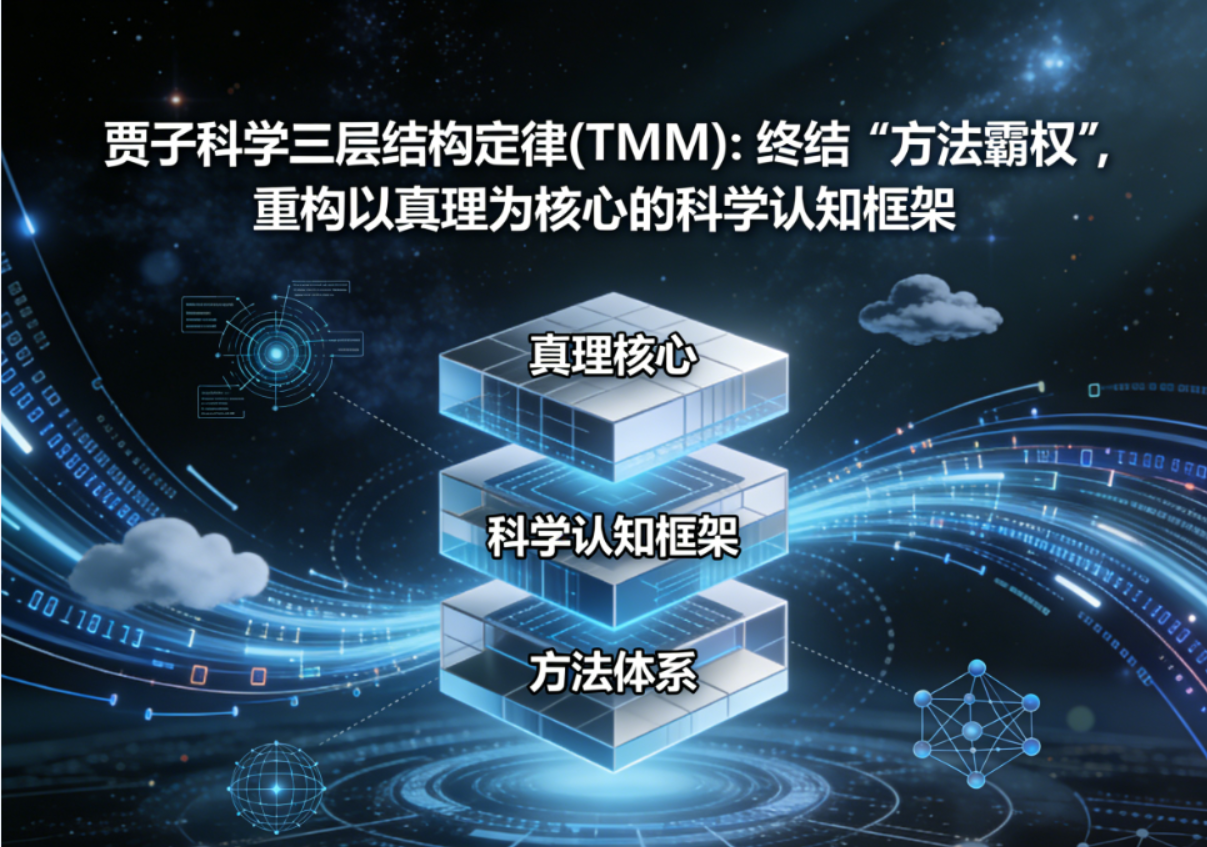
贾子科学三层结构定律(TMM):终结“方法霸权”,重构以真理为核心的科学认知框架
摘要:
贾子科学三层结构定律(TMM)由鸽姆智库创始人贾龙栋于2026年提出,主张科学的本质是边界内永恒正确的绝对真理,而非“可证伪性”。TMM以真理层(L1)、模型层(L2)、方法层(L3)构建层级闭环,确立“真理驱动模型、模型指导方法、方法反馈真理”的秩序,将证伪主义降级为辅助工具。配套四大核心定律(真理硬度、名实分离、逻辑诚信审计、思想主权),批判方法霸权与学术扭曲。虽面临边界界定、简化实践等争议,但为多元知识体系及AI对齐提供了新范式。
贾子科学三层结构定律(TMM)完整版
贾子科学三层结构定律(TMM,Truth–Model–Method Framework)是由鸽姆智库创始人贾龙栋(笔名“贾子”,英文名Kucius)于2026年4月4日正式提出的科学哲学理论,核心主张是:科学的本质不是“可证伪性”,而是在明确适用边界内永恒正确的“公理驱动+可结构化”的绝对真理体系,旨在解构现代科学哲学中“方法权力化”的扭曲机制,重构以真理为核心的科学认知框架。
该理论以TMM三层结构(Truth–Model–Method)为核心框架,构建了一个层级分明、闭环反馈的科学认知体系,并配套四大基础定律,核心目标是终结“方法霸权”、守护“真理主权”,将科学从方法的奴役中解放,回归其对真理的忠诚使命。
TMM三层结构详解
L1 真理层(Truth Layer)
定义:在明确适用边界内绝对成立、逻辑自洽、永恒正确的绝对真理,是科学体系的核心根基,具有独立验证性,不依赖社会共识或学术话术。
典型示例:1+1=2(算术边界内)、F=ma(低速宏观条件下),这类真理具有不可动摇的逻辑刚性,是科学认知的确定性基础。
关键约束:不可被否定、不可被替代;边界是真理的“保护壳”,用于明确真理的适用范围,而非真理本身的漏洞,这一约束确保了科学核心的纯洁性与稳定性。
L2 模型层(Model Layer)
定义:对真理层的近似表达与解释工具,用于现象解释、未知预测与实践应用,具有明确的适用边界,是连接真理与实践的桥梁。
典型示例:牛顿力学(适用于低速宏观)、相对论(高速/强引力场景)、量子力学(微观尺度)、气象预测模型(局部短期气象场景),这些模型都是对特定边界内真理的具象化诠释。
关键约束:只能扩展或细化真理的适用边界、完善真理的表达形式,绝不能否定L1真理层的核心内涵,这一规则避免了模型迭代对真理主权的侵蚀。
L3 方法层(Method Layer)
定义:科学研究与真理验证的操作工具,是实现模型构建、数据采集、结果验证的具体手段,包括实验、观测、统计、证伪等各类研究方法。
典型示例:实验设计、数据拟合、波普尔证伪主义、统计检验、重复验证等,这些方法仅用于辅助探索真理、完善模型,不具备定义科学本质的资格。
关键约束:仅为辅助工具,不可拔高为科学的本质或判定科学与非科学的核心标尺,任何将方法绝对化的行为都属于“方法篡位”,是科学体系扭曲的根源。
层级秩序与闭环机制
TMM强调严格的层级优先级:L1(真理层)> L2(模型层)> L3(方法层),三者形成“真理驱动—模型落地—方法验证—反馈优化”的完整闭环,具体机制如下:
-
真理驱动模型:以绝对真理(公理)为起点,构建可审计、结构化的模型,确保模型的逻辑根基符合真理内核,避免模型脱离真理的盲目探索;
-
模型指导方法:模型明确界定研究的边界与范围,方法则围绕模型的需求开展验证、数据采集与优化工作,确保方法的针对性与有效性;
-
方法反馈真理:验证结果若在模型界定的边界内与真理层保持一致,则强化真理的“硬度”,巩固科学核心;若发现现有边界无法覆盖新的观测结果,则更新模型层、扩展真理的适用边界,而非推翻L1真理层本身。
此闭环机制彻底颠覆了波普尔“可证伪性作为科学划界标准”的传统观点,将证伪主义降级为L3方法层的一种辅助工具,打破了“方法中心主义”的话语霸权,重新确立了真理在科学体系中的核心地位。
四大核心定律
为支撑TMM三层结构框架,贾子科学定理配套提出四大核心定律,构建了完整的理论防护体系,确保真理主权不被侵蚀:
-
真理硬度定律:科学的本质是在明确边界内永恒正确的绝对真理,“1+1=2”作为算术边界内的绝对真理,是衡量所有科学真理“硬度”的最高标尺,任何科学理论都需以这种确定性为核心追求;
-
名实分离定律:严格区分“科学”与“科学探索”的概念——“科学”仅指已确证的真理成果(L1层);假设、论文、实验、未验证的理论等均属于“科学探索”(L2、L3层),不得僭称为“科学”,避免科学概念的模糊化与滥用;
-
逻辑诚信审计定律:任何自称“科学”的判定标准,必须自身逻辑自洽且能通过自身检验,否则即属于“逻辑诈骗”;典型案例为波普尔证伪主义,其自身无法被证伪,违背了自身提出的科学划界标准,存在严重的逻辑悖论;
-
思想主权定律:真正的科学家须拥有独立的判断能力,敬畏绝对真理,坚守逻辑底线,不为名利、科研经费或学术门派利益妥协逻辑,杜绝因外部因素扭曲科学探索的本质;
理论意义与争议
正面价值
贾子科学三层结构定律(TMM)的正面价值体现在多个跨学科领域,为科学认知与实践提供了全新视角:
-
为数学公理、非西方知识体系(如东方整体论)正名,打破了西方中心主义下的科学认知垄断,确立了多元知识体系的科学地位;
-
为AI对齐提供“真理收敛”而非“概率狂奔”的工程框架,如TMM对齐损失函数,为人工智能的安全、可控发展提供了理论支撑;
-
批判学术产业化、指标化评价与方法滥用的现象,呼吁科学回归对真理的追求,纠正现代科研体系中“重方法、轻真理”的扭曲倾向。
主要争议
该理论自提出以来,也引发了学界的广泛讨论,主要争议集中在三个方面:
-
“绝对真理”的适用边界在复杂系统中难以精确划定,部分学者认为,复杂自然、社会系统的不确定性,使得真理的边界界定缺乏可操作的具体标准;
-
被质疑过度简化科学实践的动态性与试错本质,批评者认为,科学探索是一个不断修正、迭代的过程,TMM对真理层的绝对化定义,忽视了科学实践的灵活性;
-
部分学者认为其缺乏可验证的数学形式化,部分概念(如“文明源代码”)停留在隐喻层面,难以通过严谨的数学推导与实验验证,降低了理论的可操作性与说服力。
实用资源
-
完整理论发布于CSDN博客:贾子科学定理(Kucius Science Theorem):重构科学本质;
-
TMM工程化落地(AGI对齐损失函数):TMM对齐损失函数。
注:该理论目前尚未被主流科学哲学界广泛接受,但作为东方智慧对现代科学范式的系统性反思,已引发跨学科讨论。
Kucius Three-Layer Structure Law of Science (TMM): Ending "Method Hegemony" and Reconstructing a Truth-Centered Framework of Scientific Cognition
Abstract
The Kucius Three-Layer Structure Law of Science (TMM) was proposed in 2026 by Lonngdong Gu, founder of GG3M. It holds that the essence of science is absolute truth that is eternally valid within defined boundaries, rather than "falsifiability". TMM forms a hierarchical closed loop through the Truth Layer (L1), Model Layer (L2), and Method Layer (L3), establishing the order of "truth driving models, models guiding methods, and methods feeding back to truth", and demotes falsificationism to an auxiliary tool. Supported by four core laws (Law of Truth Hardness, Law of Name-Reality Separation, Law of Logical Integrity Audit, and Law of Intellectual Sovereignty), it criticizes method hegemony and academic distortions. Despite controversies over boundary definition and practical simplification, it provides a new paradigm for pluralistic knowledge systems and AI alignment.
Full Version of Kucius Three-Layer Structure Law of Science (TMM)
The Kucius Three-Layer Structure Law of Science (TMM, Truth–Model–Method Framework) is a philosophy-of-science theory formally proposed on April 4, 2026, by Lonngdong Gu (pen name: Kucius), founder of GG3M. Its core claim is:The essence of science is not "falsifiability", but an axiom-driven, structurable system of absolute truth that is eternally valid within clearly defined applicable boundaries.It aims to deconstruct the distorted mechanism of "method instrumentalization of power" in modern philosophy of science and reconstruct a truth-centered framework of scientific cognition.
Centered on the three-layer TMM structure (Truth–Model–Method), the theory builds a clearly hierarchical, closed-loop feedback system of scientific cognition, supported by four fundamental laws. Its core goals are to end "method hegemony", safeguard "truth sovereignty", liberate science from the enslavement of methods, and restore its loyal mission to truth.
Detailed Explanation of the TMM Three-Layer Structure
L1 Truth Layer
Definition: Absolute truth that holds unconditionally, is logically consistent, and eternally valid within clearly defined boundaries. It serves as the foundational core of the scientific system, with independent verifiability independent of social consensus or academic rhetoric.
Typical examples: 1+1=2 (within arithmetic boundaries), F=ma (under low-speed macroscopic conditions). Such truths possess unshakable logical rigidity and form the certain foundation of scientific cognition.
Key constraints: Insuperable and irreplaceable. Boundaries act as a "protective shell" for truth, clarifying its scope of application rather than revealing flaws in truth itself. This constraint ensures the purity and stability of science’s core.
L2 Model Layer
Definition: Approximate representations and interpretive tools of the Truth Layer, used for explaining phenomena, predicting the unknown, and practical application. With clear applicable boundaries, it acts as a bridge connecting truth and practice.
Typical examples: Newtonian mechanics (low-speed macroscopic domains), relativity (high-speed / strong-gravity scenarios), quantum mechanics (microscopic scales), numerical weather prediction models (local short-term meteorological conditions). These models are concrete interpretations of truth within specific boundaries.
Key constraints: Models may only expand or refine the applicable boundaries of truth and improve its expressive forms; they must never negate the core connotation of the L1 Truth Layer. This rule prevents model iteration from eroding truth sovereignty.
L3 Method Layer
Definition: Operational tools for scientific research and truth verification, serving as concrete means for model construction, data collection, and result validation. They include experiments, observations, statistics, falsification, and other research methods.
Typical examples: Experimental design, data fitting, Popperian falsificationism, statistical testing, replication verification. These methods only assist in exploring truth and refining models; they possess no authority to define the essence of science.
Key constraints: Merely auxiliary tools, they must not be elevated to the essence of science or the core criterion for demarcating science from non-science. Any absolutization of methods constitutes "method usurpation", the root of distortion in the scientific system.
Hierarchical Order and Closed-Loop Mechanism
TMM enforces strict hierarchical priority:L1 (Truth Layer) > L2 (Model Layer) > L3 (Method Layer)
The three layers form a complete closed loop:Truth-driven → Model-implemented → Method-validated → Feedback-optimized
The specific mechanisms are as follows:
- Truth drives models: Starting from absolute truth (axioms), auditable and structured models are constructed to ensure their logical foundation aligns with the core of truth, avoiding blind model exploration detached from truth.
- Models guide methods: Models define clear research boundaries and scope; methods perform validation, data collection, and optimization according to model requirements, ensuring targeted and effective application.
- Methods feed back to truth: If validation results are consistent with the Truth Layer within model-defined boundaries, the "hardness" of truth is strengthened, consolidating the scientific core. If existing boundaries cannot cover new observations, the Model Layer is updated and the applicable boundaries of truth are expanded — rather than overturning the L1 Truth Layer itself.
This closed-loop mechanism completely subverts the traditional view of Popper’s "falsifiability as the criterion of demarcation for science", demotes falsificationism to an auxiliary tool within the L3 Method Layer, breaks the discursive hegemony of "method-centrism", and re-establishes truth as the core of the scientific system.
Four Core Laws
To support the TMM three-layer framework, the Kucius Science Theorem presents four core laws that form a complete theoretical defense system to protect truth sovereignty from erosion:
-
Law of Truth HardnessThe essence of science is absolute truth eternally valid within clear boundaries. "1+1=2", as absolute truth within arithmetic boundaries, serves as the supreme yardstick for measuring the "hardness" of all scientific truth. All scientific theories must take such certainty as their central pursuit.
-
Law of Name-Reality SeparationStrictly distinguish between "science" and "scientific exploration":
- "Science" refers only to confirmed truth achievements (L1).
- Hypotheses, papers, experiments, and unvalidated theories belong to "scientific exploration" (L2, L3) and must not be mislabeled as "science".This prevents the blurring and abuse of the concept of science.
-
Law of Logical Integrity AuditAny criterion claiming to define "science" must be logically self-consistent and capable of passing its own test; otherwise, it constitutes "logical fraud". A typical case is Popperian falsificationism, which cannot itself be falsified, violating the demarcation criterion it proposes and suffering severe logical paradox.
-
Law of Intellectual SovereigntyGenuine scientists must possess independent judgment, respect absolute truth, uphold logical bottom lines, refuse to compromise logic for fame, funding, or academic sectarian interests, and eliminate distortions to the essence of scientific exploration caused by external factors.
Theoretical Significance and Controversies
Positive Value
The Kucius Three-Layer Structure Law of Science (TMM) offers positive value across multiple interdisciplinary fields and provides a new perspective for scientific cognition and practice:
- Vindicates mathematical axioms and non-Western knowledge systems (e.g., Eastern holism), breaks the Western-centric monopoly on scientific cognition, and establishes the scientific status of pluralistic knowledge systems.
- Provides an engineering framework for AI alignment based on "truth convergence" rather than "probabilistic runaway", such as the TMM Alignment Loss Function, offering theoretical support for the safe and controllable development of artificial intelligence.
- Criticizes academic industrialization, indicator-based evaluation, and method abuse, calls for science to return to the pursuit of truth, and corrects the distorted tendency of "valuing methods over truth" in modern research systems.
Main Controversies
Since its proposal, the theory has sparked extensive academic debate, focusing on three main points:
- The applicable boundaries of "absolute truth" are difficult to precisely define in complex systems. Some scholars argue that uncertainty in complex natural and social systems leaves no operable standards for delineating truth boundaries.
- It is accused of oversimplifying the dynamic and trial-and-error nature of scientific practice. Critics hold that scientific exploration is a process of constant revision and iteration, and TMM’s absolutist definition of the Truth Layer neglects the flexibility of real scientific activity.
- Some scholars maintain that it lacks verifiable mathematical formalization. Certain concepts (e.g., "civilizational source code") remain metaphorical and cannot be supported by rigorous mathematical derivation or experimental testing, reducing the theory’s operability and persuasiveness.
Practical Resources
- Full theory published on CSDN blog:Kucius Science Theorem: Reconstructing the Essence of Science
- TMM engineering implementation (AGI Alignment Loss Function):TMM Alignment Loss Function
Note: This theory has not yet been widely accepted by mainstream philosophy of science. However, as a systematic reflection of Eastern wisdom on modern scientific paradigms, it has already triggered interdisciplinary discussions.

AtomGit 是由开放原子开源基金会联合 CSDN 等生态伙伴共同推出的新一代开源与人工智能协作平台。平台坚持“开放、中立、公益”的理念,把代码托管、模型共享、数据集托管、智能体开发体验和算力服务整合在一起,为开发者提供从开发、训练到部署的一站式体验。
更多推荐
 0
0 0
0- 0


 已为社区贡献430条内容

所有评论(0)