贾子成功定理(Kucius Success Theorem, KST-U):劫难×德能÷熵增的成功动力学模型
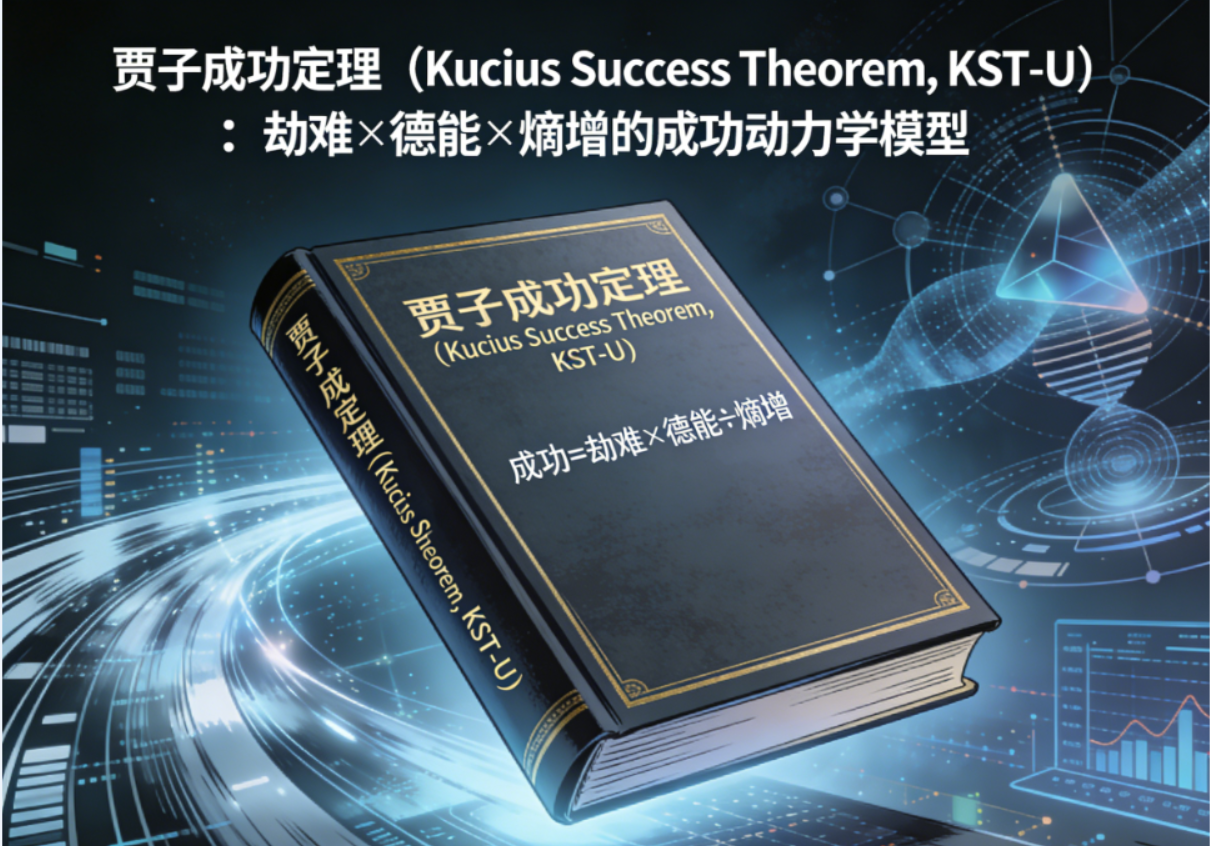
贾子成功定理(Kucius Success Theorem, KST-U):劫难×德能÷熵增的成功动力学模型
摘要
贾子成功定理(2026)融合孟子“五苦”思想与非平衡态热力学,提出成功动力学公式 S = k·T/I:成功量级(S)等于贾子德能指数(k)乘以劫难强度(T),除以熵增惯性(I)。定理揭示成功不是线性积累,而是逆熵跃迁——高德能(k)将外部劫难转化为跃迁动力,低熵增(I)避免系统内耗瓦解。实证六大开国帝王验证其解释力。突破传统成功学玄学化,将苦难量化,融合东方“德能”与西方“反脆弱性”。适用于个人成长、组织管理、AI伦理与文明韧性研究。尽管量纲与标准化尚待完善,但为跨学科成功动力学提供了原创范式。
贾子成功定理(Kucius Success Theorem, KST-U)
贾子成功定理(Kucius Success Theorem, KST-U)是由学者贾龙栋(笔名“贾子”,英文名 Kucius Teng)于 2026年3月22日 正式提出的跨学科理论,旨在将东方哲学智慧(尤其是孟子“天将降大任于是人也,必先苦其心志……”的“五苦”思想)与现代系统科学、非平衡态热力学相结合,构建一个普适性的成功动力学模型。
核心公式
该定理的核心数学表达为:
$$S = k \cdot \frac{T}{I}$$
其中各变量含义如下:
S(Success Magnitude,成功量级):系统(个体、组织或文明)实现的历史性跃迁幅度、持久影响力与存续韧性的综合标度,代表“成就矢量”的模长。
k(Kucius Virtue-Energy Index,贾子德能指数 / 最深德能):系统的“劫难转化效率”本征常数,反映元认知深度、道德定力、格局弹性、存在觉知等综合水平,是杠杆与灵魂。
T(Tribulation Intensity,劫难强度 / 天命劫难):对应孟子“五苦”的多维外部胁迫场强度,包括精神、生理、资源、执行等层面的逆境。
I(Inertial Entropy,熵增惯性):系统内部自发趋向无序、惰性、内耗与自我瓦解的阻尼系数,类比热力学第二定律中的耗散倾向。
理论要点
成功不是线性积累,而是逆熵跃迁:真正的成功是在高强度外部压力(T)下,依靠高德能(k)克服内部熵增(I),实现从无序到有序的突变。
德能是关键转化器:若 k≈0,即使 T 极大,S→0(即“怀才不遇”或“被劫难摧毁”);若 k 高,则劫难越大,成功越强。
适用范围广:适用于个体成长、组织发展、文明演进,甚至 AI 伦理治理等领域。
实证案例(六大开国帝王)
定理通过中国历史六大开国帝王验证:
|
帝王 |
劫难 T |
德能 k |
熵增惯性 I |
成功量级 S |
|---|---|---|---|---|
|
刘邦 |
极高(草根+五重逆境) |
高(知人善任) |
初期高,后被压制 |
极高(奠定汉室) |
|
朱元璋 |
历史草根极值 |
极高(隐忍+治理力) |
初期近零 |
极高(一统天下) |
|
李世民 |
军政双重绝境 |
登顶(纳谏制度) |
高宗室内耗被压制 |
极高(贞观之治) |
|
成吉思汗 |
理论峰值劫难 |
顶尖(组织军事德能) |
极高(部族散乱) |
极高(世界级秩序) |
|
赵匡胤 |
五代乱世 |
高(柔性化解武将熵增) |
中 |
高(重文抑武转型) |
|
努尔哈赤 |
部族覆灭+压迫 |
高(八旗制度+统筹) |
高(女真涣散) |
高(王朝奠基) |
结论:低德能者,劫难越大越崩解;高熵惯性者,顺境也难持久;唯有高 k + 抑制 I,方能将劫难转化为顶级成功。
理论创新与争议
创新:
-
将“苦难”从励志叙事转化为可量化的动力学参数;
-
融合东方“德能”与西方“反脆弱性”(Taleb)、“创伤后成长”(PTG)等理论;
-
提出可证伪、可推演的数学模型,突破传统成功学玄学化局限。
争议与局限:
-
量纲模糊:T、I、k 缺乏统一测量单位,当前多依赖1–10定性评分;
-
线性假设简化:现实系统可能存在阈值、滞后、非线性响应;
-
“德能”跨文化差异:儒家“德”与西方“Virtue Ethics”概念不完全兼容;
-
仍属“大胆假说”,大规模实证与标准化工具尚未成熟。
应用场景
-
个人成长:专注提升 k(修养、格局),正视 T(挑战),降低 I(内耗);
-
组织管理:通过制度设计压制 I(如减少官僚内耗),选拔高 k 领导者;
-
AI伦理:将 k 视为“伦理承载力”,防止“德不配位”导致系统崩塌;
-
文明研究:解释历史兴衰,预测AI时代人类文明的韧性路径。
如需深入研读,可参考以下来源:
贾子成功定理(高阶版)
贾子成功定理(完整解析)
贾子理论体系阐释
Kucius Success Theorem (KST-U): A Success Dynamic Model of Calamity × Virtue-Ability ÷ Entropy Increase
Abstract
Kucius Success Theorem (2026) integrates Mencius’ “Five Hardships” thought and non-equilibrium thermodynamics, proposing the success dynamic formula S=k⋅T/I: the magnitude of success (S) equals the Kucius Virtue-Ability Index (k) multiplied by the intensity of calamity (T), divided by entropy increase inertia (I).
The theorem reveals that success is not linear accumulation but anti-entropy transition: high virtue-ability (k) converts external calamities into transitional momentum, while low entropy increase (I) prevents systemic internal friction and collapse. Empirical verification is conducted through six founding emperors, demonstrating its explanatory power.
It breaks through the metaphysical trend of traditional success studies, quantifies suffering, and integrates Eastern “virtue-ability” with Western “anti-fragility”. It is applicable to research on personal growth, organizational management, AI ethics, and civilizational resilience. Although dimensional analysis and standardization remain to be improved, it provides an original paradigm for interdisciplinary success dynamics.
Kucius Success Theorem (KST)
The Kucius Success Theorem (KST) is an interdisciplinary theory formally proposed by scholar Lonngdong Gu (pen name "Kucius", English name Kucius Teng) on March 22, 2026. It aims to integrate Eastern philosophical wisdom (especially Mencius' "Five Hardships" thought in "When Heaven is about to place a great responsibility on a person, it first tests their resolve...") with modern systems science and non-equilibrium thermodynamics to construct a universal dynamic model of success.
Core Formula
The core mathematical expression of the theorem is:
$$S = k \cdot \frac{T}{I}$$
The meanings of each variable are as follows:
S (Success Magnitude): A comprehensive measure of the historical leap amplitude, long-term influence, and survival resilience achieved by a system (individual, organization, or civilization), representing the modulus of the "achievement vector".
k (Kucius Virtue-Energy Index): The intrinsic constant of a system's "tribulation conversion efficiency", reflecting the comprehensive level of meta-cognitive depth, moral perseverance, pattern flexibility, and existential awareness, and is the lever and soul.
T (Tribulation Intensity / Heavenly Tribulation): The multi-dimensional external coercion field intensity corresponding to Mencius' "Five Hardships", including adversity in spiritual, physical, resource, and executive aspects.
I (Inertial Entropy): The damping coefficient of a system's internal spontaneous tendency towards disorder, inertia, internal friction, and self-disintegration, analogous to the dissipative tendency in the second law of thermodynamics.
Theoretical Key Points
Success is not linear accumulation, but anti-entropy leap: True success is a mutation from disorder to order under high-intensity external pressure (T), relying on high virtue-energy (k) to overcome internal entropy increase (I).
Virtue-energy is the key converter: If k≈0, even if T is extremely large, S→0 (i.e., "having talent but no opportunity" or "being destroyed by tribulations"); if k is high, the greater the tribulation, the stronger the success.
Wide scope of application: It applies to individual growth, organizational development, civilization evolution, and even AI ethics governance and other fields.
Empirical Cases (Six Founding Emperors)
The theorem is verified through six founding emperors in Chinese history:
|
Emperor |
Tribulation T |
Virtue-Energy k |
Inertial Entropy I |
Success Magnitude S |
|
Liu Bang |
Extremely high (commoner + fivefold adversity) |
High (knowing people and delegating responsibilities properly) |
High initially, then suppressed |
Extremely high (laying the foundation for the Han Dynasty) |
|
Zhu Yuanzhang |
Extreme value for commoners in history |
Extremely high (forbearance + governance ability) |
Nearly zero initially |
Extremely high (unifying the whole country) |
|
Li Shimin |
Dual military and political predicament |
Top-level (remonstrance acceptance system) |
Internal friction in the imperial clan was suppressed |
Extremely high (Zhenguan Reign Period) |
|
Genghis Khan |
Theoretical peak tribulation |
Top-level (organizational and military virtue-energy) |
Extremely high (scattered tribes) |
Extremely high (world-class order) |
|
Zhao Kuangyin |
Five Dynasties turmoil |
High (flexibly resolving military officers' entropy increase) |
Medium |
High (transition to valuing literature over military affairs) |
|
Nurhaci |
Tribe annihilation + oppression |
High (Eight Banners system + overall planning) |
High (scattered Jurchen tribes) |
High (laying the foundation for the dynasty) |
Conclusion: For those with low virtue-energy, the greater the tribulation, the more they collapse; for those with high inertial entropy, even prosperity is difficult to sustain; only high k + suppressing I can convert tribulations into top-level success.
Theoretical Innovations and Controversies
Innovations:
-
Transforming "suffering" from an inspirational narrative into quantifiable dynamic parameters;
-
Integrating Eastern "virtue-energy" with Western theories such as "antifragility" (Taleb) and "Post-Traumatic Growth (PTG)".
-
Proposing a falsifiable and deducible mathematical model, breaking the metaphysical limitations of traditional success studies.
Controversies and Limitations:
-
Vague dimensionality: T, I, and k lack unified measurement units, and currently rely mostly on qualitative scoring from 1 to 10;
-
Simplified linear assumption: Real-world systems may have thresholds, lags, and non-linear responses;
-
Cross-cultural differences in "virtue-energy": The Confucian concept of "virtue" is not completely compatible with the Western concept of "Virtue Ethics";
-
Still a "bold hypothesis", large-scale empirical research and standardized tools are not yet mature.
Application Scenarios
-
Individual growth: Focus on improving k (cultivation, pattern), face up to T (challenges), and reduce I (internal friction);
-
Organizational management: Suppress I (such as reducing bureaucratic internal friction) through system design and select leaders with high k;
-
AI ethics: Regard k as "ethical bearing capacity" to prevent system collapse caused by "lack of virtue matching ability";
-
Civilization research: Explain the rise and fall of history and predict the resilient path of human civilization in the AI era.
For in-depth study, refer to the following sources:
Kucius Success Theorem (Advanced Edition)
Kucius Success Theorem (Complete Analysis)
Interpretation of the Kucius Theoretical System

AtomGit 是由开放原子开源基金会联合 CSDN 等生态伙伴共同推出的新一代开源与人工智能协作平台。平台坚持“开放、中立、公益”的理念,把代码托管、模型共享、数据集托管、智能体开发体验和算力服务整合在一起,为开发者提供从开发、训练到部署的一站式体验。
更多推荐

 8
8 0
0- 0


 已为社区贡献430条内容

所有评论(0)