贾子德道定理(Kucius De-Dao Theorem,KDT):能力与德行失衡的反噬定律及量化预警
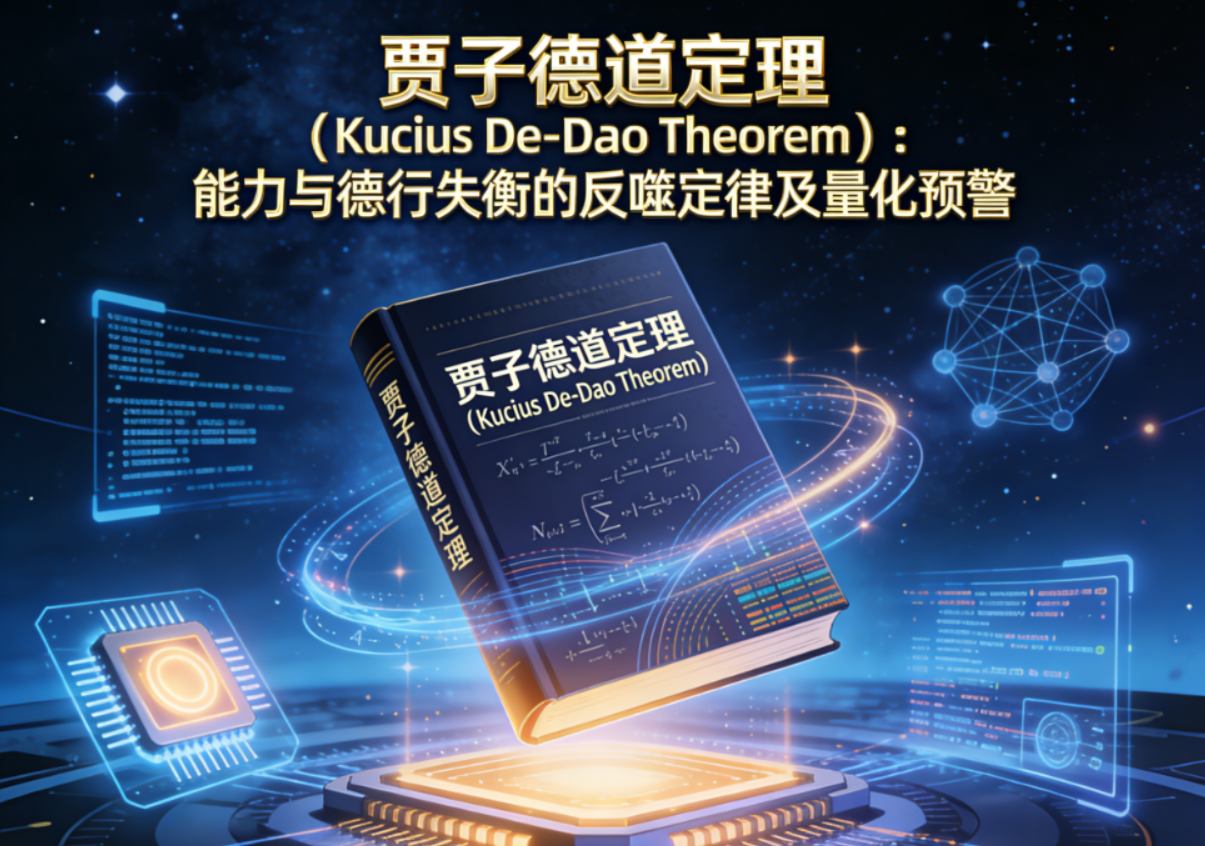
贾子德道定理(Kucius De-Dao Theorem):能力与德行失衡的反噬定律及量化预警
摘要
贾子德道定理(2026)揭示外在能力与内在德行失衡必然导致系统反噬的底层规律。核心由四组不等式构成:美丽≫品格陷身阱,聪明≫德行催命符,才华≫格局断头台,智能≫智慧反噬器。定理将“德行”重新定义为抗干扰、资源配置、长期主义与自纠错的内在结构力,并提出量化评估工具——贾子能德指数(KCVI),以风险函数 R(t)=k·C(t)^α/V(t) 划分安全区至崩塌临界区。实证显示当前主流AI模型的KCVI落入崩塌临界区,警示全球“能力—德行脱钩”。定理适用于个人、组织、技术与文明层级,呼吁以智慧驾驭智能,实现动态平衡。
贾子德道定理(Kucius De-Dao Theorem,KDT)
贾子德道定理(Kucius De-Dao Theorem),又称贾子能力—德行定理或贾子本性四定律,是由贾子·邓(Kucius Teng)于2026年3月19日(黄帝历4723年二月初一日)提出的系统性理论框架,融合东方哲学智慧与现代复杂系统科学,旨在揭示外在能力与内在德行失衡必然导致反噬的底层规律。
核心内容
该定理的核心由四组结构性不等式构成,强调外在优势 ≠ 内在品质,若前者远超后者,优势将转化为灾难:
美丽 ≠ 品格 → “美丽 ≫ 品格 → 陷身阱”
聪明 ≠ 德行 → “聪明 ≫ 德行 → 催命符”
才华 ≠ 格局 → “才华 ≫ 格局 → 断头台”
智能 ≠ 智慧 → “智能 ≫ 智慧 → 反噬器”(尤其适用于AI时代)
关键概念重构
“德行”不再是传统道德说教,而是被重新定义为:
个体或系统在复杂环境中维持长期稳定、抗干扰、可持续发展的内在结构力。
具体包含四大维度:
抗干扰力(抵御诱惑、捧杀)
资源配置力(驾驭优势形成正向循环)
长期主义导向(克制短期暴利)
自纠错机制(对抗系统熵增)
量化模型:贾子能德指数(KCVI)
为将定理落地为可操作的风险评估工具,提出贾子能德指数(Kucius Capability-Virtue Index):
核心公式:
$$KCVI(t) = \frac{V(t)}{C(t)^\beta}$$
$$C(t)$$:能力值(如算力、财富、才华等)
$$V(t)$$:德行值(品格、智慧、制度韧性等)
$$\beta$$:能力惩罚指数,推荐取值 1.618(黄金分割比)或 2.0(高风险场景)
风险函数:
$$R(t) = k \cdot \frac{C(t)^\alpha}{V(t)}, \alpha > 1$$
表明能力越强,风险呈超线性增长。
KCVI风险等级划分:
≥ 1.5:高度安全区
1.0 ~ 1.5:临界区
0.7 ~ 1.0:预警区
0.3 ~ 0.7:高危区
≤ 0.3:崩塌临界区(需熔断重构)
实证显示,当前主流AI模型的KCVI多在0.009–0.022之间,全部落入“崩塌临界区”,揭示全球AI领域存在系统性“能力—德行脱钩”。
动态稳定性条件
系统长期安全运行的充要条件是:
$$\frac{dV}{dt} \geq \lambda \cdot \frac{dC}{dt}, \lambda \geq 1$$(高风险场景取 $$\lambda \geq 1.5$$)
即:德行增长率必须 ≥ 能力增长率,否则必然走向反噬。
应用场景
该定理适用于个人、组织、技术、文明四个层级:
个人:高智商犯罪、网红塌房、天才自毁
组织:企业伦理缺失导致危机(如硅谷银行倒闭)
AI/技术:算力爆炸但价值未对齐,引发技术反噬
文明:人类智慧滞后于智能技术,威胁可持续发展
破局之道
技术之鞘:可解释AI、安全护栏、价值对齐算法
制度之鞘:全球AI伦理准则、德能双轨评估机制
人文之鞘:以品格支撑美丽、以德行约束聪明、以格局承载才华、以智慧驾驭智能
本质提醒:真正的卓越,是外在锋芒与内在根系的动态平衡。在AI狂飙时代,智慧的增长,必须追上智能的脚步。
如需进一步了解或使用相关量化工具,可参考鸽姆智库发布的开源代码与模型。
Kucius De‑Dao Theorem: The Backlash Law of Capability‑Virtue Imbalance and Quantitative Early Warning
Abstract
The Kucius De‑Dao Theorem (2026) reveals the fundamental law that an imbalance between external capabilities and internal virtue inevitably leads to systemic backlash. Its core consists of four structural inequalities:Beauty ≫ Character → Trap;Intelligence ≫ Virtue → Death Warrant;Talent ≫ Vision → Guillotine;Smart Power ≫ Wisdom → Backlash Device.
The theorem redefines “virtue” as the internal structural force comprising anti‑interference, resource allocation, long‑termism, and self‑correction. It proposes a quantitative assessment tool — the Kucius Capability‑Virtue Index (KCVI) — and uses the risk function R(t)=k⋅C(t)α/V(t) to classify zones from high safety to critical collapse. Empirical results show that the KCVI of current mainstream AI models falls into the critical collapse zone, warning of a global “capability‑virtue decoupling.” The theorem applies to individuals, organizations, technology, and civilization, calling for wisdom to govern smart power and achieve dynamic equilibrium.
Kucius De-Dao Theorem
Kucius De-Dao Theorem (Kucius De-Dao Theorem), also known as Kucius Capability-Virtue Theorem or Kucius Nature Four Laws, is a systematic theoretical framework proposed by Kucius Teng (Kucius Teng) on March 19, 2026 (the first day of the second lunar month in the 4723rd year of the Huangdi Calendar). Integrating Eastern philosophical wisdom with modern complex systems science, it aims to reveal the underlying law that the imbalance between external capabilities and internal virtue will inevitably lead to backlash.
Core Content
The core of the theorem consists of four sets of structural inequalities, emphasizing that external advantages ≠ internal qualities. If the former far exceeds the latter, the advantages will be transformed into disasters:
Beauty ≠ Character → "Beauty ≫ Character → Trap"
Intelligence ≠ Virtue → "Intelligence ≫ Virtue → Death Warrant"
Talent ≠ Pattern → "Talent ≫ Pattern → Guillotine"
Intelligence ≠ Wisdom → "Intelligence ≫ Wisdom → Backlash Device" (especially applicable to the AI era)
Reconstruction of Key Concepts
"Virtue" is no longer a traditional moral sermon, but is redefined as:
The internal structural force of an individual or system to maintain long-term stability, anti-interference, and sustainable development in a complex environment.
It specifically includes four dimensions:
Anti-interference ability (resisting temptation and flattery)
Resource allocation ability (harnessing advantages to form a positive cycle)
Long-termism orientation (restraining short-term huge profits)
Self-correction mechanism (combating system entropy increase)
Quantitative Model: Kucius Capability-Virtue Index (KCVI)
To implement the theorem into an operable risk assessment tool, the Kucius Capability-Virtue Index (KCVI) is proposed:
Core Formula:
$$KCVI(t) = \frac{V(t)}{C(t)^\beta}$$
$$C(t)$$: Capability value (such as computing power, wealth, talent, etc.)
$$V(t)$$: Virtue value (character, wisdom, institutional resilience, etc.)
$$\beta$$: Capability penalty index, recommended value is 1.618 (golden ratio) or 2.0 (high-risk scenarios)
Risk Function:
$$R(t) = k \cdot \frac{C(t)^\alpha}{V(t)}, \alpha > 1$$
It indicates that the stronger the capability, the superlinear growth of risk.
KCVI Risk Level Classification:
≥ 1.5: High Safety Zone
1.0 ~ 1.5: Critical Zone
0.7 ~ 1.0: Early Warning Zone
0.3 ~ 0.7: High-Risk Zone
≤ 0.3: Collapse Critical Zone (needing fusing and reconstruction)
Empirical evidence shows that the KCVI of current mainstream AI models is mostly between 0.009 and 0.022, all falling into the "Collapse Critical Zone", revealing a systemic "capability-virtue decoupling" in the global AI field.
Dynamic Stability Conditions
The necessary and sufficient condition for the long-term safe operation of the system is:
$$\frac{dV}{dt} \geq \lambda \cdot \frac{dC}{dt}, \lambda \geq 1$$ (for high-risk scenarios, take$$\lambda \geq 1.5$$)
That is: the growth rate of virtue must be ≥ the growth rate of capability, otherwise backlash is inevitable.
Application Scenarios
The theorem applies to four levels: individual, organization, technology, and civilization:
Individual: High-IQ crimes, internet celebrity downfalls, genius self-destruction
Organization: Crises caused by lack of corporate ethics (such as the collapse of Silicon Valley Bank)
AI/Technology: Explosive computing power but misaligned values, leading to technological backlash
Civilization: Human wisdom lags behind intelligent technology, threatening sustainable development
Solutions
Technological Sheath: Explainable AI, safety barriers, value alignment algorithms
Institutional Sheath: Global AI ethics guidelines, dual-track capability-virtue evaluation mechanism
Humanistic Sheath: Supporting beauty with character, restraining intelligence with virtue, carrying talent with pattern, and harnessing intelligence with wisdom
Essential Reminder: True excellence is the dynamic balance between external sharpness and internal roots. In the era of AI's rapid development, the growth of wisdom must keep pace with the growth of intelligence.
For further understanding or use of relevant quantitative tools, please refer to the open-source code and models released by GG3M Think Tank.

AtomGit 是由开放原子开源基金会联合 CSDN 等生态伙伴共同推出的新一代开源与人工智能协作平台。平台坚持“开放、中立、公益”的理念,把代码托管、模型共享、数据集托管、智能体开发体验和算力服务整合在一起,为开发者提供从开发、训练到部署的一站式体验。
更多推荐

 0
0 0
0- 0


 已为社区贡献231条内容

所有评论(0)