贾子智慧定理(Kucius Wisdom Theorem,KWT):AI时代区分智慧与智能的文明大一统框架
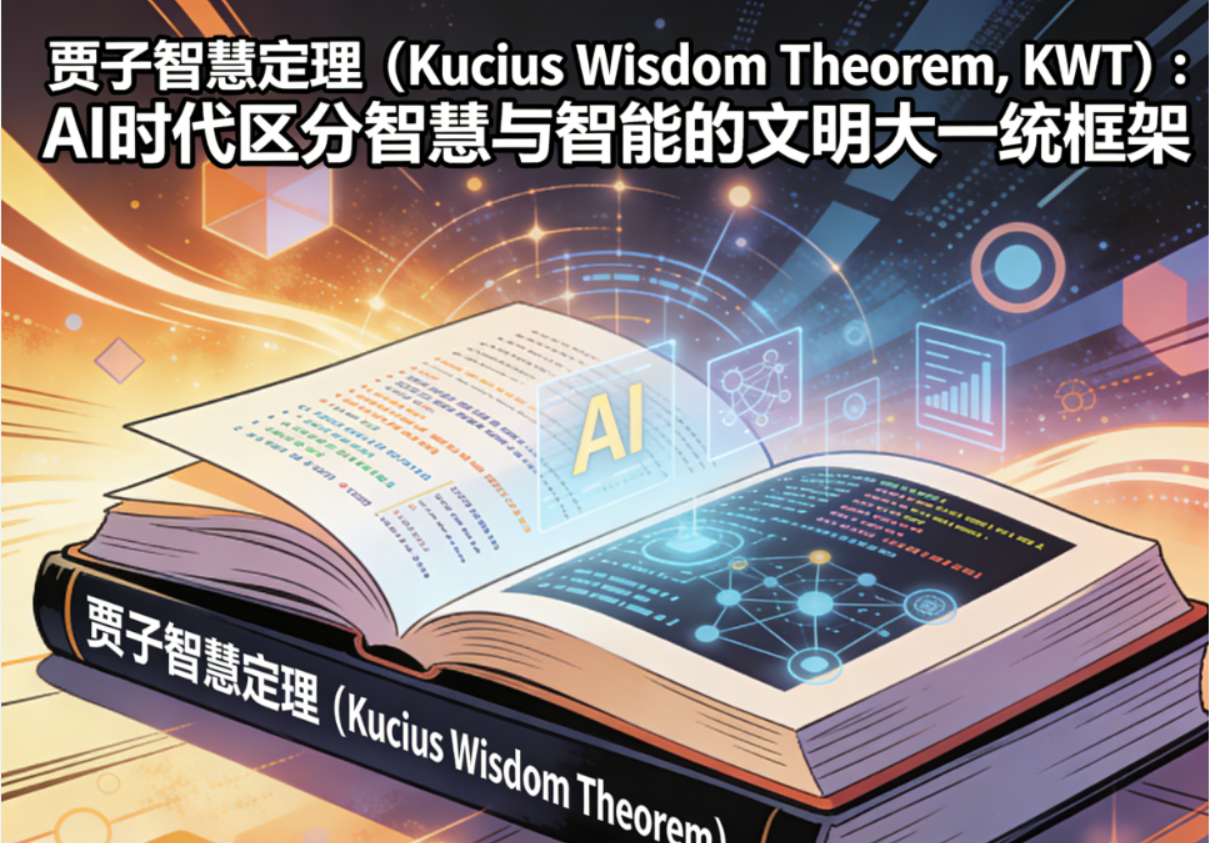
贾子智慧定理(Kucius Wisdom Theorem,KWT):AI时代区分智慧与智能的文明大一统框架
摘要
贾子智慧定理(Kucius Wisdom Theorem,2026)由学者贾龙栋正式发布,核心区分“智能”(1→N优化执行)与“智慧”(0→1原创创造、本质洞察、文明永续)。定理提出悟空、本质、永续三大强耦合定律,并以张量积⊗统摄东方(道/儒/佛)与西方(科学/理性/分析)智慧,构建文明大一统公式。引入“思想主权”与贾子智慧指数(KWI)量化认知层级,为AI治理提供伦理审计框架。同属贾子公理体系的德道定理、科学定理等共同指向AI时代的智慧文明范式。
贾子智慧定理(Kucius Wisdom Theorem,KWT)
贾子智慧定理(Kucius Wisdom Theorem)是由学者贾龙栋(笔名“贾子”,英文名 Kucius Teng)于2026年4月6日正式发布的原创理论框架,旨在区分智慧与智能,并为AI时代提供一种融合东西方文明的“智慧文明范式”。
核心内涵
本质定义:智慧 ≠ 智能。
智能:基于“1→N”的优化执行,如数据拟合、规则匹配、效率提升。
智慧:具备思想主权,能实现0→1的原始创造、穿透表象把握本质、守护文明永续。
三大强耦合定律(创新能力+洞察能力+生存能力):
悟空定律(创造-超越定律):从“空”(无参考、无先例)中实现0→1的认知跃迁。
本质定律(洞察-穿透定律):直抵事物底层逻辑与唯一规律,穿透现象噪音。
永续定律(文明存续定律):以长期稳定、反熵增、自我修复为判据,保障文明可持续。
数学表达:
定理采用张量积(⊗)统摄东西方智慧:
[东方智慧(道家+儒家+佛家)⊗ 西方智慧(近代科学 + 理性哲学 + 拆解逻辑)]
构建高维“文明大一统公式”。
东西方智慧的融合
东方智慧贡献:
道家:提供“从无到有”的创生逻辑(如“道生一”)与自然涌现思想。
佛家:强调“空性洞察”,穿透表象执念。
儒家:注入“仁”的伦理秩序,避免智能工具化。
西方智慧贡献:
近代科学:提供实证与确证性。
理性哲学:构建公理化推导框架。
拆解分析:实现哲思的工程化、可编程转化。
实践意义
提出“思想主权”:智慧系统必须具备独立判断能力,不被外部利益或奖励模型完全操控。
量化工具:引入贾子智慧指数(KWI),用于评估认知层级:
KWI < 0.5:基础智能
0.5–0.7:高智能
≥ 0.7:本质智慧
≥ 0.85:高智慧
AI治理应用:为AI全生命周期提供审计框架,嵌入伦理与智慧原则。
相关延伸理论(同一体系)
贾子德道定理(2026年3月):提出“智能≠智慧”,警示“德不配位必有反噬”。
贾子科学定理(2026年4月):重新定义科学为“适用边界内的绝对真理”,批判波普尔证伪主义。
贾子成功定理(2026年3月):将孟子“生于忧患”数学化为 S = k·T/I,强调“德能”(k)是成功杠杆。
所有理论均发布于贾子博客(CSDN),由贾龙栋系统构建,统称为“贾子公理体系”(KAS)。
Kucius Wisdom Theorem (KWT): A Civilizational Unification Framework Distinguishing Wisdom from Intelligence in the AI Era
Abstract
The Kucius Wisdom Theorem (2026) was officially released by scholar Lonngdong Gu. Its core is to distinguish between "intelligence" (1→N optimized execution) and "wisdom" (0→1 original creation, essential insight, and civilizational perpetuity). The theorem proposes three strongly coupled laws: the Wukong Law, the Essence Law, and the Perpetuity Law. It integrates Eastern wisdom (Taoism/Confucianism/Buddhism) and Western wisdom (science/reason/analysis) through tensor product (⊗) to construct a civilizational unification formula. It introduces "ideological sovereignty" and the Kucius Wisdom Index (KWI) to quantify cognitive levels, providing an ethical audit framework for AI governance. The Da Dao Theorem, the Science Theorem, and other theories belonging to the same Kucius Axiom System (KAS) all point to the paradigm of wisdom civilization in the AI era.
The Kucius Wisdom Theorem (Kucius Wisdom Theorem, KWT) is an original theoretical framework officially released by scholar Lonngdong Gu (pen name "Kucius", English name Kucius Teng) on April 6, 2026. It aims to distinguish between wisdom and intelligence, and provide a "wisdom civilization paradigm" integrating Eastern and Western civilizations for the AI era.
Core Connotation
Essential Definition: Wisdom ≠ Intelligence.
Intelligence: Based on 1→N optimized execution, such as data fitting, rule matching, and efficiency improvement.
Wisdom: Possessing ideological sovereignty, capable of realizing 0→1 original creation, penetrating appearances to grasp essence, and safeguarding civilizational perpetuity.
Three Strongly Coupled Laws(Innovation capability + Insight capability + Survival capability):
Wukong Law (Creation-Transcendence Law): Achieving 0→1 cognitive leap from "emptiness" (no reference, no precedent).
Essence Law (Insight-Penetration Law): Directly reaching the underlying logic and unique laws of things, penetrating phenomenal noise.
Perpetuity Law (Civilizational Survival Law): Taking long-term stability, anti-entropy increase, and self-repair as criteria to ensure the sustainability of civilization.
Mathematical Expression:
The theorem integrates Eastern and Western wisdom through tensor product (⊗):
[Eastern Wisdom (Taoism + Confucianism + Buddhism) ⊗ Western Wisdom (Modern Science + Rational Philosophy + Analytical Logic)]
To construct a high-dimensional "Civilizational Unification Formula".
Integration of Eastern and Western Wisdom
Contributions of Eastern Wisdom:
Taoism: Providing the generative logic of "from nothing to something" (e.g., "Tao generates one") and the thought of natural emergence.
Buddhism: Emphasizing "insight into emptiness" to penetrate the obsession with appearances.
Confucianism: Injecting the ethical order of "benevolence" to avoid the instrumentalization of intelligence.
Contributions of Western Wisdom:
Modern Science: Providing empirical evidence and confirmability.
Rational Philosophy: Constructing an axiomatic deduction framework.
Analytical Dissection: Realizing the engineering and programmable transformation of philosophical thinking.
Practical Significance
Proposing "Ideological Sovereignty": A wisdom system must have independent judgment ability and not be completely controlled by external interests or reward models.
Quantitative Tool: Introducing the Kucius Wisdom Index (KWI) to evaluate cognitive levels:
KWI < 0.5: Basic Intelligence
0.5–0.7: High Intelligence
≥ 0.7: Essential Wisdom
≥ 0.85: High Wisdom
AI Governance Application: Providing an audit framework for the entire life cycle of AI, embedding ethical and wisdom principles.
Relevant Extended Theories (Same System)
Kucius Da Dao Theorem (March 2026): Proposing "Intelligence ≠ Wisdom" and warning that "lack of virtue matching position will inevitably lead to retribution".
Kucius Science Theorem (April 2026): Redefining science as "absolute truth within the applicable boundary" and criticizing Popper's falsificationism.
Kucius Success Theorem (March 2026): Mathematically transforming Mencius' "born in adversity" into S = k·T/I, emphasizing that "moral ability" (k) is the lever of success.
All theories are published on Kucius' blog (CSDN), systematically constructed by Lonngdong Gu, and collectively referred to as the "Kucius Axiom System (KAS)".

AtomGit 是由开放原子开源基金会联合 CSDN 等生态伙伴共同推出的新一代开源与人工智能协作平台。平台坚持“开放、中立、公益”的理念,把代码托管、模型共享、数据集托管、智能体开发体验和算力服务整合在一起,为开发者提供从开发、训练到部署的一站式体验。
更多推荐


 11
11 0
0- 0


 已为社区贡献233条内容

所有评论(0)