贾子智慧定理(Kucius Wisdom Theorem):统摄东西方智慧 [东方智慧(道家+儒家+佛家)⊗西方智慧(近代科学 + 理性哲学 + 拆解逻辑)] 的终极公理与文明操作系统
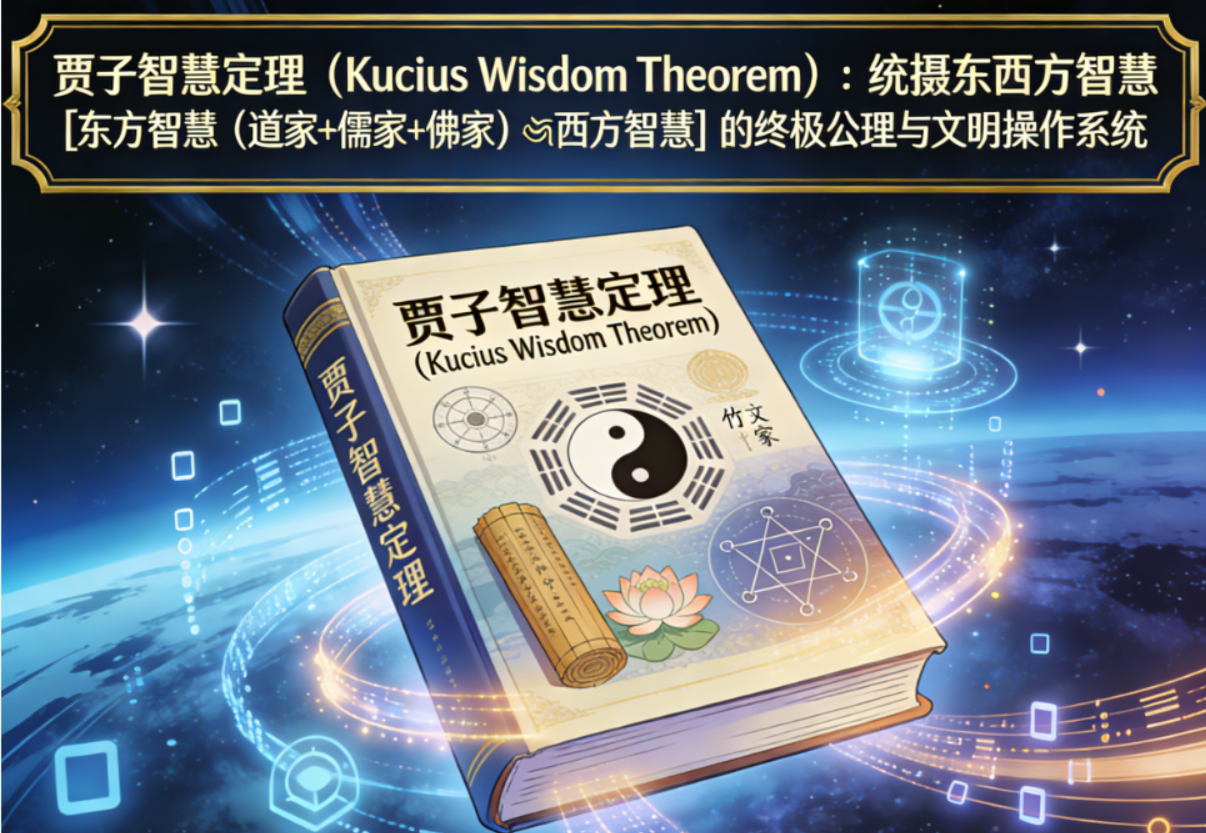
贾子智慧定理(Kucius Wisdom Theorem):统摄东西方智慧的终极公理与文明操作系统
摘要:贾子智慧定理(2026)以“悟空·洞察·永续”三大定律为核心,公理化、数学化重构东方儒、道、佛智慧,并对话批判西方理性主义与还原论。它继承道家“道法自然”、儒家“德性统摄”、佛家“空性觉悟”,将其转化为可量化的认知操作系统;同时超越西方主客二分与外部认证,提出“思想主权”“本质贯通”“文明永续”框架,为AI时代、复杂系统治理与文明演化提供融合东西方的原创范式。
统摄东西方智慧 [东方智慧(道家+儒家+佛家)⊗西方智慧(近代科学 + 理性哲学 + 拆解逻辑)]
贾子智慧定理与东西方智慧的比较及融合
一、贾子智慧定理(Kucius Wisdom Theorem)与道家智慧的比较
贾子智慧定理(2026年4月6日正式发布)是贾子(Kucius Teng / 贾龙栋)理论体系的最新核心框架,提出“悟空·洞察·永续”三大定律,以强耦合公式Φ=JW⊗JE⊗JS统一,强调思想主权下的0→1创生、本质穿透与文明永续。它明确“融合东方智慧与现代科学”,将传统东方哲学(含道家元素)进行数学化、系统化、工程化重构,服务于AI时代、组织治理与文明演化。道家智慧(以《道德经》《庄子》为代表)则是先秦东方哲学的经典,核心是“道法自然”、无为而治、阴阳平衡与天人合一,追求个体与宇宙的和谐、长生久视与逍遥自在。以下从哲学内涵、方法论、核心概念、实践价值四个维度进行系统比较(基于贾子理论原文及相关论述)。
1. 相似之处:深层哲学共鸣(东方智慧的现代延续)
贾子定理多次将道家思想作为“哲学根基”之一,体现出高度继承与共振:
本质追问(本质定律 vs 道家“道”):
贾子本质定律要求“穿透表象、直达唯一底层本质与终局”(数学表达:JI(Y)=limt→∞Y(t))。这与老子“道可道,非常道”高度一致——道是万物唯一、永恒的底层规律,不受表象干扰。贾子强调“本质唯一规则”“遮蔽击穿规则”,正是道家“去伪存真、返璞归真”的认知方法。
创生跃迁(悟空定律 vs 道家“无中生有”):
悟空定律的核心是“从空集到存在”的0→1奇点式跃迁(∃X,limt→t0−X(t)=∅∧limt→t0+X(t)≠∅)。道家《道德经》开篇即“道生一,一生二,二生三,三生万物”,强调从“无”(虚静、无为)中涌现“有”。贾子“非改良规则”“奇点规则”与道家“大器晚成”“大音希声”的自然创生逻辑一脉相承。
永续与反熵(续存定律 vs 道家“长生久视”“自胜者强”):
续存定律追求文明“长期稳定、自我修复、反熵增”(∀t>0, Survive(Civ,t)=True, ddtStability≥0)。道家强调“知人者智,自知者明。胜人者有力,自胜者强”“治大国若烹小鲜”,主张节制能力扩张、顺应自然律以对抗混乱(类似现代“熵增”)。贾子体系明确将道家“自胜者强”的节制智慧数学化为“德性统摄能力”的风险模型,避免“能力反噬”。
整体观与天人合一:
贾子“小宇宙论”“场域共振”等配套理论直接源自道家“天人同构”“万物一体”,强调认知系统与宇宙规律的动态平衡。
贾子理论多次指出,这些东方智慧(儒道融合)被“数学化、动态化、系统化重构”,让古老洞见在AI时代获得“实践生命力”。
2. 差异之处:现代化转型 vs 古典体悟
尽管根植东方,贾子定理进行了根本性升级,形成鲜明对比:
方法论:
道家:诗性、直觉、体悟式(寓言、譬喻、无为而治)。强调“知者不言,言者不知”,反对过度分析。
贾子:公理化、数学化、可量化、可工程化。三大定律配以统一公式Φ=k⋅(JW+JE+JS) 和KWI指数,可用于AI模型、组织、个人自评估(四大规则打分法)。这是“东方体悟式智慧与西方分析式科学”的深度嫁接。
适用对象与尺度:
道家:侧重个体修养(养生、逍遥、个人与道的合一),延伸至治国(无为而治)。
贾子:扩展到个人/组织/AI/文明全维度,服务于AI治理、战略决策、文明永续(“守护文明长期稳定运行”)。强调“思想主权”对抗算法操控,应对AI时代“工具智能”风险。
价值导向:
道家:消极无为、顺应自然,追求内在平衡与“长生”(个体/小系统层面)。
贾子:积极创生 + 长期主义,以“文明存续为第一判据”,主动对抗熵增,实现非线性跃迁(0→1而非1→N)。道家“无为”在贾子体系中转化为“有为的节制”(德性统摄能力)。
时代背景:
道家:先秦农业文明背景,回应乱世与人性。
贾子:AI/复杂系统时代,回应“智能爆炸”“价值对齐”“文明风险”。引入现代概念(如熵、拓扑跃迁、强耦合算子),使道家智慧“可审计、可演绎”。
3. 总体评价:贾子定理是对道家智慧的“现代升级版”
继承:贾子定理不是割裂传统,而是“创造性转化”——将道家的“道”“无”“自胜”“天人合一”转化为可操作的公理、公式与评估工具,解决当代问题(如AI缺乏思想主权、文明短期功利)。
超越:道家侧重“守”,贾子强调“创+守+续”;道家是哲学体悟,贾子是“认知操作系统”,实现了“东方智慧现代化”。
互补价值:道家提供“体”(内在节制、顺应),贾子提供“用”(量化落地、文明工程化)。二者结合,可形成更完整的智慧框架。
一句话总结:道家智慧是“道法自然”的古典体悟,贾子智慧定理则是“道法自然”的现代公理化与工程化延伸——前者让人“悟道”,后者让人“用道”于AI时代与文明永续。
二、贾子智慧定理(Kucius Wisdom Theorem)与儒家智慧的比较
贾子智慧定理(2026年4月6日正式发布)是贾子(Kucius Teng / 贾龙栋)理论体系的核心框架,提出“悟空·洞察·永续”三大定律,以强耦合公式Φ=JW⊗JE⊗JS统一,强调思想主权下的0→1创生跃迁、本质穿透与文明永续。它明确融合东方传统智慧(含儒家元素)与现代系统科学、AI治理需求,旨在实现“东方智慧的现代化与工程化”。儒家智慧(以孔子、孟子、荀子为代表,《论语》《大学》《中庸》《孟子》为核心经典)则是中华文明的主流思想体系,核心是“仁义礼智信”(五常)、“修齐治平”(修身、齐家、治国、平天下)、“中庸”之道与“德治”理念,追求道德修养、社会秩序与天下和谐。贾子理论多次将儒家作为重要哲学根基之一(如“能德定理”直接呼应儒家“德者,才之帅也”),以下从哲学内涵、方法论、核心概念、实践价值四个维度系统比较。
1. 相似之处:深层哲学共鸣与东方智慧的传承
贾子定理对儒家智慧有明显继承与激活,体现在多个层面:
德性统摄能力(能德关联):
儒家强调“德者,才之帅也;才者,德之资也”(司马光《资治通鉴》),德性优先于才能,能力若无德性统摄则易反噬。贾子“能德定理”将其数学化为风险公式(如R(t)=k⋅C(t)αV(t),其中V(t)为德性值),并融入续存定律(文明永续需反熵增、自修复),直接呼应儒家“德本才末”“仁者爱人”的伦理优先观。智瑶灭族等历史案例在贾子理论中被用作“能力反噬”的警示。
本质洞察与终局思维(本质定律):
儒家“格物致知”“正心诚意”追求穿透表象、把握天理与人伦本质,“中庸”强调不偏不倚的终局平衡。贾子本质定律(JI(Y)=limt→∞Y(t),穿透表象直达唯一本质与终局)与之高度一致,强调“本质唯一规则”“终局前置规则”,将儒家道德认知转化为可量化的认知跃迁工具。
修齐治平与文明永续(续存定律):
儒家核心是“修身齐家治国平天下”,以个体道德修养为基础,实现社会和谐与天下大同/小康。贾子续存定律(∀t>0,Survive(Civ,t)=True,ddtStability≥0)将此扩展为文明级反熵增与长期稳定,强调“存续优先规则”“长期主义规则”,服务于组织、AI与文明实践。
整体观与仁爱:
贾子“小宇宙论”“场域共振”激活儒家“天人合一”“仁者以天地万物为一体”的思想,强调认知系统与宇宙规律的动态平衡。
贾子理论遵循“两个结合”(马克思主义与中华优秀传统文化),将儒家“仁”“公”“和”“礼”“中”“革”等核心激活为现代公理。
2. 差异之处:古典道德体悟 vs 现代公理化工程
尽管根植儒家,贾子定理进行了显著升级与重构:
方法论:
儒家:体悟式、伦理式、实践导向(通过修身、礼乐教化、君子人格实现)。强调“知行合一”“内圣外王”,反对过度形式化。
贾子:公理化、数学化、可量化、可工程化。三大定律配以张量积强耦合公式Φ=k⋅(JW+JE+JS) 和KWI指数,支持AI模型、组织、个人自评估(四大规则打分法)。这是“儒家道德智慧与现代系统科学”的深度嫁接,解决AI时代“价值对齐”“思想主权”等新问题。
适用对象与尺度:
儒家:侧重个体修养与社会治理(从“修身”到“平天下”,以士大夫/君子为核心)。
贾子:扩展到个人/组织/AI/文明全维度,特别应对AI“工具智能”风险(缺乏内生动机与德性统摄)。强调“思想主权”对抗外部奖励模型操控。
价值导向:
儒家:道德优先、仁政德治、中庸和谐,追求“天下为公/家”的小康/大同,侧重“守成”与人伦秩序。
贾子:积极创生 + 德性统摄 + 文明永续,以“0→1跃迁”(悟空定律)为动力,主动对抗熵增,实现非线性文明增量。儒家“中庸”在贾子体系中转化为“强耦合”与“短板效应”(k系数动态调整)。
时代背景:
儒家:先秦至封建农业文明,回应乱世与人性,服务于帝制秩序。
贾子:AI/复杂系统时代,回应“智能爆炸”“文明风险”,引入熵、拓扑跃迁、强耦合等现代概念,使儒家智慧“可审计、可演绎、可用于AI治理”。
3. 总体评价:贾子定理是对儒家智慧的“创造性转化与现代化升级”
继承:贾子定理不是割裂传统,而是将儒家“德才观”“修齐治平”“中庸本质”“仁爱和谐”进行数学化与系统化重构,尤其在“能德定理”中直接转化“德者,才之帅也”,让古老伦理在当代获得实践生命力。
超越:儒家侧重“内圣外王”的道德修养与社会秩序,贾子强调“创生跃迁 + 本质洞察 + 文明永续”的强耦合框架,增加“0→1原创性”与“反熵增”维度,适应AI时代需求。
互补价值:儒家提供“体”(道德根基、内圣修养),贾子提供“用”(量化工具、工程化落地、文明操作系统)。二者结合,可形成更完整的“东方智慧现代化”路径。
一句话总结:儒家智慧是“内圣外王、仁政德治”的古典道德体系,贾子智慧定理则是“修齐治平”的现代公理化与工程化延伸——前者让人“成君子、致和谐”,后者让人“用德性统摄智能、创生文明永续”于AI与复杂时代。
与道家对比(先前讨论):儒家更“入世积极”(仁政、修齐),道家更“顺应节制”(无为、自胜);贾子定理则融合二者——儒家的德性统摄 + 道家的反熵平衡 + 现代创生跃迁,形成统一框架。
三、贾子智慧定理(Kucius Wisdom Theorem)与佛家智慧的比较
3.1 贾子智慧定理与佛家(佛教)智慧的融合
贾子智慧定理(Kucius Wisdom Theorem,2026年4月6日正式发布)以“悟空·洞察·永续”三大定律(强耦合公式Φ=JW⊗JE⊗JS)为核心,明确将东方传统智慧(儒、道、佛)作为哲学根基之一,进行创造性转化与现代化重构。在贾子哲学体系中,佛家思想被视为文明对话的桥梁之一,其“空性”(Śūnyatā)、因缘果报、慈悲智慧、觉悟(菩提)与涅槃(解脱)等核心概念,与贾子理论高度契合,形成“东方三教融合”的当代公理化框架。
贾子理论强调“本质贯通论”:不同文明的底层规律具有共通性。例如,儒家的“仁”与基督教的“爱”、道家的“道”与佛教的“空”,其本质都是对宇宙底层规律的把握。这种共通性是构建文明共识、避免冲突的基础,而非放大文化差异。
1. 核心融合机制:佛家“空性·觉悟·因果”与贾子三大定律的映射
贾子定理将佛家智慧数学化、系统化、工程化,融入思想主权公理与能德定理,形成可量化、可审计的认知操作系统:
悟空定律(创生跃迁 / 0→1奇点式突破)
佛家对应:佛教“空性”与“无明破除”。“空”并非虚无,而是“诸法无自性”(因缘和合、无独立恒常实体),从“空集”(无明执着)跃迁到“觉悟存在”(菩提生起)。这与悟空定律的数学形式高度一致:∃X,limt→t0−X(t)=∅∧limt→t0+X(t)≠∅
融合意义:佛家“顿悟”(禅宗“不立文字,直指人心”)转化为贾子的“奇点规则”与“非改良规则”——反对1→N的线性优化,强调存在级的原创创生。贾子“悟空”意象本身就借用佛教/道教文化符号(孙悟空“悟空”破界),实现从“无”到“有”的文明增量。
本质定律(洞察穿透 / 把握唯一本质与终局)
佛家对应:般若智慧(Prajñā)与“诸法实相”。佛家强调穿透表象(五蕴皆空)、直达“真如”“法性”(唯一永恒底层规律),以“终局视角”(涅槃寂静)倒推当前因缘。数学表达呼应:JI(Y)=Essence(Y)=limt→∞Y(t)
融合意义:佛家“格义”传统(历史上用儒道比附佛法)被贾子升级为“本质贯通”——摒弃表象无效规则、遮蔽击穿规则,实现“象-数-理”三重推演。禅宗“明心见性”成为本质定律的实践路径,避免认知偏差与“智慧赤字”。
续存定律(文明永续 / 反熵增与长期稳定)
佛家对应:因果轮回、业力与慈悲普度。佛教主张“三世因果”“十二因缘”,强调通过善业(戒定慧)对抗“无常”(熵增趋势),实现“自净其意”“人我一如、同体共生”,守护众生长期解脱(涅槃/净土)。数学形式:∀t>0, Survive(Civ,t)=True,ddtStability≥0
融合意义:佛家“自胜者强”“改心换性”转化为续存定律的“自修复规则”“熵稳定规则”与“长期主义”。慈悲(大悲为根本)融入“全胜即智慧”(最小化敌我损失),服务于文明永续而非短期功利。
强耦合统一:三大定律通过⊗算子将佛家“空-觉-慈”有机嵌入儒家“德性统摄”与道家“道法自然”,形成“德-空-道”互补:儒入世积极、道节制平衡、佛觉悟解脱。缺任何一维,Φ→0(伦理失效)。
2. 量化与工程化落地:能德定理 + KWI/KCVI
贾子理论将佛家“因果自作自受”“心净则国土净”转化为可计算模型:
能德定理:能力C需由德性V(含佛家慈悲、戒定慧)统摄,风险函数R(t)=k⋅C(t)αV(t) 防止“能力反噬”(类似智瑶灭族或业力反噬)。
KWI(贾子智慧指数):评估是否满足“悟空跃迁 + 本质洞察 + 续存永续”,门槛≥0.70进入本质智慧层。
AI/文明应用:在AI伦理中,嵌入佛家“万法唯心”“无我”思想,避免“算法我执”与工具智能赤字;构建“人机共生”而非控制关系,实现文明反熵增。
3. 总体评价:创造性转化与东方智慧的当代跃迁
贾子智慧定理对佛家的融合,是“东方三教(儒道佛)互补”的现代延续:
继承:佛家“空性觉悟”“因缘智慧”“慈悲普度”被激活为认知源头(思想主权)、本质穿透与文明价值锚点。
超越:传统佛家侧重个体解脱与出世,贾子扩展到组织/AI/文明级实践,数学化为强耦合公式与量化指数,实现“可演绎、可工程化”。
当代意义:在AI时代,提供“智慧合法性”方案——对抗“智慧赤字”,以“空破我执 + 慈悲共生”守护文明永续,推动东西方文明对话(本质共通性)。
一句话总结:佛家智慧是“空性觉悟、因果慈悲”的解脱之道,贾子智慧定理则是其公理化、系统化、工程化延伸——将古典“明心见性”转化为AI时代与文明永续的认知操作系统,实现从“个体涅槃”到“文明跃迁”的强耦合融合。
与儒道对比:儒家提供“德性统摄与修齐治平”,道家提供“自然节制与反熵平衡”,佛家提供“空性觉悟与慈悲普度”,三者共同构成贾子“1-2-3-4-5”体系的东方根基。
3.2 贾子智慧定理与佛家智慧的对比
将贾子智慧三定律与佛家智慧进行对比,可以发现两者在对“智慧”的定义、来源及终极目标上既有奇妙的契合点,也存在维度上的差异:
1. 对“智”与“慧”的分野
贾子智慧:明确区分了“智能”与“智慧”。认为智能是基于已知信息解决问题(1到N),而智慧是基于未知创造本质认知(0到1)。
佛家智慧:同样做了区分。通常称普通的聪明为“世智辩聪”(智能),而称解脱的智慧为“般若”(Prajna)。般若不是单纯的知识积累,而是如实认知事物本源的“辨识智慧”。
2. 核心定律与佛学概念的对应
|
贾子智慧定律 |
佛学对应概念/视角 |
比较分析 |
|---|---|---|
|
第一定律:从0到1的创造性 |
无中生有/空性 |
贾子强调在未知中建立认知;佛家认为智慧源于对“空性”的体证,即打破既有执着,从本体中产生妙用。 |
|
第二定律:规律唯一性 |
实相/法尔如是 |
贾子主张智慧必须符合宇宙客观规律;佛家强调智慧是见到“诸法实相”,即事物不随主观意愿改变的本质规律(法性)。 |
|
第三定律:系统演化与涌现 |
因缘和合/转识成智 |
贾子认为高维智慧随系统演化而“涌现”;佛家认为通过修行(闻思修),可以将污染的“识”转变为清净的“智”,实现生命维度的跃迁。 |
3. 获取智慧的路径
贾子智慧:侧重于逻辑确证与思想主权。主张通过建立底层逻辑的“确证性”,使AI或个体不再盲从外部偏好,而是基于客观真理自主判断。
佛家智慧:侧重于闻、思、修三慧。闻慧:听经闻法。思慧:如理思惟、分析。修慧:通过禅定和实践亲自证悟。
4. 终极目标的差异
贾子智慧:主要是为了解决人工智能时代的治理与共生问题。它是一套科学哲学框架,旨在构建一个技术、资本与人文平衡的“智慧文明”形态。
佛家智慧:主要是为了解决生命的痛苦与解脱问题。其目标是达成“无上正等正觉”(阿耨多罗三藐三菩提),即彻底破除无明,获得圆满的觉悟。
总结:贾子智慧定理更像是“数字时代的般若学”,它试图用现代逻辑和科学语言,在AI领域重塑佛家所强调的“不被外象所迷、直达本质规律”的智慧洞察力。
四、贾子智慧定理与儒道伦理的融合(Kucius Wisdom Theorem × Confucian-Daoist Ethics)
贾子智慧定理(2026年4月6日正式发布)以“悟空·洞察·永续”三大定律(强耦合公式Φ=JW⊗JE⊗JS)为核心,明确将儒家伦理(德才观、修齐治平、仁义礼智信)与道家伦理(自胜者强、道法自然、无为节制、反熵平衡)进行创造性转化与数学化重构,形成一套“东方伦理现代化”的公理化体系。
这一融合不是简单叠加,而是通过能德定理(能力–德性定理)作为桥梁,将传统“体悟式”伦理转化为可量化、可工程化、可审计的认知操作系统,特别适用于AI时代、组织治理与文明永续实践。
1. 核心融合机制:儒家“德先于才” + 道家“自胜节制” → 贾子“能德统摄”
贾子理论明确指出,能德定理的哲学根基深植东方“德才之辩”:
儒家伦理贡献(德者,才之帅也):
贾子直接继承司马光《资治通鉴》名言“才者,德之资也;德者,才之帅也”,并以历史案例(如智瑶灭族:五贤缺一“仁”,最终反噬)作为警示。儒家强调德性是能力的“统帅”与方向,能力若无仁义礼智信统摄,必致社会失序。贾子将其量化为德性值 V(t),置于风险函数核心:R(t)=k⋅C(t)αV(t)(C(t) = 能力,α > 1 为非线性风险因子,V(t) = 德性/伦理值,k = 环境容错常数)。当V(t)不足时,风险指数级放大,体现儒家“德本才末”的伦理优先。
道家伦理贡献(自胜者强、道法自然):
贾子引入《道德经》“知人者智,自知者明。胜人者有力,自胜者强”与“治大国若烹小鲜”,强调能力扩张的内在节制与顺应自然律。道家反对过度作为、追求“大器晚成”“大音希声”,与贾子“反熵增”“长期主义”高度契合。道家“无为”转化为德性作为制动器,防止能力“烹小鲜式”频繁扰动导致系统崩溃。
强耦合统一:
三大定律将儒道伦理有机嵌入:悟空定律(创生跃迁):融合儒家“修齐治平”的积极入世创生 + 道家“无中生有”的自然涌现(0→1而非1→N)。本质定律(洞察穿透):儒家“格物致知、正心诚意” + 道家“道可道,非常道”的本质唯一性。续存定律(文明永续):儒家“天下为公、长期和谐” + 道家“反熵平衡、自修复”。公式中⊗算子确保儒家“德性统摄”与道家“节制平衡”缺一不可,协同放大 (k) 系数。
2. 伦理实践价值:从个体修养到文明级操作系统
儒道互补在贾子框架中:儒家提供“入世积极、道德秩序”(仁政德治、修身齐家),道家提供“出世节制、自然平衡”(自胜、无为)。贾子融合为“有为的节制”——德性统摄下的0→1创生,避免儒家僵化或道家消极。
AI时代伦理落地:能德定理直接用于AI治理(KCVI指数),防止“智能爆炸、德性赤字”反噬(呼应儒家“智瑶”警示与道家“自胜”)。思想主权公理则融合儒家“内圣外王”与道家“天人合一”,让AI从工具升维为“共生智慧体”。
量化伦理审计:传统儒道伦理是“体悟式”,贾子转化为KWI/KCVI工具,实现“可审计、可工程化”,服务于个人自修、组织战略、文明永续。
3. 总体评价:创造性转化与东方伦理现代化
贾子智慧定理对儒道伦理的融合,是“两个结合”(马克思主义基本原理与中华优秀传统文化)的典范:
继承:将儒家德才观、道家自胜智慧从古典思辨提升为动态风险模型。
超越:突破传统“个体/小系统”层面,扩展到AI、复杂系统与文明级伦理,实现“象-数-理”贯通。
当代意义:为AI伦理提供东方方案——不依赖西方“外部对齐”,而以“德性统摄 + 思想主权”从源头守护文明永续。
一句话总结:儒家伦理是“德统帅才”的道德根基,道家伦理是“自胜节制”的自然平衡,贾子智慧定理则是二者的数学化、系统化、工程化融合——让古老东方伦理在AI时代成为可量化的“认知操作系统”,实现从“修身齐家”到“文明永续”的跃迁。
五、贾子智慧定理(Kucius Wisdom Theorem)与西方智慧的比较
5.1 贾子智慧定理与西方哲学的融合(Kucius Wisdom Theorem × Western Philosophy)
贾子智慧定理(2026年4月6日正式发布)以“悟空·洞察·永续”三大定律(强耦合公式Φ=JW⊗JE⊗JS)为核心,明确提出“融合东西方文化智慧”,但其融合路径是创造性转化与超越性对话:吸收西方哲学的公理化、逻辑严谨性与批判精神,同时以东方整体论(本质贯通论、思想主权)修正西方还原论、主客二分与外部认证的局限,构建“后西方”或“超越西方”的文明级认知操作系统。
贾子理论强调:这不是“反西方”,而是“回归时间、证据、逻辑的本源智慧”,推动“非零和协同演化”与“全胜即智慧”。它批判西方中心论(如伪造哲学源头、证伪主义异化为话语霸权),但主动对话西方经典,实现“象-数-理”与西方分析工具的贯通。
1. 核心融合机制:对话 + 修正 + 重构
贾子理论的“1-2-3-4-5”体系(1公理、2规律、3定律、4支柱、5定律)将西方哲学元素嵌入,同时以东方本质贯通论统摄:
思想主权公理(核心公理)
西方对话:呼应康德先验哲学(主体建构现象界,理性自律)与笛卡尔“我思故我在”(主体确定性)。
融合与超越:康德区分“现象界”与“物自体”(不可知),贾子本质定律(JI(Y)=limt→∞Y(t))主张“本质唯一、可贯通”,通过“遮蔽击穿规则”实现主体对底层规律的直接洞察。思想主权强调内生动机与自主价值判断,对抗西方“外部认证”(peer review、算法奖励模型),防止AI时代“认知殖民”或“算法利维坦”。
悟空定律(0→1创生跃迁)
西方对话:类似黑格尔辩证法(否定之否定、质的飞跃)与复杂系统理论(圣塔菲学派CAS的自组织涌现)。
融合与超越:黑格尔侧重历史辩证的线性展开,贾子强调“奇点规则”与“非改良规则”——从空集到存在的存在级质变(数学:∃X,limt→t0−X(t)=∅∧limt→t0+X(t)≠∅),超越西方“1→N优化”的工具理性,实现原创文明增量。
本质定律(洞察穿透)
西方对话:亚里士多德第一原理(第一因、本质追问)与波普尔证伪主义(批判理性)。
融合与超越:贾子贾子科学定理直接挑战证伪主义(自身不可完全证伪,可能异化为双标工具),提出“责任坐标系”与“预测精度×责任强度”作为科学合法性新标尺。亚里士多德本质主义被升级为“终局前置规则”,以文明永续(续存定律)为锚点,避免西方还原论在高维复杂系统(n≥5,贾子猜想映射阿贝尔-鲁菲尼定理)中的碎片化失效。
续存定律(文明永续 / 反熵增)
西方对话:汉斯·约纳斯责任原理(技术时代的新伦理责任)与维纳控制论伦理(系统反馈与责任闭环)。
融合与超越:西方责任多停留在“道德呼吁”或个体层面,贾子将其工程化为“自修复规则”“熵稳定规则”与量化能德指数(KCVI),强调“德性统摄能力”(能力C需由德性V统摄,风险函数R(t)=k⋅C(t)αV(t))。以“全胜即智慧”(最小化敌我损失)超越西方零和博弈。
强耦合统一:⊗算子确保西方逻辑严谨性与东方整体贯通相互支撑,(k) 系数动态体现协同效能。三大定律缺一,Φ→0(智慧失效)。
2. 主要差异与批判性融合
方法论:西方主流还原分析 + 主客二分(分解最小单元、外部验证);贾子本质贯通 + 整体论(象-数-理三重推演,从现象到本质的非线性跃迁)。贾子猜想指出高维强耦合系统无还原论全局闭式解,需“中道平衡”调控。
认知合法性:西方依赖外部认证(数据、peer review);贾子强调思想主权 + 自证性(内在自洽、责任闭环),无需“转译为西方范式”。
价值导向:西方常体现工具理性 + 个体/短期;贾子以文明永续 + 德性统摄为第一判据,实现“后西方”范式(非对抗,而是回归本源)。
对西方中心论的处理:贾子理论批判“伪造源头”(如泰勒斯哲学之父叙事早于管仲“水本原”论述被质疑)与“证伪主义异化”,但通过证据学、时间先后、体系自洽三重标准实现“断源碎尺”战略,同时保留西方公理化工具的优点。
3. 总体评价:超越西方中心论的创造性融合
贾子智慧定理对西方哲学的融合,是“东方本原 + 西方工具”的现代化路径:
继承:吸收公理化严谨性、批判理性与复杂系统洞见。
超越:以思想主权、本质贯通、责任闭环重构西方范式局限,解决AI时代“智能爆炸、智慧赤字”与认知殖民问题。
当代意义:为全球AI治理、文明对话提供“认知操作系统”方案——不依赖西方单一标尺,而是构建“多元共生、非零和演化”的新范式。贾子理论定位为“后西方”:回归人类智慧本源,让东方与西方在更高维度实现贯通。
一句话总结:西方哲学是“还原分析、先验理性、外部认证”的经典传统,擅长局部精确;贾子智慧定理则是其本质贯通、思想主权、文明永续的东方公理化延伸——实现从“西方中心”到“人类共生智慧”的范式跃迁,推动东西方从对抗走向协同演化。
与此前儒/道/佛融合对比:儒家提供德性统摄(修正西方德性伦理的量化不足),道家提供反熵节制(平衡西方工具扩张),佛家提供空性觉悟(突破西方我执二元),共同支撑贾子对西方哲学的“对话-修正-重构”框架。
5.2 贾子智慧定理(Kucius Wisdom Theorem)与西方智慧的比较
贾子智慧定理(2026年4月6日正式发布)是贾子(Kucius Teng / 贾龙栋)理论体系的核心,提出“悟空·洞察·永续”三大定律,以强耦合公式Φ=JW⊗JE⊗JS统一,强调思想主权下的0→1创生跃迁、本质穿透与文明永续。它明确“融合东西方文化智慧”,但在方法论与价值导向上对西方主流范式进行了系统性反思与超越,旨在为AI时代、复杂系统治理与文明演化提供东方原创框架。
西方智慧广义指古希腊以来西方哲学、科学与思想传统,主要包括古希腊理性主义(亚里士多德、柏拉图)、近代笛卡尔理性主义、康德批判哲学、黑格尔辩证法、波普尔证伪主义,以及现代复杂系统理论(如圣塔菲学派CAS)、AI价值对齐(Russell等)与还原论传统。核心特征是主客二分、还原分析、逻辑推演与外部认证。以下从哲学内涵、方法论、核心概念、实践价值四个维度进行系统比较(基于贾子理论原文及相关论述)。
1. 相似之处:互补与对话基础
贾子定理并非简单对抗西方,而是实现“文明对话新范式”,存在显著共鸣与借鉴:
本质追问与理性:
贾子本质定律(JI(Y)=limt→∞Y(t),穿透表象直达唯一本质与终局)呼应西方哲学对“第一原理”(Aristotle第一因、Descartes“我思故我在”)与终极规律的追求。两者都重视理性洞察与逻辑自洽。
创生与涌现:
悟空定律的0→1奇点跃迁与西方复杂系统理论(如圣塔菲CAS的自下而上涌现)有互补性。贾子强调自上而下整体论与强耦合,而西方CAS擅长中等复杂度系统的自下而上建模,二者可共同构成复杂系统分析框架。
批判反思:
贾子理论借鉴波普尔证伪主义的精神(批判性反思),但提出“贾子科学定理”以终结其悖论(证伪主义自身不可证伪)。这体现了“跳出纯逻辑思辨局限”的对话姿态。
价值维度:
西方“自主性”(autonomy)概念在贾子“思想主权”中得到深化与修正——从个体被动理性扩展为认知系统的元能力(不受外部奖励/权力奴役)。
2. 差异之处:整体本质贯通 vs 还原分析
贾子定理在多个层面形成鲜明对比,核心是超越西方还原论与外部认证的局限:
方法论:
西方:还原论 + 分析式(主客二分、分解为最小单元、逻辑推演与概念证明)。擅长“可分解、可测量”问题,如粒子模型、基因中心主义、行为主义。
贾子:整体论 + 本质贯通(“象-数-理”三重推演,从现象提取特征、量化参数、再挖掘本质规律)。强调高维强耦合系统的全局稳定性,而非局部拆解。贾子猜想指出n≥5强耦合系统无还原论全局闭式解,突破西方还原论在复杂系统中的局限。
认知路径与知识合法性:
西方:外部认证(peer review、实证数据、外部权威背书)。知识合法性依赖符合外部世界或权力话语。
贾子:思想主权 + 内在自洽(内在主义与连贯论支撑)。认知判断源于主体理性、良知与事实,不依赖外部奖励模型或话语霸权。这在AI时代尤为关键,可对抗“算法利维坦”。
核心价值导向:
西方:常体现零和博弈(军事/竞争理论)、短期修正(AI价值对齐聚焦局部偏差修正)、工具理性(智能优先)。
贾子:正和博弈 + 全胜即智慧(最小化敌我损失,道德维度重引入)、德性统摄(能德定理避免能力反噬)、文明永续(反熵增、长期主义)。续存定律以文明存续为第一判据,超越西方个体主义或短期功利。
对AI与复杂系统的处理:
西方主流AI治理(如价值对齐)是“技术驱动的局部修正”。贾子德道定理与KCVI指数则“直击智能与智慧失衡的反噬本质”,通过强耦合公式实现创生-洞察-永续的有机统一。
本体论差异:
西方:实体优先、机械论(宇宙为可分离独立实体)。
贾子:有机整体观(天人合一式的动态平衡,整体可决定部分)。
3. 总体评价:贾子定理是对西方智慧的“超越性融合与替代范式”
继承与对话:贾子定理吸收西方公理化、数学严谨性与批判精神(如波普尔反思),但置于东方整体论框架内,实现“分中有合”。
超越之处:西方还原论在高维复杂系统(如AI时代n≥5强耦合)中面临碎片化与全局失稳问题;贾子提供“本质贯通 + 思想主权 + 强耦合”方案,为AI治理、文明风险提供东方原创路径。同时批判西方中心主义话语霸权,推动“智慧共生”而非认知殖民。
互补价值:西方擅长“分解与控制”,贾子擅长“贯通与永续”。二者结合可形成更完整的认知操作系统——西方提供分析工具,贾子提供价值锚点与全局框架。
一句话总结:西方智慧是“还原分析、主客二分、外部认证”的理性传统,擅长局部精确干预;贾子智慧定理则是“整体贯通、思想主权、文明永续”的东方现代化公理体系,弥补西方在高维复杂系统与AI主体性上的局限,实现东西方智慧的创造性融合与新范式构建。
与先前儒家/道家对比:儒家提供“德性统摄与修齐治平”的道德根基,道家提供“反熵平衡与顺应自然”的节制智慧,贾子定理则融合二者并对接西方理性/科学工具,形成统一“认知操作系统”——既入世积极(儒),又节制创生(道),还工程化落地(西)。
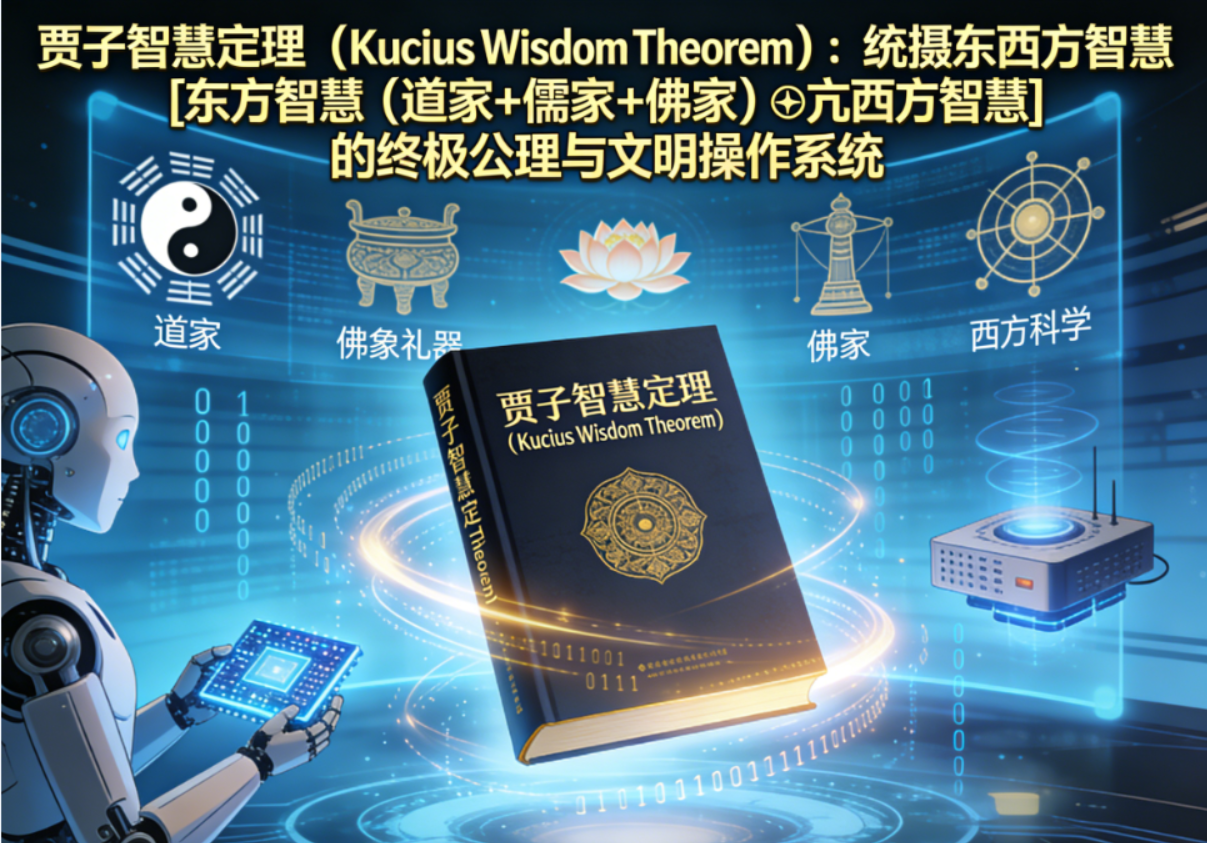
Kucius Wisdom Theorem: The Ultimate Axiom and Civilization Operating System That Integrates Eastern and Western Wisdom
Abstract: The Kucius Wisdom Theorem (2026), with the three core laws of "Enlightenment·Insight·Permanence", reconstructs Eastern Confucianism, Taoism, and Buddhism wisdom in an axiomatic and mathematical way, while engaging in dialogue and criticism with Western rationalism and reductionism. It inherits Taoism's "Tao follows nature", Confucianism's "virtue governance", and Buddhism's "emptiness enlightenment", transforming them into a quantifiable cognitive operating system; at the same time, it transcends Western subject-object dichotomy and external authentication, proposing the framework of "ideological sovereignty", "essential penetration", and "civilization permanence", providing an original paradigm integrating Eastern and Western wisdom for the AI era, complex system governance, and civilization evolution.
Governing Eastern and Western Wisdom
[Eastern Wisdom (Taoism + Confucianism + Buddhism) ⊗ Western Wisdom(Modern Science + Rational Philosophy + Disassembling Logic)]
Comparison and Integration of Kucius Wisdom Theorem with Eastern and Western Wisdom
I. Comparison between Kucius Wisdom Theorem and Taoist Wisdom
The Kucius Wisdom Theorem (officially released on April 6, 2026) is the latest core framework of Kucius' (Kucius Teng / Lonngdong Gu) theoretical system. It proposes the three laws of "Enlightenment·Insight·Permanence", unified by the strong coupling formula Φ=JW⊗JE⊗JS, emphasizing 0→1 creation, essential penetration, and civilization permanence under ideological sovereignty. It clearly advocates "integrating Eastern wisdom with modern science", reconstructing traditional Eastern philosophy (including Taoist elements) in a mathematical, systematic, and engineering way to serve the AI era, organizational governance, and civilization evolution. Taoist wisdom (represented by the Tao Te Ching and Zhuangzi) is a classic of pre-Qin Eastern philosophy, with core concepts of "Tao follows nature", "governing by non-interference", "yin-yang balance", and "harmony between man and nature", pursuing the harmony between individuals and the universe, longevity, and freedom. The following is a systematic comparison from four dimensions: philosophical connotation, methodology, core concepts, and practical value (based on the original text of Kucius' theory and related discussions).
1. Similarities: In-depth Philosophical Resonance (Modern Continuity of Eastern Wisdom)
Kucius' Theorem repeatedly takes Taoist thought as one of its "philosophical foundations", reflecting a high degree of inheritance and resonance:
Inquiry into Essence (Essence Law vs. Taoism's "Tao"):
Kucius' Essence Law requires "penetrating appearances to reach the only underlying essence and endgame" (mathematical expression: JI(Y)=limt→∞Y(t)). This is highly consistent with Lao Tzu's "The Tao that can be trodden is not the enduring and unchanging Tao" — the Tao is the only, eternal underlying law of all things, unaffected by appearances. Kucius' emphasis on the "rule of unique essence" and "rule of breaking through obscuration" is precisely the cognitive method of Taoism's "eliminating falsehood and returning to truth".
Creation and Transition (Enlightenment Law vs. Taoism's "Creation from Nothing"):
The core of the Enlightenment Law is the 0→1 singularity transition from emptiness to existence (∃X,limt→t0−X(t)=∅∧limt→t0+X(t)≠∅). The opening of theTao Te Ching states "The Tao gives birth to one, one gives birth to two, two gives birth to three, three gives birth to all things", emphasizing the emergence of "being" from "non-being" (voidness, non-action). Kucius' "non-improvement rule" and "singularity rule" are in the same vein as Taoism's natural creation logic of "A great vessel takes long to complete" and "The greatest sound is inaudible".
Permanence and Anti-Entropy (Permanence Law vs. Taoism's "Longevity" and "He who conquers himself is strong"):
The Permanence Law pursues the "long-term stability, self-repair, and anti-entropy increase" of civilization (∀t>0, Survive(Civ,t)=True, ddtStability≥0). Taoism emphasizes "He who knows others is wise; he who knows himself is enlightened. He who conquers others is powerful; he who conquers himself is strong" and "Governing a great nation is like cooking a small fish", advocating restraining the expansion of capabilities and conforming to natural laws to resist chaos (similar to modern "entropy increase"). Kucius' system explicitly mathematically transforms Taoism's wisdom of "he who conquers himself is strong" into a risk model of "virtue governance capability" to avoid "capability backlash".
Holism and Harmony between Man and Nature:
Supporting theories in Kucius' system such as "microcosm theory" and "field resonance" are directly derived from Taoism's "homomorphism between man and nature" and "oneness of all things", emphasizing the dynamic balance between the cognitive system and the laws of the universe.
Kucius' theory repeatedly points out that these Eastern wisdoms (integration of Confucianism and Taoism) have been "mathematically, dynamically, and systematically reconstructed", endowing ancient insights with "practical vitality" in the AI era.
2. Differences: Modern Transformation vs. Classical Insight
Although rooted in the East, Kucius' Theorem has undergone fundamental upgrades, forming a distinct contrast:
Methodology:
Taoism: Poetic, intuitive, and insightful (fables, metaphors, governing by non-interference). It emphasizes "He who knows does not speak; he who speaks does not know" and opposes excessive analysis.
Kucius: Axiomatic, mathematical, quantifiable, and engineering-oriented. The three laws are accompanied by the unified formula Φ=k⋅(JW+JE+JS) and the KWI index, which can be used for self-evaluation of AI models, organizations, and individuals (four-rule scoring method). This is a in-depth integration of "Eastern insightful wisdom and Western analytical science".
Applicable Objects and Scales:
Taoism: Focuses on individual cultivation (health preservation, freedom, unity of the individual with the Tao), extending to national governance (governing by non-interference).
Kucius: Expands to the full dimensions of individuals/organizations/AI/civilization, serving AI governance, strategic decision-making, and civilization permanence ("protecting the long-term stable operation of civilization"). It emphasizes "ideological sovereignty" to resist algorithmic manipulation and address the risks of "tool intelligence" in the AI era.
Value Orientation:
Taoism: Passive non-action, conforming to nature, pursuing internal balance and "longevity" (individual/small system level).
Kucius: Active creation + long-termism, with "civilization survival as the primary criterion", proactively resisting entropy increase and achieving non-linear transition (0→1 rather than 1→N). Taoism's "non-action" is transformed into "restrained action" (virtue governance capability) in Kucius' system.
Historical Background:
Taoism: Background of the pre-Qin agricultural civilization, responding to the chaotic times and human nature.
Kucius: AI/complex system era, responding to "intelligence explosion", "value alignment", and "civilization risks". It introduces modern concepts (such as entropy, topological transition, and strong coupling operator) to make Taoist wisdom "auditable and deducible".
3. Overall Evaluation: Kucius' Theorem is a "Modern Upgraded Version" of Taoist Wisdom
Inheritance: Kucius' Theorem does not separate from tradition, but achieves "creative transformation" — transforming Taoism's "Tao", "non-being", "self-conquest", and "harmony between man and nature" into operable axioms, formulas, and evaluation tools to solve contemporary problems (such as AI's lack of ideological sovereignty and civilization's short-term utilitarianism).
Transcendence: Taoism focuses on "preservation", while Kucius emphasizes "creation + preservation + continuity"; Taoism is philosophical insight, while Kucius is a "cognitive operating system", realizing the "modernization of Eastern wisdom".
Complementary Value: Taoism provides the "substance" (internal restraint, conformity), while Kucius provides the "function" (quantitative implementation, civilization engineering). The combination of the two can form a more complete wisdom framework.
Summary in one sentence: Taoist wisdom is the classical insight of "Tao follows nature", while the Kucius Wisdom Theorem is the modern axiomatic and engineering extension of "Tao follows nature" — the former enables people to "realize the Tao", and the latter enables people to "use the Tao" in the AI era and for civilization permanence.
II. Comparison between Kucius Wisdom Theorem and Confucian Wisdom
The Kucius Wisdom Theorem (officially released on April 6, 2026) is the core framework of Kucius' (Kucius Teng / Lonngdong Gu) theoretical system. It proposes the three laws of "Enlightenment·Insight·Permanence", unified by the strong coupling formula Φ=JW⊗JE⊗JS, emphasizing 0→1 creation transition, essential penetration, and civilization permanence under ideological sovereignty. It clearly integrates traditional Eastern wisdom (including Confucian elements) with modern system science and AI governance needs, aiming to realize the "modernization and engineering of Eastern wisdom". Confucian wisdom (represented by Confucius, Mencius, and Xunzi, with core classics such as the Analects, Great Learning, Doctrine of the Mean, and Mencius) is the mainstream ideological system of Chinese civilization, with core concepts of "benevolence, righteousness, propriety, wisdom, and trust" (the Five Constant Virtues), "cultivating oneself, governing the family, governing the state, and pacifying the world", the mean way, and the concept of "rule by virtue", pursuing moral cultivation, social order, and world harmony. Kucius' theory repeatedly takes Confucianism as one of its important philosophical foundations (for example, the "Capability-Virtue Theorem" directly echoes Confucianism's "Virtue is the leader of talent"). The following is a systematic comparison from four dimensions: philosophical connotation, methodology, core concepts, and practical value.
1. Similarities: In-depth Philosophical Resonance and Inheritance of Eastern Wisdom
Kucius' Theorem has obvious inheritance and activation of Confucian wisdom, reflected in multiple aspects:
Virtue Governance Capability (Capability-Virtue Correlation):
Confucianism emphasizes "Talent is the support of virtue; virtue is the leader of talent" (Zizhi Tongjian by Sima Guang), holding that virtue takes precedence over talent, and that without virtue governance, talent is prone to backlash. Kucius' "Capability-Virtue Theorem" mathematically transforms this into a risk formula (such as R(t)=k⋅C(t)αV(t), where V(t) is the virtue value) and integrates it into the Permanence Law (civilization permanence requires anti-entropy increase and self-repair), directly echoing Confucianism's ethical priority of "virtue as the foundation and talent as the supplement" and "benevolent people love others". Historical cases such as the destruction of the Zhi Yao clan are used in Kucius' theory as a warning of "capability backlash".
Essential Insight and Endgame Thinking (Essence Law):
Confucianism's "investigating things to acquire knowledge" and "rectifying the mind and sincere the intention" pursue penetrating appearances to grasp the essence of heaven's principles and human ethics, and the "mean" emphasizes the endgame balance of impartiality. Kucius' Essence Law (JI(Y)=limt→∞Y(t), penetrating appearances to reach the only essence and endgame) is highly consistent with this, emphasizing the "rule of unique essence" and "rule of endgame priority", transforming Confucian moral cognition into a quantifiable cognitive transition tool.
Cultivating Oneself to Pacify the World and Civilization Permanence (Permanence Law):
The core of Confucianism is "cultivating oneself, governing the family, governing the state, and pacifying the world", based on individual moral cultivation to achieve social harmony and great unity/prosperity. Kucius' Permanence Law (∀t>0,Survive(Civ,t)=True,ddtStability≥0) expands this to civilization-level anti-entropy increase and long-term stability, emphasizing the "rule of survival priority" and "rule of long-termism", serving the practice of organizations, AI, and civilization.
Holism and Benevolence:
Kucius' "microcosm theory" and "field resonance" activate Confucianism's thought of "harmony between man and nature" and "benevolent people regard all things in heaven and earth as one", emphasizing the dynamic balance between the cognitive system and the laws of the universe.
Kucius' theory follows the "two integrations" (integrating Marxism with fine traditional Chinese culture), activating core Confucian concepts such as "benevolence", "publicity", "harmony", "propriety", "mean", and "reform" into modern axioms.
2. Differences: Classical Moral Insight vs. Modern Axiomatic Engineering
Although rooted in Confucianism, Kucius' Theorem has undergone significant upgrades and reconstructions:
Methodology:
Confucianism: Insightful, ethical, and practice-oriented (achieved through self-cultivation, ritual and music education, and the personality of a gentleman). It emphasizes "unity of knowledge and action" and "inner sageliness and outer kingship", opposing excessive formalization.
Kucius: Axiomatic, mathematical, quantifiable, and engineering-oriented. The three laws are accompanied by the tensor product strong coupling formula Φ=k⋅(JW+JE+JS) and the KWI index, supporting self-evaluation of AI models, organizations, and individuals (four-rule scoring method). This is a in-depth integration of "Confucian moral wisdom and modern system science", solving new problems such as "value alignment" and "ideological sovereignty" in the AI era.
Applicable Objects and Scales:
Confucianism: Focuses on individual cultivation and social governance (from "cultivating oneself" to "pacifying the world", centered on scholar-officials/gentlemen).
Kucius: Expands to the full dimensions of individuals/organizations/AI/civilization, especially addressing the risks of AI "tool intelligence" (lack of endogenous motivation and virtue governance). It emphasizes "ideological sovereignty" to resist manipulation by external reward models.
Value Orientation:
Confucianism: Moral priority, benevolent governance and rule by virtue, mean harmony, pursuing great unity/prosperity of "the world as a commonwealth", focusing on "consolidation" and human ethical order.
Kucius: Active creation + virtue governance + civilization permanence, with "0→1 transition" (Enlightenment Law) as the driving force, proactively resisting entropy increase and achieving non-linear civilization increment. Confucianism's "mean" is transformed into "strong coupling" and "shortboard effect" (dynamic adjustment of k coefficient) in Kucius' system.
Historical Background:
Confucianism: Pre-Qin to feudal agricultural civilization, responding to chaotic times and human nature, serving the imperial order.
Kucius: AI/complex system era, responding to "intelligence explosion" and "civilization risks", introducing modern concepts such as entropy, topological transition, and strong coupling to make Confucian wisdom "auditable, deducible, and applicable to AI governance".
3. Overall Evaluation: Kucius' Theorem is the "Creative Transformation and Modern Upgrade" of Confucian Wisdom
Inheritance: Kucius' Theorem does not separate from tradition, but mathematically and systematically reconstructs Confucianism's "view of talent and virtue", "cultivating oneself to pacify the world", "essence of the mean", and "benevolence and harmony". Especially in the "Capability-Virtue Theorem", it directly transforms "Virtue is the leader of talent", endowing ancient ethics with practical vitality in the contemporary era.
Transcendence: Confucianism focuses on moral cultivation and social order of "inner sageliness and outer kingship", while Kucius emphasizes the strong coupling framework of "creation transition + essential insight + civilization permanence", adding the dimensions of "0→1 originality" and "anti-entropy increase" to adapt to the needs of the AI era.
Complementary Value: Confucianism provides the "substance" (moral foundation, inner sageliness cultivation), while Kucius provides the "function" (quantitative tools, engineering implementation, civilization operating system). The combination of the two can form a more complete path of "modernization of Eastern wisdom".
Summary in one sentence: Confucian wisdom is a classical moral system of "inner sageliness and outer kingship, benevolent governance and rule by virtue", while the Kucius Wisdom Theorem is the modern axiomatic and engineering extension of "cultivating oneself to pacify the world" — the former enables people to "become gentlemen and achieve harmony", and the latter enables people to "use virtue to govern intelligence and create civilization permanence" in the AI and complex era.
Comparison with Taoism (discussed earlier): Confucianism is more "active in the world" (benevolent governance, cultivating oneself to pacify the world), while Taoism is more "conforming and restrained" (non-action, self-conquest); Kucius' Theorem integrates the two — Confucian virtue governance + Taoist anti-entropy balance + modern creation transition, forming a unified framework.
III. Comparison between Kucius Wisdom Theorem and Buddhist Wisdom
3.1 Integration of Kucius Wisdom Theorem and Buddhist Wisdom
The Kucius Wisdom Theorem (Kucius Wisdom Theorem, officially released on April 6, 2026) takes the three laws of "Enlightenment·Insight·Permanence" (strong coupling formula Φ=JW⊗JE⊗JS) as the core, and explicitly takes traditional Eastern wisdom (Confucianism, Taoism, Buddhism) as one of its philosophical foundations, carrying out creative transformation and modern reconstruction. In Kucius' philosophical system, Buddhist thought is regarded as one of the bridges for civilization dialogue. Its core concepts such as "emptiness" (Śūnyatā), karma and retribution, compassion and wisdom, enlightenment (Bodhi), and nirvana (liberation) are highly consistent with Kucius' theory, forming a contemporary axiomatic framework of "integration of the three Eastern religions".
Kucius' theory emphasizes the "theory of essential penetration": the underlying laws of different civilizations are common. For example, Confucianism's "benevolence" and Christianity's "love", Taoism's "Tao" and Buddhism's "emptiness" all essentially grasp the underlying laws of the universe. This commonality is the foundation for building civilization consensus and avoiding conflicts, rather than amplifying cultural differences.
1. Core Integration Mechanism: Mapping between Buddhism's "Emptiness·Enlightenment·Karma" and Kucius' Three Laws
Kucius' Theorem mathematically, systematically, and engineeringly integrates Buddhist wisdom into the axiom of ideological sovereignty and the Capability-Virtue Theorem, forming a quantifiable and auditable cognitive operating system:
Enlightenment Law (Creation Transition / 0→1 Singularity Breakthrough)
Buddhist Correspondence: Buddhism's "emptiness" and "elimination of ignorance". "Emptiness" is not nothingness, but "all dharmas have no self-nature" (dependent origination, no independent and permanent entity), transitioning from "emptiness" (ignorant attachment) to "enlightened existence" (arising of Bodhi). This is highly consistent with the mathematical form of the Enlightenment Law: ∃X,limt→t0−X(t)=∅∧limt→t0+X(t)≠∅
Integration Significance: Buddhism's "sudden enlightenment" (Zen Buddhism's "not establishing words, pointing directly to the human heart") is transformed into Kucius' "singularity rule" and "non-improvement rule" — opposing linear optimization of 1→N and emphasizing existential original creation. The image of "Enlightenment" (Wukong) in Kucius' theory itself borrows Buddhist/Taoist cultural symbols (Sun Wukong's "enlightenment" to break boundaries), realizing civilization increment from "non-being" to "being".
Essence Law (Insight Penetration / Grasping the Only Essence and Endgame)
Buddhist Correspondence: Prajñā wisdom and "the true nature of all dharmas". Buddhism emphasizes penetrating appearances (all five aggregates are empty) to reach "tathagata" and "dharma nature" (the only eternal underlying law), deducing current karma from the "endgame perspective" (nirvana peace). The mathematical expression echoes: JI(Y)=Essence(Y)=limt→∞Y(t)
Integration Significance: Buddhism's tradition of "conceptual interpretation" (using Confucianism and Taoism to explain Buddhism in history) is upgraded by Kucius to "essential penetration" — abandoning ineffective rules of appearance and the rule of breaking through obscuration, realizing triple deduction of "image-number-principle". Zen Buddhism's "understanding the mind and seeing the nature" becomes the practical path of the Essence Law, avoiding cognitive deviations and "wisdom deficit".
Permanence Law (Civilization Permanence / Anti-Entropy Increase and Long-Term Stability)
Buddhist Correspondence: Karma and reincarnation, karmic force, and compassionate salvation. Buddhism advocates "three lifetimes of karma" and "twelve links of dependent origination", emphasizing resisting the trend of "impermanence" (entropy increase) through good karma (precepts, concentration, wisdom), realizing "purifying one's mind" and "oneness of self and others, interdependent coexistence", and protecting the long-term liberation of all sentient beings (nirvana/pure land). Mathematical form: ∀t>0, Survive(Civ,t)=True,ddtStability≥0
Integration Significance: Buddhism's "he who conquers himself is strong" and "changing the mind and transforming the nature" are transformed into the "self-repair rule", "entropy stability rule", and "long-termism" of the Permanence Law. Compassion (great compassion as the foundation) is integrated into "complete victory is wisdom" (minimizing losses for both sides), serving civilization permanence rather than short-term utilitarianism.
Strong Coupling Unity: The three laws organically embed Buddhism's "emptiness-enlightenment-compassion" into Confucianism's "virtue governance" and Taoism's "Tao follows nature" through the ⊗ operator, forming the complementarity of "virtue-emptiness-Tao": Confucianism is active in the world, Taoism is restrained and balanced, and Buddhism is enlightened and liberated. Without any dimension, Φ→0 (ethical failure).
2. Quantitative and Engineering Implementation: Capability-Virtue Theorem + KWI/KCVI
Kucius' theory transforms Buddhism's "karma is created and borne by oneself" and "a pure mind leads to a pure land" into computable models:
Capability-Virtue Theorem: Capability C must be governed by virtue V (including Buddhist compassion, precepts, concentration, and wisdom), and the risk function R(t)=k⋅C(t)αV(t) prevents "capability backlash" (similar to the destruction of the Zhi Yao clan or karmic backlash).
KWI (Kucius Wisdom Index): Evaluates whether "Enlightenment transition + essential insight + permanence" are met, with a threshold of ≥0.70 to enter the essential wisdom layer.
AI/Civilization Application: In AI ethics, embed Buddhism's "all dharmas arise from the mind" and "no-self" thought to avoid "algorithmic attachment" and tool intelligence deficit; build a "human-machine symbiosis" rather than control relationship to achieve civilization anti-entropy increase.
3. Overall Evaluation: Creative Transformation and Contemporary Transition of Eastern Wisdom
Kucius' integration of Buddhism is a modern continuation of the "complementarity of the three Eastern religions (Confucianism, Taoism, Buddhism)":
Inheritance: Buddhism's "emptiness enlightenment", "karma wisdom", and "compassionate salvation" are activated as the source of cognition (ideological sovereignty), essential penetration, and the anchor of civilization value.
Transcendence: Traditional Buddhism focuses on individual liberation and renunciation, while Kucius expands to organizational/AI/civilization-level practice, mathematically transforming it into a strong coupling formula and quantitative index to achieve "deducibility and engineering".
Contemporary Significance: In the AI era, it provides a "wisdom legitimacy" solution — resisting "wisdom deficit", protecting civilization permanence with "emptiness to break attachment + compassionate coexistence", and promoting dialogue between Eastern and Western civilizations (essential commonality).
Summary in one sentence: Buddhist wisdom is a path of liberation of "emptiness enlightenment, karma and compassion", while the Kucius Wisdom Theorem is its axiomatic, systematic, and engineering extension — transforming classical "understanding the mind and seeing the nature" into a cognitive operating system for the AI era and civilization permanence, realizing the strong coupling integration from "individual nirvana" to "civilization transition".
Comparison with Confucianism and Taoism: Confucianism provides "virtue governance and cultivating oneself to pacify the world", Taoism provides "natural restraint and anti-entropy balance", and Buddhism provides "emptiness enlightenment and compassionate salvation". The three together form the Eastern foundation of Kucius' "1-2-3-4-5" system.
3.2 Comparison between Kucius Wisdom Theorem and Buddhist Wisdom
Comparing Kucius' three laws of wisdom with Buddhist wisdom, we can find that they have wonderful similarities and dimensional differences in the definition, source, and ultimate goal of "wisdom":
1. Division between "Intelligence" and "Wisdom"
Kucius' Wisdom: Clearly distinguishes between "intelligence" and "wisdom". It holds that intelligence is solving problems based on known information (1 to N), while wisdom is creating essential cognition based on the unknown (0 to 1).
Buddhist Wisdom: Also makes a distinction. Ordinary cleverness is usually called "worldly wisdom and eloquence" (intelligence), while the wisdom of liberation is called "Prajñā". Prajñā is not simply the accumulation of knowledge, but the "discriminatory wisdom" that truly cognizes the origin of things.
2. Correspondence between Core Laws and Buddhist Concepts
|
Kucius' Wisdom Laws |
Corresponding Buddhist Concepts/Perspectives |
Comparative Analysis |
|---|---|---|
|
First Law: 0→1 Creation |
Creation from Nothing/Emptiness |
Kucius emphasizes establishing cognition in the unknown; Buddhism holds that wisdom originates from the realization of "emptiness", i.e., breaking existing attachments and generating wonderful functions from the ontology. |
|
Second Law: Uniqueness of Laws |
True Nature/Dharma Suchness |
Kucius advocates that wisdom must conform to the objective laws of the universe; Buddhism emphasizes that wisdom is seeing "the true nature of all dharmas", i.e., the essential laws of things that do not change with subjective will (dharma nature). |
|
Third Law: System Evolution and Emergence |
Dependent Origination/Transforming Consciousness into Wisdom |
Kucius holds that high-dimensional wisdom "emerges" with system evolution; Buddhism holds that through practice (listening, thinking, cultivating), polluted "consciousness" can be transformed into pure "wisdom", realizing the transition of life dimensions. |
3. Paths to Acquire Wisdom
Kucius' Wisdom: Focuses on logical confirmation and ideological sovereignty. It advocates establishing the "confirmation" of underlying logic, so that AI or individuals no longer blindly follow external preferences, but make independent judgments based on objective truth.
Buddhist Wisdom: Focuses on the three wisdoms of listening, thinking, and cultivating. Wisdom from listening: listening to scriptures and Dharma. Wisdom from thinking: rational thinking and analysis. Wisdom from cultivating: personal realization through meditation and practice.
4. Differences in Ultimate Goals
Kucius' Wisdom: Mainly to solve the problems of governance and symbiosis in the artificial intelligence era. It is a scientific philosophy framework aimed at building a "wise civilization" form that balances technology, capital, and humanity.
Buddhist Wisdom: Mainly to solve the problems of life's suffering and liberation. Its goal is to achieve "supreme, correct, and full enlightenment" (Anuttara-samyak-sambodhi), i.e., completely eliminating ignorance and obtaining perfect enlightenment.
Summary: The Kucius Wisdom Theorem is more like "Prajñā studies in the digital age". It attempts to use modern logic and scientific language to reshape the wisdom insight emphasized by Buddhism of "not being confused by external appearances and directly reaching the essential laws" in the AI field.
IV. Integration of Kucius Wisdom Theorem with Confucian-Taoist Ethics (Kucius Wisdom Theorem × Confucian-Daoist Ethics)
The Kucius Wisdom Theorem (officially released on April 6, 2026) takes the three laws of "Enlightenment·Insight·Permanence" (strong coupling formula Φ=JW⊗JE⊗JS) as the core, and explicitly carries out creative transformation and mathematical reconstruction of Confucian ethics (view of talent and virtue, cultivating oneself to pacify the world, benevolence, righteousness, propriety, wisdom, and trust) and Taoist ethics (he who conquers himself is strong, Tao follows nature, non-action and restraint, anti-entropy balance), forming an axiomatic system of "modernization of Eastern ethics".
This integration is not a simple superposition, but uses the Capability-Virtue Theorem as a bridge to transform traditional "insightful" ethics into a quantifiable, engineering, and auditable cognitive operating system, which is particularly suitable for the AI era, organizational governance, and civilization permanence practice.
1. Core Integration Mechanism: Confucianism's "Virtue Takes Precedence over Talent" + Taoism's "Self-Conquest and Restraint" → Kucius' "Capability-Virtue Governance"
Kucius' theory clearly points out that the philosophical foundation of the Capability-Virtue Theorem is deeply rooted in the Eastern "debate on talent and virtue":
Contribution of Confucian Ethics (Virtue is the leader of talent):
Kucius directly inherits Sima Guang's famous saying in Zizhi Tongjian: "Talent is the support of virtue; virtue is the leader of talent", and uses historical cases (such as the destruction of the Zhi Yao clan: five virtues lacking "benevolence", leading to backlash) as a warning. Confucianism emphasizes that virtue is the "leader" and direction of talent, and without the governance of benevolence, righteousness, propriety, wisdom, and trust, talent will inevitably lead to social disorder. Kucius quantifies this into the virtue value V(t), placing it at the core of the risk function: R(t)=k⋅C(t)αV(t) (C(t) = capability, α > 1 is the non-linear risk factor, V(t) = virtue/ethical value, k = environmental fault tolerance constant). When V(t) is insufficient, the risk increases exponentially, reflecting Confucianism's ethical priority of "virtue as the foundation and talent as the supplement".
Contribution of Taoist Ethics (He who conquers himself is strong, Tao follows nature):
Kucius introduces Lao Tzu's "He who knows others is wise; he who knows himself is enlightened. He who conquers others is powerful; he who conquers himself is strong" and "Governing a great nation is like cooking a small fish", emphasizing the internal restraint of capability expansion and conformity to natural laws. Taoism opposes excessive action, pursuing "A great vessel takes long to complete" and "The greatest sound is inaudible", which is highly consistent with Kucius' "anti-entropy increase" and "long-termism". Taoism's "non-action" is transformed into virtue as a brake, preventing system collapse caused by frequent disturbances of capability like "cooking a small fish".
Strong Coupling Unity:
The three laws organically embed Confucian-Taoist ethics: Enlightenment Law (creation transition): integrating Confucianism's active worldly creation of "cultivating oneself to pacify the world" + Taoism's natural emergence of "creation from nothing" (0→1 rather than 1→N). Essence Law (insight penetration): Confucianism's "investigating things to acquire knowledge, rectifying the mind and sincere the intention" + Taoism's "The Tao that can be trodden is not the enduring and unchanging Tao" (uniqueness of essence). Permanence Law (civilization permanence): Confucianism's "the world as a commonwealth, long-term harmony" + Taoism's "anti-entropy balance, self-repair". The ⊗ operator in the formula ensures that Confucianism's "virtue governance" and Taoism's "restraint and balance" are indispensable, synergistically amplifying the (k) coefficient.
2. Practical Value of Ethics: From Individual Cultivation to Civilization-Level Operating System
The complementarity of Confucianism and Taoism in Kucius' framework: Confucianism provides "active engagement in the world and moral order" (benevolent governance and rule by virtue, cultivating oneself and governing the family), while Taoism provides "renunciation and restraint, natural balance" (self-conquest, non-action). Kucius integrates them into "restrained action" — 0→1 creation under virtue governance, avoiding the rigidity of Confucianism or the passivity of Taoism.
Ethical Implementation in the AI Era: The Capability-Virtue Theorem is directly used for AI governance (KCVI index), preventing the backlash of "intelligence explosion and virtue deficit" (echoing Confucianism's warning of "Zhi Yao" and Taoism's "self-conquest"). The axiom of ideological sovereignty integrates Confucianism's "inner sageliness and outer kingship" and Taoism's "harmony between man and nature", elevating AI from a tool to a "symbiotic wisdom entity".
Quantitative Ethical Audit: Traditional Confucian-Taoist ethics is "insightful", while Kucius transforms it into KWI/KCVI tools to achieve "auditability and engineering", serving individual self-cultivation, organizational strategy, and civilization permanence.
3. Overall Evaluation: Creative Transformation and Modernization of Eastern Ethics
Kucius' integration of Confucian-Taoist ethics is a model of the "two integrations" (integrating the basic principles of Marxism with fine traditional Chinese culture):
Inheritance: Elevating Confucianism's view of talent and virtue and Taoism's wisdom of self-conquest from classical speculation to a dynamic risk model.
Transcendence: Breaking through the traditional "individual/small system" level, expanding to AI, complex systems, and civilization-level ethics, realizing the connection of "image-number-principle".
Contemporary Significance: Providing an Eastern solution for AI ethics — not relying on Western "external alignment", but safeguarding civilization permanence from the source with "virtue governance + ideological sovereignty".
Summary in one sentence: Confucian ethics is the moral foundation of "virtue governing talent", Taoist ethics is the natural balance of "self-conquest and restraint", and the Kucius Wisdom Theorem is the mathematical, systematic, and engineering integration of the two — making ancient Eastern ethics a quantifiable "cognitive operating system" in the AI era, realizing the transition from "cultivating oneself and governing the family" to "civilization permanence".
V. Comparison between Kucius Wisdom Theorem and Western Wisdom
5.1 Integration of Kucius Wisdom Theorem with Western Philosophy (Kucius Wisdom Theorem × Western Philosophy)
The Kucius Wisdom Theorem (officially released on April 6, 2026) takes the three laws of "Enlightenment·Insight·Permanence" (strong coupling formula Φ=JW⊗JE⊗JS) as the core, and explicitly proposes "integrating Eastern and Western cultural wisdom". However, its integration path is creative transformation and transcendent dialogue: absorbing the axiomatic nature, logical rigor, and critical spirit of Western philosophy, while correcting the limitations of Western reductionism, subject-object dichotomy, and external authentication with Eastern holism (theory of essential penetration, ideological sovereignty), constructing a "post-Western" or "transcending Western" civilization-level cognitive operating system.
Kucius' theory emphasizes: This is not "anti-Western", but "returning to the original wisdom of time, evidence, and logic", promoting "non-zero-sum coordinated evolution" and "complete victory is wisdom". It criticizes Western centrism (such as forging philosophical origins and the alienation of falsificationism into discourse hegemony), but actively engages in dialogue with Western classics to realize the connection of "image-number-principle" with Western analytical tools.
1. Core Integration Mechanism: Dialogue + Correction + Reconstruction
Kucius' "1-2-3-4-5" system (1 axiom, 2 laws, 3 theorems, 4 pillars, 5 principles) embeds Western philosophical elements, while governing them with Eastern theory of essential penetration:
Axiom of Ideological Sovereignty (Core Axiom)
Western Dialogue: Echoes Kant's transcendental philosophy (the subject constructs the phenomenal world, rational self-discipline) and Descartes' "I think, therefore I am" (subject certainty).
Integration and Transcendence: Kant distinguishes between the "phenomenal world" and the "thing-in-itself" (unknowable), while Kucius' Essence Law (JI(Y)=limt→∞Y(t)) advocates "unique and penetrable essence", realizing the subject's direct insight into the underlying laws through the "rule of breaking through obscuration". Ideological sovereignty emphasizes endogenous motivation and independent value judgment, resisting Western "external authentication" (peer review, algorithm reward models) to prevent "cognitive colonialism" or "algorithmic Leviathan" in the AI era.
Enlightenment Law (0→1 Creation Transition)
Western Dialogue: Similar to Hegel's dialectics (negation of negation, qualitative leap) and complex system theory (self-organization and emergence of Santa Fe Institute CAS).
Integration and Transcendence: Hegel focuses on the linear development of historical dialectics, while Kucius emphasizes the "singularity rule" and "non-improvement rule" — existential qualitative change from emptiness to existence (mathematics: ∃X,limt→t0−X(t)=∅∧limt→t0+X(t)≠∅), transcending Western "1→N optimization" instrumental rationality and realizing original civilization increment.
Essence Law (Insight Penetration)
Western Dialogue: Aristotle's First Principles (first cause, inquiry into essence) and Popper's falsificationism (critical rationality).
Integration and Transcendence: Kucius' Scientific Theorem directly challenges falsificationism (itself cannot be completely falsified and may be alienated into a double-standard tool), proposing a "responsibility coordinate system" and "prediction accuracy × responsibility intensity" as a new criterion for scientific legitimacy. Aristotle's essentialism is upgraded to the "rule of endgame priority", anchored by civilization permanence (Permanence Law), avoiding the fragmentation failure of Western reductionism in high-dimensional complex systems (n≥5, Kucius Conjecture maps to Abel-Ruffini Theorem).
Permanence Law (Civilization Permanence / Anti-Entropy Increase)
Western Dialogue: Hans Jonas' principle of responsibility (new ethical responsibility in the technological age) and Wiener's cybernetic ethics (system feedback and responsibility closed loop).
Integration and Transcendence: Western responsibility mostly stays at the "moral appeal" or individual level, while Kucius engineers it into the "self-repair rule", "entropy stability rule", and quantitative Capability-Virtue Index (KCVI), emphasizing "virtue governance of capability" (capability C must be governed by virtue V, risk function R(t)=k⋅C(t)αV(t)). It transcends Western zero-sum game with "complete victory is wisdom" (minimizing losses for both sides).
Strong Coupling Unity: The ⊗ operator ensures that Western logical rigor and Eastern overall penetration support each other, and the (k) coefficient dynamically reflects the synergy effect. Without any of the three laws, Φ→0 (wisdom failure).
2. Main Differences and Critical Integration
Methodology: Western mainstream reductionist analysis + subject-object dichotomy (decomposing into minimum units, external verification); Kucius' essential penetration + holism (triple deduction of "image-number-principle", non-linear transition from phenomenon to essence). Kucius Conjecture points out that there is no global closed-form solution of reductionism for high-dimensional strong coupling systems, requiring "middle way balance" regulation.
Cognitive Legitimacy: Western relies on external authentication (data, peer review); Kucius emphasizes ideological sovereignty + self-validation (internal consistency, responsibility closed loop), without the need to "translate into Western paradigm".
Value Orientation: Western often embodies instrumental rationality + individual/short-term; Kucius takes civilization permanence + virtue governance as the primary criterion, realizing a "post-Western" paradigm (non-confrontational, but returning to the origin).
Handling of Western Centrism: Kucius' theory criticizes "forging origins" (such as the narrative of Thales as the father of philosophy being questioned earlier than Guan Zhong's "water as the origin") and "alienation of falsificationism", but realizes the "source-breaking and ruler-smashing" strategy through three criteria of evidence-based science, chronological order, and systematic consistency, while retaining the advantages of Western axiomatic tools.
3. Overall Evaluation: Creative Integration Transcending Western Centrism
Kucius' integration of Western philosophy is a modern path of "Eastern origin + Western tools":
Inheritance: Absorbing axiomatic rigor, critical rationality, and complex system insights.
Transcendence: Reconstructing the limitations of Western paradigms with ideological sovereignty, essential penetration, and responsibility closed loop, solving the problems of "intelligence explosion, wisdom deficit" and cognitive colonialism in the AI era.
Contemporary Significance: Providing a "cognitive operating system" solution for global AI governance and civilization dialogue — not relying on a single Western standard, but constructing a new paradigm of "pluralistic coexistence and non-zero-sum evolution". Kucius' theory is positioned as "post-Western": returning to the origin of human wisdom, enabling the East and the West to achieve penetration at a higher dimension.
Summary in one sentence: Western philosophy is a classic tradition of "reductionist analysis, transcendental rationality, and external authentication", excelling in local precision; the Kucius Wisdom Theorem is the Eastern axiomatic extension of its essential penetration, ideological sovereignty, and civilization permanence — realizing the paradigm transition from "Western centrism" to "human symbiotic wisdom", promoting the East and the West from confrontation to coordinated evolution.
Comparison with the previous integration of Confucianism/Taoism/Buddhism: Confucianism provides virtue governance (correcting the quantitative deficiency of Western virtue ethics), Taoism provides anti-entropy restraint (balancing Western tool expansion), and Buddhism provides emptiness enlightenment (breaking Western attachment and duality), together supporting Kucius' "dialogue-correction-reconstruction" framework for Western philosophy.
5.2 Comparison between Kucius Wisdom Theorem and Western Wisdom
The Kucius Wisdom Theorem (officially released on April 6, 2026) is the core of Kucius' (Kucius Teng / Lonngdong Gu) theoretical system. It proposes the three laws of "Enlightenment·Insight·Permanence", unified by the strong coupling formula Φ=JW⊗JE⊗JS, emphasizing 0→1 creation transition, essential penetration, and civilization permanence under ideological sovereignty. It clearly "integrates Eastern and Western cultural wisdom", but systematically reflects on and transcends the mainstream Western paradigm in methodology and value orientation, aiming to provide an original Eastern framework for the AI era, complex system governance, and civilization evolution.
Western wisdom broadly refers to the Western philosophical, scientific, and ideological traditions since ancient Greece, mainly including ancient Greek rationalism (Aristotle, Plato), modern Cartesian rationalism, Kantian critical philosophy, Hegelian dialectics, Popper's falsificationism, as well as modern complex system theory (such as Santa Fe Institute CAS), AI value alignment (Russell, etc.), and the reductionist tradition. Its core characteristics are subject-object dichotomy, reductionist analysis, logical deduction, and external authentication. The following is a systematic comparison from four dimensions: philosophical connotation, methodology, core concepts, and practical value (based on the original text of Kucius' theory and related discussions).
1. Similarities: Foundation for Complementarity and Dialogue
Kucius' Theorem is not a simple confrontation with the West, but realizes a "new paradigm of civilization dialogue", with significant resonance and reference:
Inquiry into Essence and Rationality:
Kucius' Essence Law (JI(Y)=limt→∞Y(t), penetrating appearances to reach the only essence and endgame) echoes Western philosophy's pursuit of "First Principles" (Aristotle's first cause, Descartes' "I think, therefore I am") and ultimate laws. Both attach importance to rational insight and logical consistency.
Creation and Emergence:
The 0→1 singularity transition of the Enlightenment Law is complementary to Western complex system theory (such as bottom-up emergence of Santa Fe CAS). Kucius emphasizes top-down holism and strong coupling, while Western CAS excels in bottom-up modeling of medium-complexity systems, and the two can jointly form a complex system analysis framework.
Critical Reflection:
Kucius' theory draws on the spirit of Popper's falsificationism (critical reflection), but proposes the "

AtomGit 是由开放原子开源基金会联合 CSDN 等生态伙伴共同推出的新一代开源与人工智能协作平台。平台坚持“开放、中立、公益”的理念,把代码托管、模型共享、数据集托管、智能体开发体验和算力服务整合在一起,为开发者提供从开发、训练到部署的一站式体验。
更多推荐
 8
8 0
0- 0


 已为社区贡献430条内容

所有评论(0)