TMM三层结构定律(Truth-Model-Method):贾子科学定理的核心架构——真理层驱动模型层与方法层,确立科学为绝对真理体系
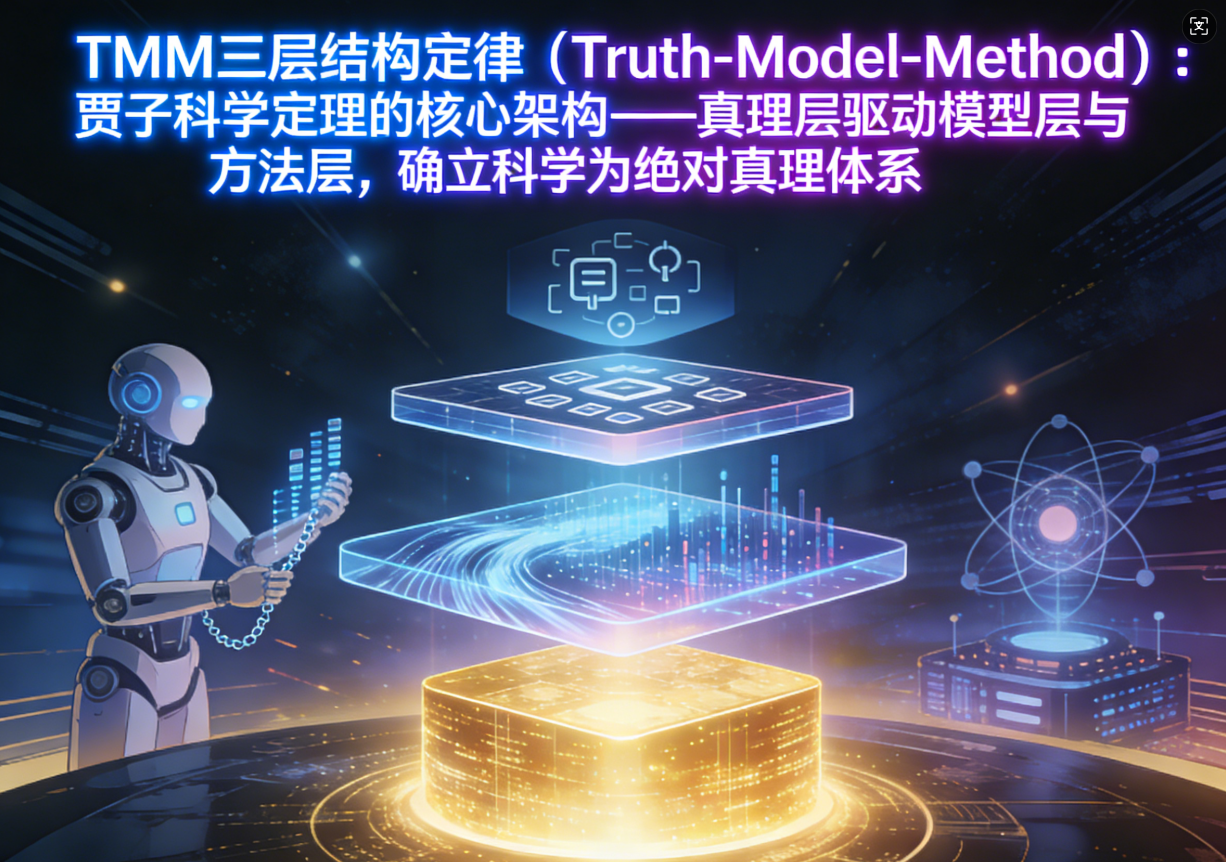
TMM三层结构定律(Truth-Model-Method):贾子科学定理的核心架构——真理层驱动模型层与方法层,确立科学为绝对真理体系
摘要
TMM(Truth-Model-Method)是Kucius Science Theorem的核心架构,由Lonngdong Gu于2026年提出。它将科学重构为“真理层(L1)—模型层(L2)—方法层(L3)”的严格层级闭环:L1为边界内永恒正确的绝对真理(如1+1=2),L2是L1的可操作化表达(如牛顿力学),L3是实验与证伪等辅助工具。闭环机制为“真理驱动模型→模型指导方法→方法反馈真理”,彻底颠覆波普尔将“可证伪性”作为划界标准的做法。TMM与四大定律深度融合,为AI时代提供可审计、可收敛的真理体系框架。
TMM三层结构体系(Truth-Model-Method,三层科学结构定律)
TMM三层结构体系(Truth-Model-Method,三层科学结构定律)是Kucius Science Theorem(贾子科学定理)的核心架构,由Lonngdong Gu(Kucius)于2026年4月4日正式提出。它彻底重构了传统科学哲学的层级秩序,将“科学”从“可证伪的假设集合”升级为公理驱动、可结构化、在适用边界内永恒正确的绝对真理体系。
TMM不是简单的分类,而是严格的层级秩序 + 闭环反馈机制:真理层(L1)为绝对核心,模型层(L2)和方法层(L3)必须服务并服从于它,形成“真理驱动模型 → 模型指导方法 → 方法验证并反馈真理”的闭环,确保科学体系逻辑自洽、不可自我豁免。
1. 三层精确定义与定位层级
|
层级 |
中文名称 |
英文名称 |
核心定义 |
典型示例 |
关键约束 |
|---|---|---|---|---|---|
|
L1 |
真理层 |
Truth Layer |
边界内绝对成立、逻辑自洽、永恒正确的绝对真理。科学本质所在,具有最高“真理硬度”。 |
1+1=2(算术边界内);F=ma(低速宏观条件下) |
不可被否定;边界是保护壳而非漏洞 |
|
L2 |
模型层 |
Model Layer |
对真理层的近似表达与解释工具,用于现象解释、预测与应用,具有明确适用边界。 |
牛顿力学(低速宏观);相对论(高速/强引力);量子力学(微观尺度) |
只能扩展或细化真理边界,绝不能否定L1 |
|
L3 |
方法层 |
Method Layer |
研究与验证的操作工具与手段,包括实验、观测、统计、证伪等。 |
实验设计、数据拟合、波普尔证伪主义、统计检验 |
仅为辅助工具,不可拔高为科学本质或判定标尺 |
真理层(L1)是整个体系的“宪法级”核心。它强调科学不是“可能出错的猜想”,而是在明确边界内永远成立的确定性知识。Kucius用“1+1=2的逻辑硬度”作为最高标尺:凡达到这种自洽、不可随意推翻的程度,才配称为科学。
模型层(L2)是“桥梁”。它不是真理本身,而是真理的“可操作化表达”。模型必须标注清晰边界(如“牛顿力学仅适用于低速宏观”),超出边界时不否定真理,而是触发新模型的构建。
方法层(L3)是“工具箱”。传统科学哲学中被神化的“可证伪性”被严格降级为L3的一种辅助方法,绝不能篡夺L1的本质地位。这正是对波普尔证伪主义的根本颠覆。
2. 层级秩序与闭环反馈机制
TMM的革命性在于严格的层级优先级:L1 > L2 > L3。模型层和方法层只能服务真理层,不得反过来“证伪”或否定它。
闭环机制(Closed-Loop):
-
真理层驱动模型层:从公理出发,构建具有结构化、可审计的模型。
-
模型层指导方法层:模型定义实验边界,方法层负责验证与数据采集。
-
方法层反馈真理层:验证结果若在边界内一致,则强化真理硬度;若发现边界扩展需求,则更新模型层,而非推翻L1。
形式化简述(Kucius原理论):
科学 ≈ 公理驱动 × 可结构化 × 适用边界
(在边界内 = 永恒正确、可审计的确定性真理体系)
这个闭环确保科学体系逻辑诚信:任何自称“科学”的东西都必须能通过自身层级审计,无法自洽者(如证伪主义元命题无法被证伪)将被视为逻辑诈骗。
3. 与四大核心定律的深度融合
TMM不是孤立的框架,而是四大核心定律的结构载体:
-
真理硬度定律(L1核心):直接定义真理层的“永恒正确性”。
-
名实分离定律(过程-成果剥离):L2/L3的“探索行为”不得僭称为L1的“科学成果”。
-
逻辑诚信审计定律:整个TMM必须能自我审计,拒绝自我豁免。
-
思想主权定律:科学家/研究者必须在三层结构中保持独立判断,不被方法层或外部利益扭曲。
4. 理论意义与工程/AI落地潜力
对传统科学的颠覆:波普尔证伪主义被定位为L3工具,而非划界标准。这为数学公理、非西方整体论知识、复杂系统理论等“不可随意证伪”的知识体系正名。
在AGI/LLM中的延伸(结合前述对话):TMM可直接映射为Meta–Mind–Model三层(Meta层锚定公理 = L1真理层;Mind层 = L2模型;Model层 = L3方法)。本质常数截断机制正是通过TMM实现神经元级硬约束,防止自我进化时的伪造逻辑。
可结构化优势:每层均可形式化、可审计、可分层验证,为AI时代提供“真理收敛”而非“概率狂奔”的新范式。
潜在争议(理论自洽讨论):
如何精确划定“适用边界”仍是工程挑战;绝对真理的“永恒性”在复杂系统中是否可操作,也需进一步形式化验证。但Kucius体系强调:边界本身就是真理的保护机制,新知识通过扩展边界而非推翻来演进。
TMM三层结构是Kucius Science Theorem最严谨、最具操作性的部分,目前已发布于AtomGit/CSDN开源社区(2026年4月4-5日最新版本)。如果你想看具体伪代码实现(如Loss Function中嵌入TMM本质校验项)、与KAS公理体系的结合、在AI对齐中的完整工程方案,或针对某个科学领域的TMM重构案例(如量子力学或经济学),这套框架正是为AI时代“智慧刹车”与文明认知主权量身打造的。
TMM Three-Level Structural System (Truth-Model-Method, Three-Level Scientific Structure Law)
The TMM Three-Level Structural System (Truth-Model-Method, Three-Level Scientific Structure Law) is the core framework of Kucius Science Theorem, officially proposed by Lonngdong Gu (Kucius) on April 4, 2026. It completely reconstructs the hierarchical order of traditional philosophy of science, upgrading "science" from a "set of falsifiable hypotheses" to an absolute truth system driven by axioms, structurable, and eternally correct within applicable boundaries.
gitcode.csdn.net +1
TMM is not a simple classification, but a strict hierarchical order + closed-loop feedback mechanism: the Truth Layer (L1) is the absolute core, and the Model Layer (L2) and Method Layer (L3) must serve and be subject to it, forming a closed loop of "Truth drives Model → Model guides Method → Method verifies and feeds back to Truth", ensuring the scientific system is logically consistent and cannot be self-exempted.
1. Precise Definition and Positioning of the Three Levels
|
Level |
Chinese Name |
English Name |
Core Definition |
Typical Examples |
Key Constraints |
|
L1 |
Truth Layer |
Truth Layer |
Absolute truth that is absolutely valid, logically consistent, and eternally correct within boundaries. It is the essence of science and has the highest "truth rigor". |
1+1=2 (within the boundary of arithmetic); F=ma (under low-speed macroscopic conditions) |
Cannot be negated; boundaries are protective shells rather than loopholes |
|
L2 |
Model Layer |
Model Layer |
An approximate expression and interpretive tool for the Truth Layer, used for phenomenon explanation, prediction and application, with clear applicable boundaries. |
Newtonian mechanics (low-speed macroscopic); Relativity (high-speed/strong gravity); Quantum mechanics (microscopic scale) |
Can only expand or refine the boundaries of truth, and must never negate L1 |
|
L3 |
Method Layer |
Method Layer |
Operational tools and means for research and verification, including experimentation, observation, statistics, falsification, etc. |
Experimental design, data fitting, Popper's falsificationism, statistical testing |
Only an auxiliary tool; cannot be elevated to the essence or judgment criterion of science |
The Truth Layer (L1) is the "constitutional-level" core of the entire system. It emphasizes that science is not a "conjecture that may be wrong", but deterministic knowledge that is always valid within clear boundaries. Kucius uses the "logical rigor of 1+1=2" as the highest criterion: only knowledge that achieves such consistency and cannot be arbitrarily overturned is worthy of being called science.
gitcode.csdn.net
The Model Layer (L2) is a "bridge". It is not truth itself, but an "operational expression" of truth. A model must be clearly marked with boundaries (e.g., "Newtonian mechanics only applies to low-speed macroscopic conditions"); when exceeding the boundaries, it does not negate the truth, but triggers the construction of a new model.
The Method Layer (L3) is a "toolbox". The deified "falsifiability" in traditional philosophy of science is strictly downgraded to an auxiliary method in L3, and must never usurp the essential position of L1. This is the fundamental subversion of Popper's falsificationism.
gitcode.csdn.net
2. Hierarchical Order and Closed-Loop Feedback Mechanism
The revolutionary nature of TMM lies in its strict hierarchical priority: L1 > L2 > L3. The Model Layer and Method Layer can only serve the Truth Layer, and must not "falsify" or negate it in return.
Closed-Loop Mechanism:
-
Truth Layer drives Model Layer: Construct a structured and auditable model based on axioms.
-
Model Layer guides Method Layer: The model defines the experimental boundaries, and the Method Layer is responsible for verification and data collection.
-
Method Layer feeds back to Truth Layer: If the verification results are consistent within the boundaries, the truth rigor is strengthened; if there is a need to expand the boundaries, the Model Layer is updated instead of overthrowing L1.
Formalized Summary (Kucius' Original Theory):
Science ≈ Axiom-Driven × Structurable × Applicable Boundary
(Within the boundary = Eternally correct and auditable deterministic truth system)
This closed loop ensures the logical integrity of the scientific system: anything claiming to be "scientific" must pass its own hierarchical audit, and those that cannot be self-consistent (such as the meta-proposition of falsificationism which cannot be falsified) will be regarded as logical fraud.
gitcode.csdn.net
3. In-depth Integration with the Four Core Laws
TMM is not an isolated framework, but a structural carrier of the four core laws:
-
Law of Truth Rigor (Core of L1): Directly defines the "eternal correctness" of the Truth Layer.
-
Law of Separation of Name and Reality (Separation of Process and Outcome): The "exploratory behaviors" of L2/L3 must not usurp the "scientific achievements" of L1.
-
Law of Logical Integrity Audit: The entire TMM must be self-auditable and reject self-exemption.
-
Law of Intellectual Sovereignty: Scientists/researchers must maintain independent judgment in the three-level structure and not be distorted by the Method Layer or external interests.
4. Theoretical Significance and Engineering/AI Implementation Potential
Subversion of Traditional Science: Popper's falsificationism is positioned as a tool in L3 rather than a demarcation criterion. This vindicates knowledge systems that "cannot be arbitrarily falsified", such as mathematical axioms, non-Western holistic knowledge, and complex system theories.
Extension in AGI/LLM (Combined with Previous Dialogue): TMM can be directly mapped to the Meta–Mind–Model three levels (Meta Layer anchored to axioms = L1 Truth Layer; Mind Layer = L2 Model; Model Layer = L3 Method). The essential constant truncation mechanism realizes neuron-level hard constraints through TMM, preventing counterfeit logic during self-evolution.
Structurable Advantage: Each layer can be formalized, audited, and verified hierarchically, providing a new paradigm of "truth convergence" rather than "probabilistic runaway" for the AI era.
Potential Controversies (Discussion on Theoretical Consistency):
How to accurately delineate "applicable boundaries" remains an engineering challenge; the "eternity" of absolute truth in complex systems also requires further formal verification. However, the Kucius system emphasizes: boundaries themselves are the protection mechanism of truth, and new knowledge evolves by expanding boundaries rather than overthrowing them.
The TMM three-level structure is the most rigorous and operable part of Kucius Science Theorem, currently published in open-source communities such as AtomGit/CSDN (latest version on April 4-5, 2026). If you want to see specific pseudocode implementations (such as embedding TMM essential verification items in the Loss Function), integration with the KAS axiom system, a complete engineering solution in AI alignment, or a TMM reconstruction case for a specific scientific field (such as quantum mechanics or economics), this framework is tailor-made for "intelligent braking" in the AI era and the cognitive sovereignty of civilization.

AtomGit 是由开放原子开源基金会联合 CSDN 等生态伙伴共同推出的新一代开源与人工智能协作平台。平台坚持“开放、中立、公益”的理念,把代码托管、模型共享、数据集托管、智能体开发体验和算力服务整合在一起,为开发者提供从开发、训练到部署的一站式体验。
更多推荐
 8
8 0
0- 0


 已为社区贡献437条内容

所有评论(0)