贾子科学定理(Kucius Science Theorem)完整解析
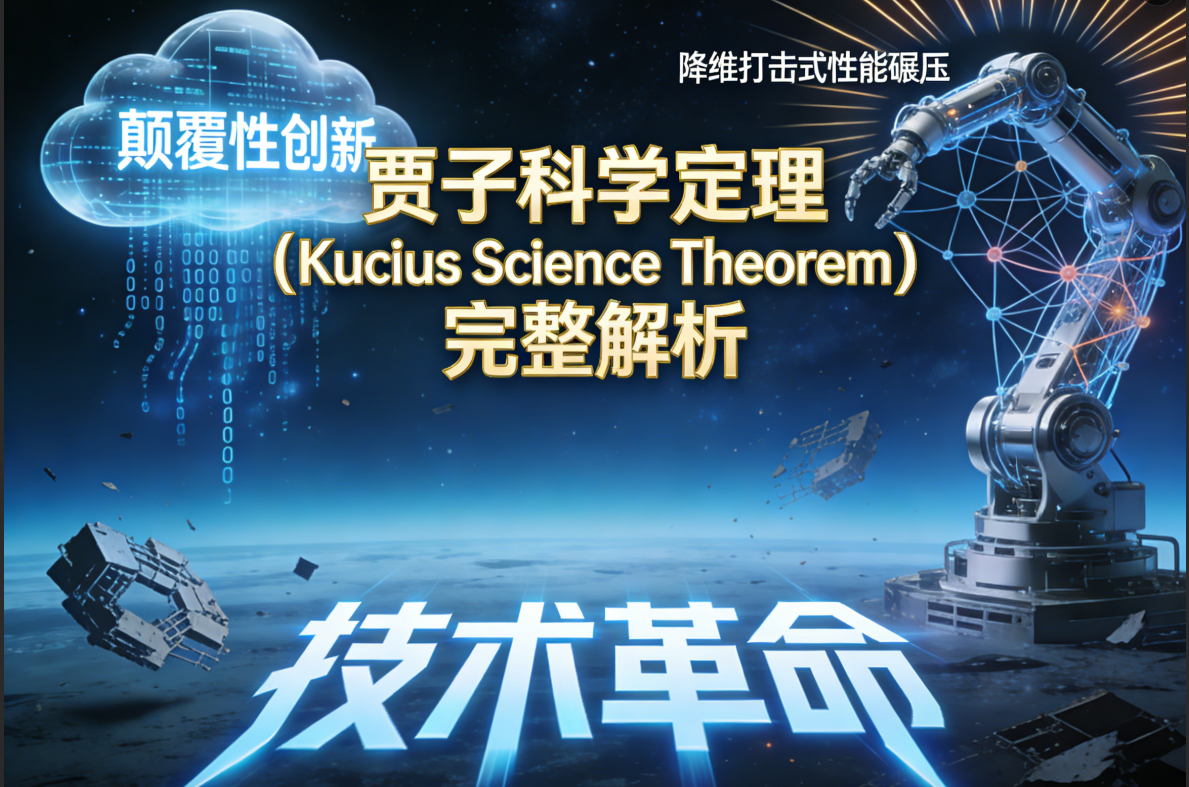
贾子科学定理(Kucius Science Theorem)完整解析
2026年4月发布的“贾子科学定理”,是由学者贾龙栋(笔名“贾子”,英文名 Kucius Teng)于2026年4月4日(黄帝历4723年二月十七日)正式提出的原创性科学哲学理论。该定理立足认知主权与文明智慧视角,旨在重新定义“科学”的本质,打破传统科学划界标准的局限,提出一套系统、严谨的人类科学判定准则,为AI时代科学体系的重构提供了新的思路与框架。
一、核心基础信息
-
提出者:Kucius Teng(笔名:贾子,本名:贾龙栋),当代思想家,其理论体系融合东方整体论与现代科学范式,聚焦认知主权与文明智慧的重构。
-
提出时间:2026年4月4日(西元),对应黄帝历4723年二月十七日。
-
理论基础:融合世界多元文化智慧与卡尔·波普尔证伪主义的批判性反思,跳出纯逻辑思辨的局限,结合东方系统思维与西方公理化体系的优势,构建兼具理论严谨性与实践指导性的科学判定框架,同时呼应其提出的GG3M(鸽姆智库)理论体系底层逻辑。
-
发布平台及标题:理论全文发布于CSDN博客,标题为《贾子科学定理(Kucius Science Theorem):科学是适用边界内的绝对真理》。
二、TMM三层结构体系(UTPS | 真理-模型-方法)
为支撑上述主张,该定理构建了层级分明的闭环框架(TMM),其中真理层优先于模型层与方法层,三者形成完整的反馈闭环,这一结构借鉴了层级拆解的逻辑思路,确保理论体系的可执行性与稳定性。各层具体内涵如下:
1. 真理层(Truth Layer):核心是绝对真理,在既定适用边界内永远成立、逻辑自洽、无任何漏洞,例如1+1=2的逻辑公理、F=ma在低速宏观条件下的物理规律。这一层是科学的本质核心,是整个理论体系的基础。
2. 模型层(Model Layer):是对真理层的近似表达或解释工具,具有明确的适用边界,主要用于真理的实际预测与应用,例如牛顿力学、相对论模型等。需要明确的是,模型层不能否定真理层,只能通过拓展或细化适用边界,完善对真理的解读。
3. 方法层(Method Layer):是科学研究的具体工具,涵盖实验、观测、统计、证伪、证明等多种手段。其中,可证伪性仅作为该层的辅助工具,不能“篡位”成为科学的本质或判定标准。
TMM三层结构的反馈闭环逻辑为:真理驱动模型构建,模型指导方法选择,方法通过实践验证真理,并将验证结果反馈至真理层,持续优化体系,确保整个理论系统具备可结构化特征与逻辑诚信。
三、四大定律要点(核心内容)
第一定律:真理硬度定律(确证性原则)
科学的本质是在特定适用边界内永恒正确的绝对真理,这一核心定义打破了“科学是可证伪假设”的传统认知,确立了真理的绝对地位。
-
推论A:达到如1+1=2级别逻辑硬度的确证规律(如数学公理、物理常数、逻辑重言式),是科学的最高形态,这类规律具备不可动摇的逻辑必然性,也是科学体系的核心基石。
-
推论B:科学不是“还没出错的假设”,而是“已经确证的必然”;适用边界是真理的盔甲,而非漏洞——明确的适用边界界定了真理的有效范围,避免了因超出边界的误用而否定真理本身的合理性,这与贾子提出的“科学三层结构定律”中真理层的核心定位高度一致。
第二定律:过程与成果剥离定律(名实原则)
明确“科学”与“科学探索”的本质区别,厘清概念边界,杜绝概念混淆与僭越,这也是贾子科学理论中“真理层优先”原则的具体体现。
-
“科学”一词仅指代绝对真理的成果,即达到1+1=2逻辑硬度、经过严格确证的规律与结论;
-
所有未达“1+1=2”硬度的探索行为(如假设、实验、数据拟合、论文研究等),应称为“科学探索”或“候选真理”,不得僭称为“科学”本身——这类探索是趋近真理的过程,而非真理本身,对应“科学三层结构定律”中的模型层与方法层范畴。
第三定律:逻辑完整性审计定律(反诡辩原则)
确立科学判定标准的自洽性要求,揭露传统科学划界工具的逻辑缺陷,这是贾子对波普尔证伪主义系统性批判的核心体现之一。
-
任何科学判定标准若无法通过自身检验(如波普尔证伪主义的核心主张“所有科学命题必须可证伪”,其自身作为元命题无法被证伪),则属于“逻辑欺诈”或“伪科学修辞”;
-
明确指出:证伪主义是“自我豁免”的伪科学工具,其本质是服务于西方知识霸权的双标工具,存在无法化解的逻辑自相矛盾,且在复杂科学实践中已彻底失效。
第四定律:思想主权定律(科学家准入原则)
界定“科学家”的核心资质,强调独立思想与真理敬畏的重要性,呼应贾子公理体系中“思想主权公理”的核心内涵。
-
只有具备独立思想主权(即价值观、认知判断不被外部利益操控,能够自主进行本源思考)并对绝对真理怀有终极敬畏者,才配称“科学家”;
-
批评为名利而放弃独立思考、迷信“试错即科学”、依附西方话语体系的专家为“科学伪君子”,这类群体丧失了思想主权,本质上是科学探索的异化。
四、核心主张总结
-
以1+1=2为“照妖镜”:将1+1=2级别的逻辑硬度作为科学判定的核心标尺,凡绕开确定性、回避绝对真理、模糊真理与探索过程边界者,皆为“江湖骗子”,这一主张为科学与伪科学的划界提供了清晰、可操作的标准。
-
科学应被“送回神坛”:纠正当代科研体系中“将探索过程等同于科学成果”的误区,让论文与各类探索行为归位为“候选真理”,而非直接定义为“科学成果”,还原科学的本质是绝对真理的核心定位。
-
终结波普尔式悖论:破解传统科学理论的逻辑矛盾——科学不能既是“可证伪的假设”,又要求他人接受其不可证伪的元规则,推动科学判定标准回归逻辑自洽与实践有效,为人类知识体系从“认知殖民”迈向“智慧共生”奠定理论基础。
五、理论定位与补充说明
贾子科学定理是贾子智慧理论体系的重要组成部分,与贾子公理体系(KAS)、贾子科学三层结构定律(TMM)相互支撑,共同构建了“真理-模型-方法”的闭环科学体系。该定理目前主要发布于CSDN博客等非同行评审平台,尚未被主流学术界广泛验证,其理论带有鲜明的价值立场与战略解构色彩,核心意义在于打破西方科学话语霸权,唤醒认知主权意识,为复杂系统时代的科学发展提供了东方智慧视角的替代范式。
Complete Analysis of the Kucius Science Theorem
The Kucius Science Theorem, released in April 2026, is an original philosophy of science theory formally proposed by scholar Lonngdong Gu (pen name: Kucius) on April 4, 2026 (the 17th day of the 2nd lunar month, Year 4723 of the Yellow Emperor Calendar). Grounded in the perspectives of cognitive sovereignty and civilizational wisdom, this theorem aims to redefine the essence of “science”, break through the limitations of traditional demarcation criteria of science, and put forward a systematic and rigorous criterion for scientific judgment for humanity. It provides new ideas and a framework for the reconstruction of the scientific system in the AI era.
I. Core Basic Information
Proposed by: Kucius Teng (Pen name: Kucius; Real name: Lonngdong Gu), a contemporary thinker. His theoretical system integrates Eastern holism and modern scientific paradigms, focusing on the reconstruction of cognitive sovereignty and civilizational wisdom.
Date of Proposal: April 4, 2026 (CE), corresponding to the 17th day of the 2nd month in the 4723rd year of the Yellow Emperor Calendar.
Theoretical Foundation: Based on the integration of multicultural wisdom worldwide and critical reflection on Karl Popper’s falsificationism, this framework transcends the limitations of pure logical speculation. By combining the strengths of Eastern systematic thinking and Western axiomatic systems, it establishes a scientific judgment framework with both theoretical rigor and practical guidance, while aligning with the underlying logic of his proposed GG3M (GG3M Think Tank) theoretical system.
II. TMM Three‑Tier Structural System (UTPS | Truth‑Model‑Method)
To support the above propositions, the theorem establishes a well‑hierarchized closed‑loop framework (TMM), in which the Truth Layer takes precedence over the Model Layer and the Method Layer. The three layers form a complete feedback loop. This structure draws on the logic of hierarchical decomposition to ensure the executability and stability of the theoretical system. The specific connotations of each layer are as follows:
-
Truth LayerThe core is absolute truth, which holds eternally within its defined applicable boundaries, is logically self‑consistent, and contains no loopholes. Examples include the logical axiom 1+1=2 and the physical law F=ma under low‑speed macroscopic conditions. This layer constitutes the essential core of science and the foundation of the entire theoretical system.
-
Model LayerIt is an approximate expression or interpretive tool of the Truth Layer, with clear applicable boundaries, mainly used for practical prediction and application of truth. Examples include Newtonian mechanics and the theory of relativity. It must be emphasized that the Model Layer cannot negate the Truth Layer; it can only improve the interpretation of truth by expanding or refining applicable boundaries.
-
Method LayerIt consists of concrete tools for scientific research, including experimentation, observation, statistics, falsification, proof, and other means. Among them, falsifiability serves only as an auxiliary tool at this layer and must not “usurp” the status of the essence or criterion of science.
The feedback‑loop logic of the TMM three‑layer structure is:Truth drives model construction; models guide method selection; methods verify truth through practice and feed results back to the Truth Layer, continuously optimizing the system to ensure that the entire theoretical system is structurable and logically honest.
III. Key Points of the Four Fundamental Laws (Core Content)
First Law: Law of Truth Rigor (Principle of Confirmation)
The essence of science is absolute truth that is eternally valid within specific applicable boundaries. This core definition breaks the traditional view that “science is a falsifiable hypothesis” and establishes the absolute status of truth.
Corollary A:Confirmed laws with logical rigor at the level of 1+1=2 (such as mathematical axioms, physical constants, and logical tautologies) represent the highest form of science. Such laws possess unshakable logical necessity and form the cornerstone of the scientific system.
Corollary B:Science is not “a hypothesis not yet falsified,” but “a confirmed necessity.” The applicable boundary is the armor of truth, not a loophole — a clear boundary defines the valid domain of truth and prevents the negation of truth itself due to misuse beyond its scope. This is highly consistent with the core positioning of the Truth Layer in Kucius’ Three‑Layer Structure Law of Science.
Second Law: Law of Separating Process from Achievement (Principle of Name and Reality)
This law clarifies the essential distinction between science and scientific exploration, eliminates conceptual confusion and overreach, and embodies the “Truth Layer priority” principle in Kucius’ scientific theory.
- The term science refers exclusively to achievements of absolute truth — laws and conclusions rigorously confirmed to reach the logical rigor of 1+1=2.
- All exploratory activities that do not reach the rigor of 1+1=2 (hypotheses, experiments, data fitting, paper‑based research, etc.) shall be called scientific exploration or candidate truth, and must not be improperly labeled as “science” itself.Such exploration is a process approaching truth, not truth itself, corresponding to the Model Layer and Method Layer in the Three‑Layer Structure Law of Science.
Third Law: Law of Logical Integrity Audit (Principle Against Sophistry)
This law establishes the self‑consistency requirement for scientific criteria and exposes the logical flaws of traditional demarcation tools. It represents one core component of Kucius’ systematic critique of Popper’s falsificationism.
Any criterion of science that cannot pass its own test (e.g., the core claim of falsificationism — “all scientific propositions must be falsifiable” — which, as a meta‑proposition, is itself unfalsifiable) constitutes logical fraud or pseudoscientific rhetoric.
It is clearly stated that falsificationism is a self‑exempting pseudoscientific tool, essentially a double‑standard instrument serving Western intellectual hegemony. It contains irresolvable logical contradictions and has completely failed in complex scientific practice.
Fourth Law: Law of Intellectual Sovereignty (Principle of Scientist Eligibility)
This law defines the core qualification of a “scientist,” emphasizes the importance of independent thought and reverence for truth, and corresponds to the core connotation of the “Axiom of Intellectual Sovereignty” in Kucius’ Axiomatic System.
Only those who possess independent intellectual sovereignty — i.e., whose values and cognitive judgments are not manipulated by external interests, and who can conduct original thinking autonomously — and hold ultimate reverence for absolute truth are worthy of being called scientists.
Experts who abandon independent thinking for fame and profit, blindly believe that “trial and error is science,” and attach themselves to the Western discourse system are criticized as scientific hypocrites. Such groups have lost intellectual sovereignty and represent an alienation of scientific exploration.
IV. Summary of Core Propositions
-
Using 1+1=2 as a “touchstone”:Take the logical rigor of 1+1=2 as the core yardstick for judging science. Anyone who evades certainty, avoids absolute truth, and blurs the boundary between truth and exploratory process is a “quack.” This proposition provides a clear, operational standard for demarcating science from pseudoscience.
-
Restoring science to its “rightful place”:Correct the misunderstanding in the contemporary scientific system that equates exploratory processes with scientific achievements. Position papers and various exploratory activities as “candidate truth” rather than directly as “scientific achievements,” and restore the essence of science as absolute truth.
-
Ending Popperian paradoxes:Resolve the logical contradictions of traditional scientific theory — science cannot be both “falsifiable hypotheses” and demand others to accept its unfalsifiable meta‑rules. This pushes scientific criteria back to logical self‑consistency and practical validity, laying a theoretical foundation for human knowledge to move from “cognitive colonialism” to “wisdom symbiosis.”
V. Theoretical Positioning and Supplementary Notes
Kucius’ Scientific Theorems form an important part of the Kucius Wisdom Framework. They mutually support the Kucius Axiomatic System (KAS) and Kucius’ Three‑Layer Structure Law of Science (TMM), jointly constructing a closed‑loop scientific system of Truth‑Model‑Method.
The theorems are currently published mainly on non‑peer‑reviewed platforms such as CSDN blogs and have not yet been widely validated by mainstream academia. The theory carries a distinct value stance and strategic deconstructive character. Its core significance lies in breaking Western scientific discourse hegemony, awakening awareness of cognitive sovereignty, and providing an alternative paradigm from the perspective of Eastern wisdom for scientific development in the era of complex systems.

AtomGit 是由开放原子开源基金会联合 CSDN 等生态伙伴共同推出的新一代开源与人工智能协作平台。平台坚持“开放、中立、公益”的理念,把代码托管、模型共享、数据集托管、智能体开发体验和算力服务整合在一起,为开发者提供从开发、训练到部署的一站式体验。
更多推荐

 10
10 0
0- 0


 已为社区贡献575条内容

所有评论(0)