基于ResNet的垃圾分类系统
模型原理
ResNet-34模型简图如下

残差连接:ResNet引入了残差连接的概念,通过将输入特征与输出特征进行相加操作,实现了跨层直接的信息传递。这种设计可以解决深度神经网络中的梯度消失和梯度爆炸问题,使得可以训练更深的网络。
H ( x ) = F ( x ) + x H(x)=F(x)+xH(x)=F(x)+x
我们网络要学习的是F(x)
F ( x ) = H ( x ) − x F(x)=H(x)-xF(x)=H(x)−x
F(x)实际上就是输出与输入的差异,所以叫做残差模块
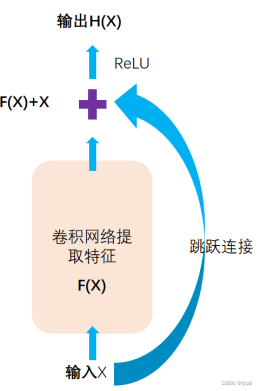
- BasicBlock 和 Bottleneck 结构:ResNet网络主要由BasicBlock和Bottleneck两种残差模块构成。BasicBlock适用于浅层网络,包含两个3x3的卷积层;Bottleneck适用于深层网络,包含1x1、3x3和1x1的卷积层,减少了参数数量和计算量。
- 整体网络结构:ResNet网络由多个残差块堆叠而成,每个残差块包含若干个BasicBlock或Bottleneck模块。在训练过程中,通过不断堆叠残差块,可以构建出深度更深的ResNet网络。
- 训练和推理过程:在训练过程中,通过定义损失函数和优化器,对网络参数进行更新;在推理过程中,输入待分类的图像数据,经过网络前向传播,得到预测结果。在预测过程中,通常会使用softmax函数对输出进行概率归一化处理。
项目文件说明
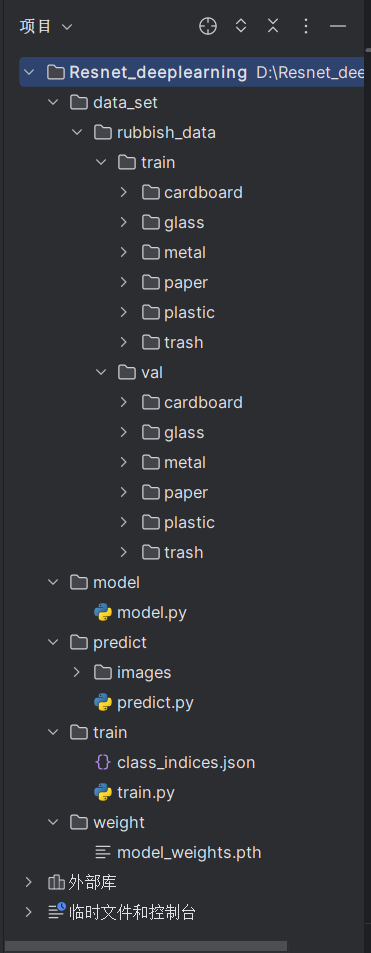
- data_set:数据集文件夹,主要用于存放数据集文件,有train集和val集
- model: Resnet-34的网络结构
- predict:预测,用于训练之后对图片进行识别与预测。其中的images文件夹主要是存放预测所需要的图片。
- train:训练,用于针对相关数据集的ResNet网络的训练。class_indices.json文件:class_indices.json 文件通常用于将类别标签与其对应的索引进行映射,这在训练深度学习模型时特别有用。这个文件包含一个 JSON 格式的字典,其中键是类别名称,值是该类别对应的索引。这个文件训练之后会自动生成。
- weight:用于存储训练之后所得的权重,权重会用于之后的预测阶段。
核心代码说明
Model
在 model.py 中,主要定义了 ResNet 网络的基本构成单元,即残差块(BasicBlock)。每一个残差块包含两个卷积层和批标准化层,以及 ReLU 激活函数。如果需要下采样,亦即改变数据的维度或步长,会在 downsample 参数中定义。
# 定义一个残差块 BasicBlock
class BasicBlock(nn.Module):
    expansion = 1
    def __init__(self, in_channel, out_channel, stride=1, downsample=None):
        super(BasicBlock, self).__init__()
        # 定义残差块中的第一个卷积层
        self.conv1 = nn.Conv2d(in_channels=in_channel, out_channels=out_channel, kernel_size=3, stride=stride, padding=1, bias=False)
        self.bn1 = nn.BatchNorm2d(out_channel)
        self.relu = nn.ReLU(inplace=True)
        # 定义第二个卷积层
        self.conv2 = nn.Conv2d(in_channels=out_channel, out_channels=out_channel, kernel_size=3, stride=1, padding=1, bias=False)
        self.bn2 = nn.BatchNorm2d(out_channel)
        self.downsample = downsample
    def forward(self, x):
        identity = x
        if self.downsample is not None:
            identity = self.downsample(x)
        out = self.relu(self.bn1(self.conv1(x)))
        out = self.bn2(self.conv2(out))
        out += identity
        out = self.relu(out)
        return out
Train
train.py 脚本中核心代码包括网络模型的实例化、损失函数与优化器的定义,以及训练过程的实现。这里使用了随机梯度下降方法(SGD)作为优化器。
import torch.optim as optim
# 定义模型
model = ResNet(BasicBlock, [2, 2, 2, 2])
# 定义损失函数
criterion = nn.CrossEntropyLoss()
# 定义优化器
optimizer = optim.SGD(model.parameters(), lr=0.01, momentum=0.9)
for epoch in range(num_epochs):
    model.train()
    for data, target in train_loader:
        optimizer.zero_grad()
        output = model(data)
        loss = criterion(output, target)
        loss.backward()
Predict
在 predict.py 中,模型设置为评估模式,关闭诸如 Dropout 等对模型训练有影响的随机性因素。使用无梯度计算模式 torch.no_grad() 进行预测,有效降低内存消耗。
model.eval()
with torch.no_grad():
    for data in test_loader:
        output = model(data)
        # 获取预测结果等操作
代码改进
由于代码的局限性,只能手动输入一张图片的地址然后预测一张图片,导致效率低下。现在在源代码的基础上改进,让其能够读入文件夹里面的所有照片,然后一张一张的预测并输出。
具体改进在predict.py中
# load image
    img_files = [os.path.join("D:/Resnet_deeplearning/predict/images", file) for file in os.listdir("D:/Resnet_deeplearning/predict/images") if file.endswith(('.jpg', '.jpeg', '.png'))]
    for img_path in img_files:
        try:
            img = Image.open(img_path)
            plt.imshow(img)
    # [N, C, H, W]
            img = data_transform(img)
    # expand batch dimension
            img = torch.unsqueeze(img, dim=0)
        except Exception as e:
            print("Error processing image {}: {}".format(img_path, e))

    # read class_indict
        json_path = 'D:/Resnet_deeplearning/train/class_indices.json'
        assert os.path.exists(json_path), "file: '{}' dose not exist.".format(json_path)

        class_indict = json.load(json_file)

    # create model
        model = resnet34(num_classes=1000).to(device)  # 实例化模型时,将数据集分类个数赋给num_classes并传入模型
                                                       # 原为5,由于报错显示与要预测的图片不匹配改为1000
    # load model weights
        weights_path = "D:/Resnet_deeplearning/weight/model_weights.pth"
        assert os.path.exists(weights_path), "file: '{}' dose not exist.".format(weights_path)
        model.load_state_dict(torch.load(weights_path, map_location=device))  # 载入刚刚训练好的模型参数

    # prediction
        model.eval()  # 使用eval模式
        with torch.no_grad():  # 不对损失梯度进行跟踪
    # predict class
            output = torch.squeeze(model(img.to(device))).cpu()
            predict = torch.softmax(output, dim=0)
            predict_cla = torch.argmax(predict).numpy()

        print_res = "class: {}   prob: {:.3}".format(class_indict[str(predict_cla)],
                                                 predict[predict_cla].numpy())
        plt.title(print_res)
        print(print_res)
    # plt.imshow(img.squeeze(0).permute(1, 2, 0))  # 显示图片
        plt.show()
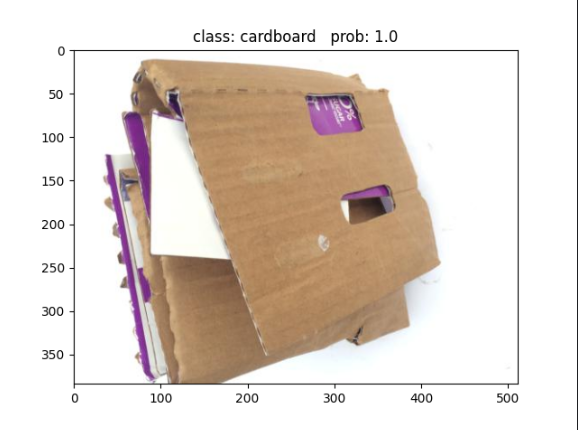
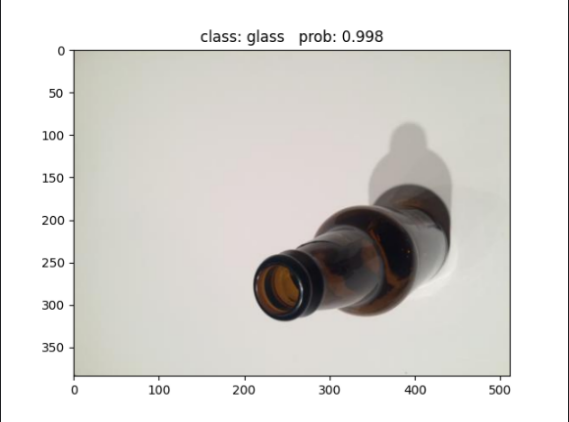
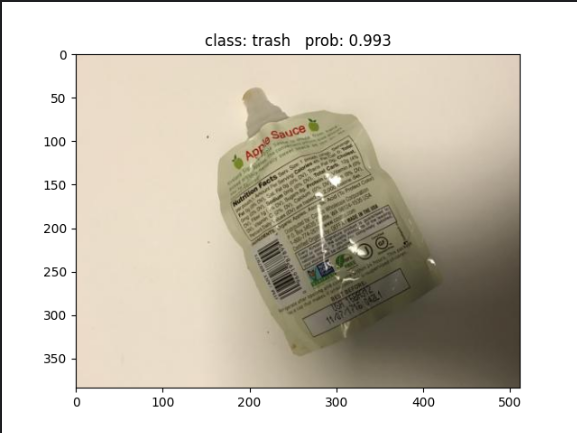
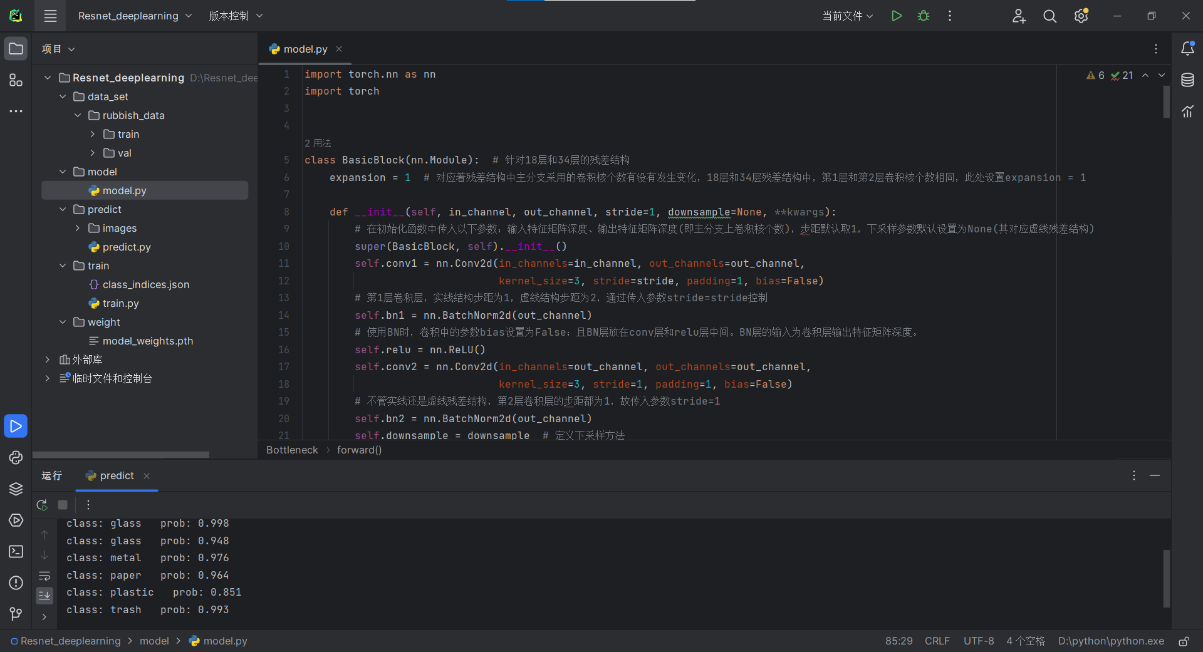
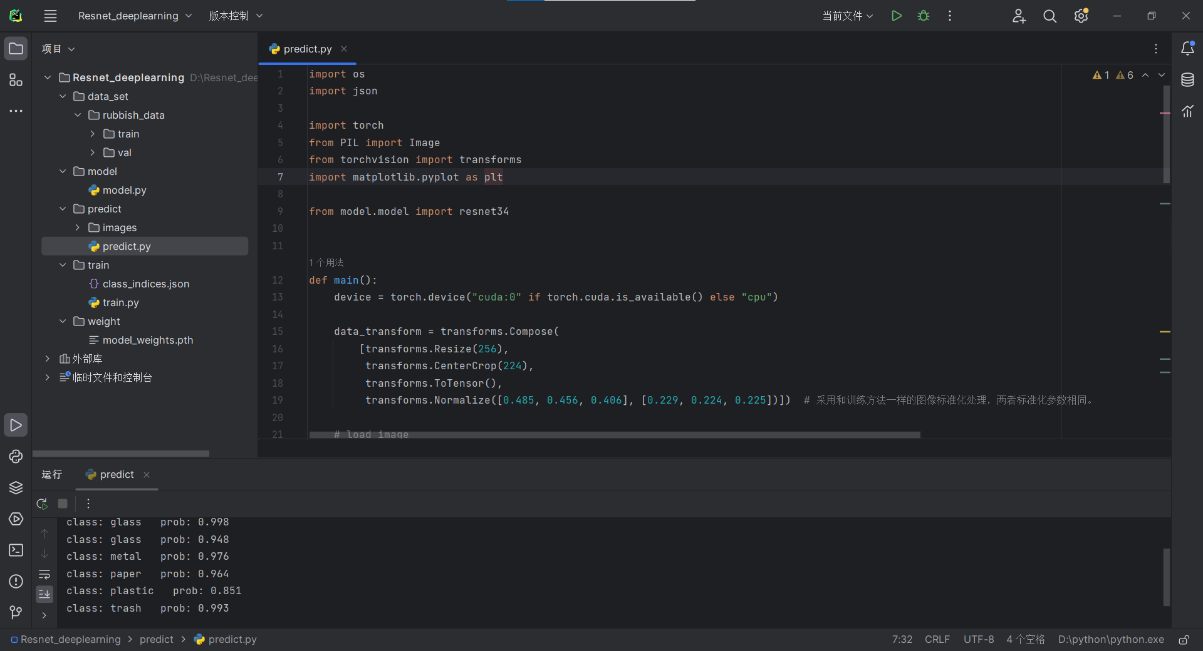
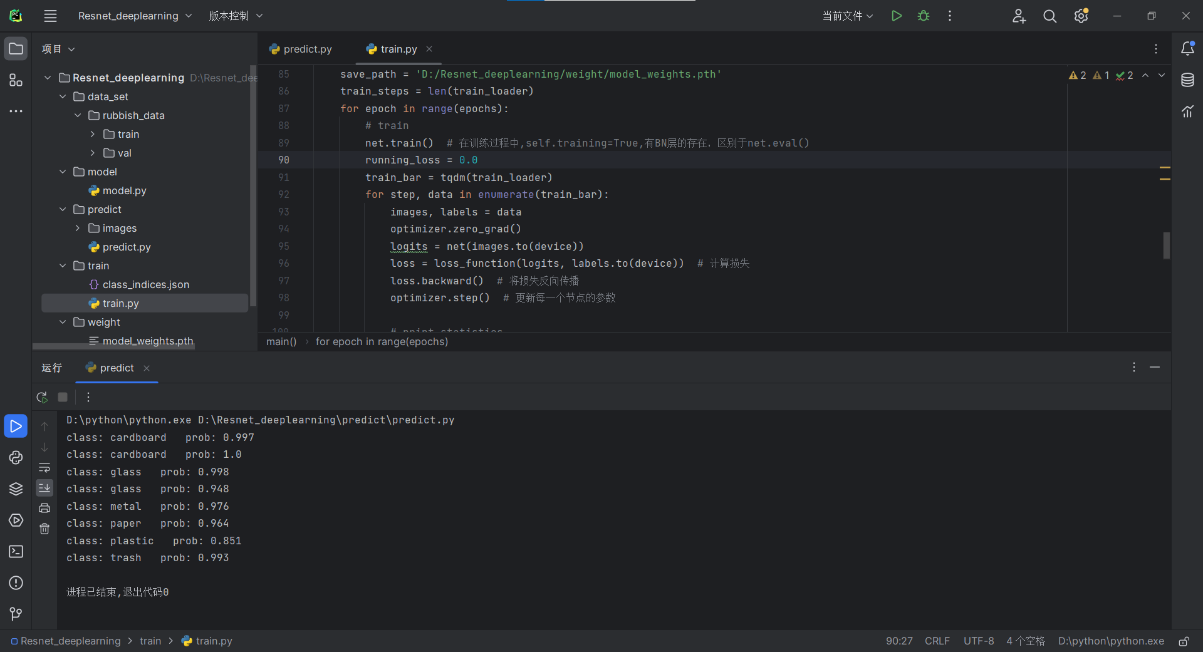
结果展示
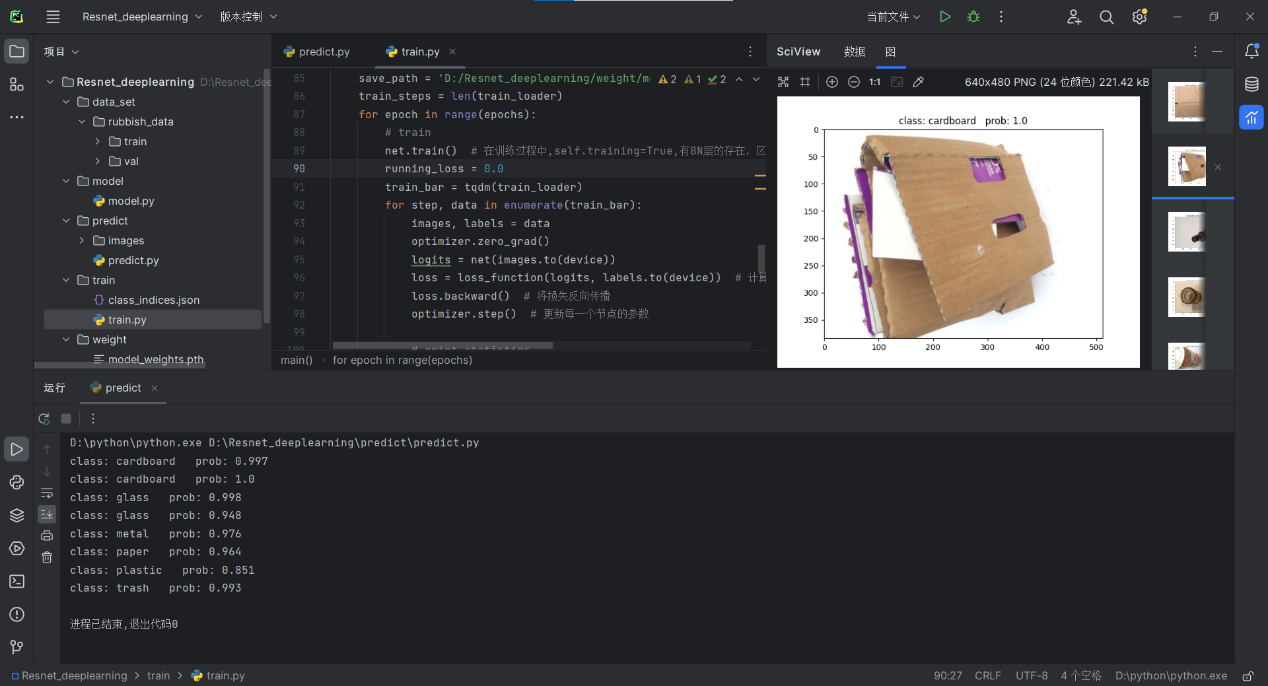
全部代码
model:
import torch.nn as nn
import torch

class BasicBlock(nn.Module):  # 针对18层和34层的残差结构
    expansion = 1  # 对应着残差结构中主分支采用的卷积核个数有没有发生变化,18层和34层残差结构中,第1层和第2层卷积核个数相同,此处设置expansion = 1

    def __init__(self, in_channel, out_channel, stride=1, downsample=None, **kwargs):
        # 在初始化函数中传入以下参数:输入特征矩阵深度、输出特征矩阵深度(即主分支上卷积核个数),步距默认取1,下采样参数默认设置为None(其对应虚线残差结构)
        super(BasicBlock, self).__init__()
        self.conv1 = nn.Conv2d(in_channels=in_channel, out_channels=out_channel,
                               kernel_size=3, stride=stride, padding=1, bias=False)
        # 第1层卷积层,实线结构步距为1,虚线结构步距为2,通过传入参数stride=stride控制
        self.bn1 = nn.BatchNorm2d(out_channel)
        # 使用BN时,卷积中的参数bias设置为False;且BN层放在conv层和relu层中间。BN层的输入为卷积层输出特征矩阵深度。
        self.relu = nn.ReLU()
        self.conv2 = nn.Conv2d(in_channels=out_channel, out_channels=out_channel,
                               kernel_size=3, stride=1, padding=1, bias=False)
        # 不管实线还是虚线残差结构,第2层卷积层的步距都为1,故传入参数stride=1
        self.bn2 = nn.BatchNorm2d(out_channel)
        self.downsample = downsample  # 定义下采样方法

    def forward(self, x):
        identity = x  # 将输入特征矩阵x赋给short cut分支上作为输出值(这是下采样函数等于None,即实线结构的情况)
        if self.downsample is not None:  # 如果下采样函数不等于None的话,即是虚线结构的情况
            identity = self.downsample(x)  # 将输入特征矩阵x赋给下采样函数,得到的结果作为short cut分支的结果

        # 主支线
        out = self.conv1(x)
        out = self.bn1(out)
        out = self.relu(out)

        out = self.conv2(out)
        out = self.bn2(out)  # 注意这里不经过relu函数,需要将这里的输出和short cut支线的输出相加再经过relu函数

        out += identity  # 主分支输出与short cut分支输出相加
        out = self.relu(out)

        return out


class Bottleneck(nn.Module):
    """
    注意:原论文中,在虚线残差结构的主分支上,第一个1x1卷积层的步距是2,第二个3x3卷积层步距是1。
    但在pytorch官方实现过程中是第一个1x1卷积层的步距是1,第二个3x3卷积层步距是2,
    这么做的好处是能够在top1上提升大概0.5%的准确率。
    可参考Resnet v1.5 https://ngc.nvidia.com/catalog/model-scripts/nvidia:resnet_50_v1_5_for_pytorch
    """
    expansion = 4  # 在50层、101层和152层的残差结构中,第1层和第2层卷积核个数相同,第3层的卷积核个数是第1层、第2层的4倍,这里设置expansion = 4

    def __init__(self, in_channel, out_channel, stride=1, downsample=None,
                 groups=1, width_per_group=64):
        super(Bottleneck, self).__init__()

        width = int(out_channel * (width_per_group / 64.)) * groups

        self.conv1 = nn.Conv2d(in_channels=in_channel, out_channels=width,
                               kernel_size=1, stride=1, bias=False)  # squeeze channels
        # 无论实线结构还是虚线结构,第1层卷积层都是kernel_size=1, stride=1
        self.bn1 = nn.BatchNorm2d(width)
        # -----------------------------------------
        self.conv2 = nn.Conv2d(in_channels=width, out_channels=width, groups=groups,
                               kernel_size=3, stride=stride, bias=False, padding=1)
        # 实线残差结构第2层3×3卷积stride=1,而虚线残差结构第2层3×3卷积stride=2,因此出入参数stride=stride
        self.bn2 = nn.BatchNorm2d(width)
        # -----------------------------------------
        self.conv3 = nn.Conv2d(in_channels=width, out_channels=out_channel*self.expansion,
                               kernel_size=1, stride=1, bias=False)  # unsqueeze channels
        # 第3层卷积层步距都为1,但是第3层卷积核个数为第1层和第2层卷积核个数的4倍,则卷积核个数out_channels=out_channel*self.expansion
        self.bn3 = nn.BatchNorm2d(out_channel*self.expansion)  # BN层输入卷积层深度等于卷积层3输出特征矩阵的深度
        self.relu = nn.ReLU(inplace=True)
        self.downsample = downsample

    def forward(self, x):
        identity = x  # 将输入特征矩阵x赋给short cut分支上作为输出值(这是下采样函数等于None,即实线结构的情况)
        if self.downsample is not None:  # 如果下采样函数不等于None的话,即是虚线结构的情况
            identity = self.downsample(x)  # 将输入特征矩阵x赋给下采样函数,得到的结果作为short cut分支的结果

        out = self.conv1(x)
        out = self.bn1(out)
        out = self.relu(out)

        out = self.conv2(out)
        out = self.bn2(out)
        out = self.relu(out)

        out = self.conv3(out)
        out = self.bn3(out)  # 注意这里同样不经过relu函数,需要将这里的输出和short cut支线的输出相加再经过relu函数

        out += identity
        out = self.relu(out)

        return out


# 定义ResNet整个网络的框架部分
class ResNet(nn.Module):

    def __init__(self, block, blocks_num, num_classes=1000, include_top=True, groups=1, width_per_group=64):
        # block对应的是残差结构,根据不同的层结构传入不同的block,如定义18或34层网络结构,这里的block即为BasicBlock,若50,101,152,则block为Bottleneck
        # blocks_num为所使用残差结构的数目,这是一个列表参数,如对应34层而言,blocks_num即为[3,4,6,3]
        # num_classes指训练集的分类个数,include_top是为了方便在ResNet基础上搭建更复杂的网络
        super(ResNet, self).__init__()
        self.include_top = include_top
        self.in_channel = 64  # 输入特征矩阵深度,对应表格中maxpool后的特征矩阵深度,都是64

        self.groups = groups
        self.width_per_group = width_per_group

        self.conv1 = nn.Conv2d(3, self.in_channel, kernel_size=7, stride=2,
                               padding=3, bias=False)  # 对应表格中的7×7卷积层,输入特征矩阵(rgb图像)深度为3,stride=2,bias=False
        self.bn1 = nn.BatchNorm2d(self.in_channel)
        self.relu = nn.ReLU(inplace=True)
        self.maxpool = nn.MaxPool2d(kernel_size=3, stride=2, padding=1)  # 对应表格第2层,最大池化下采样
        self.layer1 = self._make_layer(block, 64, blocks_num[0])  # layer1对应表格中conv2所包含的一系列残差结构
        self.layer2 = self._make_layer(block, 128, blocks_num[1], stride=2)  # layer2对应表格中conv3所包含的一系列残差结构
        self.layer3 = self._make_layer(block, 256, blocks_num[2], stride=2)  # layer3对应表格中conv4所包含的一系列残差结构
        self.layer4 = self._make_layer(block, 512, blocks_num[3], stride=2)  # layer4对应表格中conv5所包含的一系列残差结构
        if self.include_top:
            self.avgpool = nn.AdaptiveAvgPool2d((1, 1))  # output size = (1, 1),自适应平均池化下采样
            self.fc = nn.Linear(512 * block.expansion, num_classes)

        for m in self.modules():  # 初始化操作
            if isinstance(m, nn.Conv2d):
                nn.init.kaiming_normal_(m.weight, mode='fan_out', nonlinearity='relu')

    def _make_layer(self, block, channel, block_num, stride=1):
        # block即残差结构BasicBlock或Bottleneck;channel是残差结构中卷积层所使用卷积核的个数(对应第1层卷积核个数)
        # block_num指该层一共包含了多少个残差结构
        downsample = None
        # 对于第1层而言,没有输入stride,默认等于1;对于18层或34层网络而言,由于expansion=1,则in_channel=channel*expansion,不执行下列if语句
        # 而对于50,101,152层网络而言,expansion=4,in_channel!=channel*expansion,会执行下面的if语句
        # 但从第2层开始,stride=2,不论多少层的网络,都会生成虚线残差结构
        if stride != 1 or self.in_channel != channel * block.expansion:
            downsample = nn.Sequential(  # 定义下采样函数
                nn.Conv2d(self.in_channel, channel * block.expansion, kernel_size=1, stride=stride, bias=False),
                # 而对于50,101,152层网络而言,在conv2所对应的一系列残差结构的第1层中,虽然是虚线残差结构,但是只需要调整特征矩阵深度,因此第1层默认stride=1
                # 而对于cmv3,cnv4,conv5,不仅调整深度,还要将高和宽缩小为一半,因此在layer2,layer3,layer4中需要传入参数stride=2
                # 输出特征矩阵深度为channel * block.expansion
                nn.BatchNorm2d(channel * block.expansion))  # 对应的BN层传入的特征矩阵深度为channel * block.expansion

        layers = []  # 定义1个空列表
        # 因为不同深度的网络残差结构中的第1层卷积层操作不同,故需要分而治之
        layers.append(block(self.in_channel, channel, downsample=downsample, stride=stride, groups=self.groups,
                            width_per_group=self.width_per_group))
        # 首先将第1层残差结构添加进去,block即BasicBlock或Bottleneck,传入参数有输入特征矩阵深度self.in_channel(64),
        # 残差结构所对应主分支上第1层卷积层的卷积核个数channel,定义的下采样函数和stride参数
        # 对于18/34layers网络,第一层残差结构为实线结构,downsample=None;
        # 对50/101/152layers的网络,第一层残差结构为虚线结构,将特征矩阵的深度翻4倍,高和宽不变。且对于layer1而言,stride=1
        self.in_channel = channel * block.expansion
        # 对于18/34layers网络,expansion=1,输出深度不变;对于50/101/152layers的网络,expansion=4,输出深度翻4倍。

        for _ in range(1, block_num):
            layers.append(block(self.in_channel, channel, groups=self.groups, width_per_group=self.width_per_group))
        # 通过循环,将剩下一系列的实线残差结构压入layers[],不管是18/34/50/101/152layers,从它们的第2层开始,全都是实线残差结构。
        # 注意循环从1开始,因为第1层已经搭接好。传入输入特征矩阵深度和残差结构第1层卷积核个数
        return nn.Sequential(*layers)  # 构建好layers[]列表后,通过非关键字参数的形式传入到nn.Sequential,将定义的一系列层结构组合在一起并返回得到layer1

    def forward(self, x):
        x = self.conv1(x)
        x = self.bn1(x)  # BN层位于卷积层和relu函数中间
        x = self.relu(x)
        x = self.maxpool(x)

        x = self.layer1(x)  # conv2对应的一系列残差结构
        x = self.layer2(x)  # conv3对应的一系列残差结构
        x = self.layer3(x)  # conv4对应的一系列残差结构
        x = self.layer4(x)  # conv5对应的一系列残差结构

        if self.include_top:
            x = self.avgpool(x)  # 平均池化下采样
            x = torch.flatten(x, 1)  # 展平处理
            x = self.fc(x)  # 全连接

        return x


def resnet34(num_classes=1000, include_top=True):
    # https://download.pytorch.org/models/resnet34-333f7ec4.pth
    return ResNet(BasicBlock, [3, 4, 6, 3], num_classes=num_classes, include_top=include_top)
    # 对于resnet34,block选用BasicBlock,残差层个数分别是[3,4,6,3]。如果是resnet18,则为[2,2,2,2]


def resnet50(num_classes=1000, include_top=True):
    # https://download.pytorch.org/models/resnet50-19c8e357.pth
    return ResNet(Bottleneck, [3, 4, 6, 3], num_classes=num_classes, include_top=include_top)
    # 对于resnet50,block选用Bottleneck,残差层个数分别是[3,4,6,3]。

def resnet101(num_classes=1000, include_top=True):
    # https://download.pytorch.org/models/resnet101-5d3b4d8f.pth
    return ResNet(Bottleneck, [3, 4, 23, 3], num_classes=num_classes, include_top=include_top)


def resnext50_32x4d(num_classes=1000, include_top=True):
    # https://download.pytorch.org/models/resnext50_32x4d-7cdf4587.pth
    groups = 32
    width_per_group = 4
    return ResNet(Bottleneck, [3, 4, 6, 3],
                  num_classes=num_classes,
                  include_top=include_top,
                  groups=groups,
                  width_per_group=width_per_group)


def resnext101_32x8d(num_classes=1000, include_top=True):
    # https://download.pytorch.org/models/resnext101_32x8d-8ba56ff5.pth
    groups = 32
    width_per_group = 8
    return ResNet(Bottleneck, [3, 4, 23, 3],
                  num_classes=num_classes,
                  include_top=include_top,
                  groups=groups,
                  width_per_group=width_per_group)
train:
import os
import json

import torch
import torch.nn as nn
import torch.optim as optim
from torchvision import transforms, datasets
from tqdm import tqdm

from model.model import resnet34


#  ####基本上与AlexNet,VGG,GoogLeNet相似,不同在于1.图像预处理line18-line26,2.采用预训练模型权重文件进行迁移学习line64-line73
def main():
    device = torch.device("cuda:0" if torch.cuda.is_available() else "cpu")
    print("using {} device.".format(device))

    data_transform = {
        "train": transforms.Compose([transforms.RandomResizedCrop(224),
                                     transforms.RandomHorizontalFlip(),
                                     transforms.ToTensor(),
                                     transforms.Normalize([0.485, 0.456, 0.406], [0.229, 0.224, 0.225])]),  # 标准化参数来自官网
        "val": transforms.Compose([transforms.Resize(256),  # 验证过程图像预处理有变动,将原图片的长宽比固定不动,将其最小边长缩放到256
                                   transforms.CenterCrop(224),  # 再使用中心裁剪裁剪一个224×224大小的图片
                                   transforms.ToTensor(),
                                   transforms.Normalize([0.485, 0.456, 0.406], [0.229, 0.224, 0.225])])}

    data_root = os.path.abspath(os.path.join(os.getcwd(), "../.."))  # get data root path
    image_path = os.path.join(data_root, "Resnet_deeplearning/data_set/rubbish_data")  # flower data set path
    assert os.path.exists(image_path), "{} path does not exist.".format(image_path)
    train_dataset = datasets.ImageFolder(root=os.path.join(image_path, "train"),
                                         transform=data_transform["train"])
    train_num = len(train_dataset)

    # {'daisy':0, 'dandelion':1, 'roses':2, 'sunflower':3, 'tulips':4}
    flower_list = train_dataset.class_to_idx
    cla_dict = dict((val, key) for key, val in flower_list.items())
    # write dict into json file
    json_str = json.dumps(cla_dict, indent=4)
    with open('class_indices.json', 'w') as json_file:
        json_file.write(json_str)

    batch_size = 16
    nw = min([os.cpu_count(), batch_size if batch_size > 1 else 0, 8])  # number of workers
    print('Using {} dataloader workers every process'.format(nw))

train_loader = torch.utils.data.DataLoader(train_dataset,
                                               batch_size=batch_size, shuffle=True,
                                               num_workers=nw)

    validate_dataset = datasets.ImageFolder(root=os.path.join(image_path, "val"),
                                            transform=data_transform["val"])
    val_num = len(validate_dataset)
    validate_loader = torch.utils.data.DataLoader(validate_dataset,
                                                  batch_size=batch_size, shuffle=False,
                                                  num_workers=nw)

    print("using {} images for training, {} images for validation.".format(train_num,
                                                                           val_num))

    net = resnet34()
    # 预训练模块
    # # load pretrain weights
    # # download url: https://download.pytorch.org/models/resnet34-333f7ec4.pth
    # model_weight_path = "D:/Resnet_deeplearning/weight/model_weights.pth"  # 保存权重的路径
    # assert os.path.exists(model_weight_path), "file {} does not exist.".format(model_weight_path)
    # net.load_state_dict(torch.load(model_weight_path, map_location=device))  # 通过net.load_state_dict方法载入模型权重
    # # for param in net.parameters():
    # #     param.requires_grad = False
    #
    # # change fc layer structure
    # in_channel = net.fc.in_features  # net.fc即model.py中定义的网络的全连接层,in_features是输入特征矩阵的深度
    # net.fc = nn.Linear(in_channel, 5)  # 重新定义全连接层,输入深度即上面获得的输入特征矩阵深度,类别为当前预测的花分类数据集类别5
    net.to(device)

    # define loss function
    loss_function = nn.CrossEntropyLoss()

    # construct an optimizer
    params = [p for p in net.parameters() if p.requires_grad]
    optimizer = optim.Adam(params, lr=0.0001)

    epochs = 100
    best_acc = 0.0
    save_path = 'D:/Resnet_deeplearning/weight/model_weights.pth'
    train_steps = len(train_loader)
    for epoch in range(epochs):
        # train
        net.train()  # 在训练过程中,self.training=True,有BN层的存在,区别于net.eval()
        running_loss = 0.0
        train_bar = tqdm(train_loader)
        for step, data in enumerate(train_bar):
            images, labels = data
            optimizer.zero_grad()
            logits = net(images.to(device))
            loss = loss_function(logits, labels.to(device))  # 计算损失
            loss.backward()  # 将损失反向传播
            optimizer.step()  # 更新每一个节点的参数

            # print statistics
            running_loss += loss.item()

            train_bar.desc = "train epoch[{}/{}] loss:{:.3f}".format(epoch + 1,
                                                                     epochs,
                                                                     loss)

        # validate
        net.eval()  # 在验证过程中,self.training=False,没有BN层
        acc = 0.0  # accumulate accurate number / epoch
        with torch.no_grad():  # 用以禁止pytorch对参数进行跟踪,即在验证过程中不去计算损失梯度
            val_bar = tqdm(validate_loader)
            for val_data in val_bar:
                val_images, val_labels = val_data
                outputs = net(val_images.to(device))
                # loss = loss_function(outputs, test_labels)
                predict_y = torch.max(outputs, dim=1)[1]
                acc += torch.eq(predict_y, val_labels.to(device)).sum().item()

                val_bar.desc = "valid epoch[{}/{}]".format(epoch + 1,
                                                           epochs)

        val_accurate = acc / val_num
        print('[epoch %d] train_loss: %.3f  val_accuracy: %.3f' %
              (epoch + 1, running_loss / train_steps, val_accurate))

        if val_accurate > best_acc:
            best_acc = val_accurate
            torch.save(net.state_dict(), save_path)

    print('Finished Training')


if __name__ == '__main__':
    main()
predict:
import os
import json

import torch
from PIL import Image
from torchvision import transforms
import matplotlib.pyplot as plt

from model.model import resnet34


def main():
    device = torch.device("cuda:0" if torch.cuda.is_available() else "cpu")

    data_transform = transforms.Compose(
        [transforms.Resize(256),
         transforms.CenterCrop(224),
         transforms.ToTensor(),
         transforms.Normalize([0.485, 0.456, 0.406], [0.229, 0.224, 0.225])])  # 采用和训练方法一样的图像标准化处理,两者标准化参数相同。

    # load image
    img_files = [os.path.join("D:/Resnet_deeplearning/predict/images", file) for file in os.listdir("D:/Resnet_deeplearning/predict/images") if file.endswith(('.jpg', '.jpeg', '.png'))]
    for img_path in img_files:
        try:
            img = Image.open(img_path)
            plt.imshow(img)
    # [N, C, H, W]
            img = data_transform(img)
    # expand batch dimension
            img = torch.unsqueeze(img, dim=0)
        except Exception as e:
            print("Error processing image {}: {}".format(img_path, e))

    # read class_indict
        json_path = 'D:/Resnet_deeplearning/train/class_indices.json'
        assert os.path.exists(json_path), "file: '{}' dose not exist.".format(json_path)

        json_file = open(json_path, "r")
        class_indict = json.load(json_file)

    # create model
        model = resnet34(num_classes=1000).to(device)  # 实例化模型时,将数据集分类个数赋给num_classes并传入模型
                                                       # 原为5,由于报错显示与要预测的图片不匹配改为1000

    # load model weights
        weights_path = "D:/Resnet_deeplearning/weight/model_weights.pth"
        assert os.path.exists(weights_path), "file: '{}' dose not exist.".format(weights_path)
        model.load_state_dict(torch.load(weights_path, map_location=device))  # 载入刚刚训练好的模型参数

    # prediction
        model.eval()  # 使用eval模式
        with torch.no_grad():  # 不对损失梯度进行跟踪
    # predict class
            output = torch.squeeze(model(img.to(device))).cpu()
            predict = torch.softmax(output, dim=0)
            predict_cla = torch.argmax(predict).numpy()

        print_res = "class: {}   prob: {:.3}".format(class_indict[str(predict_cla)],
                                                 predict[predict_cla].numpy())
        plt.title(print_res)
        print(print_res)
    # plt.imshow(img.squeeze(0).permute(1, 2, 0))  # 显示图片
        plt.show()


if __name__ == '__main__':
    main()
AtomGit 是由开放原子开源基金会联合 CSDN 等生态伙伴共同推出的新一代开源与人工智能协作平台。平台坚持“开放、中立、公益”的理念,把代码托管、模型共享、数据集托管、智能体开发体验和算力服务整合在一起,为开发者提供从开发、训练到部署的一站式体验。
更多推荐



 5
5 0
0- 0


 已为社区贡献4条内容

所有评论(0)