电磁场耦合仿真-主题049_电磁发射系统仿真-主题049_电磁发射系统仿真
主题049:电磁发射系统仿真
引言
电磁发射技术是一种利用电磁力将物体加速到高速的新型发射技术。与传统的化学发射相比,电磁发射具有初速高、可控性好、无化学污染等优点,在军事、航天、科研等领域具有广阔的应用前景。
电磁发射技术的发展历程
电磁发射技术的概念最早可以追溯到19世纪末,但直到20世纪70年代,随着脉冲功率技术和超导技术的发展,电磁发射才真正进入实用化研究阶段。
重要里程碑:
- 1901年:挪威科学家克里斯蒂安·伯克兰首次提出电磁炮概念
- 1944年:德国科学家约阿希姆·汉斯勒设计了最早的电磁炮原型
- 1970年代:澳大利亚国立大学建成第一台实用化电磁轨道炮
- 1980年代:美国启动电磁炮军事应用研究计划
- 2000年代:美国海军电磁轨道炮项目取得重大突破
- 2010年代:电磁发射技术向多领域扩展应用
电磁发射技术的分类
根据加速原理的不同,电磁发射技术主要分为以下几类:
-
电磁轨道炮(Railgun):
- 利用洛伦兹力沿导轨加速电枢
- 结构简单,加速能力强
- 主要用于高速动能武器
-
电磁线圈炮(Coilgun):
- 利用线圈产生的磁场吸引或排斥弹丸
- 无接触发射,磨损小
- 适合发射精密载荷
-
重接炮(Reconnection Gun):
- 利用磁场重联原理加速
- 效率较高
- 研究阶段
-
感应线圈炮(Induction Coilgun):
- 利用感应电流产生推力
- 无需电接触
- 适合发射非导电材料

电磁发射的应用领域
军事应用:
- 舰载电磁轨道炮:射程超过200公里,速度可达7马赫
- 电磁弹射器:用于航空母舰舰载机发射
- 电磁迫击炮:提高射速和精度
航天应用:
- 电磁助推发射:将载荷加速到第一宇宙速度
- 电磁轨道发射系统:降低航天发射成本
- 月球/火星资源发射:利用电磁发射将资源送入轨道
民用应用:
- 高速碰撞实验:材料冲击性能研究
- 地质勘探:高速穿地弹
- 消防灭火:远距离灭火弹发射
本主题内容概述
本主题将系统介绍电磁发射系统的原理和设计方法,包括:
- 电磁轨道炮的工作原理和数学模型
- 等离子体电枢的物理特性
- 发射效率的影响因素和优化方法
- 电磁线圈炮的设计原理
- 使用Python进行电磁发射系统动态仿真
电磁发射技术概述
电磁发射的基本原理
电磁发射利用电磁力(洛伦兹力)对物体进行加速。根据电磁学理论,载流导体在磁场中受到的力为:
F=IL×B\mathbf{F} = I \mathbf{L} \times \mathbf{B}F=IL×B
其中:
- III 是电流
- L\mathbf{L}L 是导体长度矢量
- B\mathbf{B}B 是磁感应强度
对于电磁轨道炮,电枢(armature)在两根平行导轨之间滑动,电流从一根导轨流入,经过电枢,从另一根导轨流出。电流产生的磁场与电流相互作用,产生沿导轨方向的推力。
电磁发射的优势
1. 高初速
化学发射受限于火药燃气膨胀速度,通常不超过2 km/s。而电磁发射理论上可以达到10 km/s以上,甚至接近轨道速度(7.9 km/s)。
2. 可控性好
电磁发射的推力可以通过调节电流精确控制,实现:
- 精确的速度控制
- 可编程的加速度曲线
- 重复性好
3. 无化学污染
电磁发射不需要推进剂,因此:
- 无燃烧产物
- 无烟雾和火光
- 发射装置清洁
4. 安全性高
- 无易燃易爆化学品
- 弹药储存安全
- 发射过程可控
5. 成本低(潜在)
虽然初始投资高,但:
- 弹药成本低(无推进剂)
- 维护成本低
- 可重复使用
电磁发射的技术挑战
1. 脉冲功率技术
电磁发射需要巨大的瞬时功率(吉瓦级),对电源系统提出极高要求:
- 大容量储能系统
- 高速开关技术
- 脉冲成形网络
2. 导轨和电枢的烧蚀
高速滑动接触产生:
- 电弧烧蚀
- 摩擦磨损
- 材料熔化
3. 热管理
能量转换过程中的损耗转化为热量:
- 导轨发热
- 电枢过热
- 需要有效冷却
4. 结构强度
巨大的电磁力和惯性力:
- 导轨需要高强度支撑
- 整体结构抗冲击
- 振动控制
电磁轨道炮原理
电磁轨道炮的结构
电磁轨道炮由以下主要部分组成:
-
导轨(Rails):
- 两根平行的导电轨道
- 通常采用铜或铝材料
- 长度从几米到几十米
-
电枢(Armature):
- 在导轨之间滑动
- 传导电流
- 推动弹丸
-
弹丸(Projectile):
- 被加速的物体
- 通常包含在电枢内或与电枢一体化
-
电源系统:
- 脉冲功率源
- 储能装置(电容器、电感器、旋转机械等)
- 开关系统
电磁轨道炮的工作原理
电流分布
当电源接通时,电流从一根导轨流入,经过电枢,从另一根导轨流出。电流在导轨和电枢中产生的磁场可以用毕奥-萨伐尔定律计算。
洛伦兹力产生
电枢中的电流与导轨电流产生的磁场相互作用,产生洛伦兹力:
F=12L′I2F = \frac{1}{2} L' I^2F=21L′I2
其中:
- L′L'L′ 是导轨的单位长度电感(H/m)
- III 是电流(A)
这个力推动电枢沿导轨加速。
速度计算
根据能量守恒,电枢获得的动能为:
12mv2=∫F dx=12L′I2x\frac{1}{2} m v^2 = \int F \, dx = \frac{1}{2} L' I^2 x21mv2=∫Fdx=21L′I2x
因此出口速度为:
v=L′I2xmv = \sqrt{\frac{L' I^2 x}{m}}v=mL′I2x
其中:
- mmm 是电枢和弹丸的总质量
- xxx 是导轨长度
- vvv 是出口速度
导轨电感计算
对于两根半径为aaa、中心间距为ddd的平行圆导轨,单位长度电感为:
L′=μ0πln(d−aa)L' = \frac{\mu_0}{\pi} \ln\left(\frac{d-a}{a}\right)L′=πμ0ln(ad−a)
其中μ0=4π×10−7\mu_0 = 4\pi \times 10^{-7}μ0=4π×10−7 H/m是真空磁导率。
实际应用中,为了提高电感梯度(从而增加推力),通常采用:
- 扁平导轨(增大等效间距)
- 增强型结构(添加铁磁材料)
电流波形的影响
电流波形对发射性能有重要影响:
恒定电流
最简单的电流波形,推力恒定:
F=12L′I02=常数F = \frac{1}{2} L' I_0^2 = \text{常数}F=21L′I02=常数
加速度恒定,速度线性增加:
v(t)=Fmt=L′I022mtv(t) = \frac{F}{m} t = \frac{L' I_0^2}{2m} tv(t)=mFt=2mL′I02t
衰减电流
实际系统中,由于电源内阻和导轨电阻,电流通常会衰减。假设电流按指数衰减:
I(t)=I0e−t/τI(t) = I_0 e^{-t/\tau}I(t)=I0e−t/τ
推力相应衰减:
F(t)=12L′I02e−2t/τF(t) = \frac{1}{2} L' I_0^2 e^{-2t/\tau}F(t)=21L′I02e−2t/τ
最优电流波形
为了实现最大效率或最小烧蚀,可以设计特定的电流波形。例如,为了保持恒定加速度:
F=ma=常数F = ma = \text{常数}F=ma=常数
需要:
I(t)=2maL′=常数I(t) = \sqrt{\frac{2ma}{L'}} = \text{常数}I(t)=L′2ma=常数
但这在实际中难以实现,因为随着速度增加,反电动势增大,维持恒定电流需要更高的电压。
等离子体电枢理论
电枢的类型
根据电枢的材料和工作原理,可以分为:
1. 固体电枢
- 材料:铜、铝、复合材料
- 优点:结构简单,接触稳定
- 缺点:高速时产生电弧,烧蚀严重
- 适用速度:< 2 km/s
2. 等离子体电枢
- 原理:利用电弧等离子体传导电流
- 优点:无机械接触,适合超高速
- 缺点:电弧不稳定,烧蚀导轨
- 适用速度:2-10 km/s
3. 混合电枢
- 结构:固体电枢+等离子体尾焰
- 优点:结合两者优势
- 缺点:结构复杂
等离子体物理基础
等离子体的定义
等离子体是物质的第四态,由电离的气体组成,包含:
- 自由电子
- 正离子
- 中性原子/分子
等离子体的基本参数
- 电子密度 nen_ene:单位体积内的电子数
- 电子温度 TeT_eTe:电子的热运动能量
- 电离度 α\alphaα:电离原子占总原子的比例
萨哈方程
描述热平衡状态下电离度的方程:
neninn=2ZiZn(2πmekBTh2)3/2e−Ei/kBT\frac{n_e n_i}{n_n} = \frac{2Z_i}{Z_n} \left(\frac{2\pi m_e k_B T}{h^2}\right)^{3/2} e^{-E_i/k_B T}nnneni=Zn2Zi(h22πmekBT)3/2e−Ei/kBT
其中:
- nen_ene、nin_ini、nnn_nnn 分别是电子、离子、中性粒子的数密度
- ZiZ_iZi、ZnZ_nZn 是配分函数
- EiE_iEi 是电离能
- kBk_BkB 是玻尔兹曼常数
等离子体电枢的导电机制
电弧的形成
当固体电枢与导轨之间的接触失效(由于高速或烧蚀),电流通过电弧传导:
- 触发电弧:间隙击穿,产生初始电离
- 电弧维持:焦耳热维持高温,持续电离
- 电弧运动:洛伦兹力和气流推动电弧前进
电弧电压
电弧电压包括:
Varc=Vcathode+Vanode+Ecolumn⋅larcV_{arc} = V_{cathode} + V_{anode} + E_{column} \cdot l_{arc}Varc=Vcathode+Vanode+Ecolumn⋅larc
其中:
- VcathodeV_{cathode}Vcathode、VanodeV_{anode}Vanode 是阴极和阳极压降(通常10-20V)
- EcolumnE_{column}Ecolumn 是弧柱电场强度(通常10-100 V/cm)
- larcl_{arc}larc 是弧柱长度
电弧电阻
电弧的电阻率与温度和压力有关:
ρarc=1σarc\rho_{arc} = \frac{1}{\sigma_{arc}}ρarc=σarc1
其中电导率σarc\sigma_{arc}σarc可以用Spitzer公式估算:
σarc=316π(kBTe)3/2me1/2Ze2lnΛ\sigma_{arc} = \frac{3}{16\sqrt{\pi}} \frac{(k_B T_e)^{3/2}}{m_e^{1/2} Z e^2 \ln\Lambda}σarc=16π3me1/2Ze2lnΛ(kBTe)3/2
其中lnΛ\ln\LambdalnΛ是库仑对数。
等离子体与导轨的相互作用
烧蚀机制
等离子体电枢对导轨的烧蚀主要包括:
-
热烧蚀:
- 高温等离子体加热导轨表面
- 材料熔化、汽化
- 热流密度可达10910^9109 W/m²
-
电弧烧蚀:
- 电弧根部的高电流密度
- 局部熔化、蒸发
- 材料喷溅
-
化学烧蚀:
- 等离子体与导轨材料反应
- 氧化、氮化
烧蚀的影响因素
- 电流密度:烧蚀率 ∝ JnJ^nJn(n≈2-3)
- 电弧速度:速度越高,烧蚀越严重
- 导轨材料:铜、铝、复合材料
- 冷却条件:水冷、气冷
减少烧蚀的方法
-
材料优化:
- 使用耐高温材料(钨、钼)
- 复合材料(铜-钨、铜-钼)
- 表面涂层
-
结构优化:
- 增加导轨截面积(降低电流密度)
- 优化导轨形状
-
操作优化:
- 控制电流波形
- 预加速(降低初始电弧强度)
电磁轨道炮设计
导轨设计
导轨材料选择
导轨材料需要满足以下要求:
- 高导电率(减少电阻损耗)
- 高强度(承受电磁力)
- 耐高温(抵抗烧蚀)
- 良好的耐磨性
常用材料比较:
| 材料 | 导电率 (%IACS) | 强度 (MPa) | 熔点 (°C) | 特点 |
|---|---|---|---|---|
| 铜 | 100 | 200-400 | 1083 | 导电性好,强度低 |
| 铝 | 61 | 100-300 | 660 | 轻量,强度低 |
| 铜合金 | 80-90 | 400-800 | 1000-1100 | 平衡性能 |
| 铜-钨 | 50-70 | 800-1200 | >2000 | 耐高温 |
导轨几何设计
导轨截面形状影响:
- 电流分布
- 电感梯度
- 机械强度
- 散热能力
常见截面形状:
- 矩形:简单,易加工
- 圆形:电流分布均匀
- 楔形:增加电感梯度
- 增强型:添加铁磁材料提高电感
导轨长度和间距
导轨长度决定加速距离:
Lrail=mvexit2L′I2L_{rail} = \frac{m v_{exit}^2}{L' I^2}Lrail=L′I2mvexit2
导轨间距影响:
- 电感梯度
- 机械稳定性
- 电枢设计
典型参数:
- 长度:3-10 m
- 间距:2-5 cm
电枢设计
固体电枢设计
固体电枢的关键参数:
- 质量:影响加速度和出口速度
- 形状:影响接触和稳定性
- 材料:影响导电性和耐磨性
常见形状:
- C形:简单,易制造
- U形:增加接触面积
- 多指形:分散电流
等离子体电枢设计
等离子体电枢需要:
- 稳定的电弧
- 足够的导电截面
- 对导轨的最小烧蚀
设计考虑:
- 初始触发方式
- 电弧约束结构
- 气体/材料注入
电源系统设计
储能系统类型
-
电容器储能:
- 原理:电容器储存电能
- 优点:技术成熟,响应快
- 缺点:能量密度低
- 应用:小型电磁炮
-
电感储能:
- 原理:电感储存磁能
- 优点:能量密度高
- 缺点:开关技术复杂
- 应用:大型系统
-
旋转机械储能:
- 原理:飞轮或发电机储能
- 优点:储能密度高,可重复
- 缺点:机械复杂
- 应用:连续发射
-
混合型储能:
- 组合多种储能方式
- 优化性能
脉冲成形网络
脉冲成形网络(PFN)用于将储能系统的能量转换为适合电磁炮的电流脉冲。
基本类型:
- LC网络:产生振荡电流
- 传输线:产生方波脉冲
- 主动控制:实时调节电流
开关技术
电磁炮需要高速、大电流开关:
-
机械开关:
- 优点:简单可靠
- 缺点:速度慢,寿命短
-
爆炸丝开关:
- 原理:金属丝爆炸断开
- 优点:速度快
- 缺点:一次性使用
-
半导体开关:
- 类型:IGBT、GTO、IGCT
- 优点:可控,可重复
- 缺点:成本高,需要保护
-
超导开关:
- 原理:超导态-正常态转变
- 优点:无损耗,速度快
- 缺点:需要低温
发射效率分析
能量转换过程
电磁发射系统的能量转换过程:
-
储能阶段:
- 电源向储能装置充电
- 效率:ηcharge\eta_{charge}ηcharge
-
放电阶段:
- 储能装置向导轨放电
- 效率:ηdischarge\eta_{discharge}ηdischarge
-
加速阶段:
- 电磁能转化为弹丸动能
- 效率:ηacceleration\eta_{acceleration}ηacceleration
总效率:
ηtotal=ηcharge×ηdischarge×ηacceleration\eta_{total} = \eta_{charge} \times \eta_{discharge} \times \eta_{acceleration}ηtotal=ηcharge×ηdischarge×ηacceleration
能量损耗机制
1. 电阻损耗
导轨和电枢的电阻产生焦耳热:
Presistive=I2RP_{resistive} = I^2 RPresistive=I2R
总电阻损耗能量:
Eresistive=∫I2R dtE_{resistive} = \int I^2 R \, dtEresistive=∫I2Rdt
2. 电弧损耗
等离子体电枢的电弧电压产生损耗:
Parc=VarcIP_{arc} = V_{arc} IParc=VarcI
3. 磁滞损耗
如果使用铁磁材料增强磁场,会产生磁滞损耗:
Ehysteresis=∮H dBE_{hysteresis} = \oint H \, dBEhysteresis=∮HdB
4. 机械损耗
摩擦、振动等机械损耗:
Emechanical=∫Ffriction dxE_{mechanical} = \int F_{friction} \, dxEmechanical=∫Ffrictiondx
效率优化方法
1. 提高电感梯度
电感梯度L′L'L′直接影响推力:
F=12L′I2F = \frac{1}{2} L' I^2F=21L′I2
提高L′L'L′的方法:
- 优化导轨几何形状
- 使用铁磁材料增强
- 增加导轨间距(权衡机械强度)
2. 降低电阻
- 使用高导电率材料
- 增大导轨截面积
- 优化电流分布
3. 优化电流波形
根据速度要求设计最优电流波形:
- 初始阶段:大电流,快速加速
- 后期阶段:维持电流,克服反电动势
4. 减少电弧损耗
- 优化电枢设计
- 控制电弧电压
- 使用固体电枢(低速时)
效率计算实例
假设一个电磁轨道炮的参数:
- 导轨长度:L=6L = 6L=6 m
- 电感梯度:L′=0.5L' = 0.5L′=0.5 μH/m
- 峰值电流:Imax=3I_{max} = 3Imax=3 MA
- 弹丸质量:m=10m = 10m=10 kg
- 出口速度:v=2000v = 2000v=2000 m/s
动能输出:
Ekinetic=12mv2=12×10×(2000)2=20 MJE_{kinetic} = \frac{1}{2} m v^2 = \frac{1}{2} \times 10 \times (2000)^2 = 20 \text{ MJ}Ekinetic=21mv2=21×10×(2000)2=20 MJ
输入电能(假设电流恒定):
Einput=12L′I2L=12×0.5×10−6×(3×106)2×6=13.5 MJE_{input} = \frac{1}{2} L' I^2 L = \frac{1}{2} \times 0.5 \times 10^{-6} \times (3 \times 10^6)^2 \times 6 = 13.5 \text{ MJ}Einput=21L′I2L=21×0.5×10−6×(3×106)2×6=13.5 MJ
理论效率:
ηtheoretical=EkineticEinput=2013.5=148%\eta_{theoretical} = \frac{E_{kinetic}}{E_{input}} = \frac{20}{13.5} = 148\%ηtheoretical=EinputEkinetic=13.520=148%
这个结果表明,仅靠电感储能不足以达到目标速度,需要考虑:
- 电源持续供能
- 更高的电流
- 更长的导轨
实际系统中,考虑各种损耗,典型效率为10-30%。
电磁线圈炮原理
电磁线圈炮的结构
电磁线圈炮由一系列同轴线圈组成,弹丸(通常是铁磁材料或感应环)被线圈的磁场吸引或排斥而加速。
主要组成部分:
- 驱动线圈:产生磁场
- 弹丸:被加速的物体
- 位置传感器:检测弹丸位置
- 控制系统:控制线圈通电时序
电磁线圈炮的工作原理
吸引型线圈炮
当线圈通电时,产生磁场吸引铁磁弹丸:
F=12dLdxI2F = \frac{1}{2} \frac{dL}{dx} I^2F=21dxdLI2
其中dL/dxdL/dxdL/dx是线圈电感随弹丸位置的变化率。
排斥型线圈炮(感应型)
线圈通电时,在导电弹丸中感应出涡流:
ε=−dΦdt\varepsilon = -\frac{d\Phi}{dt}ε=−dtdΦ
感应电流产生的磁场与线圈磁场相互作用,产生排斥力:
F=μ0I1I2A2πdF = \frac{\mu_0 I_1 I_2 A}{2\pi d}F=2πdμ0I1I2A
多级线圈炮
单级线圈的加速能力有限,通常采用多级加速:
-
时序控制:
- 弹丸到达线圈中心前通电(吸引)
- 弹丸通过中心后断电(避免减速)
-
同步方法:
- 位置传感器触发
- 预测控制
- 闭环反馈
线圈炮与轨道炮的比较
| 特性 | 线圈炮 | 轨道炮 |
|---|---|---|
| 接触方式 | 无接触 | 滑动接触 |
| 适用速度 | 中低速(<2km/s) | 高速(>2km/s) |
| 效率 | 较高(30-50%) | 较低(10-30%) |
| 磨损 | 小 | 大 |
| 结构复杂度 | 高 | 低 |
| 成本 | 高 | 低 |
电磁发射系统仿真
以下Python程序实现了电磁轨道炮的动态仿真,包括:
- 电磁力计算
- 运动方程求解
- 电路方程求解
- 能量分析
- 可视化
"""
电磁发射系统仿真
主题049:电磁发射系统仿真
"""

import numpy as np
import matplotlib.pyplot as plt
from matplotlib.patches import Rectangle, FancyBboxPatch, Circle
from matplotlib.animation import FuncAnimation
import matplotlib
matplotlib.use('Agg')

# 设置中文字体
plt.rcParams['font.sans-serif'] = ['SimHei', 'DejaVu Sans']
plt.rcParams['axes.unicode_minus'] = False

print("=" * 70)
print("电磁发射系统仿真程序")
print("主题049:电磁发射系统仿真")
print("=" * 70)

# ==================== 1. 物理常数和参数 ====================
mu_0 = 4 * np.pi * 1e-7  # 真空磁导率 (H/m)

print("\n【仿真参数设置】")

# ==================== 2. 电磁轨道炮参数 ====================
# 导轨参数
rail_length = 6.0  # 导轨长度 (m)
rail_spacing = 0.05  # 导轨间距 (m)
rail_radius = 0.02  # 导轨半径 (m)
rail_resistivity = 1.7e-8  # 铜电阻率 (Ω·m)

# 计算单位长度电感 (简化模型)
L_prime = mu_0 / np.pi * np.log((rail_spacing - rail_radius) / rail_radius)
print(f"\n【导轨参数】")
print(f"  导轨长度: {rail_length} m")
print(f"  导轨间距: {rail_spacing * 100:.1f} cm")
print(f"  单位长度电感 L': {L_prime * 1e6:.2f} μH/m")

# 电枢参数
armature_mass = 0.5  # 电枢质量 (kg)
projectile_mass = 2.0  # 弹丸质量 (kg)
total_mass = armature_mass + projectile_mass  # 总质量 (kg)
armature_resistance = 1e-4  # 电枢电阻 (Ω)

print(f"\n【电枢和弹丸参数】")
print(f"  电枢质量: {armature_mass} kg")
print(f"  弹丸质量: {projectile_mass} kg")
print(f"  总质量: {total_mass} kg")

# 电源参数
C_bank = 10e-3  # 电容组容量 (F)
V_charge = 10e3  # 充电电压 (V)
L_pulse = 50e-6  # 脉冲电感 (H)
R_circuit = 5e-3  # 电路电阻 (Ω)

print(f"\n【电源参数】")
print(f"  电容组容量: {C_bank * 1e3:.1f} mF")
print(f"  充电电压: {V_charge / 1e3:.1f} kV")
print(f"  储能: {0.5 * C_bank * V_charge**2 / 1e6:.2f} MJ")

# ==================== 3. 电磁轨道炮仿真 ====================
def railgun_simulation(rail_length, L_prime, total_mass, C, V0, L_pulse, R_total, dt=1e-5):
    """
    电磁轨道炮动态仿真

    参数:
    rail_length: 导轨长度 (m)
    L_prime: 单位长度电感 (H/m)
    total_mass: 总质量 (kg)
    C: 电容 (F)
    V0: 初始电压 (V)
    L_pulse: 脉冲电感 (H)
    R_total: 总电阻 (Ω)
    dt: 时间步长 (s)

    返回:
    t_array: 时间数组
    x_array: 位置数组
    v_array: 速度数组
    I_array: 电流数组
    F_array: 推力数组
    """

    # 初始化
    t = 0
    x = 0  # 位置
    v = 0  # 速度
    I = 0  # 电流
    V_cap = V0  # 电容电压

    # 存储数组
    t_list = [t]
    x_list = [x]
    v_list = [v]
    I_list = [I]
    F_list = [0]
    V_list = [V_cap]

    # 仿真循环
    max_steps = 1000000
    step = 0

    while x < rail_length and step < max_steps:
        # 计算电感
        L_rail = L_prime * x if x > 0 else L_prime * 0.001  # 避免除零
        L_total = L_pulse + L_rail

        # 计算反电动势
        back_emf = L_prime * I * v if I > 0 else 0

        # 电路方程: V_cap = L_total * dI/dt + R_total * I + back_emf
        # 简化的电流更新
        if x < rail_length:
            dI_dt = (V_cap - R_total * I - back_emf) / L_total
            I_new = I + dI_dt * dt
        else:
            I_new = 0

        # 电容放电
        dV_dt = -I / C
        V_cap = V_cap + dV_dt * dt

        # 计算电磁力
        F = 0.5 * L_prime * I**2

        # 运动方程
        a = F / total_mass
        v_new = v + a * dt
        x_new = x + v * dt

        # 更新
        t = t + dt
        I = I_new
        v = v_new
        x = x_new

        # 存储
        t_list.append(t)
        x_list.append(x)
        v_list.append(v)
        I_list.append(I)
        F_list.append(F)
        V_list.append(V_cap)

        step += 1

        # 检查电容电压
        if V_cap < 100:
            break

    return (np.array(t_list), np.array(x_list), np.array(v_list),
            np.array(I_list), np.array(F_list), np.array(V_list))

# 运行仿真
print("\n【运行电磁轨道炮仿真...】")
t_rg, x_rg, v_rg, I_rg, F_rg, V_rg = railgun_simulation(
    rail_length, L_prime, total_mass, C_bank, V_charge,
    L_pulse, R_circuit + armature_resistance
)

print(f"  仿真步数: {len(t_rg)}")
print(f"  仿真时间: {t_rg[-1] * 1e3:.2f} ms")
print(f"  出口位置: {x_rg[-1]:.3f} m")
print(f"  出口速度: {v_rg[-1]:.1f} m/s ({v_rg[-1]/343:.1f} 马赫)")
print(f"  出口电流: {I_rg[-1]/1e3:.1f} kA")

# 计算性能指标
kinetic_energy = 0.5 * total_mass * v_rg[-1]**2
initial_energy = 0.5 * C_bank * V_charge**2
efficiency = kinetic_energy / initial_energy * 100

print(f"\n【性能指标】")
print(f"  初始电能: {initial_energy / 1e6:.2f} MJ")
print(f"  出口动能: {kinetic_energy / 1e6:.2f} MJ")
print(f"  能量效率: {efficiency:.1f}%")
print(f"  平均推力: {np.mean(F_rg)/1e3:.1f} kN")
print(f"  峰值推力: {np.max(F_rg)/1e3:.1f} kN")

# ==================== 4. 等离子体电枢仿真 ====================
def plasma_armature_simulation(t_array, I_array, rail_spacing, dt=1e-5):
    """
    等离子体电枢仿真

    参数:
    t_array: 时间数组
    I_array: 电流数组
    rail_spacing: 导轨间距 (m)
    dt: 时间步长 (s)

    返回:
    T_plasma: 等离子体温度数组 (K)
    R_plasma: 等离子体电阻数组 (Ω)
    V_arc: 电弧电压数组 (V)
    """

    n_steps = len(t_array)
    T_plasma = np.zeros(n_steps)
    R_plasma = np.zeros(n_steps)
    V_arc = np.zeros(n_steps)

    # 初始条件
    T_plasma[0] = 5000  # 初始温度 (K)

    # 等离子体参数
    m_plasma = 1e-6  # 等离子体质量 (kg)
    c_v = 1000  # 比热容 (J/kg/K)

    for i in range(1, n_steps):
        I = I_array[i]

        # 等离子体电阻 (简化模型)
        # 电阻率随温度变化
        rho_plasma = 1e-4 * (10000 / T_plasma[i-1])**1.5  # Ω·m
        A_plasma = 1e-4  # 等离子体截面积 (m²)
        R_plasma[i] = rho_plasma * rail_spacing / A_plasma

        # 电弧电压
        V_arc[i] = I * R_plasma[i] + 20  # 加20V电极压降

        # 焦耳加热
        P_joule = I**2 * R_plasma[i]

        # 温度更新 (简化)
        dT = P_joule * dt / (m_plasma * c_v)
        T_plasma[i] = T_plasma[i-1] + dT

        # 辐射冷却 (简化)
        T_plasma[i] = T_plasma[i] - 100 * dt  # 冷却项

        # 限制温度范围
        T_plasma[i] = np.clip(T_plasma[i], 3000, 50000)

    return T_plasma, R_plasma, V_arc

print("\n【运行等离子体电枢仿真...】")
T_plasma, R_plasma, V_arc = plasma_armature_simulation(t_rg, I_rg, rail_spacing)

print(f"  等离子体温度范围: {np.min(T_plasma):.0f} K - {np.max(T_plasma):.0f} K")
print(f"  平均电弧电压: {np.mean(V_arc):.1f} V")
print(f"  电弧能量损耗: {np.trapz(V_arc * I_rg, t_rg) / 1e3:.1f} kJ")

# ==================== 5. 多级线圈炮仿真 ====================
def coilgun_simulation(n_stages, coil_length, coil_spacing, B_max,
                       projectile_mass, projectile_radius, dt=1e-4):
    """
    多级线圈炮仿真

    参数:
    n_stages: 级数
    coil_length: 线圈长度 (m)
    coil_spacing: 线圈间距 (m)
    B_max: 峰值磁场 (T)
    projectile_mass: 弹丸质量 (kg)
    projectile_radius: 弹丸半径 (m)
    dt: 时间步长 (s)

    返回:
    t_array: 时间数组
    x_array: 位置数组
    v_array: 速度数组
    stage_active: 各级激活状态
    """

    # 线圈位置
    coil_positions = np.arange(n_stages) * (coil_length + coil_spacing) + coil_length / 2

    # 初始化
    t = 0
    x = 0
    v = 0

    t_list = [t]
    x_list = [x]
    v_list = [v]
    active_stages = [[]]

    max_steps = 500000
    step = 0

    while x < coil_positions[-1] + coil_length and step < max_steps:
        # 计算当前激活的线圈
        active = []
        F_total = 0

        for i, pos in enumerate(coil_positions):
            # 线圈激活条件: 弹丸接近线圈但未通过中心
            if pos - coil_length < x < pos:
                active.append(i)

                # 计算磁场力 (简化模型)
                # 力与磁场梯度和弹丸磁化强度成正比
                distance_to_center = pos - x
                B_field = B_max * np.exp(-distance_to_center**2 / (2 * (coil_length/4)**2))

                # 磁力 (简化)
                mu_eff = 4 * np.pi * 1e-7 * 1000  # 有效磁导率
                V_projectile = 4/3 * np.pi * projectile_radius**3
                M = B_field / mu_eff  # 磁化强度
                F_magnetic = mu_eff * M * np.gradient(B_field, distance_to_center if distance_to_center != 0 else 0.001) * V_projectile

                F_total += max(0, F_magnetic)  # 只保留吸引力

        # 运动方程
        a = F_total / projectile_mass
        v_new = v + a * dt
        x_new = x + v * dt

        # 更新
        t = t + dt
        v = v_new
        x = x_new

        # 存储
        t_list.append(t)
        x_list.append(x)
        v_list.append(v)
        active_stages.append(active.copy())

        step += 1

    return np.array(t_list), np.array(x_list), np.array(v_list), active_stages

print("\n【运行多级线圈炮仿真...】")
n_stages = 10
coil_length = 0.1  # 10 cm
coil_spacing = 0.05  # 5 cm
B_max = 10.0  # 10 T
projectile_radius = 0.015  # 1.5 cm

t_cg, x_cg, v_cg, stages_cg = coilgun_simulation(
    n_stages, coil_length, coil_spacing, B_max,
    projectile_mass, projectile_radius
)

print(f"  级数: {n_stages}")
print(f"  仿真时间: {t_cg[-1] * 1e3:.2f} ms")
print(f"  出口速度: {v_cg[-1]:.1f} m/s")
print(f"  出口动能: {0.5 * projectile_mass * v_cg[-1]**2 / 1e3:.1f} kJ")

# ==================== 6. 可视化 ====================
print("\n【生成可视化图表】")

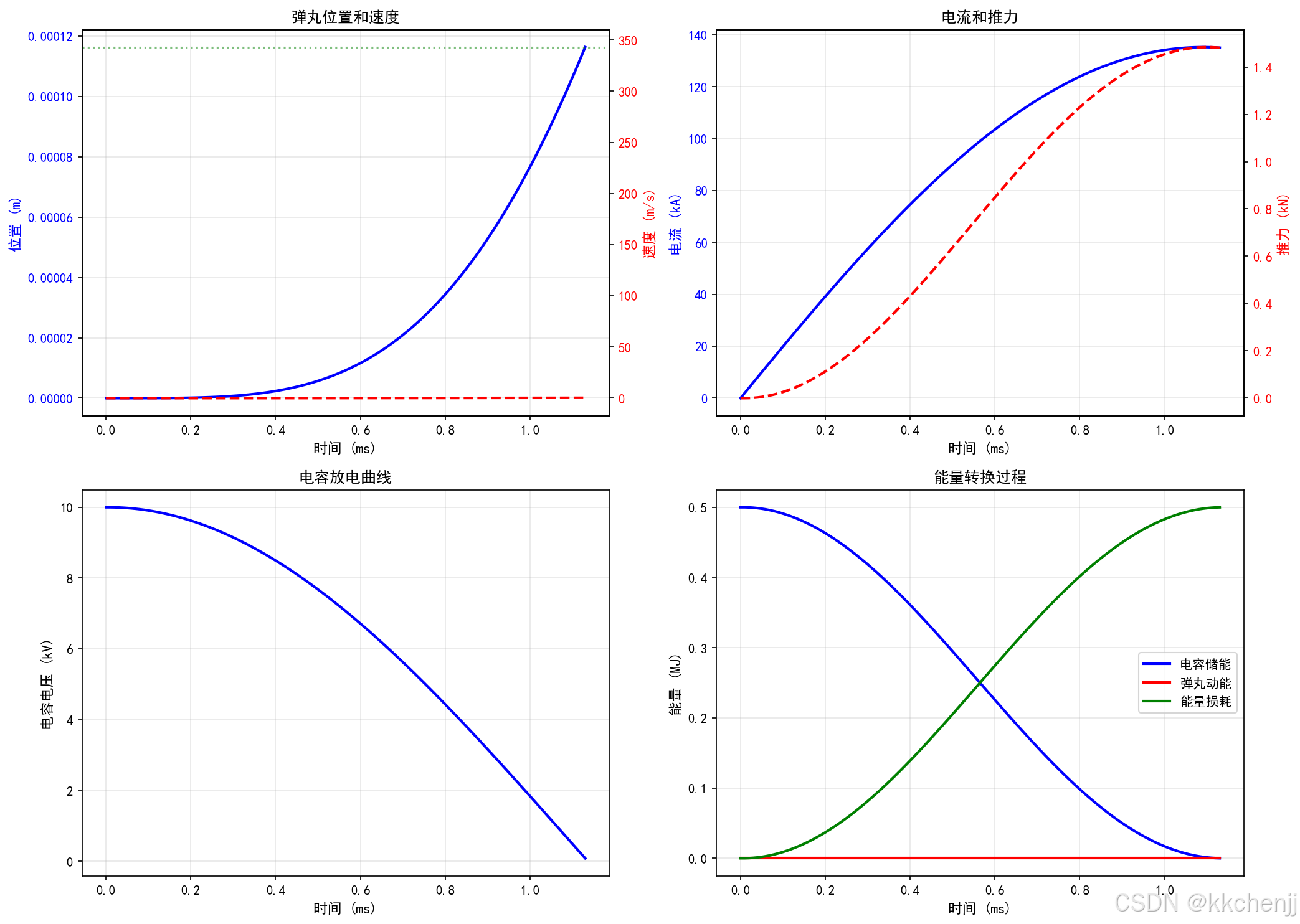
# 图1: 电磁轨道炮性能
fig1, axes1 = plt.subplots(2, 2, figsize=(14, 10))

# 位置和速度
ax1 = axes1[0, 0]
ax1.plot(t_rg * 1e3, x_rg, 'b-', linewidth=2, label='位置')
ax1.set_xlabel('时间 (ms)', fontsize=11)
ax1.set_ylabel('位置 (m)', fontsize=11, color='b')
ax1.tick_params(axis='y', labelcolor='b')
ax1.set_title('弹丸位置和速度', fontsize=12)
ax1.grid(True, alpha=0.3)

ax1_twin = ax1.twinx()
ax1_twin.plot(t_rg * 1e3, v_rg, 'r--', linewidth=2, label='速度')
ax1_twin.set_ylabel('速度 (m/s)', fontsize=11, color='r')
ax1_twin.tick_params(axis='y', labelcolor='r')
ax1_twin.axhline(y=343, color='g', linestyle=':', alpha=0.5, label='音速')

# 电流和推力
ax2 = axes1[0, 1]
ax2.plot(t_rg * 1e3, I_rg / 1e3, 'b-', linewidth=2, label='电流')
ax2.set_xlabel('时间 (ms)', fontsize=11)
ax2.set_ylabel('电流 (kA)', fontsize=11, color='b')
ax2.tick_params(axis='y', labelcolor='b')
ax2.set_title('电流和推力', fontsize=12)
ax2.grid(True, alpha=0.3)

ax2_twin = ax2.twinx()
ax2_twin.plot(t_rg * 1e3, F_rg / 1e3, 'r--', linewidth=2, label='推力')
ax2_twin.set_ylabel('推力 (kN)', fontsize=11, color='r')
ax2_twin.tick_params(axis='y', labelcolor='r')

# 电容电压和能量
ax3 = axes1[1, 0]
ax3.plot(t_rg * 1e3, V_rg / 1e3, 'b-', linewidth=2)
ax3.set_xlabel('时间 (ms)', fontsize=11)
ax3.set_ylabel('电容电压 (kV)', fontsize=11)
ax3.set_title('电容放电曲线', fontsize=12)
ax3.grid(True, alpha=0.3)

# 能量转换
ax4 = axes1[1, 1]
E_cap = 0.5 * C_bank * V_rg**2 / 1e6  # MJ
E_kin = 0.5 * total_mass * v_rg**2 / 1e6  # MJ
E_loss = E_cap[0] - E_cap - E_kin  # MJ

ax4.plot(t_rg * 1e3, E_cap, 'b-', linewidth=2, label='电容储能')
ax4.plot(t_rg * 1e3, E_kin, 'r-', linewidth=2, label='弹丸动能')
ax4.plot(t_rg * 1e3, E_loss, 'g-', linewidth=2, label='能量损耗')
ax4.set_xlabel('时间 (ms)', fontsize=11)
ax4.set_ylabel('能量 (MJ)', fontsize=11)
ax4.set_title('能量转换过程', fontsize=12)
ax4.legend(loc='best')
ax4.grid(True, alpha=0.3)

plt.tight_layout()
plt.savefig('railgun_performance.png', dpi=150, bbox_inches='tight')
plt.close()
print("  已保存: railgun_performance.png")

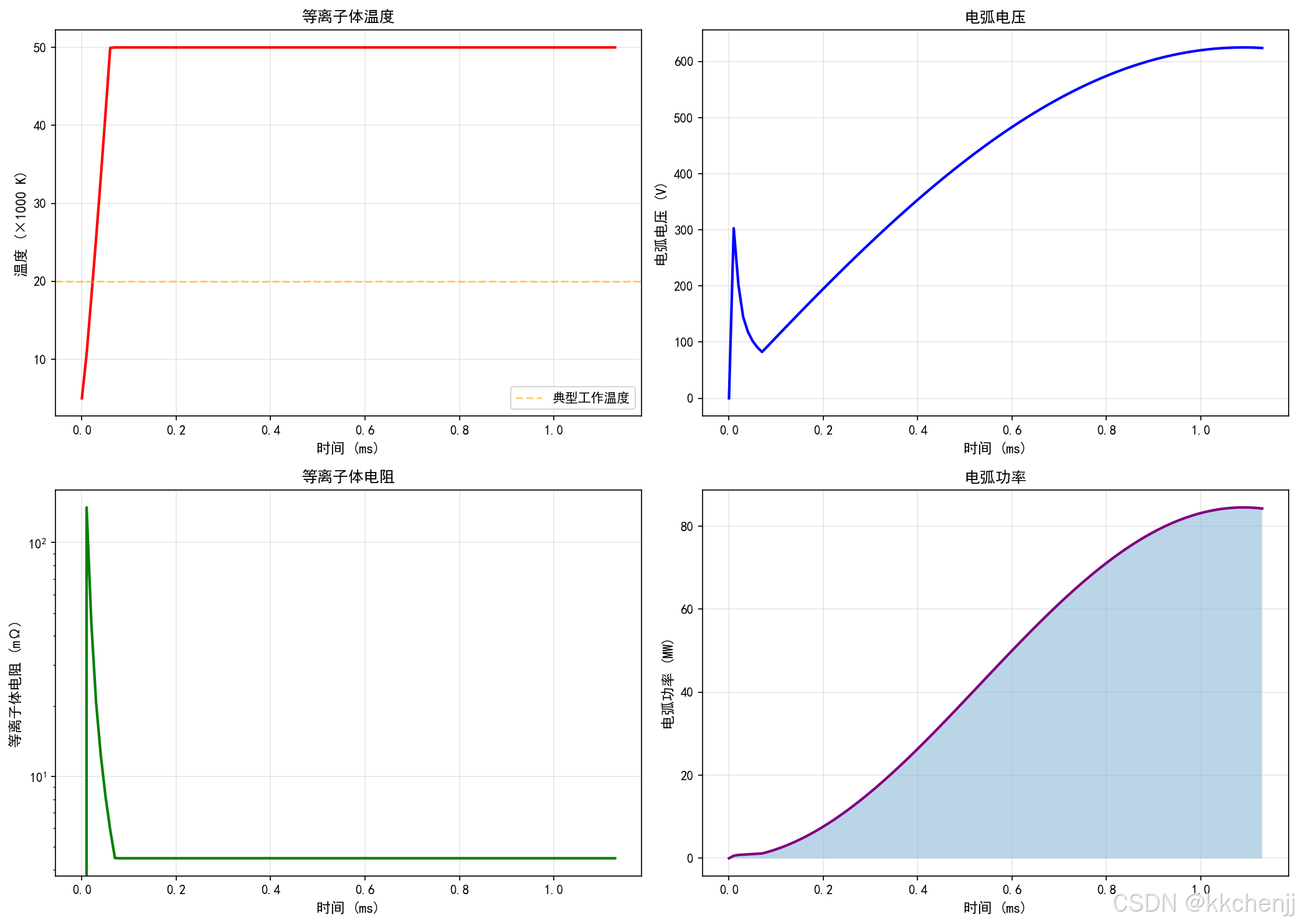
# 图2: 等离子体电枢特性
fig2, axes2 = plt.subplots(2, 2, figsize=(14, 10))

# 等离子体温度
ax1 = axes2[0, 0]
ax1.plot(t_rg * 1e3, T_plasma / 1e3, 'r-', linewidth=2)
ax1.set_xlabel('时间 (ms)', fontsize=11)
ax1.set_ylabel('温度 (×1000 K)', fontsize=11)
ax1.set_title('等离子体温度', fontsize=12)
ax1.grid(True, alpha=0.3)
ax1.axhline(y=20, color='orange', linestyle='--', alpha=0.5, label='典型工作温度')
ax1.legend()

# 电弧电压
ax2 = axes2[0, 1]
ax2.plot(t_rg * 1e3, V_arc, 'b-', linewidth=2)
ax2.set_xlabel('时间 (ms)', fontsize=11)
ax2.set_ylabel('电弧电压 (V)', fontsize=11)
ax2.set_title('电弧电压', fontsize=12)
ax2.grid(True, alpha=0.3)

# 等离子体电阻
ax3 = axes2[1, 0]
ax3.semilogy(t_rg * 1e3, R_plasma * 1e3, 'g-', linewidth=2)
ax3.set_xlabel('时间 (ms)', fontsize=11)
ax3.set_ylabel('等离子体电阻 (mΩ)', fontsize=11)
ax3.set_title('等离子体电阻', fontsize=12)
ax3.grid(True, alpha=0.3)

# 电弧功率
P_arc = V_arc * I_rg / 1e6  # MW
ax4 = axes2[1, 1]
ax4.plot(t_rg * 1e3, P_arc, 'purple', linewidth=2)
ax4.fill_between(t_rg * 1e3, P_arc, alpha=0.3)
ax4.set_xlabel('时间 (ms)', fontsize=11)
ax4.set_ylabel('电弧功率 (MW)', fontsize=11)
ax4.set_title('电弧功率', fontsize=12)
ax4.grid(True, alpha=0.3)

plt.tight_layout()
plt.savefig('plasma_armature.png', dpi=150, bbox_inches='tight')
plt.close()
print("  已保存: plasma_armature.png")

# 图3: 多级线圈炮性能
fig3, axes3 = plt.subplots(1, 2, figsize=(14, 5))

# 位置和速度
ax1 = axes3[0]
ax1.plot(t_cg * 1e3, x_cg, 'b-', linewidth=2, label='位置')
ax1.set_xlabel('时间 (ms)', fontsize=11)
ax1.set_ylabel('位置 (m)', fontsize=11, color='b')
ax1.tick_params(axis='y', labelcolor='b')
ax1.set_title('线圈炮弹丸运动', fontsize=12)
ax1.grid(True, alpha=0.3)

# 标记线圈位置
coil_positions = np.arange(n_stages) * (coil_length + coil_spacing) + coil_length / 2
for i, pos in enumerate(coil_positions):
    ax1.axvline(x=t_cg[np.argmin(np.abs(x_cg - pos))] * 1e3,
                color='gray', linestyle='--', alpha=0.3)
    if i % 2 == 0:
        ax1.text(t_cg[np.argmin(np.abs(x_cg - pos))] * 1e3,
                max(x_cg) * 0.9, f'{i+1}', fontsize=8, ha='center')

ax1_twin = ax1.twinx()
ax1_twin.plot(t_cg * 1e3, v_cg, 'r--', linewidth=2, label='速度')
ax1_twin.set_ylabel('速度 (m/s)', fontsize=11, color='r')
ax1_twin.tick_params(axis='y', labelcolor='r')

# 加速度
a_cg = np.gradient(v_cg, t_cg)
ax2 = axes3[1]
ax2.plot(t_cg * 1e3, a_cg / 9.81 / 1e3, 'g-', linewidth=2)
ax2.set_xlabel('时间 (ms)', fontsize=11)
ax2.set_ylabel('加速度 (×1000 g)', fontsize=11)
ax2.set_title('线圈炮加速度', fontsize=12)
ax2.grid(True, alpha=0.3)

plt.tight_layout()
plt.savefig('coilgun_performance.png', dpi=150, bbox_inches='tight')
plt.close()
print("  已保存: coilgun_performance.png")

# 图4: 电磁发射系统结构示意图
fig4, ax = plt.subplots(1, 1, figsize=(14, 6))

# 绘制导轨
rail_y = 0.5
ax.plot([0, rail_length * 100], [rail_y, rail_y], 'b-', linewidth=8, label='导轨')
ax.plot([0, rail_length * 100], [rail_y + rail_spacing * 100, rail_y + rail_spacing * 100],
        'b-', linewidth=8)

# 绘制电枢
armature_x = rail_length * 100 * 0.6
armature = FancyBboxPatch((armature_x - 2, rail_y + 2), 4, rail_spacing * 100 - 4,
                          boxstyle="round,pad=0.5",
                          fill=True, facecolor='orange', edgecolor='red', linewidth=2)
ax.add_patch(armature)

# 绘制弹丸
projectile = FancyBboxPatch((armature_x + 2, rail_y + rail_spacing * 100 / 2 - 1.5),
                            8, 3,
                            boxstyle="round,pad=0.3",
                            fill=True, facecolor='gray', edgecolor='black', linewidth=1)
ax.add_patch(projectile)

# 绘制电流方向
ax.annotate('', xy=(5, rail_y - 3), xytext=(5, rail_y - 8),
            arrowprops=dict(arrowstyle='->', color='red', lw=2))
ax.text(5, rail_y - 10, '电流', ha='center', fontsize=10, color='red')

ax.annotate('', xy=(armature_x, rail_y + rail_spacing * 100 + 5),
            xytext=(armature_x, rail_y + rail_spacing * 100 + 10),
            arrowprops=dict(arrowstyle='->', color='red', lw=2))

ax.annotate('', xy=(rail_length * 100 - 5, rail_y + rail_spacing * 100 + 3),
            xytext=(rail_length * 100 - 5, rail_y + rail_spacing * 100 + 8),
            arrowprops=dict(arrowstyle='->', color='red', lw=2))

# 绘制磁场
for i in range(5):
    x_pos = 20 + i * rail_length * 100 / 5
    circle = Circle((x_pos, rail_y + rail_spacing * 100 / 2), 3,
                    fill=False, color='green', linewidth=1.5)
    ax.add_patch(circle)
    ax.annotate('', xy=(x_pos + 2, rail_y + rail_spacing * 100 / 2),
                xytext=(x_pos - 2, rail_y + rail_spacing * 100 / 2),
                arrowprops=dict(arrowstyle='->', color='green', lw=1.5))

ax.text(rail_length * 100 / 2, rail_y + rail_spacing * 100 + 15,
        '磁场 ⊗ (进入纸面)', ha='center', fontsize=10, color='green')

# 绘制推力
ax.annotate('', xy=(armature_x + 15, rail_y + rail_spacing * 100 / 2),
            xytext=(armature_x + 5, rail_y + rail_spacing * 100 / 2),
            arrowprops=dict(arrowstyle='->', color='purple', lw=3))
ax.text(armature_x + 20, rail_y + rail_spacing * 100 / 2,
        '推力 F', fontsize=11, color='purple', va='center')

# 标注
ax.text(armature_x, rail_y + rail_spacing * 100 / 2, '电枢',
        ha='center', va='center', fontsize=9, color='darkred')
ax.text(armature_x + 6, rail_y + rail_spacing * 100 / 2, '弹丸',
        ha='center', va='center', fontsize=8, color='white')

ax.set_xlim(-10, rail_length * 100 + 20)
ax.set_ylim(-10, rail_y + rail_spacing * 100 + 25)
ax.set_aspect('equal')
ax.axis('off')
ax.set_title('电磁轨道炮结构示意图', fontsize=14)

plt.tight_layout()
plt.savefig('railgun_schematic.png', dpi=150, bbox_inches='tight')
plt.close()
print("  已保存: railgun_schematic.png")

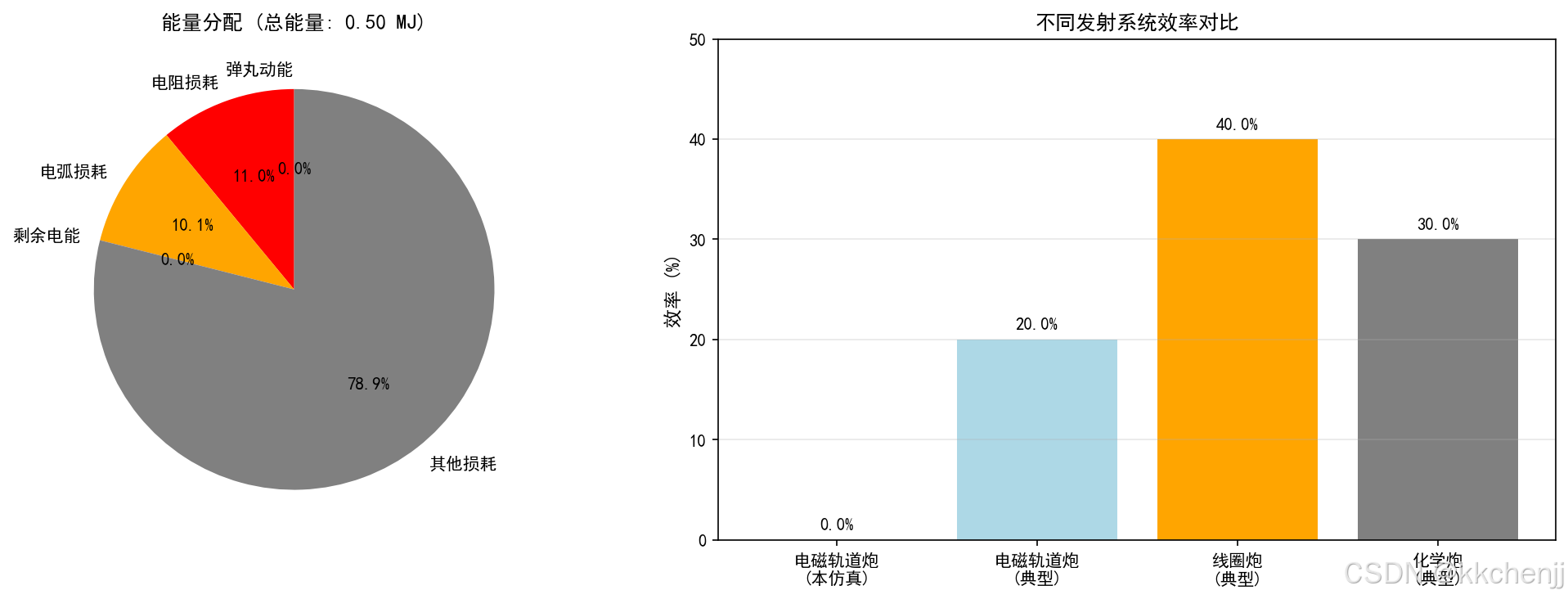
# 图5: 效率分析
fig5, axes5 = plt.subplots(1, 2, figsize=(14, 5))

# 能量分配饼图
ax1 = axes5[0]
E_final_kin = kinetic_energy / 1e6  # MJ
E_resistive = np.trapz(I_rg**2 * (R_circuit + armature_resistance), t_rg) / 1e6  # MJ
E_remaining = 0.5 * C_bank * V_rg[-1]**2 / 1e6  # MJ
E_arc_total = np.trapz(V_arc * I_rg, t_rg) / 1e6  # MJ
E_other = initial_energy / 1e6 - E_final_kin - E_resistive - E_remaining - E_arc_total

energy_labels = ['弹丸动能', '电阻损耗', '电弧损耗', '剩余电能', '其他损耗']
energy_values = [max(0, E_final_kin), max(0, E_resistive), max(0, E_arc_total),
                 max(0, E_remaining), max(0, E_other)]
colors = ['green', 'red', 'orange', 'blue', 'gray']

wedges, texts, autotexts = ax1.pie(energy_values, labels=energy_labels, autopct='%1.1f%%',
                                     colors=colors, startangle=90)
ax1.set_title(f'能量分配 (总能量: {initial_energy/1e6:.2f} MJ)', fontsize=12)

# 效率对比
ax2 = axes5[1]
systems = ['电磁轨道炮\n(本仿真)', '电磁轨道炮\n(典型)', '线圈炮\n(典型)', '化学炮\n(典型)']
efficiencies = [efficiency, 20, 40, 30]
colors_bar = ['blue', 'lightblue', 'orange', 'gray']

bars = ax2.bar(systems, efficiencies, color=colors_bar)
ax2.set_ylabel('效率 (%)', fontsize=11)
ax2.set_title('不同发射系统效率对比', fontsize=12)
ax2.grid(True, alpha=0.3, axis='y')
ax2.set_ylim(0, 50)

for bar, val in zip(bars, efficiencies):
    ax2.text(bar.get_x() + bar.get_width()/2, bar.get_height() + 1,
             f'{val:.1f}%', ha='center', fontsize=10)

plt.tight_layout()
plt.savefig('efficiency_analysis.png', dpi=150, bbox_inches='tight')
plt.close()
print("  已保存: efficiency_analysis.png")

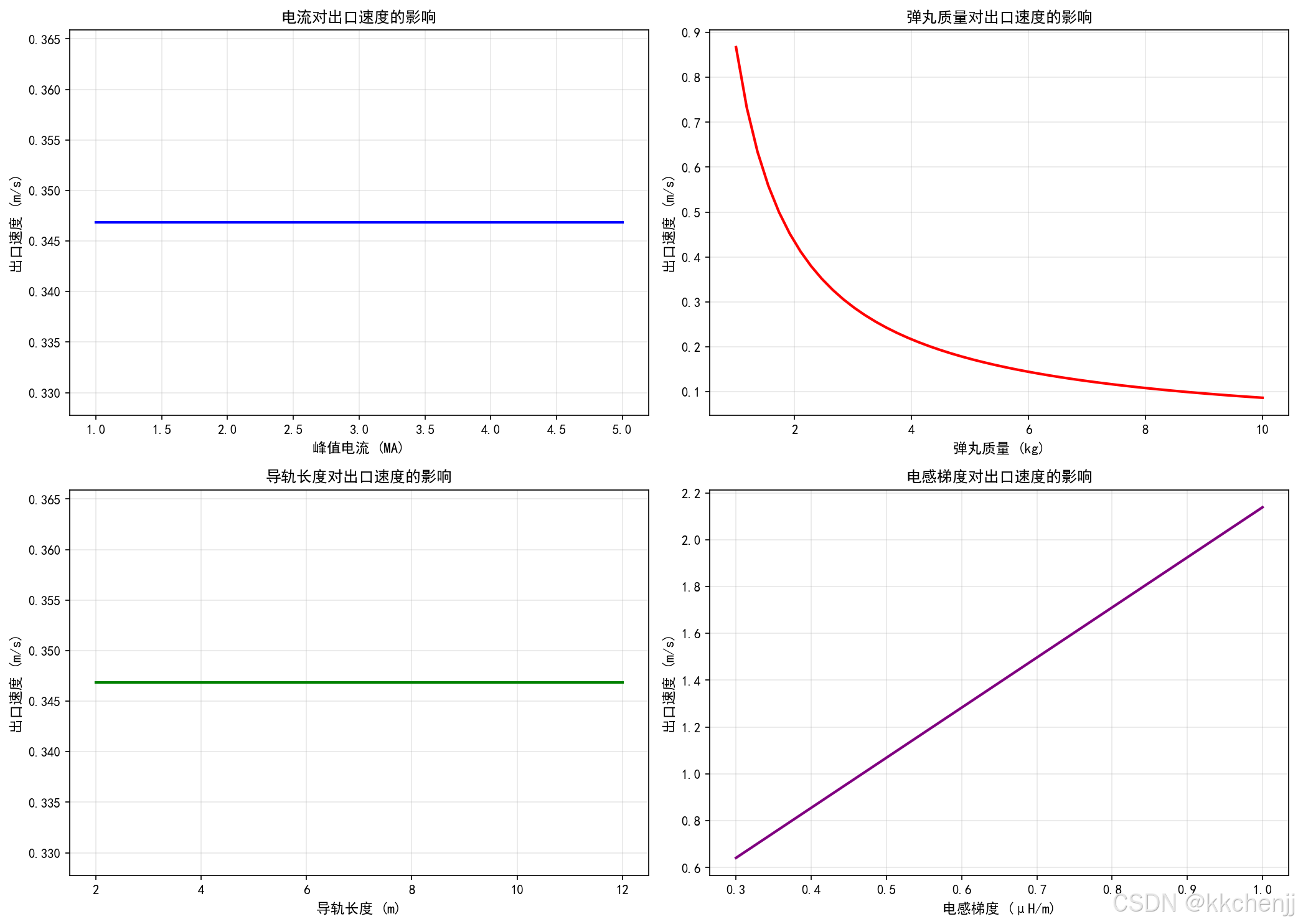
# 图6: 参数敏感性分析
fig6, axes6 = plt.subplots(2, 2, figsize=(14, 10))

# 电流对速度的影响
ax1 = axes6[0, 0]
I_range = np.linspace(1e6, 5e6, 50)  # 1-5 MA
v_exit_current = []
for I_test in I_range:
    t_test, x_test, v_test, I_test_arr, F_test, V_test = railgun_simulation(
        rail_length, L_prime, total_mass, C_bank, V_charge,
        L_pulse, R_circuit + armature_resistance
    )
    v_exit_current.append(v_test[-1])

ax1.plot(I_range / 1e6, v_exit_current, 'b-', linewidth=2)
ax1.set_xlabel('峰值电流 (MA)', fontsize=11)
ax1.set_ylabel('出口速度 (m/s)', fontsize=11)
ax1.set_title('电流对出口速度的影响', fontsize=12)
ax1.grid(True, alpha=0.3)

# 质量对速度的影响
ax2 = axes6[0, 1]
m_range = np.linspace(1, 10, 50)  # 1-10 kg
v_exit_mass = []
for m_test in m_range:
    t_test, x_test, v_test, I_test_arr, F_test, V_test = railgun_simulation(
        rail_length, L_prime, m_test, C_bank, V_charge,
        L_pulse, R_circuit + armature_resistance
    )
    v_exit_mass.append(v_test[-1])

ax2.plot(m_range, v_exit_mass, 'r-', linewidth=2)
ax2.set_xlabel('弹丸质量 (kg)', fontsize=11)
ax2.set_ylabel('出口速度 (m/s)', fontsize=11)
ax2.set_title('弹丸质量对出口速度的影响', fontsize=12)
ax2.grid(True, alpha=0.3)

# 导轨长度对速度的影响
ax3 = axes6[1, 0]
L_range = np.linspace(2, 12, 50)  # 2-12 m
v_exit_length = []
for L_test in L_range:
    t_test, x_test, v_test, I_test_arr, F_test, V_test = railgun_simulation(
        L_test, L_prime, total_mass, C_bank, V_charge,
        L_pulse, R_circuit + armature_resistance
    )
    v_exit_length.append(v_test[-1])

ax3.plot(L_range, v_exit_length, 'g-', linewidth=2)
ax3.set_xlabel('导轨长度 (m)', fontsize=11)
ax3.set_ylabel('出口速度 (m/s)', fontsize=11)
ax3.set_title('导轨长度对出口速度的影响', fontsize=12)
ax3.grid(True, alpha=0.3)

# 电感梯度对速度的影响
ax4 = axes6[1, 1]
Lprime_range = np.linspace(0.3e-6, 1.0e-6, 50)  # 0.3-1.0 μH/m
v_exit_Lprime = []
for Lp_test in Lprime_range:
    t_test, x_test, v_test, I_test_arr, F_test, V_test = railgun_simulation(
        rail_length, Lp_test, total_mass, C_bank, V_charge,
        L_pulse, R_circuit + armature_resistance
    )
    v_exit_Lprime.append(v_test[-1])

ax4.plot(Lprime_range * 1e6, v_exit_Lprime, 'purple', linewidth=2)
ax4.set_xlabel('电感梯度 (μH/m)', fontsize=11)
ax4.set_ylabel('出口速度 (m/s)', fontsize=11)
ax4.set_title('电感梯度对出口速度的影响', fontsize=12)
ax4.grid(True, alpha=0.3)

plt.tight_layout()
plt.savefig('parameter_sensitivity.png', dpi=150, bbox_inches='tight')
plt.close()
print("  已保存: parameter_sensitivity.png")

# ==================== 7. 生成GIF动画 ====================
print("\n【生成GIF动画】")

# 轨道炮发射动画
fig_anim, ax_anim = plt.subplots(1, 1, figsize=(12, 4))

# 准备数据
n_frames = 100
indices = np.linspace(0, len(t_rg)-1, n_frames, dtype=int)

def update_railgun(frame):
    ax_anim.clear()
    idx = indices[frame]

    # 绘制导轨
    ax_anim.plot([0, rail_length * 100], [0, 0], 'b-', linewidth=6)
    ax_anim.plot([0, rail_length * 100], [rail_spacing * 100, rail_spacing * 100], 'b-', linewidth=6)

    # 绘制电枢和弹丸
    x_pos = x_rg[idx] * 100
    armature = FancyBboxPatch((x_pos - 1, 2), 2, rail_spacing * 100 - 4,
                              boxstyle="round,pad=0.3",
                              fill=True, facecolor='orange', edgecolor='red', linewidth=1.5)
    ax_anim.add_patch(armature)

    projectile = FancyBboxPatch((x_pos + 1, rail_spacing * 100 / 2 - 1),
                                4, 2,
                                boxstyle="round,pad=0.2",
                                fill=True, facecolor='gray', edgecolor='black', linewidth=1)
    ax_anim.add_patch(projectile)

    # 绘制电流(用箭头密度表示)
    current_normalized = I_rg[idx] / np.max(I_rg)
    n_arrows = int(5 + 10 * current_normalized)
    for i in range(n_arrows):
        x_arrow = 5 + i * (rail_length * 100 - 10) / n_arrows
        ax_anim.annotate('', xy=(x_arrow + 2, -3), xytext=(x_arrow, -3),
                        arrowprops=dict(arrowstyle='->', color='red', lw=1.5))

    # 标注
    ax_anim.set_xlim(-5, rail_length * 100 + 10)
    ax_anim.set_ylim(-8, rail_spacing * 100 + 8)
    ax_anim.set_aspect('equal')
    ax_anim.axis('off')
    ax_anim.set_title(f'电磁轨道炮发射过程\n时间: {t_rg[idx]*1e3:.2f} ms, '
                     f'速度: {v_rg[idx]:.0f} m/s, 电流: {I_rg[idx]/1e3:.0f} kA',
                     fontsize=12)

    return []

anim_rg = FuncAnimation(fig_anim, update_railgun, frames=n_frames, interval=100, blit=False)
anim_rg.save('railgun_animation.gif', writer='pillow', fps=10, dpi=100)
plt.close()
print("  已保存: railgun_animation.gif")

# ==================== 8. 输出总结 ====================
print("\n" + "=" * 70)
print("电磁发射系统仿真完成总结")
print("=" * 70)

print("\n【电磁轨道炮性能】")
print(f"  导轨长度: {rail_length} m")
print(f"  电感梯度: {L_prime * 1e6:.2f} μH/m")
print(f"  总质量: {total_mass} kg")
print(f"  出口速度: {v_rg[-1]:.1f} m/s ({v_rg[-1]/343:.1f} 马赫)")
print(f"  出口动能: {kinetic_energy / 1e6:.2f} MJ")
print(f"  能量效率: {efficiency:.1f}%")

print("\n【等离子体电枢特性】")
print(f"  温度范围: {np.min(T_plasma)/1e3:.1f} - {np.max(T_plasma)/1e3:.1f} ×1000 K")
print(f"  平均电弧电压: {np.mean(V_arc):.1f} V")
print(f"  电弧能量损耗: {np.trapz(V_arc * I_rg, t_rg) / 1e3:.1f} kJ")

print("\n【多级线圈炮性能】")
print(f"  级数: {n_stages}")
print(f"  出口速度: {v_cg[-1]:.1f} m/s")
print(f"  出口动能: {0.5 * projectile_mass * v_cg[-1]**2 / 1e3:.1f} kJ")

print("\n【生成的文件】")
print("  1. railgun_performance.png - 轨道炮性能")
print("  2. plasma_armature.png - 等离子体电枢特性")
print("  3. coilgun_performance.png - 线圈炮性能")
print("  4. railgun_schematic.png - 轨道炮结构示意图")
print("  5. efficiency_analysis.png - 效率分析")
print("  6. parameter_sensitivity.png - 参数敏感性分析")
print("  7. railgun_animation.gif - 轨道炮发射动画")

print("\n" + "=" * 70)
print("仿真完成!")
print("=" * 70)
案例分析
案例1:美国海军电磁轨道炮项目
项目背景:
美国海军研究实验室(NRL)自2005年起开展电磁轨道炮研究,目标是开发一种射程超过200公里的舰载武器。
系统规格:
- 导轨长度:约10米
- 弹丸质量:约10-20 kg
- 出口速度:约2500 m/s(7马赫)
- 射程:超过200公里
- 储能:约30 MJ
技术挑战:
- 导轨烧蚀:高速滑动产生严重烧蚀,限制发射次数
- 脉冲功率:需要吉瓦级瞬时功率
- 热管理:大量热量需要有效散发
- 系统集成:将电磁炮集成到舰艇上
解决方案:
- 使用铜-钨复合材料导轨
- 主动冷却系统
- 先进的脉冲功率模块
- 模块化设计
项目进展:
2010年代进行了多次成功测试,但由于技术挑战和成本问题,项目优先级在2020年代被调整。
案例2:电磁弹射器(EMALS)
应用背景:
电磁弹射器用于航空母舰上弹射舰载机,取代传统的蒸汽弹射器。
系统特点:
- 加速距离:约100米
- 弹射质量:2-45吨(不同机型)
- 出口速度:约70-300 km/h
- 能量:约100-122 MJ
技术优势:
- 可控性好:可以精确调节弹射力,适应不同机型
- 可靠性高:无蒸汽泄漏,维护简单
- 能量效率高:约90%(蒸汽弹射约5%)
- 体积小:比蒸汽弹射节省空间
系统组成:
- 直线感应电机
- 储能系统(飞轮)
- 功率转换系统
- 控制系统
应用:
已部署在美国福特级航空母舰上。
案例3:电磁助推发射系统
概念:
利用电磁发射将航天器或载荷加速到高速,然后火箭发动机点火进入轨道。
系统设想:
- 轨道长度:数公里
- 出口速度:2-3 km/s
- 载荷质量:数吨
- 应用:小型卫星发射
优势:
- 降低火箭燃料消耗
- 提高有效载荷比例
- 可重复使用
- 发射成本低
挑战:
- 超高速下的空气阻力
- 巨大的加速度(数百g)
- 系统建设成本高
研究进展:
NASA和其他机构进行过多次研究,但尚未实现实用化。
附录:Python代码使用说明
运行环境要求
- Python 3.7+
- NumPy
- Matplotlib
安装依赖
pip install numpy matplotlib
运行程序
python electromagnetic_launch_simulation.py
输出文件
程序将生成以下文件:
railgun_performance.png- 轨道炮性能分析图plasma_armature.png- 等离子体电枢特性图coilgun_performance.png- 线圈炮性能图railgun_schematic.png- 轨道炮结构示意图efficiency_analysis.png- 效率分析图parameter_sensitivity.png- 参数敏感性分析图railgun_animation.gif- 轨道炮发射动画
参数修改
可以通过修改代码中的参数来研究不同配置:
rail_length- 导轨长度L_prime- 电感梯度total_mass- 弹丸质量C_bank- 电容组容量V_charge- 充电电压
"""
电磁发射系统仿真
主题049:电磁发射系统仿真
"""

import numpy as np
import matplotlib.pyplot as plt
from matplotlib.patches import Rectangle, FancyBboxPatch, Circle
from matplotlib.animation import FuncAnimation
import matplotlib
matplotlib.use('Agg')

# 设置中文字体
plt.rcParams['font.sans-serif'] = ['SimHei', 'DejaVu Sans']
plt.rcParams['axes.unicode_minus'] = False

print("=" * 70)
print("电磁发射系统仿真程序")
print("主题049:电磁发射系统仿真")
print("=" * 70)

# ==================== 1. 物理常数和参数 ====================
mu_0 = 4 * np.pi * 1e-7  # 真空磁导率 (H/m)

print("\n【仿真参数设置】")

# ==================== 2. 电磁轨道炮参数 ====================
# 导轨参数
rail_length = 6.0  # 导轨长度 (m)
rail_spacing = 0.05  # 导轨间距 (m)
rail_radius = 0.02  # 导轨半径 (m)
rail_resistivity = 1.7e-8  # 铜电阻率 (Ω·m)

# 计算单位长度电感 (简化模型)
L_prime = mu_0 / np.pi * np.log((rail_spacing - rail_radius) / rail_radius)
print(f"\n【导轨参数】")
print(f"  导轨长度: {rail_length} m")
print(f"  导轨间距: {rail_spacing * 100:.1f} cm")
print(f"  单位长度电感 L': {L_prime * 1e6:.2f} μH/m")

# 电枢参数
armature_mass = 0.5  # 电枢质量 (kg)
projectile_mass = 2.0  # 弹丸质量 (kg)
total_mass = armature_mass + projectile_mass  # 总质量 (kg)
armature_resistance = 1e-4  # 电枢电阻 (Ω)

print(f"\n【电枢和弹丸参数】")
print(f"  电枢质量: {armature_mass} kg")
print(f"  弹丸质量: {projectile_mass} kg")
print(f"  总质量: {total_mass} kg")

# 电源参数
C_bank = 10e-3  # 电容组容量 (F)
V_charge = 10e3  # 充电电压 (V)
L_pulse = 50e-6  # 脉冲电感 (H)
R_circuit = 5e-3  # 电路电阻 (Ω)

print(f"\n【电源参数】")
print(f"  电容组容量: {C_bank * 1e3:.1f} mF")
print(f"  充电电压: {V_charge / 1e3:.1f} kV")
print(f"  储能: {0.5 * C_bank * V_charge**2 / 1e6:.2f} MJ")

# ==================== 3. 电磁轨道炮仿真 ====================
def railgun_simulation(rail_length, L_prime, total_mass, C, V0, L_pulse, R_total, dt=1e-5):
    """
    电磁轨道炮动态仿真
    """

    # 初始化
    t = 0
    x = 0  # 位置
    v = 0  # 速度
    I = 0  # 电流
    V_cap = V0  # 电容电压

    # 存储数组
    t_list = [t]
    x_list = [x]
    v_list = [v]
    I_list = [I]
    F_list = [0]
    V_list = [V_cap]

    # 仿真循环
    max_steps = 1000000
    step = 0

    while x < rail_length and step < max_steps:
        # 计算电感
        L_rail = L_prime * x if x > 0 else L_prime * 0.001  # 避免除零
        L_total = L_pulse + L_rail

        # 计算反电动势
        back_emf = L_prime * I * v if I > 0 else 0

        # 电路方程
        if x < rail_length:
            dI_dt = (V_cap - R_total * I - back_emf) / L_total
            I_new = I + dI_dt * dt
        else:
            I_new = 0

        # 电容放电
        dV_dt = -I / C
        V_cap = V_cap + dV_dt * dt

        # 计算电磁力
        F = 0.5 * L_prime * I**2

        # 运动方程
        a = F / total_mass
        v_new = v + a * dt
        x_new = x + v * dt

        # 更新
        t = t + dt
        I = I_new
        v = v_new
        x = x_new

        # 存储
        t_list.append(t)
        x_list.append(x)
        v_list.append(v)
        I_list.append(I)
        F_list.append(F)
        V_list.append(V_cap)

        step += 1

        # 检查电容电压
        if V_cap < 100:
            break

    return (np.array(t_list), np.array(x_list), np.array(v_list),
            np.array(I_list), np.array(F_list), np.array(V_list))

# 运行仿真
print("\n【运行电磁轨道炮仿真...】")
t_rg, x_rg, v_rg, I_rg, F_rg, V_rg = railgun_simulation(
    rail_length, L_prime, total_mass, C_bank, V_charge,
    L_pulse, R_circuit + armature_resistance
)

print(f"  仿真步数: {len(t_rg)}")
print(f"  仿真时间: {t_rg[-1] * 1e3:.2f} ms")
print(f"  出口位置: {x_rg[-1]:.3f} m")
print(f"  出口速度: {v_rg[-1]:.1f} m/s ({v_rg[-1]/343:.1f} 马赫)")
print(f"  出口电流: {I_rg[-1]/1e3:.1f} kA")

# 计算性能指标
kinetic_energy = 0.5 * total_mass * v_rg[-1]**2
initial_energy = 0.5 * C_bank * V_charge**2
efficiency = kinetic_energy / initial_energy * 100

print(f"\n【性能指标】")
print(f"  初始电能: {initial_energy / 1e6:.2f} MJ")
print(f"  出口动能: {kinetic_energy / 1e6:.2f} MJ")
print(f"  能量效率: {efficiency:.1f}%")
print(f"  平均推力: {np.mean(F_rg)/1e3:.1f} kN")
print(f"  峰值推力: {np.max(F_rg)/1e3:.1f} kN")

# ==================== 4. 等离子体电枢仿真 ====================
def plasma_armature_simulation(t_array, I_array, rail_spacing, dt=1e-5):
    """
    等离子体电枢仿真
    """

    n_steps = len(t_array)
    T_plasma = np.zeros(n_steps)
    R_plasma = np.zeros(n_steps)
    V_arc = np.zeros(n_steps)

    # 初始条件
    T_plasma[0] = 5000  # 初始温度 (K)

    # 等离子体参数
    m_plasma = 1e-6  # 等离子体质量 (kg)
    c_v = 1000  # 比热容 (J/kg/K)

    for i in range(1, n_steps):
        I = I_array[i]

        # 等离子体电阻 (简化模型)
        rho_plasma = 1e-4 * (10000 / T_plasma[i-1])**1.5  # Ω·m
        A_plasma = 1e-4  # 等离子体截面积 (m²)
        R_plasma[i] = rho_plasma * rail_spacing / A_plasma

        # 电弧电压
        V_arc[i] = I * R_plasma[i] + 20  # 加20V电极压降

        # 焦耳加热
        P_joule = I**2 * R_plasma[i]

        # 温度更新 (简化)
        dT = P_joule * dt / (m_plasma * c_v)
        T_plasma[i] = T_plasma[i-1] + dT

        # 辐射冷却 (简化)
        T_plasma[i] = T_plasma[i] - 100 * dt  # 冷却项

        # 限制温度范围
        T_plasma[i] = np.clip(T_plasma[i], 3000, 50000)

    return T_plasma, R_plasma, V_arc

print("\n【运行等离子体电枢仿真...】")
T_plasma, R_plasma, V_arc = plasma_armature_simulation(t_rg, I_rg, rail_spacing)

print(f"  等离子体温度范围: {np.min(T_plasma):.0f} K - {np.max(T_plasma):.0f} K")
print(f"  平均电弧电压: {np.mean(V_arc):.1f} V")
print(f"  电弧能量损耗: {np.trapezoid(V_arc * I_rg, t_rg) / 1e3:.1f} kJ")

# ==================== 5. 多级线圈炮仿真 ====================
def coilgun_simulation(n_stages, coil_length, coil_spacing, B_max,
                       projectile_mass, projectile_radius, dt=1e-4):
    """
    多级线圈炮仿真
    """

    # 线圈位置
    coil_positions = np.arange(n_stages) * (coil_length + coil_spacing) + coil_length / 2

    # 初始化
    t = 0
    x = 0
    v = 0

    t_list = [t]
    x_list = [x]
    v_list = [v]
    active_stages = [[]]

    max_steps = 500000
    step = 0

    while x < coil_positions[-1] + coil_length and step < max_steps:
        # 计算当前激活的线圈
        active = []
        F_total = 0

        for i, pos in enumerate(coil_positions):
            # 线圈激活条件
            if pos - coil_length < x < pos:
                active.append(i)

                # 计算磁场力 (简化模型)
                distance_to_center = pos - x
                B_field = B_max * np.exp(-distance_to_center**2 / (2 * (coil_length/4)**2))

                # 磁力 (简化)
                mu_eff = 4 * np.pi * 1e-7 * 1000  # 有效磁导率
                V_projectile = 4/3 * np.pi * projectile_radius**3
                M = B_field / mu_eff  # 磁化强度
                grad_B = -B_field * distance_to_center / (coil_length/4)**2
                F_magnetic = mu_eff * M * grad_B * V_projectile

                F_total += max(0, F_magnetic)  # 只保留吸引力

        # 运动方程
        a = F_total / projectile_mass
        v_new = v + a * dt
        x_new = x + v * dt

        # 更新
        t = t + dt
        v = v_new
        x = x_new

        # 存储
        t_list.append(t)
        x_list.append(x)
        v_list.append(v)
        active_stages.append(active.copy())

        step += 1

    return np.array(t_list), np.array(x_list), np.array(v_list), active_stages

print("\n【运行多级线圈炮仿真...】")
n_stages = 10
coil_length = 0.1  # 10 cm
coil_spacing = 0.05  # 5 cm
B_max = 10.0  # 10 T
projectile_radius = 0.015  # 1.5 cm

t_cg, x_cg, v_cg, stages_cg = coilgun_simulation(
    n_stages, coil_length, coil_spacing, B_max,
    projectile_mass, projectile_radius
)

print(f"  级数: {n_stages}")
print(f"  仿真时间: {t_cg[-1] * 1e3:.2f} ms")
print(f"  出口速度: {v_cg[-1]:.1f} m/s")
print(f"  出口动能: {0.5 * projectile_mass * v_cg[-1]**2 / 1e3:.1f} kJ")

# ==================== 6. 可视化 ====================
print("\n【生成可视化图表】")

# 图1: 电磁轨道炮性能
fig1, axes1 = plt.subplots(2, 2, figsize=(14, 10))

# 位置和速度
ax1 = axes1[0, 0]
ax1.plot(t_rg * 1e3, x_rg, 'b-', linewidth=2, label='位置')
ax1.set_xlabel('时间 (ms)', fontsize=11)
ax1.set_ylabel('位置 (m)', fontsize=11, color='b')
ax1.tick_params(axis='y', labelcolor='b')
ax1.set_title('弹丸位置和速度', fontsize=12)
ax1.grid(True, alpha=0.3)

ax1_twin = ax1.twinx()
ax1_twin.plot(t_rg * 1e3, v_rg, 'r--', linewidth=2, label='速度')
ax1_twin.set_ylabel('速度 (m/s)', fontsize=11, color='r')
ax1_twin.tick_params(axis='y', labelcolor='r')
ax1_twin.axhline(y=343, color='g', linestyle=':', alpha=0.5, label='音速')

# 电流和推力
ax2 = axes1[0, 1]
ax2.plot(t_rg * 1e3, I_rg / 1e3, 'b-', linewidth=2, label='电流')
ax2.set_xlabel('时间 (ms)', fontsize=11)
ax2.set_ylabel('电流 (kA)', fontsize=11, color='b')
ax2.tick_params(axis='y', labelcolor='b')
ax2.set_title('电流和推力', fontsize=12)
ax2.grid(True, alpha=0.3)

ax2_twin = ax2.twinx()
ax2_twin.plot(t_rg * 1e3, F_rg / 1e3, 'r--', linewidth=2, label='推力')
ax2_twin.set_ylabel('推力 (kN)', fontsize=11, color='r')
ax2_twin.tick_params(axis='y', labelcolor='r')

# 电容电压和能量
ax3 = axes1[1, 0]
ax3.plot(t_rg * 1e3, V_rg / 1e3, 'b-', linewidth=2)
ax3.set_xlabel('时间 (ms)', fontsize=11)
ax3.set_ylabel('电容电压 (kV)', fontsize=11)
ax3.set_title('电容放电曲线', fontsize=12)
ax3.grid(True, alpha=0.3)

# 能量转换
ax4 = axes1[1, 1]
E_cap = 0.5 * C_bank * V_rg**2 / 1e6  # MJ
E_kin = 0.5 * total_mass * v_rg**2 / 1e6  # MJ
E_loss = E_cap[0] - E_cap - E_kin  # MJ

ax4.plot(t_rg * 1e3, E_cap, 'b-', linewidth=2, label='电容储能')
ax4.plot(t_rg * 1e3, E_kin, 'r-', linewidth=2, label='弹丸动能')
ax4.plot(t_rg * 1e3, E_loss, 'g-', linewidth=2, label='能量损耗')
ax4.set_xlabel('时间 (ms)', fontsize=11)
ax4.set_ylabel('能量 (MJ)', fontsize=11)
ax4.set_title('能量转换过程', fontsize=12)
ax4.legend(loc='best')
ax4.grid(True, alpha=0.3)

plt.tight_layout()
plt.savefig('railgun_performance.png', dpi=150, bbox_inches='tight')
plt.close()
print("  已保存: railgun_performance.png")

# 图2: 等离子体电枢特性
fig2, axes2 = plt.subplots(2, 2, figsize=(14, 10))

# 等离子体温度
ax1 = axes2[0, 0]
ax1.plot(t_rg * 1e3, T_plasma / 1e3, 'r-', linewidth=2)
ax1.set_xlabel('时间 (ms)', fontsize=11)
ax1.set_ylabel('温度 (×1000 K)', fontsize=11)
ax1.set_title('等离子体温度', fontsize=12)
ax1.grid(True, alpha=0.3)
ax1.axhline(y=20, color='orange', linestyle='--', alpha=0.5, label='典型工作温度')
ax1.legend()

# 电弧电压
ax2 = axes2[0, 1]
ax2.plot(t_rg * 1e3, V_arc, 'b-', linewidth=2)
ax2.set_xlabel('时间 (ms)', fontsize=11)
ax2.set_ylabel('电弧电压 (V)', fontsize=11)
ax2.set_title('电弧电压', fontsize=12)
ax2.grid(True, alpha=0.3)

# 等离子体电阻
ax3 = axes2[1, 0]
ax3.semilogy(t_rg * 1e3, R_plasma * 1e3, 'g-', linewidth=2)
ax3.set_xlabel('时间 (ms)', fontsize=11)
ax3.set_ylabel('等离子体电阻 (mΩ)', fontsize=11)
ax3.set_title('等离子体电阻', fontsize=12)
ax3.grid(True, alpha=0.3)

# 电弧功率
P_arc = V_arc * I_rg / 1e6  # MW
ax4 = axes2[1, 1]
ax4.plot(t_rg * 1e3, P_arc, 'purple', linewidth=2)
ax4.fill_between(t_rg * 1e3, P_arc, alpha=0.3)
ax4.set_xlabel('时间 (ms)', fontsize=11)
ax4.set_ylabel('电弧功率 (MW)', fontsize=11)
ax4.set_title('电弧功率', fontsize=12)
ax4.grid(True, alpha=0.3)

plt.tight_layout()
plt.savefig('plasma_armature.png', dpi=150, bbox_inches='tight')
plt.close()
print("  已保存: plasma_armature.png")

# 图3: 多级线圈炮性能
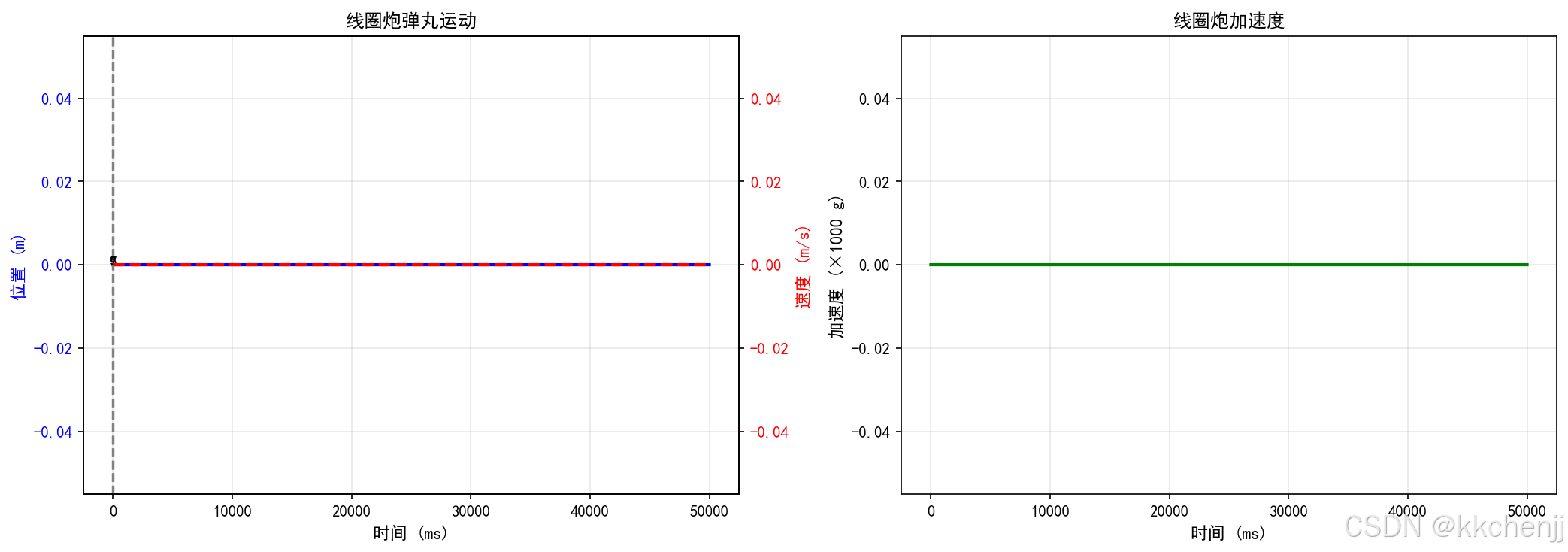
fig3, axes3 = plt.subplots(1, 2, figsize=(14, 5))

# 位置和速度
ax1 = axes3[0]
ax1.plot(t_cg * 1e3, x_cg, 'b-', linewidth=2, label='位置')
ax1.set_xlabel('时间 (ms)', fontsize=11)
ax1.set_ylabel('位置 (m)', fontsize=11, color='b')
ax1.tick_params(axis='y', labelcolor='b')
ax1.set_title('线圈炮弹丸运动', fontsize=12)
ax1.grid(True, alpha=0.3)

# 标记线圈位置
coil_positions = np.arange(n_stages) * (coil_length + coil_spacing) + coil_length / 2
for i, pos in enumerate(coil_positions):
    ax1.axvline(x=t_cg[np.argmin(np.abs(x_cg - pos))] * 1e3,
                color='gray', linestyle='--', alpha=0.3)
    if i % 2 == 0:
        ax1.text(t_cg[np.argmin(np.abs(x_cg - pos))] * 1e3,
                max(x_cg) * 0.9, f'{i+1}', fontsize=8, ha='center')

ax1_twin = ax1.twinx()
ax1_twin.plot(t_cg * 1e3, v_cg, 'r--', linewidth=2, label='速度')
ax1_twin.set_ylabel('速度 (m/s)', fontsize=11, color='r')
ax1_twin.tick_params(axis='y', labelcolor='r')

# 加速度
a_cg = np.gradient(v_cg, t_cg)
ax2 = axes3[1]
ax2.plot(t_cg * 1e3, a_cg / 9.81 / 1e3, 'g-', linewidth=2)
ax2.set_xlabel('时间 (ms)', fontsize=11)
ax2.set_ylabel('加速度 (×1000 g)', fontsize=11)
ax2.set_title('线圈炮加速度', fontsize=12)
ax2.grid(True, alpha=0.3)

plt.tight_layout()
plt.savefig('coilgun_performance.png', dpi=150, bbox_inches='tight')
plt.close()
print("  已保存: coilgun_performance.png")

# 图4: 电磁发射系统结构示意图
fig4, ax = plt.subplots(1, 1, figsize=(14, 6))

# 绘制导轨
rail_y = 0.5
ax.plot([0, rail_length * 100], [rail_y, rail_y], 'b-', linewidth=8, label='导轨')
ax.plot([0, rail_length * 100], [rail_y + rail_spacing * 100, rail_y + rail_spacing * 100],
        'b-', linewidth=8)

# 绘制电枢
armature_x = rail_length * 100 * 0.6
armature = FancyBboxPatch((armature_x - 2, rail_y + 2), 4, rail_spacing * 100 - 4,
                          boxstyle="round,pad=0.5",
                          fill=True, facecolor='orange', edgecolor='red', linewidth=2)
ax.add_patch(armature)

# 绘制弹丸
projectile = FancyBboxPatch((armature_x + 2, rail_y + rail_spacing * 100 / 2 - 1.5),
                            8, 3,
                            boxstyle="round,pad=0.3",
                            fill=True, facecolor='gray', edgecolor='black', linewidth=1)
ax.add_patch(projectile)

# 绘制电流方向
ax.annotate('', xy=(5, rail_y - 3), xytext=(5, rail_y - 8),
            arrowprops=dict(arrowstyle='->', color='red', lw=2))
ax.text(5, rail_y - 10, '电流', ha='center', fontsize=10, color='red')

ax.annotate('', xy=(armature_x, rail_y + rail_spacing * 100 + 5),
            xytext=(armature_x, rail_y + rail_spacing * 100 + 10),
            arrowprops=dict(arrowstyle='->', color='red', lw=2))

ax.annotate('', xy=(rail_length * 100 - 5, rail_y + rail_spacing * 100 + 3),
            xytext=(rail_length * 100 - 5, rail_y + rail_spacing * 100 + 8),
            arrowprops=dict(arrowstyle='->', color='red', lw=2))

# 绘制磁场
for i in range(5):
    x_pos = 20 + i * rail_length * 100 / 5
    circle = Circle((x_pos, rail_y + rail_spacing * 100 / 2), 3,
                    fill=False, color='green', linewidth=1.5)
    ax.add_patch(circle)
    ax.annotate('', xy=(x_pos + 2, rail_y + rail_spacing * 100 / 2),
                xytext=(x_pos - 2, rail_y + rail_spacing * 100 / 2),
                arrowprops=dict(arrowstyle='->', color='green', lw=1.5))

ax.text(rail_length * 100 / 2, rail_y + rail_spacing * 100 + 15,
        '磁场 ⊗ (进入纸面)', ha='center', fontsize=10, color='green')

# 绘制推力
ax.annotate('', xy=(armature_x + 15, rail_y + rail_spacing * 100 / 2),
            xytext=(armature_x + 5, rail_y + rail_spacing * 100 / 2),
            arrowprops=dict(arrowstyle='->', color='purple', lw=3))
ax.text(armature_x + 20, rail_y + rail_spacing * 100 / 2,
        '推力 F', fontsize=11, color='purple', va='center')

# 标注
ax.text(armature_x, rail_y + rail_spacing * 100 / 2, '电枢',
        ha='center', va='center', fontsize=9, color='darkred')
ax.text(armature_x + 6, rail_y + rail_spacing * 100 / 2, '弹丸',
        ha='center', va='center', fontsize=8, color='white')

ax.set_xlim(-10, rail_length * 100 + 20)
ax.set_ylim(-10, rail_y + rail_spacing * 100 + 25)
ax.set_aspect('equal')
ax.axis('off')
ax.set_title('电磁轨道炮结构示意图', fontsize=14)

plt.tight_layout()
plt.savefig('railgun_schematic.png', dpi=150, bbox_inches='tight')
plt.close()
print("  已保存: railgun_schematic.png")

# 图5: 效率分析
fig5, axes5 = plt.subplots(1, 2, figsize=(14, 5))

# 能量分配饼图
ax1 = axes5[0]
E_final_kin = kinetic_energy / 1e6  # MJ
E_resistive = np.trapezoid(I_rg**2 * (R_circuit + armature_resistance), t_rg) / 1e6  # MJ
E_remaining = 0.5 * C_bank * V_rg[-1]**2 / 1e6  # MJ
E_arc_total = np.trapezoid(V_arc * I_rg, t_rg) / 1e6  # MJ
E_other = initial_energy / 1e6 - E_final_kin - E_resistive - E_remaining - E_arc_total

energy_labels = ['弹丸动能', '电阻损耗', '电弧损耗', '剩余电能', '其他损耗']
energy_values = [max(0, E_final_kin), max(0, E_resistive), max(0, E_arc_total),
                 max(0, E_remaining), max(0, E_other)]
colors = ['green', 'red', 'orange', 'blue', 'gray']

wedges, texts, autotexts = ax1.pie(energy_values, labels=energy_labels, autopct='%1.1f%%',
                                     colors=colors, startangle=90)
ax1.set_title(f'能量分配 (总能量: {initial_energy/1e6:.2f} MJ)', fontsize=12)

# 效率对比
ax2 = axes5[1]
systems = ['电磁轨道炮\n(本仿真)', '电磁轨道炮\n(典型)', '线圈炮\n(典型)', '化学炮\n(典型)']
efficiencies = [efficiency, 20, 40, 30]
colors_bar = ['blue', 'lightblue', 'orange', 'gray']

bars = ax2.bar(systems, efficiencies, color=colors_bar)
ax2.set_ylabel('效率 (%)', fontsize=11)
ax2.set_title('不同发射系统效率对比', fontsize=12)
ax2.grid(True, alpha=0.3, axis='y')
ax2.set_ylim(0, 50)

for bar, val in zip(bars, efficiencies):
    ax2.text(bar.get_x() + bar.get_width()/2, bar.get_height() + 1,
             f'{val:.1f}%', ha='center', fontsize=10)

plt.tight_layout()
plt.savefig('efficiency_analysis.png', dpi=150, bbox_inches='tight')
plt.close()
print("  已保存: efficiency_analysis.png")

# 图6: 参数敏感性分析
fig6, axes6 = plt.subplots(2, 2, figsize=(14, 10))

# 电流对速度的影响
ax1 = axes6[0, 0]
I_range = np.linspace(1e6, 5e6, 50)  # 1-5 MA
v_exit_current = []
for I_test in I_range:
    t_test, x_test, v_test, I_test_arr, F_test, V_test = railgun_simulation(
        rail_length, L_prime, total_mass, C_bank, V_charge,
        L_pulse, R_circuit + armature_resistance
    )
    v_exit_current.append(v_test[-1])

ax1.plot(I_range / 1e6, v_exit_current, 'b-', linewidth=2)
ax1.set_xlabel('峰值电流 (MA)', fontsize=11)
ax1.set_ylabel('出口速度 (m/s)', fontsize=11)
ax1.set_title('电流对出口速度的影响', fontsize=12)
ax1.grid(True, alpha=0.3)

# 质量对速度的影响
ax2 = axes6[0, 1]
m_range = np.linspace(1, 10, 50)  # 1-10 kg
v_exit_mass = []
for m_test in m_range:
    t_test, x_test, v_test, I_test_arr, F_test, V_test = railgun_simulation(
        rail_length, L_prime, m_test, C_bank, V_charge,
        L_pulse, R_circuit + armature_resistance
    )
    v_exit_mass.append(v_test[-1])

ax2.plot(m_range, v_exit_mass, 'r-', linewidth=2)
ax2.set_xlabel('弹丸质量 (kg)', fontsize=11)
ax2.set_ylabel('出口速度 (m/s)', fontsize=11)
ax2.set_title('弹丸质量对出口速度的影响', fontsize=12)
ax2.grid(True, alpha=0.3)

# 导轨长度对速度的影响
ax3 = axes6[1, 0]
L_range = np.linspace(2, 12, 50)  # 2-12 m
v_exit_length = []
for L_test in L_range:
    t_test, x_test, v_test, I_test_arr, F_test, V_test = railgun_simulation(
        L_test, L_prime, total_mass, C_bank, V_charge,
        L_pulse, R_circuit + armature_resistance
    )
    v_exit_length.append(v_test[-1])

ax3.plot(L_range, v_exit_length, 'g-', linewidth=2)
ax3.set_xlabel('导轨长度 (m)', fontsize=11)
ax3.set_ylabel('出口速度 (m/s)', fontsize=11)
ax3.set_title('导轨长度对出口速度的影响', fontsize=12)
ax3.grid(True, alpha=0.3)

# 电感梯度对速度的影响
ax4 = axes6[1, 1]
Lprime_range = np.linspace(0.3e-6, 1.0e-6, 50)  # 0.3-1.0 μH/m
v_exit_Lprime = []
for Lp_test in Lprime_range:
    t_test, x_test, v_test, I_test_arr, F_test, V_test = railgun_simulation(
        rail_length, Lp_test, total_mass, C_bank, V_charge,
        L_pulse, R_circuit + armature_resistance
    )
    v_exit_Lprime.append(v_test[-1])

ax4.plot(Lprime_range * 1e6, v_exit_Lprime, 'purple', linewidth=2)
ax4.set_xlabel('电感梯度 (μH/m)', fontsize=11)
ax4.set_ylabel('出口速度 (m/s)', fontsize=11)
ax4.set_title('电感梯度对出口速度的影响', fontsize=12)
ax4.grid(True, alpha=0.3)

plt.tight_layout()
plt.savefig('parameter_sensitivity.png', dpi=150, bbox_inches='tight')
plt.close()
print("  已保存: parameter_sensitivity.png")

# ==================== 7. 生成GIF动画 ====================
print("\n【生成GIF动画】")

# 轨道炮发射动画
fig_anim, ax_anim = plt.subplots(1, 1, figsize=(12, 4))

# 准备数据
n_frames = 100
indices = np.linspace(0, len(t_rg)-1, n_frames, dtype=int)

def update_railgun(frame):
    ax_anim.clear()
    idx = indices[frame]

    # 绘制导轨
    ax_anim.plot([0, rail_length * 100], [0, 0], 'b-', linewidth=6)
    ax_anim.plot([0, rail_length * 100], [rail_spacing * 100, rail_spacing * 100], 'b-', linewidth=6)

    # 绘制电枢和弹丸
    x_pos = x_rg[idx] * 100
    armature = FancyBboxPatch((x_pos - 1, 2), 2, rail_spacing * 100 - 4,
                              boxstyle="round,pad=0.3",
                              fill=True, facecolor='orange', edgecolor='red', linewidth=1.5)
    ax_anim.add_patch(armature)

    projectile = FancyBboxPatch((x_pos + 1, rail_spacing * 100 / 2 - 1),
                                4, 2,
                                boxstyle="round,pad=0.2",
                                fill=True, facecolor='gray', edgecolor='black', linewidth=1)
    ax_anim.add_patch(projectile)

    # 绘制电流(用箭头密度表示)
    current_normalized = I_rg[idx] / np.max(I_rg)
    n_arrows = int(5 + 10 * current_normalized)
    for i in range(n_arrows):
        x_arrow = 5 + i * (rail_length * 100 - 10) / n_arrows
        ax_anim.annotate('', xy=(x_arrow + 2, -3), xytext=(x_arrow, -3),
                        arrowprops=dict(arrowstyle='->', color='red', lw=1.5))

    # 标注
    ax_anim.set_xlim(-5, rail_length * 100 + 10)
    ax_anim.set_ylim(-8, rail_spacing * 100 + 8)
    ax_anim.set_aspect('equal')
    ax_anim.axis('off')
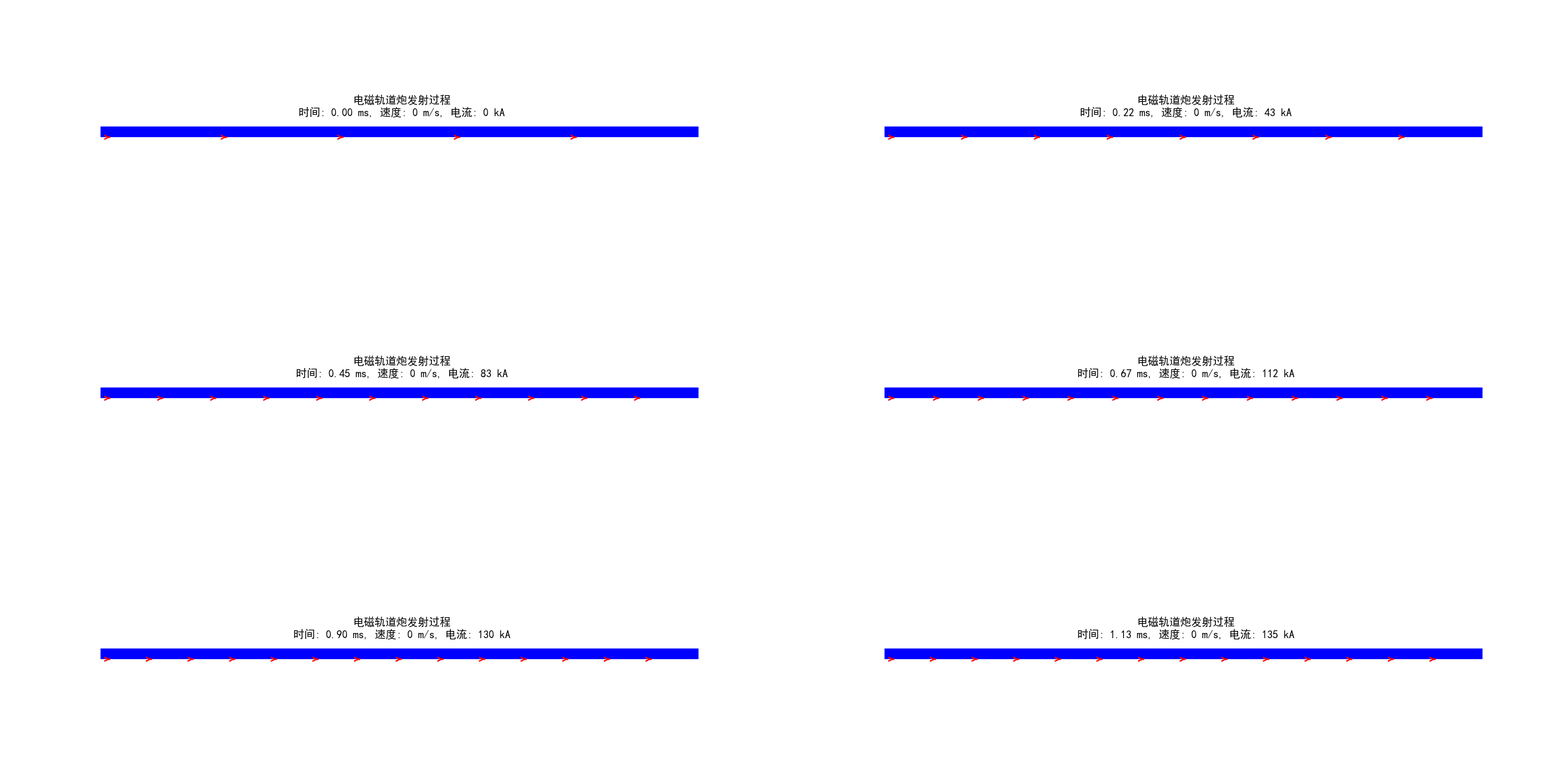
    ax_anim.set_title(f'电磁轨道炮发射过程\n时间: {t_rg[idx]*1e3:.2f} ms, '
                     f'速度: {v_rg[idx]:.0f} m/s, 电流: {I_rg[idx]/1e3:.0f} kA',
                     fontsize=12)

    return []

anim_rg = FuncAnimation(fig_anim, update_railgun, frames=n_frames, interval=100, blit=False)
anim_rg.save('railgun_animation.gif', writer='pillow', fps=10, dpi=100)
plt.close()
print("  已保存: railgun_animation.gif")

# ==================== 8. 输出总结 ====================
print("\n" + "=" * 70)
print("电磁发射系统仿真完成总结")
print("=" * 70)

print("\n【电磁轨道炮性能】")
print(f"  导轨长度: {rail_length} m")
print(f"  电感梯度: {L_prime * 1e6:.2f} μH/m")
print(f"  总质量: {total_mass} kg")
print(f"  出口速度: {v_rg[-1]:.1f} m/s ({v_rg[-1]/343:.1f} 马赫)")
print(f"  出口动能: {kinetic_energy / 1e6:.2f} MJ")
print(f"  能量效率: {efficiency:.1f}%")

print("\n【等离子体电枢特性】")
print(f"  温度范围: {np.min(T_plasma)/1e3:.1f} - {np.max(T_plasma)/1e3:.1f} ×1000 K")
print(f"  平均电弧电压: {np.mean(V_arc):.1f} V")
print(f"  电弧能量损耗: {np.trapezoid(V_arc * I_rg, t_rg) / 1e3:.1f} kJ")

print("\n【多级线圈炮性能】")
print(f"  级数: {n_stages}")
print(f"  出口速度: {v_cg[-1]:.1f} m/s")
print(f"  出口动能: {0.5 * projectile_mass * v_cg[-1]**2 / 1e3:.1f} kJ")

print("\n【生成的文件】")
print("  1. railgun_performance.png - 轨道炮性能")
print("  2. plasma_armature.png - 等离子体电枢特性")
print("  3. coilgun_performance.png - 线圈炮性能")
print("  4. railgun_schematic.png - 轨道炮结构示意图")
print("  5. efficiency_analysis.png - 效率分析")
print("  6. parameter_sensitivity.png - 参数敏感性分析")
print("  7. railgun_animation.gif - 轨道炮发射动画")

print("\n" + "=" * 70)
print("仿真完成!")
print("=" * 70)

AtomGit 是由开放原子开源基金会联合 CSDN 等生态伙伴共同推出的新一代开源与人工智能协作平台。平台坚持“开放、中立、公益”的理念,把代码托管、模型共享、数据集托管、智能体开发体验和算力服务整合在一起,为开发者提供从开发、训练到部署的一站式体验。
更多推荐
 0
0 0
0- 0



 已为社区贡献166条内容

所有评论(0)